
Mechanics Chapter 2 Force and Motion 2 1
- Slides: 13
Mechanics: Chapter 2 Force and Motion
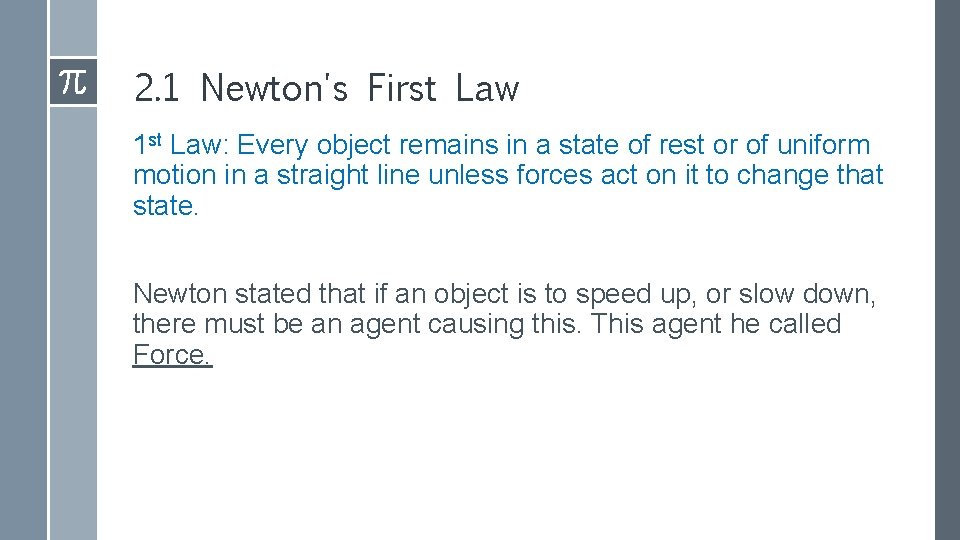
2. 1 Newton's First Law 1 st Law: Every object remains in a state of rest or of uniform motion in a straight line unless forces act on it to change that state. Newton stated that if an object is to speed up, or slow down, there must be an agent causing this. This agent he called Force.
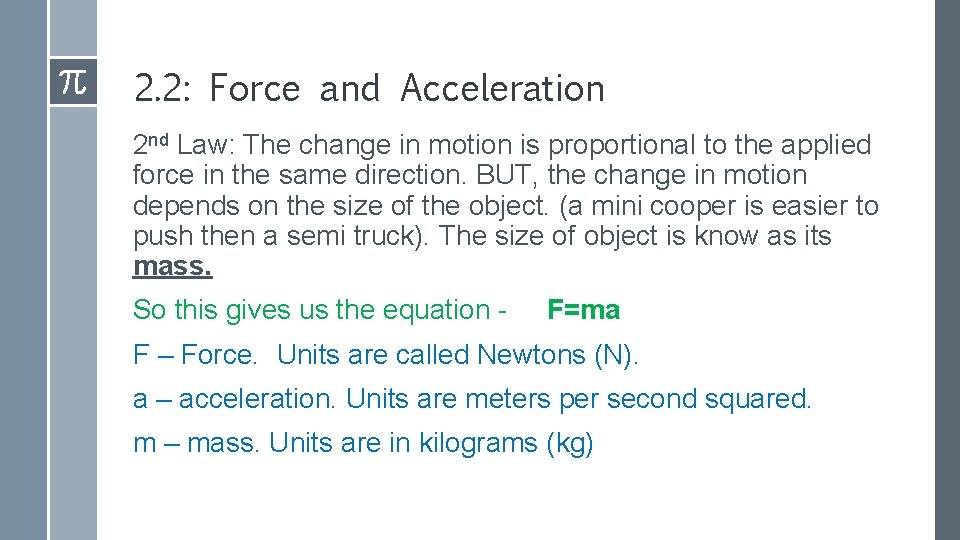
2. 2: Force and Acceleration 2 nd Law: The change in motion is proportional to the applied force in the same direction. BUT, the change in motion depends on the size of the object. (a mini cooper is easier to push then a semi truck). The size of object is know as its mass. So this gives us the equation - F=ma F – Force. Units are called Newtons (N). a – acceleration. Units are meters per second squared. m – mass. Units are in kilograms (kg)
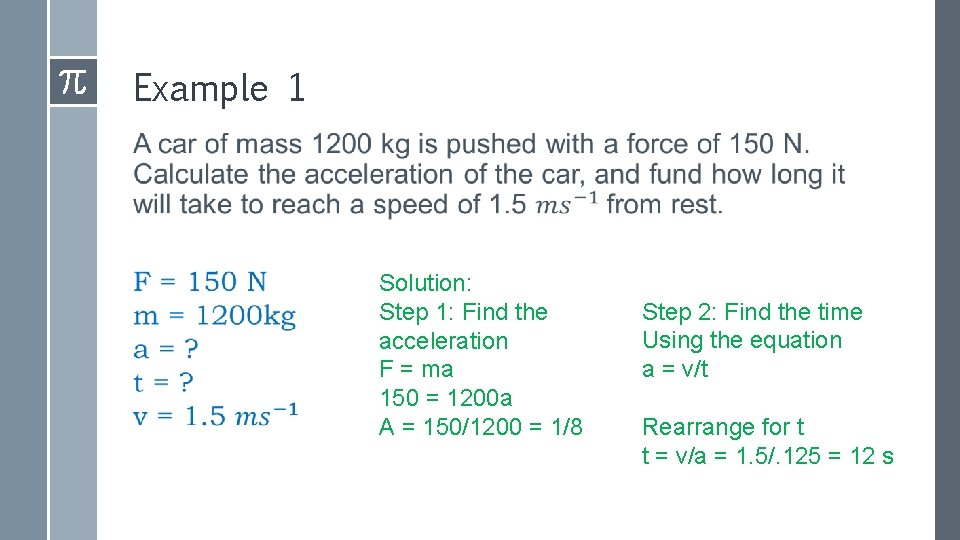
Example 1 › Solution: Step 1: Find the acceleration F = ma 150 = 1200 a A = 150/1200 = 1/8 Step 2: Find the time Using the equation a = v/t Rearrange for t t = v/a = 1. 5/. 125 = 12 s
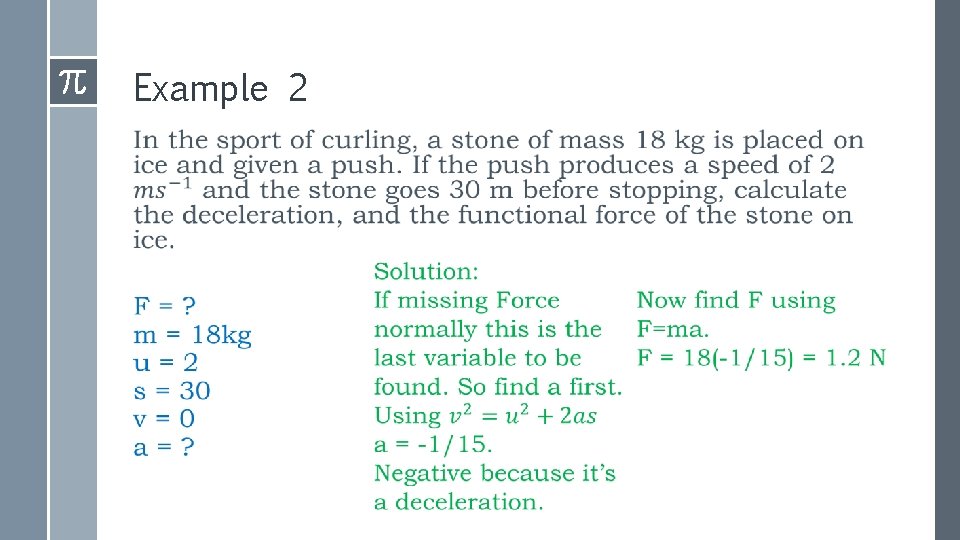
Example 2 ›
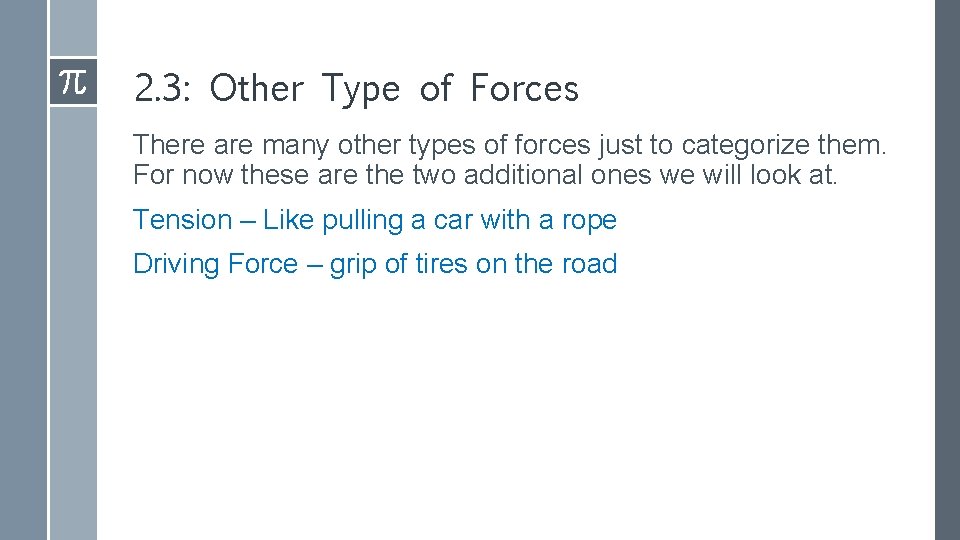
2. 3: Other Type of Forces There are many other types of forces just to categorize them. For now these are the two additional ones we will look at. Tension – Like pulling a car with a rope Driving Force – grip of tires on the road
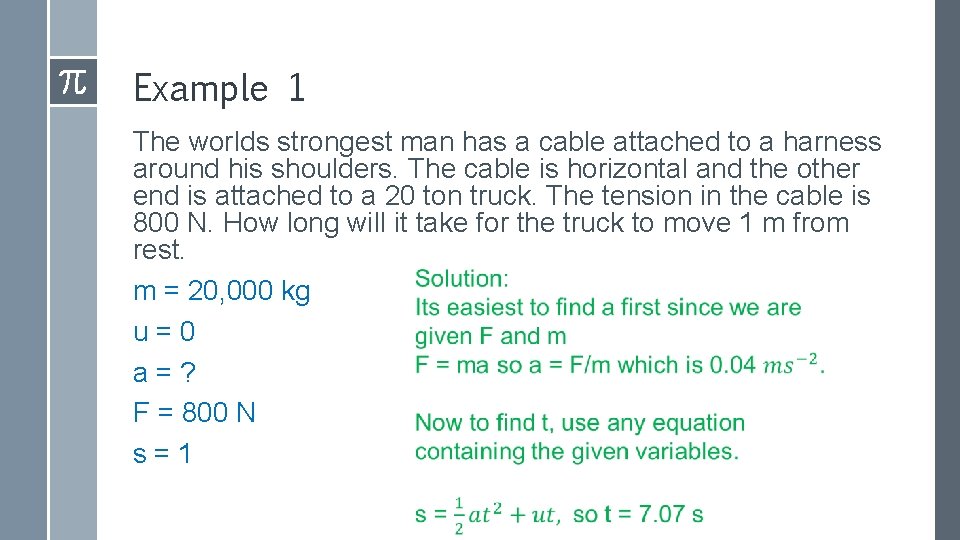
Example 1 The worlds strongest man has a cable attached to a harness around his shoulders. The cable is horizontal and the other end is attached to a 20 ton truck. The tension in the cable is 800 N. How long will it take for the truck to move 1 m from rest. m = 20, 000 kg u=0 a=? F = 800 N s=1
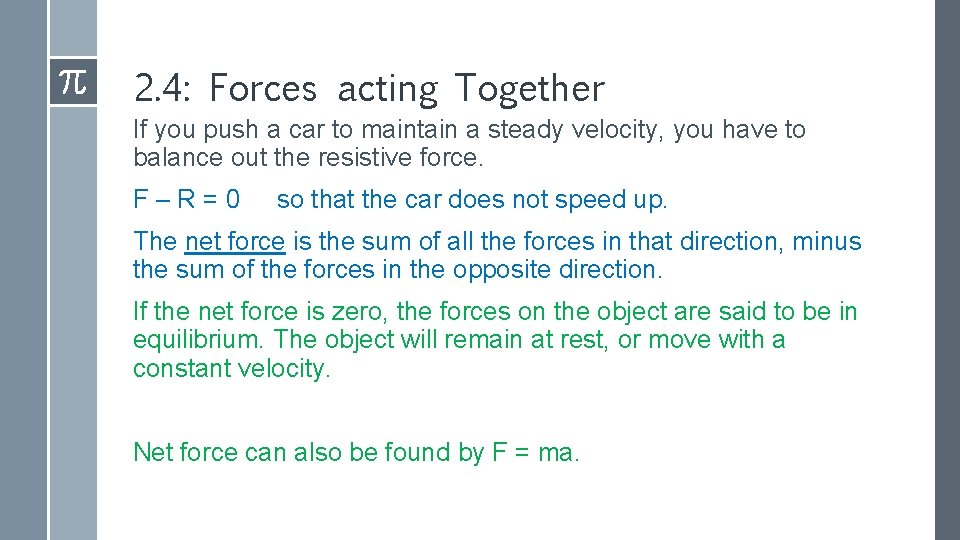
2. 4: Forces acting Together If you push a car to maintain a steady velocity, you have to balance out the resistive force. F–R=0 so that the car does not speed up. The net force is the sum of all the forces in that direction, minus the sum of the forces in the opposite direction. If the net force is zero, the forces on the object are said to be in equilibrium. The object will remain at rest, or move with a constant velocity. Net force can also be found by F = ma.
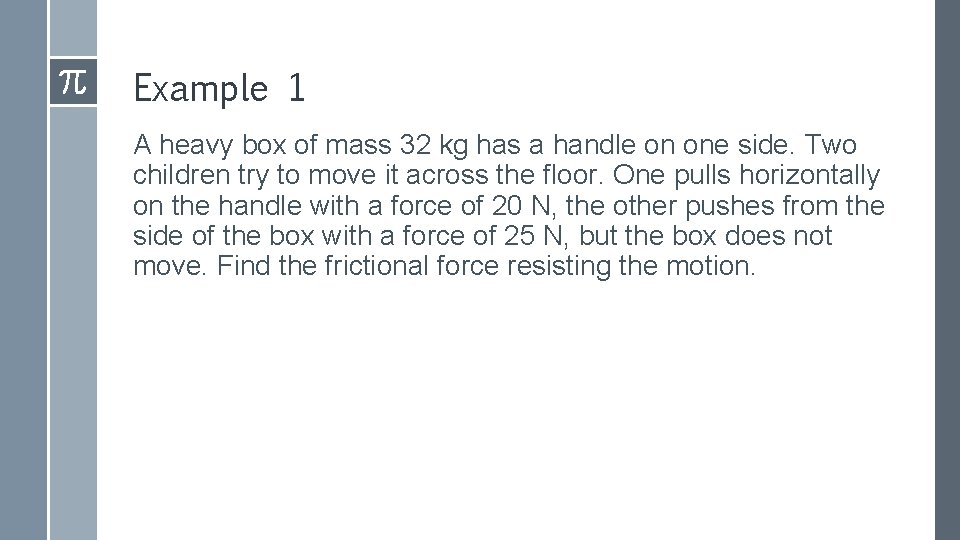
Example 1 A heavy box of mass 32 kg has a handle on one side. Two children try to move it across the floor. One pulls horizontally on the handle with a force of 20 N, the other pushes from the side of the box with a force of 25 N, but the box does not move. Find the frictional force resisting the motion.
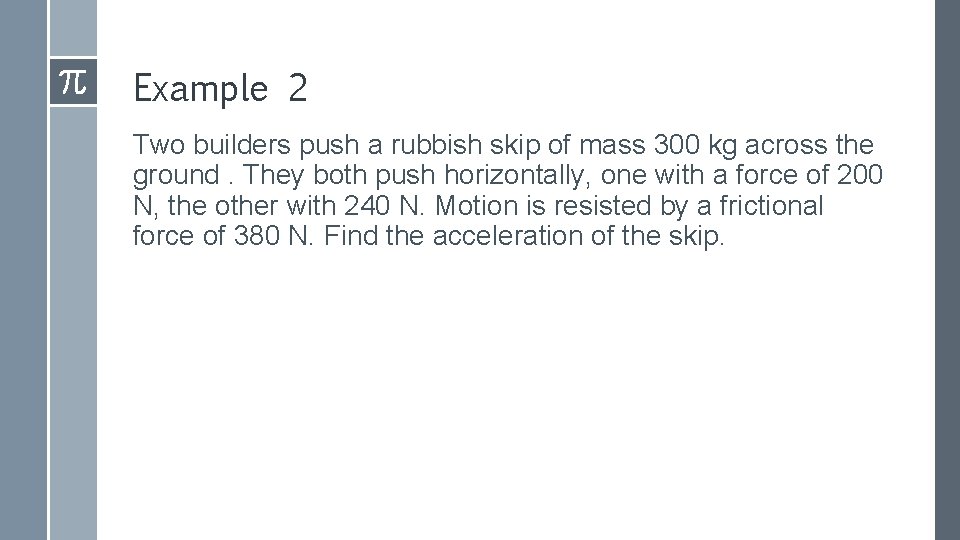
Example 2 Two builders push a rubbish skip of mass 300 kg across the ground. They both push horizontally, one with a force of 200 N, the other with 240 N. Motion is resisted by a frictional force of 380 N. Find the acceleration of the skip.
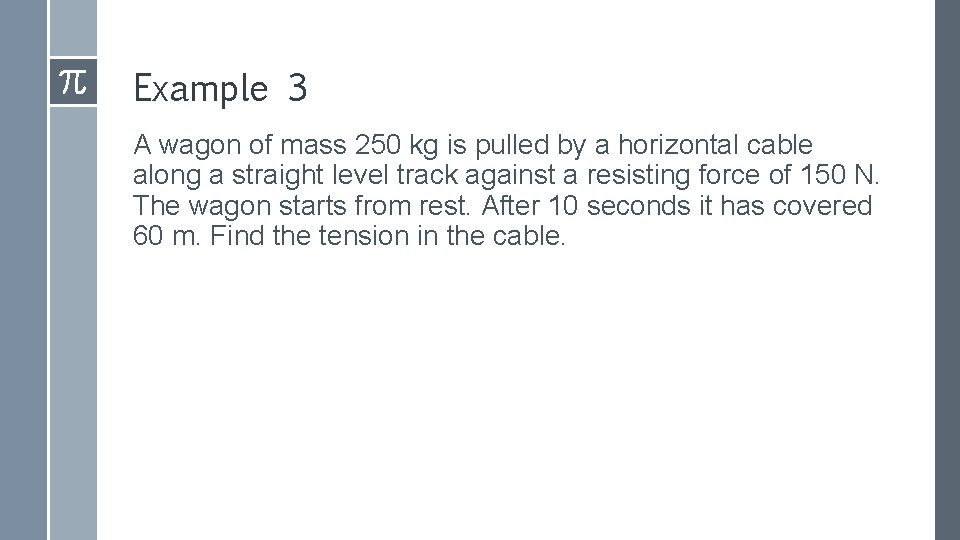
Example 3 A wagon of mass 250 kg is pulled by a horizontal cable along a straight level track against a resisting force of 150 N. The wagon starts from rest. After 10 seconds it has covered 60 m. Find the tension in the cable.
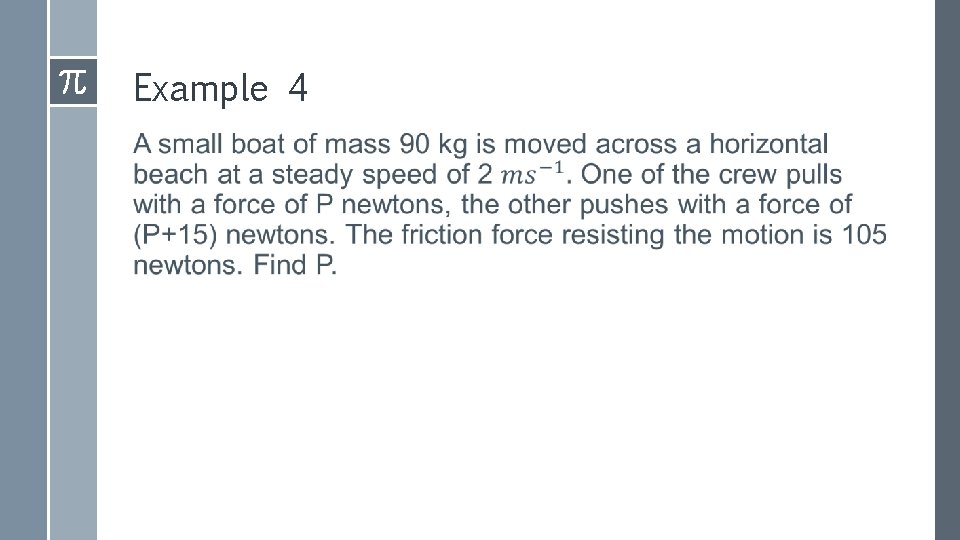
Example 4 ›
2. 5 The Particle Model Any object in these two chapters can be represented by a dot, regardless of size or shape. Not to just make it small but so it can be treated as a point so you don’t have to draw the actual the object.