
MECHANICAL WORK AND ENERGY What is energy Energy
- Slides: 12
MECHANICAL WORK AND ENERGY � � � What is energy? Energy is considered to be the capacity to do work Forms of energy Energy exist in different forms, such as Mechanical energy Electrical energy Light energy Chemical energy Sound energy Nuclear energy Heat energy
Principles of Conservation of energy State that energy can not be created or destroyed only changed from one form to another. � What are some of the engineering devices that transform energy? � examples include: � The loud speaker, which transform electrical to sound energy � The petrol engine, which transform heat to mechanical � The dynamo transforms mechanical to electrical energy � Battery transforms chemical to electrical energy � The filament bulb transforms electrical to light energy
Mechanical Work Done Mechanical work is done when a force overcome a resistance and moves through a distance. � Work done (J) may be defined as force required to overcome a resistance (N) x distance moved against the resistance (m), � In symbols W = Fs � The unit for work done is (Nm) OR joule, where 1 joule is 1 Nm. � The common resistance to be overcome include: � Friction � Gravity (weight of the body it self) � Inertial (resistance to the acceleration of the body)
Mechanical Work Done � � � (WD) against friction = frictional force x distance moved WD against gravity = weight x gain in height WD against inertial = inertial force x distance moved Inertial force is equal and opposite to the out of balance force causing the acceleration, that is Inertial force = - (mass x acceleration)
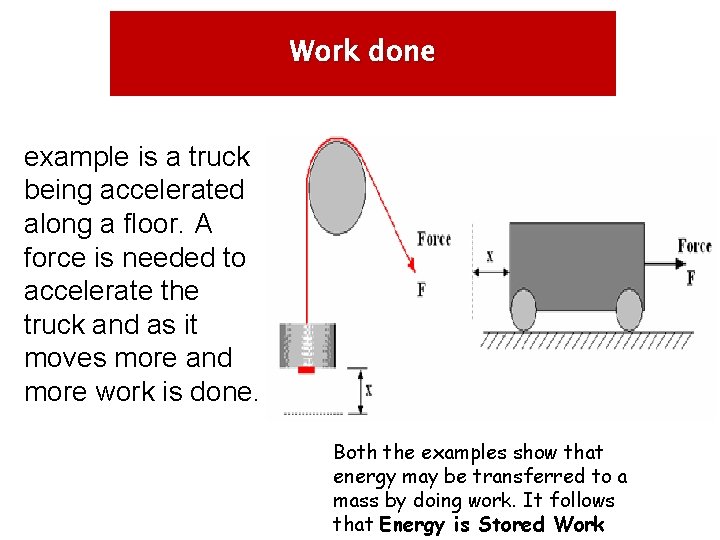
Work done example is a truck being accelerated along a floor. A force is needed to accelerate the truck and as it moves more and more work is done. Both the examples show that energy may be transferred to a mass by doing work. It follows that Energy is Stored Work
� � � WORKED EXAMPLE 1 A body of mass 30 kg is raised from the ground at a constant velocity through a vertical distance of 15 m. Calculate the work done Solution If we ignore air resistance, then the only resistance is gravity Data Mass = 30 kg Distance = 15 m WD against gravity = weight x gain in height Or WD = mgh, assuming g = 9. 81 m/s² WD = 30 X 9. 81 X 15 WD = 4414. 5 J OR 4. 415 KJ
Potential Energy (PE) � � � � This is the energy possessed by a body by virtue of its position, relative to some datum. The change in PE is equal to its weight multiplied by the change in height. Consider a mass m kg raised a height h metres against the force of gravity the work done = weight x distance moved W= Mgh Since energy can not be destroyed it is stored in the mass and may be recovered. The potential energy is P. E. = mgh Note that ‘h’ is the height and ‘x’ is the distance
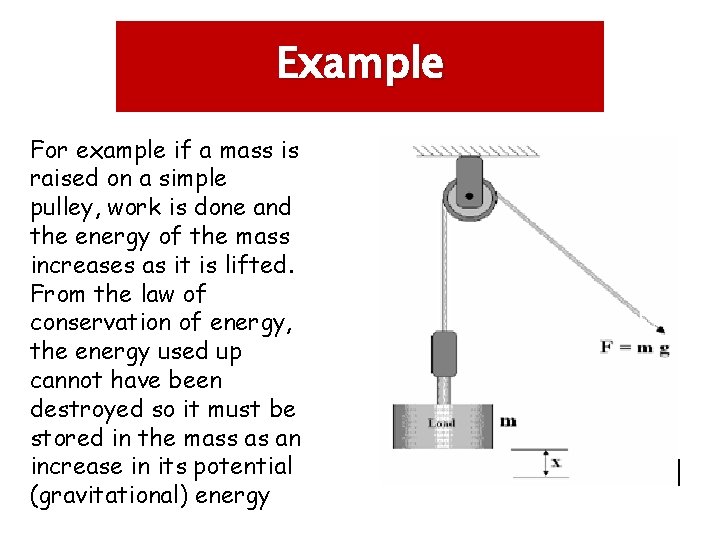
Example For example if a mass is raised on a simple pulley, work is done and the energy of the mass increases as it is lifted. From the law of conservation of energy, the energy used up cannot have been destroyed so it must be stored in the mass as an increase in its potential (gravitational) energy
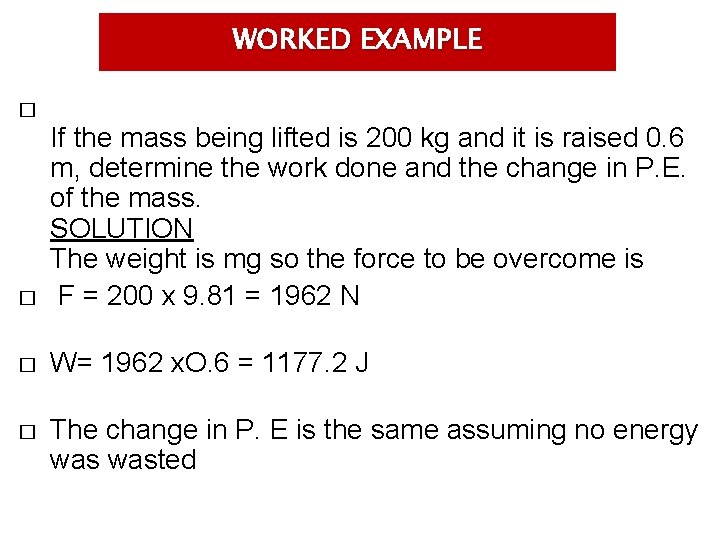
WORKED EXAMPLE � � If the mass being lifted is 200 kg and it is raised 0. 6 m, determine the work done and the change in P. E. of the mass. SOLUTION The weight is mg so the force to be overcome is F = 200 x 9. 81 = 1962 N � W= 1962 x. O. 6 = 1177. 2 J � The change in P. E is the same assuming no energy wasted
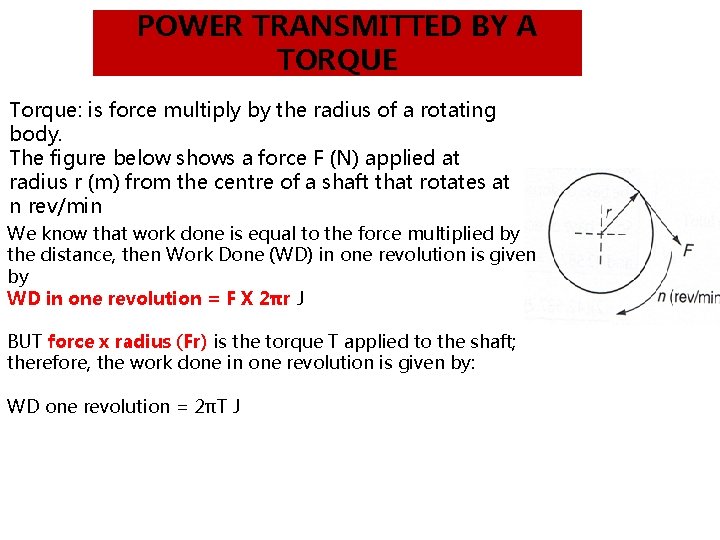
POWER TRANSMITTED BY A TORQUE Torque: is force multiply by the radius of a rotating body. The figure below shows a force F (N) applied at radius r (m) from the centre of a shaft that rotates at n rev/min We know that work done is equal to the force multiplied by the distance, then Work Done (WD) in one revolution is given by WD in one revolution = F X 2πr J BUT force x radius (Fr) is the torque T applied to the shaft; therefore, the work done in one revolution is given by: WD one revolution = 2πT J
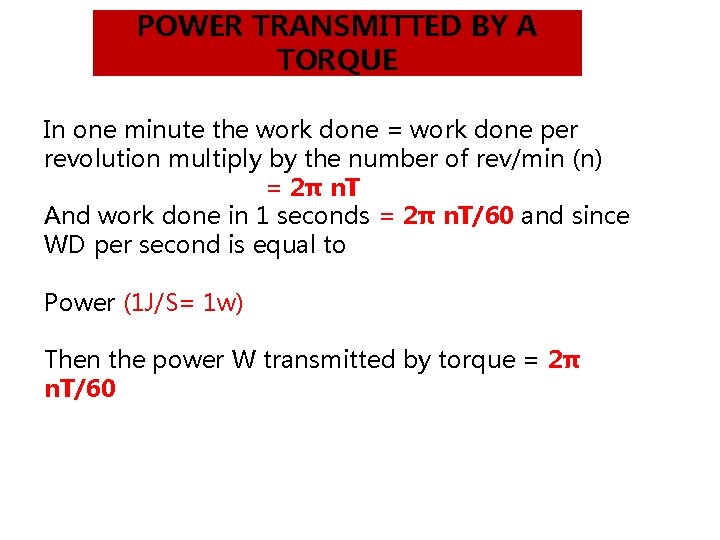
POWER TRANSMITTED BY A TORQUE In one minute the work done = work done per revolution multiply by the number of rev/min (n) = 2π n. T And work done in 1 seconds = 2π n. T/60 and since WD per second is equal to Power (1 J/S= 1 w) Then the power W transmitted by torque = 2π n. T/60
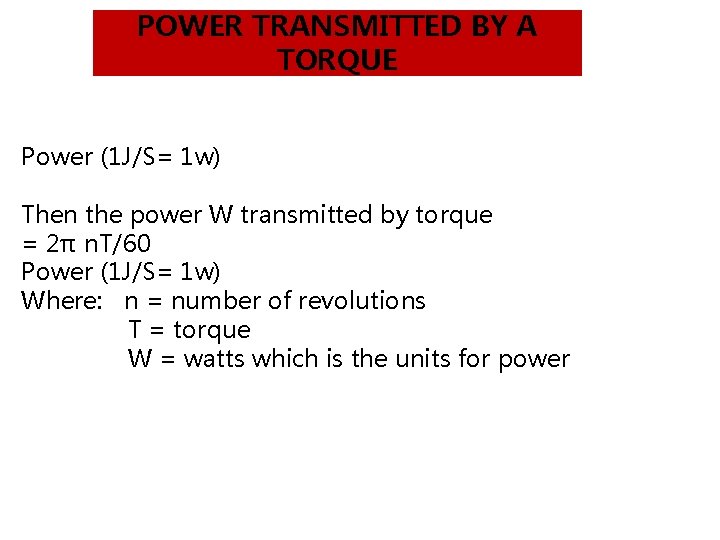
POWER TRANSMITTED BY A TORQUE Power (1 J/S= 1 w) Then the power W transmitted by torque = 2π n. T/60 Power (1 J/S= 1 w) Where: n = number of revolutions T = torque W = watts which is the units for power