
Mechanical Unit Operations1 CHE215 Chapter 4 Size Reduction


- Slides: 12
Mechanical Unit Operations(1) CHE(215) Chapter 4: Size Reduction 1
• “Size reduction” is applied to all the ways in which particles of solids are broken or cut to smaller pieces • Commercial products must sometimes meet very specific requirements: • Size • Shape of the product • Increase the reactivity of solids in some industrial reactions • Separation of unwanted large impurities • Easier handling for reduced bulk 2
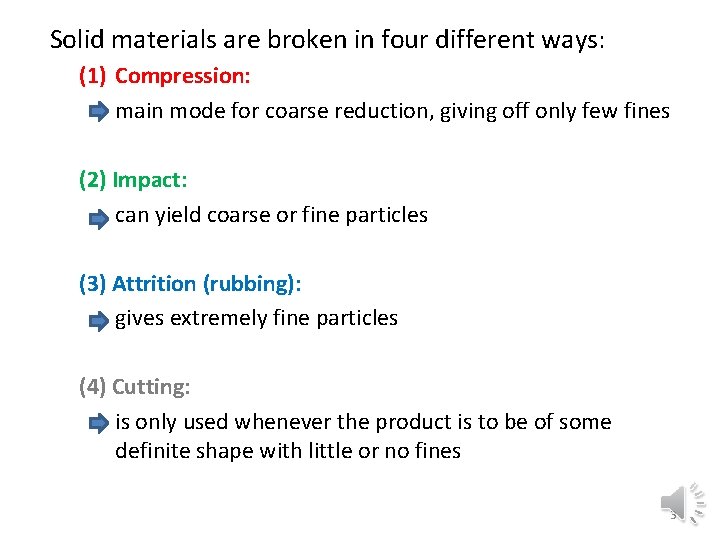
Solid materials are broken in four different ways: (1) Compression: main mode for coarse reduction, giving off only few fines (2) Impact: can yield coarse or fine particles (3) Attrition (rubbing): gives extremely fine particles (4) Cutting: is only used whenever the product is to be of some definite shape with little or no fines 3
Criteria for Size Reduction An ideal crusher or grinder should have: • Large capacity • Consume as little energy as possible • Product particles should practically have the same size In practise: (1) The actual capacity of any crusher or grinder is always several times less than its ideal capacity (2) The power required for crushing or grinding is much higher than the calculated theoretical power (3) It is common to have products with a very large particle size distribution 4
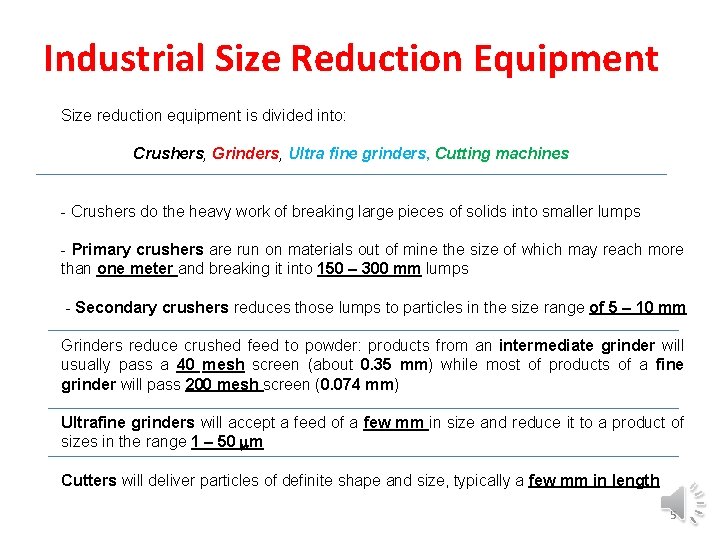
Industrial Size Reduction Equipment Size reduction equipment is divided into: Crushers, Grinders, Ultra fine grinders, Cutting machines - Crushers do the heavy work of breaking large pieces of solids into smaller lumps - Primary crushers are run on materials out of mine the size of which may reach more than one meter and breaking it into 150 – 300 mm lumps - Secondary crushers reduces those lumps to particles in the size range of 5 – 10 mm Grinders reduce crushed feed to powder: products from an intermediate grinder will usually pass a 40 mesh screen (about 0. 35 mm) while most of products of a fine grinder will pass 200 mesh screen (0. 074 mm) Ultrafine grinders will accept a feed of a few mm in size and reduce it to a product of sizes in the range 1 – 50 m Cutters will deliver particles of definite shape and size, typically a few mm in length 5
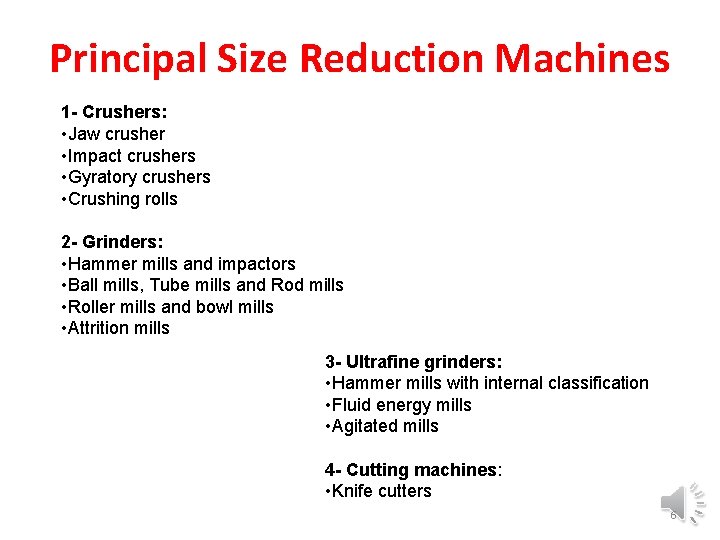
Principal Size Reduction Machines 1 - Crushers: • Jaw crusher • Impact crushers • Gyratory crushers • Crushing rolls 2 - Grinders: • Hammer mills and impactors • Ball mills, Tube mills and Rod mills • Roller mills and bowl mills • Attrition mills 3 - Ultrafine grinders: • Hammer mills with internal classification • Fluid energy mills • Agitated mills 4 - Cutting machines: • Knife cutters 6
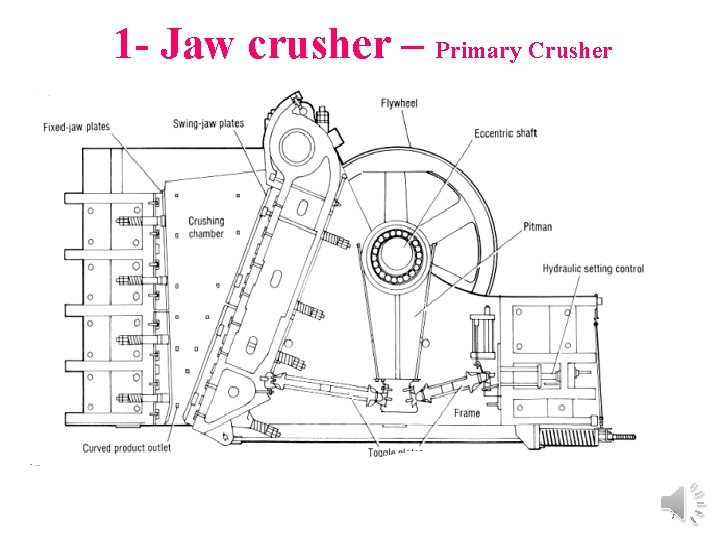
1 - Jaw crusher – Primary Crusher 7
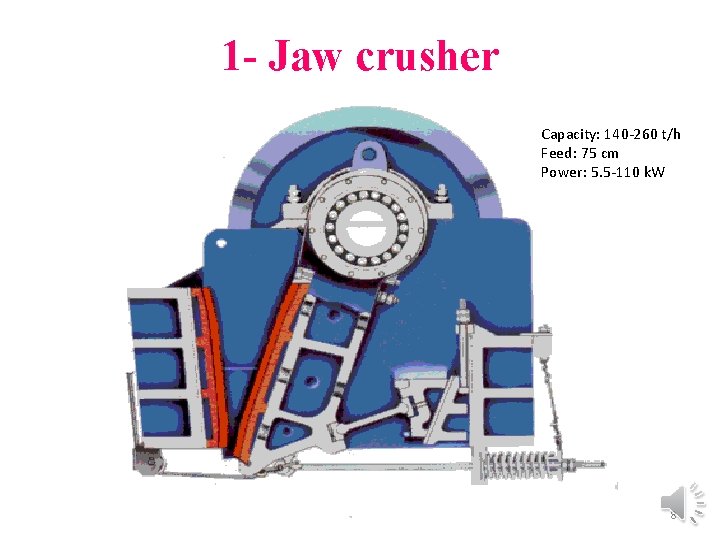
1 - Jaw crusher Capacity: 140 -260 t/h Feed: 75 cm Power: 5. 5 -110 k. W 8
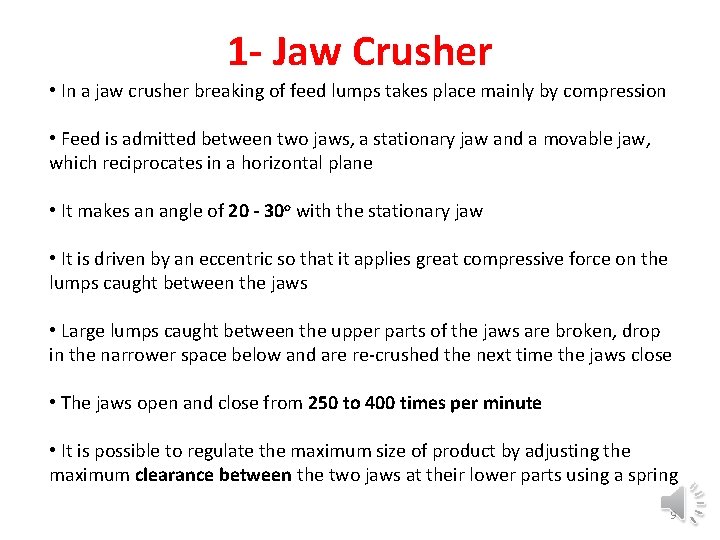
1 - Jaw Crusher • In a jaw crusher breaking of feed lumps takes place mainly by compression • Feed is admitted between two jaws, a stationary jaw and a movable jaw, which reciprocates in a horizontal plane • It makes an angle of 20 - 30 o with the stationary jaw • It is driven by an eccentric so that it applies great compressive force on the lumps caught between the jaws • Large lumps caught between the upper parts of the jaws are broken, drop in the narrower space below and are re-crushed the next time the jaws close • The jaws open and close from 250 to 400 times per minute • It is possible to regulate the maximum size of product by adjusting the maximum clearance between the two jaws at their lower parts using a spring 9
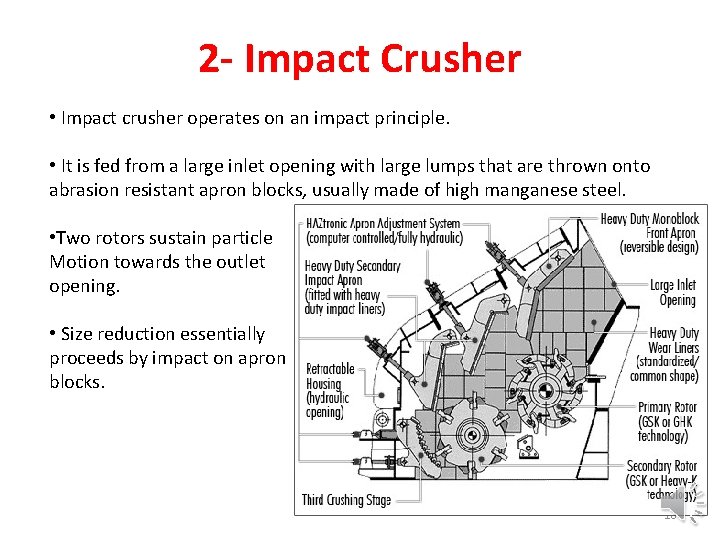
2 - Impact Crusher • Impact crusher operates on an impact principle. • It is fed from a large inlet opening with large lumps that are thrown onto abrasion resistant apron blocks, usually made of high manganese steel. • Two rotors sustain particle Motion towards the outlet opening. • Size reduction essentially proceeds by impact on apron blocks. 10
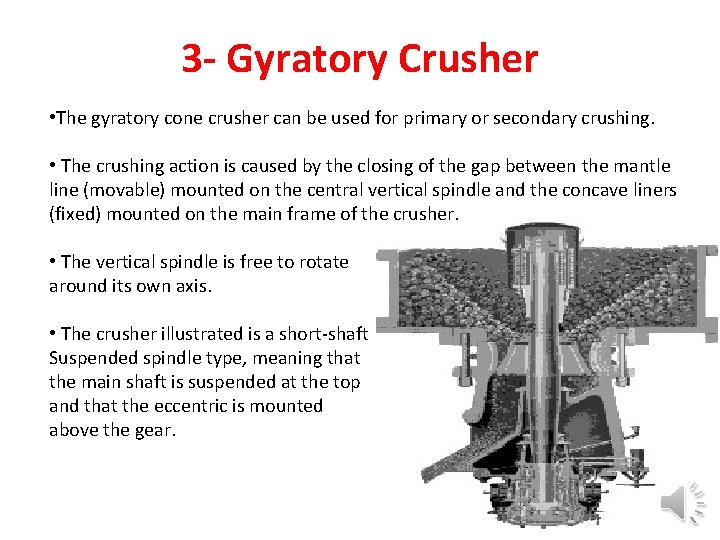
3 - Gyratory Crusher • The gyratory cone crusher can be used for primary or secondary crushing. • The crushing action is caused by the closing of the gap between the mantle line (movable) mounted on the central vertical spindle and the concave liners (fixed) mounted on the main frame of the crusher. • The vertical spindle is free to rotate around its own axis. • The crusher illustrated is a short-shaft Suspended spindle type, meaning that the main shaft is suspended at the top and that the eccentric is mounted above the gear. 11
Thank You 12