
MECHANICAL TISSUE SYSTEM To resist air currents to
- Slides: 12
MECHANICAL TISSUE SYSTEM To resist air currents, to remain erect requires some mechanical support, plant develops some specific tissues in plant known as mechanical tissues and system is mechanical tissue system. In plants some tissues carry out the function of mechanical support, in different plant organs. Common mechanical tissues are: Mechanical Tissues 1. Collenchyma 2. Sclerenchyma Function of Mechanical Tissue System 3. Xylem 4. Phloem
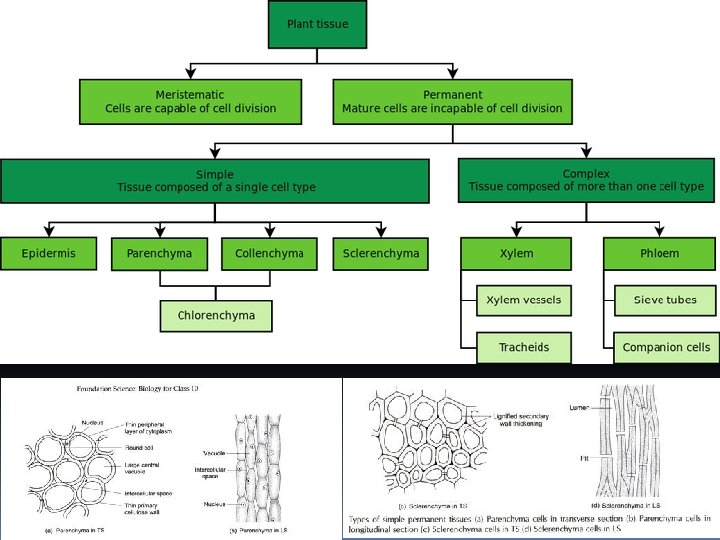
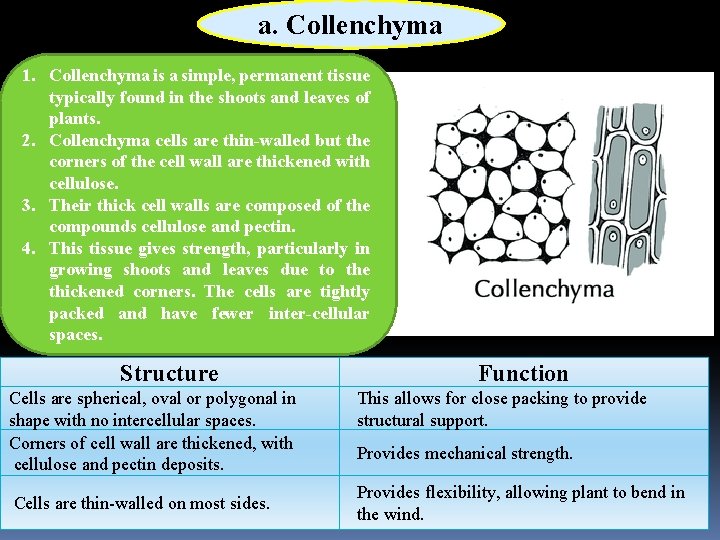
a. Collenchyma 1. Collenchyma is a simple, permanent tissue typically found in the shoots and leaves of plants. 2. Collenchyma cells are thin-walled but the corners of the cell wall are thickened with cellulose. 3. Their thick cell walls are composed of the compounds cellulose and pectin. 4. This tissue gives strength, particularly in growing shoots and leaves due to the thickened corners. The cells are tightly packed and have fewer inter-cellular spaces. Structure Cells are spherical, oval or polygonal in shape with no intercellular spaces. Corners of cell wall are thickened, with cellulose and pectin deposits. Cells are thin-walled on most sides. Function This allows for close packing to provide structural support. Provides mechanical strength. Provides flexibility, allowing plant to bend in the wind.
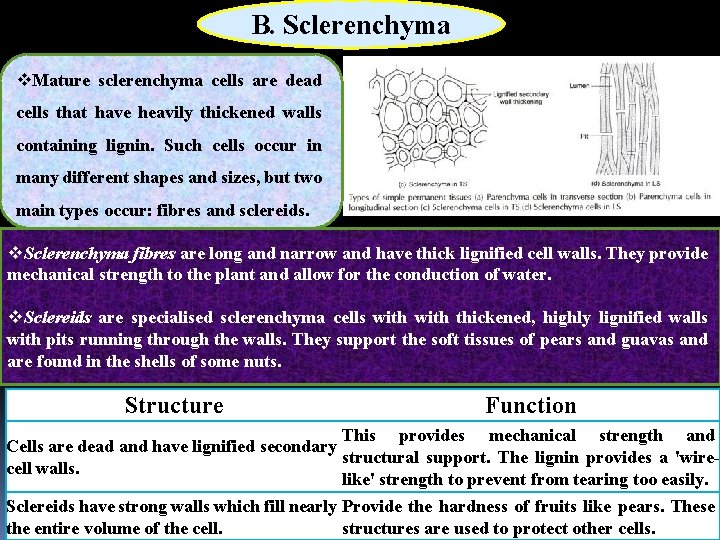
B. Sclerenchyma v. Mature sclerenchyma cells are dead cells that have heavily thickened walls containing lignin. Such cells occur in many different shapes and sizes, but two main types occur: fibres and sclereids. v. Sclerenchyma fibres are long and narrow and have thick lignified cell walls. They provide mechanical strength to the plant and allow for the conduction of water. v. Sclereids are specialised sclerenchyma cells with thickened, highly lignified walls with pits running through the walls. They support the soft tissues of pears and guavas and are found in the shells of some nuts. Structure Function This provides mechanical strength and Cells are dead and have lignified secondary structural support. The lignin provides a 'wirecell walls. like' strength to prevent from tearing too easily. Sclereids have strong walls which fill nearly Provide the hardness of fruits like pears. These the entire volume of the cell. structures are used to protect other cells.
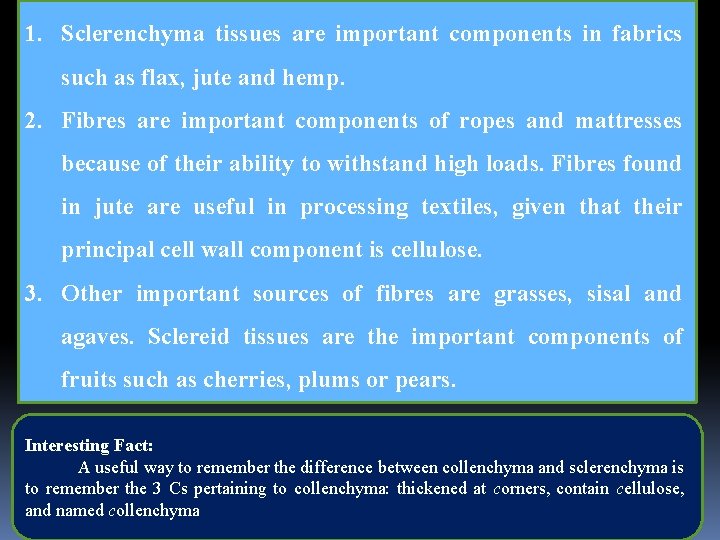
1. Sclerenchyma tissues are important components in fabrics such as flax, jute and hemp. 2. Fibres are important components of ropes and mattresses because of their ability to withstand high loads. Fibres found in jute are useful in processing textiles, given that their principal cell wall component is cellulose. 3. Other important sources of fibres are grasses, sisal and agaves. Sclereid tissues are the important components of fruits such as cherries, plums or pears. Interesting Fact: A useful way to remember the difference between collenchyma and sclerenchyma is to remember the 3 Cs pertaining to collenchyma: thickened at corners, contain cellulose, and named collenchyma
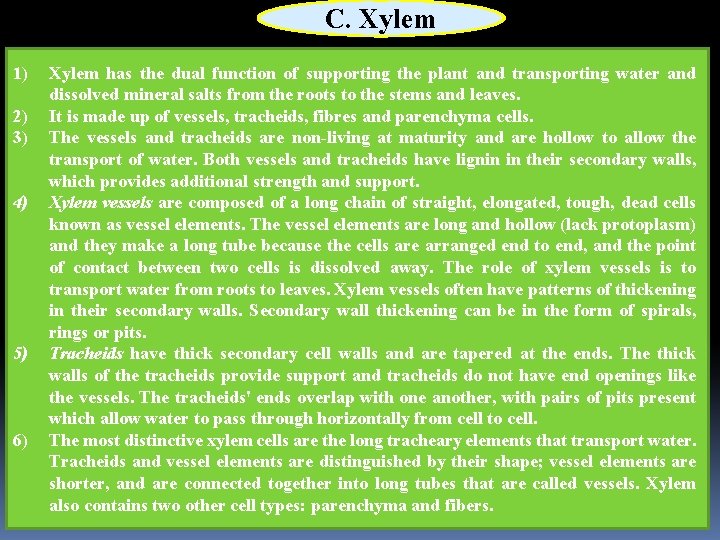
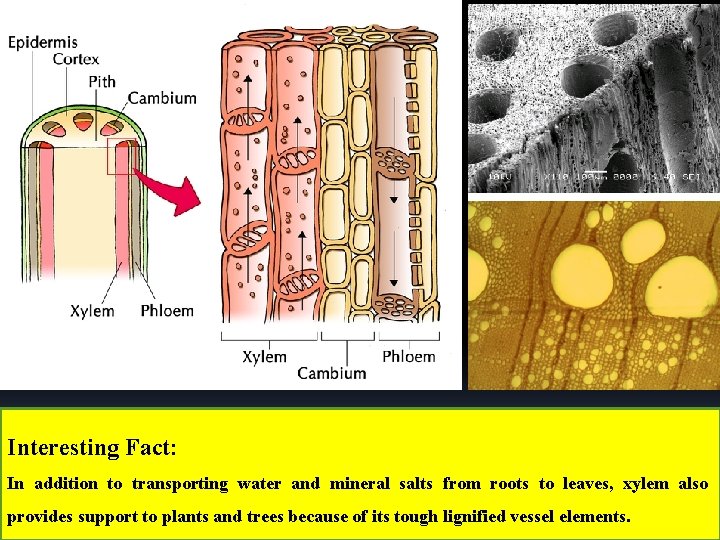
C. Xylem 1) 2) 3) 4) 5) 6) Xylem has the dual function of supporting the plant and transporting water and dissolved mineral salts from the roots to the stems and leaves. It is made up of vessels, tracheids, fibres and parenchyma cells. The vessels and tracheids are non-living at maturity and are hollow to allow the transport of water. Both vessels and tracheids have lignin in their secondary walls, which provides additional strength and support. Xylem vessels are composed of a long chain of straight, elongated, tough, dead cells known as vessel elements. The vessel elements are long and hollow (lack protoplasm) and they make a long tube because the cells are arranged end to end, and the point of contact between two cells is dissolved away. The role of xylem vessels is to transport water from roots to leaves. Xylem vessels often have patterns of thickening in their secondary walls. Secondary wall thickening can be in the form of spirals, rings or pits. Tracheids have thick secondary cell walls and are tapered at the ends. The thick walls of the tracheids provide support and tracheids do not have end openings like the vessels. The tracheids' ends overlap with one another, with pairs of pits present which allow water to pass through horizontally from cell to cell. The most distinctive xylem cells are the long tracheary elements that transport water. Tracheids and vessel elements are distinguished by their shape; vessel elements are shorter, and are connected together into long tubes that are called vessels. Xylem also contains two other cell types: parenchyma and fibers.
Interesting Fact: In addition to transporting water and mineral salts from roots to leaves, xylem also provides support to plants and trees because of its tough lignified vessel elements.
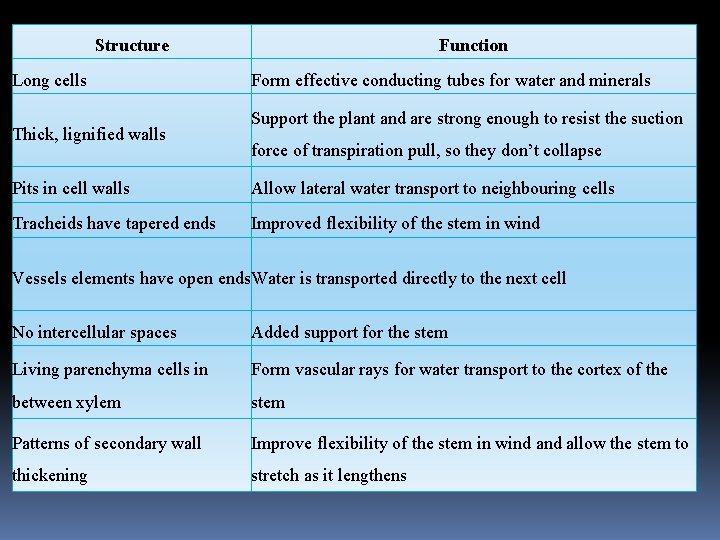
Structure Long cells Thick, lignified walls Function Form effective conducting tubes for water and minerals Support the plant and are strong enough to resist the suction force of transpiration pull, so they don’t collapse Pits in cell walls Allow lateral water transport to neighbouring cells Tracheids have tapered ends Improved flexibility of the stem in wind Vessels elements have open ends Water is transported directly to the next cell No intercellular spaces Added support for the stem Living parenchyma cells in Form vascular rays for water transport to the cortex of the between xylem stem Patterns of secondary wall Improve flexibility of the stem in wind allow the stem to thickening stretch as it lengthens
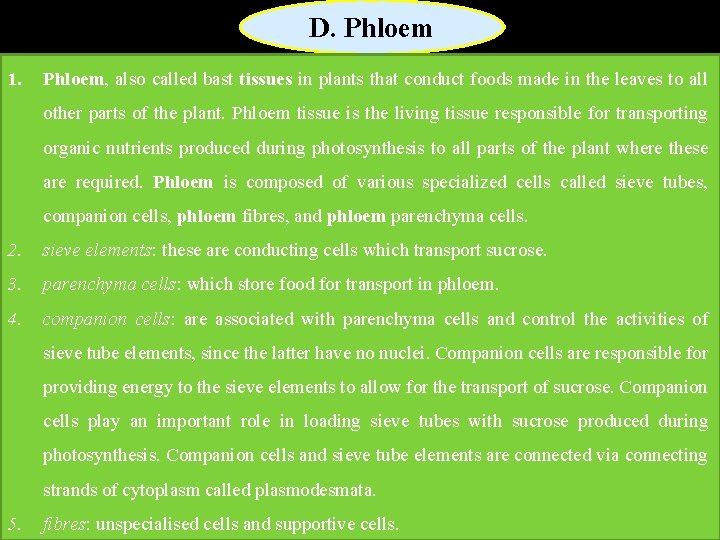
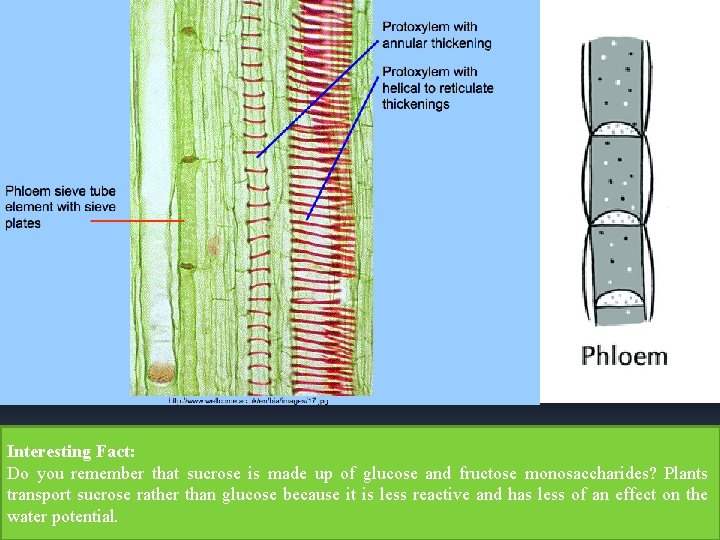
D. Phloem 1. Phloem, also called bast tissues in plants that conduct foods made in the leaves to all other parts of the plant. Phloem tissue is the living tissue responsible for transporting organic nutrients produced during photosynthesis to all parts of the plant where these are required. Phloem is composed of various specialized cells called sieve tubes, companion cells, phloem fibres, and phloem parenchyma cells. 2. sieve elements: these are conducting cells which transport sucrose. 3. parenchyma cells: which store food for transport in phloem. 4. companion cells: are associated with parenchyma cells and control the activities of sieve tube elements, since the latter have no nuclei. Companion cells are responsible for providing energy to the sieve elements to allow for the transport of sucrose. Companion cells play an important role in loading sieve tubes with sucrose produced during photosynthesis. Companion cells and sieve tube elements are connected via connecting strands of cytoplasm called plasmodesmata. 5. fibres: unspecialised cells and supportive cells.
Interesting Fact: Do you remember that sucrose is made up of glucose and fructose monosaccharides? Plants transport sucrose rather than glucose because it is less reactive and has less of an effect on the water potential.
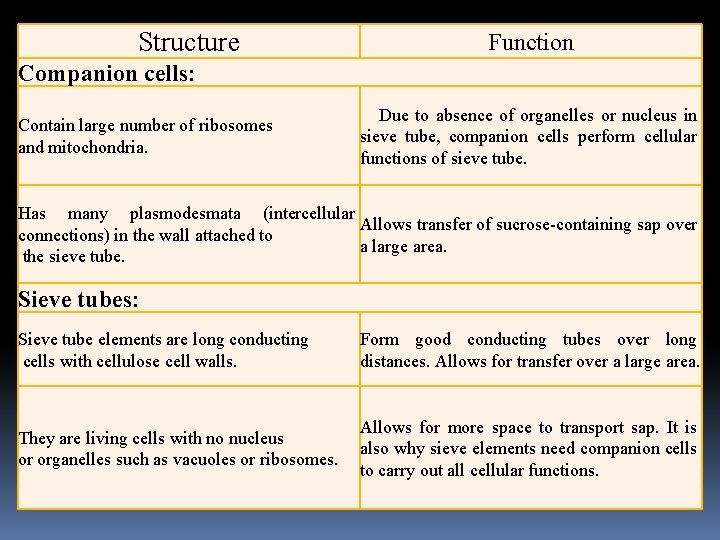
Structure Function Companion cells: Contain large number of ribosomes and mitochondria. Due to absence of organelles or nucleus in sieve tube, companion cells perform cellular functions of sieve tube. Has many plasmodesmata (intercellular Allows transfer of sucrose-containing sap over connections) in the wall attached to a large area. the sieve tube. Sieve tubes: Sieve tube elements are long conducting cells with cellulose cell walls. Form good conducting tubes over long distances. Allows for transfer over a large area. They are living cells with no nucleus or organelles such as vacuoles or ribosomes. Allows for more space to transport sap. It is also why sieve elements need companion cells to carry out all cellular functions.