
Mechanical Stabilization of Rigid PVC Compositions Mechanical Stabilization
Mechanical Stabilization of Rigid PVC Compositions
Mechanical Stabilization of Rigid PVC Compositions Thomas C. Pedersen & Robert R. Kwapisz, Jr. Rheogistics LLC Picayune, MS USA
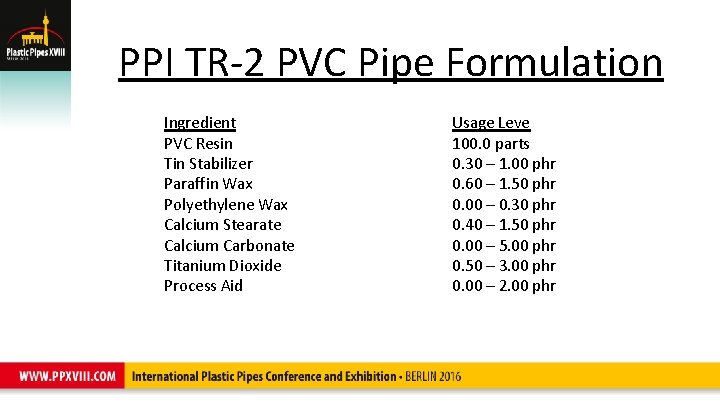
PPI TR-2 PVC Pipe Formulation Ingredient PVC Resin Tin Stabilizer Paraffin Wax Polyethylene Wax Calcium Stearate Calcium Carbonate Titanium Dioxide Process Aid Usage Leve 100. 0 parts 0. 30 – 1. 00 phr 0. 60 – 1. 50 phr 0. 00 – 0. 30 phr 0. 40 – 1. 50 phr 0. 00 – 5. 00 phr 0. 50 – 3. 00 phr 0. 00 – 2. 00 phr
Rigid PVC Lubricants • Define rheology and control fusion. • Allow the compound to be adjusted to the process. • The keys to better rigid PVC products and processing • Prevent rigid PVC from degrading when heated and sheared
Rigid PVC Lubricants • Paraffin waxes have been used for more than 40 years to lubricate rigid PVC. • Large volume rigid PVC applications using paraffin waxes as the primary lubricant include: • • • PVC Pipe Vinyl Siding Vinyl Windows PVC Fencing PVC Boards
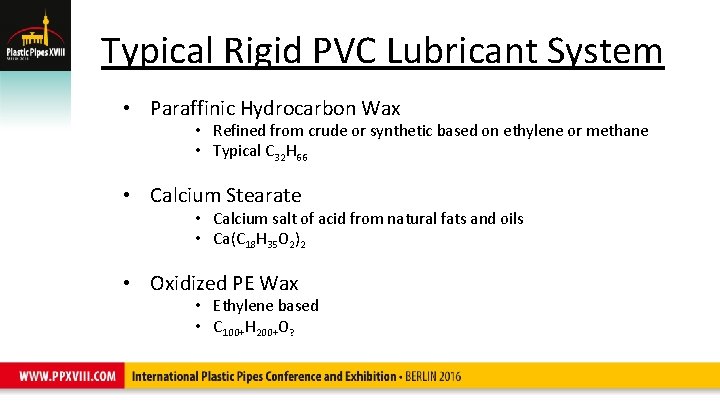
Typical Rigid PVC Lubricant System • Paraffinic Hydrocarbon Wax • Refined from crude or synthetic based on ethylene or methane • Typical C 32 H 66 • Calcium Stearate • Calcium salt of acid from natural fats and oils • Ca(C 18 H 35 O 2)2 • Oxidized PE Wax • Ethylene based • C 100+H 200+O?
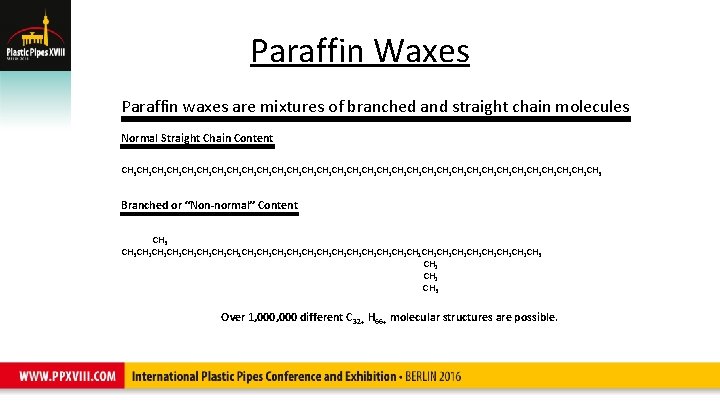
Paraffin Waxes Paraffin waxes are mixtures of branched and straight chain molecules Normal Straight Chain Content CH 3 CH 2 CH 2 CH 2 CH 2 CH 2 CH 2 CH 2 CH 2 CH 3 Branched or “Non-normal” Content CH 3 CH 2 CH 2 CH 2 CH 1 CH 2 CH 2 CH 2 CH 3 CH 2 CH 3 Over 1, 000 different C 32+ H 66+ molecular structures are possible.
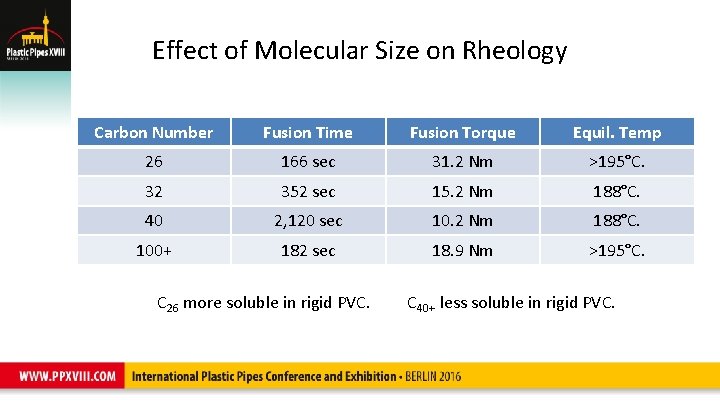
Effect of Molecular Size on Rheology Carbon Number Fusion Time Fusion Torque Equil. Temp 26 166 sec 31. 2 Nm >195°C. 32 352 sec 15. 2 Nm 188°C. 40 2, 120 sec 10. 2 Nm 188°C. 100+ 182 sec 18. 9 Nm >195°C. C 26 more soluble in rigid PVC. C 40+ less soluble in rigid PVC.
Rigid PVC Lubricants • Lubricants prevent rigid PVC from degrading when heated and sheared. • Lubricants are often adjusted to eliminate shear burning issues. • In the USA, many rigid PVC formulations run very low levels of tin stabilizer and rely on lubrication for adequate stability.
Recent Rheogistics Study • What happens when heat stabilizer is reduced and eliminated? • Could rigid PVC be processed without a conventional heat stabilizer? • Are lubricants mechanical stabilizers?
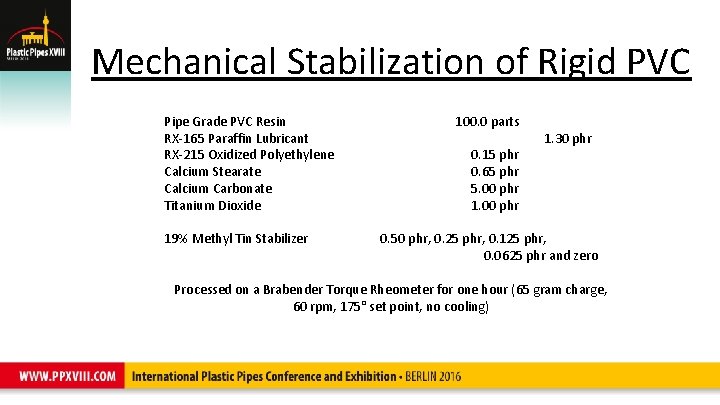
Mechanical Stabilization of Rigid PVC Pipe Grade PVC Resin RX-165 Paraffin Lubricant RX-215 Oxidized Polyethylene Calcium Stearate Calcium Carbonate Titanium Dioxide 19% Methyl Tin Stabilizer 100. 0 parts 0. 15 phr 0. 65 phr 5. 00 phr 1. 30 phr 0. 50 phr, 0. 25 phr, 0. 125 phr, 0. 0625 phr and zero Processed on a Brabender Torque Rheometer for one hour (65 gram charge, 60 rpm, 175° set point, no cooling)
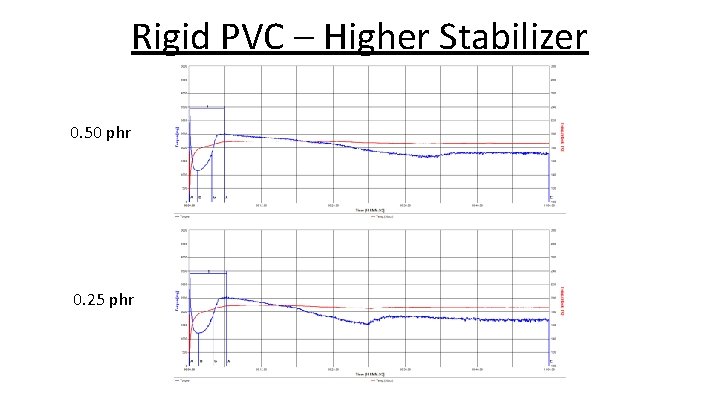
Rigid PVC – Higher Stabilizer 0. 50 phr 0. 25 phr
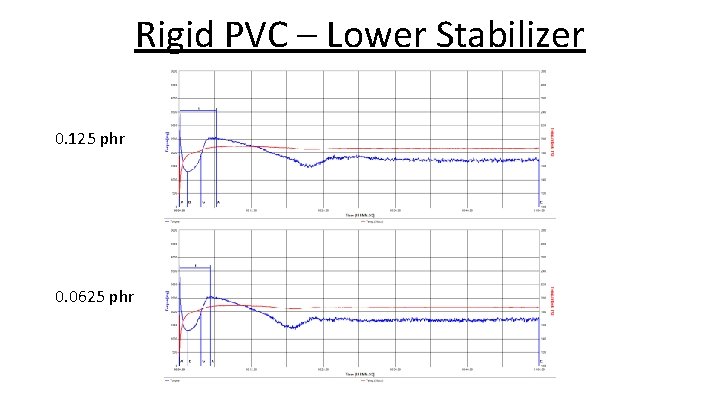
Rigid PVC – Lower Stabilizer 0. 125 phr 0. 0625 phr
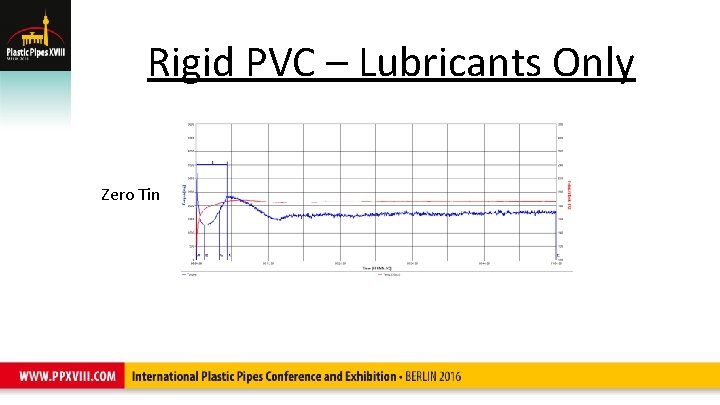
Rigid PVC – Lubricants Only Zero Tin
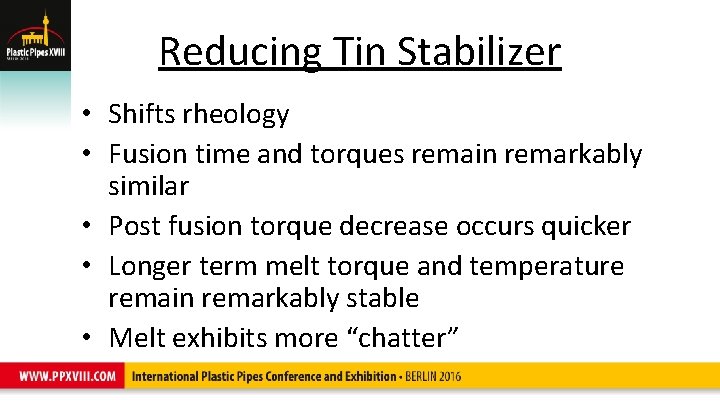
Reducing Tin Stabilizer • Shifts rheology • Fusion time and torques remain remarkably similar • Post fusion torque decrease occurs quicker • Longer term melt torque and temperature remain remarkably stable • Melt exhibits more “chatter”
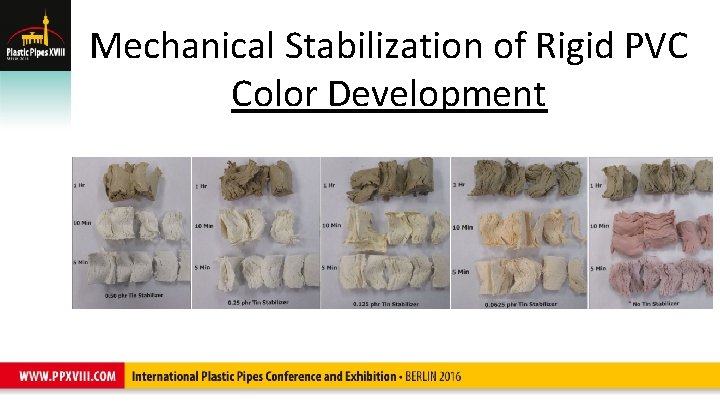
Mechanical Stabilization of Rigid PVC Color Development
Mechanical Stabilization of Rigid PVC Color Development • As the level of tin stabilizer is reduced, color develops more quickly. • When tin stabilizer is not present, early pinking becomes an issue.
Conclusions • In addition to their role in managing rheology, lubricants serve as mechanical stabilizers. • Rigid PVC free of conventional heat stabilizers may be processed under certain conditions. • Simple alkanes (paraffin waxes) are very versatile and effective primary lubricants for rigid PVC.
Conclusions • The paraffin wax, calcium stearate, and oxidized polyethylene wax long used in the USA is an excellent starting point for alternate stabilization systems.
Thank You!
- Slides: 20