
Mechanical Robustness of Cryogenic Temperature Sensors Packaged in
Mechanical Robustness of Cryogenic Temperature Sensors Packaged in a Flat, Hermetically Sealed Package 2015 CEC-ICMC, Tucson, AZ, C 30 r. G-1, 1 July 2015 Dr. Scott Courts |
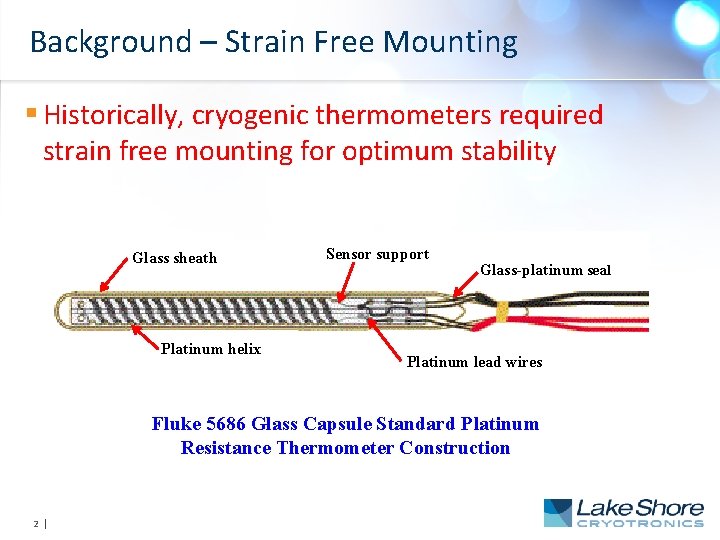
Background – Strain Free Mounting § Historically, cryogenic thermometers required strain free mounting for optimum stability Glass sheath Platinum helix Sensor support Glass-platinum seal Platinum lead wires Fluke 5686 Glass Capsule Standard Platinum Resistance Thermometer Construction 2 |
Background § The most stable devices were fragile and subject to damage from mechanical shock § True for Platinum, Rhodium-Iron, and Germanium resistance thermometers § With a small sacrifice in stability, newer devices can be packaged much more robustly This work examines the mechanical robustness of cryogenic temperature sensors mounted in a flat, hermetically sealed package 3 |
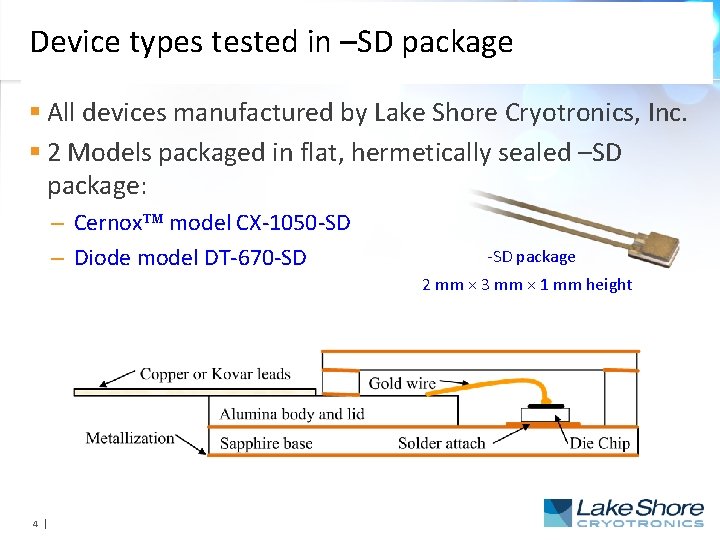
Device types tested in –SD package § All devices manufactured by Lake Shore Cryotronics, Inc. § 2 Models packaged in flat, hermetically sealed –SD package: – Cernox model CX-1050 -SD – Diode model DT-670 -SD package 2 mm × 3 mm × 1 mm height 4 |
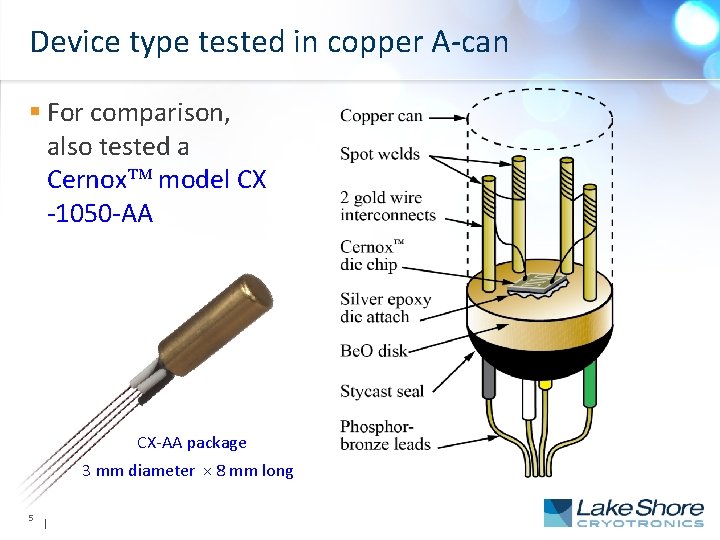
Device type tested in copper A-can § For comparison, also tested a Cernox model CX -1050 -AA CX-AA package 3 mm diameter × 8 mm long 5 |
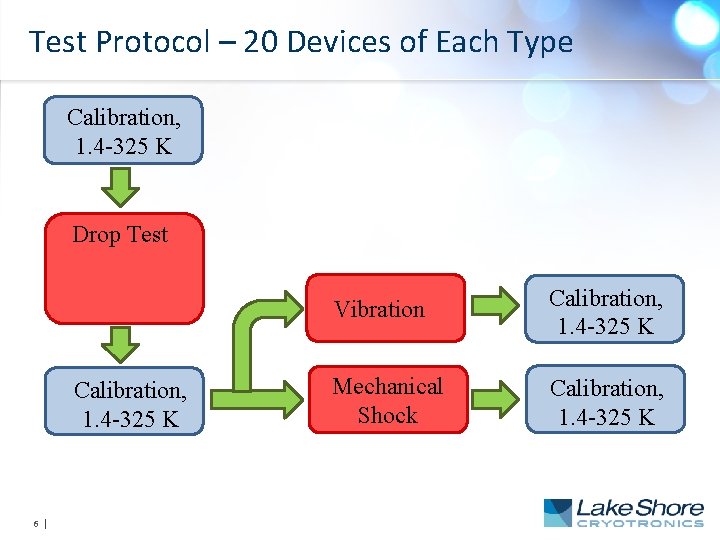
Test Protocol – 20 Devices of Each Type Calibration, 1. 4 -325 K Drop Test Calibration, 1. 4 -325 K 6 | Vibration Calibration, 1. 4 -325 K Mechanical Shock Calibration, 1. 4 -325 K
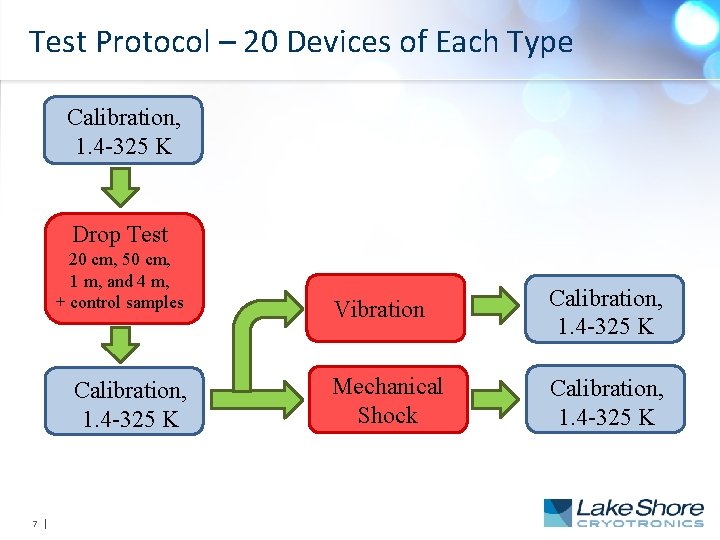
Test Protocol – 20 Devices of Each Type Calibration, 1. 4 -325 K Drop Test 20 cm, 50 cm, 1 m, and 4 m, + control samples Calibration, 1. 4 -325 K 7 | Vibration Calibration, 1. 4 -325 K Mechanical Shock Calibration, 1. 4 -325 K
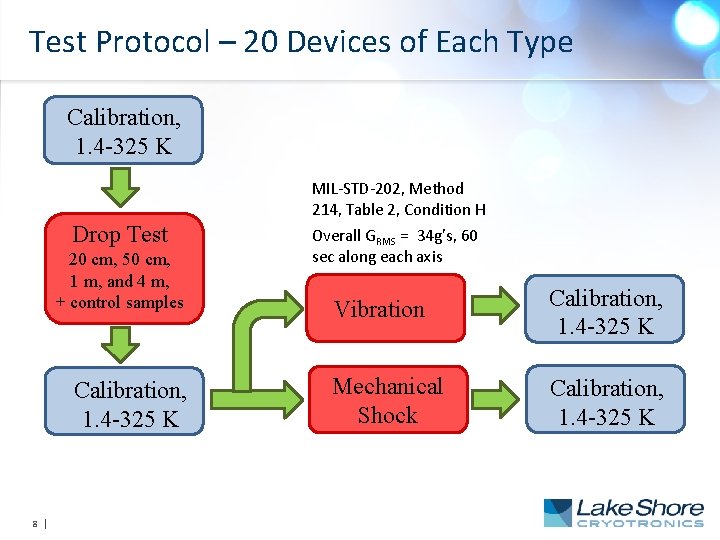
Test Protocol – 20 Devices of Each Type Calibration, 1. 4 -325 K MIL-STD-202, Method 214, Table 2, Condition H Drop Test 20 cm, 50 cm, 1 m, and 4 m, + control samples Calibration, 1. 4 -325 K 8 | Overall GRMS = 34 g’s, 60 sec along each axis Vibration Calibration, 1. 4 -325 K Mechanical Shock Calibration, 1. 4 -325 K
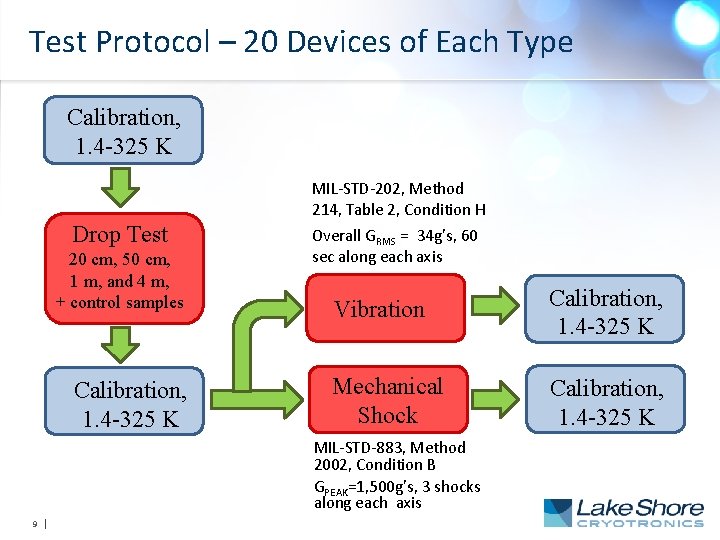
Test Protocol – 20 Devices of Each Type Calibration, 1. 4 -325 K MIL-STD-202, Method 214, Table 2, Condition H Drop Test 20 cm, 50 cm, 1 m, and 4 m, + control samples Calibration, 1. 4 -325 K Overall GRMS = 34 g’s, 60 sec along each axis Vibration Calibration, 1. 4 -325 K Mechanical Shock Calibration, 1. 4 -325 K MIL-STD-883, Method 2002, Condition B GPEAK=1, 500 g’s, 3 shocks along each axis 9 |
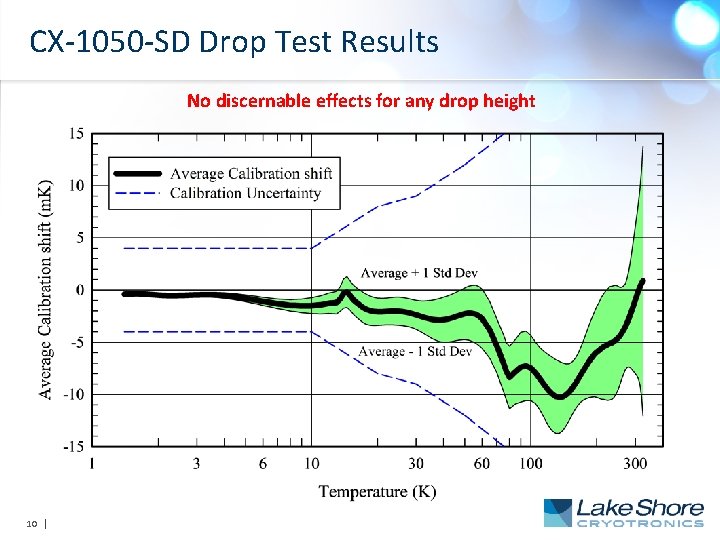
CX-1050 -SD Drop Test Results No discernable effects for any drop height 10 |
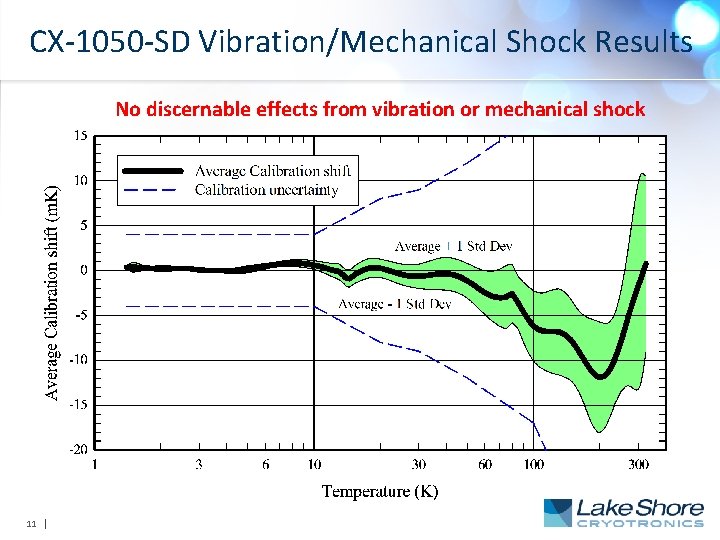
CX-1050 -SD Vibration/Mechanical Shock Results No discernable effects from vibration or mechanical shock 11 |
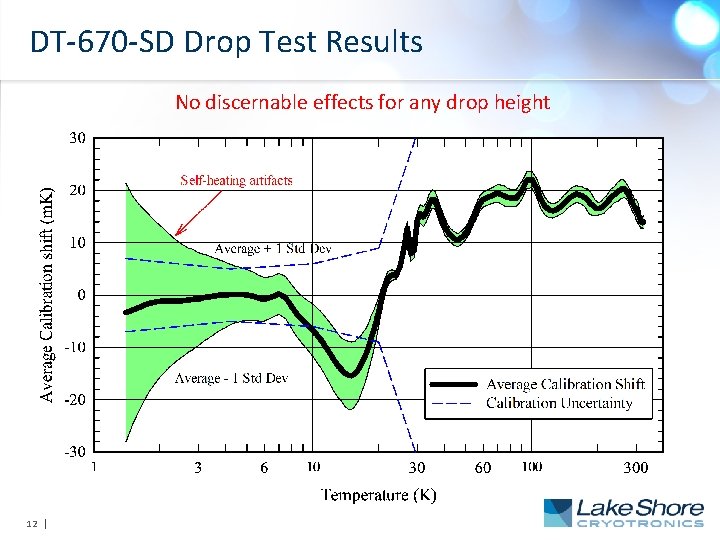
DT-670 -SD Drop Test Results No discernable effects for any drop height 12 |
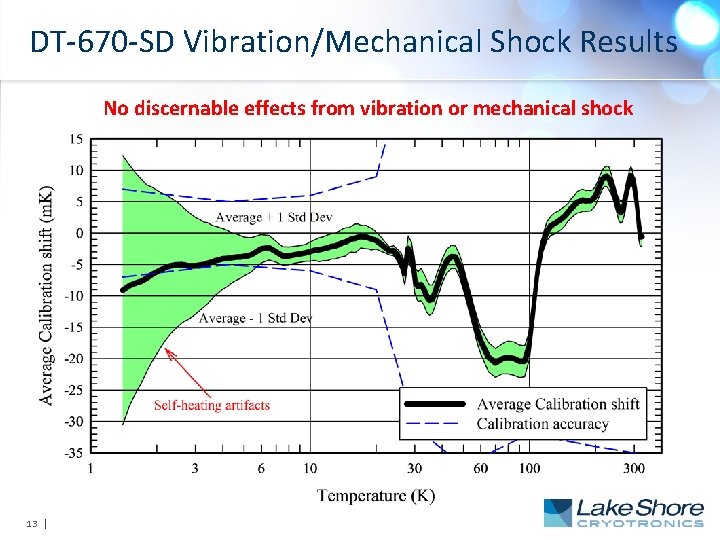
DT-670 -SD Vibration/Mechanical Shock Results No discernable effects from vibration or mechanical shock 13 |
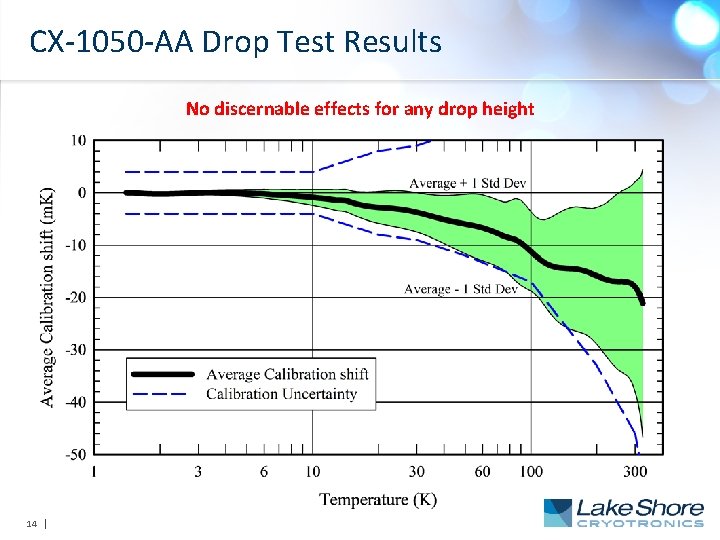
CX-1050 -AA Drop Test Results No discernable effects for any drop height 14 |
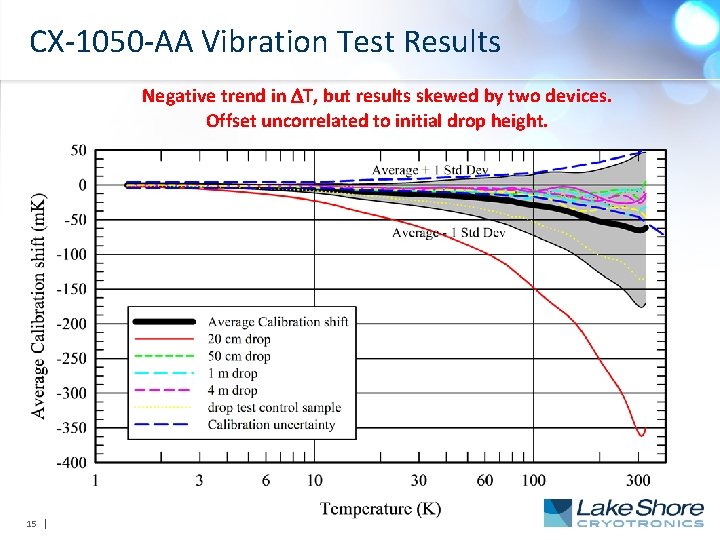
CX-1050 -AA Vibration Test Results Negative trend in T, but results skewed by two devices. Offset uncorrelated to initial drop height. 15 |
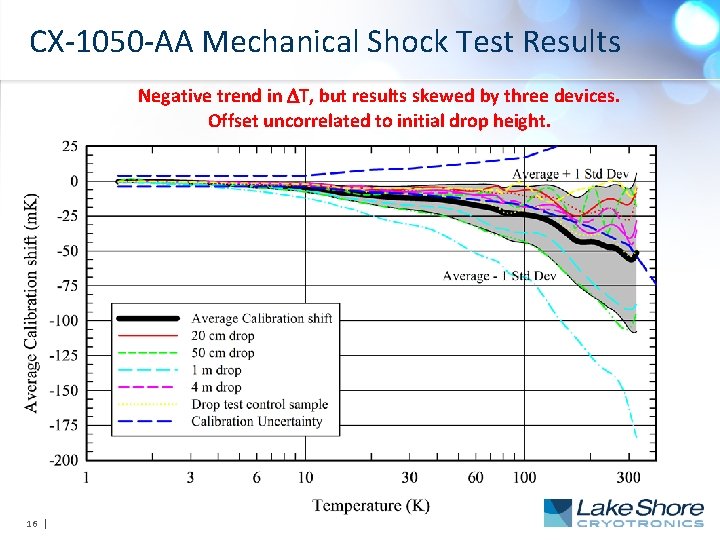
CX-1050 -AA Mechanical Shock Test Results Negative trend in T, but results skewed by three devices. Offset uncorrelated to initial drop height. 16 |
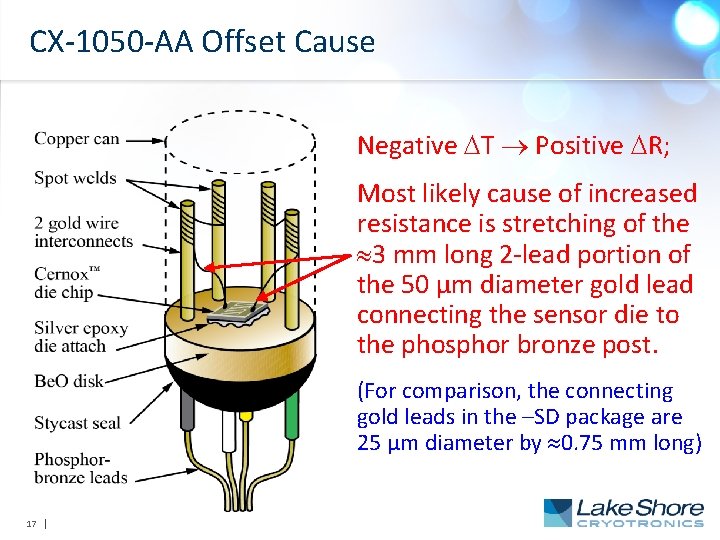
CX-1050 -AA Offset Cause Negative T Positive R; Most likely cause of increased resistance is stretching of the 3 mm long 2 -lead portion of the 50 μm diameter gold lead connecting the sensor die to the phosphor bronze post. (For comparison, the connecting gold leads in the –SD package are 25 μm diameter by 0. 75 mm long) 17 |
Conclusions This work has shown: § For models Cernox CX-1050 -SD and diode DT-670 -SD – No discernable effect when dropped from heights up to 4 m – No discernable effect from vibration with GRMS = 34 Gs – No discernable effect from mechanical shock of GPEAK = 1, 500 Gs 18 |
Conclusions This work has shown: § For models Cernox CX-1050 -SD and diode DT-670 -SD – No discernable effect when dropped from heights up to 4 m – No discernable effect from vibration with GRMS = 34 Gs – No discernable effect from mechanical shock of GPEAK = 1, 500 Gs § For model Cernox CX-1050 -AA – No discernable effect when dropped from heights up to 4 m – A negative trend in T after vibration with average offset approaching -60 m. K at 300 K, but uncorrelated to drop height – A negative trend in T after mechanical shock with average offset approaching -60 m. K at 300 K, but uncorrelated to drop height 19 |

Thank You! 20 |
- Slides: 20