
MECHANICAL PROPERTIES OF MATERIALS 1 2 3 4
- Slides: 50
MECHANICAL PROPERTIES OF MATERIALS 1. 2. 3. 4. 5. Stress‑Strain Relationships Hardness Effect of Temperature on Properties Fluid Properties Viscoelastic Behavior of Polymers © 2013 John Wiley & Sons, Inc. M P Groover, Principles of Modern Manufacturing 5/e
Mechanical Properties in Design and Manufacturing § Mechanical properties determine a material’s behavior when subjected to mechanical stresses § Properties include elastic modulus, ductility, hardness, and various measures of strength § Dilemma: mechanical properties that are desirable to the designer, such as high strength, usually make manufacturing more difficult © 2013 John Wiley & Sons, Inc. M P Groover, Principles of Modern Manufacturing 5/e
Stress‑Strain Relationships § § Three types of static stresses to which materials can be subjected: 1. Tensile - stretching the material 2. Compressive - squeezing the material 3. Shear - causing adjacent portions of the material to slide against each other Stress‑strain curve - basic relationship that describes mechanical properties for all three types © 2013 John Wiley & Sons, Inc. M P Groover, Principles of Modern Manufacturing 5/e
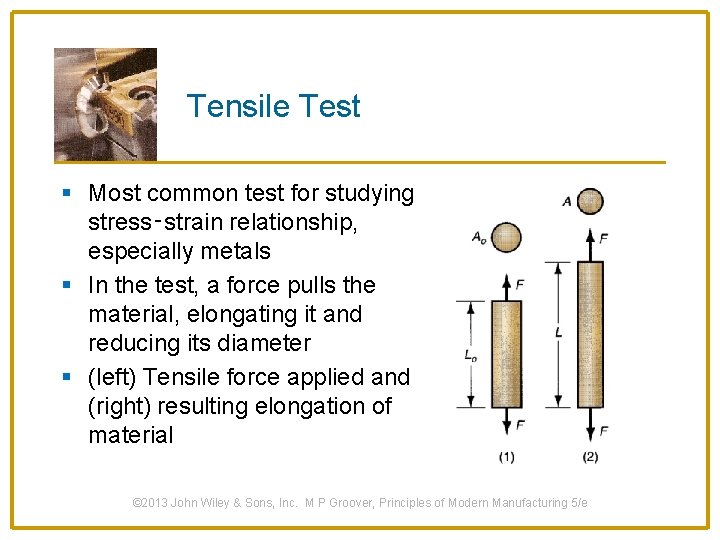
Tensile Test § Most common test for studying stress‑strain relationship, especially metals § In the test, a force pulls the material, elongating it and reducing its diameter § (left) Tensile force applied and (right) resulting elongation of material © 2013 John Wiley & Sons, Inc. M P Groover, Principles of Modern Manufacturing 5/e
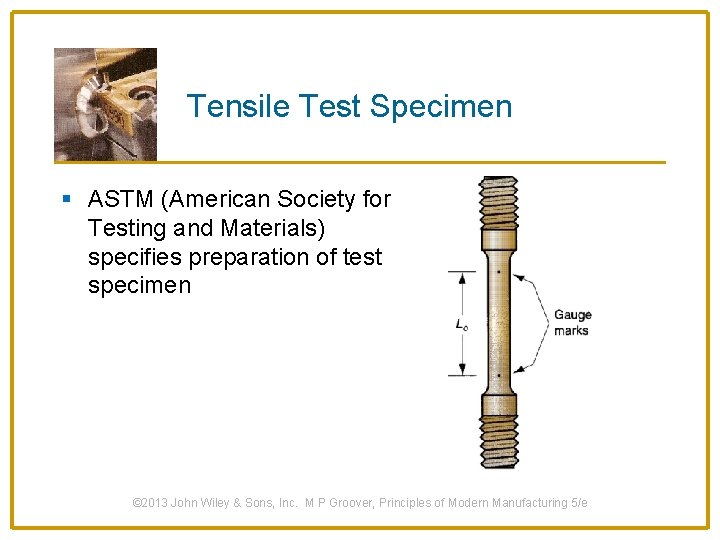
Tensile Test Specimen § ASTM (American Society for Testing and Materials) specifies preparation of test specimen © 2013 John Wiley & Sons, Inc. M P Groover, Principles of Modern Manufacturing 5/e
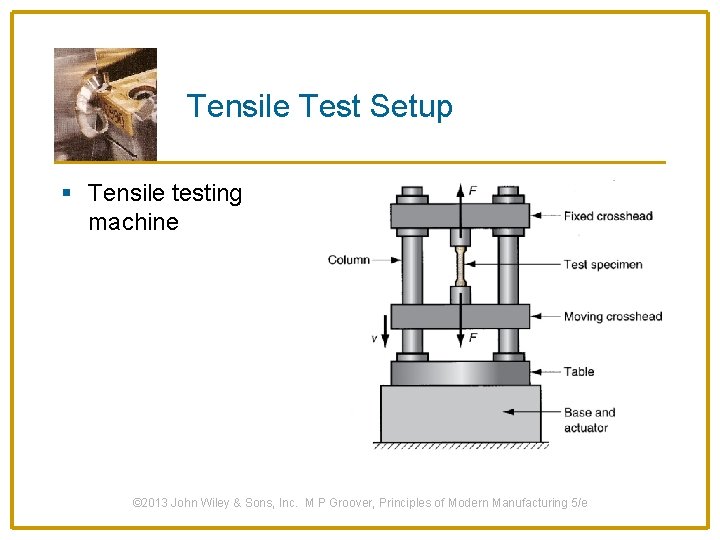
Tensile Test Setup § Tensile testing machine © 2013 John Wiley & Sons, Inc. M P Groover, Principles of Modern Manufacturing 5/e
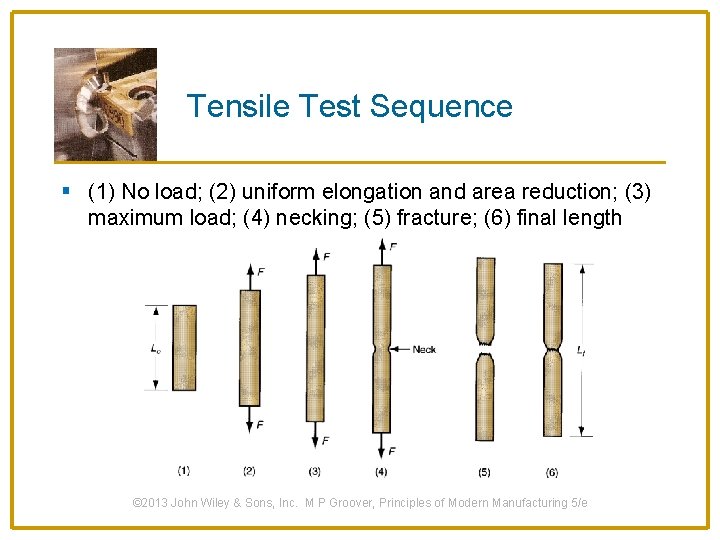
Tensile Test Sequence § (1) No load; (2) uniform elongation and area reduction; (3) maximum load; (4) necking; (5) fracture; (6) final length © 2013 John Wiley & Sons, Inc. M P Groover, Principles of Modern Manufacturing 5/e
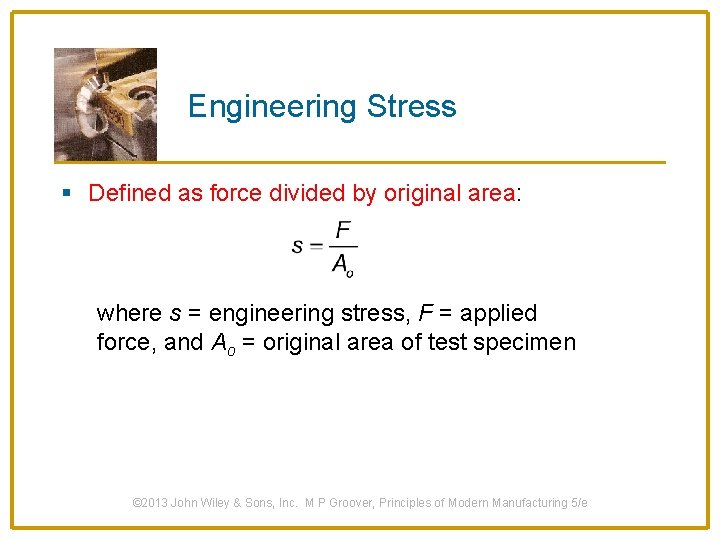
Engineering Stress § Defined as force divided by original area: where s = engineering stress, F = applied force, and Ao = original area of test specimen © 2013 John Wiley & Sons, Inc. M P Groover, Principles of Modern Manufacturing 5/e
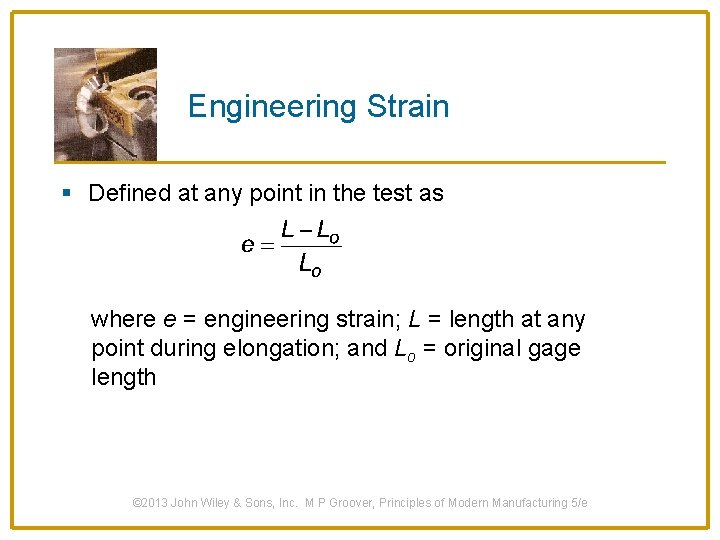
Engineering Strain § Defined at any point in the test as where e = engineering strain; L = length at any point during elongation; and Lo = original gage length © 2013 John Wiley & Sons, Inc. M P Groover, Principles of Modern Manufacturing 5/e
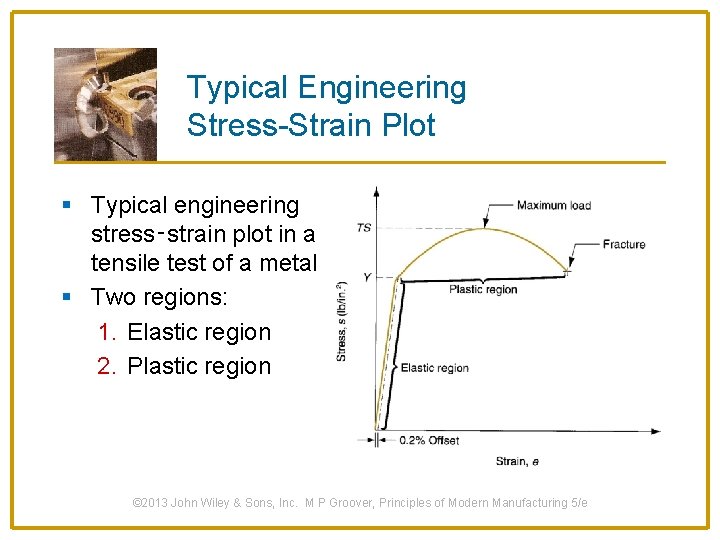
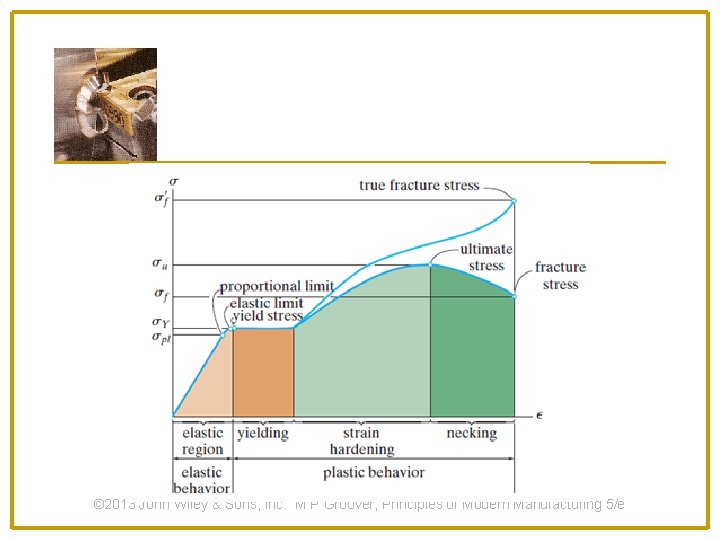
Typical Engineering Stress-Strain Plot § Typical engineering stress‑strain plot in a tensile test of a metal § Two regions: 1. Elastic region 2. Plastic region © 2013 John Wiley & Sons, Inc. M P Groover, Principles of Modern Manufacturing 5/e
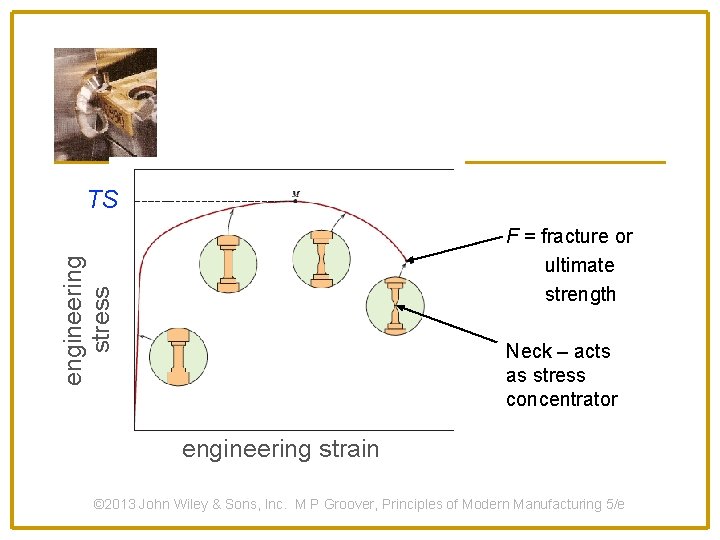
TS F = fracture or ultimate strength engineering stress y Typical response of a metal Neck – acts as stress concentrator strain engineering strain © 2013 John Wiley & Sons, Inc. M P Groover, Principles of Modern Manufacturing 5/e
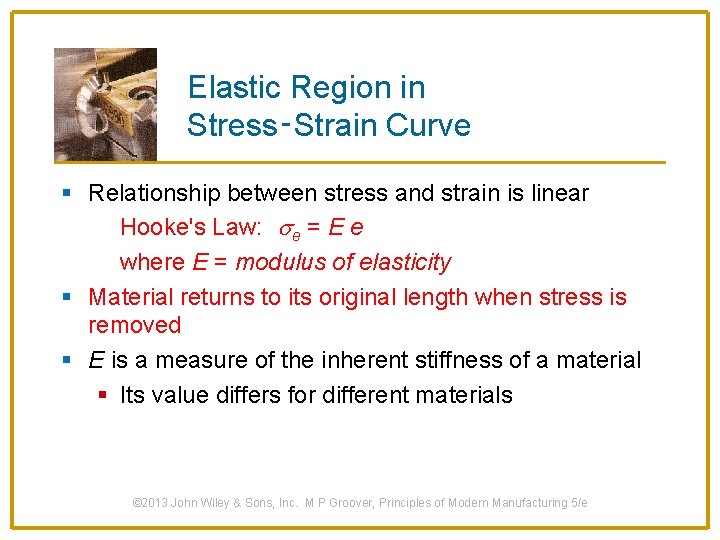
Elastic Region in Stress‑Strain Curve § Relationship between stress and strain is linear Hooke's Law: e = E e where E = modulus of elasticity § Material returns to its original length when stress is removed § E is a measure of the inherent stiffness of a material § Its value differs for different materials © 2013 John Wiley & Sons, Inc. M P Groover, Principles of Modern Manufacturing 5/e
Yield Point in Stress‑Strain Curve § As stress increases, a point in the linear relationship is finally reached when the material begins to yield § Yield point Y can be identified by the change in slope at the upper end of the linear region § Y = a strength property § Other names for yield point: § Yield strength § Yield stress § Elastic limit © 2013 John Wiley & Sons, Inc. M P Groover, Principles of Modern Manufacturing 5/e
Plastic Region in Stress‑Strain Curve § Yield point marks the beginning of plastic deformation § The stress-strain relationship is no longer guided by Hooke's Law § As load is increased beyond Y, elongation proceeds at a much faster rate than before, causing the slope of the curve to change dramatically © 2013 John Wiley & Sons, Inc. M P Groover, Principles of Modern Manufacturing 5/e
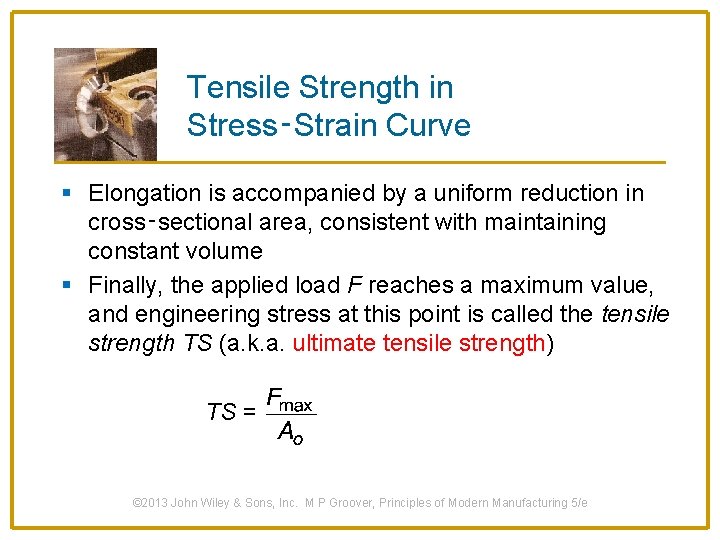
Tensile Strength in Stress‑Strain Curve § Elongation is accompanied by a uniform reduction in cross‑sectional area, consistent with maintaining constant volume § Finally, the applied load F reaches a maximum value, and engineering stress at this point is called the tensile strength TS (a. k. a. ultimate tensile strength) TS = © 2013 John Wiley & Sons, Inc. M P Groover, Principles of Modern Manufacturing 5/e
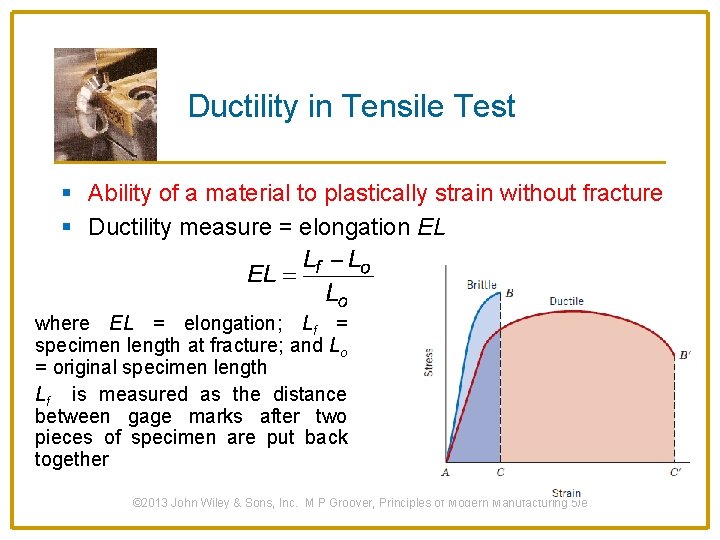
Ductility in Tensile Test § Ability of a material to plastically strain without fracture § Ductility measure = elongation EL where EL = elongation; Lf = specimen length at fracture; and Lo = original specimen length Lf is measured as the distance between gage marks after two pieces of specimen are put back together © 2013 John Wiley & Sons, Inc. M P Groover, Principles of Modern Manufacturing 5/e
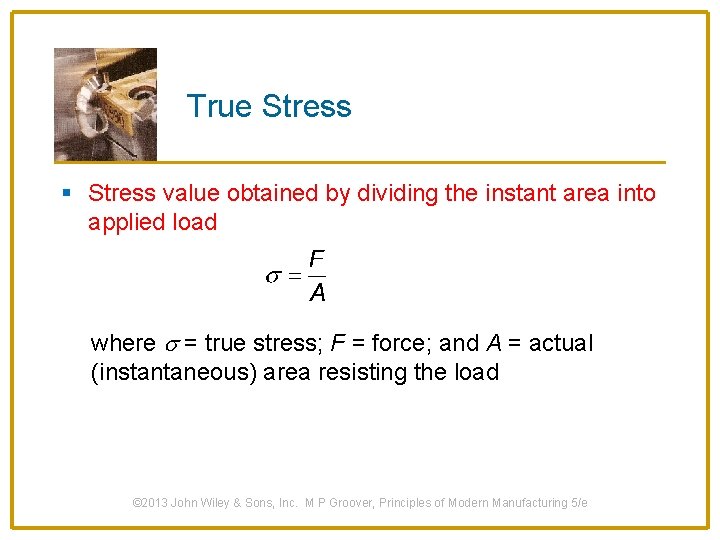
True Stress § Stress value obtained by dividing the instant area into applied load where = true stress; F = force; and A = actual (instantaneous) area resisting the load © 2013 John Wiley & Sons, Inc. M P Groover, Principles of Modern Manufacturing 5/e
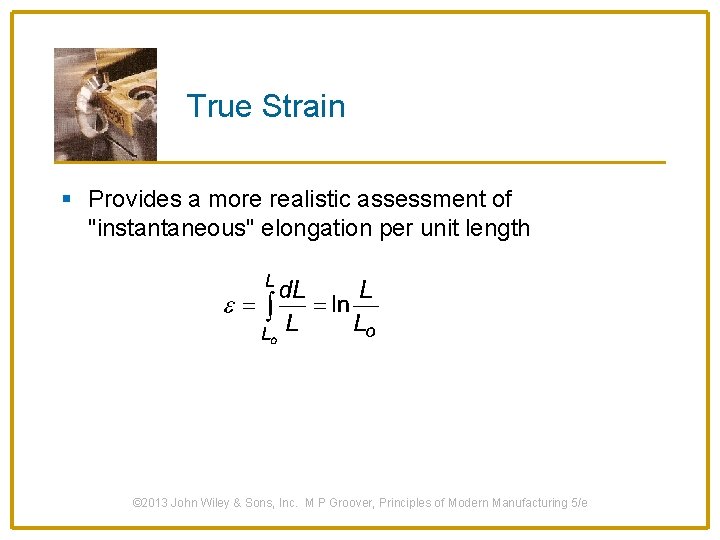
True Strain § Provides a more realistic assessment of "instantaneous" elongation per unit length © 2013 John Wiley & Sons, Inc. M P Groover, Principles of Modern Manufacturing 5/e
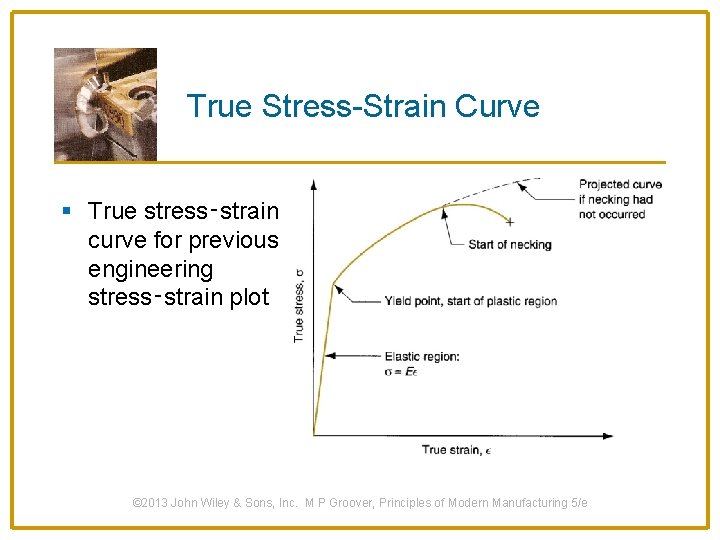
True Stress-Strain Curve § True stress‑strain curve for previous engineering stress‑strain plot © 2013 John Wiley & Sons, Inc. M P Groover, Principles of Modern Manufacturing 5/e
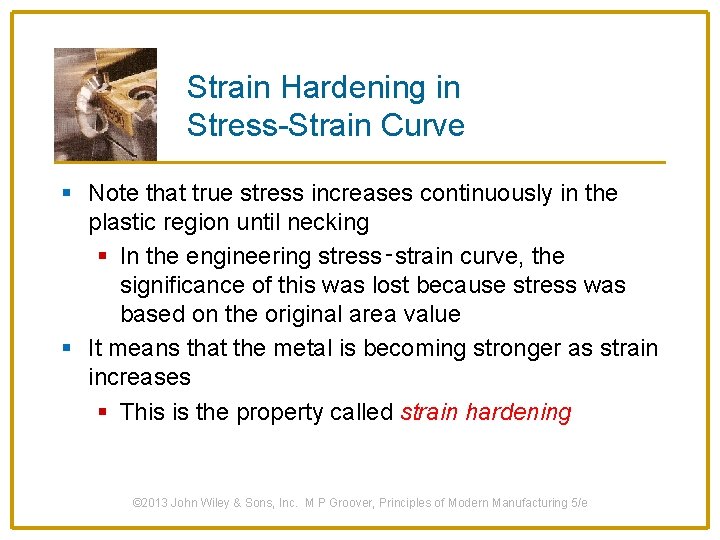
Strain Hardening in Stress-Strain Curve § Note that true stress increases continuously in the plastic region until necking § In the engineering stress‑strain curve, the significance of this was lost because stress was based on the original area value § It means that the metal is becoming stronger as strain increases § This is the property called strain hardening © 2013 John Wiley & Sons, Inc. M P Groover, Principles of Modern Manufacturing 5/e
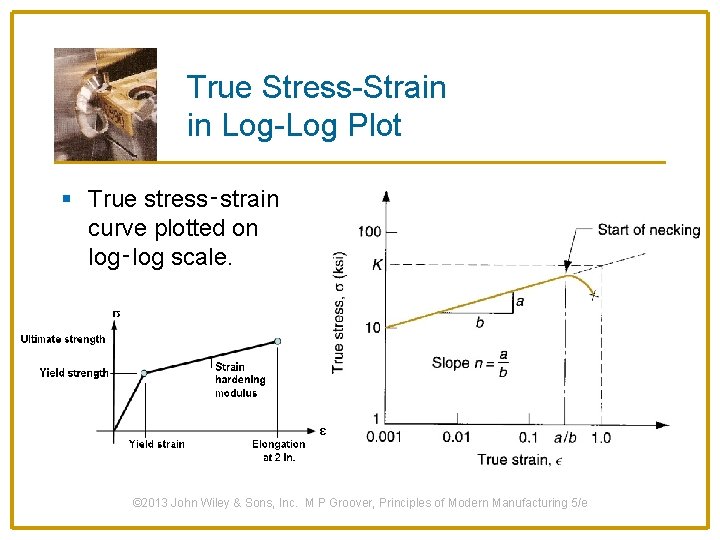
True Stress-Strain in Log-Log Plot § True stress‑strain curve plotted on log‑log scale. © 2013 John Wiley & Sons, Inc. M P Groover, Principles of Modern Manufacturing 5/e
© 2013 John Wiley & Sons, Inc. M P Groover, Principles of Modern Manufacturing 5/e
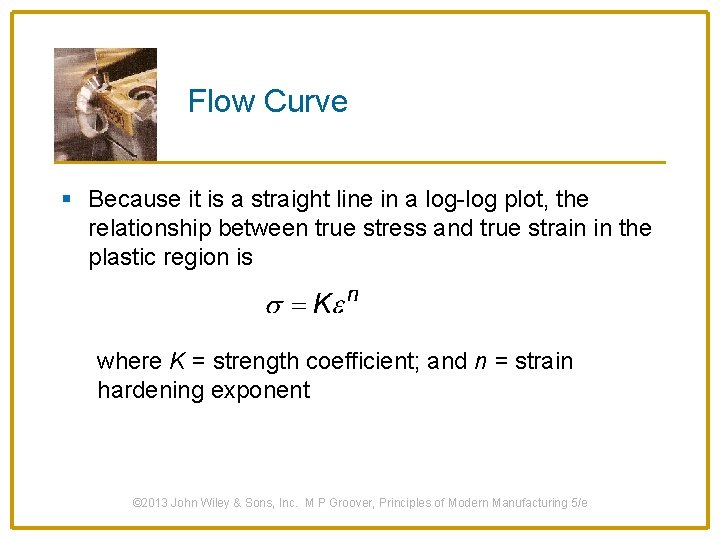
Flow Curve § Because it is a straight line in a log-log plot, the relationship between true stress and true strain in the plastic region is where K = strength coefficient; and n = strain hardening exponent © 2013 John Wiley & Sons, Inc. M P Groover, Principles of Modern Manufacturing 5/e
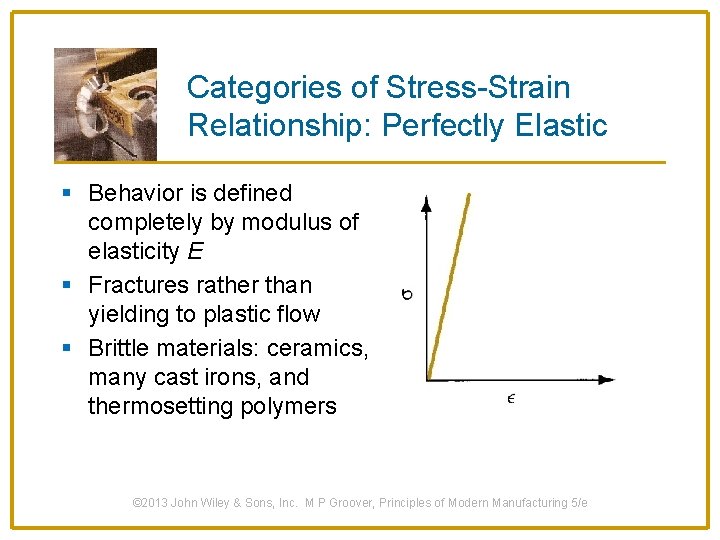
Categories of Stress-Strain Relationship: Perfectly Elastic § Behavior is defined completely by modulus of elasticity E § Fractures rather than yielding to plastic flow § Brittle materials: ceramics, many cast irons, and thermosetting polymers © 2013 John Wiley & Sons, Inc. M P Groover, Principles of Modern Manufacturing 5/e
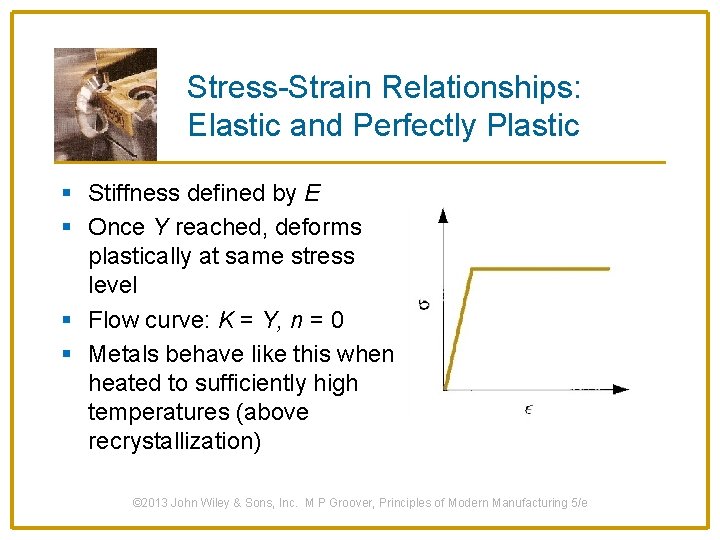
Stress-Strain Relationships: Elastic and Perfectly Plastic § Stiffness defined by E § Once Y reached, deforms plastically at same stress level § Flow curve: K = Y, n = 0 § Metals behave like this when heated to sufficiently high temperatures (above recrystallization) © 2013 John Wiley & Sons, Inc. M P Groover, Principles of Modern Manufacturing 5/e
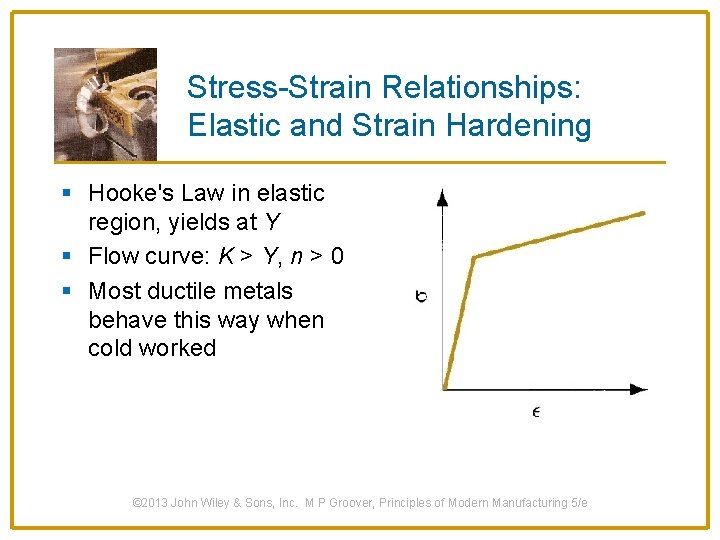
Stress-Strain Relationships: Elastic and Strain Hardening § Hooke's Law in elastic region, yields at Y § Flow curve: K > Y, n > 0 § Most ductile metals behave this way when cold worked © 2013 John Wiley & Sons, Inc. M P Groover, Principles of Modern Manufacturing 5/e
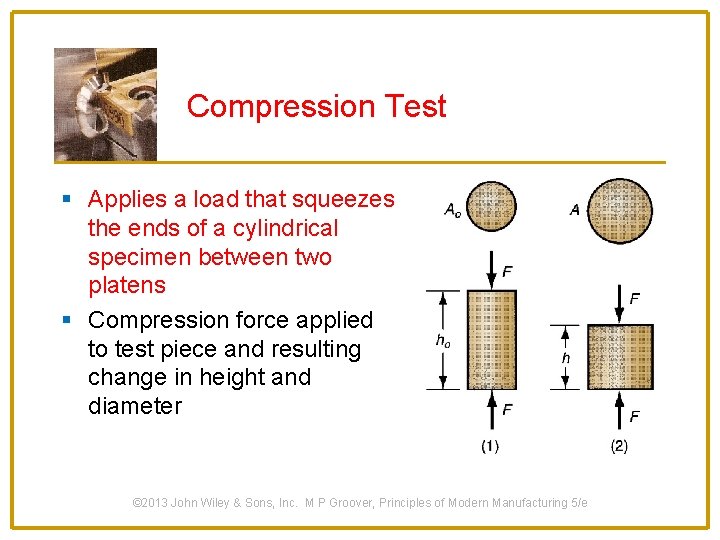
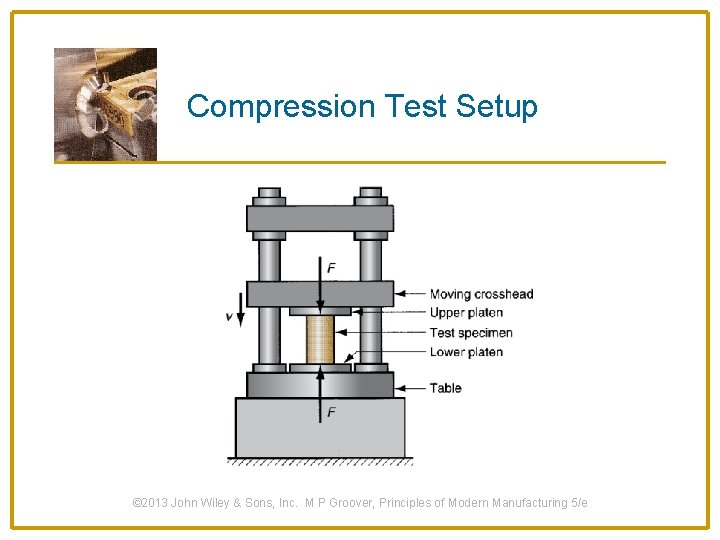
Compression Test § Applies a load that squeezes the ends of a cylindrical specimen between two platens § Compression force applied to test piece and resulting change in height and diameter © 2013 John Wiley & Sons, Inc. M P Groover, Principles of Modern Manufacturing 5/e
Compression Test Setup © 2013 John Wiley & Sons, Inc. M P Groover, Principles of Modern Manufacturing 5/e
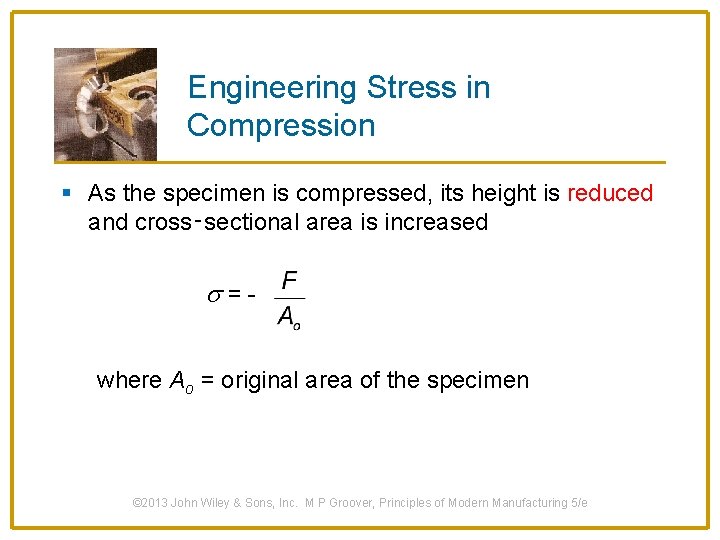
Engineering Stress in Compression § As the specimen is compressed, its height is reduced and cross‑sectional area is increased =where Ao = original area of the specimen © 2013 John Wiley & Sons, Inc. M P Groover, Principles of Modern Manufacturing 5/e
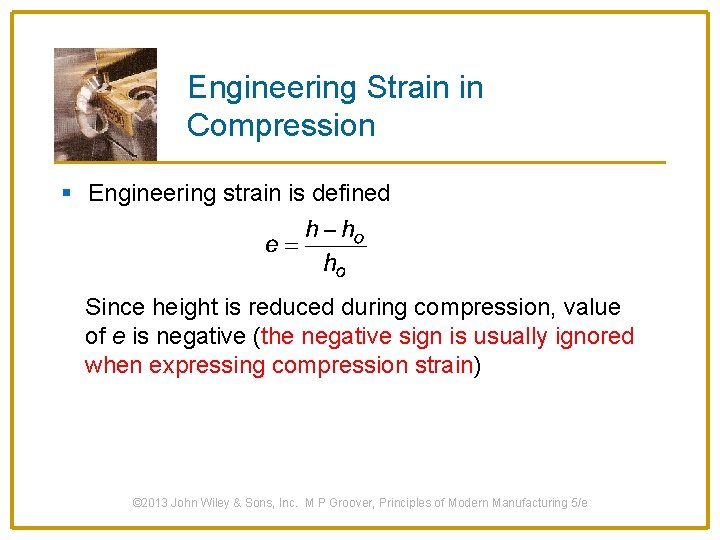
Engineering Strain in Compression § Engineering strain is defined Since height is reduced during compression, value of e is negative (the negative sign is usually ignored when expressing compression strain) © 2013 John Wiley & Sons, Inc. M P Groover, Principles of Modern Manufacturing 5/e
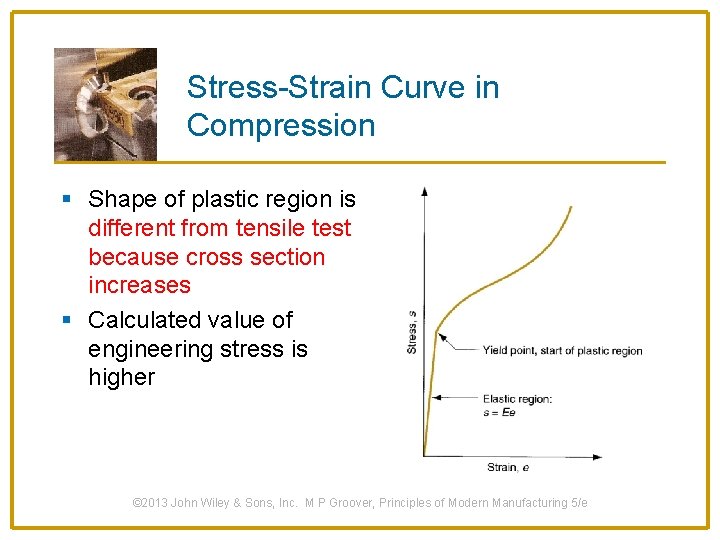
Stress-Strain Curve in Compression § Shape of plastic region is different from tensile test because cross section increases § Calculated value of engineering stress is higher © 2013 John Wiley & Sons, Inc. M P Groover, Principles of Modern Manufacturing 5/e
Tensile Test vs. Compression Test § Although differences exist between engineering stress‑strain curves in tension and compression, the true stress‑strain relationships are nearly identical § Since tensile test results are more common, flow curve values (K and n) from tensile test data can be applied to compression operations § When using tensile K and n data for compression, ignore necking, which is a phenomenon strange to strain induced by tensile stresses © 2013 John Wiley & Sons, Inc. M P Groover, Principles of Modern Manufacturing 5/e
Testing of Brittle Materials § Hard brittle materials (e. g. , ceramics) possess elasticity but little or no plasticity § Conventional tensile test cannot be easily applied § Often tested by a bending test (also called flexure test) § Specimen of rectangular cross‑section is positioned between two supports, and a load is applied at its center © 2013 John Wiley & Sons, Inc. M P Groover, Principles of Modern Manufacturing 5/e
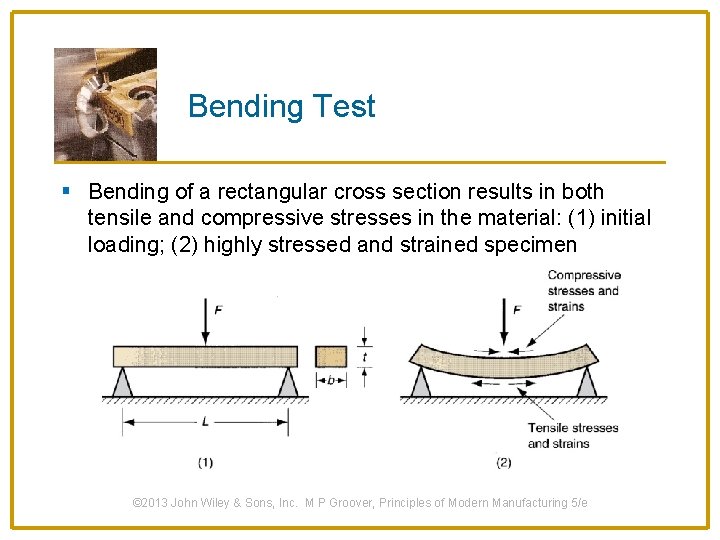
Bending Test § Bending of a rectangular cross section results in both tensile and compressive stresses in the material: (1) initial loading; (2) highly stressed and strained specimen © 2013 John Wiley & Sons, Inc. M P Groover, Principles of Modern Manufacturing 5/e
Testing of Brittle Materials § Brittle materials do not flex § They deform elastically until fracture § Failure occurs because tensile strength of outer fibers of specimen are exceeded § Failure type: cleavage - common with ceramics and metals at low temperatures, in which separation rather than slip occurs along certain crystallographic planes © 2013 John Wiley & Sons, Inc. M P Groover, Principles of Modern Manufacturing 5/e
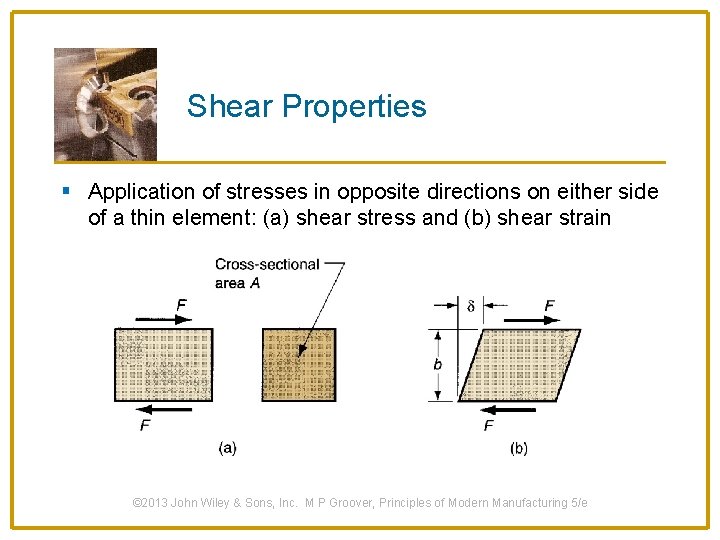
Shear Properties § Application of stresses in opposite directions on either side of a thin element: (a) shear stress and (b) shear strain © 2013 John Wiley & Sons, Inc. M P Groover, Principles of Modern Manufacturing 5/e
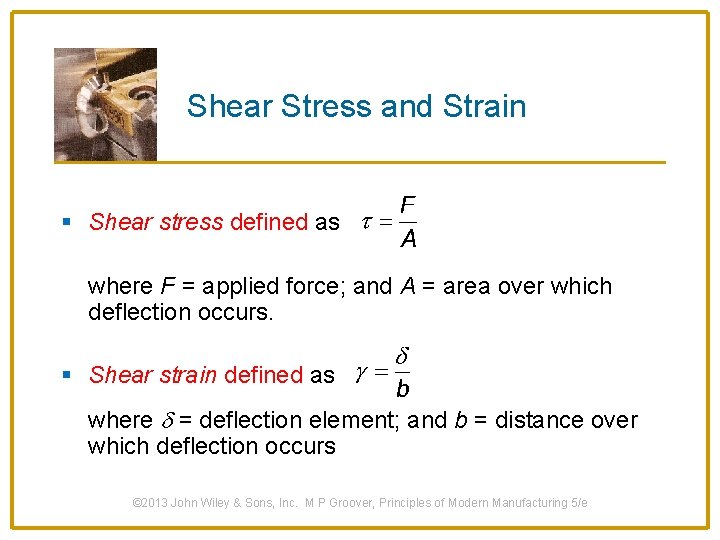
Shear Stress and Strain § Shear stress defined as where F = applied force; and A = area over which deflection occurs. § Shear strain defined as where = deflection element; and b = distance over which deflection occurs © 2013 John Wiley & Sons, Inc. M P Groover, Principles of Modern Manufacturing 5/e
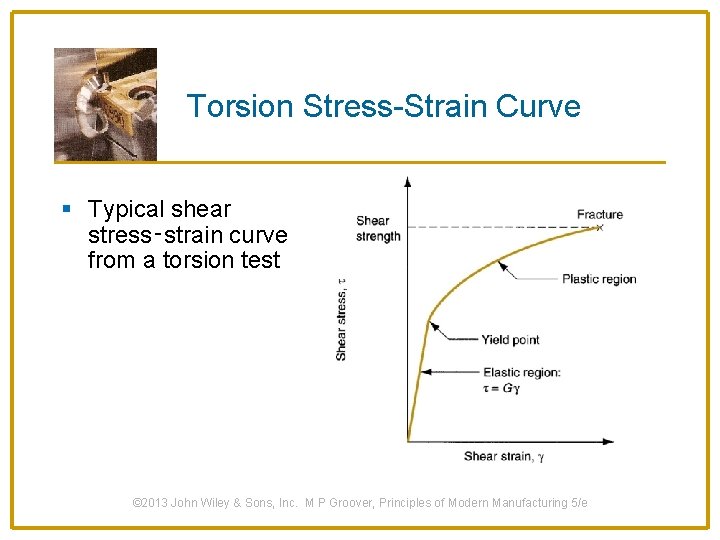
Torsion Stress-Strain Curve § Typical shear stress‑strain curve from a torsion test © 2013 John Wiley & Sons, Inc. M P Groover, Principles of Modern Manufacturing 5/e
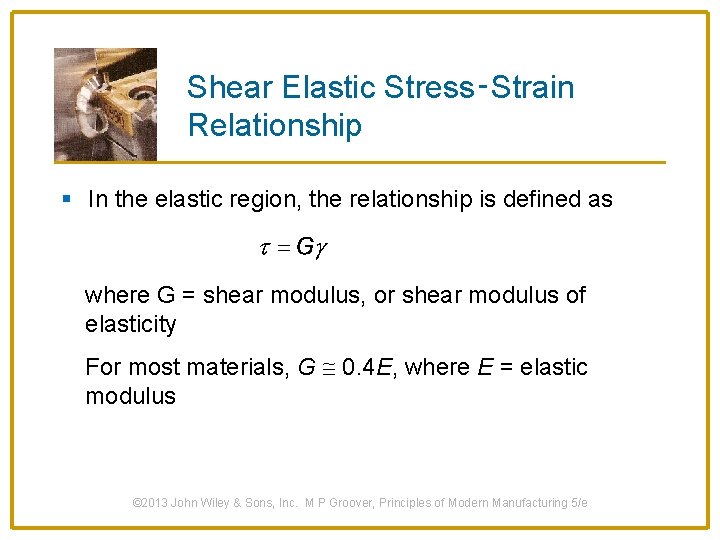
Shear Elastic Stress‑Strain Relationship § In the elastic region, the relationship is defined as where G = shear modulus, or shear modulus of elasticity For most materials, G 0. 4 E, where E = elastic modulus © 2013 John Wiley & Sons, Inc. M P Groover, Principles of Modern Manufacturing 5/e
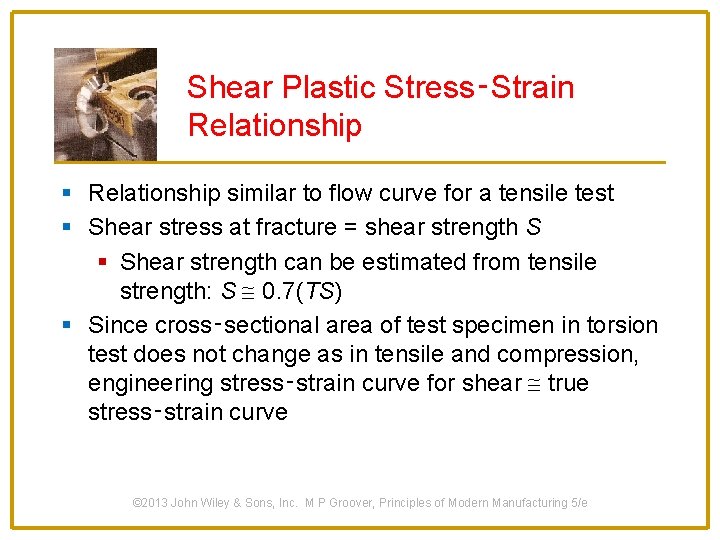
Shear Plastic Stress‑Strain Relationship § Relationship similar to flow curve for a tensile test § Shear stress at fracture = shear strength S § Shear strength can be estimated from tensile strength: S 0. 7(TS) § Since cross‑sectional area of test specimen in torsion test does not change as in tensile and compression, engineering stress‑strain curve for shear true stress‑strain curve © 2013 John Wiley & Sons, Inc. M P Groover, Principles of Modern Manufacturing 5/e
Hardness § Resistance to permanent indentation § Good hardness generally means material is resistant to scratching and wear § Most tooling used in manufacturing must be hard for scratch and wear resistance © 2013 John Wiley & Sons, Inc. M P Groover, Principles of Modern Manufacturing 5/e
Hardness Tests § Commonly used for assessing material properties because they are quick and convenient § Variety of testing methods are appropriate due to differences in hardness among different materials § Most well‑known hardness tests are Brinell , Rockwell , Vickers, and Knoop, Scleroscope, and durometer. © 2013 John Wiley & Sons, Inc. M P Groover, Principles of Modern Manufacturing 5/e
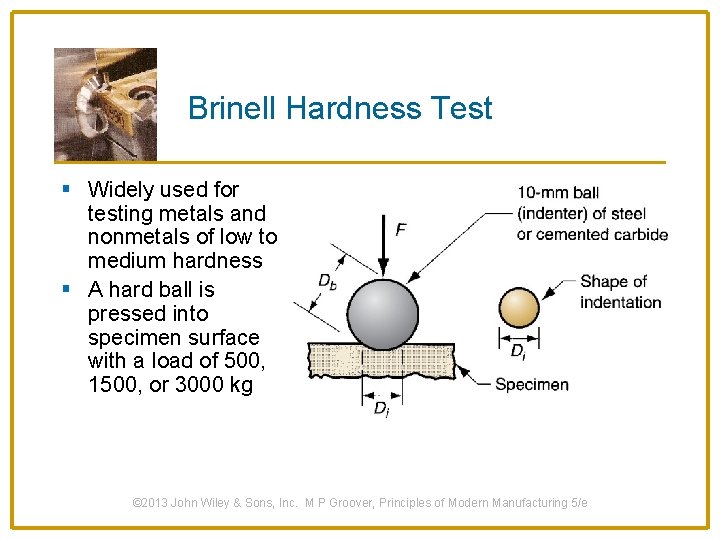
Brinell Hardness Test § Widely used for testing metals and nonmetals of low to medium hardness § A hard ball is pressed into specimen surface with a load of 500, 1500, or 3000 kg © 2013 John Wiley & Sons, Inc. M P Groover, Principles of Modern Manufacturing 5/e
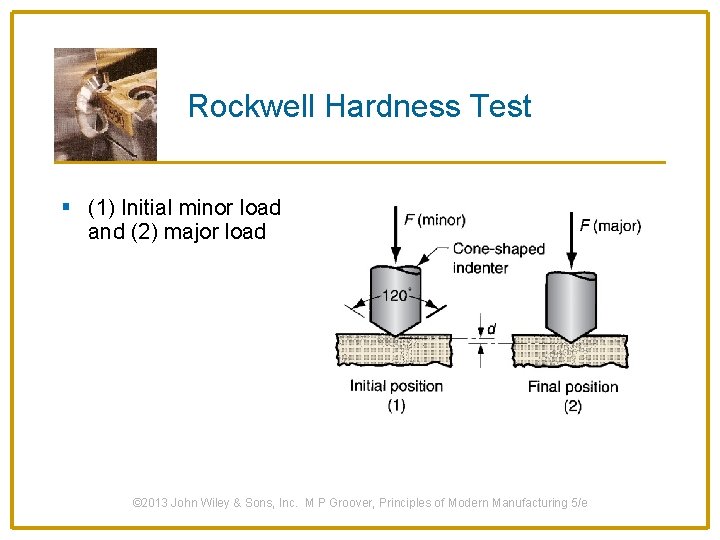
Rockwell Hardness Test § Another widely used test § A cone shaped indenter is pressed into specimen using a minor load of 10 kg, thus seating indenter in material § Then, a major load of 150 kg is applied, causing indenter to penetrate beyond its initial position § Additional penetration distance d is converted into a Rockwell hardness reading by the testing machine © 2013 John Wiley & Sons, Inc. M P Groover, Principles of Modern Manufacturing 5/e
Rockwell Hardness Test § (1) Initial minor load and (2) major load © 2013 John Wiley & Sons, Inc. M P Groover, Principles of Modern Manufacturing 5/e
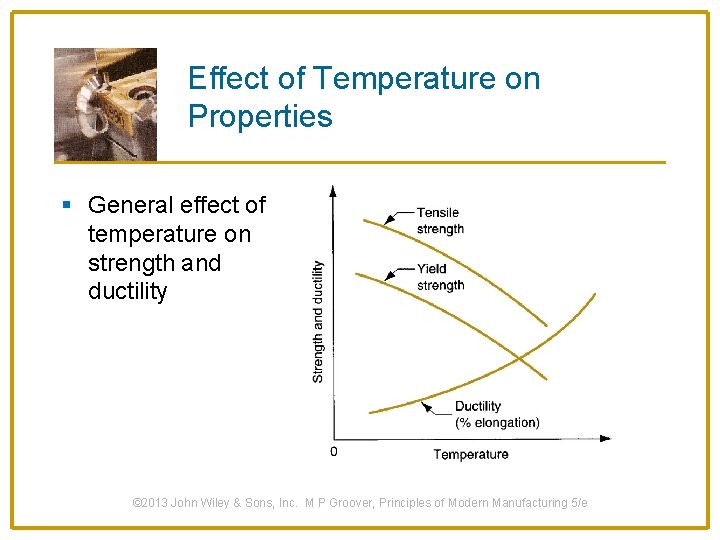
Effect of Temperature on Properties § General effect of temperature on strength and ductility © 2013 John Wiley & Sons, Inc. M P Groover, Principles of Modern Manufacturing 5/e
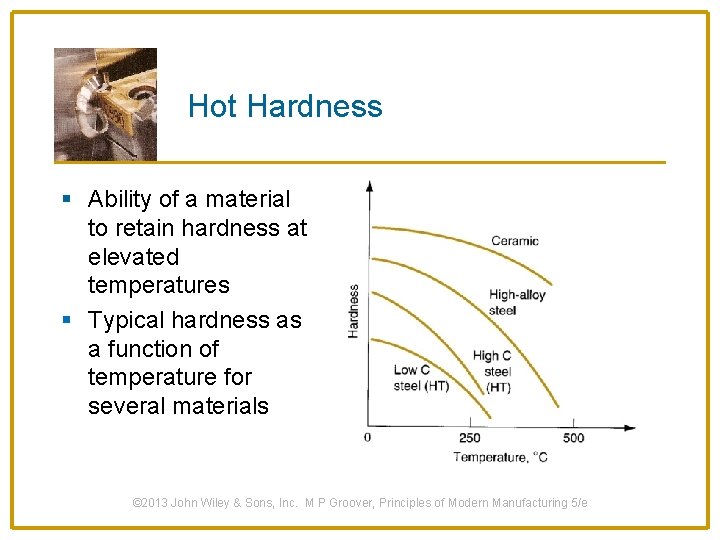
Hot Hardness § Ability of a material to retain hardness at elevated temperatures § Typical hardness as a function of temperature for several materials © 2013 John Wiley & Sons, Inc. M P Groover, Principles of Modern Manufacturing 5/e
Recrystallization in Metals § Most metals strain harden at room temperature according to the flow curve (n > 0) § But if heated to sufficiently high temperature and deformed, strain hardening does not occur § Instead, new grains form that are free of strain § The metal has recrystallized § The metal behaves as a perfectly plastic material; that is, n = 0 © 2013 John Wiley & Sons, Inc. M P Groover, Principles of Modern Manufacturing 5/e
Recrystallization Temperature § Recrystallization temperature of a given metal = about one‑half its melting point (0. 5 Tm) as measured on an absolute temperature scale § Recrystallization takes time § The recrystallization temperature is specified as the temperature at which new grains are formed in about one hour © 2013 John Wiley & Sons, Inc. M P Groover, Principles of Modern Manufacturing 5/e
Recrystallization and Manufacturing § Recrystallization can be exploited in manufacturing § Heating a metal to its recrystallization temperature prior to deformation allows a greater amount of straining § Lower forces and power are required to perform the process § Forming a metal at temperatures above its recrystallization temperature is called hot working © 2013 John Wiley & Sons, Inc. M P Groover, Principles of Modern Manufacturing 5/e