
Mechanical properties of dental biomaterials 2 To Compare
Mechanical properties of dental biomaterials 2
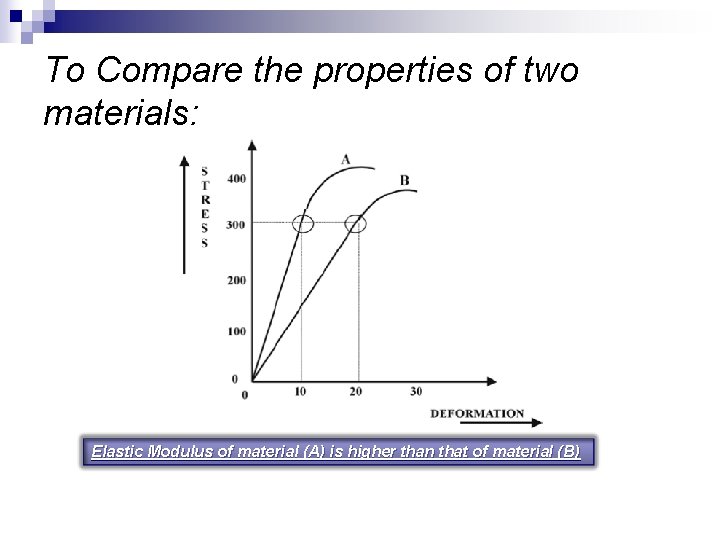
To Compare the properties of two materials: Elastic Modulus of material (A) is higher than that of material (B)
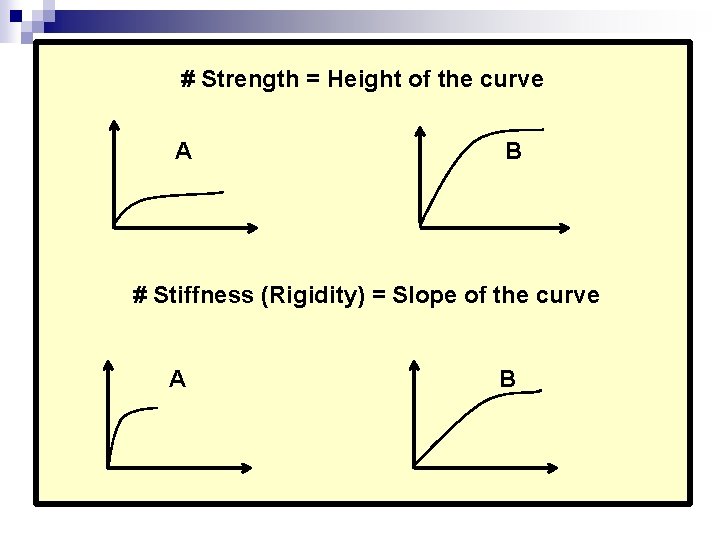
# Strength = Height of the curve A B # Stiffness (Rigidity) = Slope of the curve A B
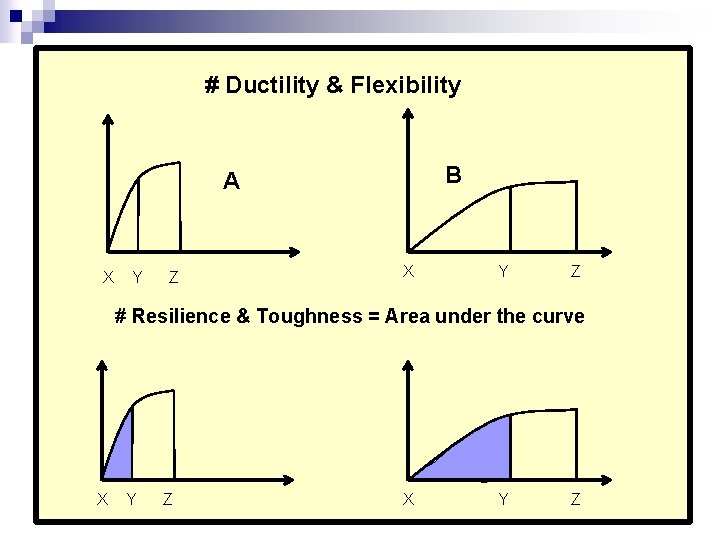
# Ductility & Flexibility B A X Y Z # Resilience & Toughness = Area under the curve X Y Z
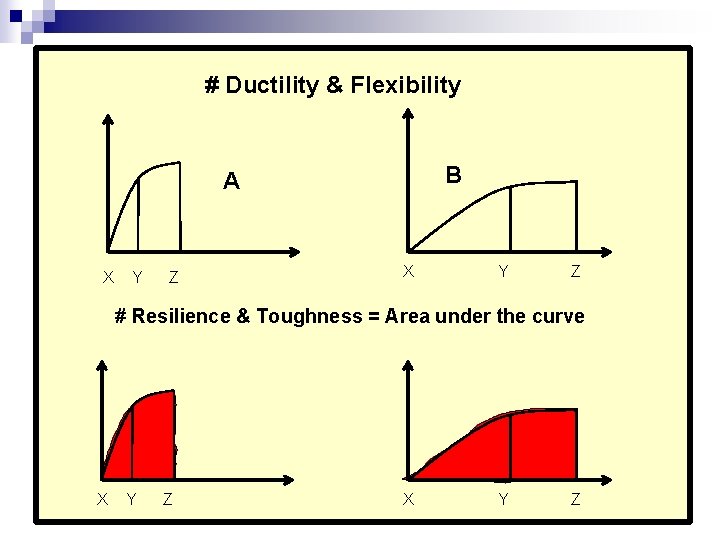
# Ductility & Flexibility B A X Y Z # Resilience & Toughness = Area under the curve X Y Z
Question? • Is rubber a rigid or a flexible material? • Which is stronger? Glass wax stainless steel
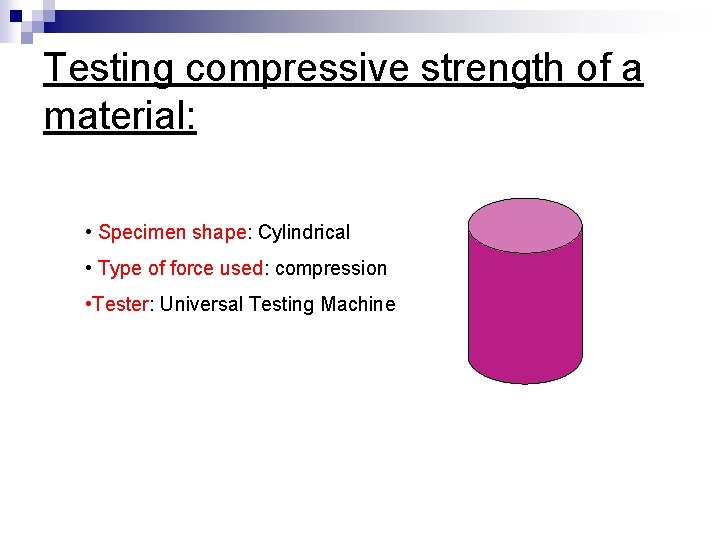
Testing compressive strength of a material: • Specimen shape: Cylindrical • Type of force used: compression • Tester: Universal Testing Machine
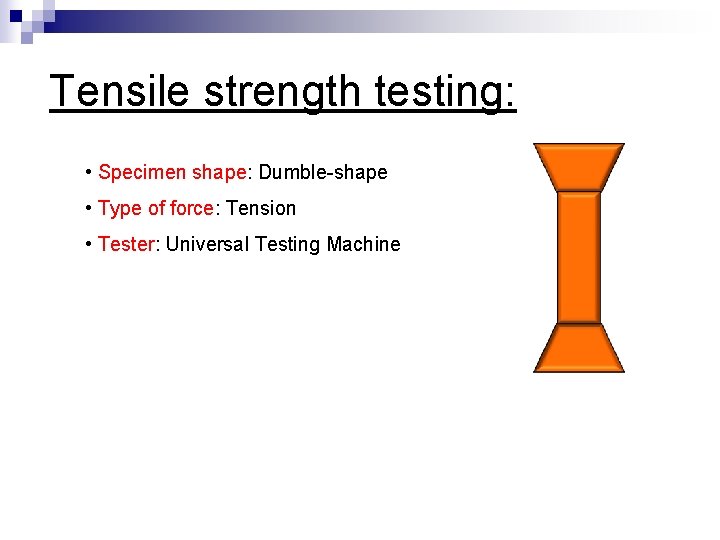
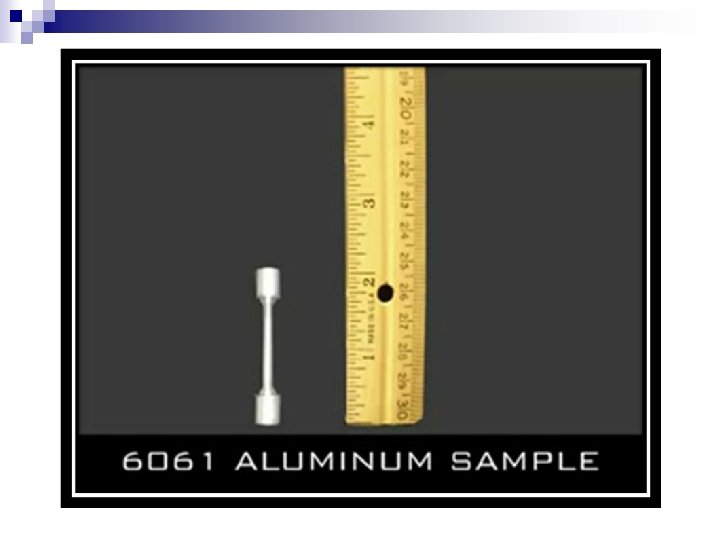
Tensile strength testing: • Specimen shape: Dumble-shape • Type of force: Tension • Tester: Universal Testing Machine
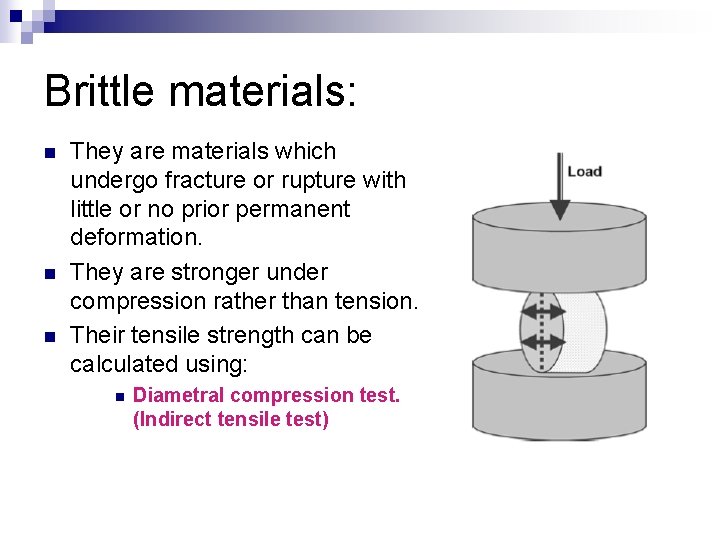
Brittle materials: n n n They are materials which undergo fracture or rupture with little or no prior permanent deformation. They are stronger under compression rather than tension. Their tensile strength can be calculated using: n Diametral compression test. (Indirect tensile test)
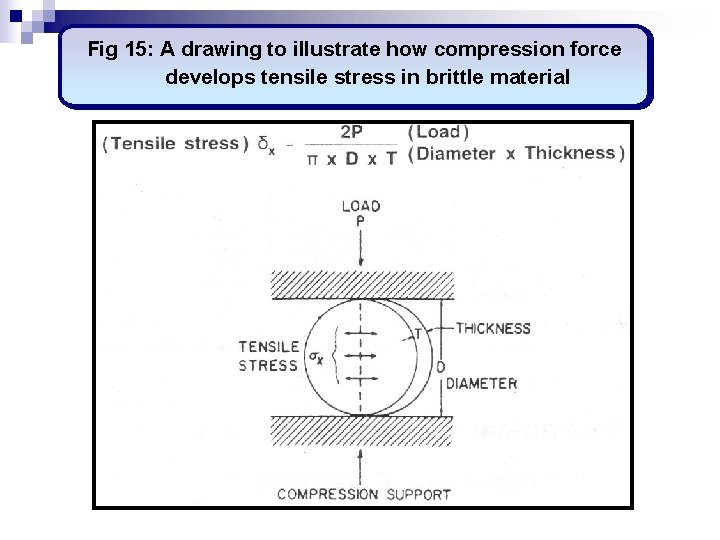
Fig 15: A drawing to illustrate how compression force develops tensile stress in brittle material
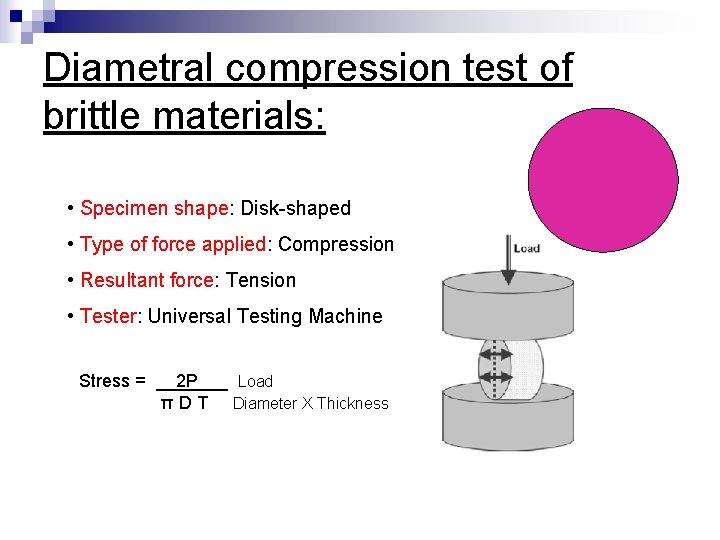
Diametral compression test of brittle materials: • Specimen shape: Disk-shaped • Type of force applied: Compression • Resultant force: Tension • Tester: Universal Testing Machine Stress = 2 P πDT Load Diameter X Thickness
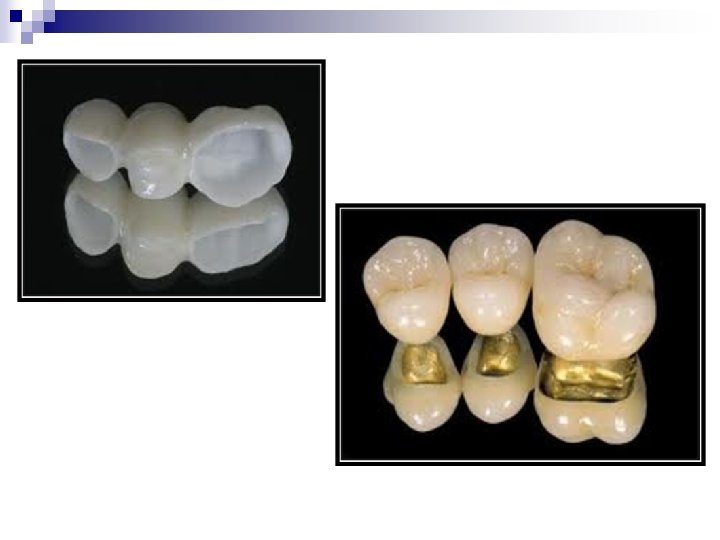
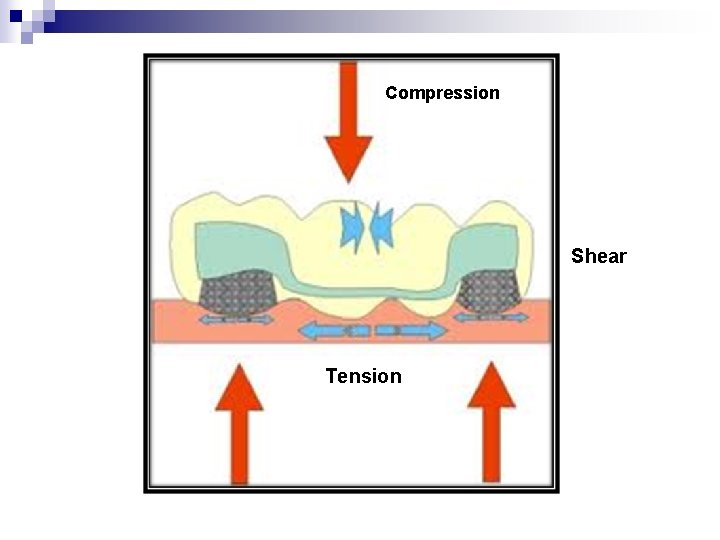
Compression Shear Tension
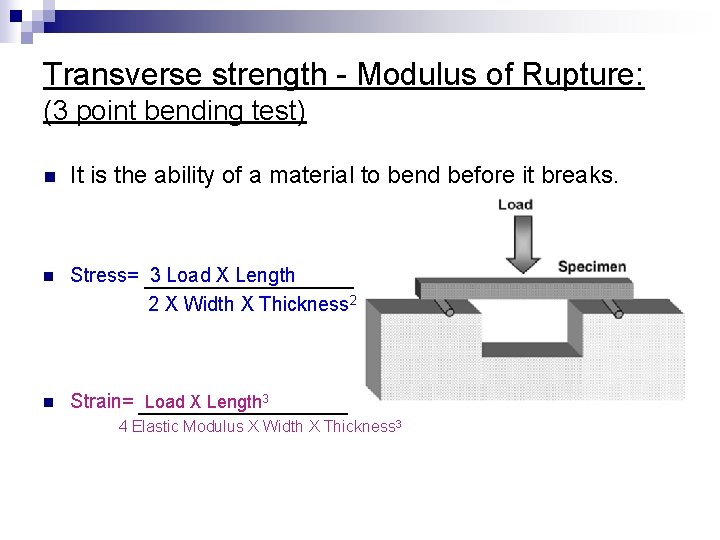
Transverse strength - Modulus of Rupture: (3 point bending test) n It is the ability of a material to bend before it breaks. n Stress= 3 Load X Length 2 X Width X Thickness 2 n Strain= Load X Length 3 4 Elastic Modulus X Width X Thickness 3
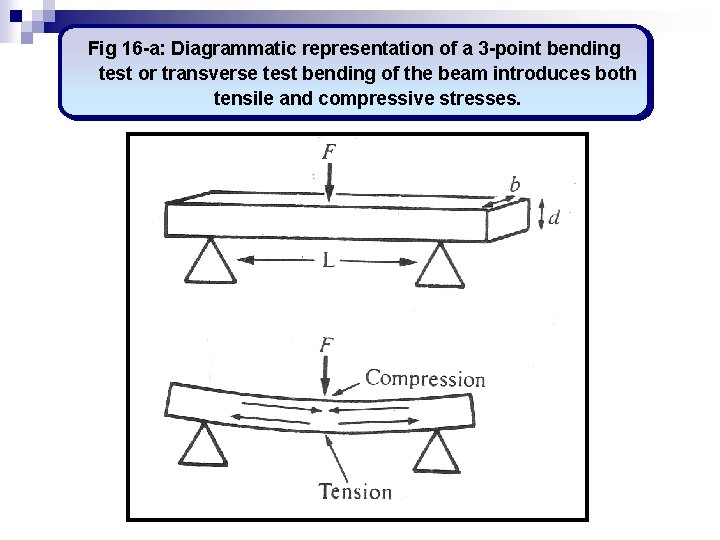
Fig 16 -a: Diagrammatic representation of a 3 -point bending test or transverse test bending of the beam introduces both tensile and compressive stresses.
Impact strength n Materials such as glasses, ceramics, cements and amalgam have low resistance to breakage when a load is applied by impact. (dynamic load).
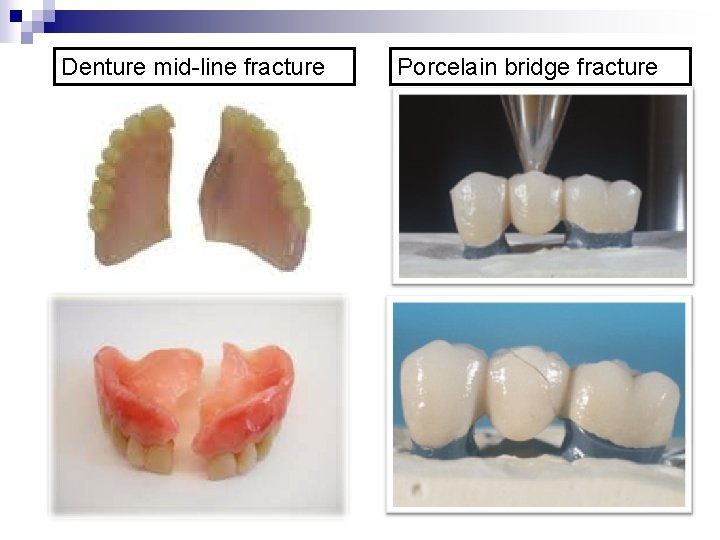
Denture mid-line fracture Porcelain bridge fracture
The impact strength is defined as the energy required to fracture a material under an impact force.
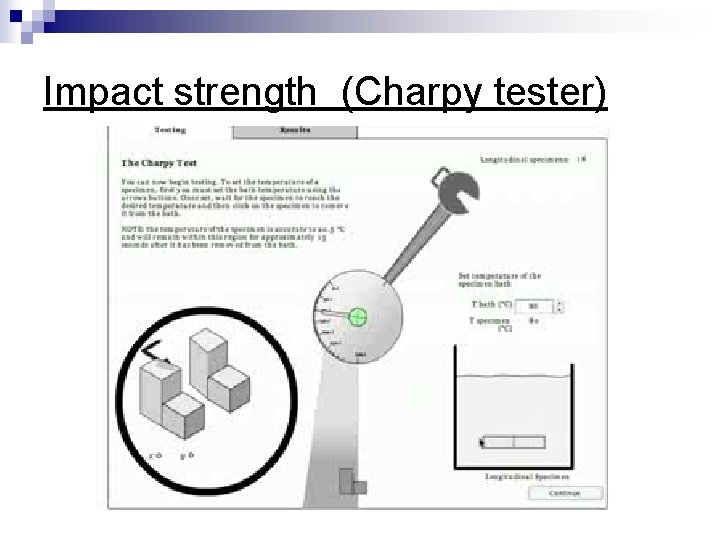
Impact strength (Charpy tester)
v. Hardness: n n It is defined as the resistance of a material to surface penetration or indentation. There are four common standard test methods for expressing the hardness of a material: Brinell, Rockwell, Vickers, and Knoop.
HARDNESS n The property of hardness is of major importance in the comparison of restorative materials. n Hardness is defined as to resistance to permanent surface indentation or penetration.
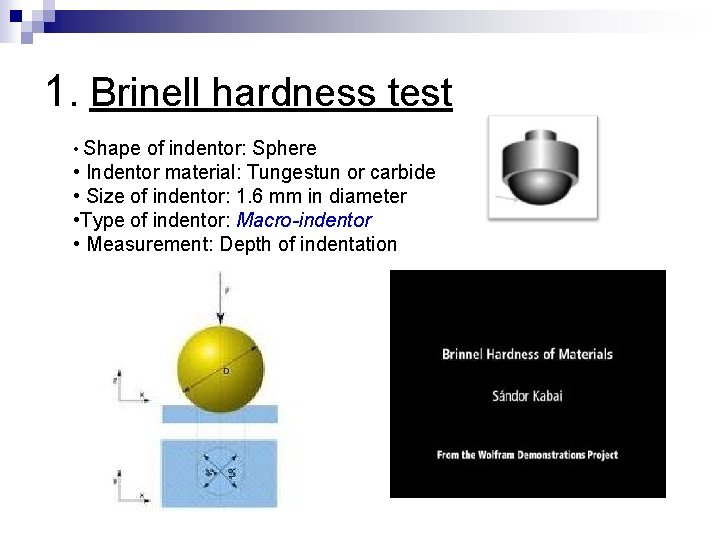
1. Brinell hardness test • Shape of indentor: Sphere • Indentor material: Tungestun or carbide • Size of indentor: 1. 6 mm in diameter • Type of indentor: Macro-indentor • Measurement: Depth of indentation
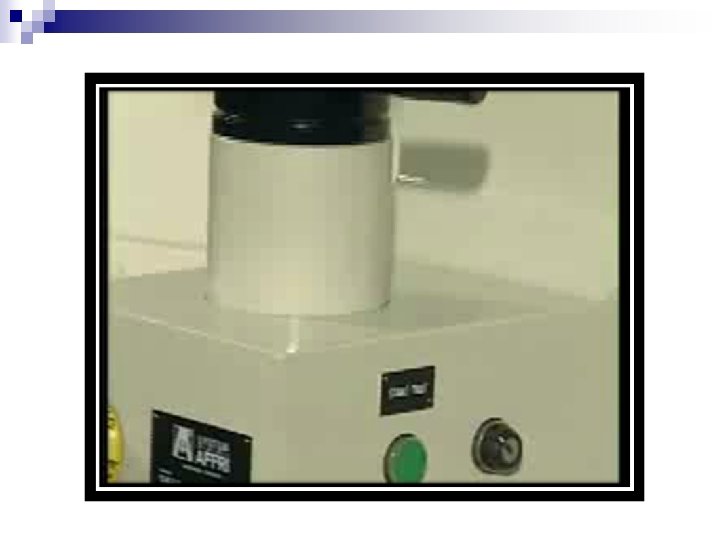
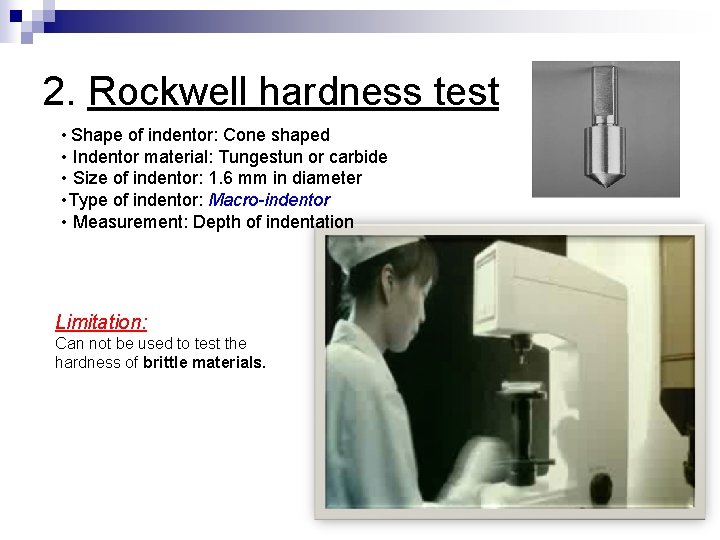
2. Rockwell hardness test • Shape of indentor: Cone shaped • Indentor material: Tungestun or carbide • Size of indentor: 1. 6 mm in diameter • Type of indentor: Macro-indentor • Measurement: Depth of indentation Limitation: Can not be used to test the hardness of brittle materials.
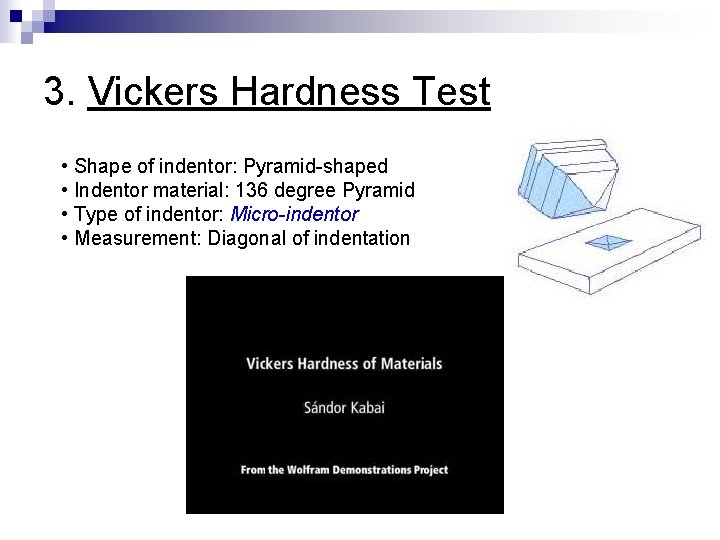
3. Vickers Hardness Test • Shape of indentor: Pyramid-shaped • Indentor material: 136 degree Pyramid • Type of indentor: Micro-indentor • Measurement: Diagonal of indentation
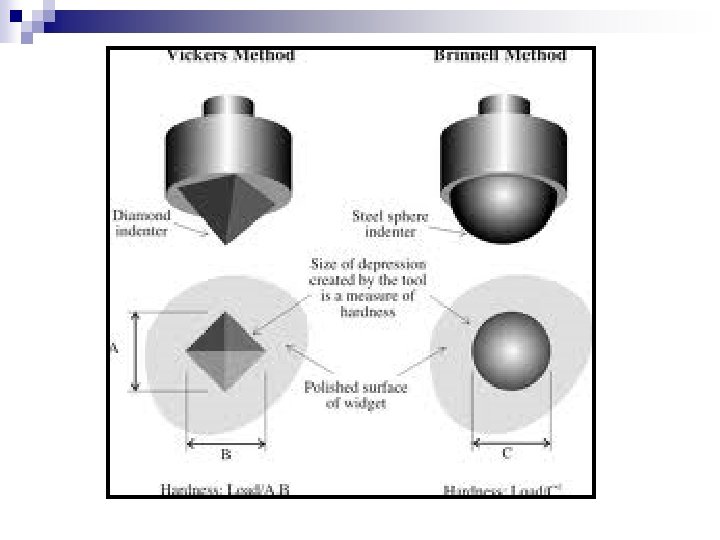
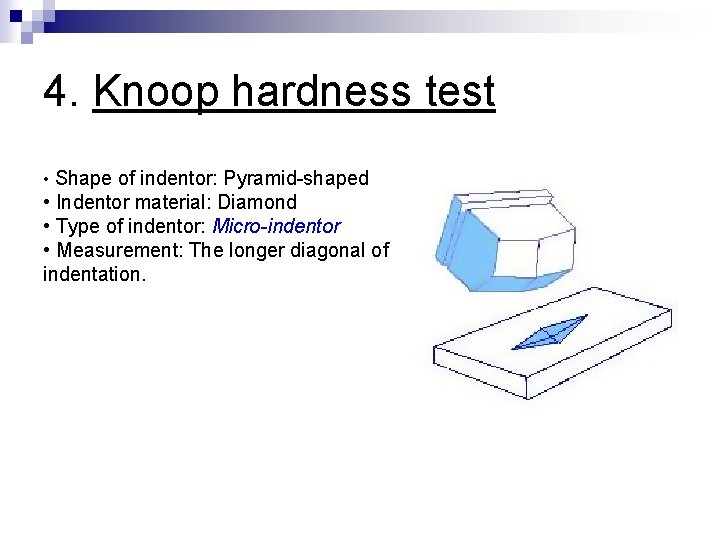
4. Knoop hardness test • Shape of indentor: Pyramid-shaped • Indentor material: Diamond • Type of indentor: Micro-indentor • Measurement: The longer diagonal of indentation.
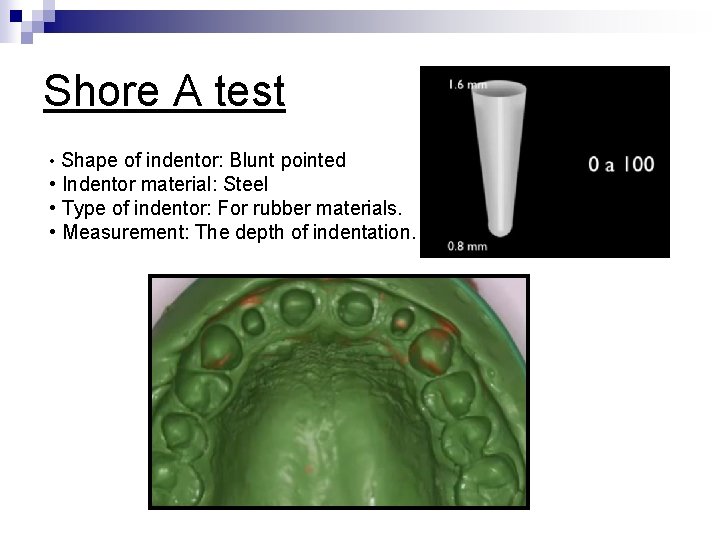
Shore A test • Shape of indentor: Blunt pointed • Indentor material: Steel • Type of indentor: For rubber materials. • Measurement: The depth of indentation.
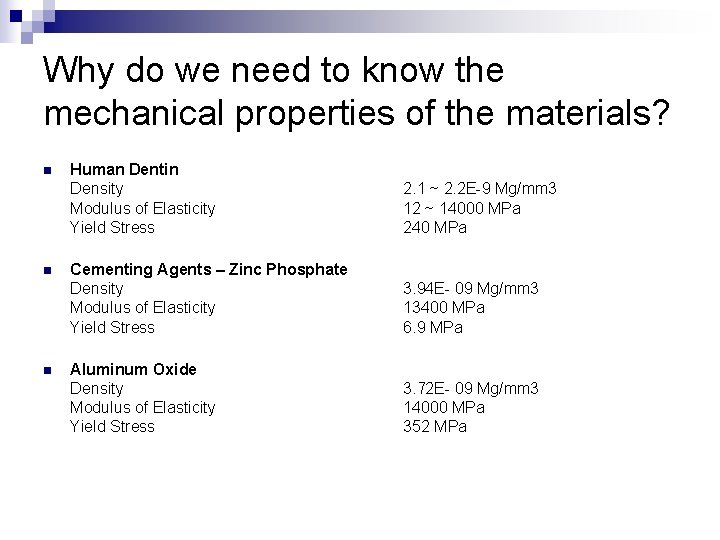
Why do we need to know the mechanical properties of the materials? n n n Human Dentin Density Modulus of Elasticity Yield Stress 2. 1 ~ 2. 2 E-9 Mg/mm 3 12 ~ 14000 MPa 240 MPa Cementing Agents – Zinc Phosphate Density Modulus of Elasticity Yield Stress 3. 94 E- 09 Mg/mm 3 13400 MPa 6. 9 MPa Aluminum Oxide Density Modulus of Elasticity Yield Stress 3. 72 E- 09 Mg/mm 3 14000 MPa 352 MPa
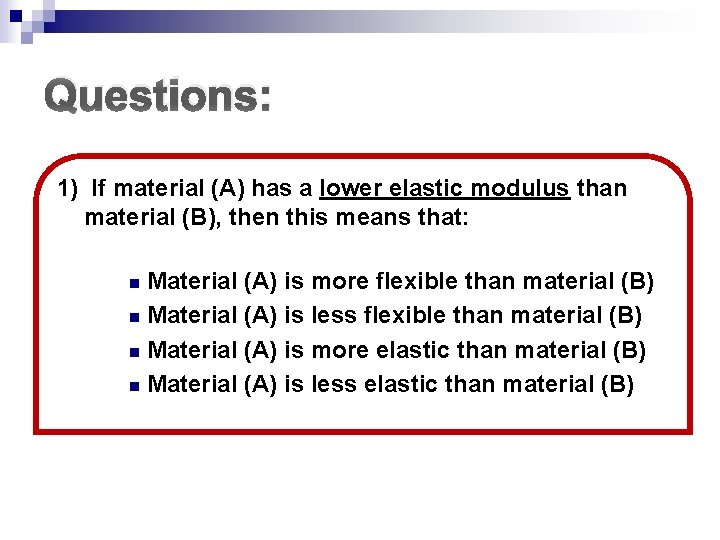
Questions: 1) If material (A) has a lower elastic modulus than material (B), then this means that: Material (A) is more flexible than material (B) n Material (A) is less flexible than material (B) n Material (A) is more elastic than material (B) n Material (A) is less elastic than material (B) n
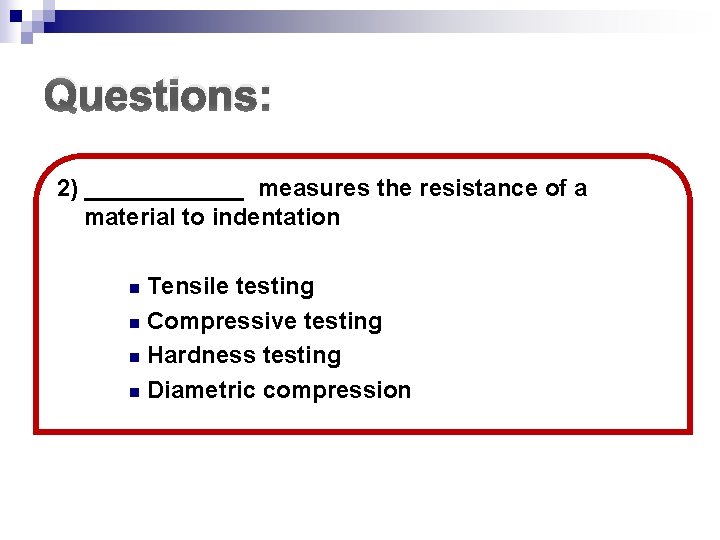
Questions: 2) ______ measures the resistance of a material to indentation Tensile testing n Compressive testing n Hardness testing n Diametric compression n

- Slides: 34