
Mechanical Properties as Indicator of Interstitial Impurities in
- Slides: 17
Mechanical Properties as Indicator of Interstitial Impurities in Large Grain Nb for Superconducting Accelerator Cavities Richard E. Ricker, Ph. D. Manufacturing Program Director Material Measurement Laboratory Gaithersburg, MD 20899 email: richard. ricker@nist. gov Material Measurement Laboratory
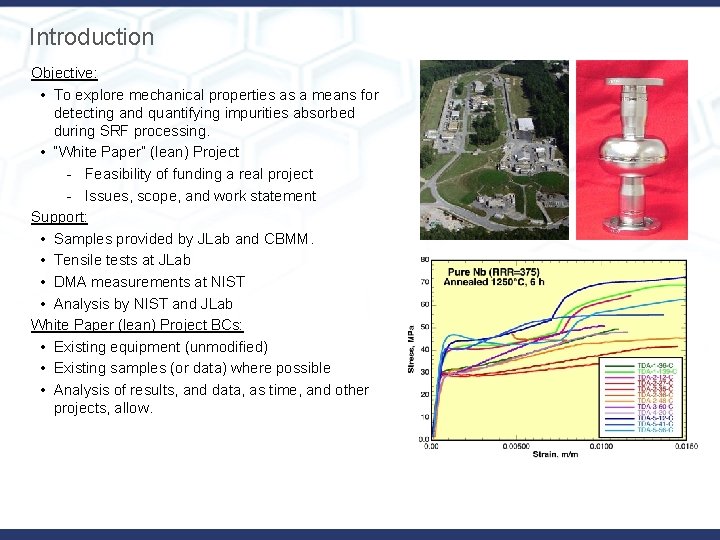
Introduction Objective: • To explore mechanical properties as a means for detecting and quantifying impurities absorbed during SRF processing. • “White Paper” (lean) Project - Feasibility of funding a real project - Issues, scope, and work statement Support: • Samples provided by JLab and CBMM. • Tensile tests at JLab • DMA measurements at NIST • Analysis by NIST and JLab White Paper (lean) Project BCs: • Existing equipment (unmodified) • Existing samples (or data) where possible • Analysis of results, and data, as time, and other projects, allow.
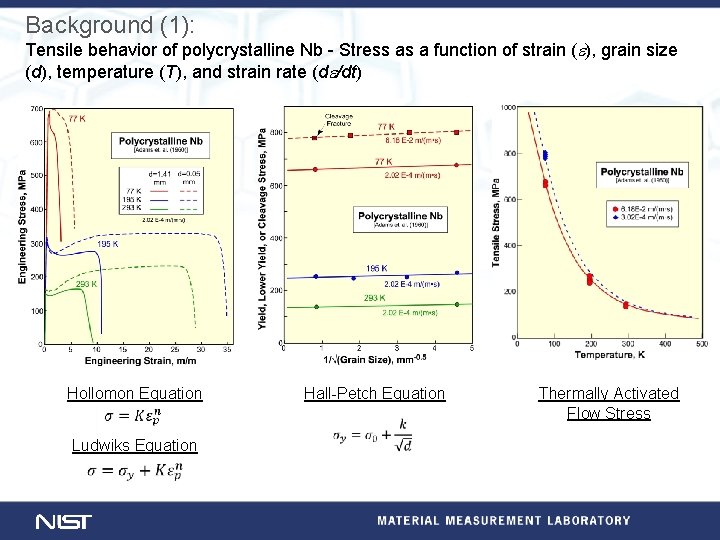
Background (1): Tensile behavior of polycrystalline Nb - Stress as a function of strain (e), grain size (d), temperature (T), and strain rate (de/dt) Hollomon Equation Ludwiks Equation Hall-Petch Equation Thermally Activated Flow Stress
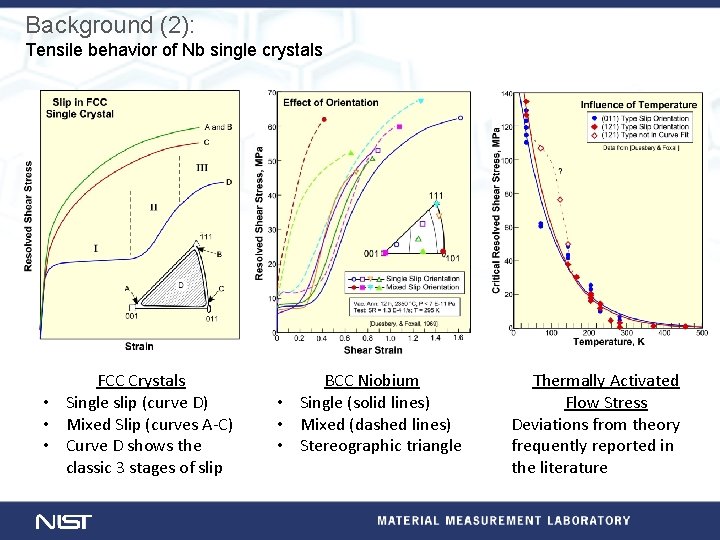
Background (2): Tensile behavior of Nb single crystals FCC Crystals • Single slip (curve D) • Mixed Slip (curves A-C) • Curve D shows the classic 3 stages of slip BCC Niobium • Single (solid lines) • Mixed (dashed lines) • Stereographic triangle Thermally Activated Flow Stress Deviations from theory frequently reported in the literature
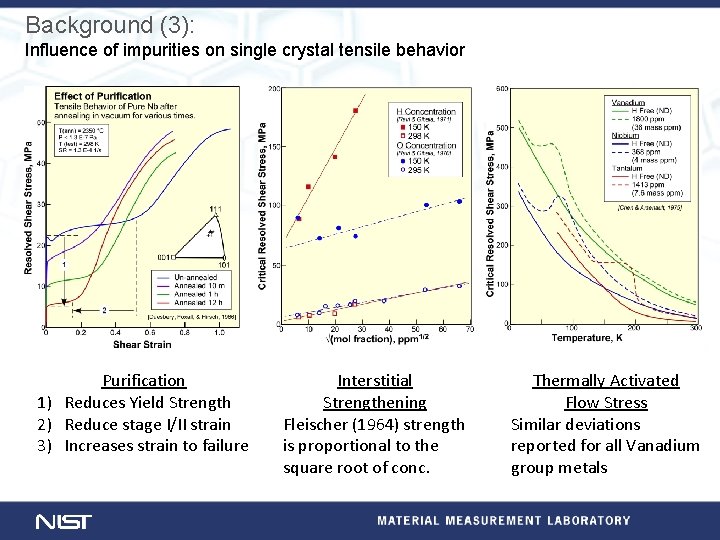
Background (3): Influence of impurities on single crystal tensile behavior Purification 1) Reduces Yield Strength 2) Reduce stage I/II strain 3) Increases strain to failure Interstitial Strengthening Fleischer (1964) strength is proportional to the square root of conc. Thermally Activated Flow Stress Similar deviations reported for all Vanadium group metals
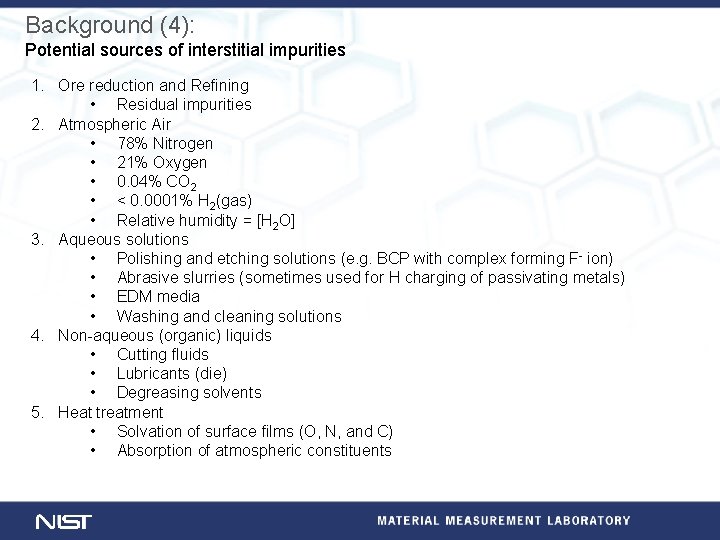
Background (4): Potential sources of interstitial impurities 1. Ore reduction and Refining • Residual impurities 2. Atmospheric Air • 78% Nitrogen • 21% Oxygen • 0. 04% CO 2 • < 0. 0001% H 2(gas) • Relative humidity = [H 2 O] 3. Aqueous solutions • Polishing and etching solutions (e. g. BCP with complex forming F- ion) • Abrasive slurries (sometimes used for H charging of passivating metals) • EDM media • Washing and cleaning solutions 4. Non-aqueous (organic) liquids • Cutting fluids • Lubricants (die) • Degreasing solvents 5. Heat treatment • Solvation of surface films (O, N, and C) • Absorption of atmospheric constituents
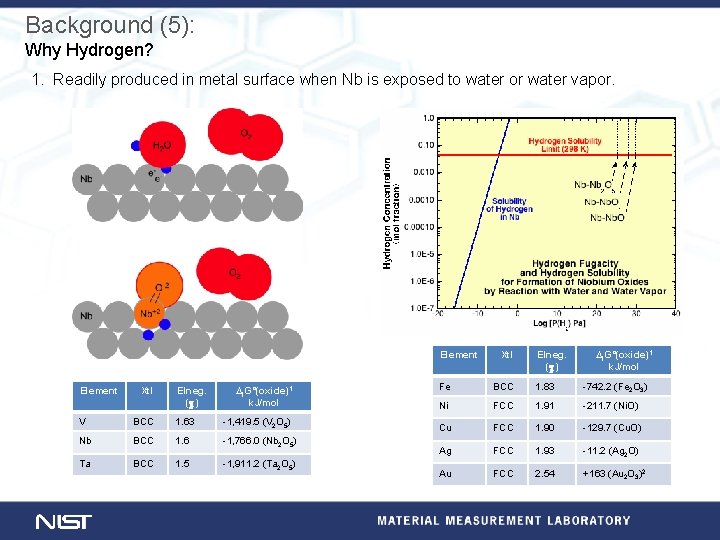
Background (5): Why Hydrogen? 1. Readily produced in metal surface when Nb is exposed to water or water vapor. Element Xtl Elneg. (c) ∆f. G°(oxide)1 k. J/mol V BCC 1. 63 -1, 419. 5 (V 2 O 5) Nb BCC 1. 6 -1, 766. 0 (Nb 2 O 5) Ta BCC 1. 5 -1, 911. 2 (Ta 2 O 5) Xtl Elneg. (c) ∆f. G°(oxide)1 k. J/mol Fe BCC 1. 83 -742. 2 (Fe 2 O 3) Ni FCC 1. 91 -211. 7 (Ni. O) Cu FCC 1. 90 -129. 7 (Cu. O) Ag FCC 1. 93 -11. 2 (Ag 2 O) Au FCC 2. 54 +163 (Au 2 O 3)2
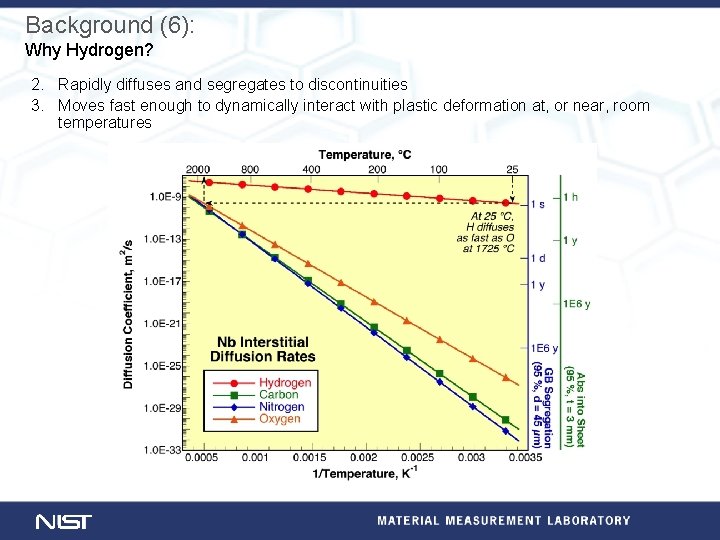
Background (6): Why Hydrogen? 2. Rapidly diffuses and segregates to discontinuities 3. Moves fast enough to dynamically interact with plastic deformation at, or near, room temperatures
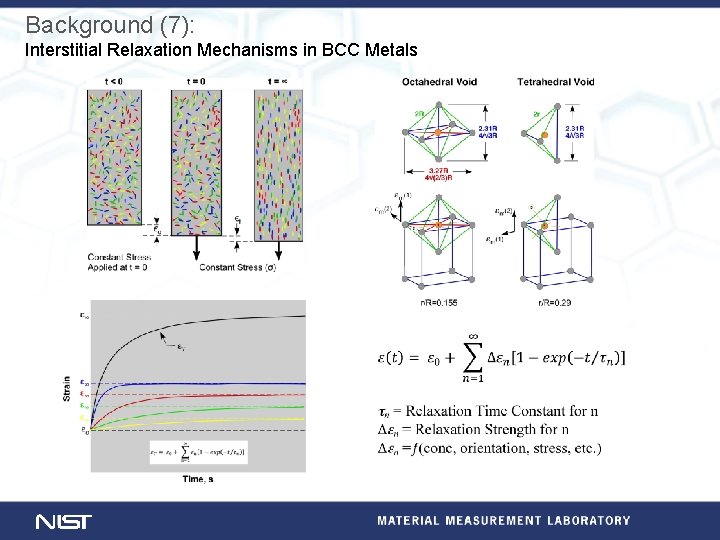
Background (7): Interstitial Relaxation Mechanisms in BCC Metals
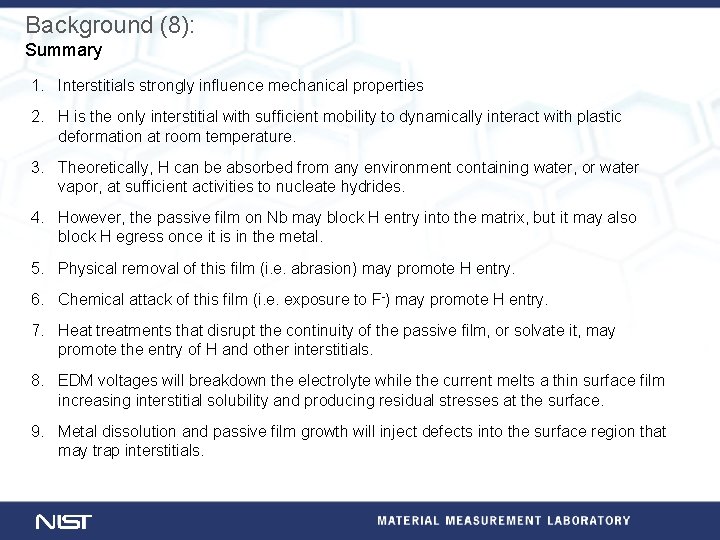
Background (8): Summary 1. Interstitials strongly influence mechanical properties 2. H is the only interstitial with sufficient mobility to dynamically interact with plastic deformation at room temperature. 3. Theoretically, H can be absorbed from any environment containing water, or water vapor, at sufficient activities to nucleate hydrides. 4. However, the passive film on Nb may block H entry into the matrix, but it may also block H egress once it is in the metal. 5. Physical removal of this film (i. e. abrasion) may promote H entry. 6. Chemical attack of this film (i. e. exposure to F-) may promote H entry. 7. Heat treatments that disrupt the continuity of the passive film, or solvate it, may promote the entry of H and other interstitials. 8. EDM voltages will breakdown the electrolyte while the current melts a thin surface film increasing interstitial solubility and producing residual stresses at the surface. 9. Metal dissolution and passive film growth will inject defects into the surface region that may trap interstitials.
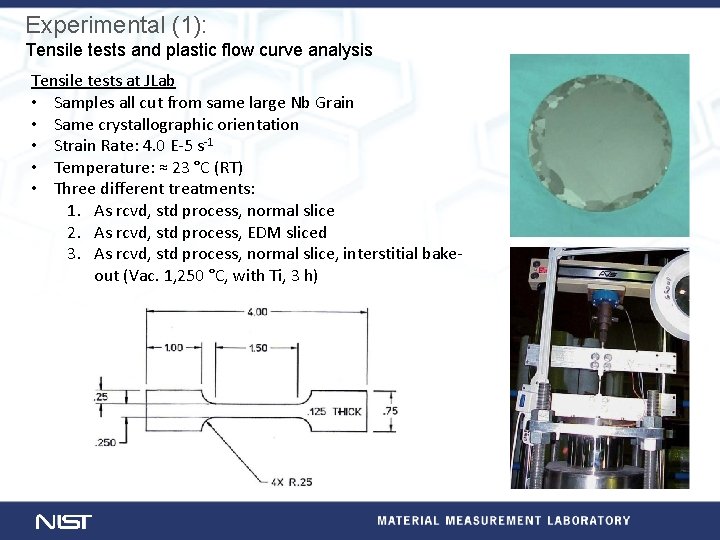
Experimental (1): Tensile tests and plastic flow curve analysis Tensile tests at JLab • Samples all cut from same large Nb Grain • Same crystallographic orientation • Strain Rate: 4. 0 E-5 s-1 • Temperature: ≈ 23 °C (RT) • Three different treatments: 1. As rcvd, std process, normal slice 2. As rcvd, std process, EDM sliced 3. As rcvd, std process, normal slice, interstitial bakeout (Vac. 1, 250 °C, with Ti, 3 h)
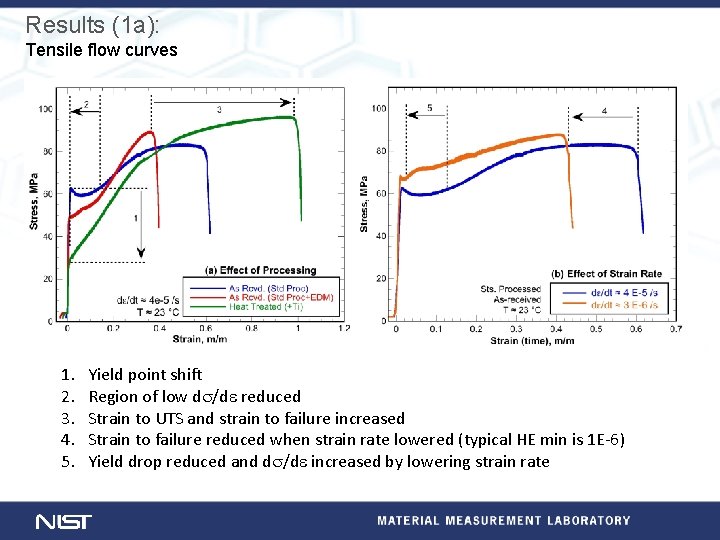
Results (1 a): Tensile flow curves 1. 2. 3. 4. 5. Yield point shift Region of low ds/de reduced Strain to UTS and strain to failure increased Strain to failure reduced when strain rate lowered (typical HE min is 1 E-6) Yield drop reduced and ds/de increased by lowering strain rate
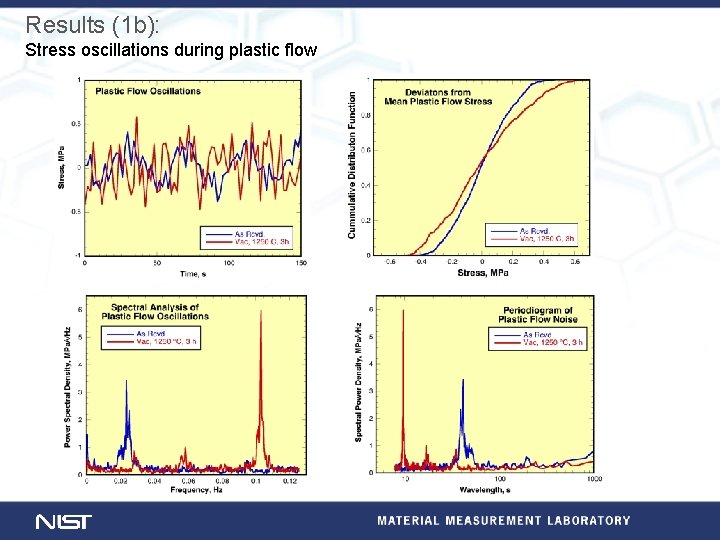
Results (1 b): Stress oscillations during plastic flow
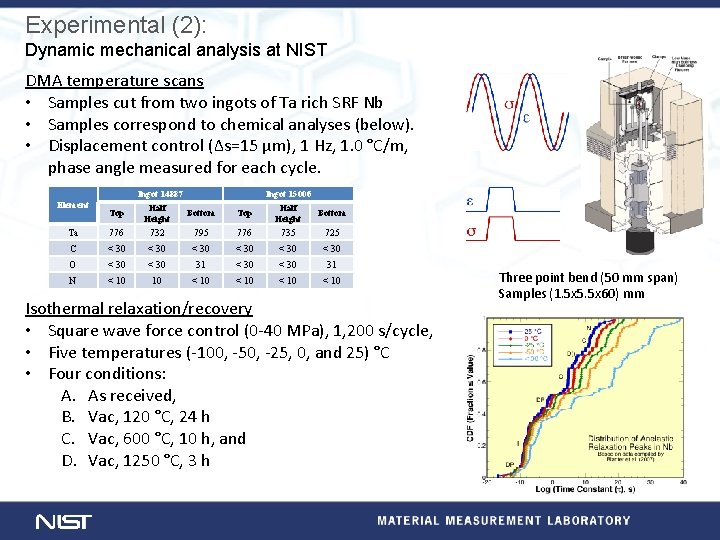
Experimental (2): Dynamic mechanical analysis at NIST DMA temperature scans • Samples cut from two ingots of Ta rich SRF Nb • Samples correspond to chemical analyses (below). • Displacement control (∆s=15 µm), 1 Hz, 1. 0 °C/m, phase angle measured for each cycle. Element Top Ingot 14887 Half Bottom Height Top Ingot 15006 Half Bottom Height Ta 776 732 795 776 735 725 C < 30 < 30 O < 30 31 N < 10 10 < 10 Isothermal relaxation/recovery • Square wave force control (0 -40 MPa), 1, 200 s/cycle, • Five temperatures (-100, -50, -25, 0, and 25) °C • Four conditions: A. As received, B. Vac, 120 °C, 24 h C. Vac, 600 °C, 10 h, and D. Vac, 1250 °C, 3 h Three point bend (50 mm span) Samples (1. 5 x 5. 5 x 60) mm
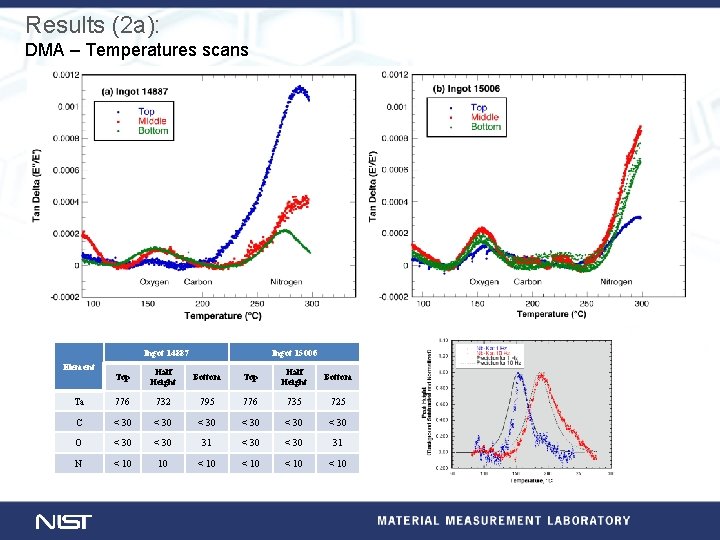
Results (2 a): DMA – Temperatures scans Ingot 14887 Element Ingot 15006 Top Half Height Bottom Ta 776 732 795 776 735 725 C < 30 < 30 O < 30 31 N < 10 10 < 10
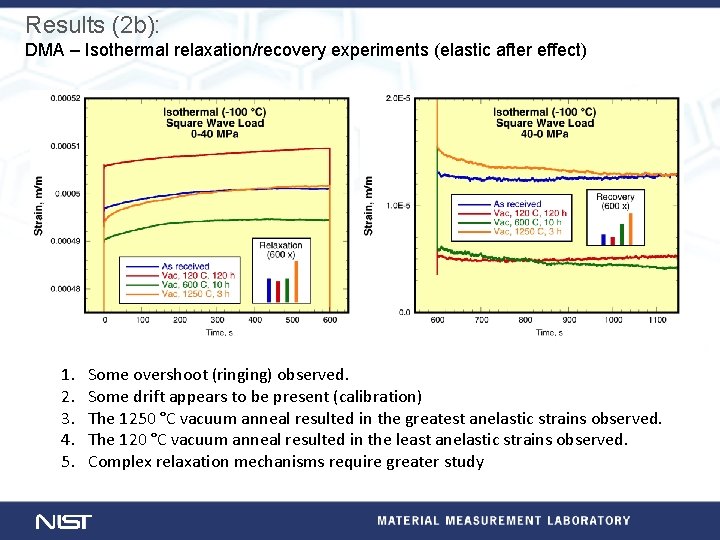
Results (2 b): DMA – Isothermal relaxation/recovery experiments (elastic after effect) 1. 2. 3. 4. 5. Some overshoot (ringing) observed. Some drift appears to be present (calibration) The 1250 °C vacuum anneal resulted in the greatest anelastic strains observed. The 120 °C vacuum anneal resulted in the least anelastic strains observed. Complex relaxation mechanisms require greater study
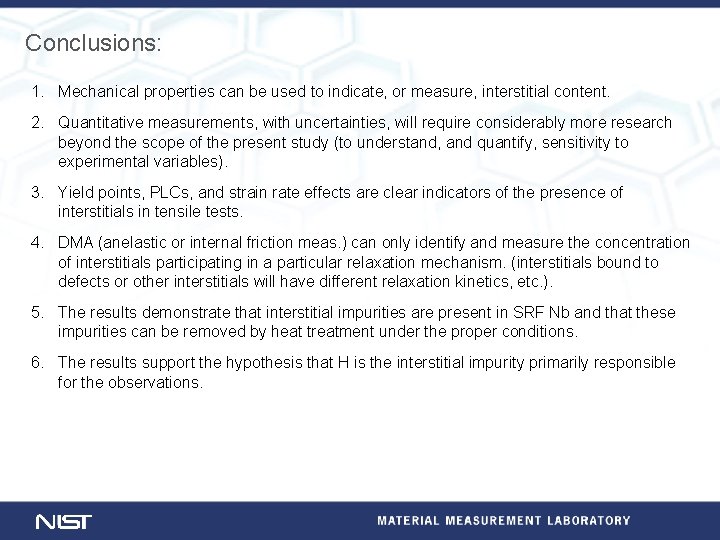
Conclusions: 1. Mechanical properties can be used to indicate, or measure, interstitial content. 2. Quantitative measurements, with uncertainties, will require considerably more research beyond the scope of the present study (to understand, and quantify, sensitivity to experimental variables). 3. Yield points, PLCs, and strain rate effects are clear indicators of the presence of interstitials in tensile tests. 4. DMA (anelastic or internal friction meas. ) can only identify and measure the concentration of interstitials participating in a particular relaxation mechanism. (interstitials bound to defects or other interstitials will have different relaxation kinetics, etc. ). 5. The results demonstrate that interstitial impurities are present in SRF Nb and that these impurities can be removed by heat treatment under the proper conditions. 6. The results support the hypothesis that H is the interstitial impurity primarily responsible for the observations.