
MECHANICAL PROPERTIES AND TESTING Mechanical Properties The ductility

- Slides: 42
MECHANICAL PROPERTIES AND TESTING
• Mechanical Properties • The ductility and strength (measured by a tensile test), related hardness properties and fracture toughness (or impact resistance) are three most frequently required materials properties. • A secondary batch include properties related to torsion, shear, bending and fatigue (although usually on components rather than raw materials) with additional measurements of creep behaviour required for elevated temperature service. • Service behaviour such as wear resistance is usually inferred from other tests while intrinsic properties such as density and damping capacity are generally only considered by the designer.
DEFORMATION OF METALS • When an external load is applied on the material, it will undergo changes in the • dimensions and change in shape will take place. As a result, strain will be induced in the • material. The change in dimensions or the shape is referred to as “deformation
TYPES • PLASTICS • DEFORMATION
PLASTIC DEFORMATION AND ELASTIC DEFORMATION. Plastic deformation is a process in which permanent deformation is caused by a sufficient load. It produces a permanent change in the shape or size of a solid body without fracture, resulting from the application of sustained stress beyond the elastic limit elastic deformation. A temporary shape change that is self-reversing after the force is removed, so that the object returns to its original shape, is called elastic deformation. In other words, elastic deformation is a change in shape of a material at low stress that is recoverable after the stress is removed
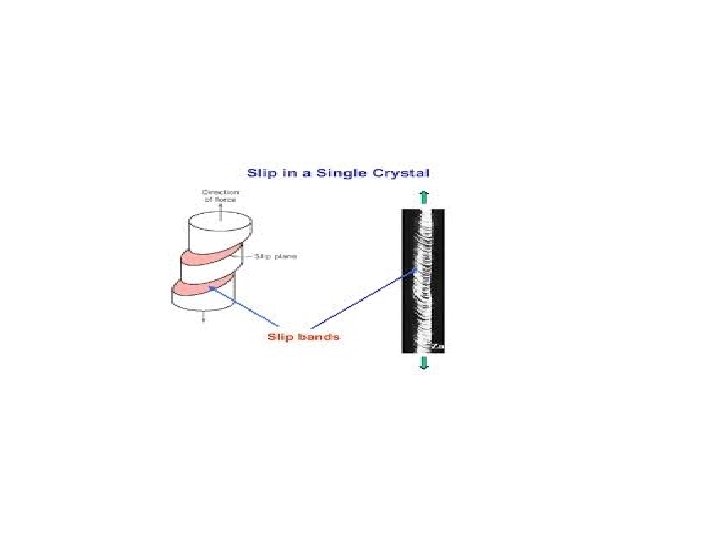
SLIP • Slip is the prominent mechanism of plastic deformation in metals. It involves sliding of blocks of crystal over one other along definite crystallographic planes, called slip planes. • it is analogous to a deck of cards when it is pushed from one end. Slip occurs when shear stress applied exceeds a critical value.
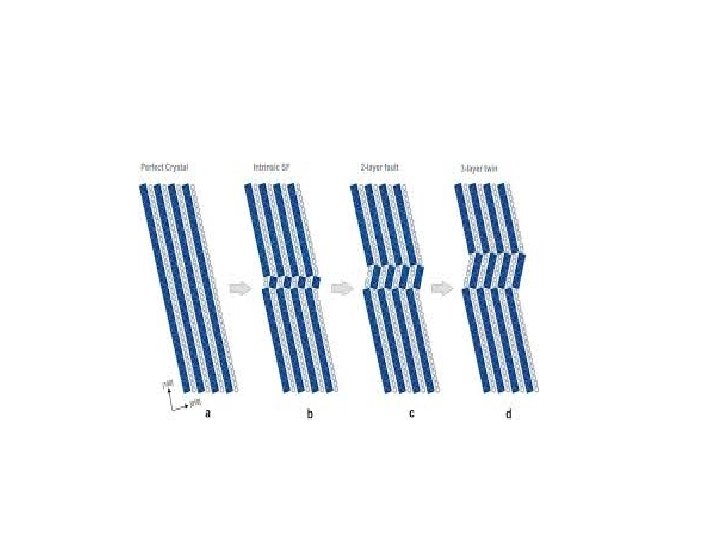
DEFORMATION TWINNING. deformation twinning (lattice gliding) When crystals are stressed they may be deformed plastically by gliding or sliding along planes between rows of atoms within the crystal structure.
FRACTURE • A fracture is a broken bone. It can range from a thin crack to a complete break. Bone can fracture crosswise, lengthwise, in several places, or into many pieces. Most fractures happen when a bone is impacted by more force or pressure than it can support
TYPES • • DUCTILE BRITTLE FATIGUE CREEP
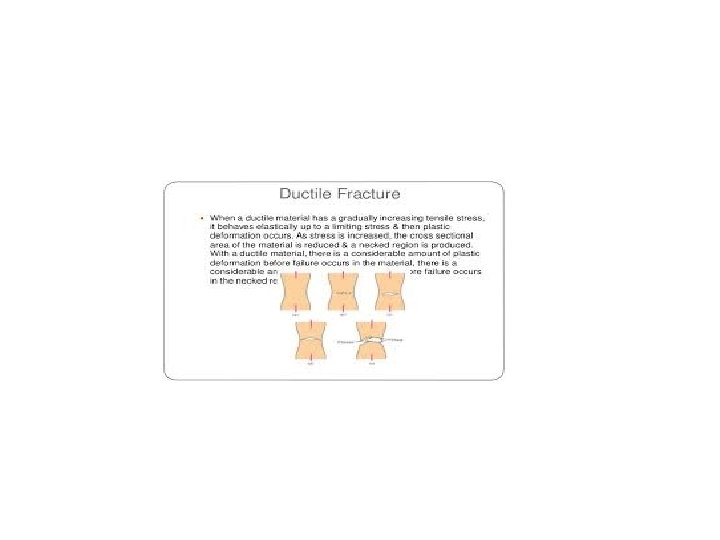
DUCTILE FRACTURE Ductile fracture is a type of fracture characterized by extensive deformation of plastic or "necking. " This usually occurs prior to the actual fracture. The term "ductile rupture" refers to the failure of highly ductile materials. In such cases, materials pull apart instead of cracking.
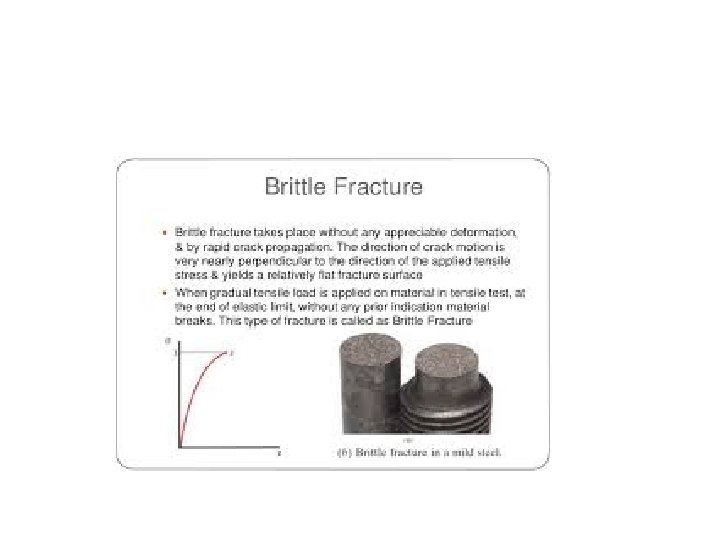
BRITTLE FRACTURE A brittle fracture is the fracture of a metallic object or other material without appreciable prior plastic deformation. It is a break in a brittle piece of metal that failed because stress exceeded cohesion.
FATIGUE FRACTURE Fatigue fractures are a type of stress fracture due to abnormal stresses on normal bone. They should not be confused with an insufficiency fracture, which occurs due to normal stresses on abnormal bone. Plain films typically demonstrate a linear sclerotic region.
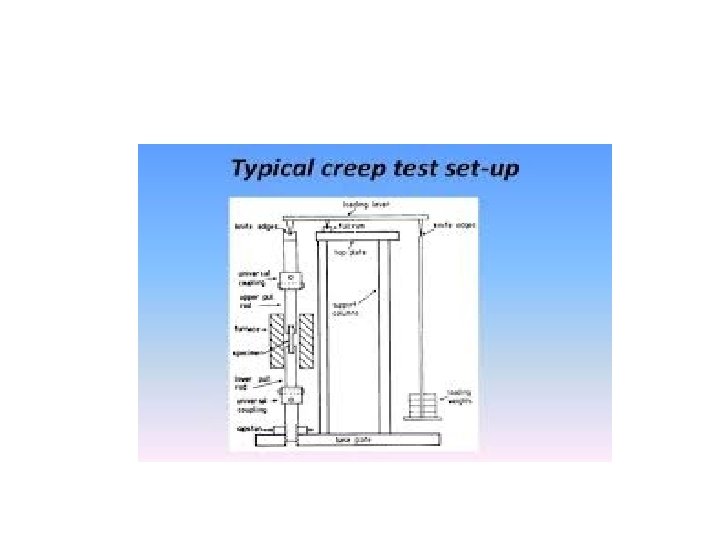
CREEP FRACTURE Creep may be defined as a time-dependent deformation at elevated temperature and constant stress. It follows, then, that a failure from such a condition is referred to as a creep failure or, occasionally, a stress rupture. The temperature at which creep begins depends on the alloy composition.
MATERIALS TESTING Materials testing is a well-established technique used to determine the physical and mechanical properties of raw materials and components from a human hair to steel, composite materials and ceramic
Tensile testing, also known as tension testing, is a fundamental materials science and engineering test in which a sample is subjected to a controlled tension until failure
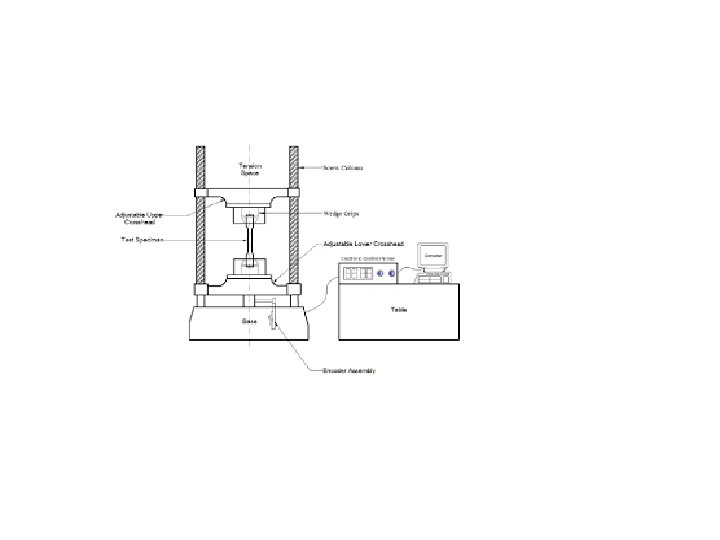
TENSILE TESTING MACHINE Tensile testing, also known as tension testing, is a fundamental materials science and engineering test in which a sample is subjected to a controlled tension until failure.
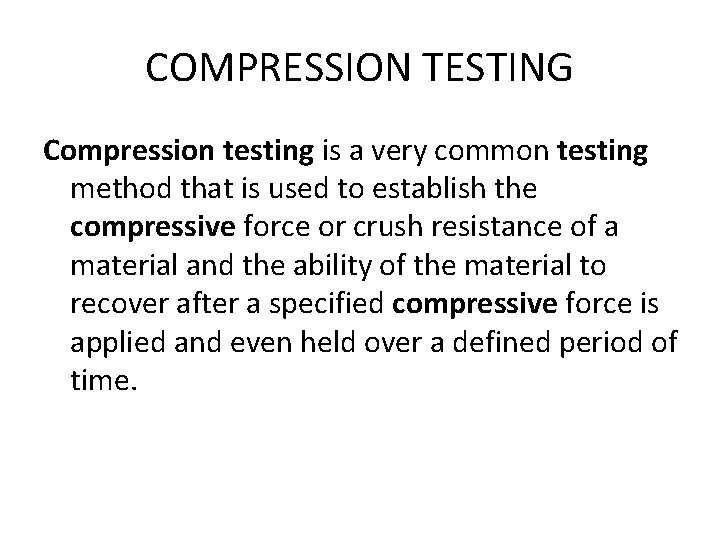
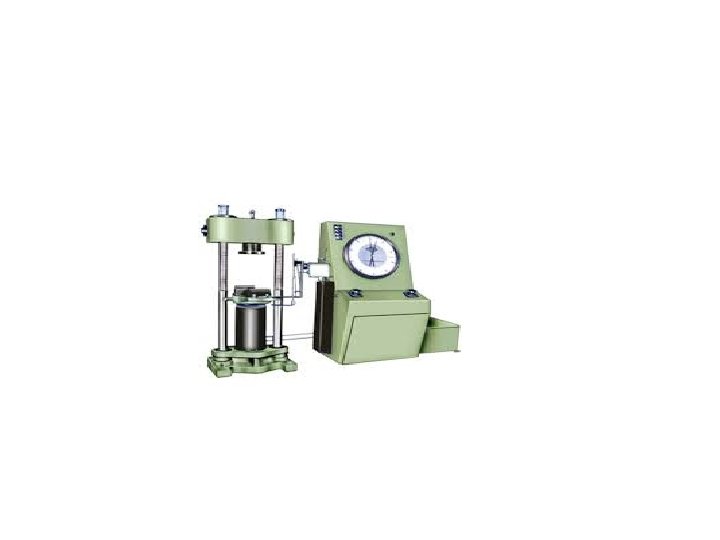
COMPRESSION TESTING Compression testing is a very common testing method that is used to establish the compressive force or crush resistance of a material and the ability of the material to recover after a specified compressive force is applied and even held over a defined period of time.
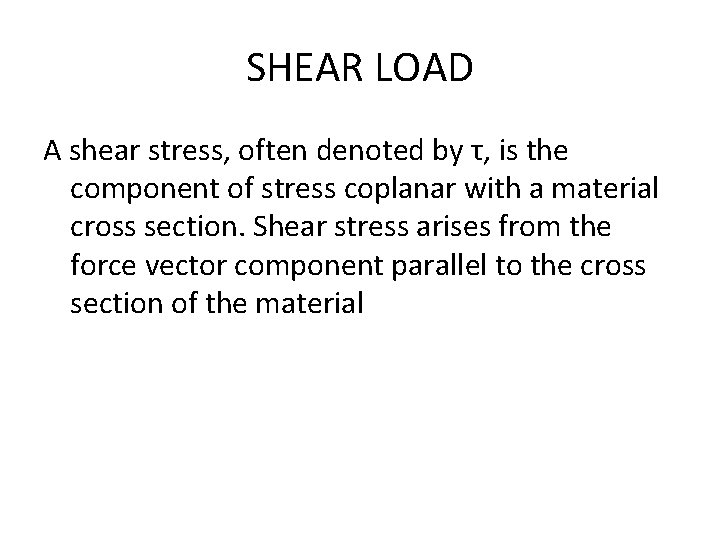
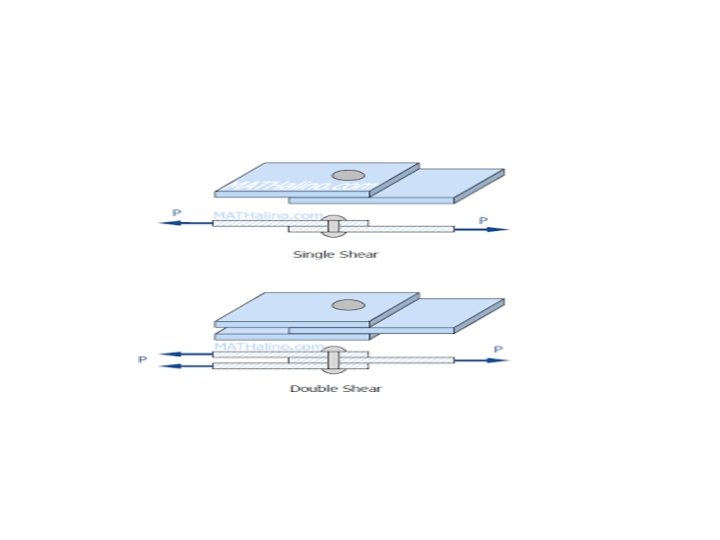
SHEAR LOAD A shear stress, often denoted by τ, is the component of stress coplanar with a material cross section. Shear stress arises from the force vector component parallel to the cross section of the material
HARDNESS TEST • Hardness is a characteristic of a material, not a fundamental physical property. It is defined as the resistance to indentation, and it is determined by measuring the permanent depth of the indentation.
TYPES • • Brinell Hardness Test. Rockwell Hardness Test. Knoop Hardness Test. Vickers Hardness Test.
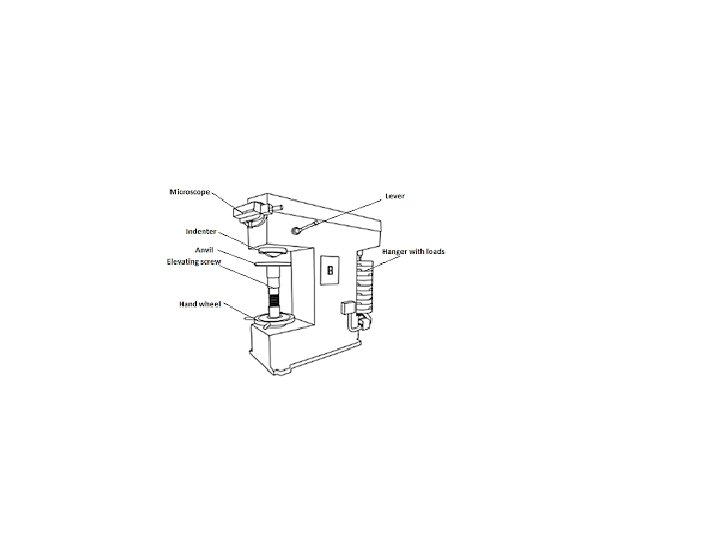
Brinell Hardness Test. • The Brinell scale /brəˈnɛl/ characterizes the indentation hardness of materials through the scale of penetration of an indenter, loaded on a material test-piece. It is one of several definitions of hardness in materials science.
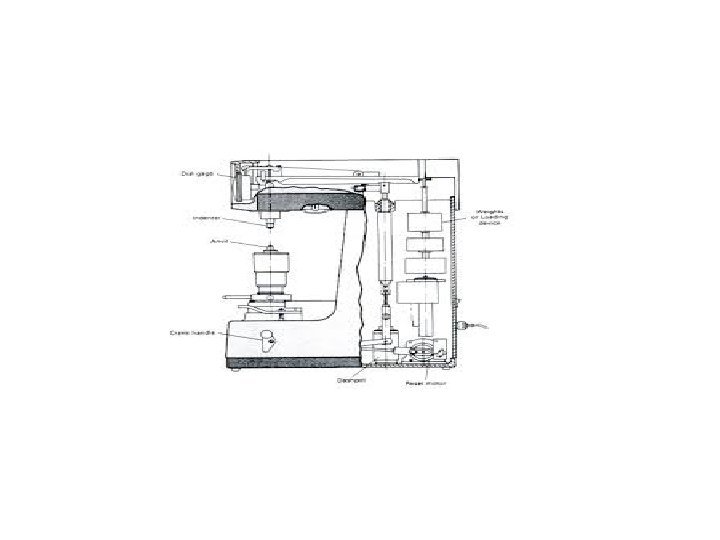
Rockwell Hardness Test Rockwell hardness testing is an indentation testing method. The indenter is either a conical diamond (brale) or a hard steel ball. Different indenter ball diameters from 1/16 to 1/2 in. are used depending on the test scale. To start the test, the indenter is “set” into the sample at a prescribed minor load.
VICKERS HARDNESS TEST The Vickers hardness test is a test performed to measure the hardness of materials, specifically thin sections and small parts. It is comprised of a diamond indenter and a light load to produce an indentation on the subject under testing. The depth of indentation is converted into the hardness value of the object.
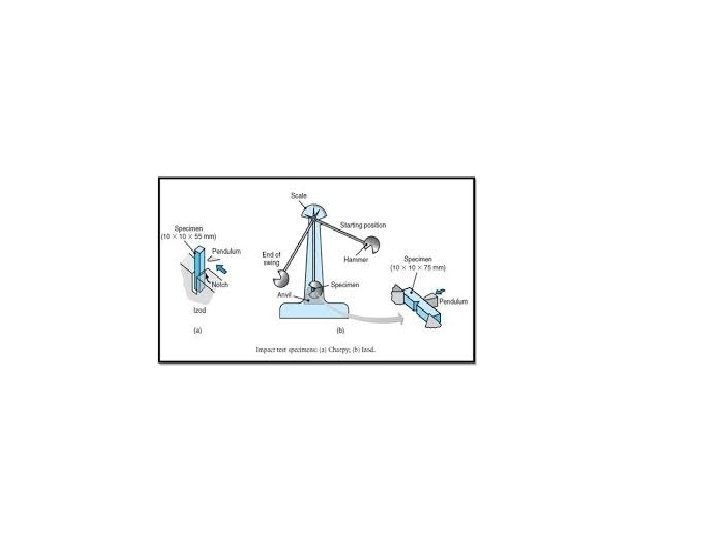
IMPACT TEST An impact test is a technique for determining the behavior of material subjected to shock loading in: • Bending • Tension • Torsion
TYPES 1. CHARPY 2. IZOD
CHARPY The Charpy impact test, also known as the Charpy V-notch test, is a standardized high strain-rate test which determines the amount of energy absorbed by a material during fracture
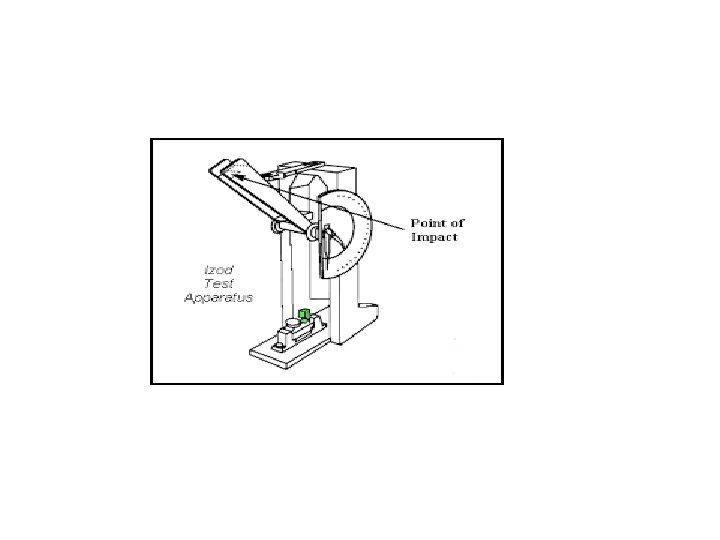
IZOD A test of a metal's or plastic's resistance to impact that is made by determining the amount of energy in foot-pounds needed by a swinging hammer to fracture a notched test piece of the material held in a vertical position and supported at its lower end
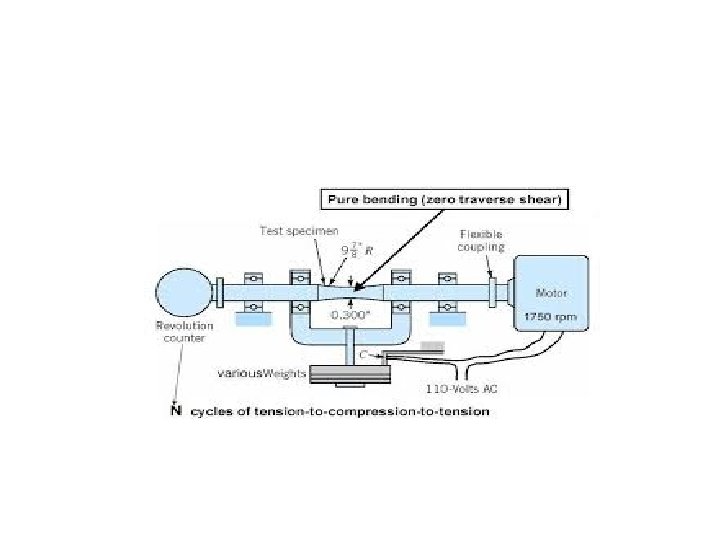
FATIGUE FAILURE MECHANISM Fatigue is the weakening of a material caused by repeatedly applied loads. It is the progressive and localized structural damage that occurs when a material is subjected to cyclic loading.
CREEP FAILURE MECHANISM Creep is a deformation mechanism that may or may not constitute a failure mode. For example, moderate creep in concrete is sometimes welcomed because it relieves tensile stresses that might otherwise lead to cracking. . Instead, strain accumulates as a result of long-term stress