
Mechanical Power Systems 9 Basic Concepts List the
Mechanical Power Systems 9
Basic Concepts • List the six simple machines and give an example of each. • List three types of gears. • Name the two primary characteristics of power. • Identify two mechanical transmission devices and describe how each operates. • Define mechanical advantage and give an example. • Recognize the difference between the ideal mechanical advantage (IMA) and actual mechanical advantage (AMA). © Goodheart-Willcox Co. , Inc. Permission granted to reproduce for educational use only.
Intermediate Concepts • Discuss force and rate in a mechanical system. • Describe the difference between scalar and vector quantities. © Goodheart-Willcox Co. , Inc. Permission granted to reproduce for educational use only.
Advanced Concepts • Design a mechanical system for a specific application. • Predict the result of a mechanical system based on knowledge of balanced and unbalanced loads. • Calculate the mechanical advantage of a simple machine. • Compute the mechanical advantage of compound machines. • Solve for the percentage of frictional loss in a mechanical system. © Goodheart-Willcox Co. , Inc. Permission granted to reproduce for educational use only.
Mechanical Systems • Produce work using one or more machines • Machines can change size, direction, and speed of forces • Machines can change type of motion produced © Goodheart-Willcox Co. , Inc. Permission granted to reproduce for educational use only.
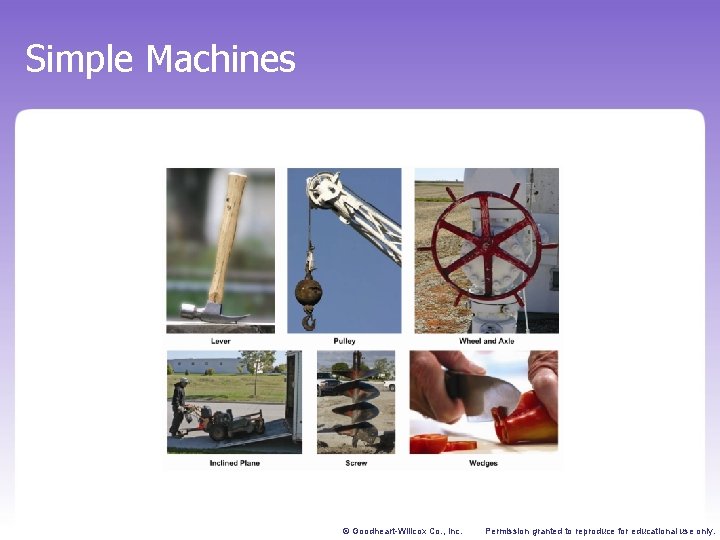
Simple Machines • • • Levers Pulleys Wheels and axles Inclined planes Screws Wedges © Goodheart-Willcox Co. , Inc. Permission granted to reproduce for educational use only.
Simple Machines © Goodheart-Willcox Co. , Inc. Permission granted to reproduce for educational use only.
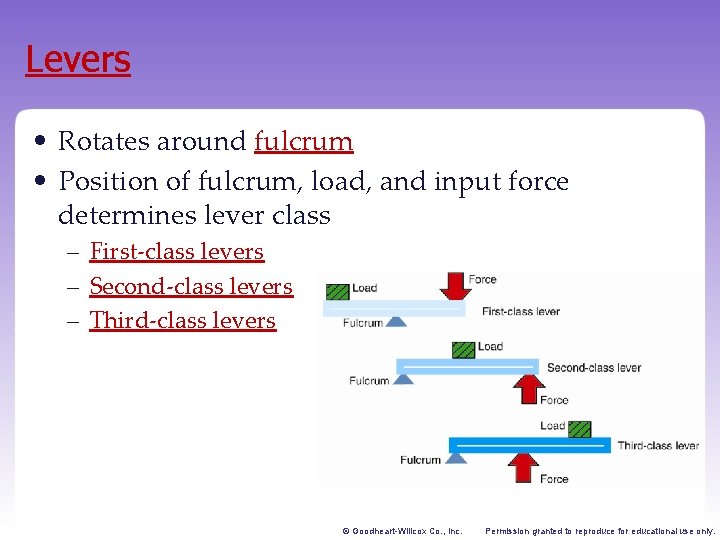
Levers • Rotates around fulcrum • Position of fulcrum, load, and input force determines lever class – First-class levers – Second-class levers – Third-class levers © Goodheart-Willcox Co. , Inc. Permission granted to reproduce for educational use only.
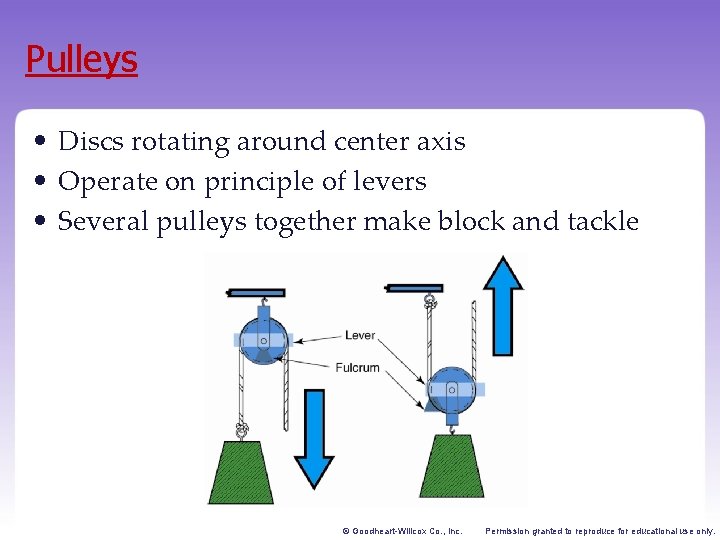
Pulleys • Discs rotating around center axis • Operate on principle of levers • Several pulleys together make block and tackle © Goodheart-Willcox Co. , Inc. Permission granted to reproduce for educational use only.
Wheels and Axles • Also based on principle of levers • Large-diameter wheel and small-diameter axle are attached to each other • Can be used to change size or distance of force © Goodheart-Willcox Co. , Inc. Permission granted to reproduce for educational use only.
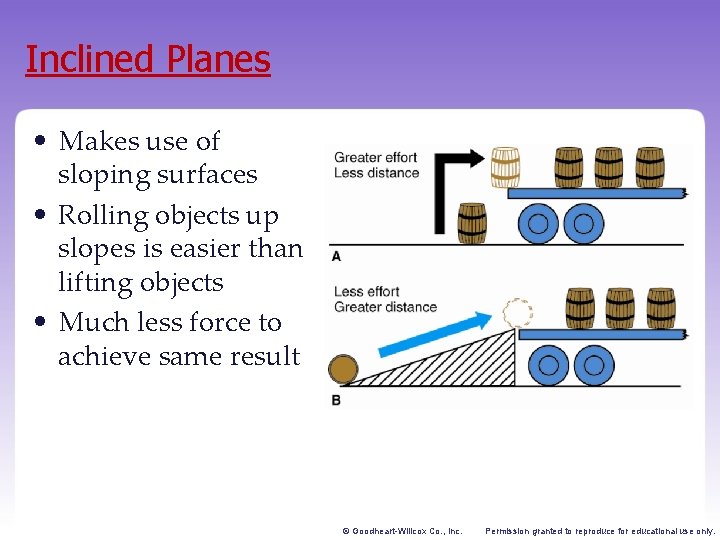
Inclined Planes • Makes use of sloping surfaces • Rolling objects up slopes is easier than lifting objects • Much less force to achieve same result © Goodheart-Willcox Co. , Inc. Permission granted to reproduce for educational use only.
Screws • Operates on principle of inclined planes • Long incline plane wrapped around shaft • Screws with more threads per inch have advantages – Apply greater force – Create for surface area to produce friction © Goodheart-Willcox Co. , Inc. Permission granted to reproduce for educational use only.
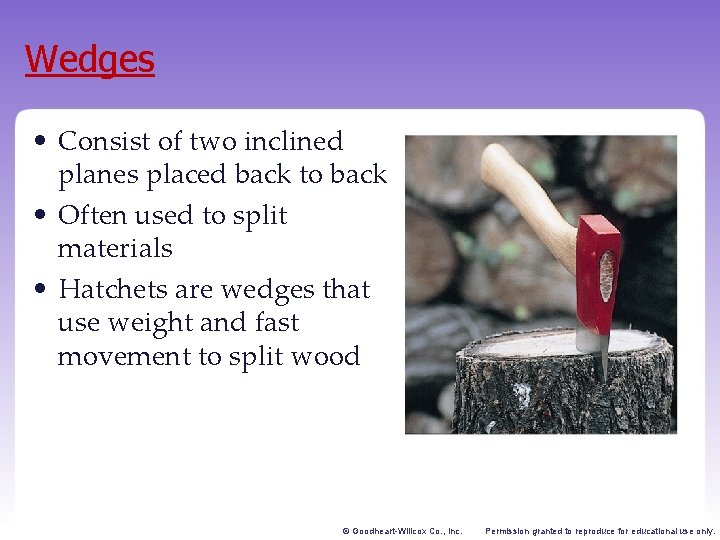
Wedges • Consist of two inclined planes placed back to back • Often used to split materials • Hatchets are wedges that use weight and fast movement to split wood © Goodheart-Willcox Co. , Inc. Permission granted to reproduce for educational use only.
Gears • Metal wheel with small notches cut into rim • Gear sets are made so gear teeth interlock and drive each other • Gears can control mechanical power in the same way as belts and pulleys • Gears change direction of power, speed, and torque © Goodheart-Willcox Co. , Inc. Permission granted to reproduce for educational use only.
Quantities of Measurement • Scalar quantity represents physical quantity and is expressed by number or unit • Vector quantities have both magnitude and direction – Displacement – Velocity © Goodheart-Willcox Co. , Inc. Permission granted to reproduce for educational use only.
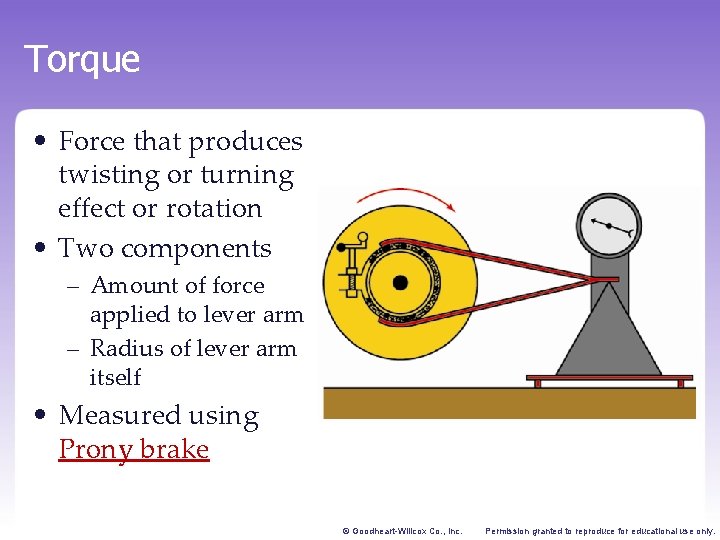
Torque • Force that produces twisting or turning effect or rotation • Two components – Amount of force applied to lever arm – Radius of lever arm itself • Measured using Prony brake © Goodheart-Willcox Co. , Inc. Permission granted to reproduce for educational use only.
Horsepower (hp) • Rate at which output work is performed • Several types of hp ratings: – Indicated horsepower (ihp) – Brake horsepower (bhp) – Frictional horsepower (fhp) © Goodheart-Willcox Co. , Inc. Permission granted to reproduce for educational use only.
Net Forces of Balanced and Unbalanced Loads • Balanced forces are in state of equilibrium • Movement ceases in balance • Forces of effort and opposition must be totally balanced • Unbalanced loads can be calculated with addition and subtraction © Goodheart-Willcox Co. , Inc. Permission granted to reproduce for educational use only.
Transmission of Mechanical Energy • Compound machines use two or more simple machines • Variations in simple machines may be used • Operations of industrial machines and transportation vehicles rely on principles of one or more simple machines © Goodheart-Willcox Co. , Inc. Permission granted to reproduce for educational use only.
Clutches • Connects power source to rest of machine • Device is needed so vehicles can remain at rest with engine running, start without stalling, and shift gears while moving • Operate on principle of friction • Types in vehicles are diaphragm clutch and centrifugal clutch © Goodheart-Willcox Co. , Inc. Permission granted to reproduce for educational use only.
Pulleys and Belts • Many belts move around pulleys in vehicles • Transmit power from engine to drive engine components, such as water pump and fan • Control mechanical energy through five different arrangements © Goodheart-Willcox Co. , Inc. Permission granted to reproduce for educational use only.
Chains and Sprockets • Found on bicycles, mopeds, and motorcycles • Usually used as drive system to bring power to driving wheel of vehicle • Provide positive power transfer, which means chain cannot slip like belt on pulley © Goodheart-Willcox Co. , Inc. Permission granted to reproduce for educational use only.
Shafts and Bearings • Shafts are vital parts of automobile engines and drive systems • Bearings are made to be strong and allow shaft to turn inside them • Shafts are not easily bent, so universal joints are used when flexibility is needed © Goodheart-Willcox Co. , Inc. Permission granted to reproduce for educational use only.
Mechanical Advantage • Simple machines can gain mechanical advantage – – – Levers Pulleys Wheels and axles Inclined planes Wedges Gears © Goodheart-Willcox Co. , Inc. Permission granted to reproduce for educational use only.
Ideal Mechanical Advantage vs. Actual Mechanical Advantage • Ideal mechanical advantage (IMA) • Actual mechanical advantage (AMA) – Accounts for loss of energy through friction – Friction is heat energy that is common by-product of mechanical energy – AMA is always less than IMA because IMA assumes for 100% efficiency – AMA accounts for frictional losses © Goodheart-Willcox Co. , Inc. Permission granted to reproduce for educational use only.
Review What are the six simple machines? Levers, pulleys, wheels and axles, inclined planes, screws, and wedges © Goodheart-Willcox Co. , Inc. Permission granted to reproduce for educational use only.
Review What two simple machines also operate on the principle of the lever? Pulleys and wheels and axles © Goodheart-Willcox Co. , Inc. Permission granted to reproduce for educational use only.
Review What type of quantity is displacement? Vector quantities © Goodheart-Willcox Co. , Inc. Permission granted to reproduce for educational use only.
- Slides: 29