
Mechanical Microprocess in a fluid Motion of particles

- Slides: 28
Mechanical Micro-process in a fluid
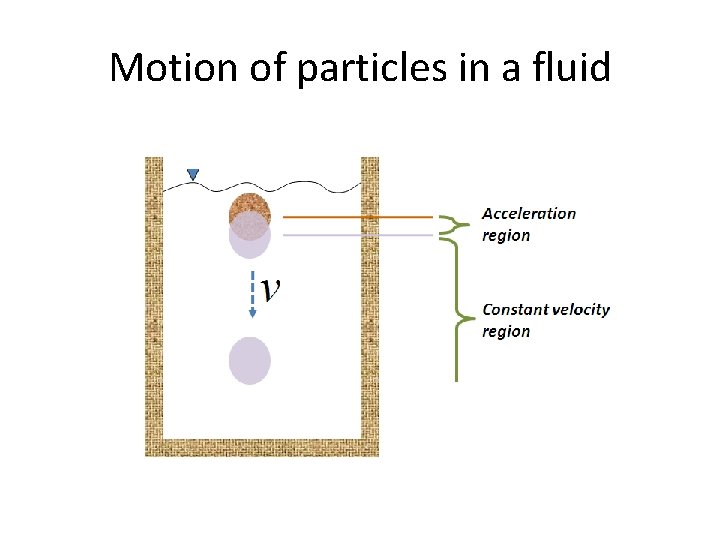
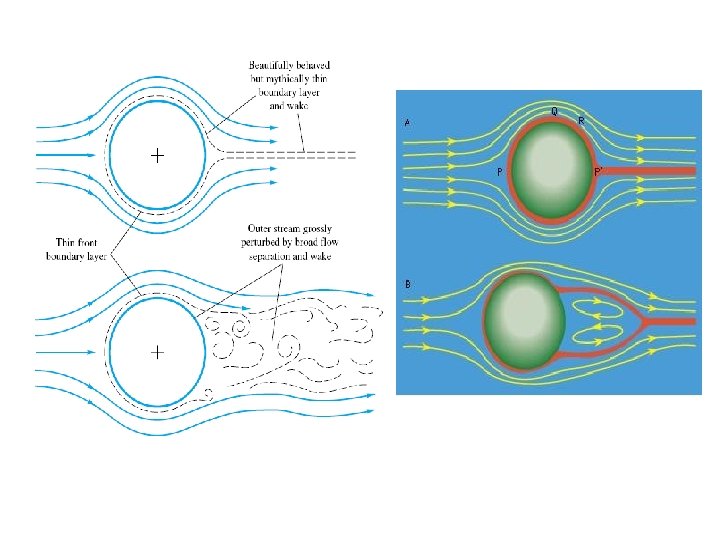
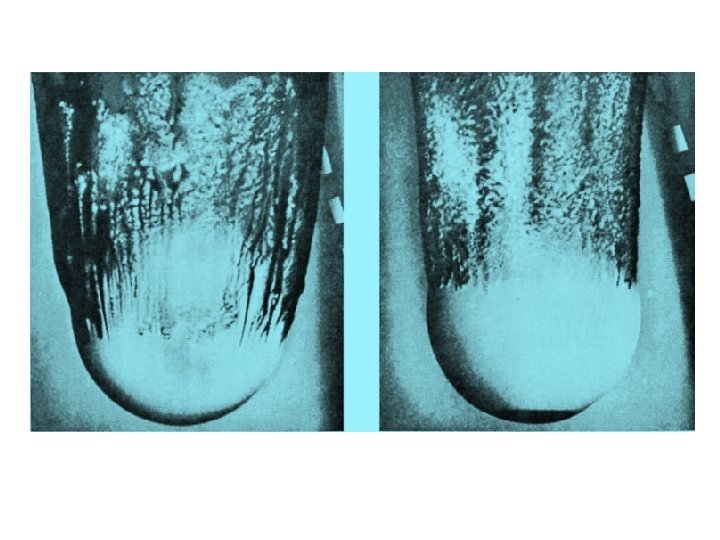
Motion of particles in a fluid
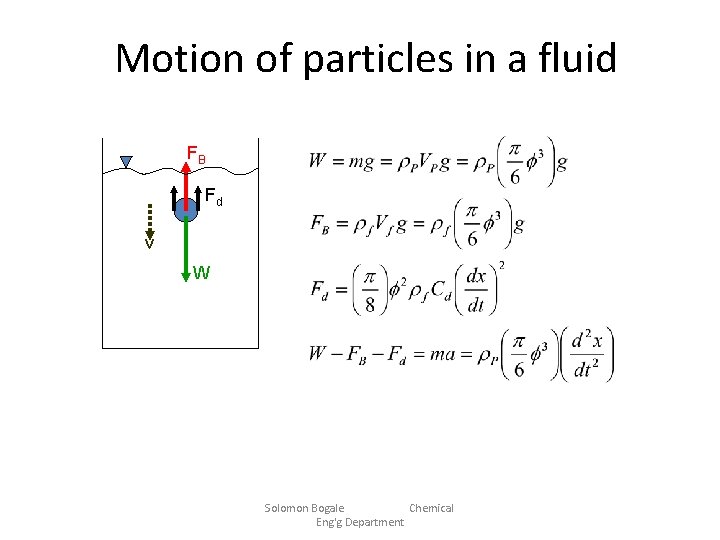
Motion of particles in a fluid FB Fd v W Solomon Bogale Chemical Eng'g Department
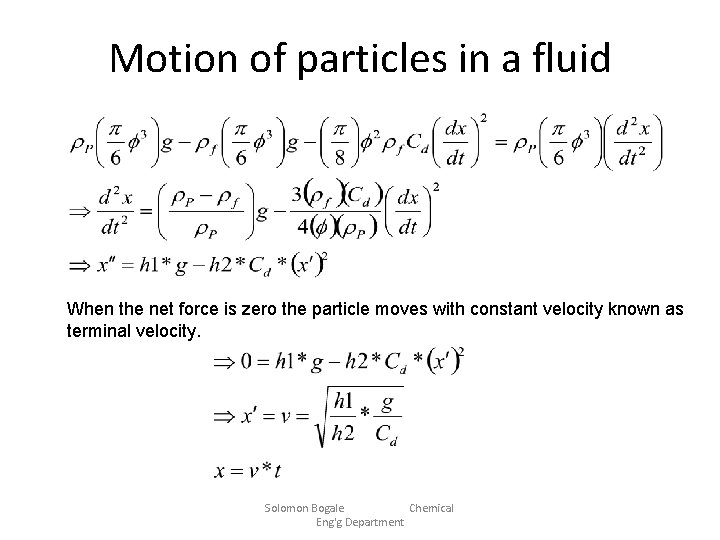
Motion of particles in a fluid When the net force is zero the particle moves with constant velocity known as terminal velocity. Solomon Bogale Chemical Eng'g Department
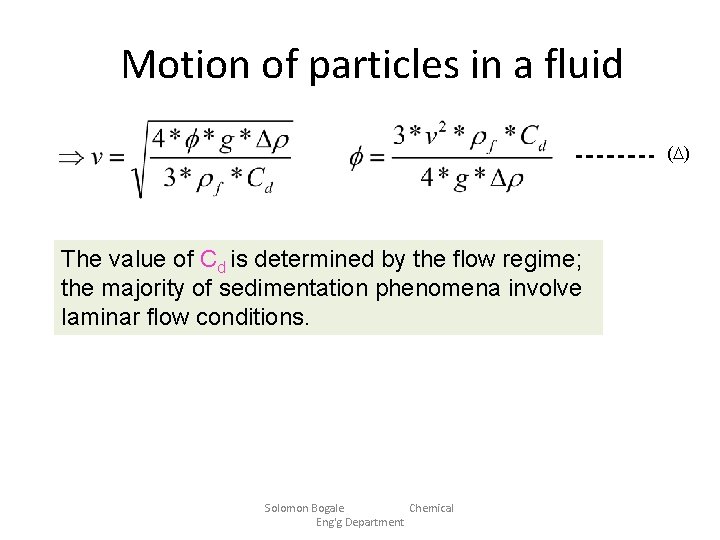
Motion of particles in a fluid ( ) The value of Cd is determined by the flow regime; the majority of sedimentation phenomena involve laminar flow conditions. Solomon Bogale Chemical Eng'g Department
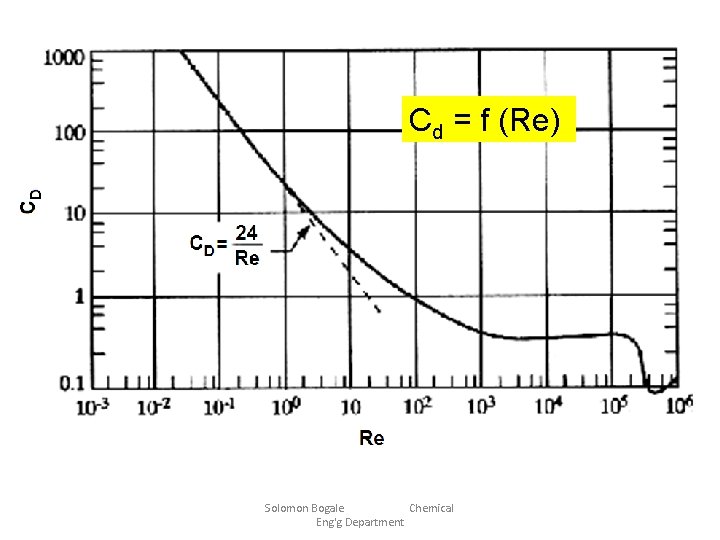
Cd = f (Re) Solomon Bogale Chemical Eng'g Department
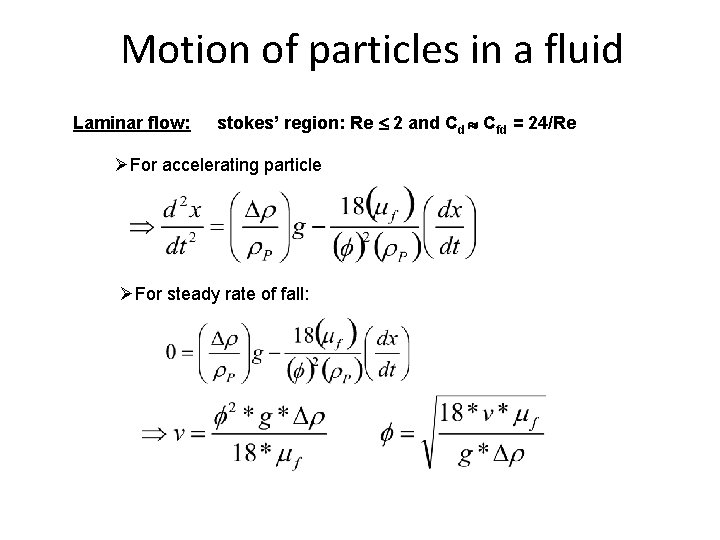
Motion of particles in a fluid Laminar flow: stokes’ region: Re 2 and Cd Cfd = 24/Re ØFor accelerating particle ØFor steady rate of fall:
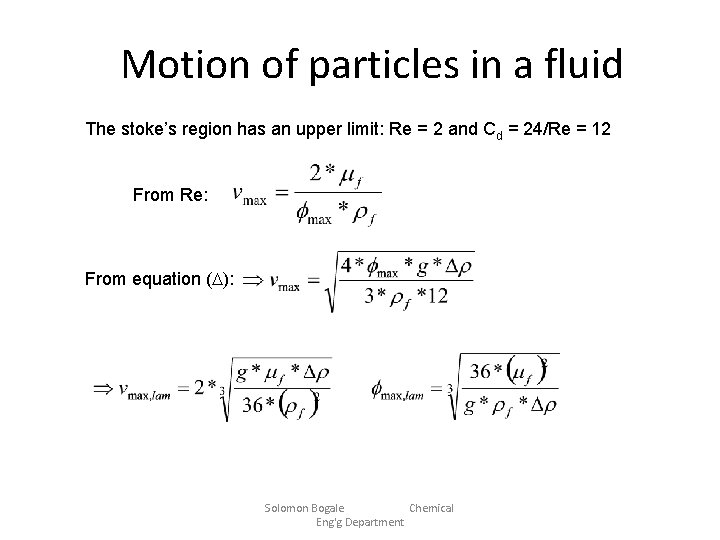
Motion of particles in a fluid The stoke’s region has an upper limit: Re = 2 and Cd = 24/Re = 12 From Re: From equation ( ): Solomon Bogale Chemical Eng'g Department
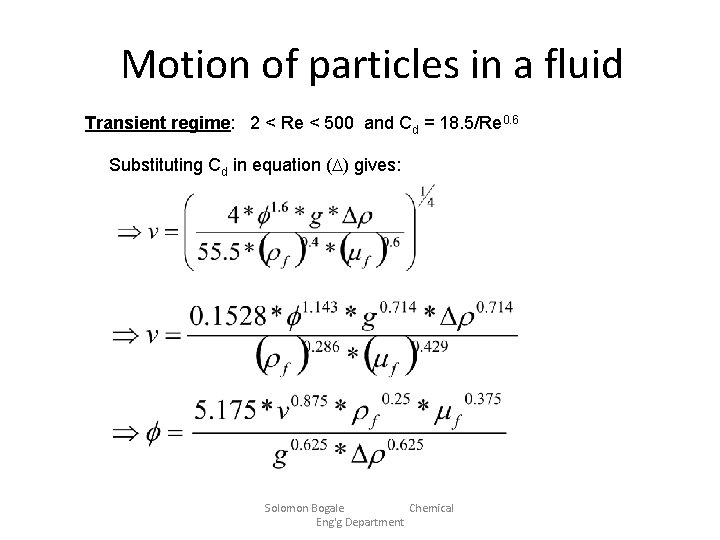
Motion of particles in a fluid Transient regime: 2 < Re < 500 and Cd = 18. 5/Re 0. 6 Substituting Cd in equation ( ) gives: Solomon Bogale Chemical Eng'g Department
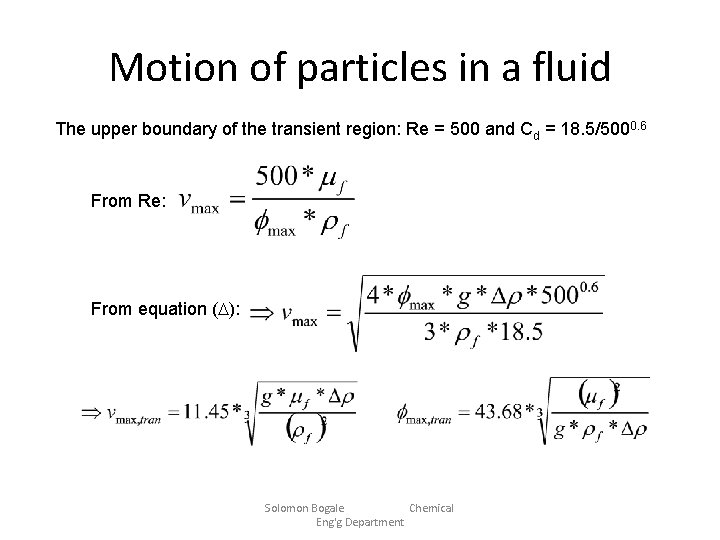
Motion of particles in a fluid The upper boundary of the transient region: Re = 500 and Cd = 18. 5/5000. 6 From Re: From equation ( ): Solomon Bogale Chemical Eng'g Department
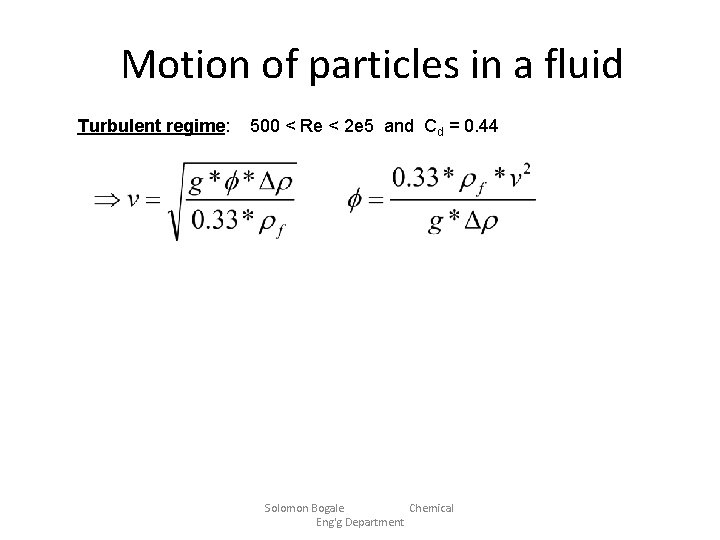
Motion of particles in a fluid Turbulent regime: 500 < Re < 2 e 5 and Cd = 0. 44 Solomon Bogale Chemical Eng'g Department
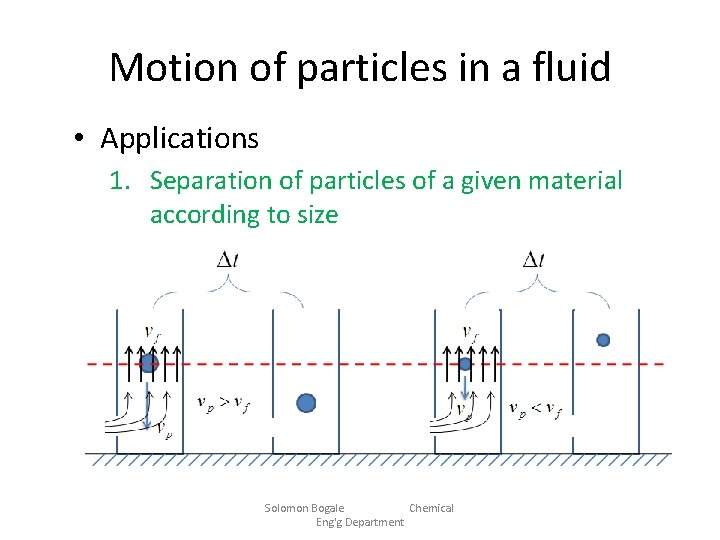
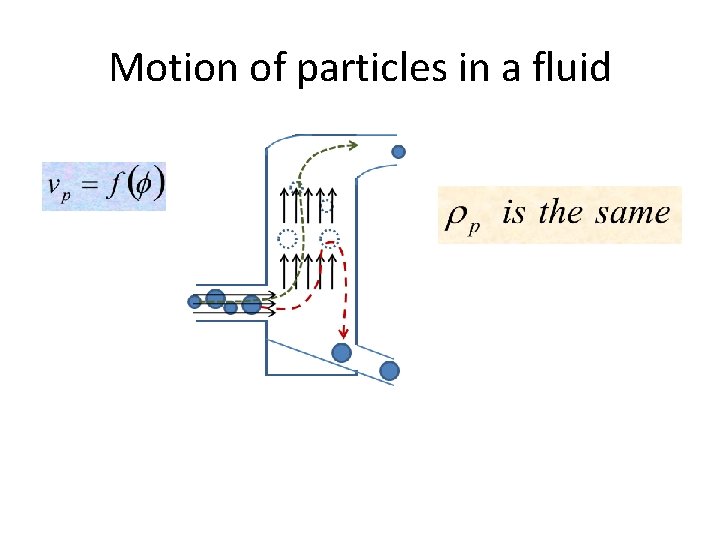
Motion of particles in a fluid • Applications 1. Separation of particles of a given material according to size Solomon Bogale Chemical Eng'g Department
Motion of particles in a fluid
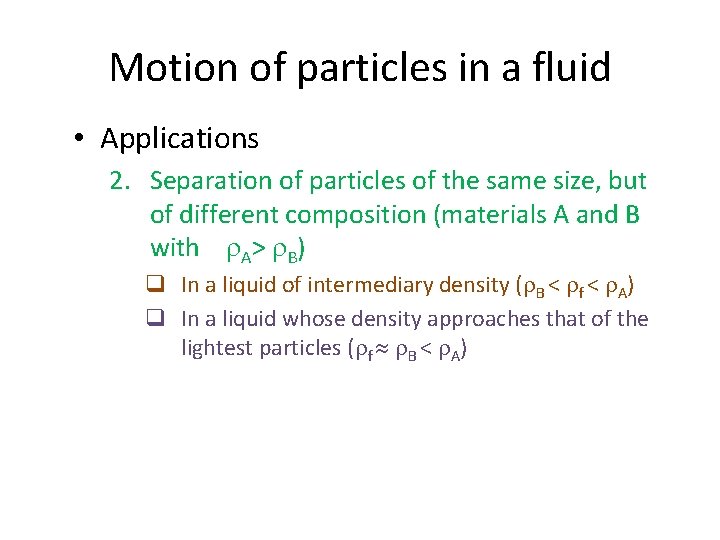
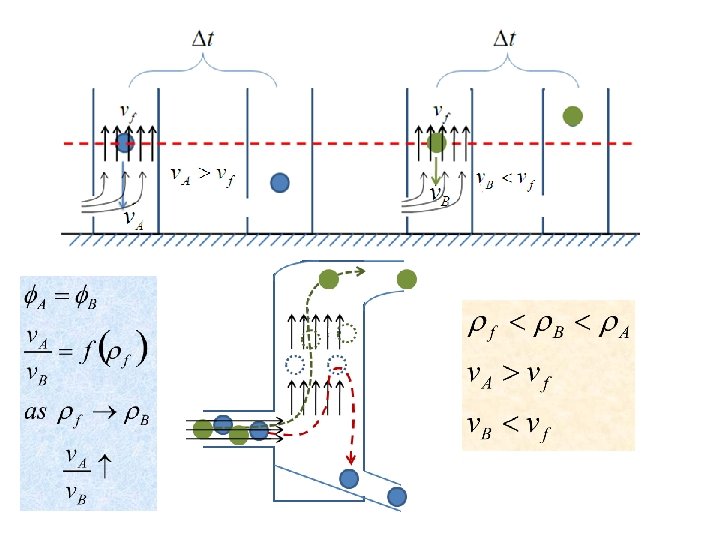
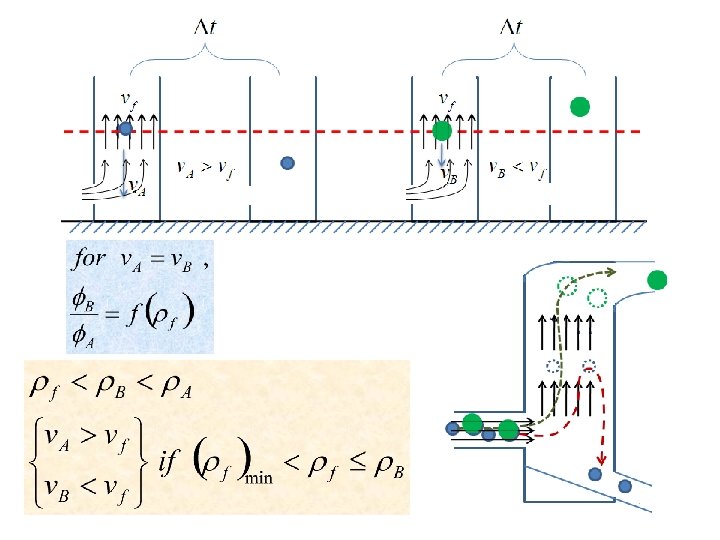
Motion of particles in a fluid • Applications 2. Separation of particles of the same size, but of different composition (materials A and B with A> B) q In a liquid of intermediary density ( B < f < A) q In a liquid whose density approaches that of the lightest particles ( f B < A)
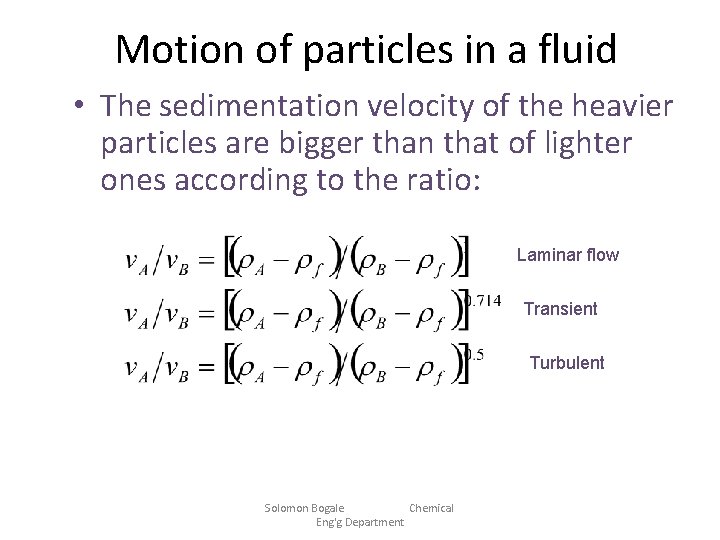
Motion of particles in a fluid • The sedimentation velocity of the heavier particles are bigger than that of lighter ones according to the ratio: Laminar flow Transient Turbulent Solomon Bogale Chemical Eng'g Department
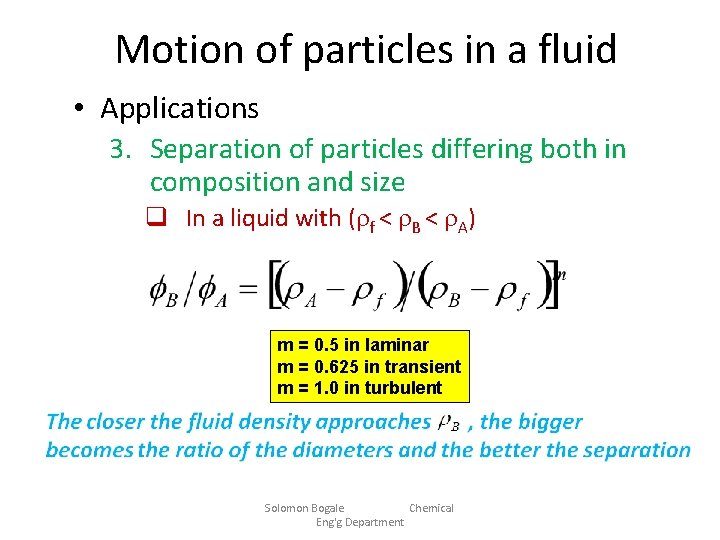
Motion of particles in a fluid • Applications 3. Separation of particles differing both in composition and size q In a liquid with ( f < B < A) m = 0. 5 in laminar m = 0. 625 in transient m = 1. 0 in turbulent Solomon Bogale Chemical Eng'g Department
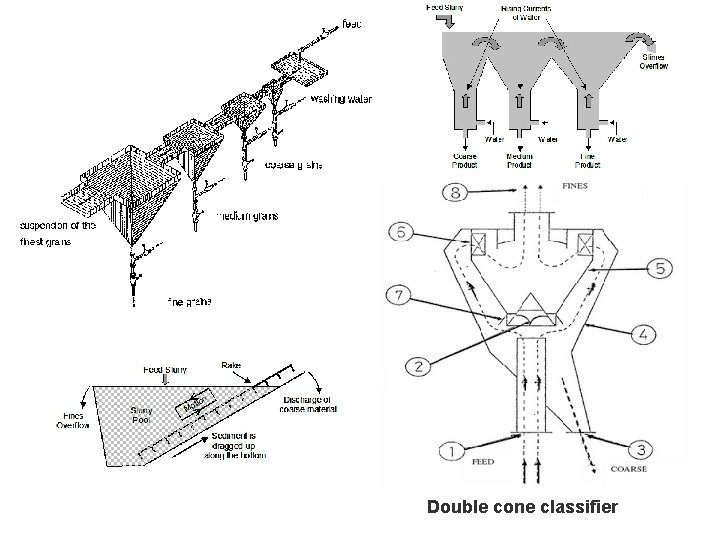
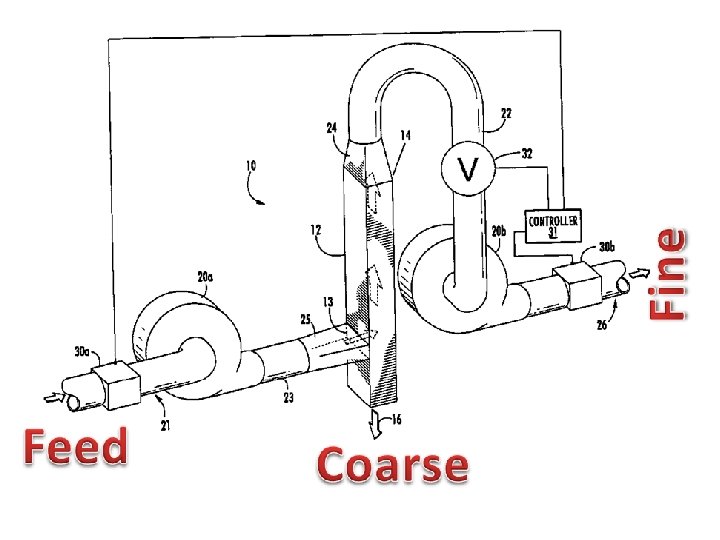
Double cone classifier
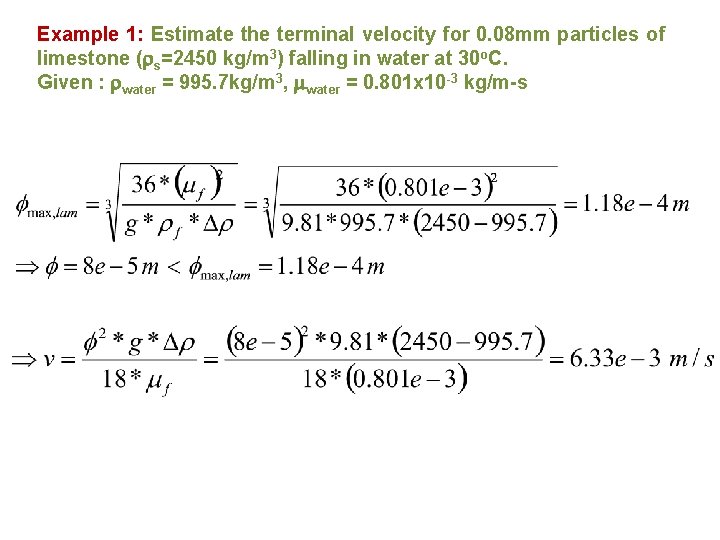
Example 1: Estimate the terminal velocity for 0. 08 mm particles of limestone ( s=2450 kg/m 3) falling in water at 30 o. C. Given : water = 995. 7 kg/m 3, water = 0. 801 x 10 -3 kg/m-s
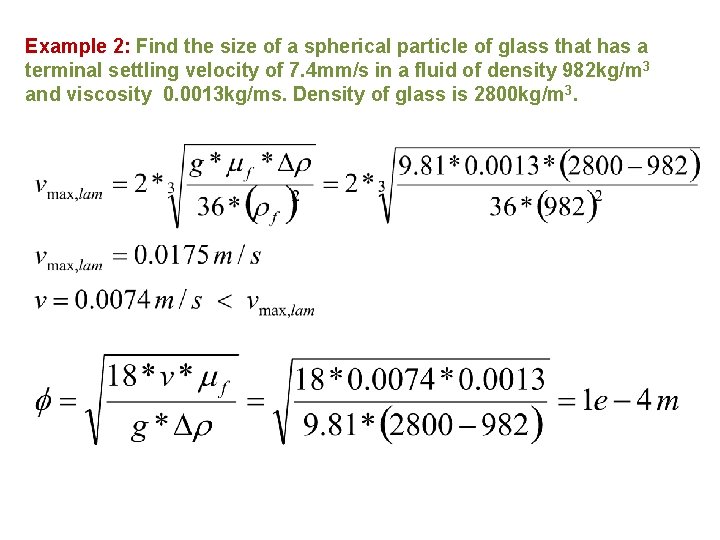
Example 2: Find the size of a spherical particle of glass that has a terminal settling velocity of 7. 4 mm/s in a fluid of density 982 kg/m 3 and viscosity 0. 0013 kg/ms. Density of glass is 2800 kg/m 3.
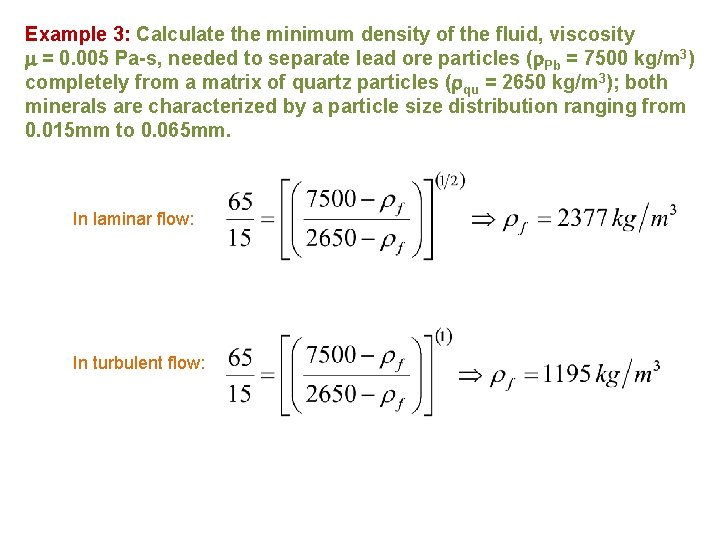
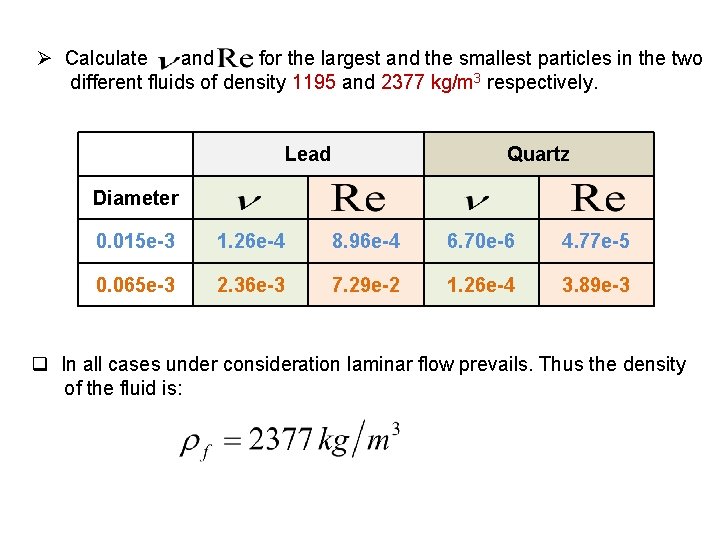
Example 3: Calculate the minimum density of the fluid, viscosity = 0. 005 Pa-s, needed to separate lead ore particles ( Pb = 7500 kg/m 3) completely from a matrix of quartz particles ( qu = 2650 kg/m 3); both minerals are characterized by a particle size distribution ranging from 0. 015 mm to 0. 065 mm. In laminar flow: In turbulent flow:
Ø Calculate and for the largest and the smallest particles in the two different fluids of density 1195 and 2377 kg/m 3 respectively. Lead Quartz Diameter 0. 015 e-3 1. 26 e-4 8. 96 e-4 6. 70 e-6 4. 77 e-5 0. 065 e-3 2. 36 e-3 7. 29 e-2 1. 26 e-4 3. 89 e-3 q In all cases under consideration laminar flow prevails. Thus the density of the fluid is:
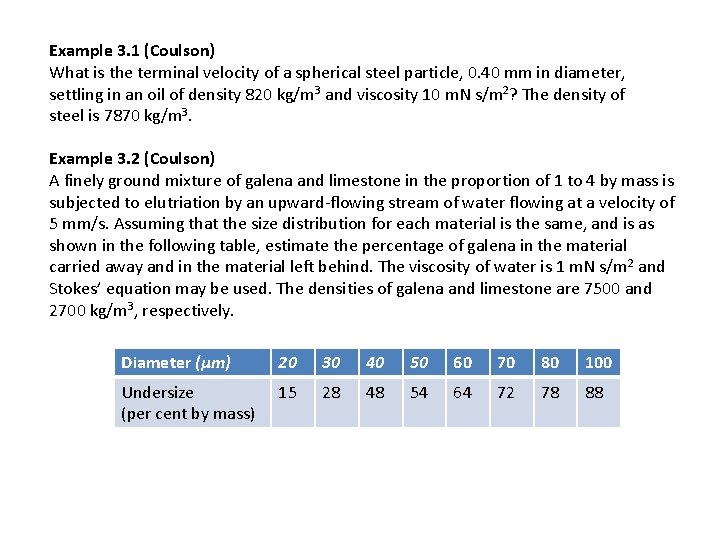
Example 3. 1 (Coulson) What is the terminal velocity of a spherical steel particle, 0. 40 mm in diameter, settling in an oil of density 820 kg/m 3 and viscosity 10 m. N s/m 2? The density of steel is 7870 kg/m 3. Example 3. 2 (Coulson) A finely ground mixture of galena and limestone in the proportion of 1 to 4 by mass is subjected to elutriation by an upward-flowing stream of water flowing at a velocity of 5 mm/s. Assuming that the size distribution for each material is the same, and is as shown in the following table, estimate the percentage of galena in the material carried away and in the material left behind. The viscosity of water is 1 m. N s/m 2 and Stokes’ equation may be used. The densities of galena and limestone are 7500 and 2700 kg/m 3, respectively. Diameter (μm) 20 30 40 50 60 70 80 100 Undersize (per cent by mass) 15 28 48 54 64 72 78 88
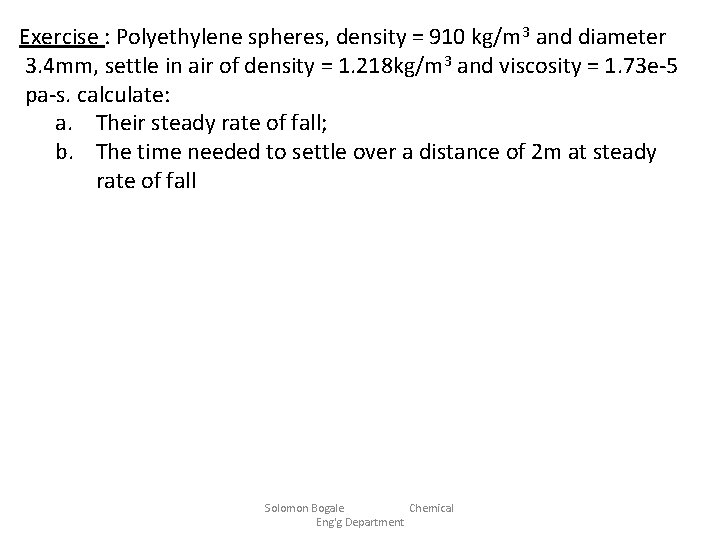
Exercise : Polyethylene spheres, density = 910 kg/m 3 and diameter 3. 4 mm, settle in air of density = 1. 218 kg/m 3 and viscosity = 1. 73 e-5 pa-s. calculate: a. Their steady rate of fall; b. The time needed to settle over a distance of 2 m at steady rate of fall Solomon Bogale Chemical Eng'g Department