
Mechanical Methods of Material Removal Chapter 4 IT
- Slides: 18
Mechanical Methods of Material Removal Chapter 4 IT 208 1
Competencies l l Identify the unique characteristics associated with powered mechanical methods of material removal Calculate the optimum feeds and speeds for milling, drilling and turning List and define the two types of milling machine configurations List the 3 major functions of cutting Chapter 4 IT 208 2
Chapter 4 IT 208 3
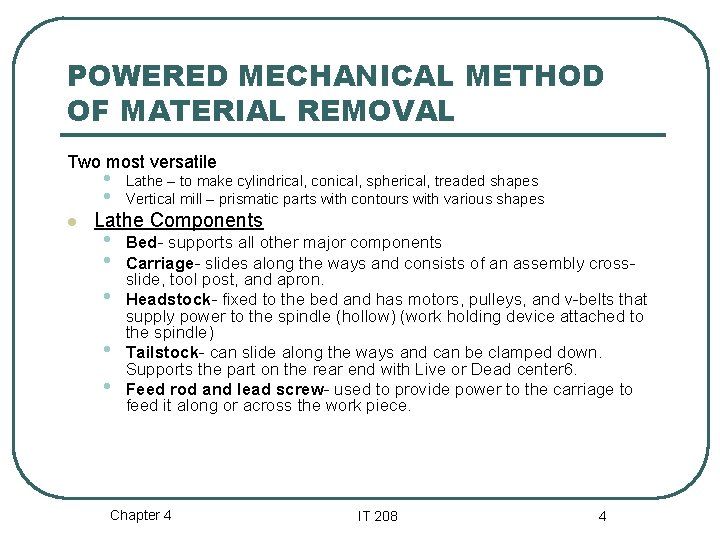
POWERED MECHANICAL METHOD OF MATERIAL REMOVAL Two most versatile • • l Lathe – to make cylindrical, conical, spherical, treaded shapes Vertical mill – prismatic parts with contours with various shapes Lathe Components • • • Bed- supports all other major components Carriage- slides along the ways and consists of an assembly crossslide, tool post, and apron. Headstock- fixed to the bed and has motors, pulleys, and v-belts that supply power to the spindle (hollow) (work holding device attached to the spindle) Tailstock- can slide along the ways and can be clamped down. Supports the part on the rear end with Live or Dead center 6. Feed rod and lead screw- used to provide power to the carriage to feed it along or across the work piece. Chapter 4 IT 208 4
MATERIAL REMOVAL 4 Considerations that determine how fast to run a lathe: • Workpiece material • Tool diameter • Diameter of the work piece • Depth of cut Chapter 4 IT 208 5
MATERIAL REMOVAL Cutting fluids- provide 3 major functions • Lubrication • Cooling • Chip removal Chapter 4 IT 208 6
MATERIAL REMOVAL Milling- A process that is capable of producing a variety of configurations using a multitooth tool, turns the tool and holds the workpiece to provide the cutting action Types of Milling Machines • Horizontal- the spindle is placed horizontal (used for heavier cutting) • Vertical- the spindle is placed vertical (the most common type of milling machine) Chapter 4 IT 208 7
MATERIAL REMOVAL Shaping and Planning - Cutting blades rotate while the material is passed through them. Routing - Uses specially shaped cutting tool to remove material in a defined geometry. Broaching - Specific file geometry is used to duplicate the profile of the broach inside a hole. Drilling and Boring • • Drilling - Stock is held stationary and the drill is rotated Boring - Cutting tool is stationary and the material rotated Chapter 4 IT 208 8
MATERIAL REMOVAL Reaming and Honing • • Reamer- Similar to a drill, but has straight cutting edges and is used for finishing a hole to very close tolerances. Hones - Small grindstone used to “move” material and smooth out the final surface. Chapter 4 IT 208 9
MATERIAL REMOVAL Sawing • • • Advantages: Quick and cheap method of material removal Disadvantages: Leaves rough surface on both sides of the cut. Saw “Set” – Making the kerf wider than the blade backing so that the blade will not bind in the kerf. Blade selection: Harder the material, the finer and closer the teeth. Steel 14 -30 t. p. i. , Aluminum 8 -12 t. p. i. Circular Saws, Jig Saws, Hack Saws, Band, Saws, Chain Saws. Abrasive Saws- used to cut (grind) extremely hard materials cannot be used to cut soft materials because it will “load” the blade. Chapter 4 IT 208 10
MATERIAL REMOVAL Shearing and Punching • • Shearing- Process of slitting flat stock up to ½” in thickness Punching- Shearing any shaped hole in flat stock. Grinding – Removal of material by abrasion. • • “Dressing” a wheel is a process of using a diamond to remove the outer layer of a wheel, so that it becomes round (true) and the ends square. Grit Size – refers to the size of grit that will pass through the number of openings per linear inch in a sieve. (i. e. 100 grit sand paper) Chapter 4 IT 208 11
MATERIAL REMOVAL Cutting Tool Shapes (see fig. 4 -50) • • Side, back, and end rake angles are determined by the materials being cut and the type of cut being made. Hard materials require very little side or back rake angle. High Speed Steel (HSS) – best choice for roughing purposes. They are inexpensive, can be easily resharpened, and are not extremely brittle. The HSS tools will take considerable shock. Their drawback is that they dull faster, especially in the cutting of harder metals. Chapter 4 IT 208 12
MATERIAL REMOVAL • • Carbide – Carbide tips will cut harder steels, but they are brittle and should not be used for roughing purposes. Carbide-tipped tools can produce closer tolerances and better finishes than the HSS tools. Ceramic tools - are not affected by heat, and can be operated at extremely high revolutions per minute. However, these tools are similar to glass in brittleness. Ceramic tools are generally used only for the final, very light cut on very hard steels. Chapter 4 IT 208 13
MATERIAL REMOVAL Feeds & Speeds • • • Cutting Speed – is the velocity of the surface of a workpiece as it passes the cutting tool. Speed (SFPM) – given in surface feet per minute (SFPM). Spindle Speed – is the rotational speed in revolutions per minute at which the lathe, milling machine, saw, grinder, or drill press is running. Feed - the rate of advance of the cutting tool per revolution. Depth of Cut – is the distance to which the cutting tool enters the workpiece. Chapter 4 IT 208 14
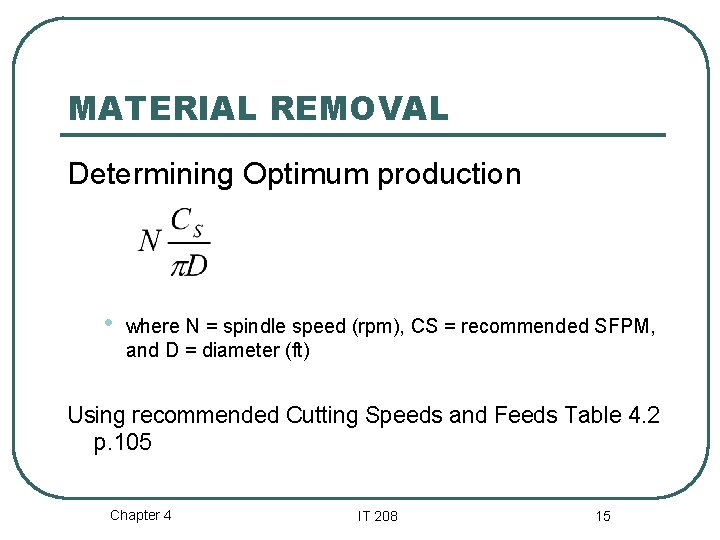
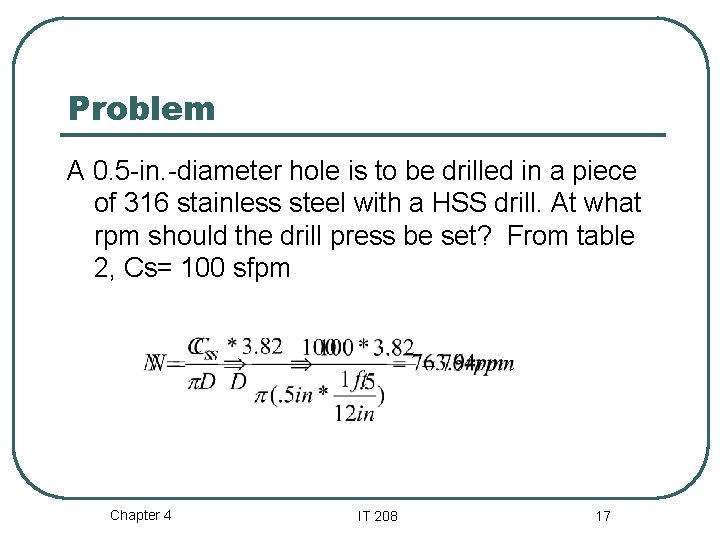
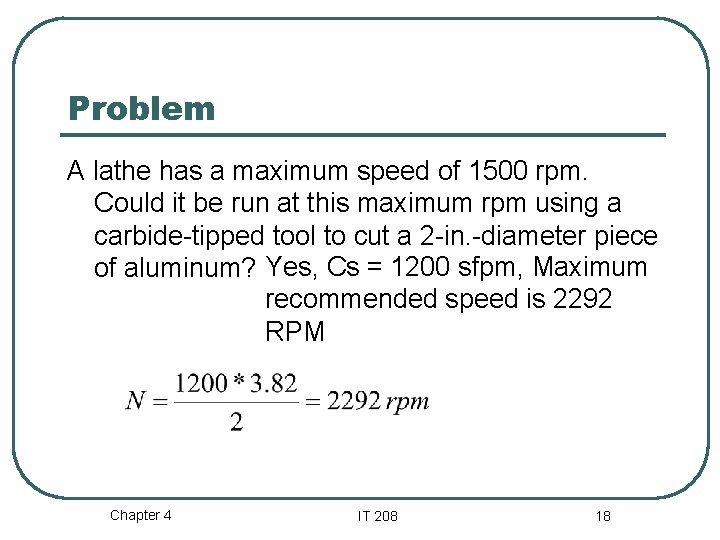
MATERIAL REMOVAL Determining Optimum production • where N = spindle speed (rpm), CS = recommended SFPM, and D = diameter (ft) Using recommended Cutting Speeds and Feeds Table 4. 2 p. 105 Chapter 4 IT 208 15
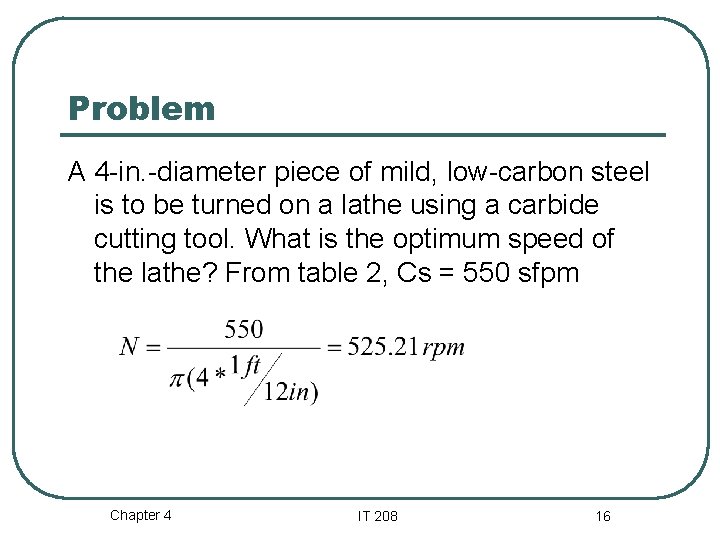
Problem A 4 -in. -diameter piece of mild, low-carbon steel is to be turned on a lathe using a carbide cutting tool. What is the optimum speed of the lathe? From table 2, Cs = 550 sfpm Chapter 4 IT 208 16
Problem A 0. 5 -in. -diameter hole is to be drilled in a piece of 316 stainless steel with a HSS drill. At what rpm should the drill press be set? From table 2, Cs= 100 sfpm Chapter 4 IT 208 17
Problem A lathe has a maximum speed of 1500 rpm. Could it be run at this maximum rpm using a carbide-tipped tool to cut a 2 -in. -diameter piece of aluminum? Yes, Cs = 1200 sfpm, Maximum recommended speed is 2292 RPM Chapter 4 IT 208 18