
Mechanical Low Back Pain and Muscle Energy Technique
Mechanical Low Back Pain and Muscle Energy Technique Briana Baldino VCU DPT 2016
What is Mechanical Back Pain? • Misalignment or dysfunction of structures within the spine ▫ Vertebral bodies, intervertebral discs, zygapophysial joints, sacroiliac (SI) joints, spinal ligaments, paraspinal muscles, dura, spinal cord, and nerve roots • Zygapophysial Joints

Review of Normal Mechanics • Flexion: Open position • Extension: Closed position • Coupled motions: Rotation and sidebending occur ipsilateral when a segment in is flexion or extension http: //www. spineuniverse. com/sites/default/files/legacyimages/facetjoints 2_250 -BB. jpg
Mechanical Examination • Observe posture(standing and seated) and gait for asymmetries • Active range of motion ▫ Weightbearing and non-weightbearing • Palpation of transverse processes, PSIS, ASIS, sacral base, inferior lateral angle, and medial malleoli
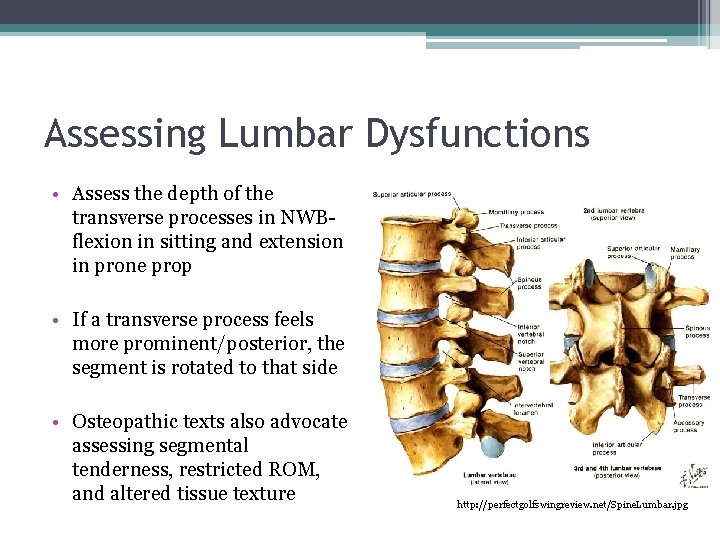
Assessing Lumbar Dysfunctions • Assess the depth of the transverse processes in NWBflexion in sitting and extension in prone prop • If a transverse process feels more prominent/posterior, the segment is rotated to that side • Osteopathic texts also advocate assessing segmental tenderness, restricted ROM, and altered tissue texture http: //perfectgolfswingreview. net/Spine. Lumbar. jpg
Positional Diagnosis • If the rotation is found in seated flexion, it is an ERS - the segment is stuck in Extension, Rotation, and Sidebending ▫ The dysfunctional facet is on the side that the vertebra has rotated towards • If the rotation is found in prone prop extension, it is an FRS- the segment is stuck in Flexion, Rotation, and Sidebending ▫ The dysfunctional facet is on the side that the vertebra has rotated away from
Sacral Dysfunctions • Sacral dysfunctions always occur with a L 5 dysfunction • Palpate the sacral base and the inferior lateral angles ▫ The SB and ILA on the same side will move together- whichever side feels more prominent is the side that the sacrum has rotated to

Sacral Dysfunctions • Right on Right (ROR)/Left on Left(LOL) torsions are always found with an ipsilateral ERS at L 5 ▫ Found in trunk flexion • Right on Left (ROL)/Left on Right (LOR) torsions are always found with an ipsilateral FRS at L 5 ▫ Found in trunk extension
MET Therapeutic Mechanisms • Increase tissue extensibility ▫ Research has shown that it is more likely due to increased tolerance to stretching rather than reflex relaxation • Influence pain mechanisms to promote hypoalgesia ▫ One theory is that it activates mechanoreceptors that are involved with centrally mediated pathways • Proposedly promotes changes in proprioception, motor planning, and control ▫ Pain inhibits the deep stabilizers and the superficial muscles overreact

Treatment • Muscle energy techniques should facilitate movement in the opposite direction of the dysfunctional segment ▫ 3 -5 seconds contractions repeated 3 -5 times • Monitor the movement barrier by palpating the inferior and superior interspinous spaces of the dysfunctional vertebra
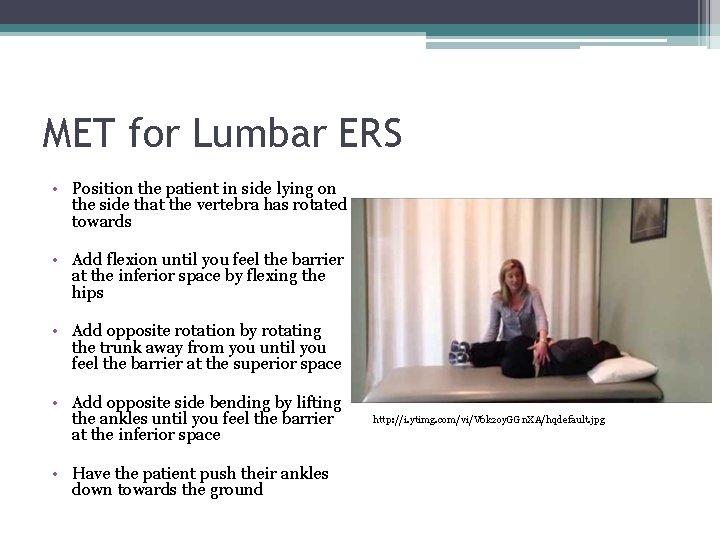
MET for Lumbar ERS • Position the patient in side lying on the side that the vertebra has rotated towards • Add flexion until you feel the barrier at the inferior space by flexing the hips • Add opposite rotation by rotating the trunk away from you until you feel the barrier at the superior space • Add opposite side bending by lifting the ankles until you feel the barrier at the inferior space • Have the patient push their ankles down towards the ground http: //i. ytimg. com/vi/V 6 k 2 oy. GGn. XA/hqdefault. jpg
MET for Sacral ROR/LOL Dysfunctions • Position the patient in side lying on the opposite side than the sacrum has rotated towards • Palpating the PSIS and SI joint, introduce flexion, rotation, and side bending the same as with lumbar ERS • Have the patient push their ankle down into your hand

MET for Lumbar FRS • Seated or side lying • Position the patient in side lying on the side that the vertebra has rotated towards • Add extension until you feel the barrier by pulling hips towards you and pushing shoulders and legs away • Add opposite rotation by rotating the trunk away from you until you feel the barrier at the superior space • Add opposite side bending by lifting the top leg until you feel the barrier at the inferior space • Have the patient pull their leg down towards the ground http: //www. csuchico. edu/~sbarker/spinealt/images/81. jpg
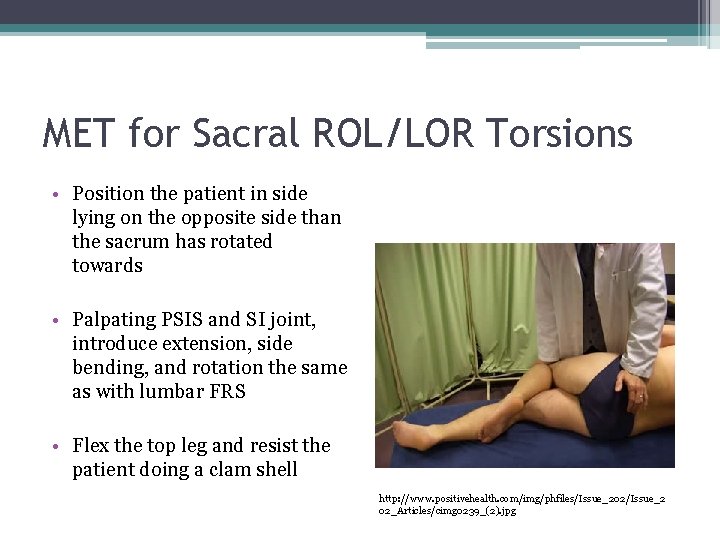
MET for Sacral ROL/LOR Torsions • Position the patient in side lying on the opposite side than the sacrum has rotated towards • Palpating PSIS and SI joint, introduce extension, side bending, and rotation the same as with lumbar FRS • Flex the top leg and resist the patient doing a clam shell http: //www. positivehealth. com/img/phfiles/Issue_202/Issue_2 02_Articles/cimg 0239_(2). jpg
Now what? • MET is just one tool- if the dysfunction occurred secondary to poor mechanics or muscle imbalances, its likely to reoccur
Interventions with Strong Evidence • Manual therapy (soft tissue mobilizations, thrust and non-thrust mobilizations, strain-counter strain, etc) • Trunk coordination, strengthening, and endurance exercises • Centralization and directional preference exercises • Patient education • Progressive fitness and endurance exercise
Any Questions?
Sources • Chien, J. , & Bajwa, Z. (2008). What is mechanical back pain and how best to treat it? Current Pain and Headache Reports, 12(6), 406 -411. • Day, J. , Mc. Keon, P. , & Nitz, A. (2010). The efficacy of cervical/thoracic active range of motion for detecting changes associated with individuals receiving muscle energy techniques. Physical Therapy Reviews, 15(6), 453 -461. • Delitto, A. , George, S. , Van Dillen, L. , Whitman, J. , Sowa, G. , Shekelle, P. , . . . Godges, J. (2012). Low back pain clinical practice guidelines linked to the international classification of functioning, disability, and health. Journal of Orthopaedic and Sports Physical Therapy, 42(4), A 1 -A 57. • Fryer, G. (2010). Muscle energy technique: An evidence-informed approach. International Journal of Osteopathic Medicine, 14(1), 3 -9. • Licciardone, J. , Minotti, D. , Gatchel, R. , Kearns, C. , & Singh, K. (2013). Osteopathic manual treatment and ultrasound therapy for chronic low back pain. Annals of Family Medicine, 11(2), 122 -129.
- Slides: 18