
Mechanical Engineering U of Utah Faculty Spring 2019
- Slides: 5
Mechanical Engineering – U of Utah • Faculty (Spring 2019): 38 tenure track, 4 research track • 2 -3 new tenure line faculty for 2019 -2020 • Staff: 16 • Enrollment (Spring 2019): • 970 undergrad, 235 graduate (132 Ph. D, 103 MS) • Doubled Ph. D enrollment in 5 years • Degrees (2017 -2018) • 166 BS, 62 MS, 18 Ph. D • Research Expenditures: over $17 M • Research Excellence: nano, heat transfer, environmental fluid dynamics, composite materials, robotics, computational mechanics, ergonomics, biomechanics, and other areas • Rankings: USNWR - 52 (U. S. - 2018)
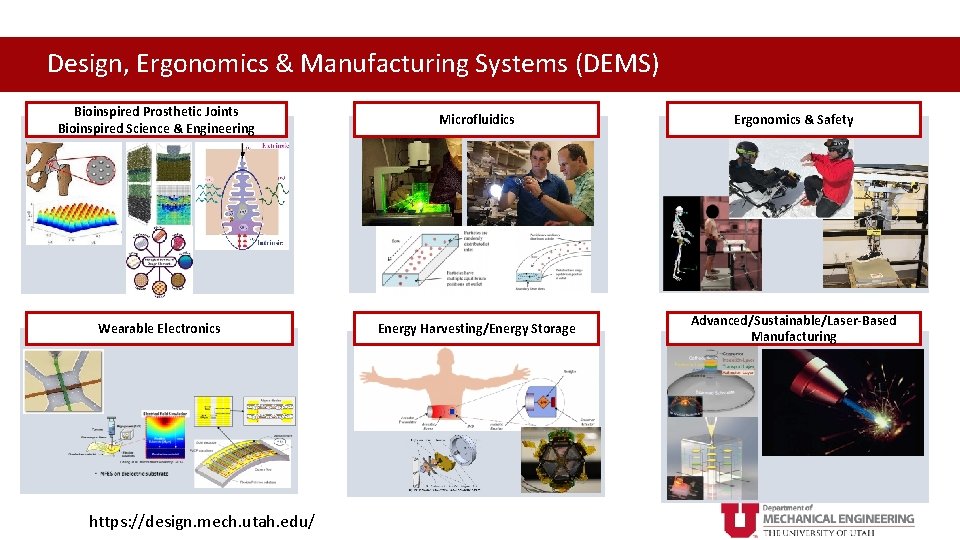
Design, Ergonomics & Manufacturing Systems(TFES) (DEMS) Thermal, Fluids and Energy Systems Bioinspired Prosthetic Joints Bioinspired Science & Engineering Microfluidics Ergonomics & Safety Wearable Electronics Energy Harvesting/Energy Storage Advanced/Sustainable/Laser-Based Manufacturing https: //design. mech. utah. edu/
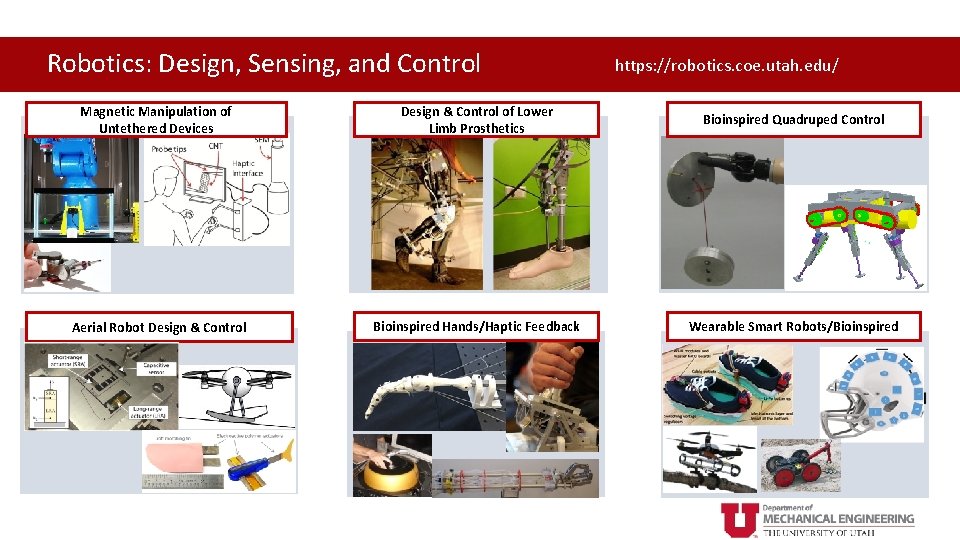
https: //robotics. coe. utah. edu/ Robotics: Thermal, Design, Sensing, and. Energy Control. Systems (TFES) Fluids and Magnetic Manipulation of Untethered Devices Design & Control of Lower Limb Prosthetics Bioinspired Quadruped Control Aerial Robot Design & Control Bioinspired Hands/Haptic Feedback Wearable Smart Robots/Bioinspired
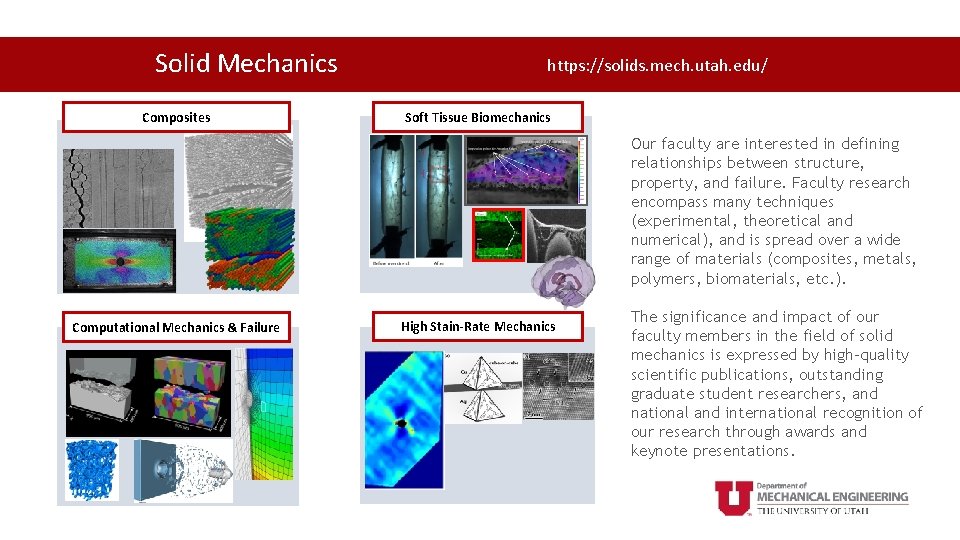
Solid Mechanics Thermal, Fluids and Energy Systemshttps: //solids. mech. utah. edu/ (TFES) Composites Soft Tissue Biomechanics Our faculty are interested in defining relationships between structure, property, and failure. Faculty research encompass many techniques (experimental, theoretical and numerical), and is spread over a wide range of materials (composites, metals, polymers, biomaterials, etc. ). 50 mm Computational Mechanics & Failure High Stain-Rate Mechanics The significance and impact of our faculty members in the field of solid mechanics is expressed by high-quality scientific publications, outstanding graduate student researchers, and national and international recognition of our research through awards and keynote presentations.
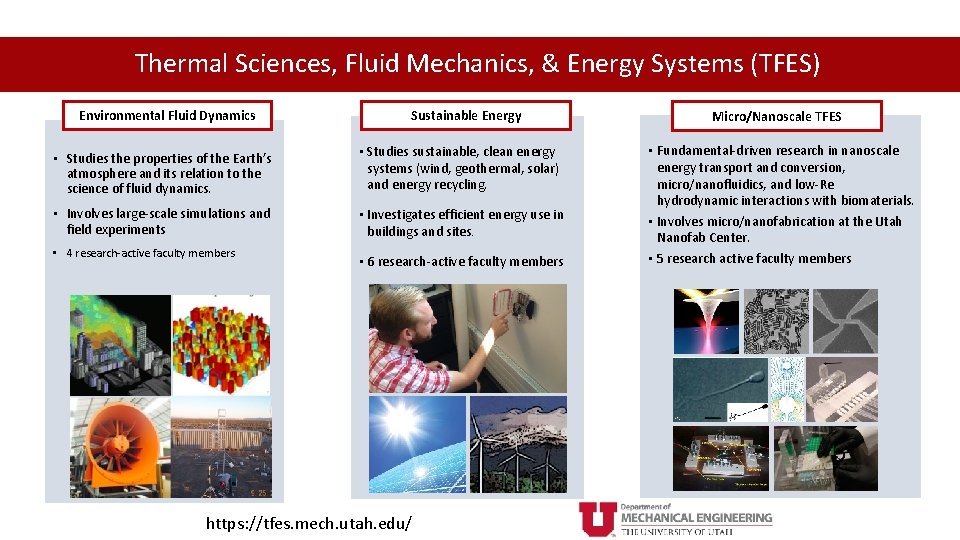
Thermal Sciences, Fluid Mechanics, & Energy Thermal, Fluids and Energy Systems (TFES) Environmental Fluid Dynamics Sustainable Energy • Studies the properties of the Earth’s atmosphere and its relation to the science of fluid dynamics. • Studies sustainable, clean energy systems (wind, geothermal, solar) and energy recycling. • Involves large-scale simulations and field experiments • Investigates efficient energy use in buildings and sites. • 4 research-active faculty members • 6 research-active faculty members https: //tfes. mech. utah. edu/ Micro/Nanoscale TFES • Fundamental-driven research in nanoscale energy transport and conversion, micro/nanofluidics, and low-Re hydrodynamic interactions with biomaterials. • Involves micro/nanofabrication at the Utah Nanofab Center. • 5 research active faculty members