
Mechanical Design representation enough information to manufacture the

![Geometric Projections: history Albrecht Durer’s machine [14? ? AD] (perspective map)](https://slidetodoc.com/presentation_image_h2/16b11e3752063a5a738f43bbf8cf4c4c/image-6.jpg "Geometric Projections: history Albrecht Durer’s machine [14? ? AD] (perspective map)")
![The hole-basic specification convention [Holes are made by drills]](https://slidetodoc.com/presentation_image_h2/16b11e3752063a5a738f43bbf8cf4c4c/image-26.jpg "The hole-basic specification convention [Holes are made by drills]")
- Slides: 39
Mechanical Design representation: enough information to manufacture the part precisely inspect the manufactured part [geometry, dimensions, tolerances] analyze the part/product behavior
Design models and data Projections Theoretical technique to map 3 D objects to 2 D Dimensions To assist machinist: e. g. distance between centers of holes Tolerances imprecision in machining must specify the tolerance range
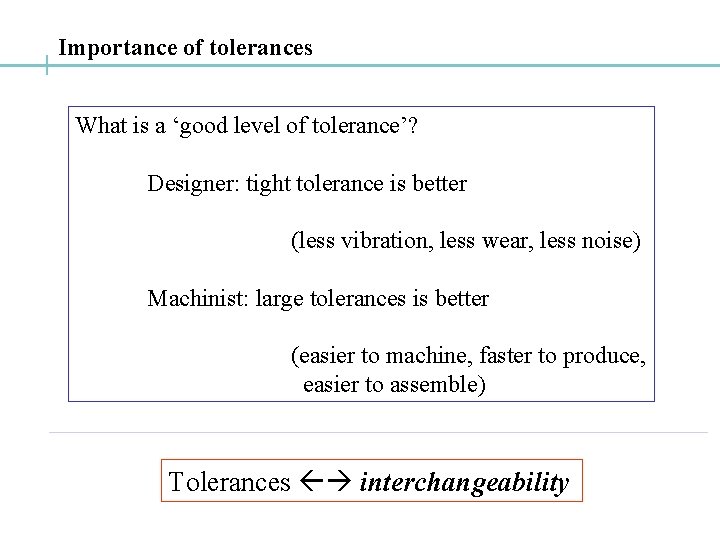
Importance of tolerances What is a ‘good level of tolerance’? Designer: tight tolerance is better (less vibration, less wear, less noise) Machinist: large tolerances is better (easier to machine, faster to produce, easier to assemble) Tolerances interchangeability
Tolerance and Concurrent Engineering Why ? Tolerance specification needs knowledge of accuracy, repeatability of machines process capability …
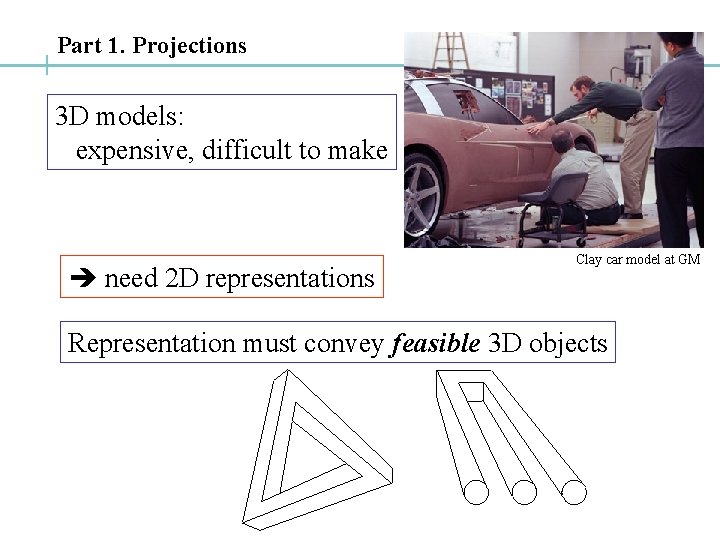
Part 1. Projections 3 D models: expensive, difficult to make need 2 D representations Clay car model at GM Representation must convey feasible 3 D objects
Geometric Projections: history Albrecht Durer’s machine [14? ? AD] (perspective map)
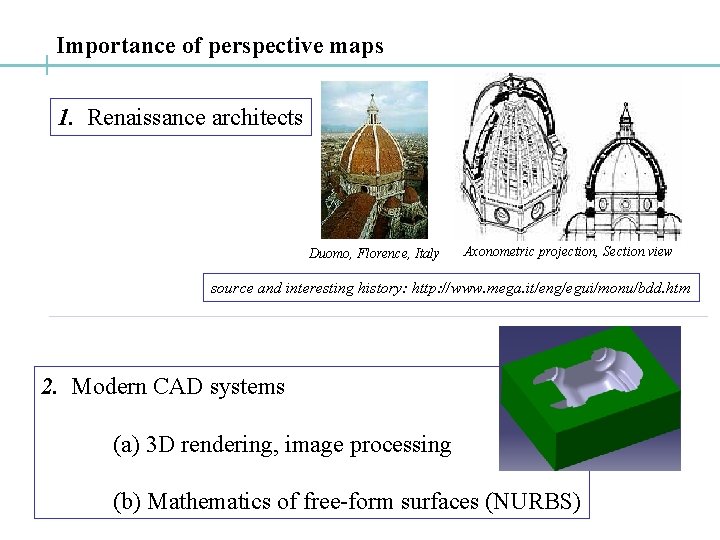
Importance of perspective maps 1. Renaissance architects Duomo, Florence, Italy Axonometric projection, Section view source and interesting history: http: //www. mega. it/eng/egui/monu/bdd. htm 2. Modern CAD systems (a) 3 D rendering, image processing (b) Mathematics of free-form surfaces (NURBS)
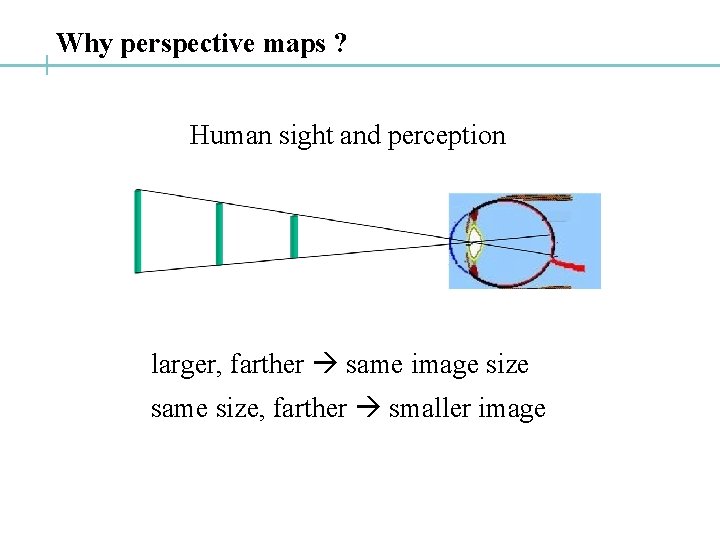
Why perspective maps ? Human sight and perception larger, farther same image size same size, farther smaller image
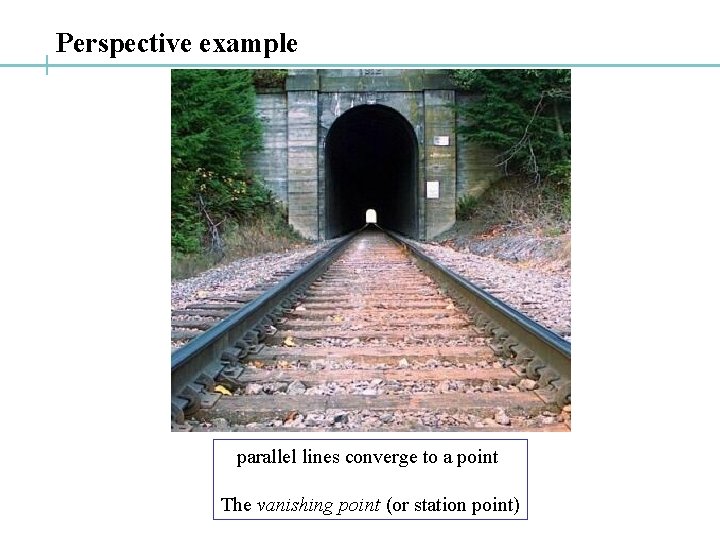
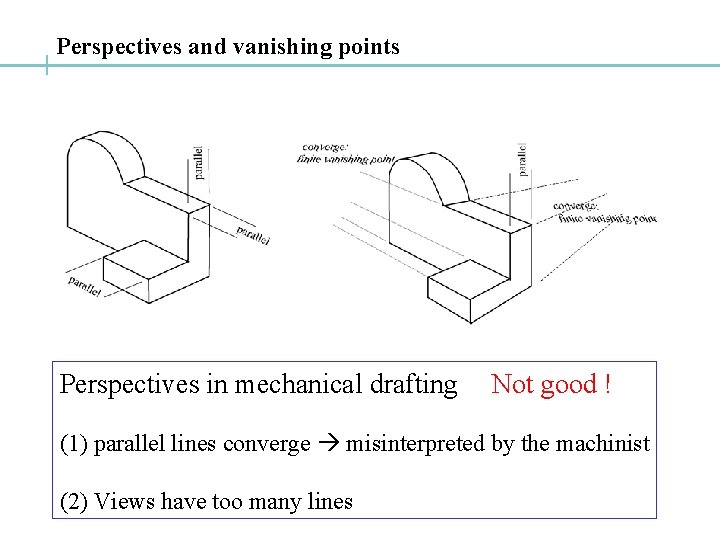
Perspective example parallel lines converge to a point The vanishing point (or station point)
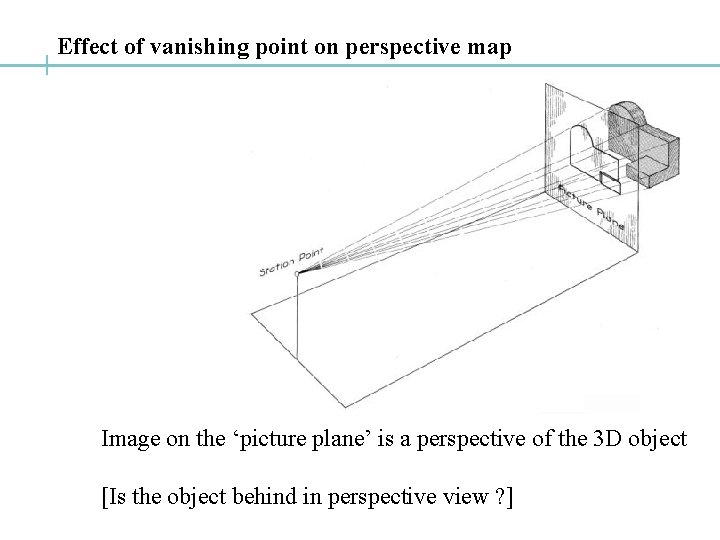
Effect of vanishing point on perspective map Image on the ‘picture plane’ is a perspective of the 3 D object [Is the object behind in perspective view ? ]
Perspectives and vanishing points Perspectives in mechanical drafting Not good ! (1) parallel lines converge misinterpreted by the machinist (2) Views have too many lines
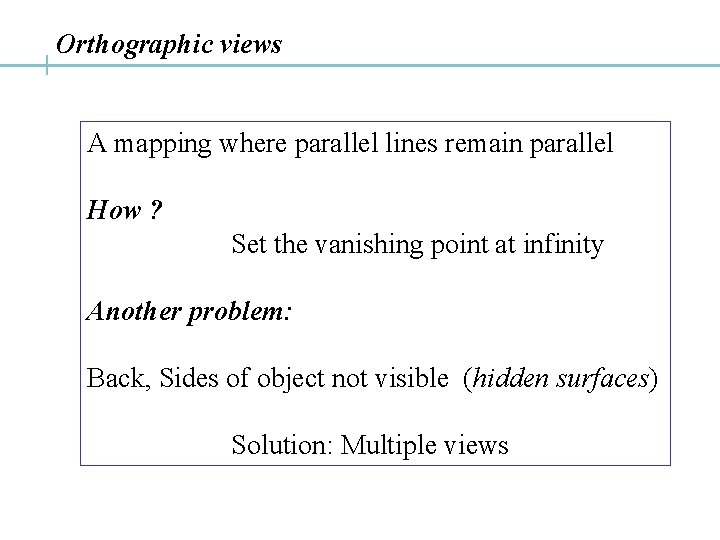
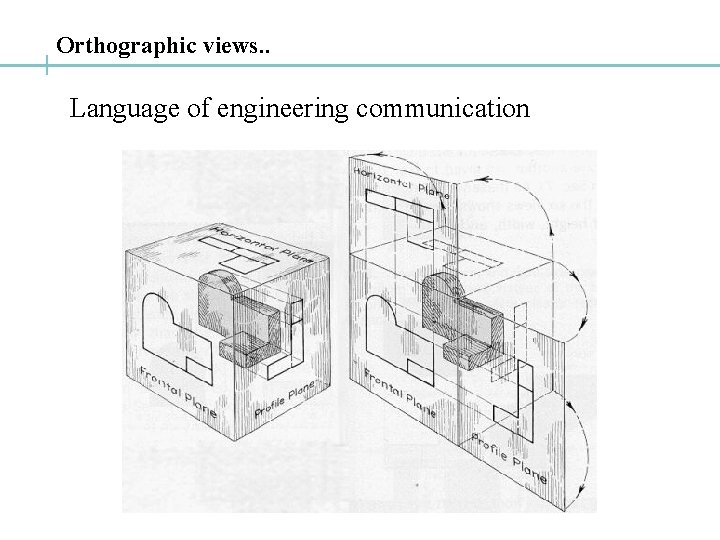
Orthographic views A mapping where parallel lines remain parallel How ? Set the vanishing point at infinity Another problem: Back, Sides of object not visible (hidden surfaces) Solution: Multiple views
Orthographic views. . Language of engineering communication
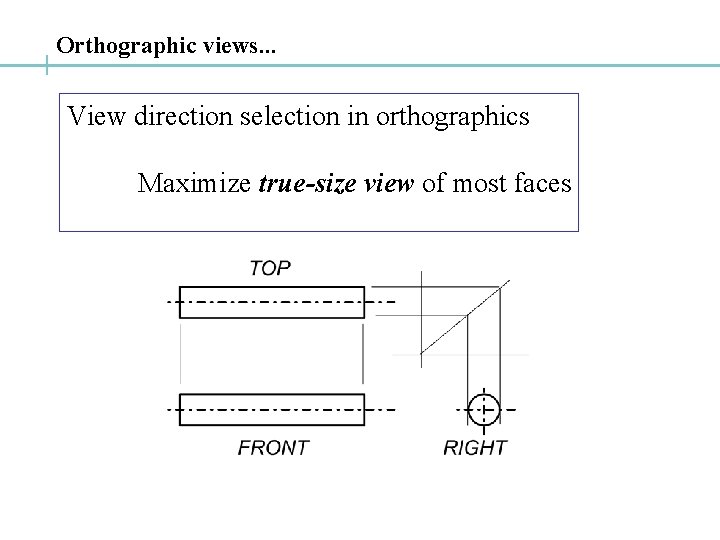
Orthographic views. . . View direction selection in orthographics Maximize true-size view of most faces
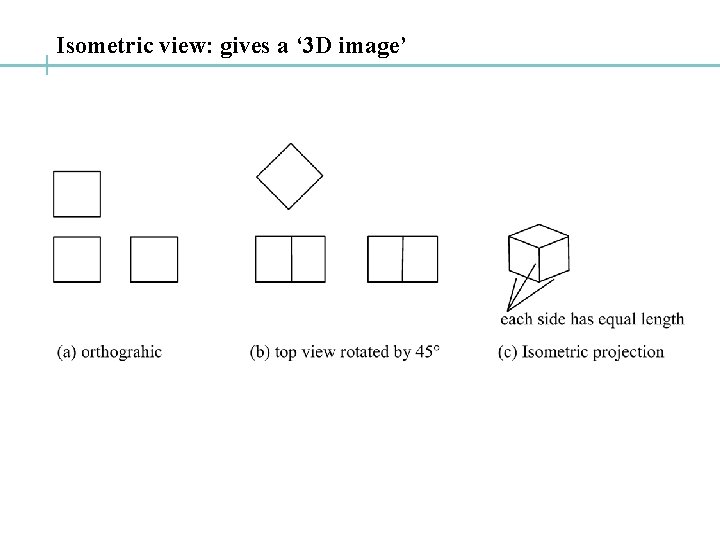
Isometric view: gives a ‘ 3 D image’
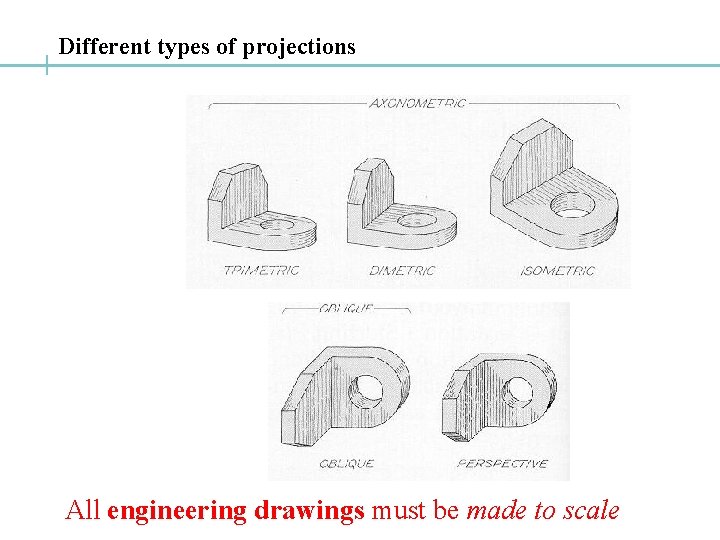
Different types of projections All engineering drawings must be made to scale
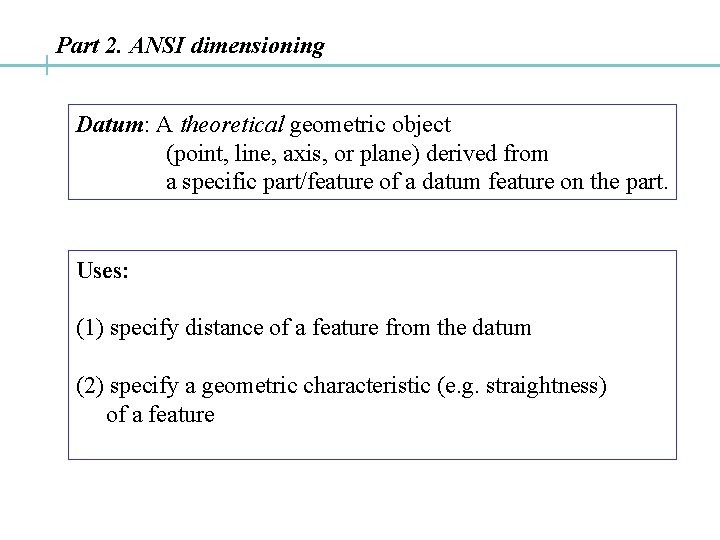
Part 2. ANSI dimensioning Datum: A theoretical geometric object (point, line, axis, or plane) derived from a specific part/feature of a datum feature on the part. Uses: (1) specify distance of a feature from the datum (2) specify a geometric characteristic (e. g. straightness) of a feature
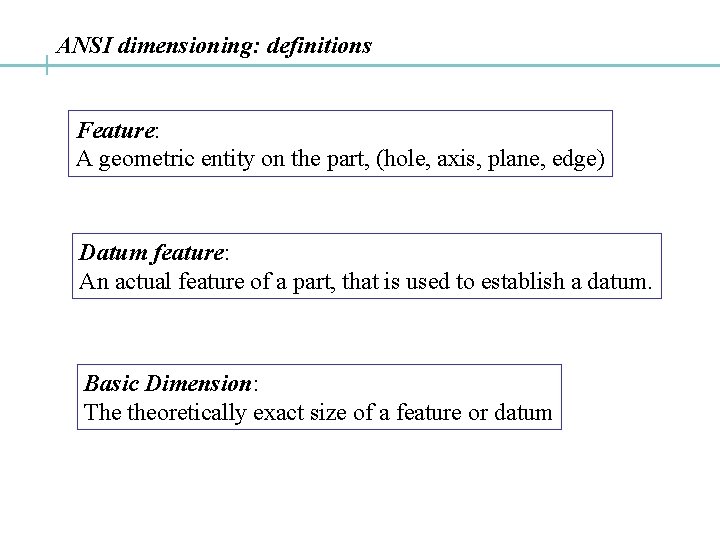
ANSI dimensioning: definitions Feature: A geometric entity on the part, (hole, axis, plane, edge) Datum feature: An actual feature of a part, that is used to establish a datum. Basic Dimension: The theoretically exact size of a feature or datum
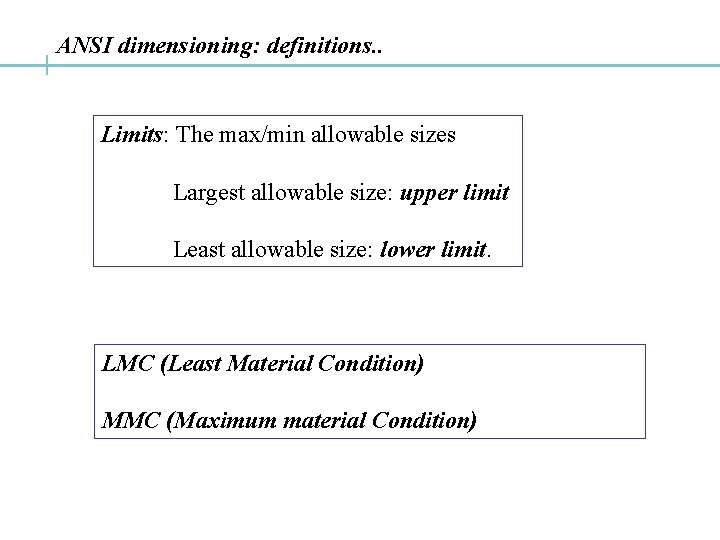
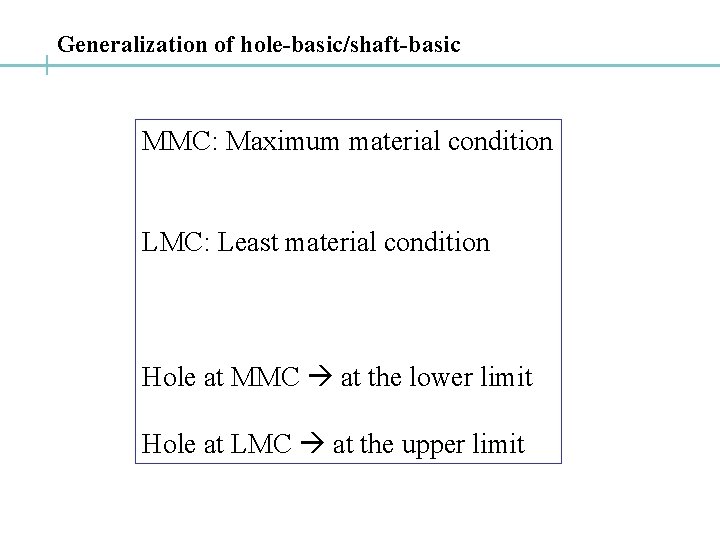
ANSI dimensioning: definitions. . Limits: The max/min allowable sizes Largest allowable size: upper limit Least allowable size: lower limit. LMC (Least Material Condition) MMC (Maximum material Condition)
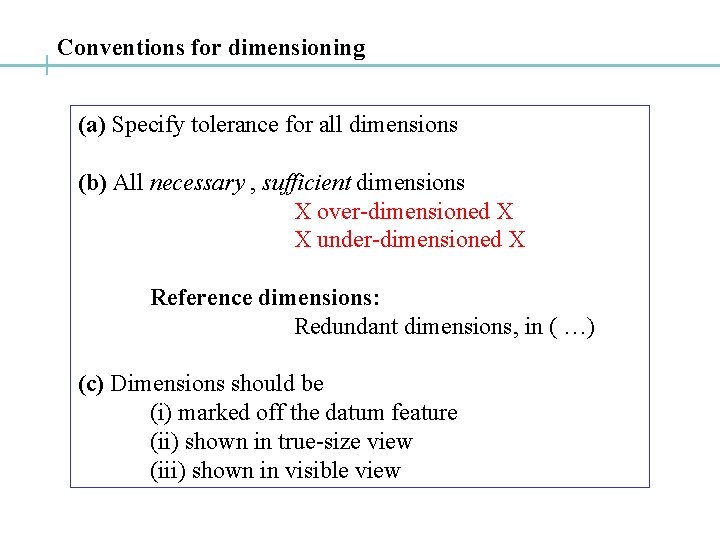
Conventions for dimensioning (a) Specify tolerance for all dimensions (b) All necessary , sufficient dimensions X over-dimensioned X X under-dimensioned X Reference dimensions: Redundant dimensions, in ( …) (c) Dimensions should be (i) marked off the datum feature (ii) shown in true-size view (iii) shown in visible view
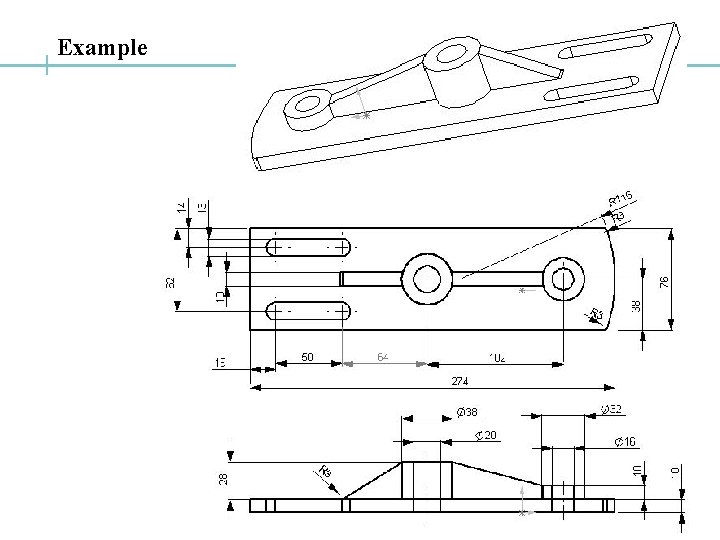
Example
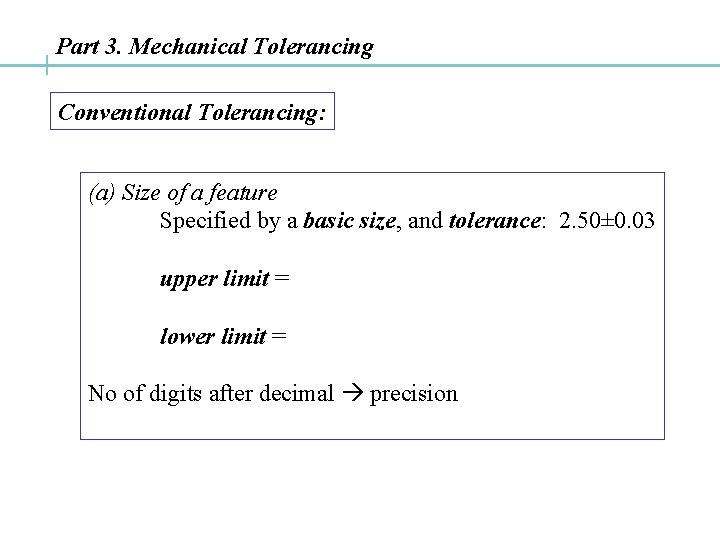
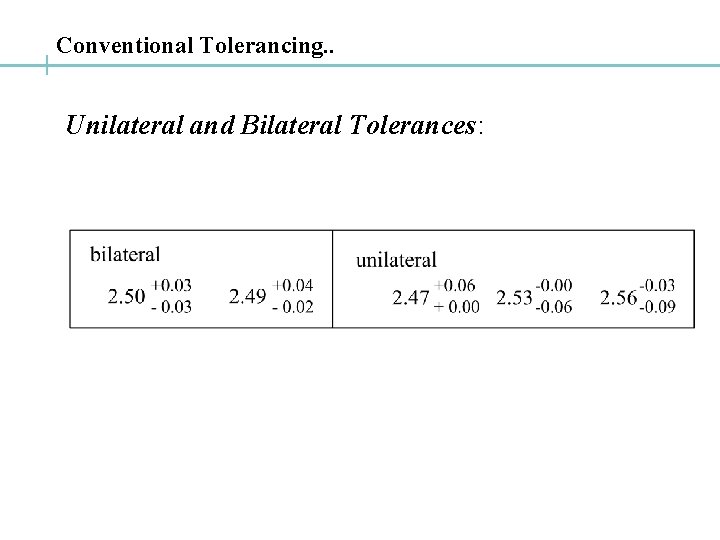
Part 3. Mechanical Tolerancing Conventional Tolerancing: (a) Size of a feature Specified by a basic size, and tolerance: 2. 50± 0. 03 upper limit = lower limit = No of digits after decimal precision
Conventional Tolerancing. . Unilateral and Bilateral Tolerances:
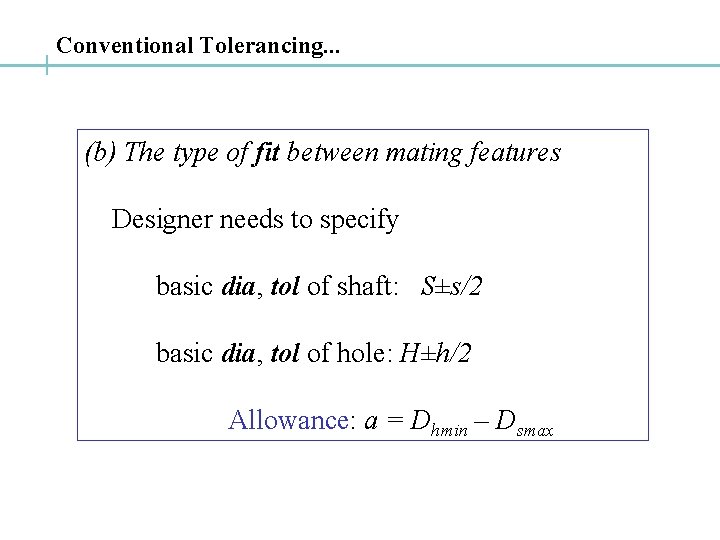
Conventional Tolerancing. . . (b) The type of fit between mating features Designer needs to specify basic dia, tol of shaft: S±s/2 basic dia, tol of hole: H±h/2 Allowance: a = Dhmin – Dsmax
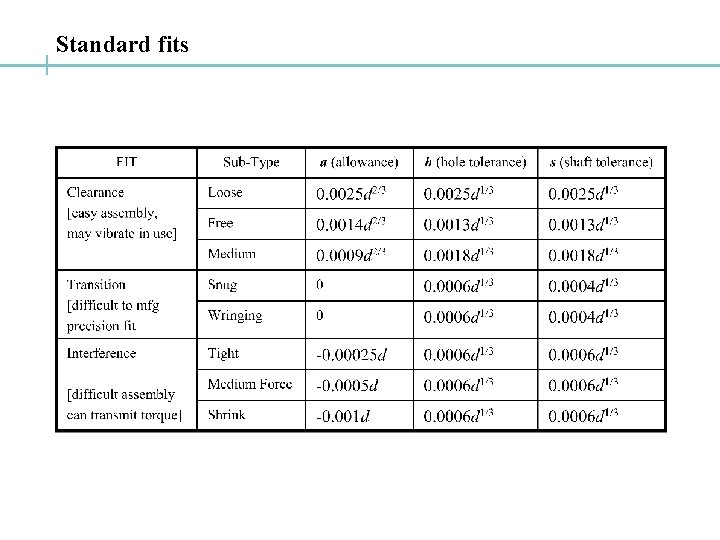
Standard fits
The hole-basic specification convention [Holes are made by drills]
Generalization of hole-basic/shaft-basic MMC: Maximum material condition LMC: Least material condition Hole at MMC at the lower limit Hole at LMC at the upper limit
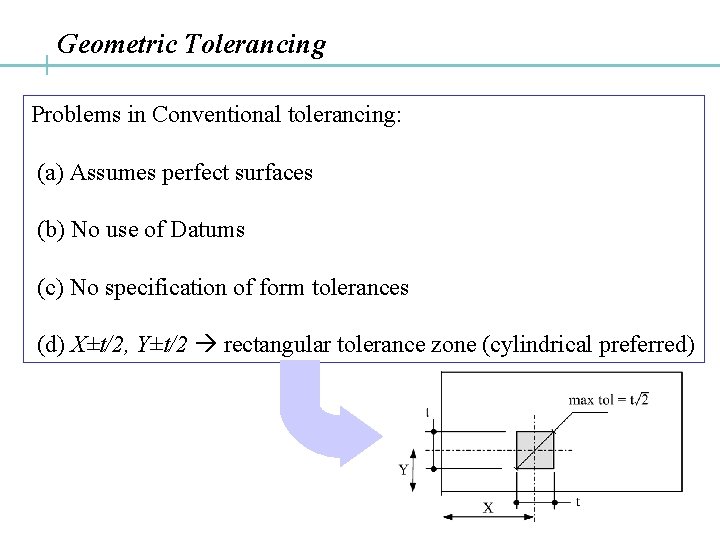
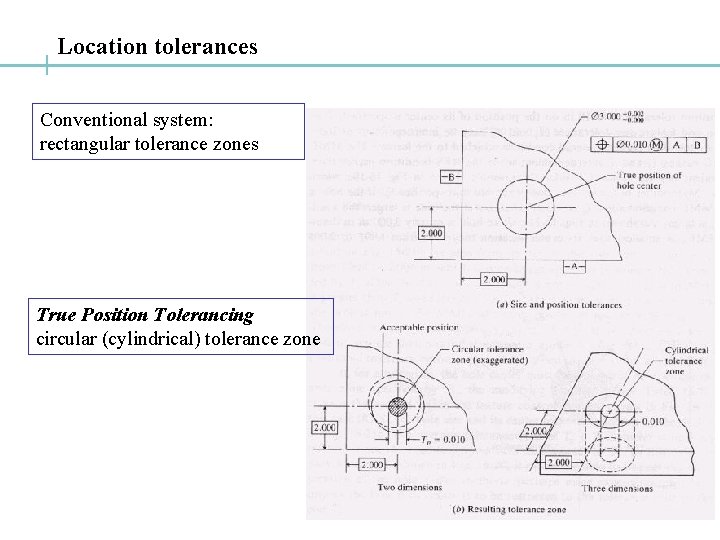
Geometric Tolerancing Problems in Conventional tolerancing: (a) Assumes perfect surfaces (b) No use of Datums (c) No specification of form tolerances (d) X±t/2, Y±t/2 rectangular tolerance zone (cylindrical preferred)
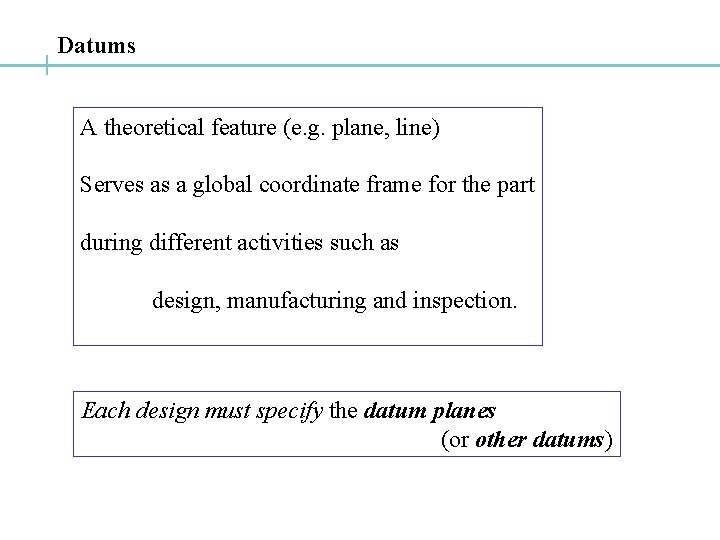
Datums A theoretical feature (e. g. plane, line) Serves as a global coordinate frame for the part during different activities such as design, manufacturing and inspection. Each design must specify the datum planes (or other datums)
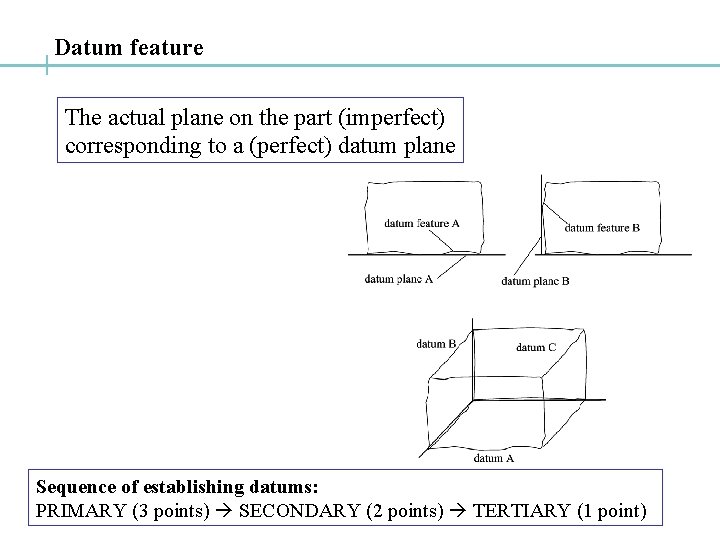
Datum feature The actual plane on the part (imperfect) corresponding to a (perfect) datum plane Sequence of establishing datums: PRIMARY (3 points) SECONDARY (2 points) TERTIARY (1 point)
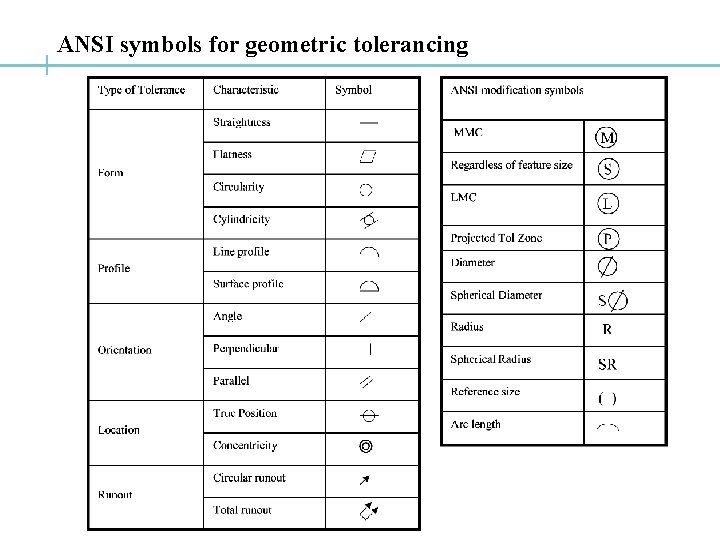
ANSI symbols for geometric tolerancing
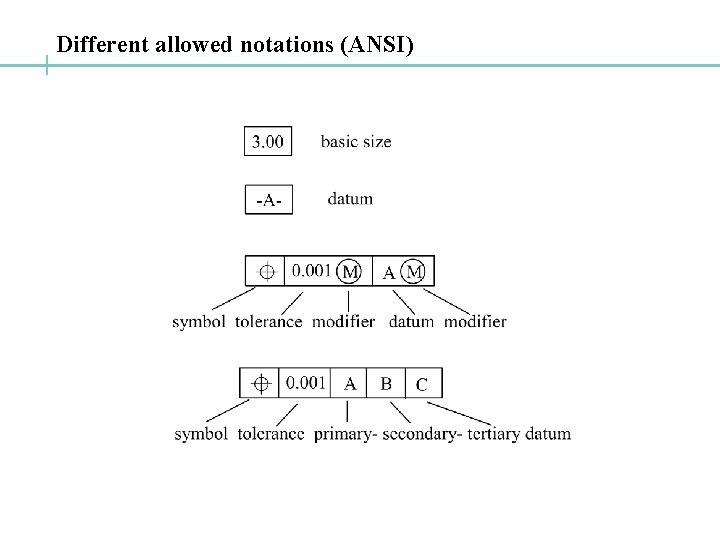
Different allowed notations (ANSI)
Location tolerances Conventional system: rectangular tolerance zones True Position Tolerancing circular (cylindrical) tolerance zone
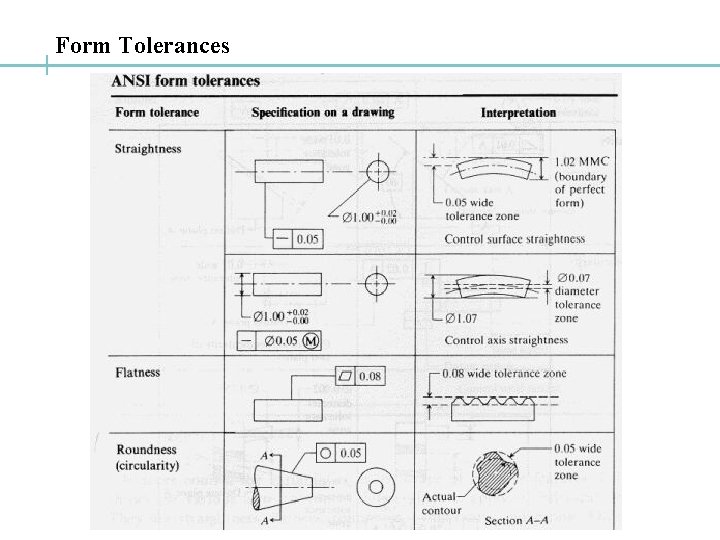
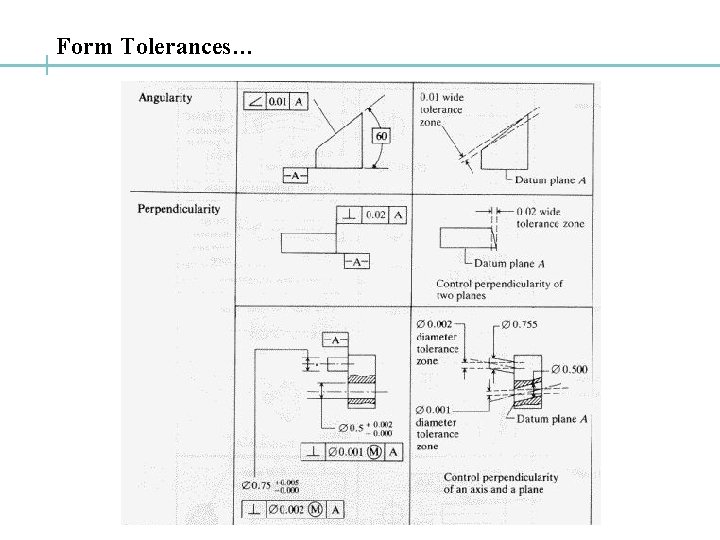
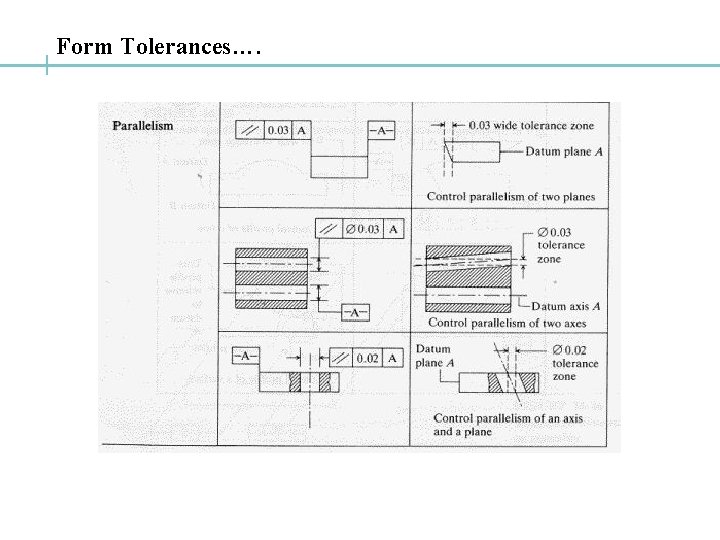
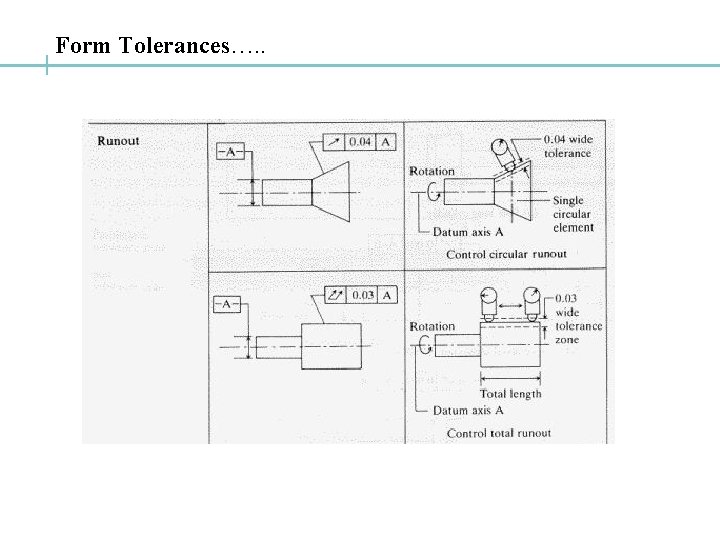
Form Tolerances
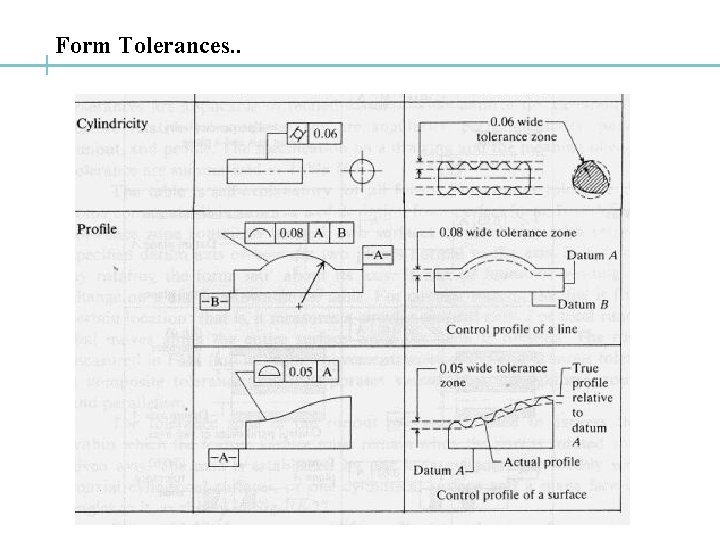
Form Tolerances. .
Form Tolerances…
Form Tolerances….
Form Tolerances…. .
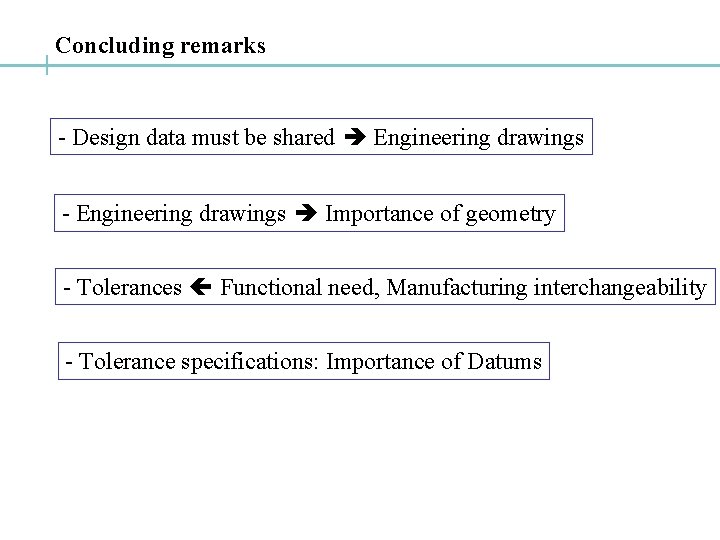
Concluding remarks - Design data must be shared Engineering drawings - Engineering drawings Importance of geometry - Tolerances Functional need, Manufacturing interchangeability - Tolerance specifications: Importance of Datums