
MECHANICAL ASSEMBLY 1 Rivets and Eyelets 2 Assembly
MECHANICAL ASSEMBLY 1. Rivets and Eyelets 2. Assembly Methods Based on Interference Fits 3. Other Mechanical Fastening Methods 4. Molding Inserts and Integral Fasteners 5. Design for Assembly © 2007 John Wiley & Sons, Inc. M P Groover, Fundamentals of Modern Manufacturing 3/e
Rivets Unthreaded, headed pin used to join two or more parts by passing pin through holes in parts and forming a second head in the pin on the opposite side § Widely used fasteners for achieving a permanent mechanically fastened joint § Clearance hole into which rivet is inserted must be close to the diameter of the rivet © 2007 John Wiley & Sons, Inc. M P Groover, Fundamentals of Modern Manufacturing 3/e
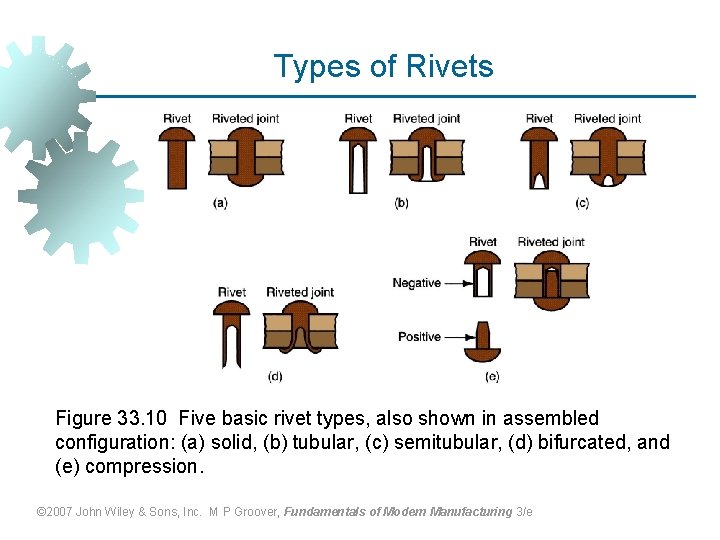
Types of Rivets Figure 33. 10 Five basic rivet types, also shown in assembled configuration: (a) solid, (b) tubular, (c) semitubular, (d) bifurcated, and (e) compression. © 2007 John Wiley & Sons, Inc. M P Groover, Fundamentals of Modern Manufacturing 3/e

Applications and Advantages of Rivets § § § Used primarily for lap joints A primary fastening method in aircraft and aerospace industries Advantages: § High production rates § Simplicity § Dependability § Low cost © 2007 John Wiley & Sons, Inc. M P Groover, Fundamentals of Modern Manufacturing 3/e
Tooling and Methods for Rivets 1. Impact - pneumatic hammer delivers a succession of blows to upset rivet 2. Steady compression - riveting tool applies a continuous squeezing pressure to upset rivet 3. Combination of impact and compression © 2007 John Wiley & Sons, Inc. M P Groover, Fundamentals of Modern Manufacturing 3/e
Interference Fits Assembly methods based on mechanical interference between two mating parts being joined § The interference, either during assembly or after joining, holds the parts together § Interference fit methods include: § Press fitting § Shrink and expansion fits § Snap fits § Retaining rings © 2007 John Wiley & Sons, Inc. M P Groover, Fundamentals of Modern Manufacturing 3/e
Press Fitting § Typical case is where a pin (e. g. , a straight cylindrical pin) of a certain diameter is pressed into a hole of a slightly smaller diameter § Possible functions: § Locating and locking components ‑ to augment threaded fasteners by holding parts in fixed alignment with each other § Pivot points - to permit rotation of one component about the other § Shear pins © 2007 John Wiley & Sons, Inc. M P Groover, Fundamentals of Modern Manufacturing 3/e
Shrink and Expansion Fits Assembly of two parts (e. g. , shaft in collar) that have an interference fit at room temperature § Shrink fitting - external part is enlarged by heating, and internal part either stays at room temperature or is contracted by cooling § Expansion fitting - internal part is contracted by cooling and inserted into mating component - when at room temperature, expansion creates interference § Used to fit gears, pulleys, sleeves, and other components onto solid and hollow shafts © 2007 John Wiley & Sons, Inc. M P Groover, Fundamentals of Modern Manufacturing 3/e
Snap Fits Joining of two parts in which mating elements possess a temporary interference during assembly, but once assembled they interlock § During assembly, one or both parts elastically deform to accommodate temporary interference § Usually designed for slight interference after assembly § Originally conceived as a method ideally suited for industrial robots § Eureka! – it’s easier for humans too © 2007 John Wiley & Sons, Inc. M P Groover, Fundamentals of Modern Manufacturing 3/e
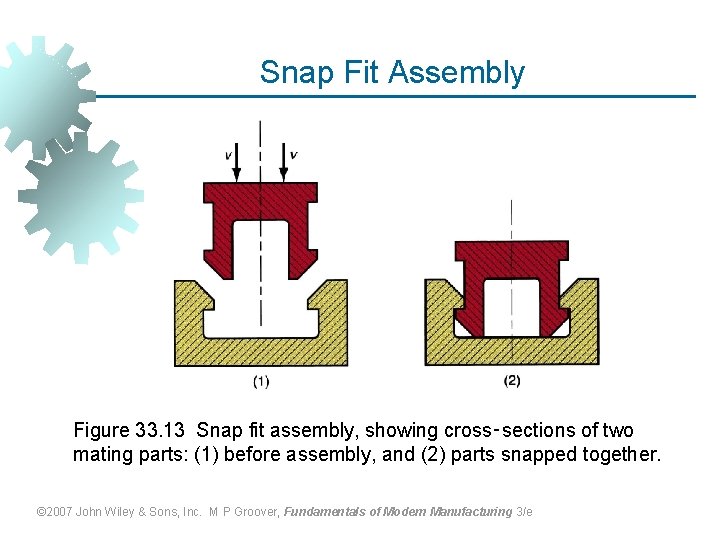
Snap Fit Assembly Figure 33. 13 Snap fit assembly, showing cross‑sections of two mating parts: (1) before assembly, and (2) parts snapped together. © 2007 John Wiley & Sons, Inc. M P Groover, Fundamentals of Modern Manufacturing 3/e
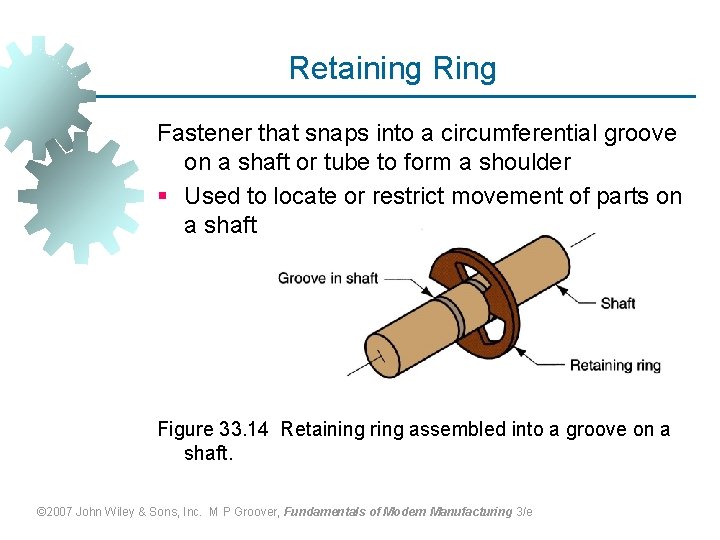
Retaining Ring Fastener that snaps into a circumferential groove on a shaft or tube to form a shoulder § Used to locate or restrict movement of parts on a shaft Figure 33. 14 Retaining ring assembled into a groove on a shaft. © 2007 John Wiley & Sons, Inc. M P Groover, Fundamentals of Modern Manufacturing 3/e
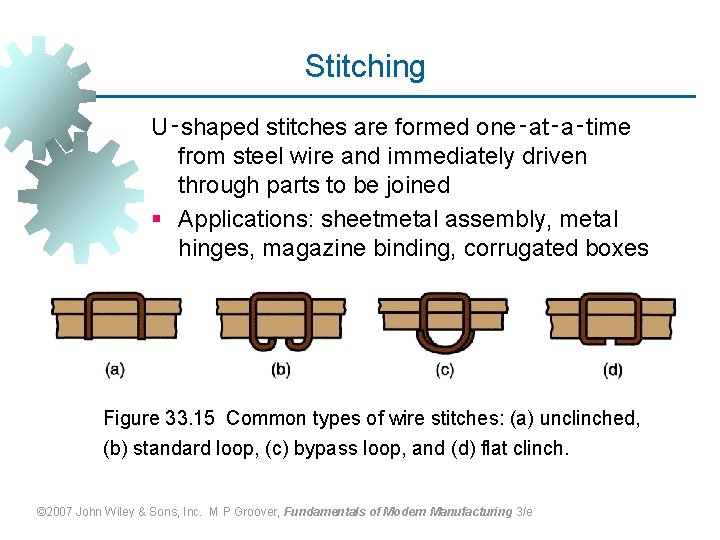
Stitching U‑shaped stitches are formed one‑at‑a‑time from steel wire and immediately driven through parts to be joined § Applications: sheetmetal assembly, metal hinges, magazine binding, corrugated boxes Figure 33. 15 Common types of wire stitches: (a) unclinched, (b) standard loop, (c) bypass loop, and (d) flat clinch. © 2007 John Wiley & Sons, Inc. M P Groover, Fundamentals of Modern Manufacturing 3/e
Stapling Preformed U‑shaped staples are punched through the two parts to be attached § Supplied in convenient strips § Usually applied by portable pneumatic guns § Applications: furniture and upholstery, car seats, various light‑gage sheetmetal and plastic assembly jobs © 2007 John Wiley & Sons, Inc. M P Groover, Fundamentals of Modern Manufacturing 3/e
Molding Inserts and Integral Fasteners Permanent joining methods that involve shaping or reshaping one of the components by a manufacturing process such as: § Casting § Molding § Sheet-metal forming © 2007 John Wiley & Sons, Inc. M P Groover, Fundamentals of Modern Manufacturing 3/e
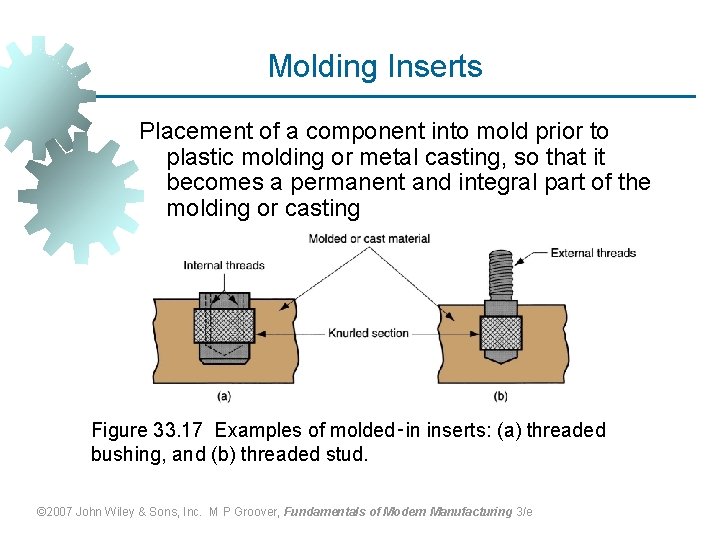
Molding Inserts Placement of a component into mold prior to plastic molding or metal casting, so that it becomes a permanent and integral part of the molding or casting Figure 33. 17 Examples of molded‑in inserts: (a) threaded bushing, and (b) threaded stud. © 2007 John Wiley & Sons, Inc. M P Groover, Fundamentals of Modern Manufacturing 3/e
Why Use Molding Inserts? § Insert has better properties than molded or cast material § Insert geometry is too complex or intricate to incorporate into mold § Examples of applications: § Internally threaded bushings and nuts § Externally threaded studs § Bearings § Electrical contacts © 2007 John Wiley & Sons, Inc. M P Groover, Fundamentals of Modern Manufacturing 3/e
Integral Fasteners Components are deformed so they interlock as a mechanically fastened joint § Methods include: § Lanced tabs § Seaming § Beading © 2007 John Wiley & Sons, Inc. M P Groover, Fundamentals of Modern Manufacturing 3/e
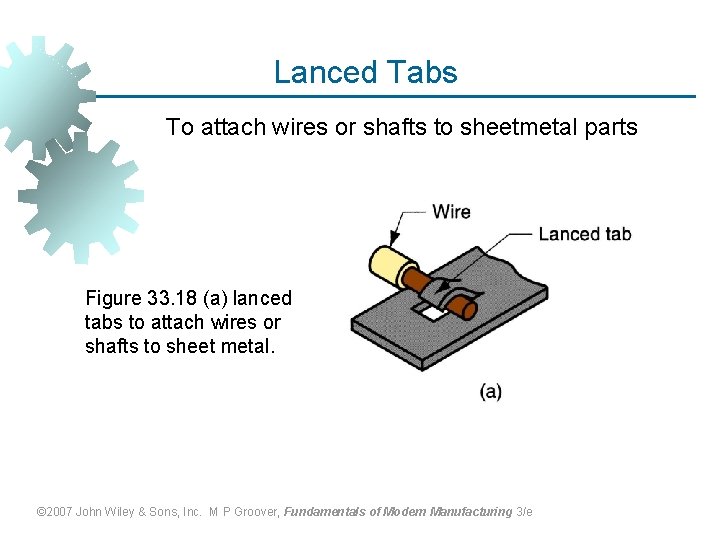
Lanced Tabs To attach wires or shafts to sheetmetal parts Figure 33. 18 (a) lanced tabs to attach wires or shafts to sheet metal. © 2007 John Wiley & Sons, Inc. M P Groover, Fundamentals of Modern Manufacturing 3/e
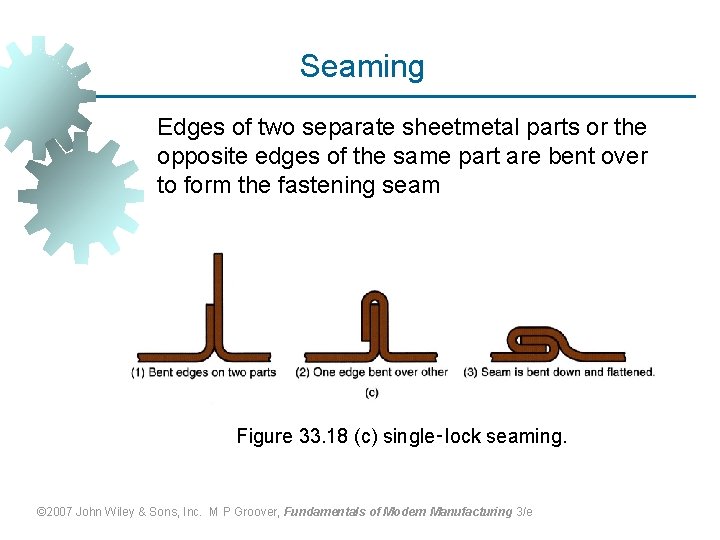
Seaming Edges of two separate sheetmetal parts or the opposite edges of the same part are bent over to form the fastening seam Figure 33. 18 (c) single‑lock seaming. © 2007 John Wiley & Sons, Inc. M P Groover, Fundamentals of Modern Manufacturing 3/e
Design for Assembly (DFA) § § Keys to successful DFA: 1. Design product with as few parts as possible 2. Design remaining parts so they are easy to assemble Assembly cost is determined largely in product design, when the number of components in the product and how they are assembled is decided § Once these decisions are made, little can be done in manufacturing to reduce assembly costs © 2007 John Wiley & Sons, Inc. M P Groover, Fundamentals of Modern Manufacturing 3/e
DFA Guidelines § Use modularity in product design § Each subassembly should have a maximum of 12 or so parts § Design the subassembly around a base part to which other components are added § Reduce the need for multiple components to be handled at once © 2007 John Wiley & Sons, Inc. M P Groover, Fundamentals of Modern Manufacturing 3/e
More DFA Guidelines § Limit the required directions of access § Adding all components vertically from above is the ideal § Use high quality components § Poor quality parts jams feeding and assembly mechanisms § Minimize threaded fasteners § Use snap fit assembly © 2007 John Wiley & Sons, Inc. M P Groover, Fundamentals of Modern Manufacturing 3/e
Thanks © 2007 John Wiley & Sons, Inc. M P Groover, Fundamentals of Modern Manufacturing 3/e
- Slides: 23