
MECHANICAL ASSEMBLY 1 Introduction 2 Threaded Fasteners 2007
MECHANICAL ASSEMBLY 1. Introduction 2. Threaded Fasteners © 2007 John Wiley & Sons, Inc. M P Groover, Fundamentals of Modern Manufacturing 3/e

Mechanical Assembly Defined Use of various fastening methods to mechanically attach two or more parts together § In most cases, discrete hardware components, called fasteners, are added to the parts during assembly § In other cases, fastening involves shaping or reshaping of a component, and no separate fasteners are required © 2007 John Wiley & Sons, Inc. M P Groover, Fundamentals of Modern Manufacturing 3/e
Products of Mechanical Assembly § Many consumer products are assembled largely by mechanical fastening methods § Examples: automobiles, large and small appliances, telephones § Many capital goods products are assembled using mechanical fastening methods § Examples: commercial airplanes, trucks, railway locomotives and cars, machine tools © 2007 John Wiley & Sons, Inc. M P Groover, Fundamentals of Modern Manufacturing 3/e
Two Major Types of Mechanical Assembly 1. Methods that allow for disassembly § Example: threaded fasteners 2. Methods that create a permanent joint § Example: rivets © 2007 John Wiley & Sons, Inc. M P Groover, Fundamentals of Modern Manufacturing 3/e

Why Use Mechanical Assembly? § Ease of assembly – can be accomplished with relative ease by unskilled workers § Minimum of special tooling required § In a relatively short time § Ease of disassembly – at least for the methods that permit disassembly § Some disassembly is required for most products to perform maintenance and repair © 2007 John Wiley & Sons, Inc. M P Groover, Fundamentals of Modern Manufacturing 3/e
Threaded Fasteners Discrete hardware components that have external or internal threads for assembly of parts § Most important category of mechanical assembly § In nearly all cases, threaded fasteners permit disassembly § Common threaded fastener types are screws, bolts, and nuts © 2007 John Wiley & Sons, Inc. M P Groover, Fundamentals of Modern Manufacturing 3/e
Screws, Bolts, and Nuts Screw - externally threaded fastener generally assembled into a blind threaded hole Bolt - externally threaded fastener inserted into through holes and "screwed" into a nut on the opposite side Nut - internally threaded fastener having standard threads that match those on bolts of the same diameter, pitch, and thread form © 2007 John Wiley & Sons, Inc. M P Groover, Fundamentals of Modern Manufacturing 3/e
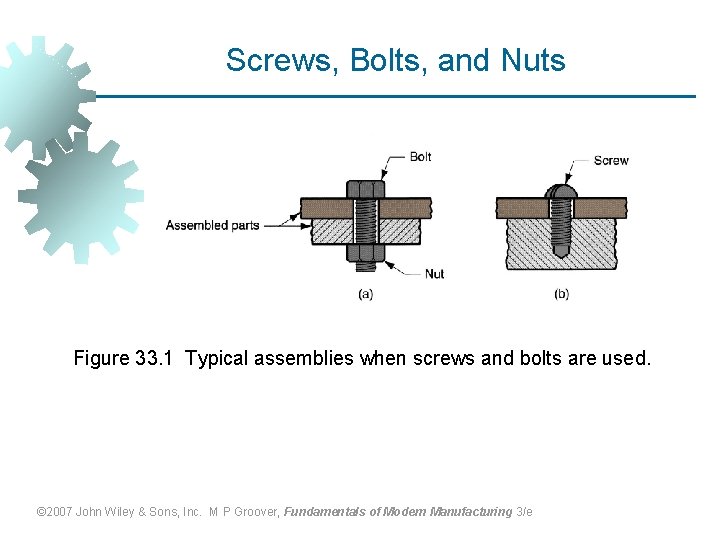
Screws, Bolts, and Nuts Figure 33. 1 Typical assemblies when screws and bolts are used. © 2007 John Wiley & Sons, Inc. M P Groover, Fundamentals of Modern Manufacturing 3/e

Some Facts About Screws and Bolts § Screws and bolts come in a variety of sizes, threads, and shapes § Much standardization in threaded fasteners, which promotes interchangeability § U. S. is converting to metric, further reducing variations § Differences between threaded fasteners affect tooling § Example: different screw head styles and sizes require different screwdriver designs © 2007 John Wiley & Sons, Inc. M P Groover, Fundamentals of Modern Manufacturing 3/e

Head Styles on Screws and Bolts Figure 33. 2 Various head styles available on screws and bolts. © 2007 John Wiley & Sons, Inc. M P Groover, Fundamentals of Modern Manufacturing 3/e
Types of Screws § Greater variety than bolts, since functions vary more § Examples: § Machine screws - generic type, generally designed for assembly into tapped holes § Capscrews - same geometry as machine screws but made of higher strength metals and to closer tolerances © 2007 John Wiley & Sons, Inc. M P Groover, Fundamentals of Modern Manufacturing 3/e
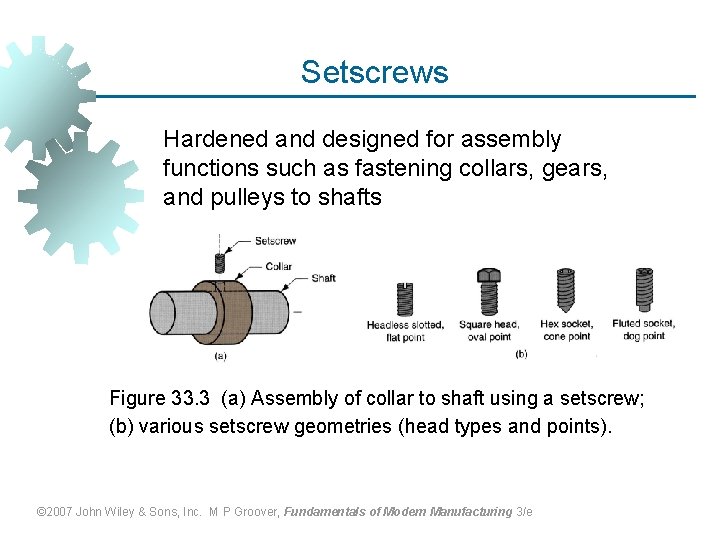
Setscrews Hardened and designed for assembly functions such as fastening collars, gears, and pulleys to shafts Figure 33. 3 (a) Assembly of collar to shaft using a setscrew; (b) various setscrew geometries (head types and points). © 2007 John Wiley & Sons, Inc. M P Groover, Fundamentals of Modern Manufacturing 3/e
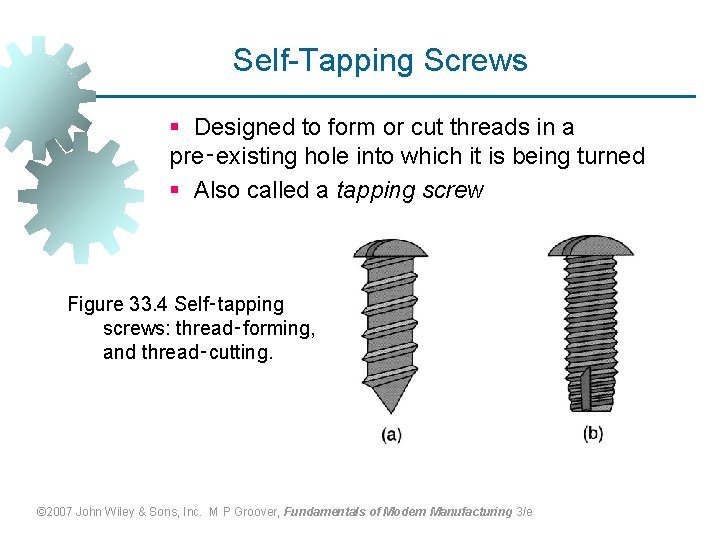
Self-Tapping Screws § Designed to form or cut threads in a pre‑existing hole into which it is being turned § Also called a tapping screw Figure 33. 4 Self‑tapping screws: thread‑forming, and thread‑cutting. © 2007 John Wiley & Sons, Inc. M P Groover, Fundamentals of Modern Manufacturing 3/e
Screw Thread Inserts Internally threaded plugs or wire coils designed to be inserted into an unthreaded hole and accept an externally threaded fastener § Assembled into weaker materials to provide strong threads § Upon assembly of screw into insert, insert barrel expands into hole to secure the assembly © 2007 John Wiley & Sons, Inc. M P Groover, Fundamentals of Modern Manufacturing 3/e
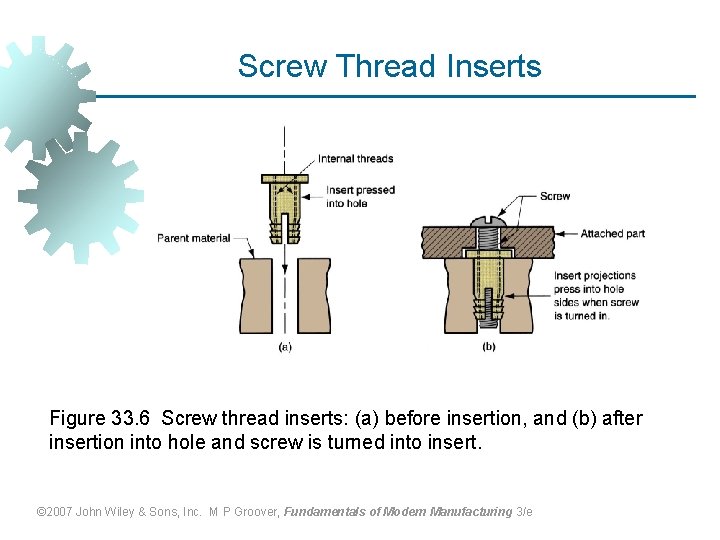
Screw Thread Inserts Figure 33. 6 Screw thread inserts: (a) before insertion, and (b) after insertion into hole and screw is turned into insert. © 2007 John Wiley & Sons, Inc. M P Groover, Fundamentals of Modern Manufacturing 3/e
Washer Hardware component often used with threaded fasteners to ensure tightness of the mechanical joint § Simplest form = flat thin ring of sheet metal § Functions: § Distribute stresses § Provide support for large clearance holes § Protect part surfaces and seal the joint § Increase spring tension § Resist inadvertent unfastening © 2007 John Wiley & Sons, Inc. M P Groover, Fundamentals of Modern Manufacturing 3/e
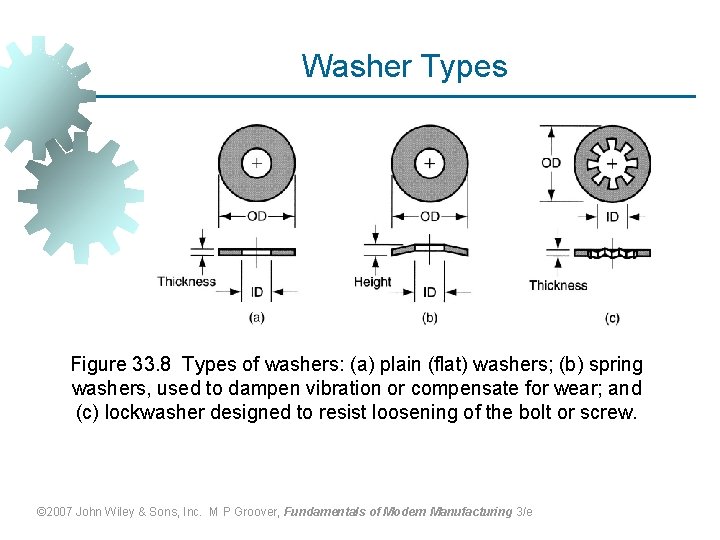
Washer Types Figure 33. 8 Types of washers: (a) plain (flat) washers; (b) spring washers, used to dampen vibration or compensate for wear; and (c) lockwasher designed to resist loosening of the bolt or screw. © 2007 John Wiley & Sons, Inc. M P Groover, Fundamentals of Modern Manufacturing 3/e
Bolt Strength Two measures: § Tensile strength, which has the traditional definition § Proof strength - roughly equivalent to yield strength § Maximum tensile stress without permanent deformation © 2007 John Wiley & Sons, Inc. M P Groover, Fundamentals of Modern Manufacturing 3/e
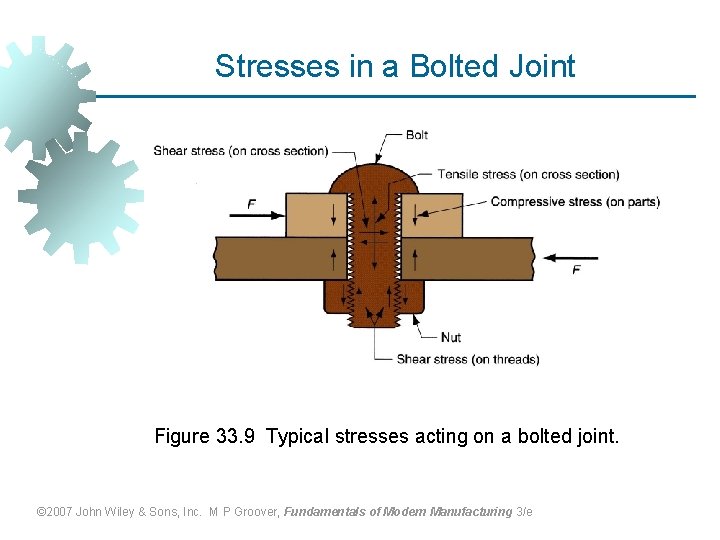
Stresses in a Bolted Joint Figure 33. 9 Typical stresses acting on a bolted joint. © 2007 John Wiley & Sons, Inc. M P Groover, Fundamentals of Modern Manufacturing 3/e
Over-tightening in Bolted Joints § § § Potential problem in assembly, causing stresses that exceed strength of fastener or nut Failure can occur in one of the following ways: 1. Stripping of external threads 2. Stripping of internal threads 3. Bolt fails due to excessive tensile stresses on cross‑sectional area Tensile failure of cross section is most common problem © 2007 John Wiley & Sons, Inc. M P Groover, Fundamentals of Modern Manufacturing 3/e
Basic Functions of Threaded Fasteners § To provide relative rotation between external and internal threads during fastening § To apply sufficient torque to secure the assembly § Product designer often specifies required preload to secure assembly § Assembly operator must apply the right torque to achieve the specified preload © 2007 John Wiley & Sons, Inc. M P Groover, Fundamentals of Modern Manufacturing 3/e
Methods to Apply Required Torque 1. Operator feel ‑ not very accurate, but adequate for most assemblies 2. Torque wrench – indicates amount of torque during tightening 3. Stall‑motor ‑ motorized wrench is set to stall when required torque is reached 4. Torque‑turn tightening - fastener is initially tightened to a low torque level and then rotated a specified additional amount © 2007 John Wiley & Sons, Inc. M P Groover, Fundamentals of Modern Manufacturing 3/e
Thanks © 2007 John Wiley & Sons, Inc. M P Groover, Fundamentals of Modern Manufacturing 3/e
- Slides: 23