
Mechanical Advantages of Simple Machines Science Overview on


- Slides: 16
Mechanical Advantages of Simple Machines Science Overview on Simple Machines
Three Classes of Levers: First-class levers Second-class levers Third-class levers
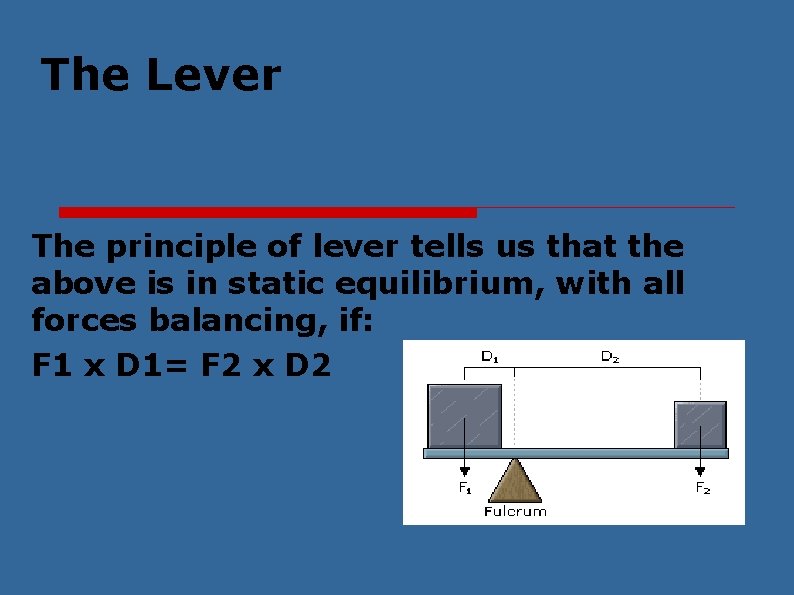
The Lever The principle of lever tells us that the above is in static equilibrium, with all forces balancing, if: F 1 x D 1= F 2 x D 2
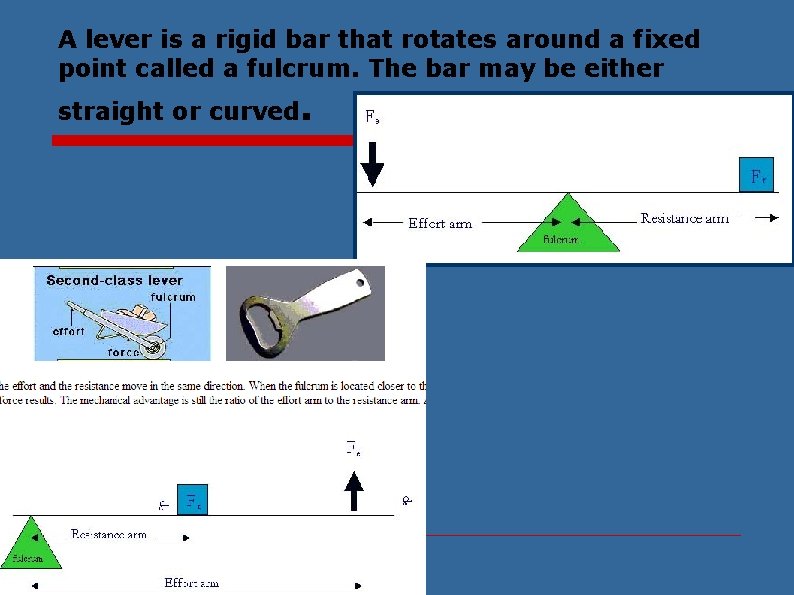
A lever is a rigid bar that rotates around a fixed point called a fulcrum. The bar may be either straight or curved.
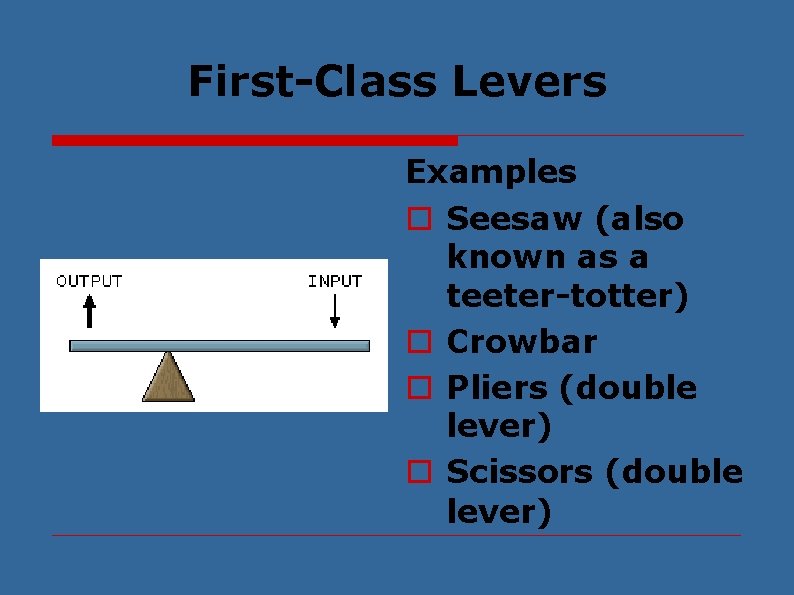
First-Class Levers Examples o Seesaw (also known as a teeter-totter) o Crowbar o Pliers (double lever) o Scissors (double lever)
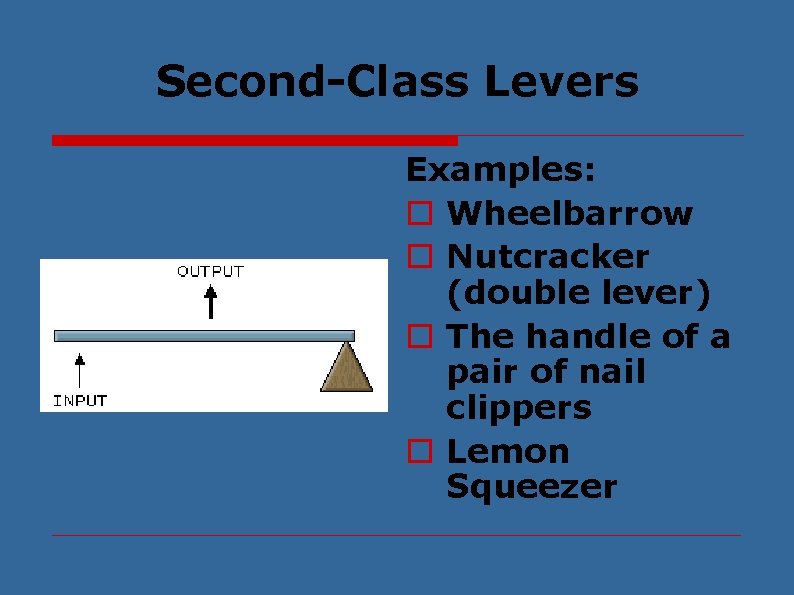
Second-Class Levers Examples: o Wheelbarrow o Nutcracker (double lever) o The handle of a pair of nail clippers o Lemon Squeezer
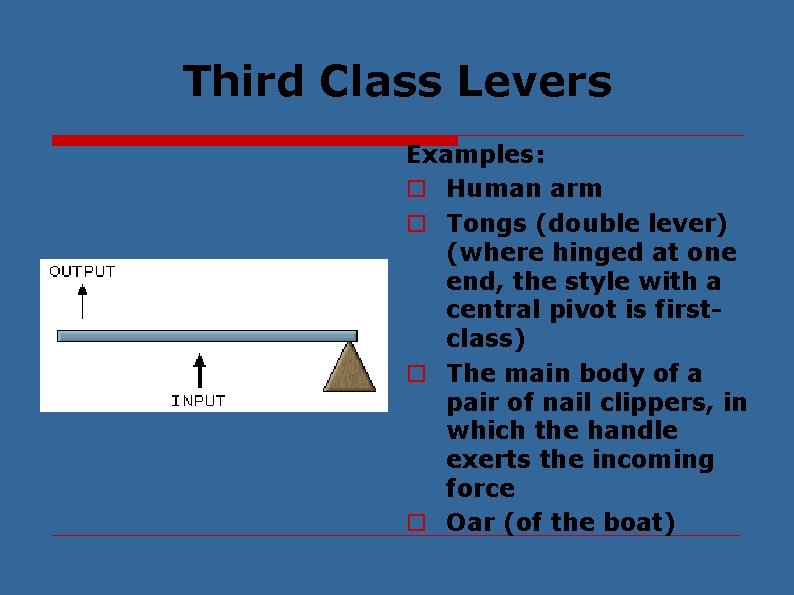
Third Class Levers Examples: o Human arm o Tongs (double lever) (where hinged at one end, the style with a central pivot is firstclass) o The main body of a pair of nail clippers, in which the handle exerts the incoming force o Oar (of the boat)
6 Six Simple Machines Inclined plane (ramp) Wedge (axe) Screw Lever (can opener, see saw, tongs) Pulley (used in wells to draw water) o Wheel and axle (door knob) o o o
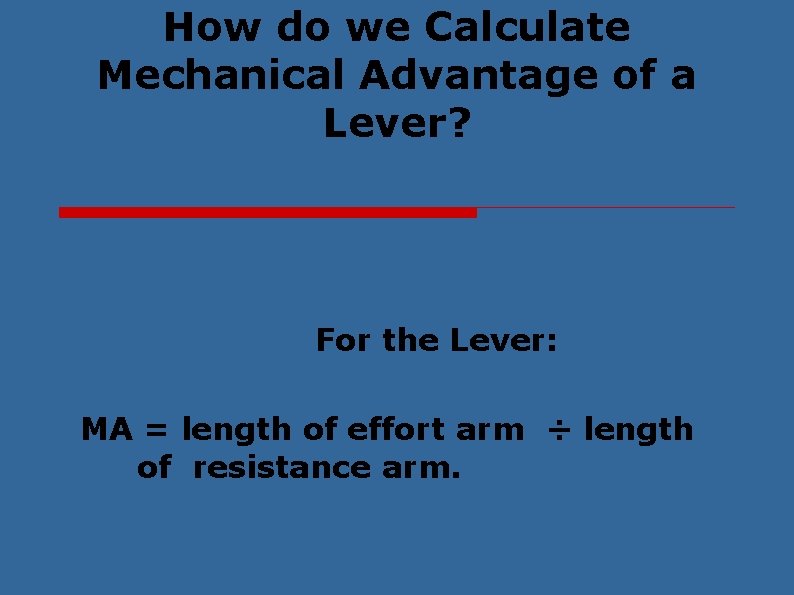
How do we Calculate Mechanical Advantage of a Lever? For the Lever: MA = length of effort arm ÷ length of resistance arm.
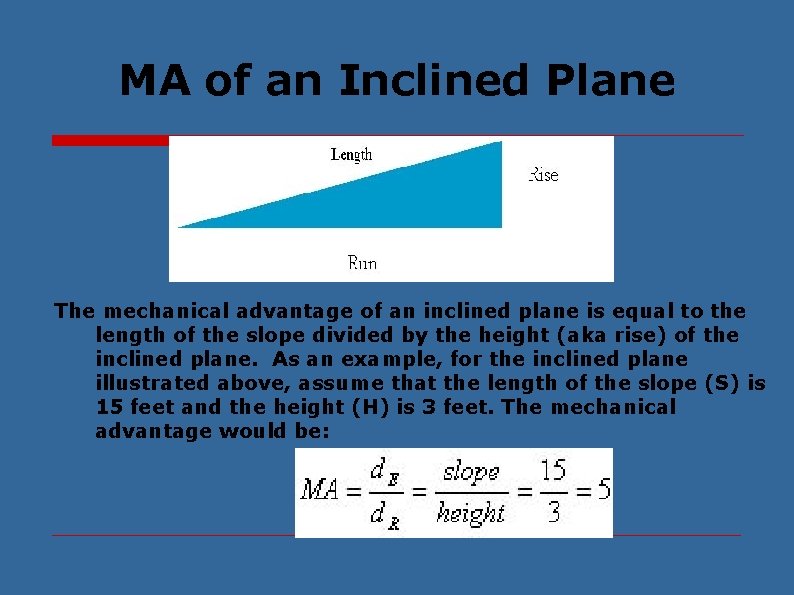
MA of an Inclined Plane The mechanical advantage of an inclined plane is equal to the length of the slope divided by the height (aka rise) of the inclined plane. As an example, for the inclined plane illustrated above, assume that the length of the slope (S) is 15 feet and the height (H) is 3 feet. The mechanical advantage would be:
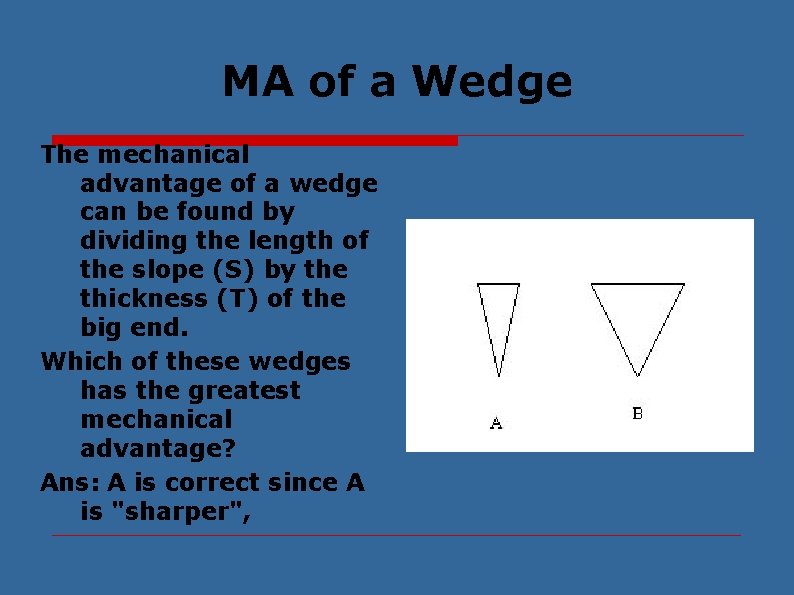
MA of a Wedge The mechanical advantage of a wedge can be found by dividing the length of the slope (S) by the thickness (T) of the big end. Which of these wedges has the greatest mechanical advantage? Ans: A is correct since A is "sharper",
PULLEY o A pulley is a wheel with a groove along its edge, for holding a rope or cable. Pulleys are usually used in sets designed to reduce the amount of force needed to lift a load. o A fixed pulley has a fixed axle and is used to redirect the force in a rope (called a belt when it goes in a full circle). o A fixed pulley has a mechanical advantage of 1.
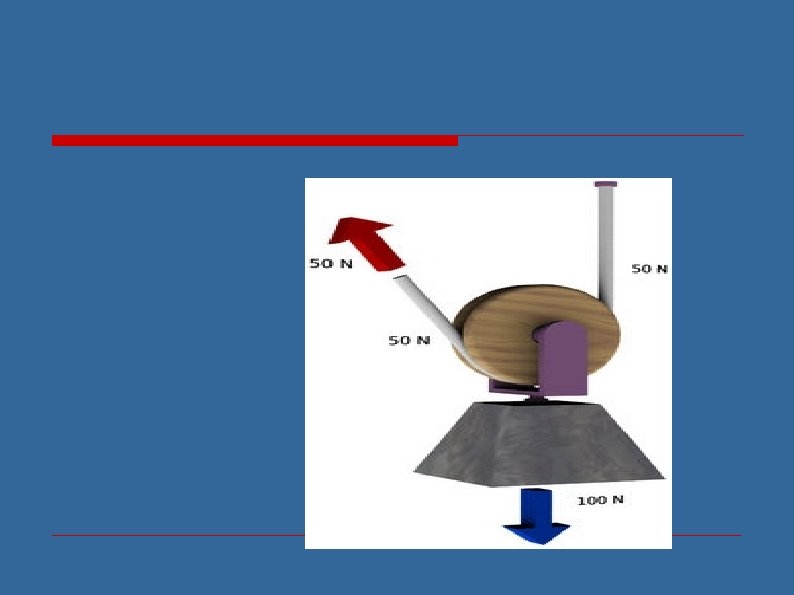
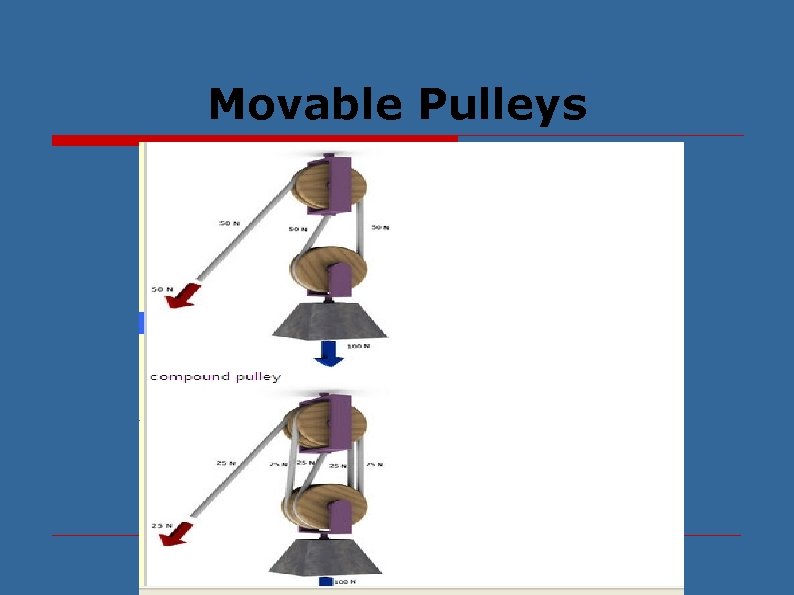
Pulley A fixed pulley has a fixed axle and is used to redirect the force in a rope A fixed pulley has a MA = 1. A single moveable pulley creates a mechanical advantage; however, it does not change the direction of force. A movable pulley has a free axle, and is used to transform forces The mechanical advantage of a moveable pulley is roughly equal to the number of ropes that support the moveable pulley
Movable Pulleys
o