
Mechanical Advantage MA Simple machines lever pulley wedge





- Slides: 25
Mechanical Advantage (MA) Simple machines (lever, pulley, wedge, screw, inclined plane, wheel and axle) are often combined to create complex mechanical machines. 1
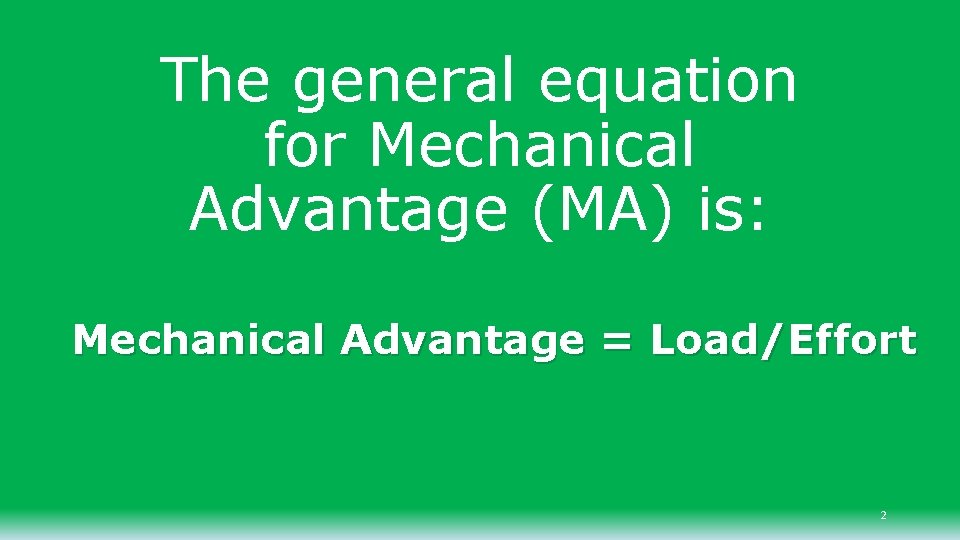
The general equation for Mechanical Advantage (MA) is: Mechanical Advantage = Load/Effort 2
Keep in mind our six basic kinds of simple machines: Lever Inclined Plane Wheel & Axle Pulley Wedge Screw 3
Each simple machine possesses its own equation for mechanical advantage. Let’s look at each ones version of the formula. 4
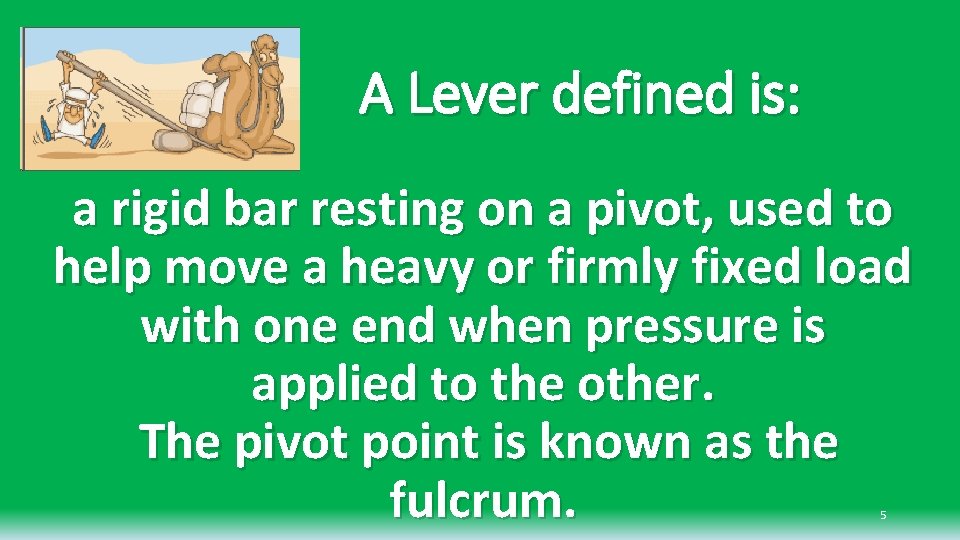
A Lever defined is: a rigid bar resting on a pivot, used to help move a heavy or firmly fixed load with one end when pressure is applied to the other. The pivot point is known as the fulcrum. 5
It is rewarding to begin to notice all the levers we use in a days time. Let’s begin to notice all of the simple machines that we use every week. 6
So the formula for a lever is: Length to Effort/Length to Load 7
Inclined Plane defined: 1) a plane inclined at an angle to the horizontal. 2) a sloping ramp up which heavy loads can be raised much easier by pulling them up the slope by ropes or chains. 8
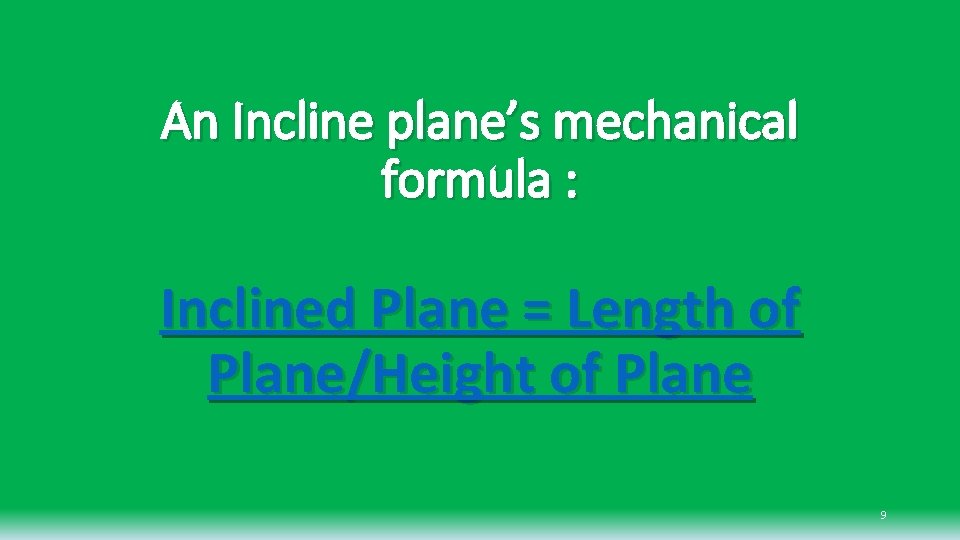
An Incline plane’s mechanical formula : Inclined Plane = Length of Plane/Height of Plane 9
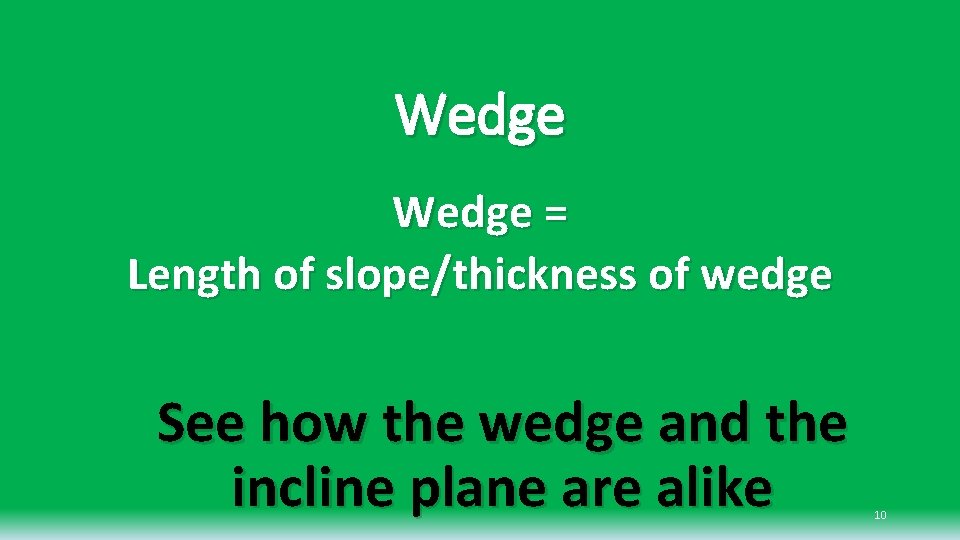
Wedge = Length of slope/thickness of wedge See how the wedge and the incline plane are alike 10
Wheel and Axle defined. a simple lifting machine consisting of a rope that unwinds from a wheel onto a cylindrical drum or shaft joined to the wheel to provide mechanical advantage 11
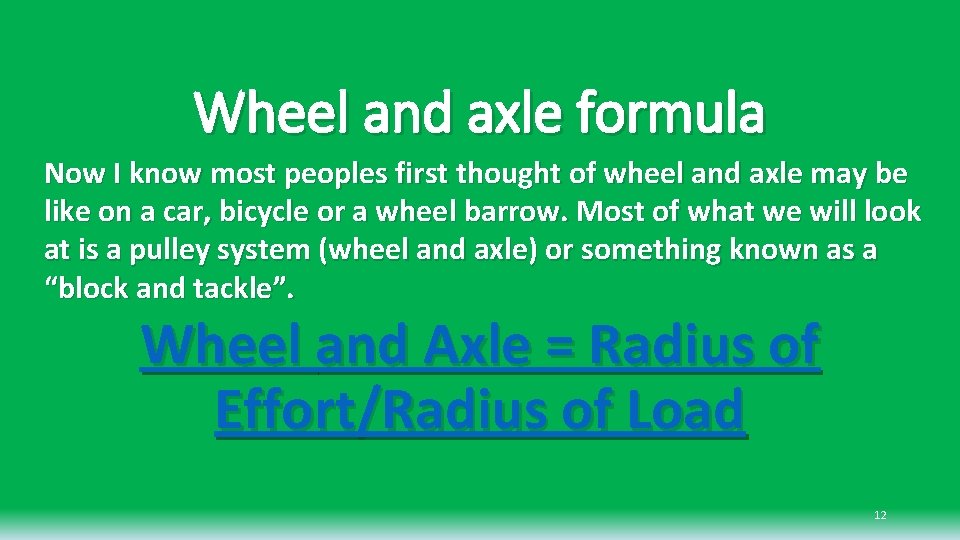
Wheel and axle formula Now I know most peoples first thought of wheel and axle may be like on a car, bicycle or a wheel barrow. Most of what we will look at is a pulley system (wheel and axle) or something known as a “block and tackle”. Wheel and Axle = Radius of Effort/Radius of Load 12
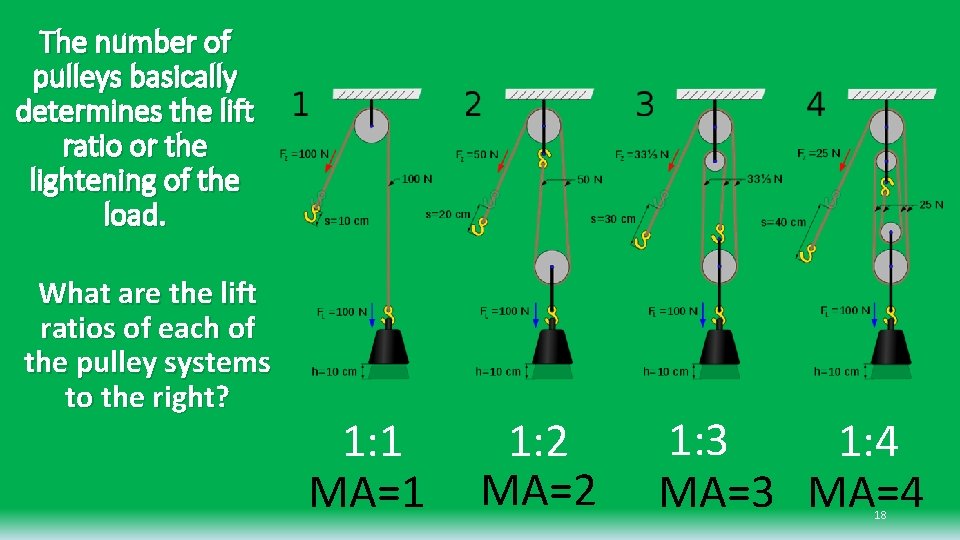
Pulley defined: The pulley is actually a version of a wheel and axle that is combined with a rope, chain or other cord to allow moving something up and down or back and forth. The pulley can be combined with other pulleys to reduce the amount of work necessary to lift huge amounts of weight or to lower them down. Many times known as a block and tackle. 13
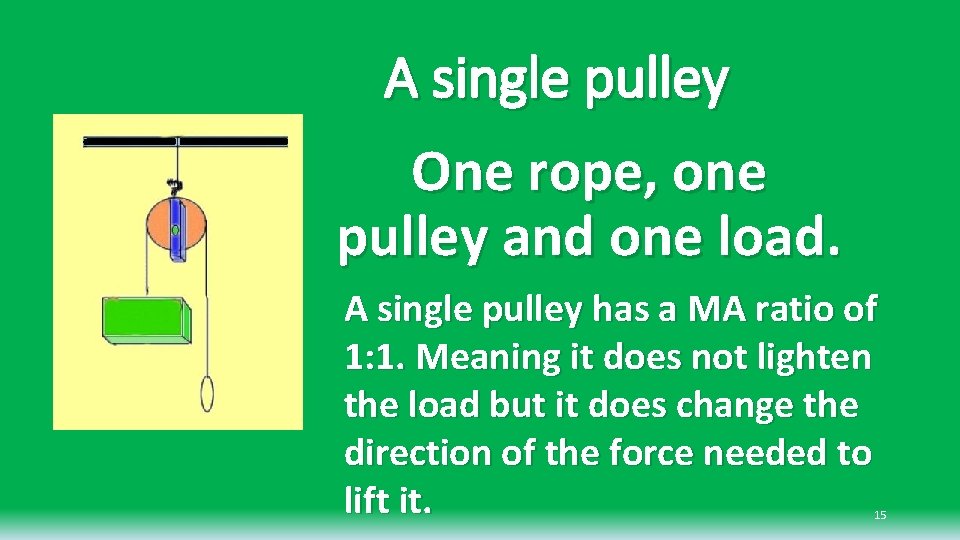
The MA of a pulley is Pulley = number of ropes that support the pulley 14
A single pulley One rope, one pulley and one load. A single pulley has a MA ratio of 1: 1. Meaning it does not lighten the load but it does change the direction of the force needed to lift it. 15
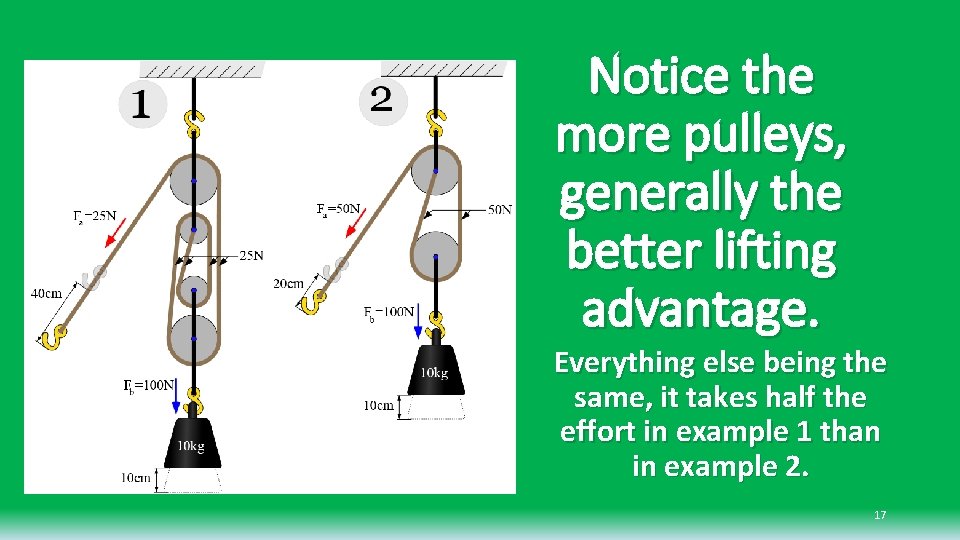
A double pulley defined: System consisting of two pulleys with a rope running around them to lift a load. Using two or more pulleys reduces the amount of effort needed. 16
Notice the more pulleys, generally the better lifting advantage. Everything else being the same, it takes half the effort in example 1 than in example 2. 17
The number of pulleys basically determines the lift ratio or the lightening of the load. What are the lift ratios of each of the pulley systems to the right? 1: 1 MA=1 1: 2 MA=2 1: 3 1: 4 MA=3 MA=4 18
A screw defined: A screw is a mechanism that converts rotational motion to linear motion, and a torque (rotational force) to a linear force. 19
Simple machines are all around us. So much so we do not always notice them. A screw can also act to hold things together in some cases. Some examples of the uses of a screw are in a jar lid, a drill, a bolt, a light bulb, faucets, bottle caps and ball point pens. 20
Screw Mechanical Advantage of a Screw = circumference / pitch 21
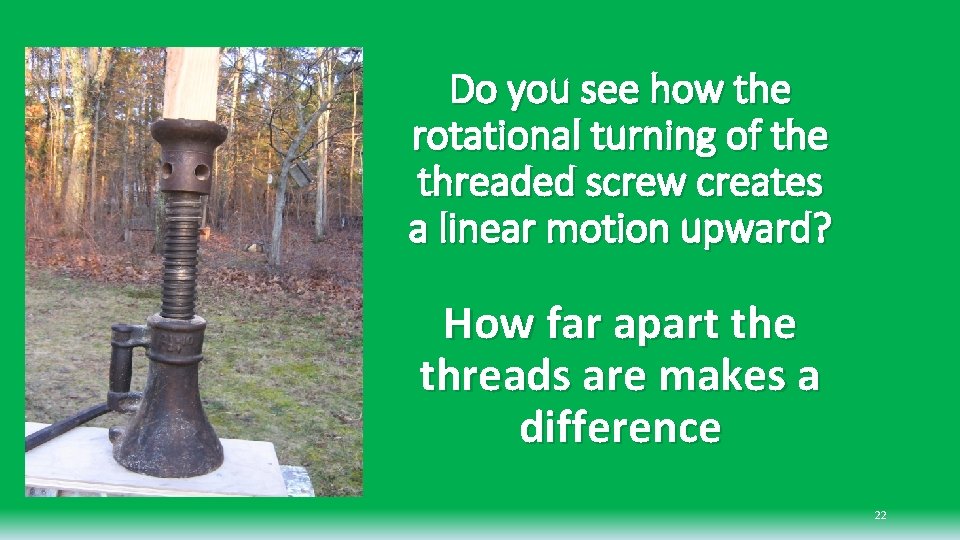
Do you see how the rotational turning of the threaded screw creates a linear motion upward? How far apart the threads are makes a difference 22
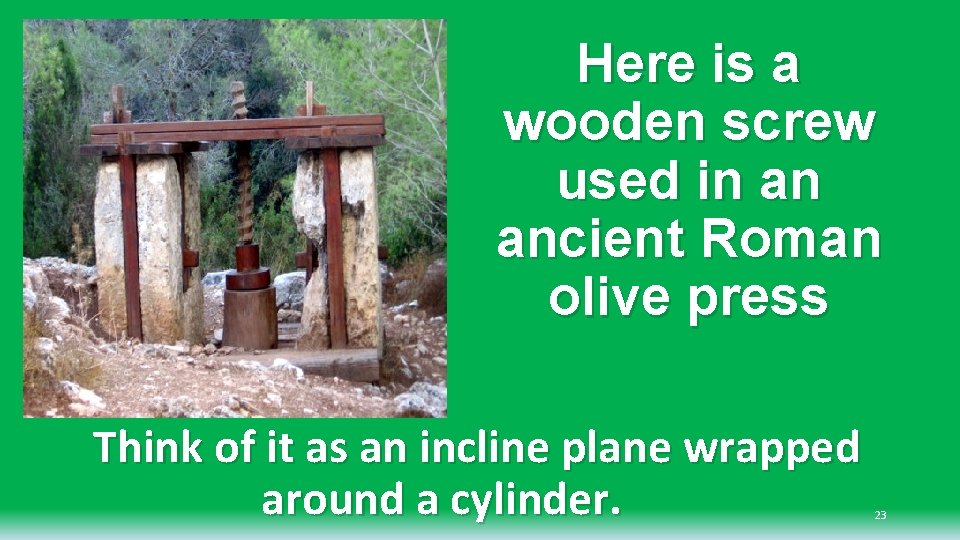
Here is a wooden screw used in an ancient Roman olive press Think of it as an incline plane wrapped around a cylinder. 23
For additional video on simple machines with Bill Nye, go to : https: //www. schooltube. com/vi deo/b 92 aaeff 6 cf 4431 aa 6 c 7/Bill% 20 Nye%20%20 Simple%20 Machines 24
The End 25