
MECHANICAL ADVANTAGE AND EFFICIENCY CH 14 3 SC
- Slides: 10
MECHANICAL ADVANTAGE AND EFFICIENCY CH. 14. 3 SC. 912. N. 4. 2 SC. 912. P. 10. 3
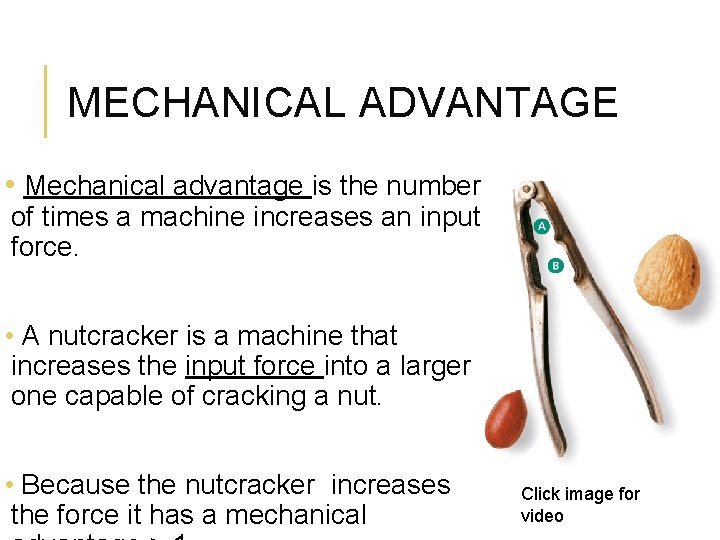
MECHANICAL ADVANTAGE • Mechanical advantage is the number of times a machine increases an input force. • A nutcracker is a machine that increases the input force into a larger one capable of cracking a nut. • Because the nutcracker increases the force it has a mechanical Click image for video
MECHANICAL ADVANTAGE • Friction plays an important role when determining how efficient a machine works. • Because friction is always present, the actual mechanical advantage of a machine is always less than the ideal mechanical advantage. • The mechanical advantage determined by measuring the actual forces acting on a machine is the actual mechanical advantage.
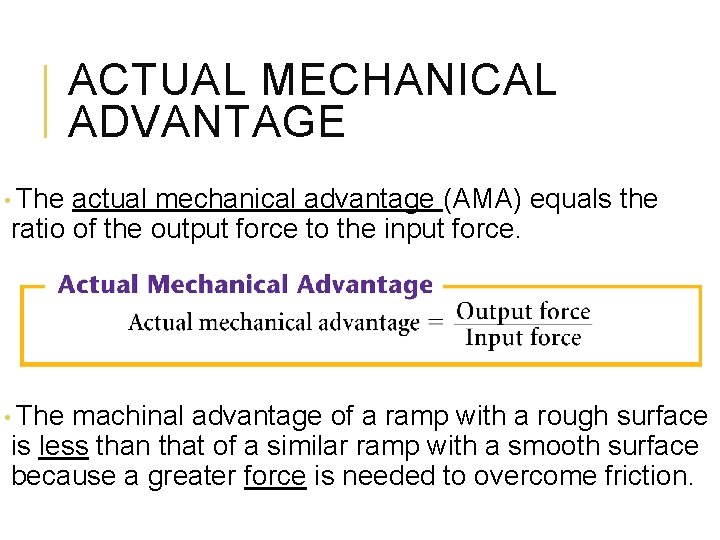
ACTUAL MECHANICAL ADVANTAGE • The actual mechanical advantage (AMA) equals the ratio of the output force to the input force. • The machinal advantage of a ramp with a rough surface is less than that of a similar ramp with a smooth surface because a greater force is needed to overcome friction.
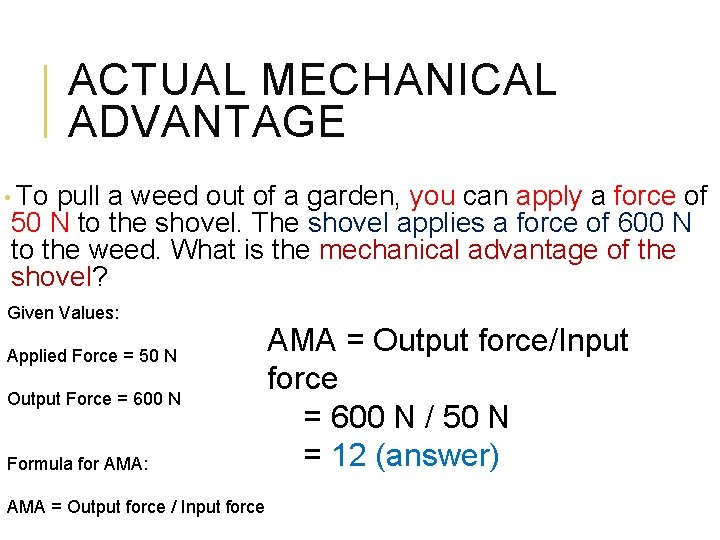
ACTUAL MECHANICAL ADVANTAGE • To pull a weed out of a garden, you can apply a force of 50 N to the shovel. The shovel applies a force of 600 N to the weed. What is the mechanical advantage of the shovel? Given Values: Applied Force = 50 N Output Force = 600 N Formula for AMA: AMA = Output force / Input force AMA = Output force/Input force = 600 N / 50 N = 12 (answer)
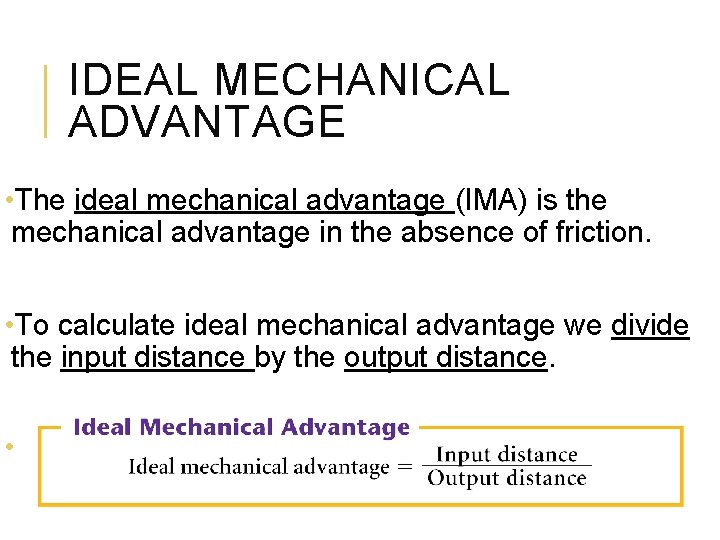
IDEAL MECHANICAL ADVANTAGE • The ideal mechanical advantage (IMA) is the mechanical advantage in the absence of friction. • To calculate ideal mechanical advantage we divide the input distance by the output distance. •
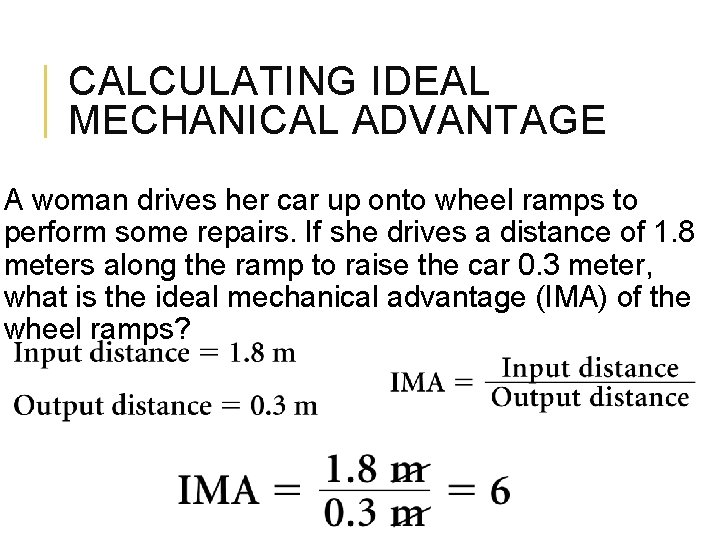
CALCULATING IDEAL MECHANICAL ADVANTAGE A woman drives her car up onto wheel ramps to perform some repairs. If she drives a distance of 1. 8 meters along the ramp to raise the car 0. 3 meter, what is the ideal mechanical advantage (IMA) of the wheel ramps?
EFFICIENCY • Efficiency is the percentage of the work input that becomes work output. • Because friction is always present, the efficiency of any machine is always less than 100% • Efficiency can be increased by reducing friction (i. e. roller bearings on wheels or some
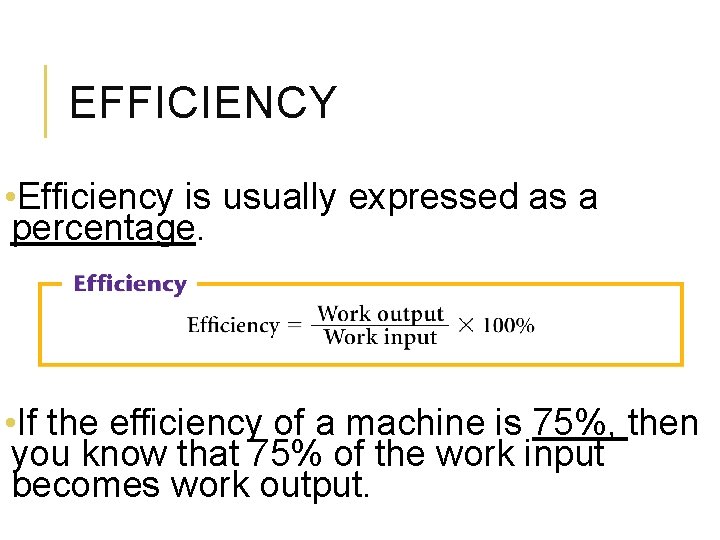
EFFICIENCY • Efficiency is usually expressed as a percentage. • If the efficiency of a machine is 75%, then you know that 75% of the work input becomes work output.
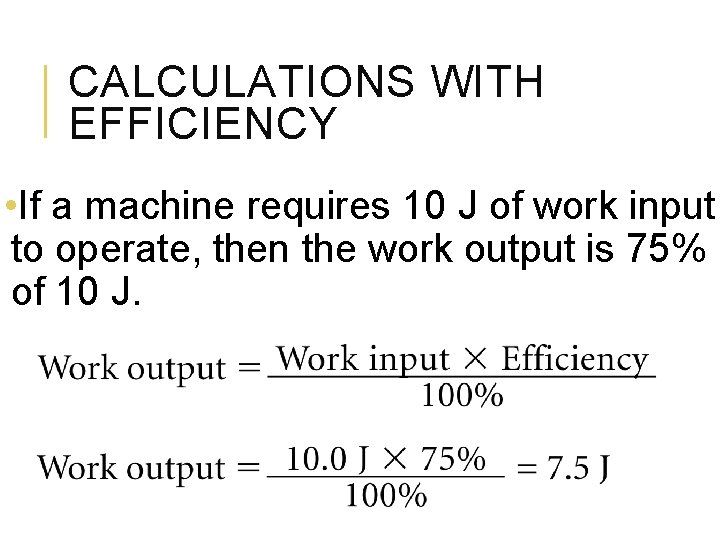
CALCULATIONS WITH EFFICIENCY • If a machine requires 10 J of work input to operate, then the work output is 75% of 10 J.