
MECH 373 Instrumentation and Measurements Lecture 22 Systems
- Slides: 38
MECH 373 Instrumentation and Measurements Lecture 22 Systems for Measuring Fluid Rate (Chapter 10) • Variable-Area Flowmeters Lecture 22 Lecture Notes on MECH 373 – Instrumentation and Measurements 1
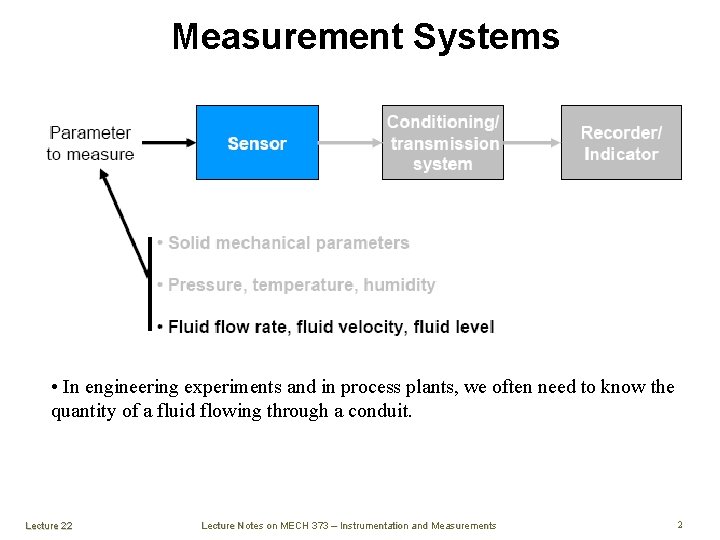
Measurement Systems • In engineering experiments and in process plants, we often need to know the quantity of a fluid flowing through a conduit. Lecture 22 Lecture Notes on MECH 373 – Instrumentation and Measurements 2
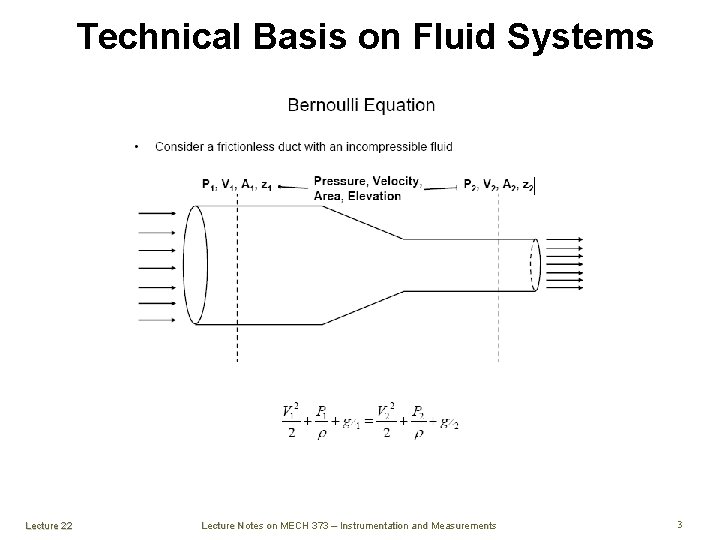
Technical Basis on Fluid Systems Lecture 22 Lecture Notes on MECH 373 – Instrumentation and Measurements 3
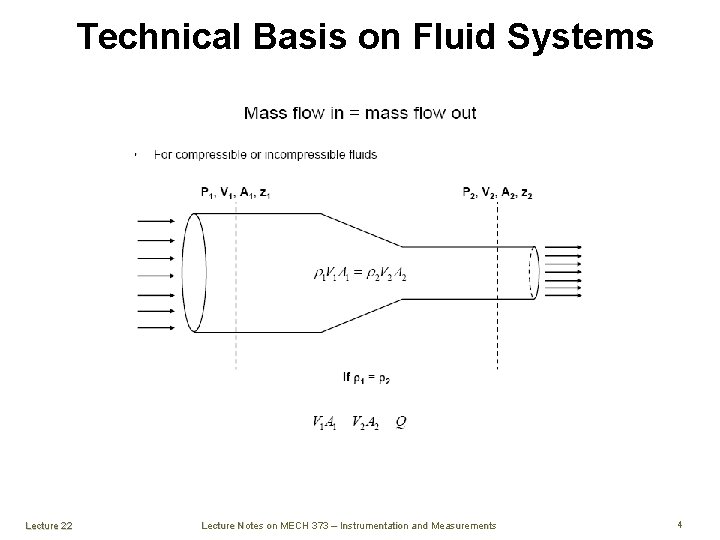
Technical Basis on Fluid Systems Lecture 22 Lecture Notes on MECH 373 – Instrumentation and Measurements 4
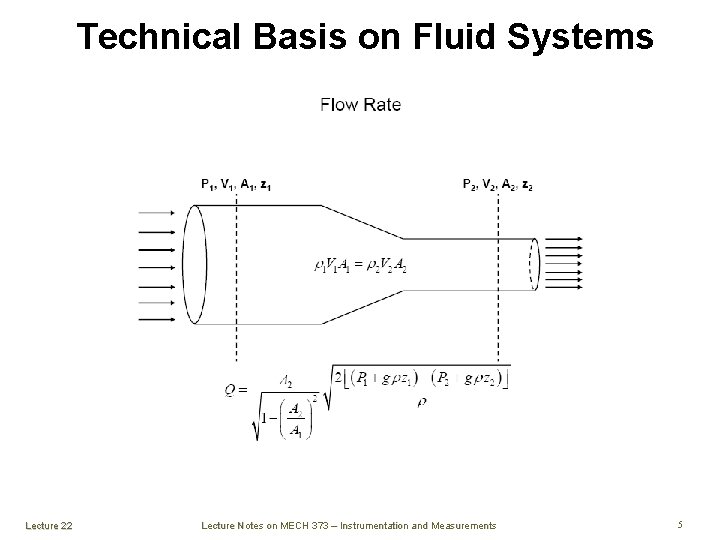
Technical Basis on Fluid Systems Lecture 22 Lecture Notes on MECH 373 – Instrumentation and Measurements 5
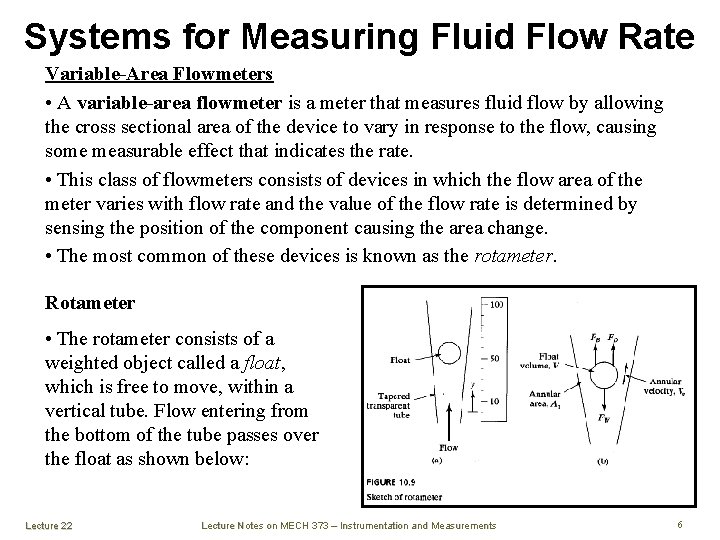
Systems for Measuring Fluid Flow Rate Variable-Area Flowmeters • A variable-area flowmeter is a meter that measures fluid flow by allowing the cross sectional area of the device to vary in response to the flow, causing some measurable effect that indicates the rate. • This class of flowmeters consists of devices in which the flow area of the meter varies with flow rate and the value of the flow rate is determined by sensing the position of the component causing the area change. • The most common of these devices is known as the rotameter. Rotameter • The rotameter consists of a weighted object called a float, which is free to move, within a vertical tube. Flow entering from the bottom of the tube passes over the float as shown below: Lecture 22 Lecture Notes on MECH 373 – Instrumentation and Measurements 6
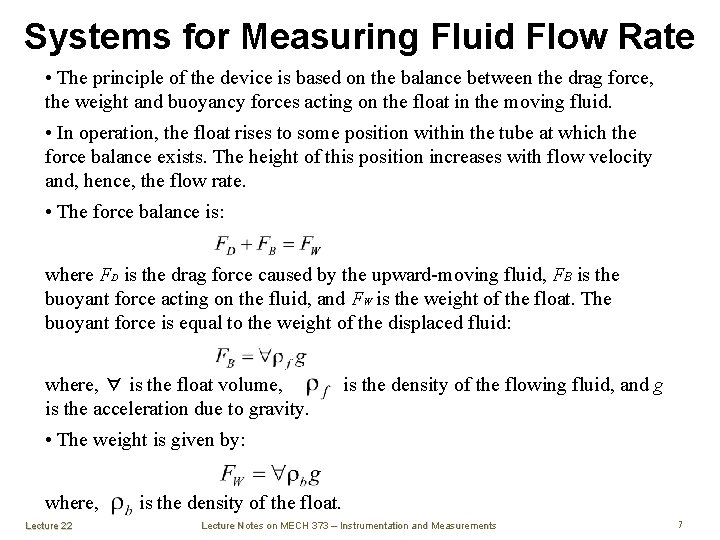
Systems for Measuring Fluid Flow Rate • The principle of the device is based on the balance between the drag force, the weight and buoyancy forces acting on the float in the moving fluid. • In operation, the float rises to some position within the tube at which the force balance exists. The height of this position increases with flow velocity and, hence, the flow rate. • The force balance is: where FD is the drag force caused by the upward-moving fluid, FB is the buoyant force acting on the fluid, and FW is the weight of the float. The buoyant force is equal to the weight of the displaced fluid: where, ∀ is the float volume, is the acceleration due to gravity. is the density of the flowing fluid, and g • The weight is given by: where, is the density of the float. Lecture 22 Lecture Notes on MECH 373 – Instrumentation and Measurements 7
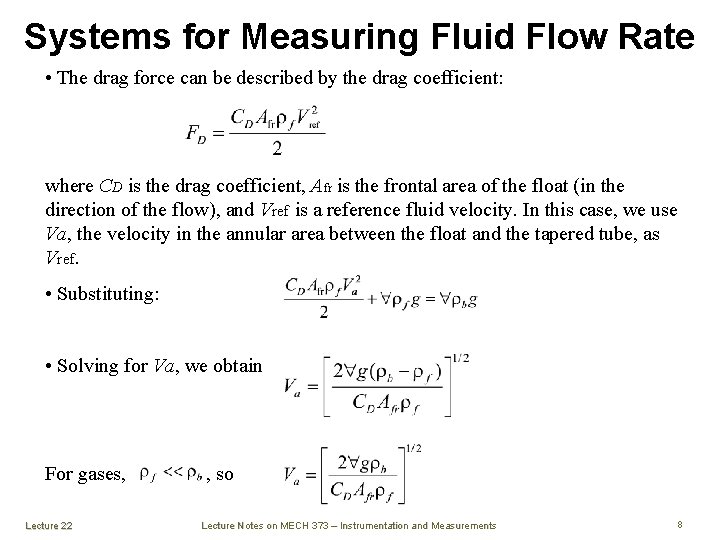
Systems for Measuring Fluid Flow Rate • The drag force can be described by the drag coefficient: where CD is the drag coefficient, Afr is the frontal area of the float (in the direction of the flow), and Vref is a reference fluid velocity. In this case, we use Va, the velocity in the annular area between the float and the tapered tube, as Vref. • Substituting: • Solving for Va, we obtain For gases, , so Lecture 22 Lecture Notes on MECH 373 – Instrumentation and Measurements 8
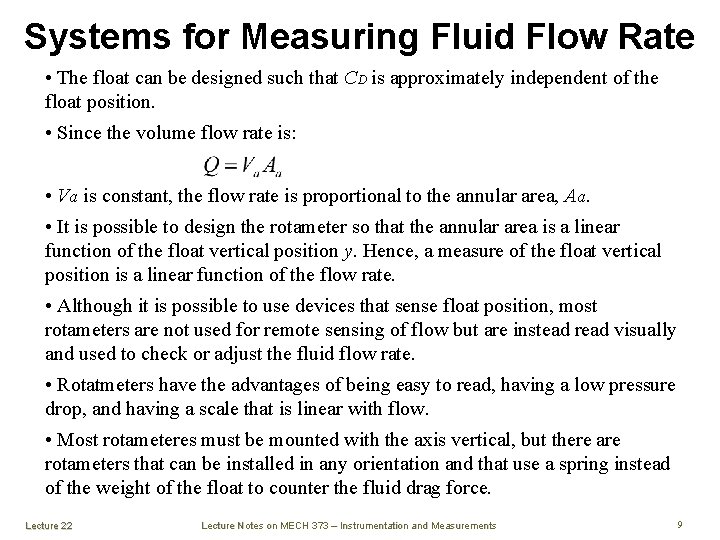
Systems for Measuring Fluid Flow Rate • The float can be designed such that CD is approximately independent of the float position. • Since the volume flow rate is: • Va is constant, the flow rate is proportional to the annular area, Aa. • It is possible to design the rotameter so that the annular area is a linear function of the float vertical position y. Hence, a measure of the float vertical position is a linear function of the flow rate. • Although it is possible to use devices that sense float position, most rotameters are not used for remote sensing of flow but are instead read visually and used to check or adjust the fluid flow rate. • Rotatmeters have the advantages of being easy to read, having a low pressure drop, and having a scale that is linear with flow. • Most rotameteres must be mounted with the axis vertical, but there are rotameters that can be installed in any orientation and that use a spring instead of the weight of the float to counter the fluid drag force. Lecture 22 Lecture Notes on MECH 373 – Instrumentation and Measurements 9
Systems for Measuring Fluid Flow Rate • While it is not common to have a sensor for remote sensing of flow rate, it is common in the process industries to have a sensing switch that will trip an alarm if the flow exceeds some system limit. • The accuracy of higher-quality rotameters can be better than ± 2% of full scale, but many are used to give a general indication of flow and are accurate only to the order of ± 10%. • Rotameters are usually calibrated to produce the best accuracy for a particular application. • To avoid a new calibration, a rotameter can sometimes be calibrated for one fluid and used to measure the flow of another fluid or the same fluid at another temperature or pressure. A simple method to permit use with another fluid is based on the above equations. Lecture 22 Lecture Notes on MECH 373 – Instrumentation and Measurements 10
MECH 373 Instrumentation and Measurements Course Review Youmin Zhang Phone: x 5741, Office Location: EV 4 -109 Email: ymzhang@encs. concordia. ca Course Website: Access from your “My Concordia” portal Lecture 22 Lecture Notes on MECH 373 – Instrumentation and Measurements 11
Course Outline 1. Introduction, Chapter 1 [1. 1] • course objective and requirements; why measurement systems, experimental design 2. General Characteristics of Measurement Systems, Chapter 2 [2. 1, 2. 2, 2. 3] • components • instrumentation • error – systematic & random, accuracy, precision, sensitivity • calibration, traceability of standards • dynamic measurement systems – response, damping, etc 3. Measurement Systems with Electrical Signals, Chapter 3 [3. 1, 3. 2 (3. 2. 1, 3. 2. 3, 3. 2. 4), 3. 3] • sensors, amplification, attenuation, filtering • measurement instruments • sensor principles and characteristics 4. Computer-based Data Acquisition Systems, Chapter 4 [4. 1, 4. 2, 4. 3 (4. 3. 1, 4. 3. 2, 4. 3. 4), 4. 4] • system components – principles of A/D & D/A conversion Lecture 22 Lecture Notes on MECH 373 – Instrumentation and Measurements 12
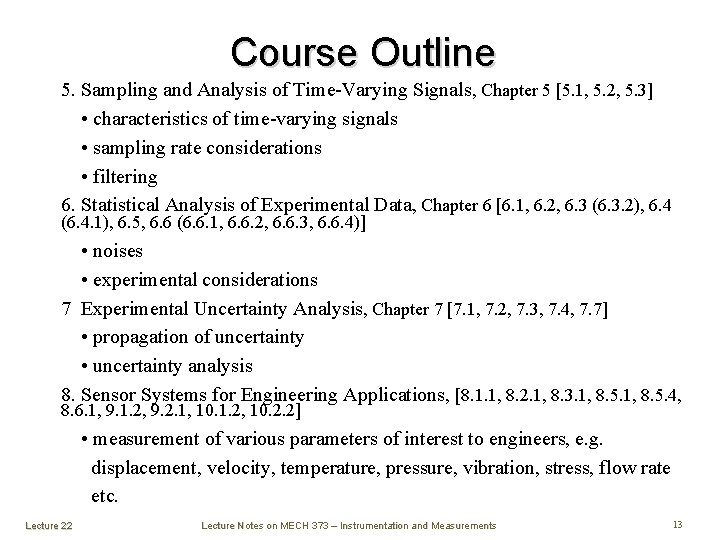
Course Outline 5. Sampling and Analysis of Time-Varying Signals, Chapter 5 [5. 1, 5. 2, 5. 3] • characteristics of time-varying signals • sampling rate considerations • filtering 6. Statistical Analysis of Experimental Data, Chapter 6 [6. 1, 6. 2, 6. 3 (6. 3. 2), 6. 4 (6. 4. 1), 6. 5, 6. 6 (6. 6. 1, 6. 6. 2, 6. 6. 3, 6. 6. 4)] • noises • experimental considerations 7 Experimental Uncertainty Analysis, Chapter 7 [7. 1, 7. 2, 7. 3, 7. 4, 7. 7] • propagation of uncertainty • uncertainty analysis 8. Sensor Systems for Engineering Applications, [8. 1. 1, 8. 2. 1, 8. 3. 1, 8. 5. 4, 8. 6. 1, 9. 1. 2, 9. 2. 1, 10. 1. 2, 10. 2. 2] • measurement of various parameters of interest to engineers, e. g. displacement, velocity, temperature, pressure, vibration, stress, flow rate etc. Lecture 22 Lecture Notes on MECH 373 – Instrumentation and Measurements 13
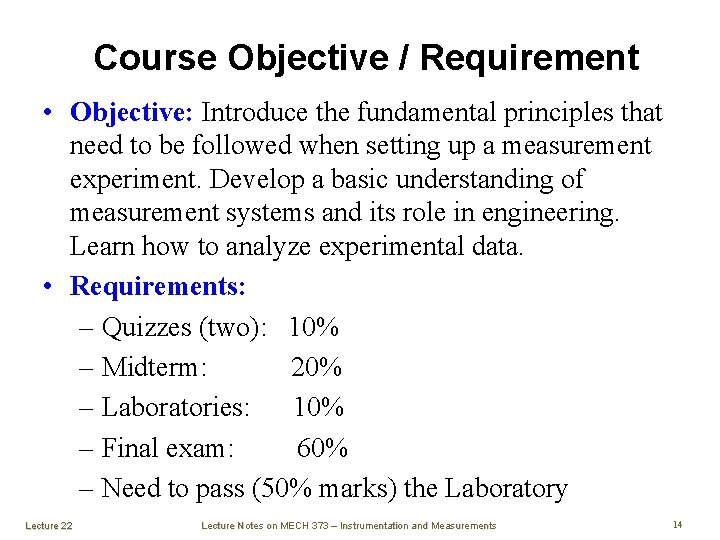
Course Objective / Requirement • Objective: Introduce the fundamental principles that need to be followed when setting up a measurement experiment. Develop a basic understanding of measurement systems and its role in engineering. Learn how to analyze experimental data. • Requirements: – Quizzes (two): 10% – Midterm: 20% – Laboratories: 10% – Final exam: 60% – Need to pass (50% marks) the Laboratory Lecture 22 Lecture Notes on MECH 373 – Instrumentation and Measurements 14
MECH 373 Instrumentation and Measurement Lecture 1 (Course Website: Access from your “My Concordia” portal) Introduction: Introduction to measurement systems Lecture 22 Lecture Notes on MECH 373 – Instrumentation and Measurements 15
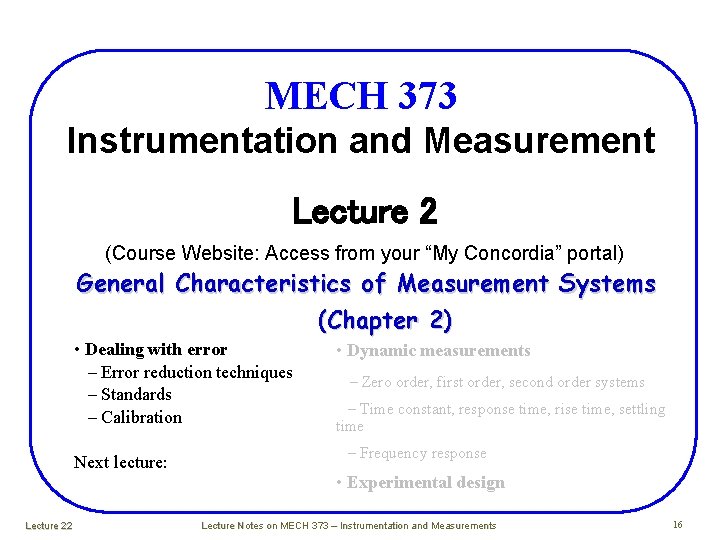
MECH 373 Instrumentation and Measurement Lecture 2 (Course Website: Access from your “My Concordia” portal) General Characteristics of Measurement Systems (Chapter 2) • Dealing with error – Error reduction techniques – Standards – Calibration Next lecture: Lecture 22 • Dynamic measurements – Zero order, first order, second order systems – Time constant, response time, rise time, settling time – Frequency response • Experimental design Lecture Notes on MECH 373 – Instrumentation and Measurements 16
MECH 373 Instrumentation and Measurement Lecture 3 (Course Website: Access from your “My Concordia” portal) General Characteristics of Measurement Systems (Chapter 2) • Dynamic measurements – Zero order, first order, second order systems – Time constant, response time, rise time, settling time – Frequency response • Experimental design Lecture 22 Lecture Notes on MECH 373 – Instrumentation and Measurements 17
MECH 373 Instrumentation and Measurements Lecture 4 (Course Website: Access from your “My Concordia” portal) Measurement Systems with Electrical Signals (Chapter 3) • Electrical signal measurement systems • Signal conditioners Amplification Attenuation Filtering Lecture 22 Lecture Notes on MECH 373 – Instrumentation and Measurements 18
MECH 373 Instrumentation and Measurements Lecture 5 (Course Website: Access from your “My Concordia” portal) Measurement Systems with Electrical Signals (Chapter 3) • Electrical signal measurement systems • Signal conditioners Amplification Attenuation Filtering Lecture 22 Lecture Notes on MECH 373 – Instrumentation and Measurements 19
MECH 373 Instrumentation and Measurements Lecture 6 (Course Website: Access from your “My Concordia” portal) Measurement Systems with Electrical Signals (Chapter 3) • Electrical signal measurement systems • Signal conditioners Filtering Indicating and recording devices Lecture 22 Lecture Notes on MECH 373 – Instrumentation and Measurements 20
MECH 373 Instrumentation and Measurements Lecture 7 (Course Website: Access from your “My Concordia” portal) Computerized Data-Acquisition Systems (Chapter 4) • Computer systems • Representing numbers in computer systems Lecture 22 Lecture Notes on MECH 373 – Instrumentation and Measurements 21
MECH 373 Instrumentation and Measurements Lecture 7 (Course Website: Access from your “My Concordia” portal) Computerized Data-Acquisition Systems (Chapter 4) • Data-acquisition components Lecture 22 Lecture Notes on MECH 373 – Instrumentation and Measurements 22
MECH 373 Instrumentation and Measurements Lecture 8 (Course Website: Access from your “My Concordia” portal) Computerized Data-Acquisition Systems (Chapter 4) • Data-acquisition components multiplexers A/D converters D/A converters Lecture 22 Lecture Notes on MECH 373 – Instrumentation and Measurements 23
MECH 373 Instrumentation and Measurements Lecture 9 (Course Website: Access from your “My Concordia” portal) Discrete Sampling & Analysis of Time-Varying Signals (Chapter 5) • Sampling-Rate Theorem Sampling Nyquist frequency Aliasing Lecture 22 Lecture Notes on MECH 373 – Instrumentation and Measurements 24
MECH 373 Instrumentation and Measurements Lecture 10 Discrete Sampling & Analysis of Time-Varying Signals (Chapter 5) • Sampling-Rate Theorem (review) • Spectral Analysis of Time-Varying Signal • Spectral Analysis uisng the Fourier Transform Lecture 22 Lecture Notes on MECH 373 – Instrumentation and Measurements 25
MECH 373 Instrumentation and Measurements Lecture 11 Discrete Sampling & Analysis of Time-Varying Signals (Chapter 5) • Sampling-Rate Theorem (review) • Spectral Analysis of Time-Varying Signal • Spectral Analysis uisng the Fourier Transform Lecture 22 Lecture Notes on MECH 373 – Instrumentation and Measurements 26
MECH 373 Instrumentation and Measurements Lecture 12 Statistical Analysis of Experimental Data (Chapter 6) • Introduction • General Concepts and Definitions • Probability Lecture 22 Lecture Notes on MECH 373 – Instrumentation and Measurements 27
MECH 373 Instrumentation and Measurements Lecture 13 Statistical Analysis of Experimental Data (Chapter 6) • Introduction • General Concepts and Definitions • Probability Distribution Function Lecture 22 Lecture Notes on MECH 373 – Instrumentation and Measurements 28
MECH 373 Instrumentation and Measurements Lecture 14 Statistical Analysis of Experimental Data (Chapter 6) • Introduction • General Concepts and Definitions • Probability Distribution Function • Parameter Estimation Lecture 22 Lecture Notes on MECH 373 – Instrumentation and Measurements 29
MECH 373 Instrumentation and Measurements Lecture 15 Statistical Analysis of Experimental Data (Chapter 6) • Introduction • General Concepts and Definitions • Probability Distribution Function • Parameter Estimation Lecture 22 • Criterion for Rejecting Questionable Data Points • Correlation of Experimental Data • Least-Squares Linear Fit • Outliers in x-y Data Sets Lecture Notes on MECH 373 – Instrumentation and Measurements 30
MECH 373 Instrumentation and Measurements Lecture 16 Experimental Uncertainty Analysis (Chapter 7) • Introduction • Types of Errors • Propagation of Uncertainties Lecture 22 Lecture Notes on MECH 373 – Instrumentation and Measurements 31
MECH 373 Instrumentation and Measurements Lecture 17 Experimental Uncertainty Analysis (Chapter 7) • Introduction • Consideration of Systematic and Random Components of Uncertainty • Types of Errors • Propagation of Uncertainties • Sources of Elemental Error • Step-by-Step Procedure for Analysis Lecture 22 Lecture Notes on MECH 373 – Instrumentation and Measurements 32
MECH 373 Instrumentation and Measurements Lecture 18 Measurement of Solid-Mechanical Quantities (Chapter 8) • Measuring Strain • Measuring Accepleration and Vibaration • Measuring Displacement • Measuring Force • Measuring Linear Velocity Lecture 22 Lecture Notes on MECH 373 – Instrumentation and Measurements 33
MECH 373 Instrumentation and Measurements Lecture 19 Measurement of Solid-Mechanical Quantities (Chapter 8) • Measuring Strain • Measuring Accepleration and Vibaration • Measuring Displacement • Measuring Force • Measuring Linear Velocity Lecture 22 Lecture Notes on MECH 373 – Instrumentation and Measurements 34
MECH 373 Instrumentation and Measurements Lecture 20 Measuring Pressure and Temperature (Chapter 9) • Measuring Pressure • Measuring Temperature Lecture 22 Lecture Notes on MECH 373 – Instrumentation and Measurements 35
MECH 373 Instrumentation and Measurements Lecture 21 Measuring Pressure and Temperature (Chapter 9) • Measuring Pressure • Measuring Temperature Lecture 22 Lecture Notes on MECH 373 – Instrumentation and Measurements 36
MECH 373 Instrumentation and Measurements Lecture 22 Systems for Measuring Fluid Rate (Chapter 10) • Variable-Area Flowmeters Lecture 22 Lecture Notes on MECH 373 – Instrumentation and Measurements 37
MECH 373 Instrumentation and Measurements Final Exam: MECH 373/2 X, 12/5/2007, 14: 00 -17: 00, H 407 Office hours before final exam: • 29/11/07 (Thursday) 13: 00 -15: 00, EV 4 -109 30/12/07 (Friday) 13: 00 -15: 00, EV 4 -109 03/12/07 (Monday) 10: 00 -12: 00, 13: 00 -15: 00, EV 4 -109 4/12/07 (Tuesday) 13: 00 -16: 00, EV 4 -109 16: 15 -17: 30, H-620 • Further office hours can be scheduled by appointment Lecture 22 Lecture Notes on MECH 373 – Instrumentation and Measurements 38