
MECCANISMI DI RESISTENZA AGLI INIBITORI DELLE TIROSINCHINASI Giuseppe

MECCANISMI DI RESISTENZA AGLI INIBITORI DELLE TIROSINCHINASI Giuseppe Saglio Università di Torino
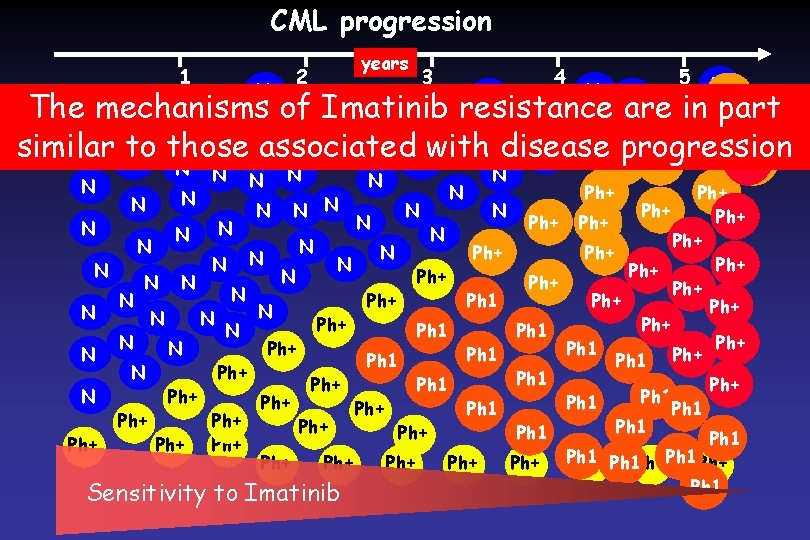
CML progression 1 N years 2 3 N 4 N N N 5 N Ph+ Ph+ Ph+ The mechanisms of N N resistance are in part N Imatinib N N Nassociated N similar to those with disease progression N N N N Ph+ N N N Ph+ Ph+ N N N Ph+ N N Ph+ Ph 1 Ph+ N N Ph+ N Ph 1 N Ph+ Ph 1 N Ph 1 Ph+ Ph 1 N Ph+ Ph 1 Ph+ Ph 1 Ph+ Ph+ Ph 1 Ph+ Ph+ Ph 1 Ph+ Ph 1 Ph+Ph 1 Ph+ Ph 1 Sensitivity to Imatinib N N N N Ph+
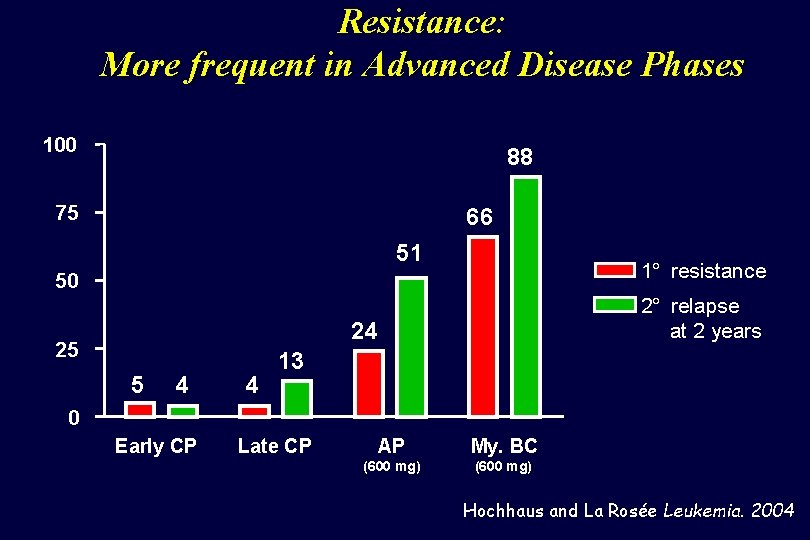
Resistance: More frequent in Advanced Disease Phases 100 88 75 66 51 1° resistance 50 2° relapse at 2 years 24 25 5 4 4 13 0 Early CP Late CP AP My. BC (600 mg) Hochhaus and La Rosée Leukemia. 2004
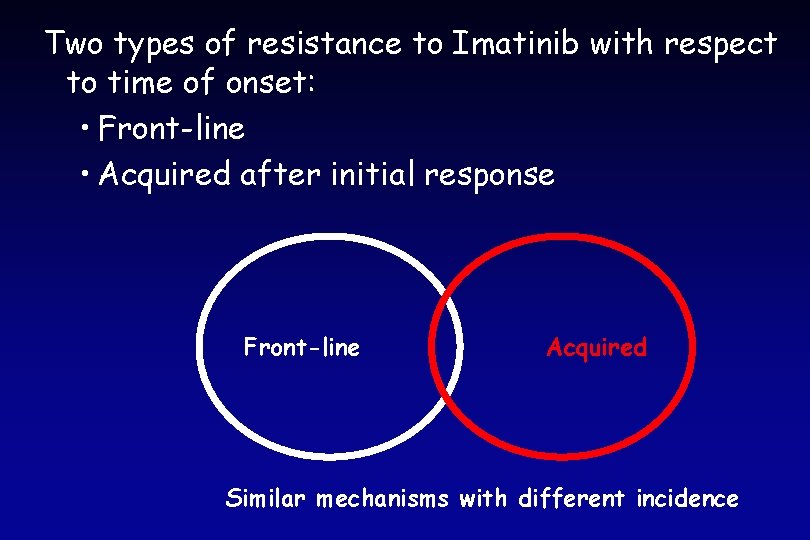
Two types of resistance to Imatinib with respect to time of onset: • Front-line • Acquired after initial response Front-line Acquired Similar mechanisms with different incidence
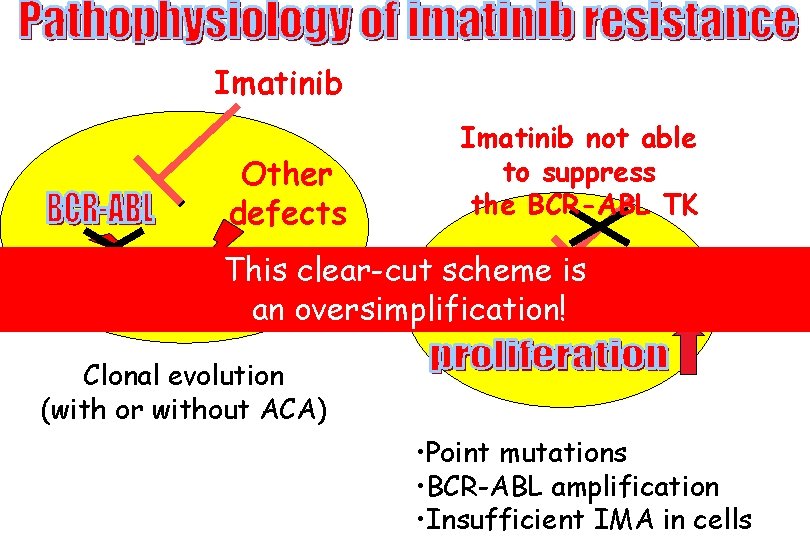
Imatinib Other defects Imatinib not able to suppress the BCR-ABL TK This clear-cut scheme is an oversimplification! Clonal evolution (with or without ACA) • Point mutations • BCR-ABL amplification • Insufficient IMA in cells
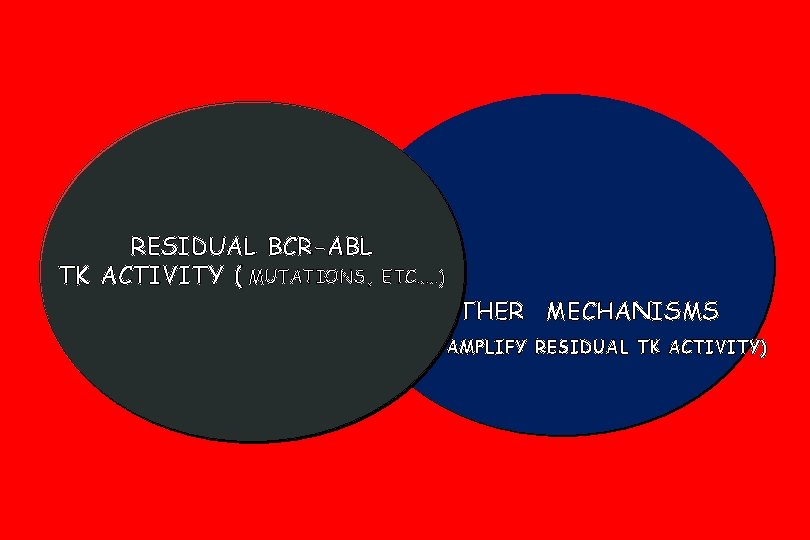
RESIDUAL BCR-ABL TK ACTIVITY ( MUTATIONS, ETC. . . ) OTHER MECHANISMS (MAY AMPLIFY RESIDUAL TK ACTIVITY)
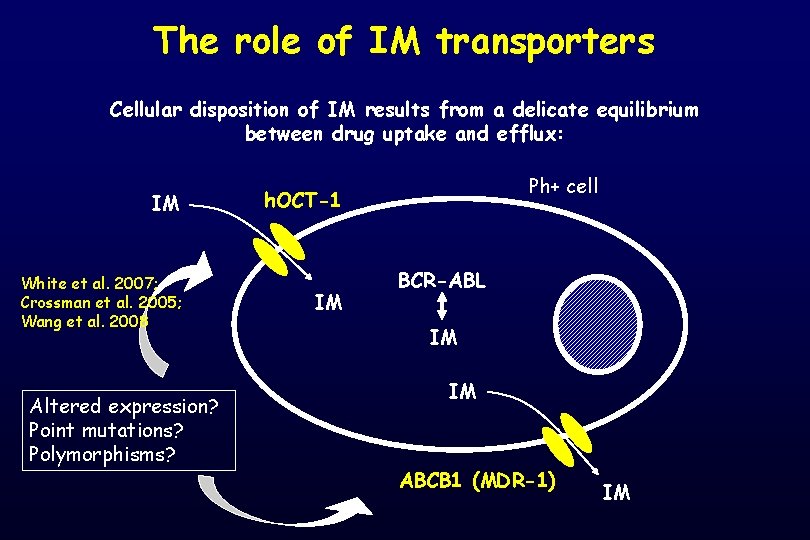
The role of IM transporters Cellular disposition of IM results from a delicate equilibrium between drug uptake and efflux: IM White et al. 2007; Crossman et al. 2005; Wang et al. 2008 Altered expression? Point mutations? Polymorphisms? Ph+ cell h. OCT-1 IM BCR-ABL IM IM ABCB 1 (MDR-1) IM
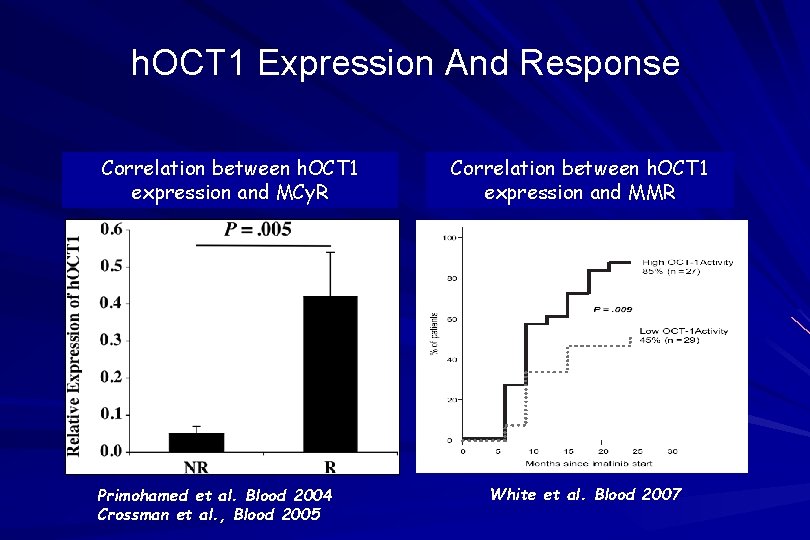
h. OCT 1 Expression And Response Correlation between h. OCT 1 expression and MCy. R Primohamed et al. Blood 2004 Crossman et al. , Blood 2005 Correlation between h. OCT 1 expression and MMR White et al. Blood 2007
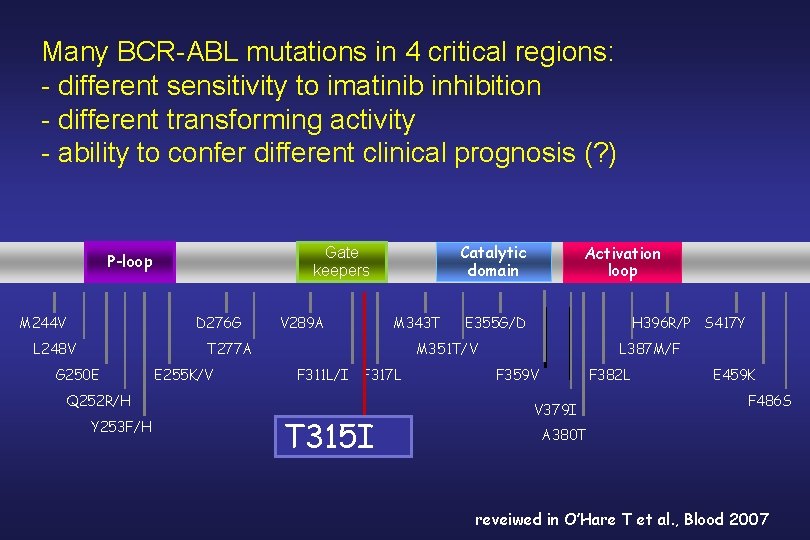
Many BCR-ABL mutations in 4 critical regions: - different sensitivity to imatinib inhibition - different transforming activity - ability to confer different clinical prognosis (? ) M 244 V D 276 G L 248 V Catalytic domain Gate keepers P-loop V 289 A M 343 T T 277 A G 250 E E 255 K/V E 355 G/D H 396 R/P S 417 Y M 351 T/V F 311 L/I F 317 L Q 252 R/H Y 253 F/H Activation loop T 315 I L 387 M/F F 359 V F 382 L V 379 I E 459 K F 486 S A 380 T reveiwed in O’Hare T et al. , Blood 2007
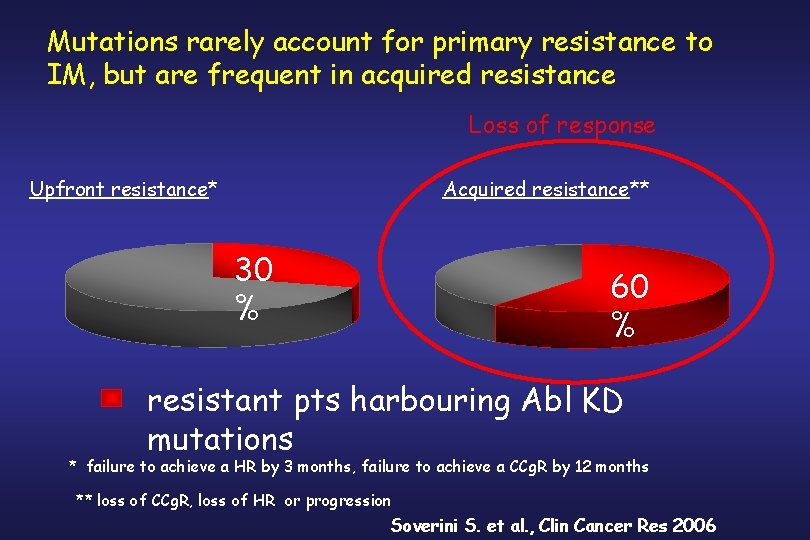
Mutations rarely account for primary resistance to IM, but are frequent in acquired resistance Loss of response Upfront resistance* Acquired resistance** 30 % 60 % resistant pts harbouring Abl KD mutations * failure to achieve a HR by 3 months, failure to achieve a CCg. R by 12 months ** loss of CCg. R, loss of HR or progression Soverini S. et al. , Clin Cancer Res 2006
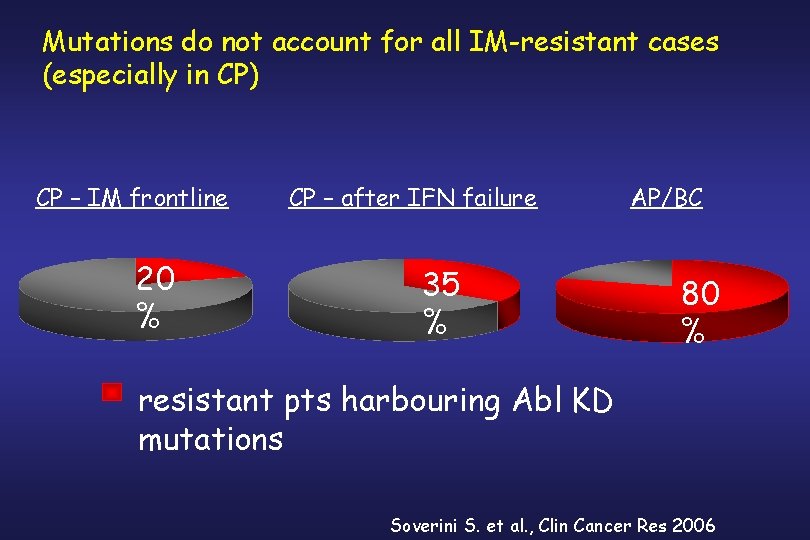
Mutations do not account for all IM-resistant cases (especially in CP) CP – IM frontline 20 % CP – after IFN failure 35 % AP/BC 80 % resistant pts harbouring Abl KD mutations Soverini S. et al. , Clin Cancer Res 2006
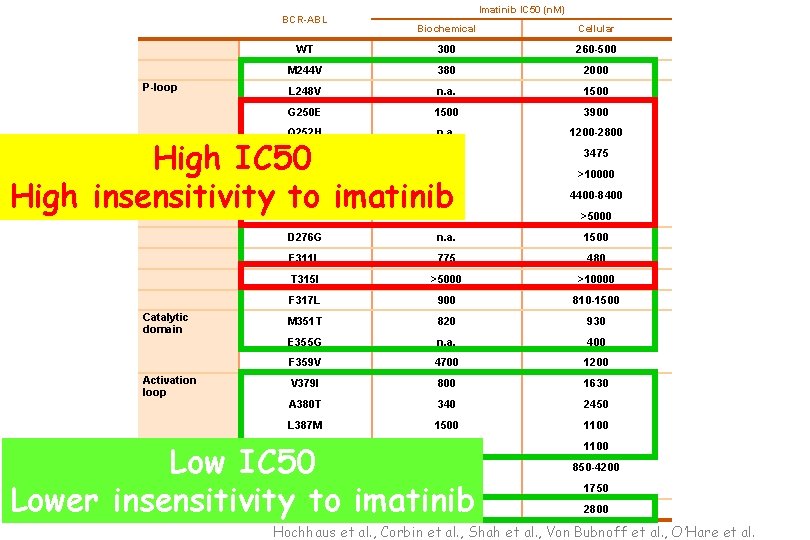
BCR-ABL P-loop Imatinib IC 50 (n. M) Biochemical Cellular WT 300 260 -500 M 244 V 380 2000 L 248 V n. a. 1500 G 250 E 1500 3900 Q 252 H n. a. 1200 -2800 Y 253 F >5000 3475 Y 253 H >5000 >10000 E 255 K 2800 4400 -8400 E 255 V >5000 D 276 G n. a. 1500 F 311 L 775 480 T 315 I >5000 >10000 F 317 L 900 810 -1500 M 351 T 820 930 E 355 G n. a. 400 F 359 V 4700 1200 V 379 I 800 1630 A 380 T 340 2450 L 387 M 1500 1100 High IC 50 High insensitivity to imatinib Catalytic domain Activation loop Low IC 50 Lower insensitivity to imatinib L 387 F n. a. 1100 H 396 P 340 -800 850 -4200 H 396 R 1950 1750 F 486 S 1230 2800 Hochhaus et al. , Corbin et al. , Shah et al. , Von Bubnoff et al. , O’Hare et al.
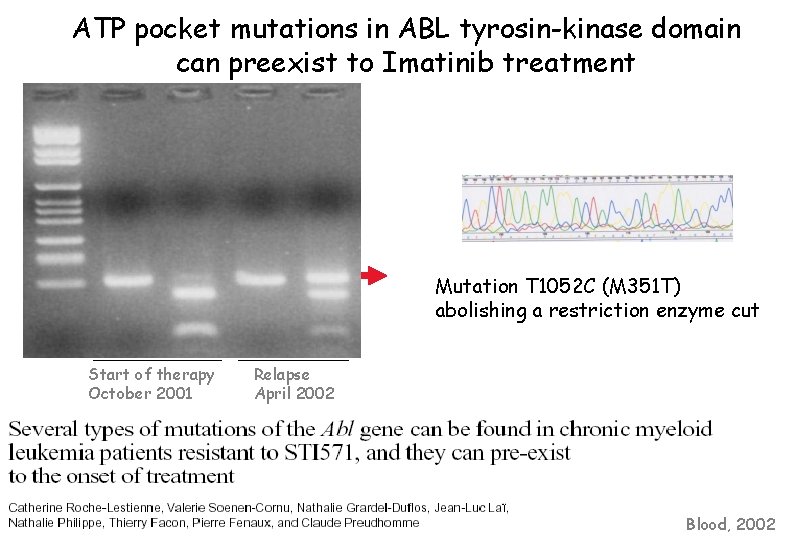
ATP pocket mutations in ABL tyrosin-kinase domain can preexist to Imatinib treatment Mutation T 1052 C (M 351 T) abolishing a restriction enzyme cut Start of therapy October 2001 Relapse April 2002 Blood, 2002
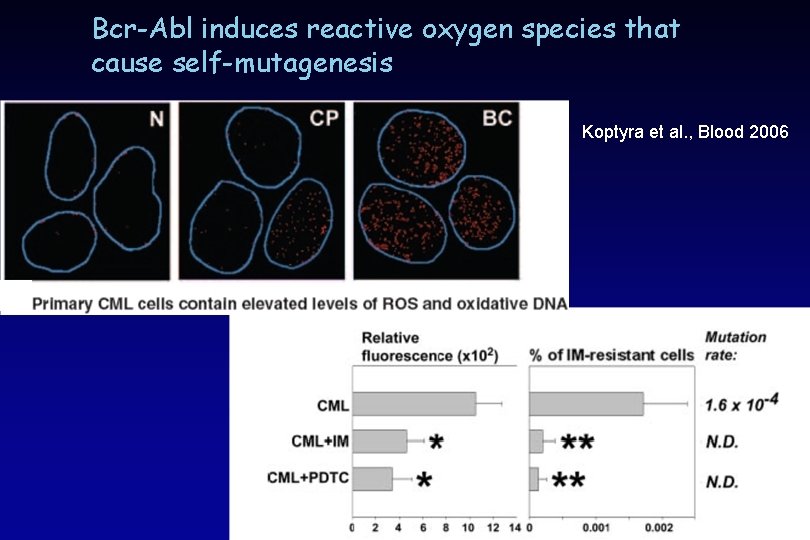
Bcr-Abl induces reactive oxygen species that cause self-mutagenesis Koptyra et al. , Blood 2006
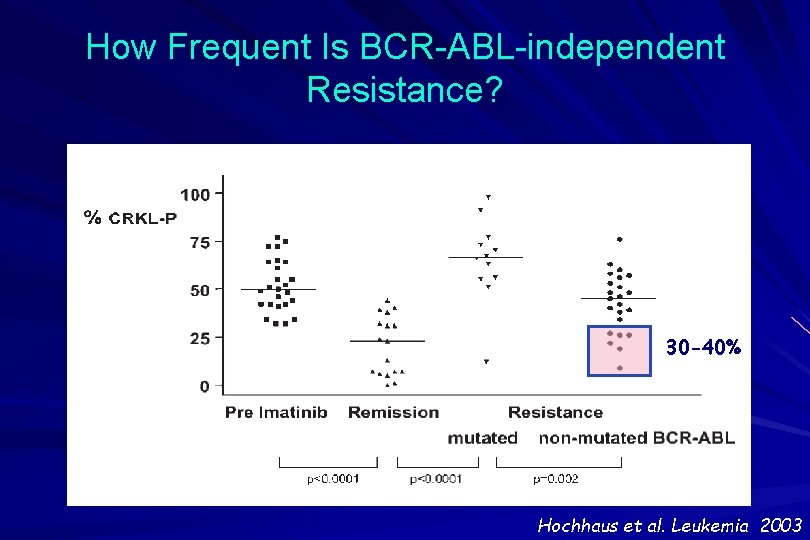
How Frequent Is BCR-ABL-independent Resistance? 30 -40% Hochhaus et al. Leukemia 2003
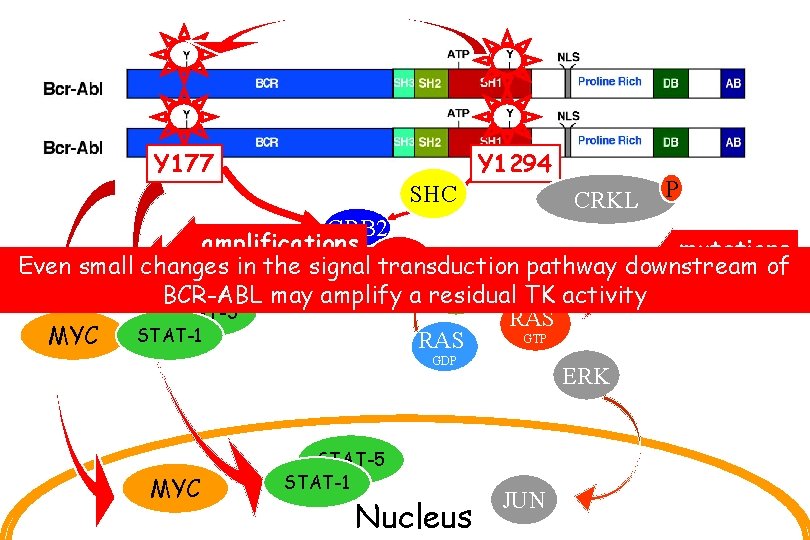
Y 177 Y 1294 SHC CRKL P GRB 2 amplifications mutations GAB 2 Even small changes in the signal transduction pathway downstream of SOS BCR-ABL may amplify a residual TK activity STAT-5 RAS STAT-1 GTP MYC RAS GDP ERK MYC STAT-5 STAT-1 Nucleus JUN
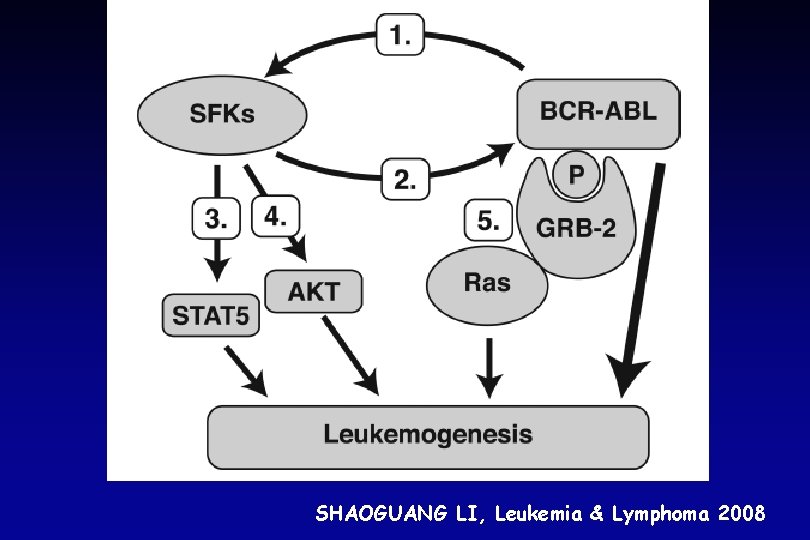
SHAOGUANG LI, Leukemia & Lymphoma 2008
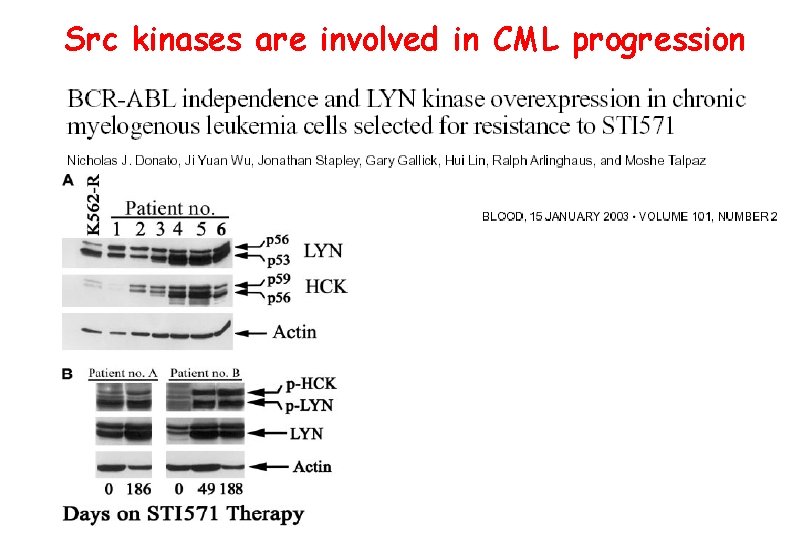
Src kinases are involved in CML progression
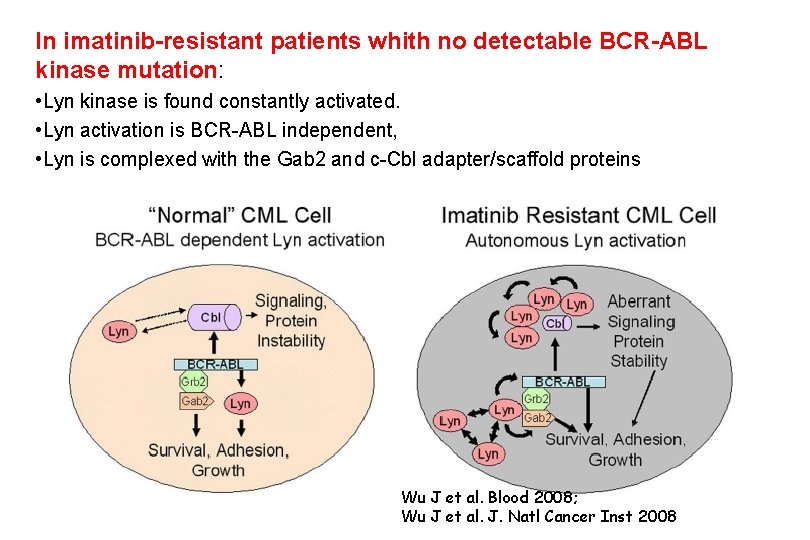
In imatinib-resistant patients whith no detectable BCR-ABL kinase mutation: • Lyn kinase is found constantly activated. • Lyn activation is BCR-ABL independent, • Lyn is complexed with the Gab 2 and c-Cbl adapter/scaffold proteins Wu J et al. Blood 2008; Wu J et al. J. Natl Cancer Inst 2008
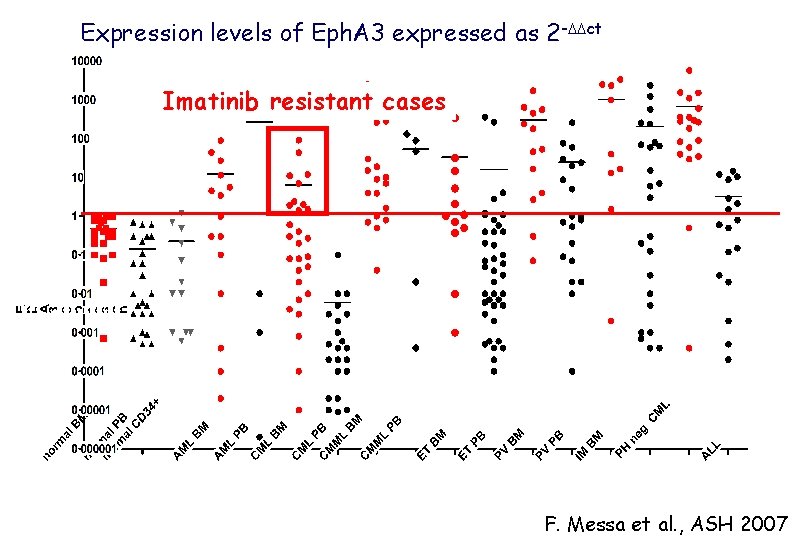
Expression levels of Eph. A 3 expressed as 2 -DDct Imatinib resistant cases F. Messa et al. , ASH 2007
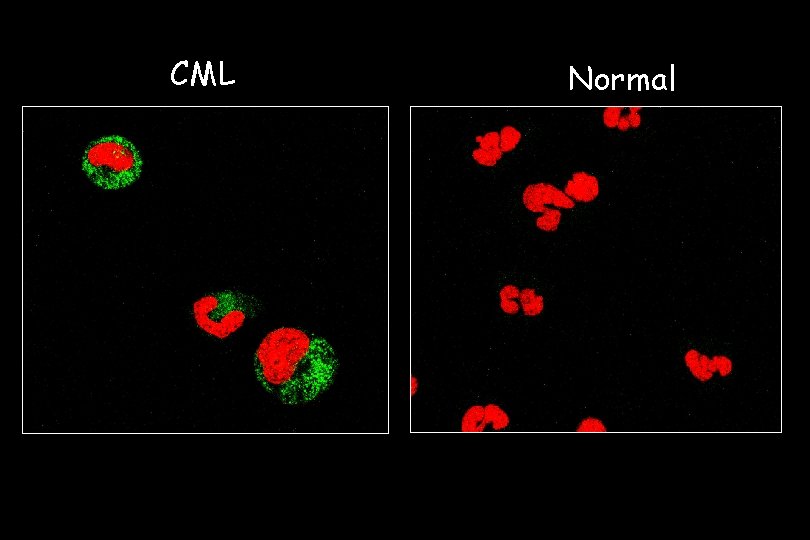
CML Normal Institute "Seràgnoli" - Bologna
Role of negative regulators Protein tyrosine phosphatase 1 B (PTP 1 B) is a negative regulator of BCR-ABL mediated transformation PTP 1 B activates Src by dephosphorylating Tyr 527
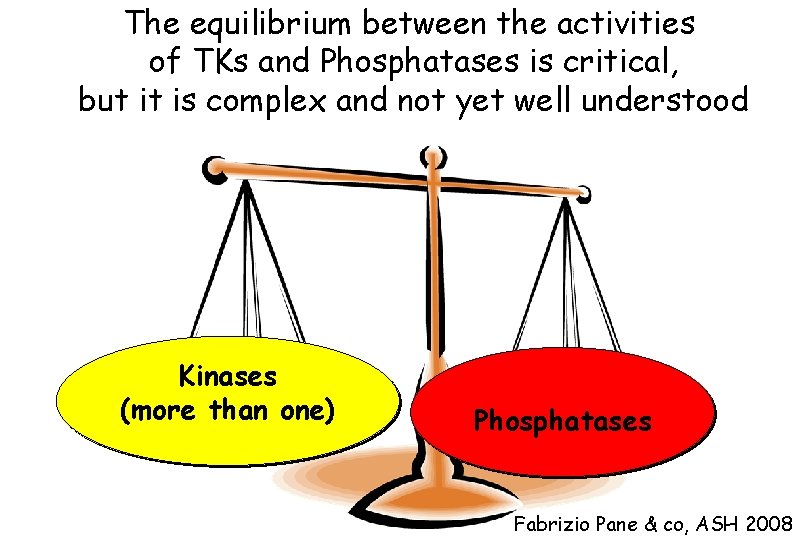
The equilibrium between the activities of TKs and Phosphatases is critical, but it is complex and not yet well understood Kinases (more than one) Phosphatases Fabrizio Pane & co, ASH 2008
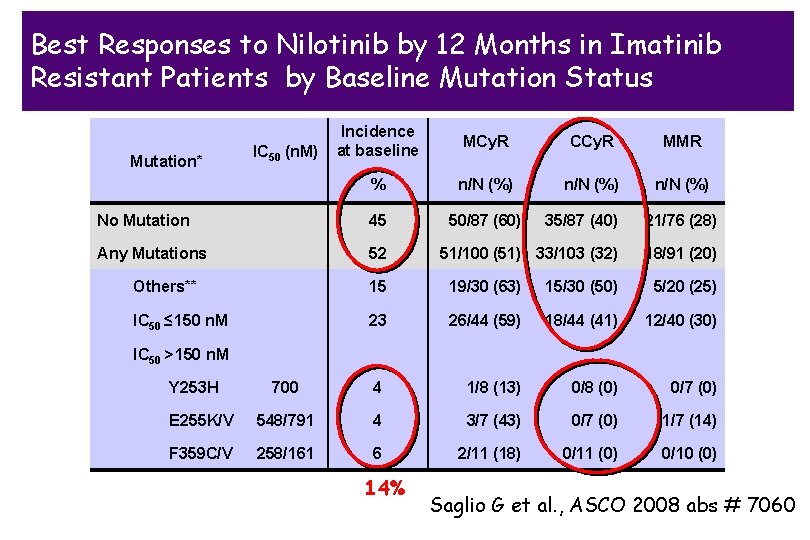
Best Responses to Nilotinib by 12 Months in Imatinib Resistant Patients by Baseline Mutation Status Mutation* Incidence IC 50 (n. M) at baseline % No Mutation 45 Any Mutations 52 Others** IC 50 ≤ 150 n. M CCy. R MMR n/N (%) 50/87 (60) 35/87 (40) 21/76 (28) 51/100 (51) 33/103 (32) 18/91 (20) 15 19/30 (63) 15/30 (50) 5/20 (25) 23 26/44 (59) 18/44 (41) 12/40 (30) IC 50 >150 n. M Y 253 H MCy. R 700 4 1/8 (13) 0/8 (0) 0/7 (0) E 255 K/V 548/791 4 3/7 (43) 0/7 (0) 1/7 (14) F 359 C/V 258/161 6 2/11 (18) 0/11 (0) 0/10 (0) 14% Saglio G et al. , ASCO 2008 abs # 7060
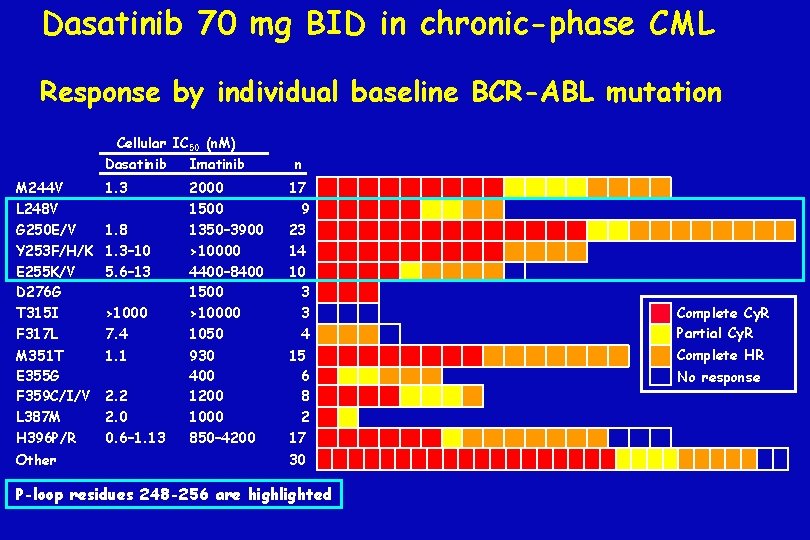
Dasatinib 70 mg BID in chronic-phase CML Response by individual baseline BCR-ABL mutation Cellular IC 50 (n. M) M 244 V Dasatinib Imatinib 1. 3 2000 17 1500 9 L 248 V G 250 E/V 1350– 3900 23 Y 253 F/H/K 1. 3– 10 E 255 K/V 5. 6– 13 D 276 G >10000 4400– 8400 1500 14 10 3 T 315 I >10000 3 F 317 L 7. 4 1050 4 M 351 T E 355 G F 359 C/I/V 1. 1 2. 2 930 400 1200 15 6 8 L 387 M 2. 0 1000 2 H 396 P/R 0. 6– 1. 13 850– 4200 Other 1. 8 n 17 30 P-loop residues 248 -256 are highlighted Complete Cy. R Partial Cy. R Complete HR No response
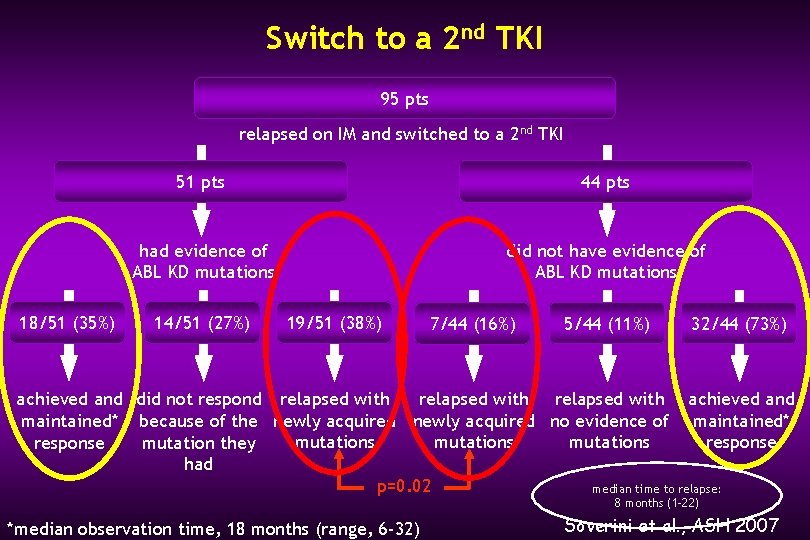
Switch to a 2 nd TKI 95 pts relapsed on IM and switched to a 2 nd TKI 18/51 (35%) 51 pts 44 pts had evidence of ABL KD mutations did not have evidence of ABL KD mutations 14/51 (27%) 19/51 (38%) 7/44 (16%) 5/44 (11%) 32/44 (73%) relapsed with achieved and did not respond relapsed with maintained* because of the newly acquired no evidence of maintained* mutations response mutation they response had p=0. 02 median time to relapse: 8 months (1 -22) *median observation time, 18 months (range, 6 -32) Soverini et al. , ASH 2007
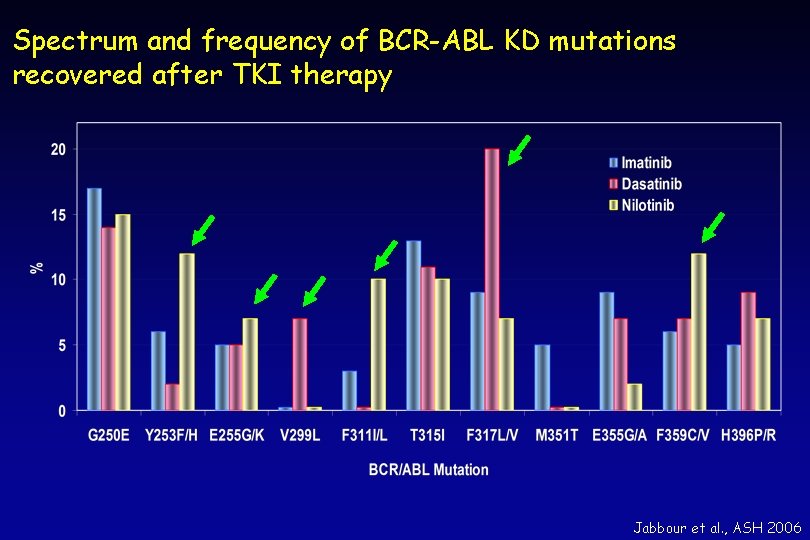
Spectrum and frequency of BCR-ABL KD mutations recovered after TKI therapy Jabbour et al. , ASH 2006
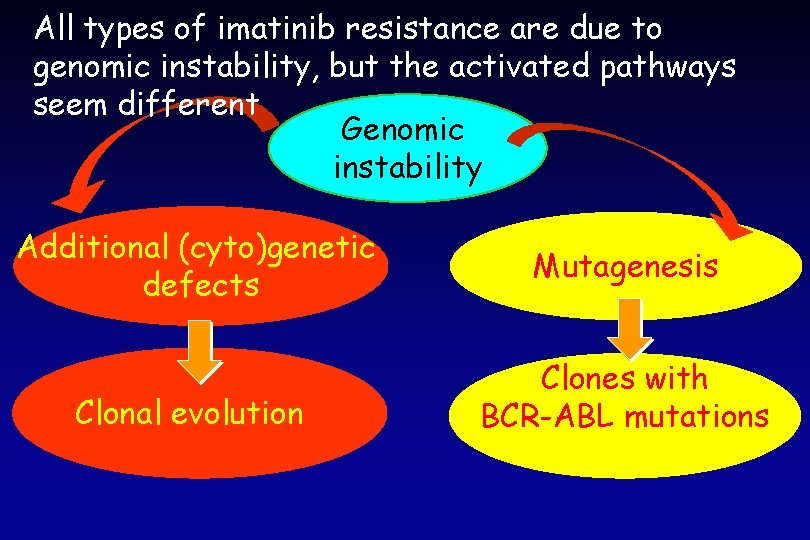
All types of imatinib resistance are due to genomic instability, but the activated pathways seem different Genomic instability Additional (cyto)genetic defects Clonal evolution Mutagenesis Clones with BCR-ABL mutations
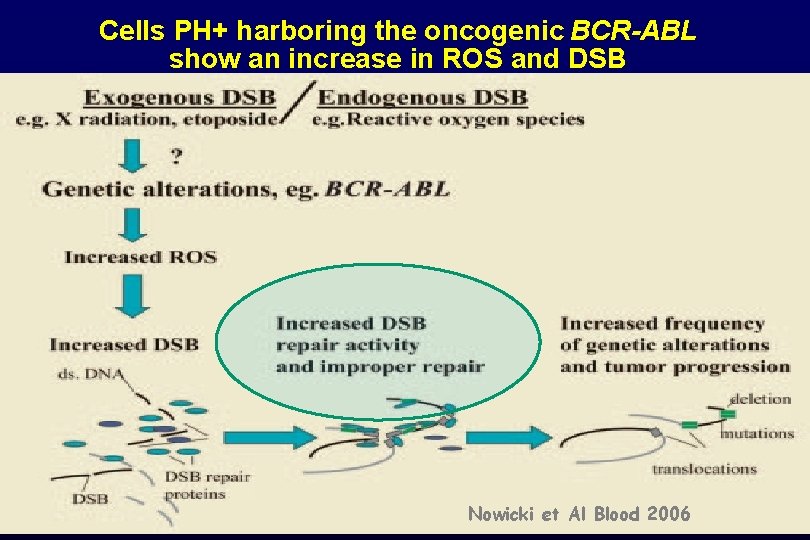
Cells PH+ harboring the oncogenic BCR-ABL show an increase in ROS and DSB Nowicki et Al Blood 2006
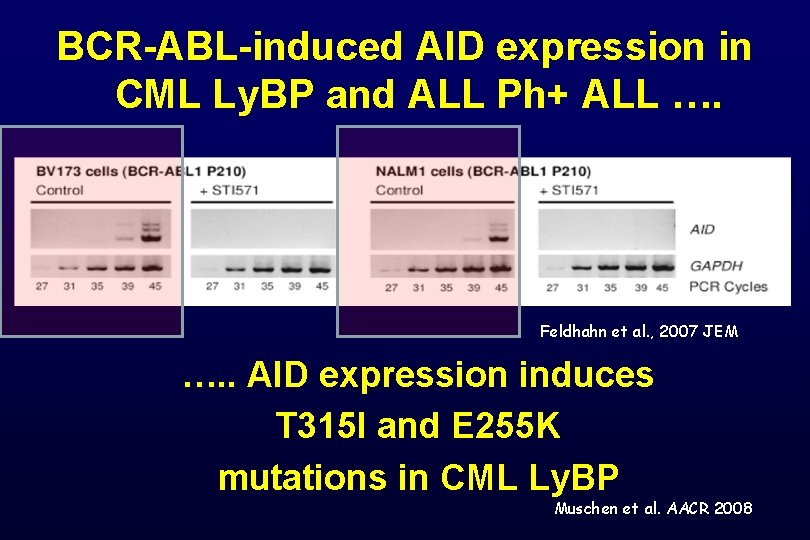
BCR-ABL-induced AID expression in CML Ly. BP and ALL Ph+ ALL …. Feldhahn et al. , 2007 JEM …. . AID expression induces T 315 I and E 255 K mutations in CML Ly. BP Muschen et al. AACR 2008
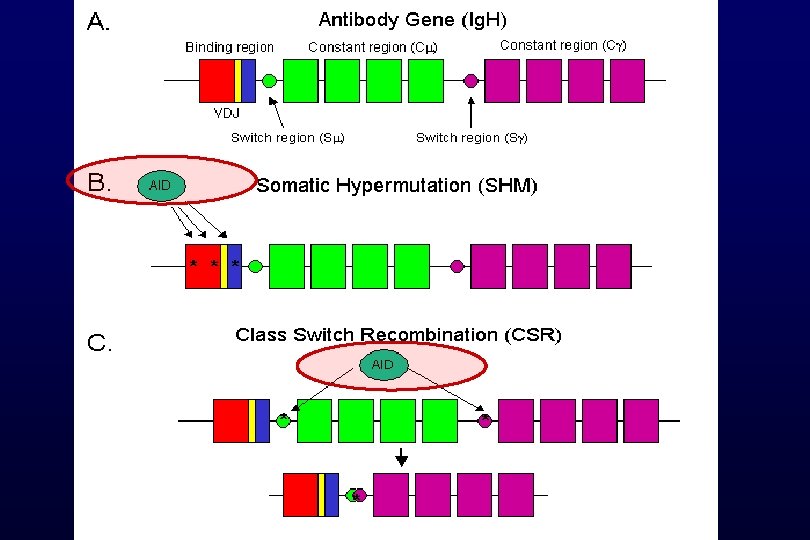
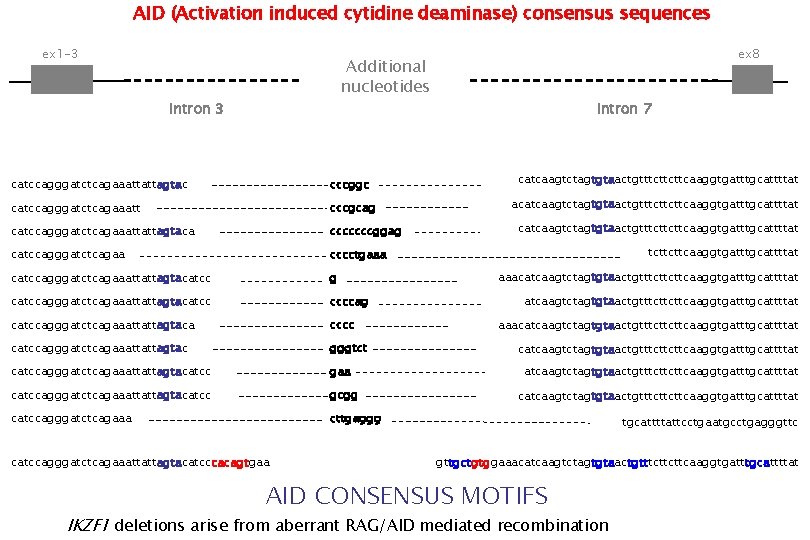
AID (Activation induced cytidine deaminase) consensus sequences ex 1 -3 ex 8 Additional nucleotides intron 3 intron 7 catccagggatctcagaaattattagtac cccggc catcaagtctagtgtaactgtttcttcttcaaggtgatttgcattttat catccagggatctcagaaatt cccgcag acatcaagtctagtgtaactgtttcttcttcaaggtgatttgcattttat catccagggatctcagaaattattagtaca cccccccggag catccagggatctcagaa cccctgaaa catccagggatctcagaaattattagtacatcc g catccagggatctcagaaattattagtacatcc ccccag catccagggatctcagaaattattagtaca cccc catccagggatctcagaaattattagtac gggtct catccagggatctcagaaattattagtacatcc gaa catccagggatctcagaaattattagtacatcc gcgg catccagggatctcagaaa cttgaggg catccagggatctcagaaattattagtacatcccacagtgaa catcaagtctagtgtaactgtttcttcttcaaggtgatttgcattttat aaacatcaagtctagtgtaactgtttcttcttcaaggtgatttgcattttat atcaagtctagtgtaactgtttcttcttcaaggtgatttgcattttat catcaagtctagtgtaactgtttcttcttcaaggtgatttgcattttattcctgaatgcctgagggttc gttgctgtggaaacatcaagtctagtgtaactgtttcttcttcaaggtgatttgcattttat AID CONSENSUS MOTIFS IKZF 1 deletions arise from aberrant RAG/AID mediated recombination
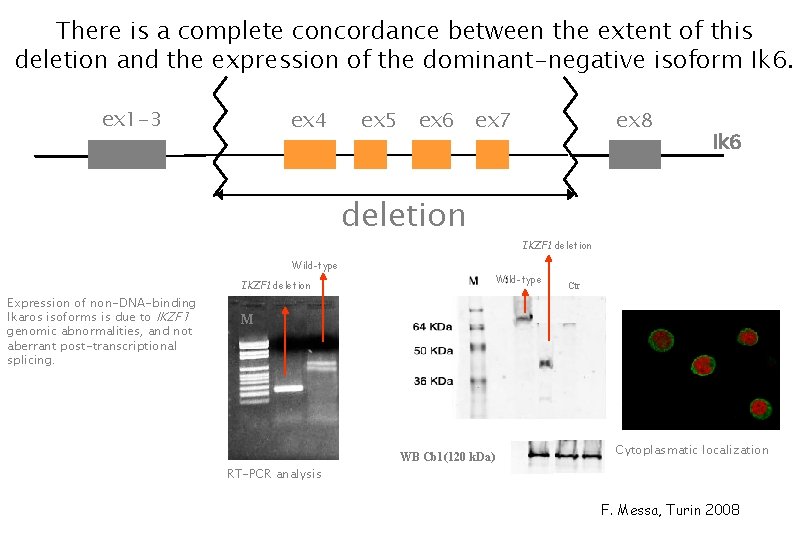
There is a complete concordance between the extent of this deletion and the expression of the dominant-negative isoform Ik 6. ex 1 -3 ex 4 ex 5 ex 6 ex 7 deletion ex 8 Ik 6 IKZF 1 deletion Wild-type IKZF 1 deletion Expression of non-DNA-binding Ikaros isoforms is due to IKZF 1 genomic abnormalities, and not aberrant post-transcriptional splicing. Ctr M WB Cbl (120 k. Da) Cytoplasmatic localization RT-PCR analysis F. Messa, Turin 2008
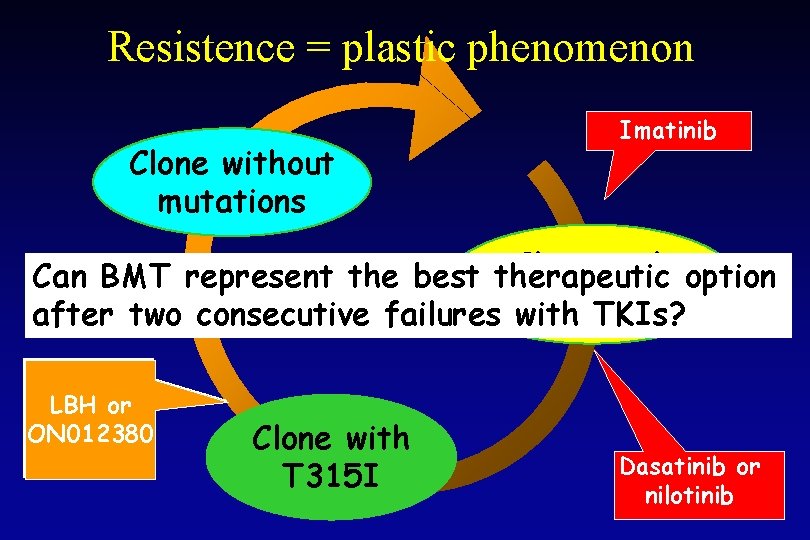
Resistence = plastic phenomenon Clone without mutations Imatinib Clone with option Can BMT represent the best therapeutic Mutation after two consecutive failures with TKIs? LBH or ON 012380 Clone with T 315 I Dasatinib or nilotinib
WP 4 on CML ICSG on CML …for support and collaboration.
- Slides: 35