
MEC10 Outline Basic Terms Forecasting Variations Forecasting Methods
MEC-10 Outline § Basic Terms § Forecasting Variations § Forecasting Methods § Naïve Method § Single Moving Averages § Centred Moving Averages § Weighted Moving Averages § Exponential Moving Averages § Regression Analysis Readings § PMBo. K, pages 92 & 238. § Rita, page 190. § Stevenson, Ch 3. § Reid, Ch 8. § Krajewski, Ch 13. § Class Notes. Forecasting MEhsan. Saeed 1
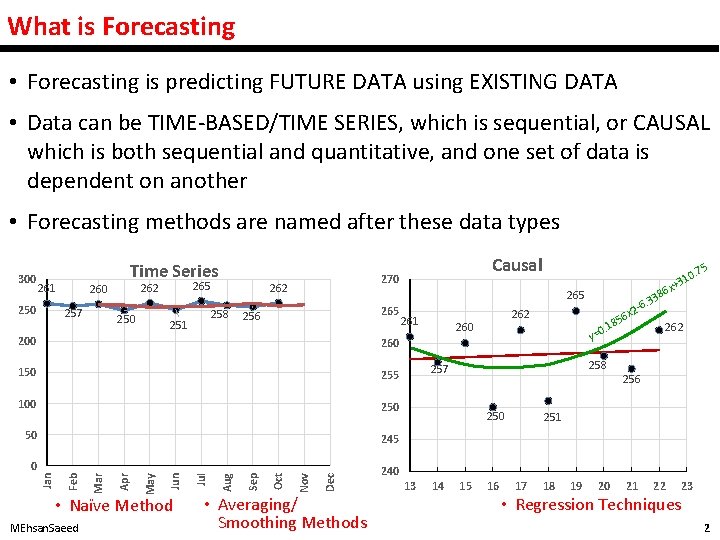
What is Forecasting • Forecasting is predicting FUTURE DATA using EXISTING DATA • Data can be TIME-BASED/TIME SERIES, which is sequential, or CAUSAL which is both sequential and quantitative, and one set of data is dependent on another • Forecasting methods are named after these data types 300 261 250 260 257 Time Series 265 262 250 262 258 251 265 256 Dec Nov Oct Sep 240 Aug 0 Jul 245 Jun 50 May 250 Apr 100 Mar 255 Feb 150 Jan 260 MEhsan. Saeed . 75 86 265 200 • Naïve Method Causal 270 • Averaging/ Smoothing Methods 261 262 260 56. 18 0 y= 258 257 250 13 14 15 16 x . 33 2 -6 10 x+3 262 256 251 17 18 19 20 21 22 23 • Regression Techniques 2
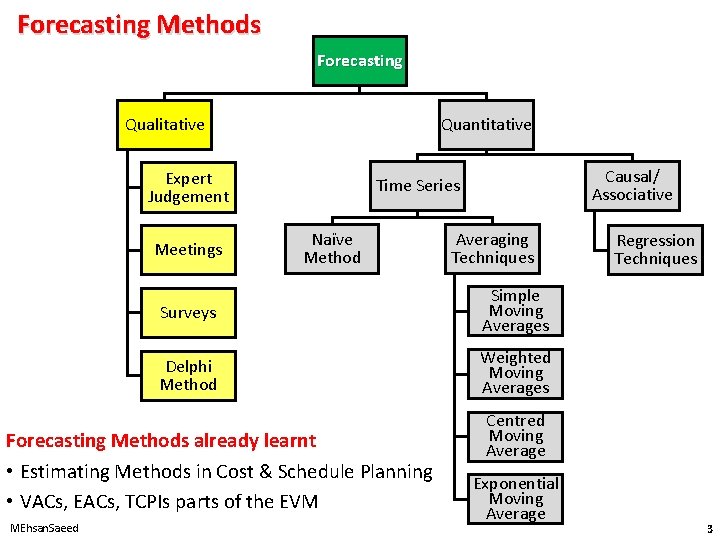
Forecasting Methods Forecasting Quantitative Qualitative Expert Judgement Meetings Naïve Method Averaging Techniques Surveys Simple Moving Averages Delphi Method Weighted Moving Averages Forecasting Methods already learnt • Estimating Methods in Cost & Schedule Planning • VACs, EACs, TCPIs parts of the EVM MEhsan. Saeed Causal/ Associative Time Series Regression Techniques Centred Moving Average Exponential Moving Average 3
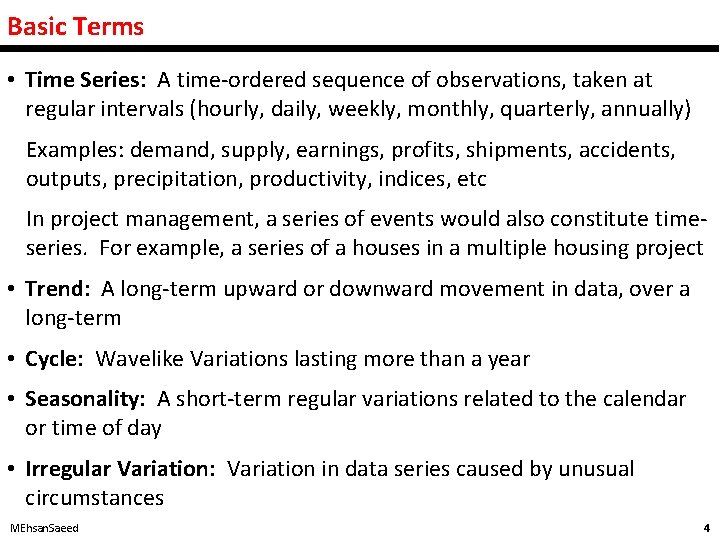
Basic Terms • Time Series: A time-ordered sequence of observations, taken at regular intervals (hourly, daily, weekly, monthly, quarterly, annually) Examples: demand, supply, earnings, profits, shipments, accidents, outputs, precipitation, productivity, indices, etc In project management, a series of events would also constitute timeseries. For example, a series of a houses in a multiple housing project • Trend: A long-term upward or downward movement in data, over a long-term • Cycle: Wavelike Variations lasting more than a year • Seasonality: A short-term regular variations related to the calendar or time of day • Irregular Variation: Variation in data series caused by unusual circumstances MEhsan. Saeed 4
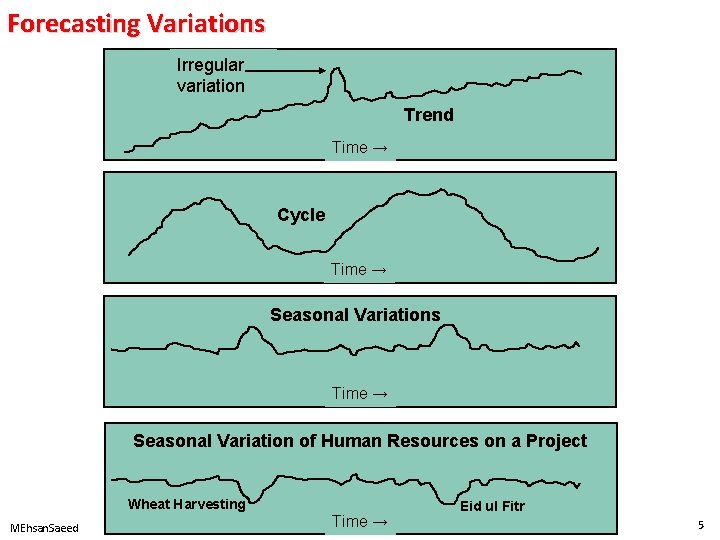
Forecasting Variations Irregular variation Trend Time → Cycle Time → Seasonal Variations Time → Seasonal Variation of Human Resources on a Project Wheat Harvesting MEhsan. Saeed Time → Eid ul Fitr 5

Naïve Method – The Simplest Forecast Example: On a multi-housing project, the time of completion of the first 10 houses (H 1 to H 10) is indicated in the table. What can be the forecasted duration of House # 11 (H 11)? House Duration to Complete H 1 260 H 2 245 Simplest Method: Forecast duration is the previous house’s (H-10’s) actual duration, i. e. 248 days. H 3 255 H 4 246 This is the Naïve Method of forecasting and is widely used for future estimating. Sometimes, the naïve forecast is indexed to inflation/escalation/increments. For example, in this case, duration of H-11 could be 248 days+10% H 5 254 H 6 243 H 7 253 H 8 242 H 9 254 H 10 248 H 11 ? Naïve Forecast: A forecast for a future period/event equals the previous period/event’s actual value MEhsan. Saeed 6
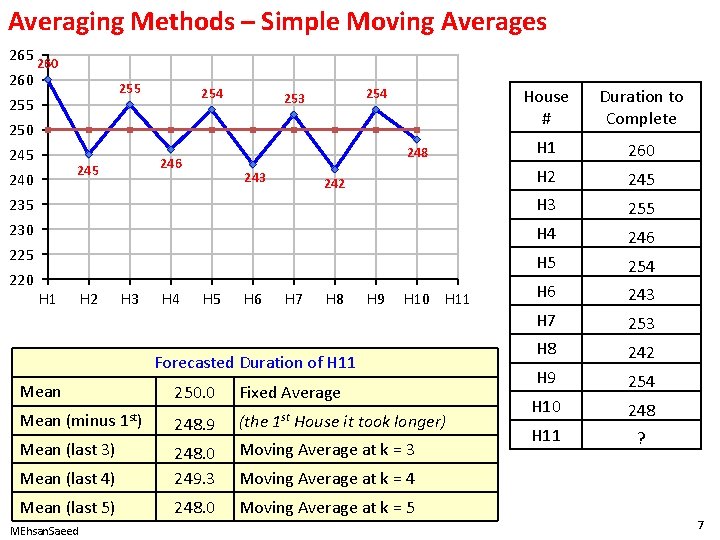
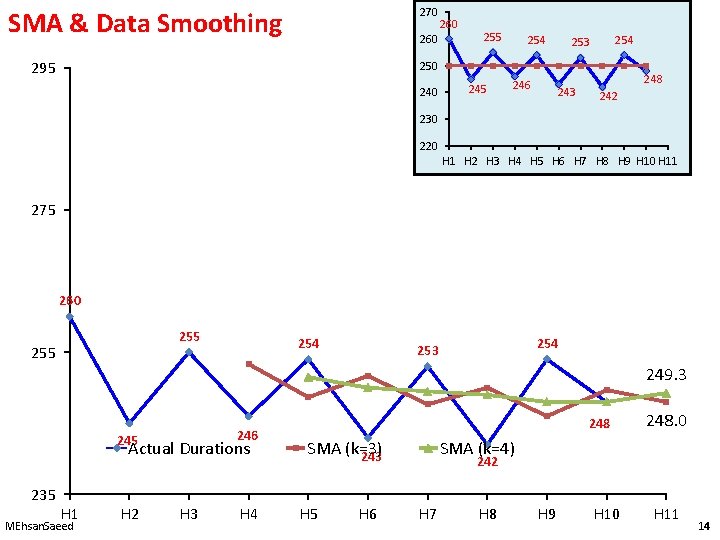
Averaging Methods – Simple Moving Averages 265 260 255 254 House # Duration to Complete H 1 260 H 2 245 235 H 3 255 230 H 4 225 246 H 5 254 H 6 243 H 7 253 H 8 242 H 9 254 H 10 248 H 11 ? 255 253 250 245 240 248 246 243 242 220 H 1 H 2 H 3 H 4 H 5 H 6 H 7 H 8 H 9 H 10 H 11 Forecasted Duration of H 11 Mean (minus 250. 0 1 st) Fixed Average 248. 9 (the Mean (last 4) 248. 0 249. 3 Moving Average at k = 3 Mean (last 5) 248. 0 Moving Average at k = 5 Mean (last 3) MEhsan. Saeed 1 st House it took longer) Moving Average at k = 4 7
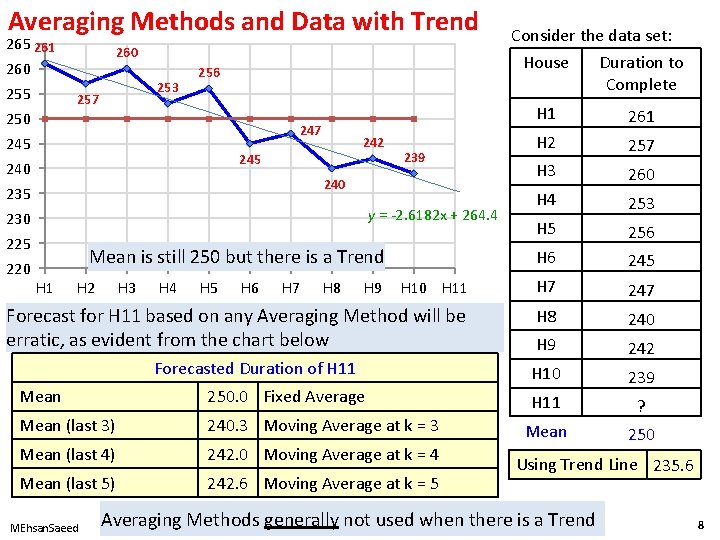
Averaging Methods and Data with Trend 265 261 260 Consider the data set: House Duration to Complete H 1 261 H 2 257 H 3 260 H 4 253 H 5 256 H 6 245 H 10 H 11 H 7 247 Forecast for H 11 based on any Averaging Method will be erratic, as evident from the chart below H 8 240 H 9 242 H 10 239 H 11 ? Mean 250 260 255 253 257 256 250 247 245 242 245 240 239 240 235 y = -2. 6182 x + 264. 4 230 225 Mean is still 250 but there is a Trend 220 H 1 H 2 H 3 H 4 H 5 H 6 H 7 H 8 H 9 Forecasted Duration of H 11 Mean 250. 0 Fixed Average Mean (last 3) 240. 3 Moving Average at k = 3 Mean (last 4) 242. 0 Moving Average at k = 4 Mean (last 5) 242. 6 Moving Average at k = 5 MEhsan. Saeed Using Trend Line 235. 6 Averaging Methods generally not used when there is a Trend 8
Moving Average … 1/3 • Moving Average is a technique to get an overall idea of the trends in a data set; it is an average of any subset of numbers. The moving average is extremely useful forecasting long-term trends Example: A construction company has data on construction cost per square foot which it can use to estimate cost for the next project • Variations include: Simple, Weighted, Centred, Exponential etc • Moving Average is used to overcome irregular, random, seasonal or cyclic variations • Overcoming variations is called "smoothing“ • Moving Average is a smoothing process MEhsan. Saeed 9
Moving Average … 2/3 • Smoothing by Moving Average is done by taking average of three (or more) recent observations, then dropping the first observation and advancing to the next one, and continuing the process till getting to the period/unit for which forecast is required • Each new data point is included in the average as it becomes available, and the oldest data point is discarded • The number of observations averaged is referred to as the “k” number; the constant number k is specified at the outset • The smaller the number k, the more weight is given to recent periods; the greater the number k, the less weight is given to recent periods MEhsan. Saeed 10
Moving Average … 3/3 • A large k is desirable when there are wide, infrequent fluctuations in the series, i. e. the data fluctuates violently • A small k is most desirable when there are sudden shifts in the level of series • For quarterly data, a four-quarter moving average, MA(4), eliminates or averages out seasonal effects • For monthly data, a 12 -month moving average, MA(12), eliminate or averages out seasonal effect • Equal weights are assigned to each observation used in the average MEhsan. Saeed 11
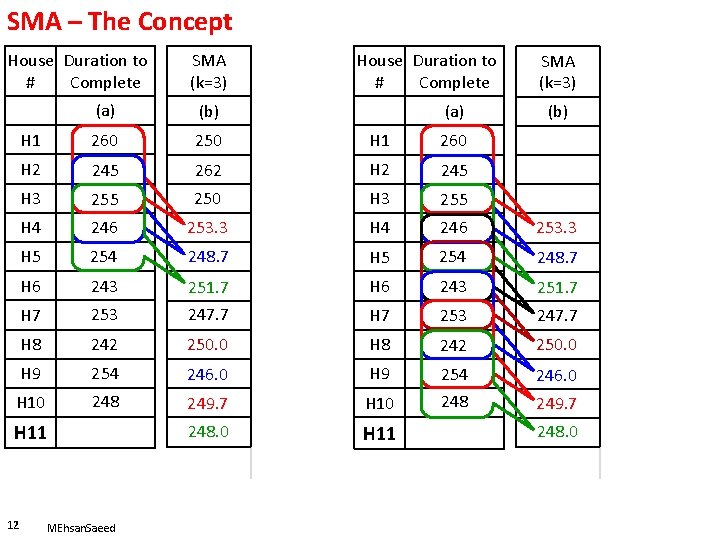
SMA – The Concept House Duration to # Complete SMA (k=3) (a) (b) H 1 260 250 H 1 260 H 2 245 262 H 2 245 H 3 255 250 H 3 255 H 4 246 253. 3 H 5 254 248. 7 H 6 243 251. 7 H 7 253 247. 7 H 8 242 250. 0 H 9 254 246. 0 H 10 248 249. 7 248. 0 H 11 12 MEhsan. Saeed (a) (b) 248. 0
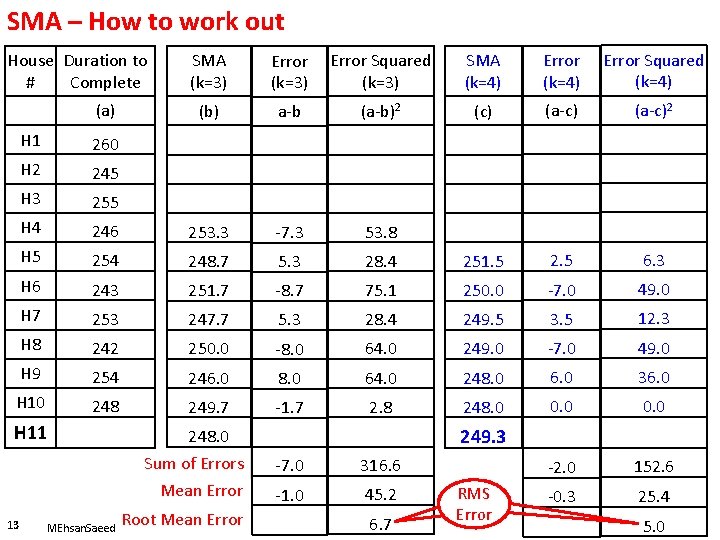
SMA – How to work out House Duration to # Complete (a) SMA (k=3) Error Squared (k=3) SMA (k=4) Error Squared (k=4) (b) a-b (a-b)2 (c) (a-c)2 H 1 260 H 2 245 H 3 255 H 4 246 253. 3 -7. 3 53. 8 H 5 254 248. 7 5. 3 28. 4 251. 5 2. 5 6. 3 H 6 243 251. 7 -8. 7 75. 1 250. 0 -7. 0 49. 0 H 7 253 247. 7 5. 3 28. 4 249. 5 3. 5 12. 3 H 8 242 250. 0 -8. 0 64. 0 249. 0 -7. 0 49. 0 H 9 254 246. 0 8. 0 64. 0 248. 0 6. 0 36. 0 H 10 248 249. 7 -1. 7 2. 8 248. 0 0. 0 -2. 0 152. 6 -0. 3 25. 4 H 11 13 MEhsan. Saeed 249. 3 248. 0 Sum of Errors -7. 0 316. 6 Mean Error -1. 0 45. 2 Root Mean Error 6. 7 RMS Error 5. 0
270 SMA & Data Smoothing 260 295 260 255 254 253 250 245 246 243 248 242 230 220 H 1 H 2 H 3 H 4 H 5 H 6 H 7 H 8 H 9 H 10 H 11 275 260 255 254 253 249. 3 246 245 Actual Durations 248 SMA (k=3) 243 248. 0 SMA (k=4) 242 235 H 1 MEhsan. Saeed H 2 H 3 H 4 H 5 H 6 H 7 H 8 H 9 H 10 H 11 14
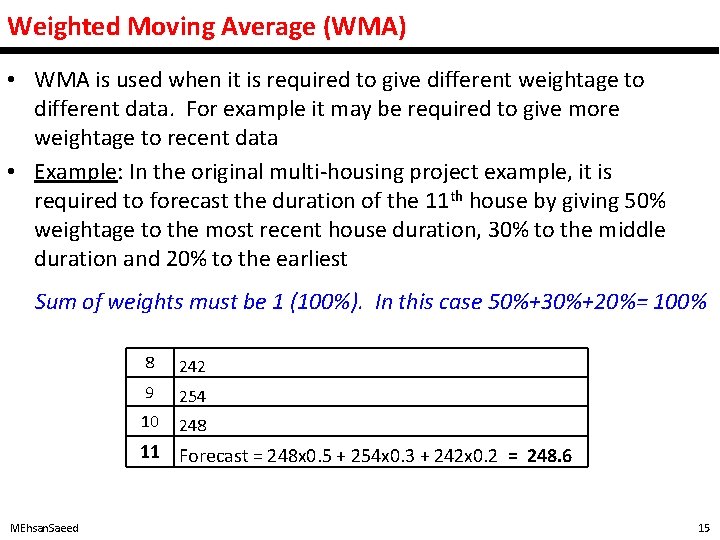
Weighted Moving Average (WMA) • WMA is used when it is required to give different weightage to different data. For example it may be required to give more weightage to recent data • Example: In the original multi-housing project example, it is required to forecast the duration of the 11 th house by giving 50% weightage to the most recent house duration, 30% to the middle duration and 20% to the earliest Sum of weights must be 1 (100%). In this case 50%+30%+20%= 100% 8 242 9 254 10 248 11 Forecast = 248 x 0. 5 + 254 x 0. 3 + 242 x 0. 2 = 248. 6 MEhsan. Saeed 15
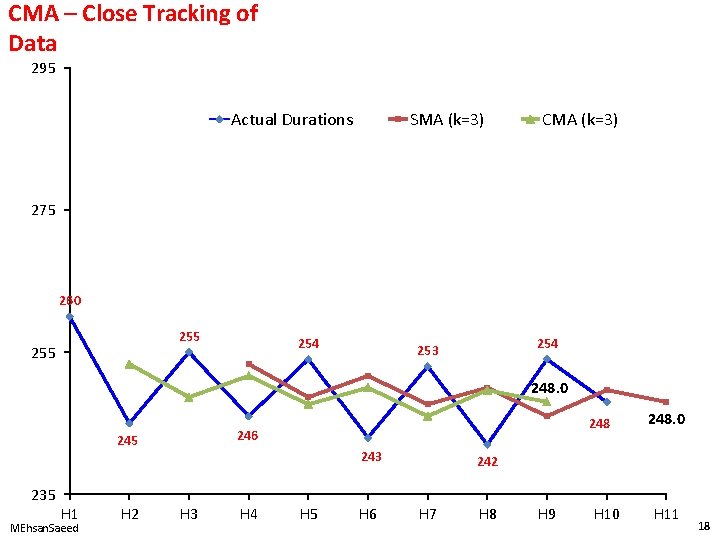
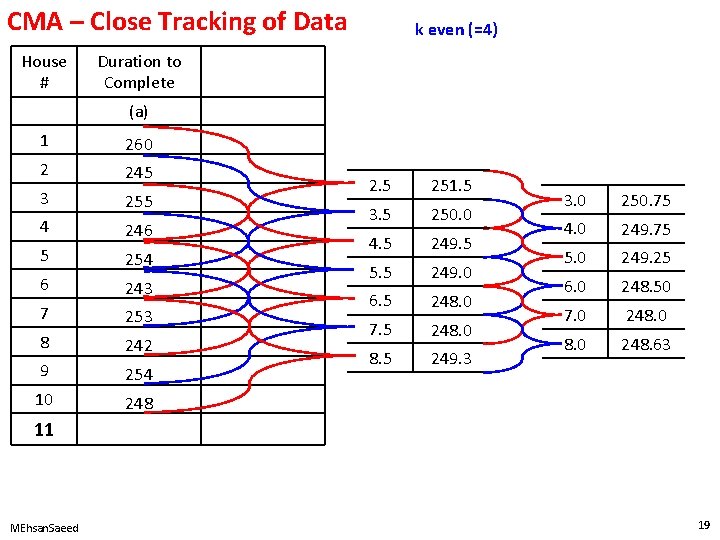
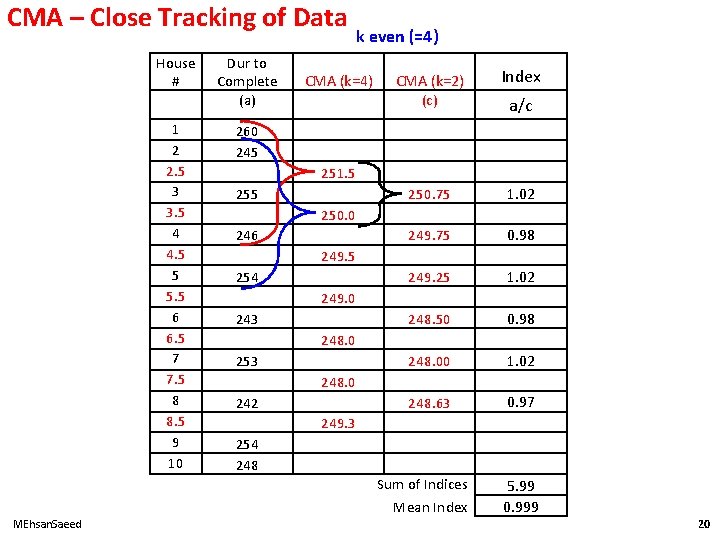
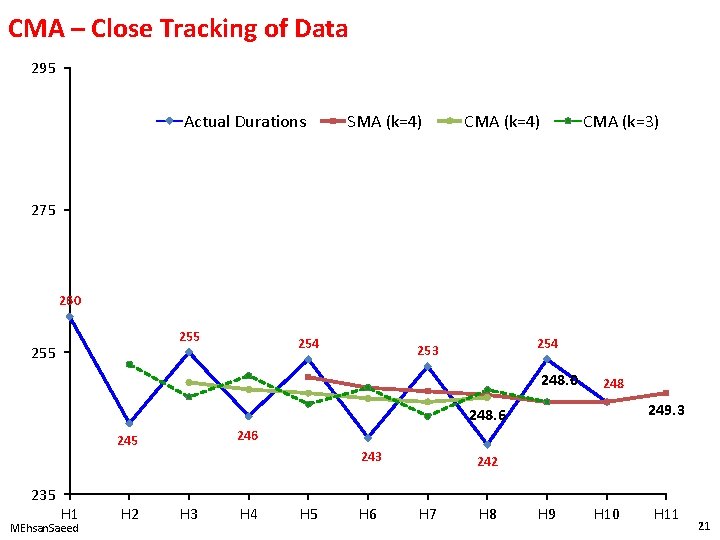
Centred Moving Average (CMA) • CMA is used for a number of situations particularly when there is a seasonal variation and there is a requirement to: – work out seasonal indices – forecast sales/demand; or – closely track the past data; • CMA can be computed, using data equally spaced on either side of the point in the series where the mean is calculated • When k is even, “smoothing of smoothing” is done MEhsan. Saeed 16
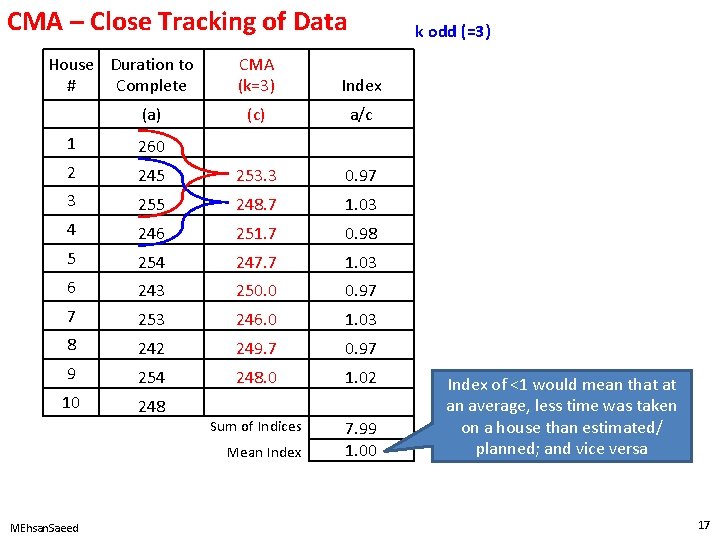
CMA – Close Tracking of Data House Duration to # Complete (a) k odd (=3) CMA (k=3) Index (c) a/c 1 260 2 245 253. 3 0. 97 3 255 248. 7 1. 03 4 246 251. 7 0. 98 5 254 247. 7 1. 03 6 243 250. 0 0. 97 7 253 246. 0 1. 03 8 242 249. 7 0. 97 9 254 248. 0 1. 02 10 248 Sum of Indices 7. 99 1. 00 Mean Index MEhsan. Saeed Index of <1 would mean that at an average, less time was taken on a house than estimated/ planned; and vice versa 17
CMA – Close Tracking of Data 295 Actual Durations SMA (k=3) CMA (k=3) 275 260 255 254 253 248. 0 248 246 245 243 248. 0 242 235 H 1 MEhsan. Saeed H 2 H 3 H 4 H 5 H 6 H 7 H 8 H 9 H 10 H 11 18
CMA – Close Tracking of Data House # k even (=4) Duration to Complete (a) 1 260 2 245 3 255 4 246 5 254 6 243 7 253 8 242 9 254 10 248 2. 5 251. 5 3. 5 250. 0 4. 5 249. 5 5. 5 249. 0 6. 5 248. 0 7. 5 248. 0 8. 5 249. 3 3. 0 250. 75 4. 0 249. 75 5. 0 249. 25 6. 0 248. 50 7. 0 248. 63 11 MEhsan. Saeed 19
CMA – Close Tracking of Data House # 1 2 2. 5 3 3. 5 4 4. 5 5 5. 5 6 6. 5 7 7. 5 8 8. 5 9 10 MEhsan. Saeed Dur to Complete (a) k even (=4) CMA (k=2) (c) Index 250. 75 1. 02 249. 75 0. 98 249. 25 1. 02 248. 50 0. 98 248. 00 1. 02 248. 63 0. 97 a/c 260 245 251. 5 250. 0 246 249. 5 254 249. 0 243 248. 0 253 248. 0 242 249. 3 254 248 Sum of Indices Mean Index 5. 99 0. 999 20
CMA – Close Tracking of Data 295 Actual Durations SMA (k=4) CMA (k=3) 275 260 255 254 253 248. 0 248 249. 3 248. 6 245 243 242 235 H 1 MEhsan. Saeed H 2 H 3 H 4 H 5 H 6 H 7 H 8 H 9 H 10 H 11 21
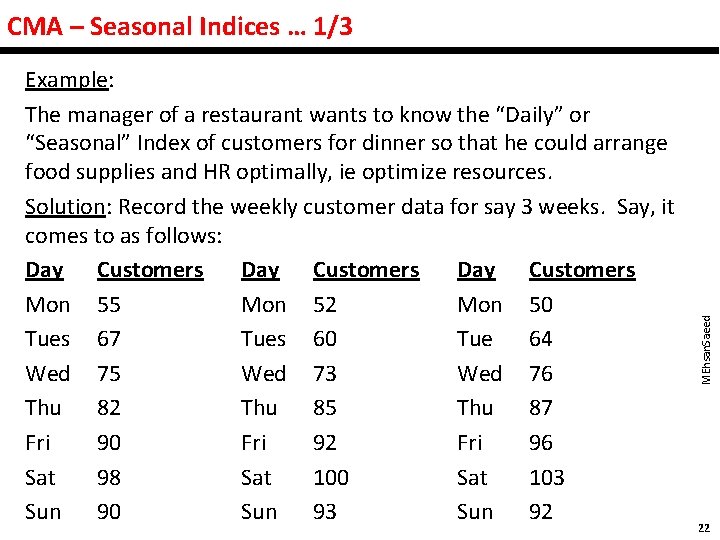
Example: The manager of a restaurant wants to know the “Daily” or “Seasonal” Index of customers for dinner so that he could arrange food supplies and HR optimally, ie optimize resources. Solution: Record the weekly customer data for say 3 weeks. Say, it comes to as follows: Day Customers Mon 55 Mon 52 Mon 50 Tues 67 Tues 60 Tue 64 Wed 75 Wed 73 Wed 76 Thu 82 Thu 85 Thu 87 Fri 90 Fri 92 Fri 96 Sat 98 Sat 100 Sat 103 Sun 90 Sun 93 Sun 92 MEhsan. Saeed CMA – Seasonal Indices … 1/3 22
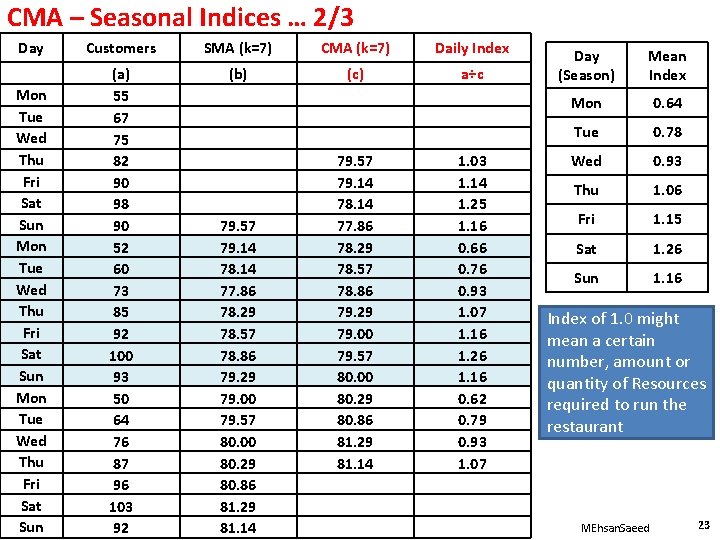
CMA – Seasonal Indices … 2/3 Day Customers SMA (k=7) CMA (k=7) Daily Index (b) (c) a÷c Mon Tue Wed Thu Fri Sat Sun (a) 55 67 75 82 90 98 90 52 60 73 85 92 100 93 50 64 76 87 96 103 92 79. 57 79. 14 78. 14 77. 86 78. 29 78. 57 78. 86 79. 29 79. 00 79. 57 80. 00 80. 29 80. 86 81. 29 81. 14 1. 03 1. 14 1. 25 1. 16 0. 66 0. 76 0. 93 1. 07 1. 16 1. 26 1. 16 0. 62 0. 79 0. 93 1. 07 Day (Season) Mean Index Mon 0. 64 Tue 0. 78 Wed 0. 93 Thu 1. 06 Fri 1. 15 Sat 1. 26 Sun 1. 16 Index of 1. 0 might mean a certain number, amount or quantity of Resources required to run the restaurant MEhsan. Saeed 23
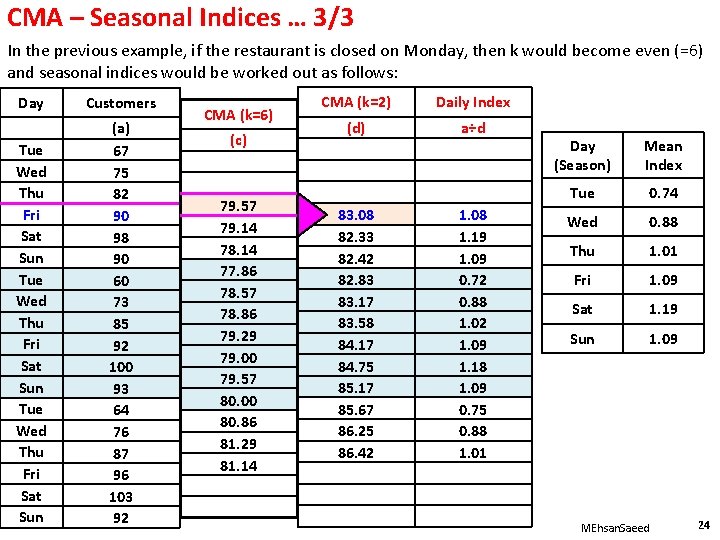
CMA – Seasonal Indices … 3/3 In the previous example, if the restaurant is closed on Monday, then k would become even (=6) and seasonal indices would be worked out as follows: Day Customers Tue Wed Thu Fri Sat Sun (a) 67 75 82 90 98 90 60 73 85 92 100 93 64 76 87 96 103 92 CMA (k=6) (c) 79. 57 79. 14 78. 14 77. 86 78. 57 78. 86 79. 29 79. 00 79. 57 80. 00 80. 86 81. 29 81. 14 CMA (k=2) Daily Index (d) a÷d 83. 08 82. 33 82. 42 82. 83 83. 17 83. 58 84. 17 84. 75 85. 17 85. 67 86. 25 86. 42 1. 08 1. 19 1. 09 0. 72 0. 88 1. 02 1. 09 1. 18 1. 09 0. 75 0. 88 1. 01 Day (Season) Mean Index Tue 0. 74 Wed 0. 88 Thu 1. 01 Fri 1. 09 Sat 1. 19 Sun 1. 09 MEhsan. Saeed 24
Exponential Moving Average (EMA) • EMA forecasts the value of next event based on: a. Actual Value of the previous item b. Forecasted Value of the previous item c. Weight assigned • EMA weigh past observations using exponentially decreasing weights as the observations get older; recent observations are given relatively more weight than the older observations • The amount of weight applied to the past observations, or the degree of smoothing required, is determined by the “smoothing constant” • EMA is in contrast to the SMA. In SMA, the same weights (=1/n) are assigned to the observations. In EMA, there are one or more smoothing parameters to be determined (or estimated) and these choices determine the weights assigned to the observations MEhsan. Saeed 25
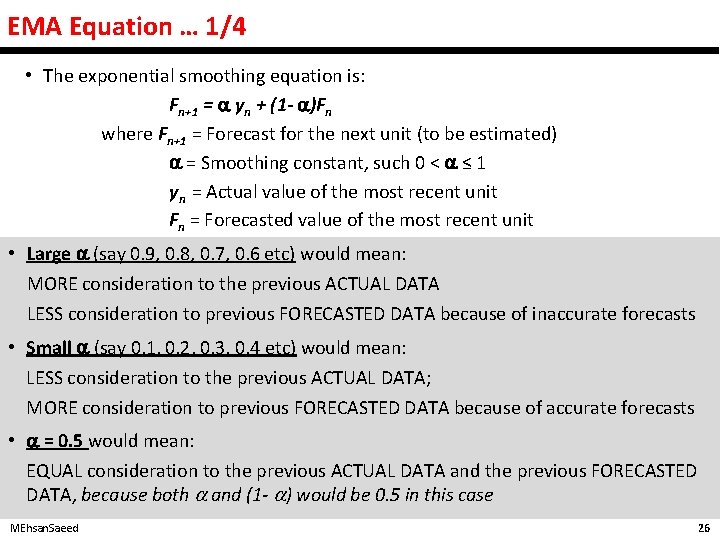
EMA Equation … 1/4 • The exponential smoothing equation is: Fn+1 = yn + (1 - )Fn where Fn+1 = Forecast for the next unit (to be estimated) = Smoothing constant, such 0 < ≤ 1 yn = Actual value of the most recent unit Fn = Forecasted value of the most recent unit • Large (say 0. 9, 0. 8, 0. 7, 0. 6 etc) would mean: MORE consideration to the previous ACTUAL DATA LESS consideration to previous FORECASTED DATA because of inaccurate forecasts • Small (say 0. 1, 0. 2, 0. 3, 0. 4 etc) would mean: LESS consideration to the previous ACTUAL DATA; MORE consideration to previous FORECASTED DATA because of accurate forecasts • = 0. 5 would mean: EQUAL consideration to the previous ACTUAL DATA and the previous FORECASTED DATA, because both and (1 - ) would be 0. 5 in this case MEhsan. Saeed 26
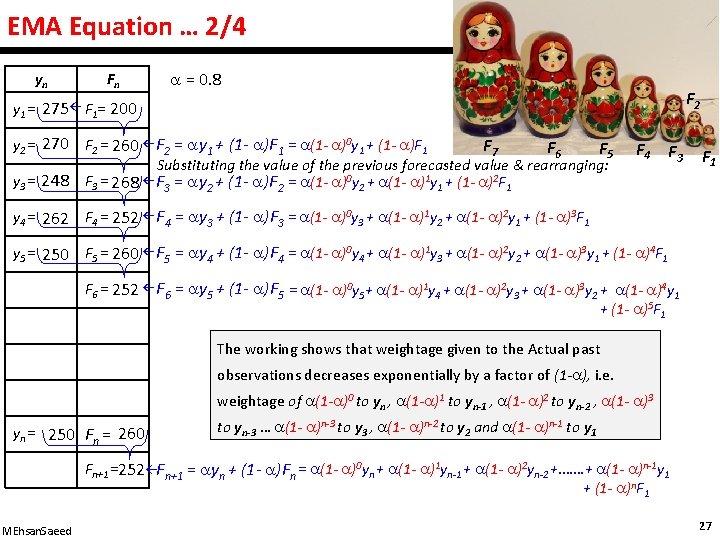
EMA Equation … 2/4 yn Fn = 0. 8 F 2 y 1 = 275← F 1= 200 y 2 = 270 F 2 = 260 ← F 2 = y 1 + (1 - )F 1 = (1 - )0 y 1 + (1 - )F 1 F 7 F 6 F 5 Substituting the value of the previous forecasted value & rearranging: y 3 = 248 F 3 = 268 ← F 3 = y 2 + (1 - )F 2 = (1 - )0 y 2 + (1 - )1 y 1 + (1 - )2 F 1 F 4 F 3 F 1 y 4 = 262 F 4 = 252 ← F 4 = y 3 + (1 - )F 3 = (1 - )0 y 3 + (1 - )1 y 2 + (1 - )2 y 1 + (1 - )3 F 1 y 5 = 250 F 5 = 260 ← F 5 = y 4 + (1 - )F 4 = (1 - )0 y 4 + (1 - )1 y 3 + (1 - )2 y 2 + (1 - )3 y 1 + (1 - )4 F 1 F 6 = 252 ← F 6 = y 5 + (1 - )F 5 = (1 - )0 y 5+ (1 - )1 y 4 + (1 - )2 y 3 + (1 - )3 y 2 + (1 - )4 y 1 + (1 - )5 F 1 The working shows that weightage given to the Actual past observations decreases exponentially by a factor of (1 - ), i. e. weightage of (1 - )0 to yn , (1 - )1 to yn-1 , (1 - )2 to yn-2 , (1 - )3 yn = 250 Fn = 260 to yn-3 … (1 - )n-3 to y 3 , (1 - )n-2 to y 2 and (1 - )n-1 to y 1 Fn+1 =252←Fn+1 = yn + (1 - )Fn = (1 - )0 yn + (1 - )1 yn-1 + (1 - )2 yn-2 +……. + (1 - )n-1 y 1 + (1 - )n. F 1 MEhsan. Saeed 27
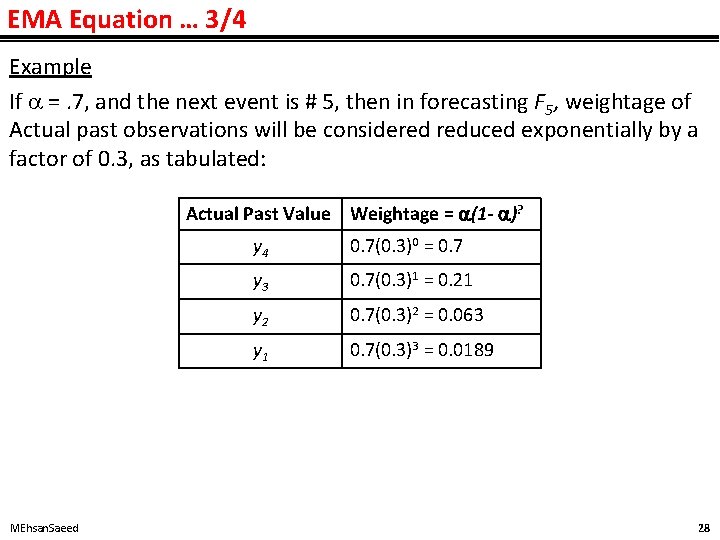
EMA Equation … 3/4 Example If =. 7, and the next event is # 5, then in forecasting F 5, weightage of Actual past observations will be considered reduced exponentially by a factor of 0. 3, as tabulated: Actual Past Value Weightage = (1 - )? MEhsan. Saeed y 4 0. 7(0. 3)0 = 0. 7 y 3 0. 7(0. 3)1 = 0. 21 y 2 0. 7(0. 3)2 = 0. 063 y 1 0. 7(0. 3)3 = 0. 0189 28
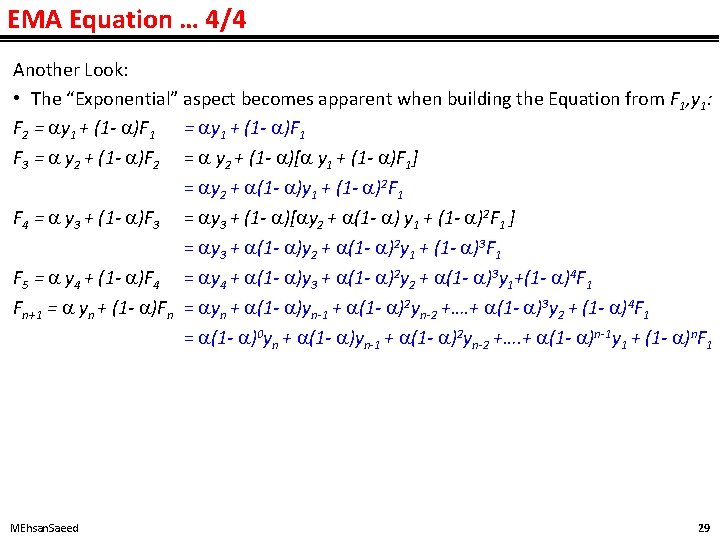
EMA Equation … 4/4 Another Look: • The “Exponential” aspect becomes apparent when building the Equation from F 1, y 1: F 2 = y 1 + (1 - )F 1 F 3 = y 2 + (1 - )F 2 = y 2 + (1 - )[ y 1 + (1 - )F 1] = y 2 + (1 - )y 1 + (1 - )2 F 1 F 4 = y 3 + (1 - )F 3 = y 3 + (1 - )[ y 2 + (1 - ) y 1 + (1 - )2 F 1 ] = y 3 + (1 - )y 2 + (1 - )2 y 1 + (1 - )3 F 1 F 5 = y 4 + (1 - )F 4 = y 4 + (1 - )y 3 + (1 - )2 y 2 + (1 - )3 y 1+(1 - )4 F 1 Fn+1 = yn + (1 - )Fn = yn + (1 - )yn-1 + (1 - )2 yn-2 +…. + (1 - )3 y 2 + (1 - )4 F 1 = (1 - )0 yn + (1 - )yn-1 + (1 - )2 yn-2 +…. + (1 - )n-1 y 1 + (1 - )n. F 1 MEhsan. Saeed 29
Applying EMA • In application, EMA is a simple affair. All what is required to be done is: – Select a suitable smoothing constant ( ) – Take the most recent observation (yn) and multiply it with the smoothing constant – Take what was the forecasted (Fn) value of the most recent observation/ event and multiply it with the complementary of the smoothing constant i. e (1 - ) – Add the two products; the sum is the forecasted value for the next unit • If the forecasted value (Fn) of the recent most event is not available, then: – Start analysing the data from the start, or from where the last (Fn) is available, by calculating Fn using the EMA equation – Continue calculating Fn by applying the EMA equation until the forecasted value of the target event is available MEhsan. Saeed 30
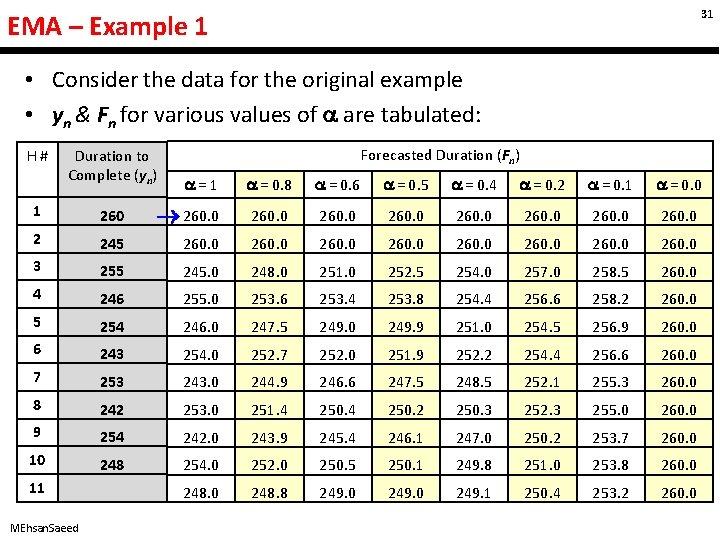
31 EMA – Example 1 • Consider the data for the original example • yn & Fn for various values of are tabulated: H# Duration to Complete (yn) Forecasted Duration (Fn) =1 = 0. 8 = 0. 6 = 0. 5 = 0. 4 = 0. 2 = 0. 1 = 0. 0 1 260. 0 260. 0 2 245 260. 0 260. 0 3 255 245. 0 248. 0 251. 0 252. 5 254. 0 257. 0 258. 5 260. 0 4 246 255. 0 253. 6 253. 4 253. 8 254. 4 256. 6 258. 2 260. 0 5 254 246. 0 247. 5 249. 0 249. 9 251. 0 254. 5 256. 9 260. 0 6 243 254. 0 252. 7 252. 0 251. 9 252. 2 254. 4 256. 6 260. 0 7 253 243. 0 244. 9 246. 6 247. 5 248. 5 252. 1 255. 3 260. 0 8 242 253. 0 251. 4 250. 2 250. 3 252. 3 255. 0 260. 0 9 254 242. 0 243. 9 245. 4 246. 1 247. 0 250. 2 253. 7 260. 0 10 248 254. 0 252. 0 250. 5 250. 1 249. 8 251. 0 253. 8 260. 0 248. 8 249. 0 249. 1 250. 4 253. 2 260. 0 11 MEhsan. Saeed
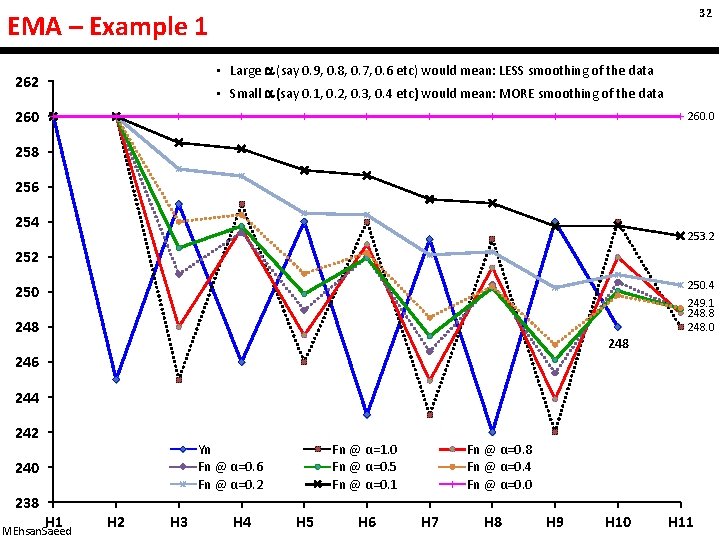
32 EMA – Example 1 • Large (say 0. 9, 0. 8, 0. 7, 0. 6 etc) would mean: LESS smoothing of the data 262 • Small (say 0. 1, 0. 2, 0. 3, 0. 4 etc) would mean: MORE smoothing of the data 260. 0 258 256 254 253. 2 250. 4 249. 1 248. 8 248. 0 250 248 246 244 242 Yn Fn @ α=0. 6 Fn @ α=0. 2 240 238 H 1 MEhsan. Saeed H 2 H 3 H 4 Fn @ α=1. 0 Fn @ α=0. 5 Fn @ α=0. 1 H 5 H 6 Fn @ α=0. 8 Fn @ α=0. 4 Fn @ α=0. 0 H 7 H 8 H 9 H 10 H 11
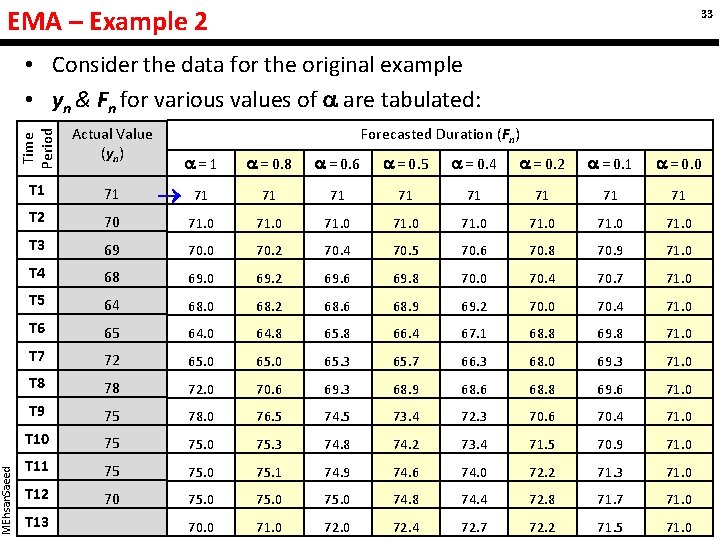
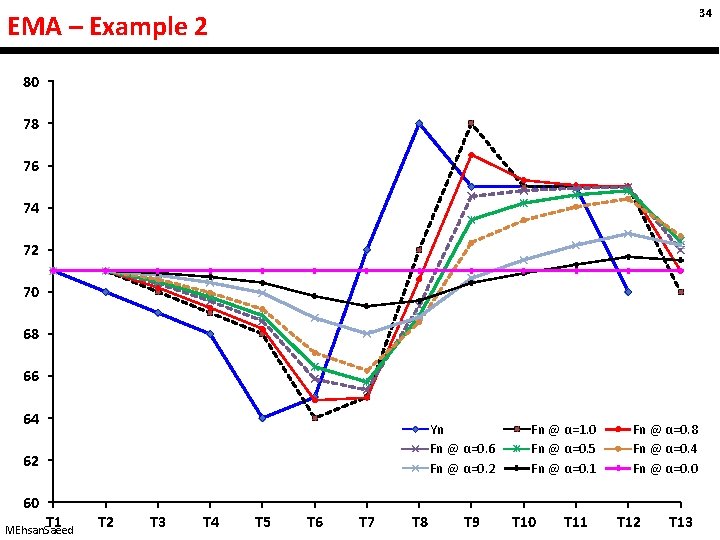
33 • Consider the data for the original example • yn & Fn for various values of are tabulated: Forecasted Duration (Fn) Time Period MEhsan. Saeed EMA – Example 2 Actual Value (yn) T 1 71 T 2 70 71. 0 T 3 69 70. 0 70. 2 70. 4 70. 5 70. 6 70. 8 70. 9 71. 0 T 4 68 69. 0 69. 2 69. 6 69. 8 70. 0 70. 4 70. 7 71. 0 T 5 64 68. 0 68. 2 68. 6 68. 9 69. 2 70. 0 70. 4 71. 0 T 6 65 64. 0 64. 8 65. 8 66. 4 67. 1 68. 8 69. 8 71. 0 T 7 72 65. 0 65. 3 65. 7 66. 3 68. 0 69. 3 71. 0 T 8 78 72. 0 70. 6 69. 3 68. 9 68. 6 68. 8 69. 6 71. 0 T 9 75 78. 0 76. 5 74. 5 73. 4 72. 3 70. 6 70. 4 71. 0 T 10 75 75. 0 75. 3 74. 8 74. 2 73. 4 71. 5 70. 9 71. 0 T 11 75 75. 0 75. 1 74. 9 74. 6 74. 0 72. 2 71. 3 71. 0 T 12 70 75. 0 74. 8 74. 4 72. 8 71. 7 71. 0 70. 0 71. 0 72. 4 72. 7 72. 2 71. 5 71. 0 T 13 =1 = 0. 8 = 0. 6 = 0. 5 = 0. 4 = 0. 2 = 0. 1 = 0. 0 71 71
34 EMA – Example 2 80 78 76 74 72 70 68 66 64 Yn Fn @ α=0. 6 Fn @ α=0. 2 62 Fn @ α=1. 0 Fn @ α=0. 5 Fn @ α=0. 1 Fn @ α=0. 8 Fn @ α=0. 4 Fn @ α=0. 0 60 T 1 MEhsan. Saeed T 2 T 3 T 4 T 5 T 6 T 7 T 8 T 9 T 10 T 11 T 12 T 13
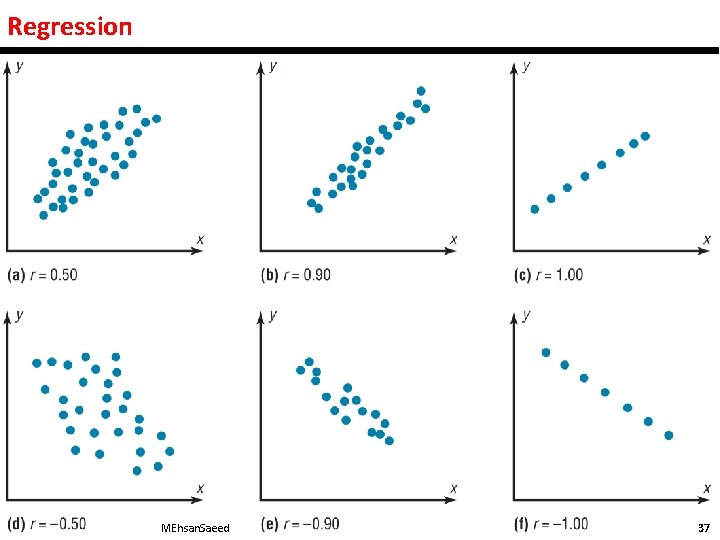
Regression is a statistical method used to describe the nature of the relationship between variables, that is, positive or negative, linear or nonlinear • Regression addresses following questions statistically: 1. Are two or more variables related (linearly, polynomially, logarithmically etc)? 2. If so, what is the strength of the relationship? 3. What type of relationship exists? 4. What kind of predictions can be made from the relationship? MEhsan. Saeed 35
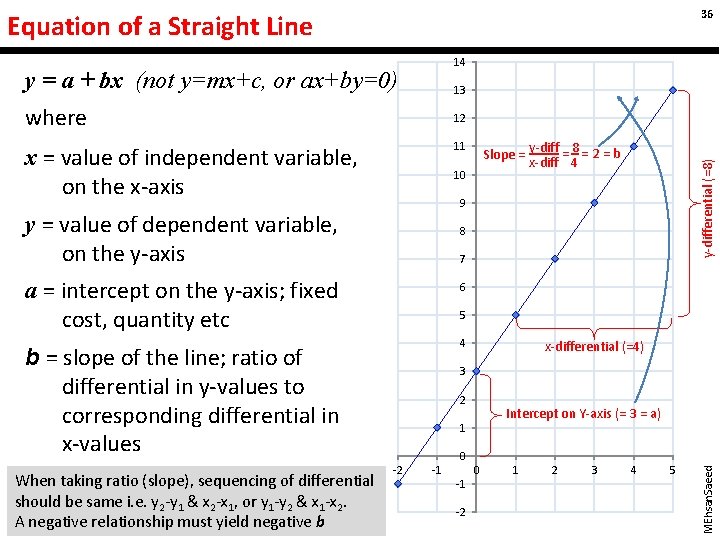
36 Equation of a Straight Line 14 y = a + bx (not y=mx+c, or ax+by=0) 13 where 12 x = value of independent variable, on the x-axis 10 y-diff = 8 = 2 = b x-diff 4 9 y = value of dependent variable, on the y-axis 8 7 a = intercept on the y-axis; fixed cost, quantity etc 6 5 4 b = slope of the line; ratio of differential in y-values to corresponding differential in x-values x-differential (=4) 3 2 Intercept on Y-axis (= 3 = a) 1 0 -2 -1 -1 -2 0 1 2 3 4 5 MEhsan. Saeed When taking ratio (slope), sequencing of differential should be same i. e. y 2 -y 1 & x 2 -x 1, or y 1 -y 2 & x 1 -x 2. A negative relationship must yield negative b Slope = y-differential (=8) 11
Regression MEhsan. Saeed 37
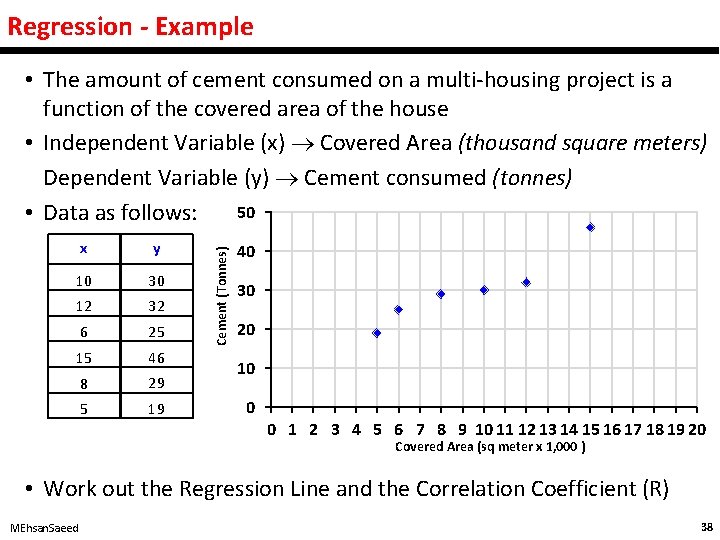
Regression - Example x y 10 30 12 32 6 25 15 46 8 29 5 19 Cement (Tonnes) • The amount of cement consumed on a multi-housing project is a function of the covered area of the house • Independent Variable (x) Covered Area (thousand square meters) Dependent Variable (y) Cement consumed (tonnes) 50 • Data as follows: 40 30 20 10 0 0 1 2 3 4 5 6 7 8 9 10 11 12 13 14 15 16 17 18 19 20 Covered Area (sq meter x 1, 000 ) • Work out the Regression Line and the Correlation Coefficient (R) MEhsan. Saeed 38
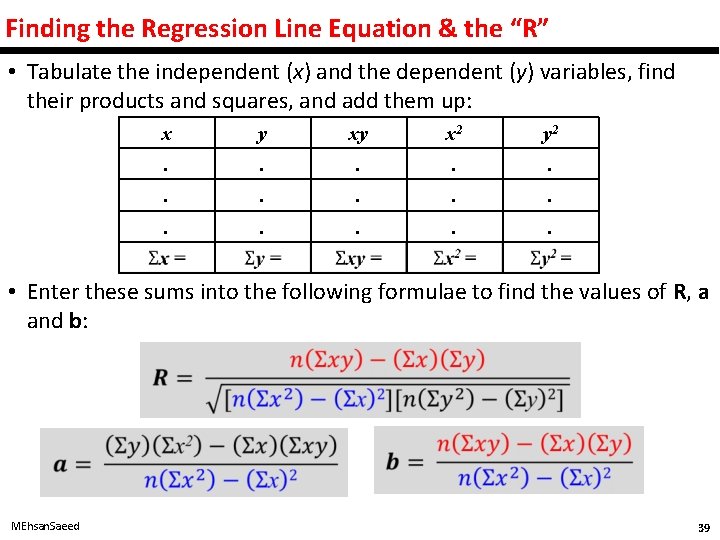
Finding the Regression Line Equation & the “R” • Tabulate the independent (x) and the dependent (y) variables, find their products and squares, and add them up: x y xy x 2 y 2 . . . . • Enter these sums into the following formulae to find the values of R, a and b: MEhsan. Saeed 39
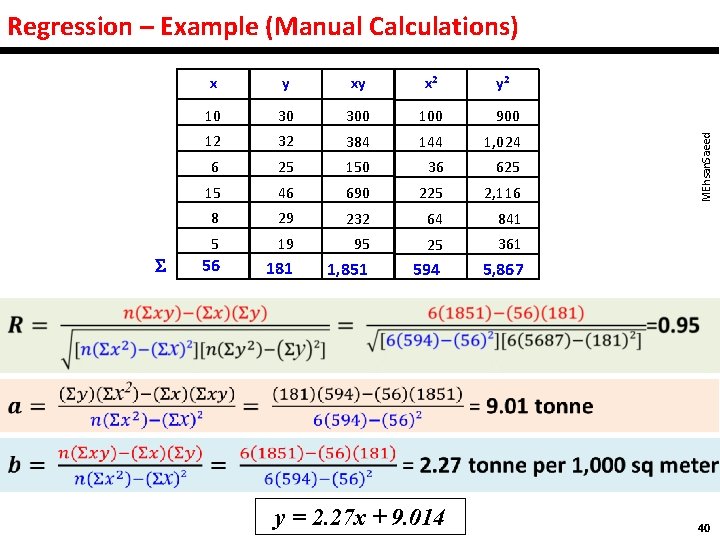
Regression – Example (Manual Calculations) x y xy x 2 10 30 300 100 900 12 32 384 144 1, 024 6 25 150 36 625 15 46 690 225 2, 116 8 29 232 64 841 5 19 95 25 361 56 181 1, 851 594 5, 867 y = 2. 27 x + 9. 014 MEhsan. Saeed y 2 40
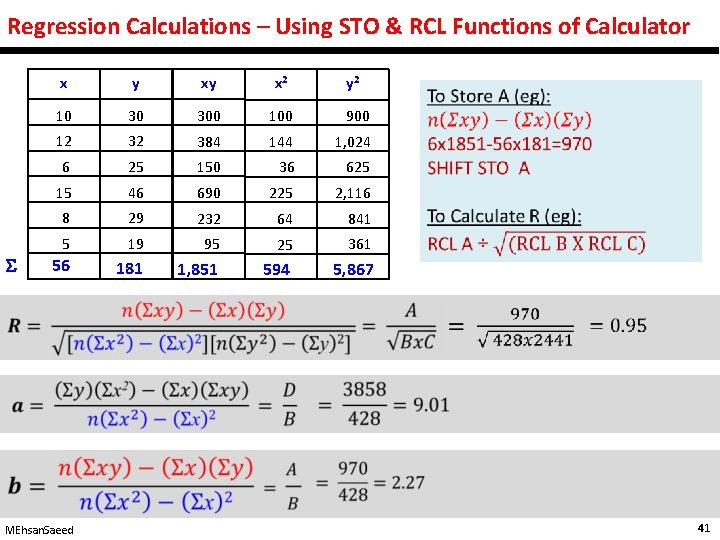
Regression Calculations – Using STO & RCL Functions of Calculator x y xy x 2 10 30 300 100 900 12 32 384 144 1, 024 6 25 150 36 625 15 46 690 225 2, 116 8 29 232 64 841 5 19 95 25 361 56 181 1, 851 594 5, 867 MEhsan. Saeed y 2 41
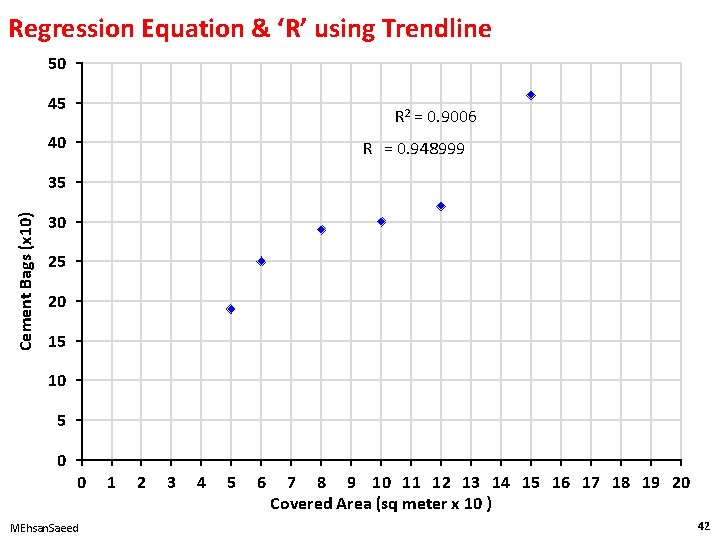
Regression Equation & ‘R’ using Trendline 50 45 R 2 = 0. 9006 40 R = 0. 948999 Cement Bags (x 10) 35 30 25 20 15 10 5 0 0 MEhsan. Saeed 1 2 3 4 5 6 7 8 9 10 11 12 13 14 15 16 17 18 19 20 Covered Area (sq meter x 10 ) 42
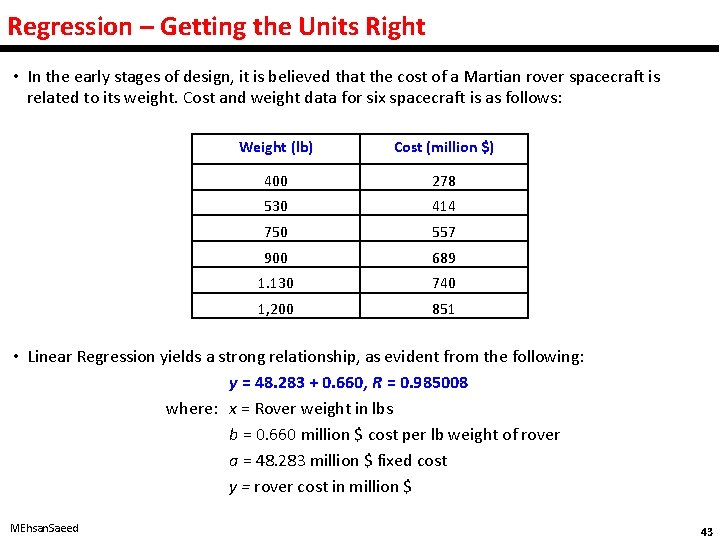
Regression – Getting the Units Right • In the early stages of design, it is believed that the cost of a Martian rover spacecraft is related to its weight. Cost and weight data for six spacecraft is as follows: Weight (lb) Cost (million $) 400 278 530 414 750 557 900 689 1. 130 740 1, 200 851 • Linear Regression yields a strong relationship, as evident from the following: y = 48. 283 + 0. 660, R = 0. 985008 where: x = Rover weight in lbs b = 0. 660 million $ cost per lb weight of rover a = 48. 283 million $ fixed cost y = rover cost in million $ MEhsan. Saeed 43
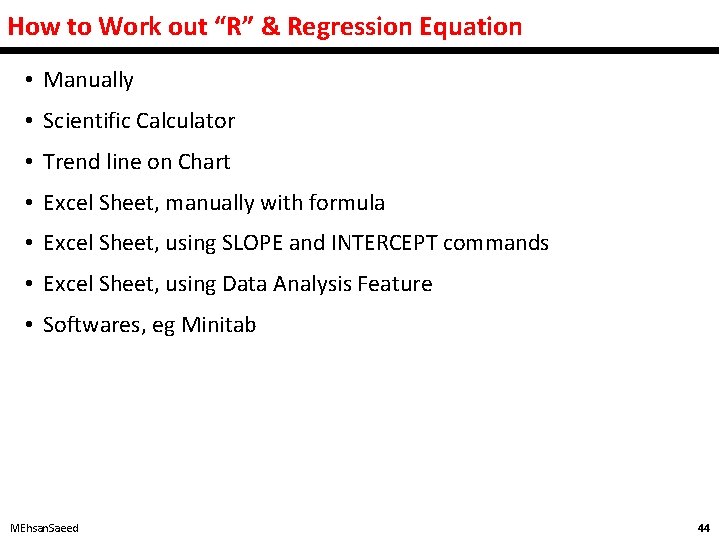
How to Work out “R” & Regression Equation • Manually • Scientific Calculator • Trend line on Chart • Excel Sheet, manually with formula • Excel Sheet, using SLOPE and INTERCEPT commands • Excel Sheet, using Data Analysis Feature • Softwares, eg Minitab MEhsan. Saeed 44

45
- Slides: 45