
MEC Use Cases Mobile Edge Computing is a

MEC Use Cases • Mobile Edge Computing is – a key enabler for Io. T and mission-critical, vertical solutions – one of the key architectural concepts and technologies for 5 G • helping to satisfy the demanding requirements for the 5 G era in terms of expected throughput, latency, scalability and automation. – offers additional privacy and security and ensures significant cost savings • Many of the use cases can be enabled with Mobile Edge Computing prior to 5 G. 2
Preliminary 5 G Markets of Interests • Preliminary 5 G work defined several vertical markets of interest – – – – general Internet (broadband) entertainment and gaming AR/VR wearables first responders critical infrastructure smart city smart utilities automotive (V 2 X) mass transit e-health e-government manufacturing (incl. industrial robots) agriculture 3
Requirements: Three Main Categories • e. MBB: enhanced mobile broadband • URLLC: ultra-reliable and low latency communications • m. MTC: (aka m. Io. T) massive machine type communications Ø These categories were the basis of ITU-R’s framework 4
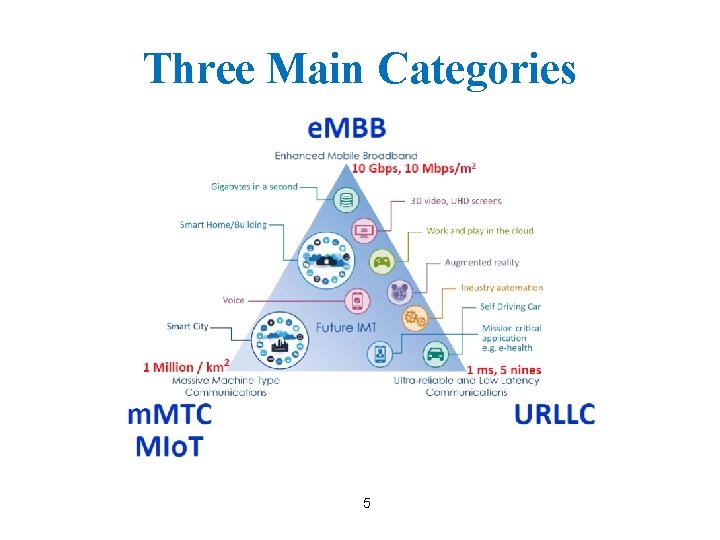
Three Main Categories 5
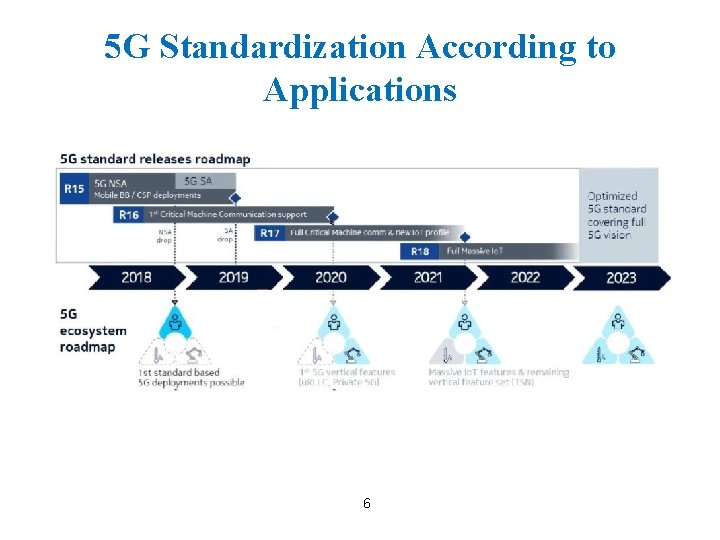
5 G Standardization According to Applications 6
e. MBB: enhanced Mobile Broad. Band (1/2) • The first use case is enhanced (Mobile) Broad. Band • e. MBB traffic is an enhanced version of 4 G broadband service with 10 times higher data rates • e. MBBis statistically characterized by – Internet-like packet and session statistics –medium to large packet sizes –typical session 7 packets, but most bandwidth in very long session – tolerance to packet loss ratio (0. 1% acceptable, 1% unacceptable) – tolerance to latency (delays of 100 ms acceptable) 7
e. MBB: enhanced Mobile Broad. Band (2/2) • e. MBBcan be subdivided into numerous sub-usecases, for example – – Fixed Wireless Access hotspot backhauling video downstream / video upstream self-backhauling • e. MBB will be the focus of the first 5 G deployments 8
Mobile Broadband (1/2) • The most obvious use case is mobile broadband, i. e. , faster browsing on your smartphone • This is the use case being addressed by most current deployments • It is not clear that 4 G is really lacking here ! • One argument often quoted goes something like this: – downloading a full-length movie using 4 G takes about 15 minutes – with 5 G will take only a five seconds 9
Mobile Broadband (2/2) • Such arguments are relatively unconvincing – how much more would a subscriber you pay for this? – is there any reason to download instead of streaming? • Mobile broadband requirements: – high bandwidth – may require high velocity (when in moving car or train) – 4 G packet loss ratio and latency are acceptable 10
Residential Broadband (1/2) • Cellular broadband access to homes or offices is often called Fixed Wireless Access • Cellular Internet access to homes can potentially replace existing HFC/DOCSIS, ADSL/VDSL, PON technologies • FWA is potentially faster and cheaper to set up – studies cite 40% improvement – end-user installation will involve mounting an antenna on a roof or window – with 4 G, do not provide sufficiently high data-rates or reliability – need 500 Mbps as compared to 4 G FWA’s average 50 Mbps 11
Residential Broadband (2/2) • Use of mm. Wave and beam-forming are an attractive FWA option especially where right-of-way for cable/fiber installation is restricted • However, coverage will be limited to 1 km from a g. NB site and the very high rates to within 150 meters • This will initially limit penetration to – dense urban environments – to a small percentage of potential customers in such environments 12
Business Services • Due to LTE’s limited data-rates and availability, mobile operators could never provide profitable business services which typically require fiber or symmetric DSL • With 5 G, business sites can be connected to the feature-rich 5 G core using – 5 G NR: Fixed Wireless Access (fixed, since CPE is not mobile) – Wireline Wireless Convergence: using the Access Gateway Function 13
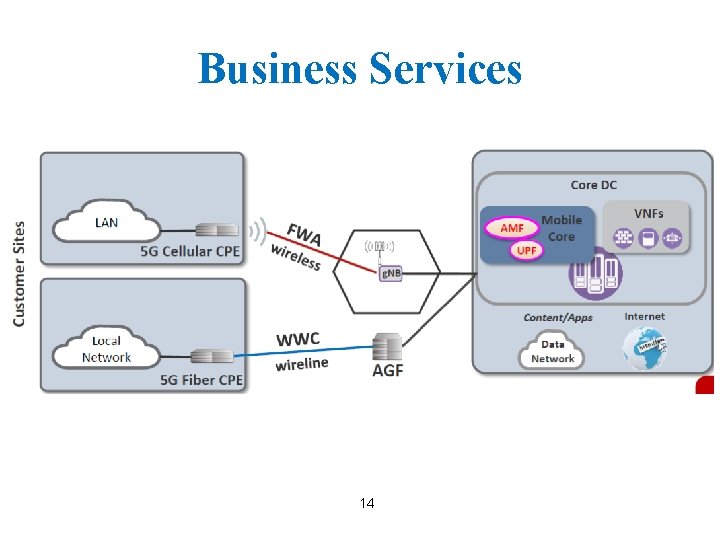
Business Services 14
5 G Home, 5 G Office (Verizon) • Verizon has only a small share of the US residential Internet access market and views 5 G as a method to catch up • Verizon was a very early adopter of 5 G NR and started deploying pre-standard (5 GTF) before R 15 • Verizon has launched 5 G Home FWA in 4 cities and stated that it intends to reach 30 M households (25% of US market) • 5 G Home is based on 28 GHz spectrum and proprietary 5 GTF standards and will cost $50 -$70 per month for > 300 Mbit/s • Verizon has launched a similar service for small offices called 5 G Office 15
Telecommuting • As a result of the health situation, there has been an uptick in working from home • Mobile operators are scrambling to increase services • T-Mobile and Verizon have received FCC approval to borrow spectrum in the 600 MHz band tied to Dish network • Analysts believe that the trend will continue as reticent corporations realize the benefits in lower expenses 16
FWA Requirements (1/2) • Rates comparable with high-rate alternatives – VDSL 2 –up to 200 Mbps – PON : XG-PON –up to 10 Gbps(DS), NG-PON 2 up to 40 Gbps • Reasonable latency (no more than 4 G) • Coverage – urban areas –full speed – other areas –at least similar to 4 G Full speed FWA necessitates wider system bandwidths that are to be found in mm. Waves which dictate small cells 17
FWA Requirements (2/2) Non-urban coverage requires finding new spectrum in the sub-6 GHz spectrum, e. g. , • low frequencies, e. g. , 600 MHz (US), 700 MHz (Europe) • unlicensed shared spectrum, e. g. , – Citizens Broadband Radio Service (in US) at 3. 5 GHz • may be used as long as do not interfere with incumbent government services • may be used as private wireless network as long as do not interfere to the above 18
Air. Gig (AT&T) • AT&T developed a novel backhaul physical layer technology based on waveguiding data transmissions with power lines and distributing to homes (and to mobile users) using 5 G NR • Air. Gigis protected by an extensive patent portfolio • Air. Gig, announced in 2016 and launched 2021, can introduce broadband to rural areas, where it isn’t economical to install conventional cabling 19
Facebook Initiatives (1/2) • Facebook has been involved in at least 3 projects (not necessarily 5 G) to bring Internet access to new coverage areas – Terragraph (60 GHz, multi-node for dense urban areas) – ARIES (96 antenna high energy/spectral efficiency) – Aquila • Aquila is a solar-powered pilotless airplane that acts as a data repeater, which first flew in June 2016 • Development ceased 2 years later, in June 2018 20
Facebook Initiatives (2/2) • The goal of Aquila was to cover 66% of Earth’s surface with no/poor Internet coverage • The Aquila drone – – – weighs 400 kg has a wingspan about the same as a 737 flies at altitude of 27 km during the day / 18 km at night endurance of up to 3 months provides Internet service to a 80 km radius area 21
One. Web (1/2) • One. Web (ex World. Vuex Google) is a collection of low altitude small satellites • Current design is for 650 in the constellation, to grow to 1, 972 • The first 6 satellites were launched in February 2019 and plans call for providing global services starting in 2021 • The satellites will fly in circular 1, 200 km orbits and operate in 12 -18 GHz spectrum 22
One. Web (2/2) • Other ideas of LEO satellites: – Samsung proposed a 4600 -satellite constellation in 2015 proposal to provide 200 gigabytes per month to everyone on earth – Amazon’s announced in April 2019 Project Kuiper in which it plans to launch 3, 236 satellites in the next decade – Space. X has proposed a 12, 000 -satellite Starlink constellation – Both Sierra Nevada and Surrey Satellite have announced similar plans – Israel’s Genesis Consortium is researching an Israeli version 23
Loon (1/2) • Google’s spin-off uses high altitude (20 km) balloons as 4 G base stations • It was named Project Loon, since even Google thought it loony • Development began in 2011, and Loon became a separate company in 2018 • The polyethylene balloons are filled with Helium and measure 15 m across and 12 m tall when fully inflated • Solar panels power during the day and onboard battery used at night 24
Loon (2/2) • Loon balloons navigate by changing their altitude based on predictive wind models and autonomous algorithms • Longest duration aloft was 223 days (and circled the earth) • Loon delivered emergency Internet connectivity to Puerto Rico in 2017 and is set to provide commercial service in Kenya and Peru in 2020 • A group of Loon balloons may creates a network to cover a defined area 25
Downstream Video – Video on Demand (1/2) • Tier 1 mobile operators expect 90% of 5 G traffic to be mobile video based on current growth trends of 50% yearon-year • From 2010 -2015 mobile video growth was due to increased watch times since 2015 mobile video growth is mostly due to migration to HD • Much of this consumer video is from 3 rdparty sources and encrypted often transported over QUIC (Google) or 0 RTT (Facebook) • For this traffic the mobile operator is a dumb-pipe provider 26
Downstream Video – Video on Demand (2/2) • 5 G data rates are much higher than needed for HD television RT streaming – standard MP 4 TV requires about 3 Mbps – 4 K resolution requires 25 -50 Mbps – 8 K 50 -100 Mbps • 5 G has the potential to replace cable TV and Digital Terrestrial Television, but present data caps will need to be significantly increased (25 Mbps is 11. 25 GB per hour) • There may also be regulatory issues regarding free live TV 27
Upstream Video (1/2) • 4 G upstream data rates may be insufficient for User Generated Content: – – – – event broadcast social streaming Youtube upload e-learning / remote learning VR conference calls surveillance backhauling drone video multi-vantage point video 28
Upstream Video (2/2) • There may be the main difference between 5 G and 4 G • Video Requirements – rates reliably over 50 Mbps – for streaming -reasonable latency (no more than 4 G) – for real-time interactive (e. g. , video conferencing) – low latency (under 20 ms) 29
Media and Entertainment Use Cases • Other Media and Entertainment use cases: – – – – ultra high fidelity media on-site live event experience user generated content & machine generated content immersive and integrated media cooperative media production gaming (including massive multi-user games) tactile Internet (very low latency 0. 5 ms so classified URLLC) – drone control and video 30
URLLC and m. MTC: Differences • URLLC: the major issues are – very low delay – very high reliability • m. MTC: the major issues are – device density – low power 31
URLLC and m. MTC • A new work item for R 17 defines a new low-cost variety named NR-Light, which is similar to 4 G NBIo. T • R 15 has some basic URLLC features – URLLC will be introduced and optimized in R 16 and m. MTC is mainly being developed for R 17 • e. MBB deployments started in 2019 – commercial URLLC services are not expected before early 2021 and m. MTC in late 2021 early 2022 32
VR/AR/MR • Virtual Reality is the ability to be virtually present in a scene – requires high accuracy rendering of natural/synthetic image and sound – correlates image and sound to movements of immersed user – responds to user actions enabling realistic interaction with the scene • Augmented Reality is overlaying of information or artificial content over true real-time environment • Mixed Reality is an advanced form of AR where virtual elements are inserted into the scene to provide the illusion that these elements are part of the true scene • VR requirements – data rate of 200 Mbps (much less for AR) – low latency (under 10 ms) 33
Smart Home • Analysts predicted 25 -100 Billion Internet-connected devices by 2020, such as: – – – – thermostats and temperature control home automation (smart lighting, smart temperature control) meters (electric, water, gas) household appliances (refrigerators, microwaves, water heaters, . . . ) RFID on disposables wearable health devices household robots • Smart Home requirements – large of devices but each requiring low rates – low cost per device (perhaps unlicensed spectrum, SIMless) – edge computation (for privacy and aggregation / blocking) 34
Smart utilities (1/2) • Utilities (electric, water, gas) have 3 different types of communications – Operational Technology network (control of critical infrastructures) – Information Technology network (as in any corporation) – customer facing network (e. g. , automatic meter reading) • The first two are often wired networks (although some segments may be wireless), while wireless implementation of metering may be advantageous due to scale. 35
Smart Utilities (2/2) • Smart metering – – – massive number of endpoints infrequent transmission low cost per endpoint no latency requirements some privacy requirements • High voltage distribution – 5 ms, 6 nines, 200 km 100 Gbps/km 2 • Medium voltage distribution – 25 ms, 3 nines, 100 km 10 Gbps/km 2 36
Smart City • Smart City refers to the use of large numbers of connected sensors – to collect and forward (big) data – for (ML/AI) analysis • To efficiently manage a city’s assets, resources and services: – – – traffic and transportation systems electric distribution water supply networks waste management surveillance and law enforcement hospitals 37
Smart City Requirements • Massive number of endpoints • Infrequent transmission to or from each endpoint • Low cost per endpoint • Strict security requirements 38
Industry 4. 0 (1/2) • 1 st industrial revolution – mechanization – – – use machines instead of manual/animal labor coal, iron, railroads, textiles 1765 Watt invents steam engine 1780 s in UK –mechanized factories and agriculture 1878 internal combustion engine • 2 nd industrial revolution –electricity – – – petroleum/gas, steel coal, iron, railroads, textiles 1879 Swan invents light bulb (later perfected by Edison) 1913 first assembly line (Ford) 1930 Tesla’s motor 39
Industry 4. 0 (2/2) • 3 rd generation –computers – – electronics digital instead of analog 1960 Programmable Logic Controller 1980 s personal computers • 4 th generation –networked cyber-physical devices 40
Industrial Io. T (1/2) • Industrial Internet of Things (IIo. T) refers to various sensors / measurement devices / relays / actuators / regulators and supervisory controllers (microcomputers/servers) networked together for industrial applications, such as: – – – manufacturing quality control material processing energy management Supervisory Control And Data Acquisition (SCADA) 41
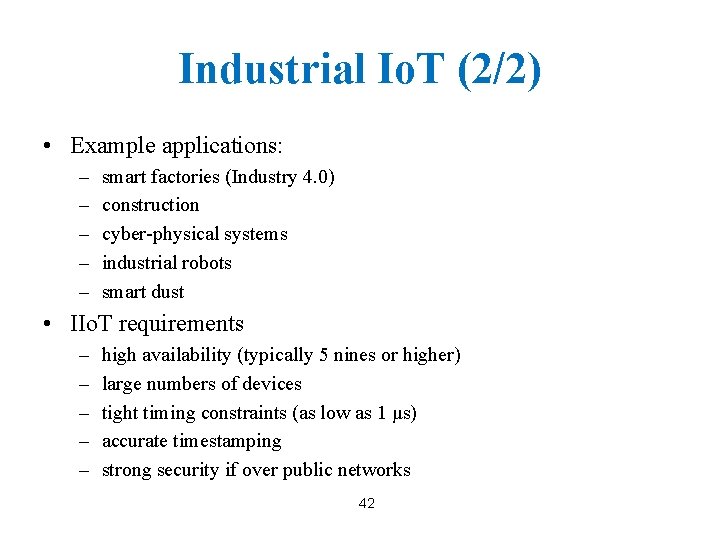
Industrial Io. T (2/2) • Example applications: – – – smart factories (Industry 4. 0) construction cyber-physical systems industrial robots smart dust • IIo. T requirements – – – high availability (typically 5 nines or higher) large numbers of devices tight timing constraints (as low as 1 μs) accurate timestamping strong security if over public networks 42
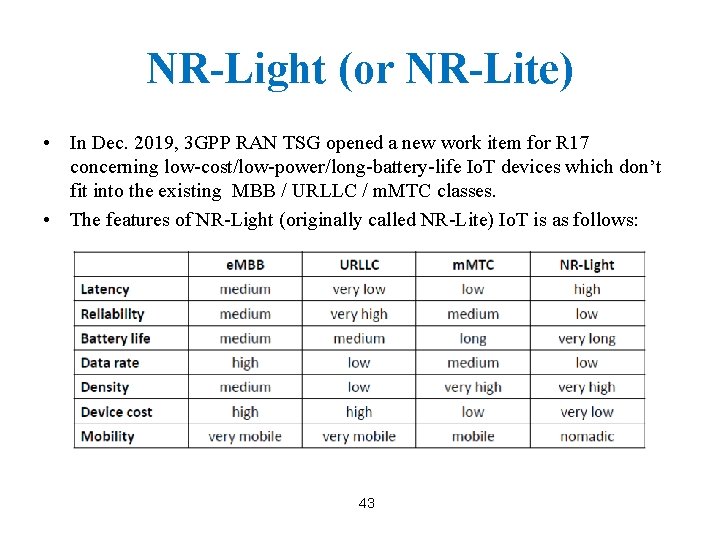
NR-Light (or NR-Lite) • In Dec. 2019, 3 GPP RAN TSG opened a new work item for R 17 concerning low-cost/low-power/long-battery-life Io. T devices which don’t fit into the existing MBB / URLLC / m. MTC classes. • The features of NR-Light (originally called NR-Lite) Io. T is as follows: 43
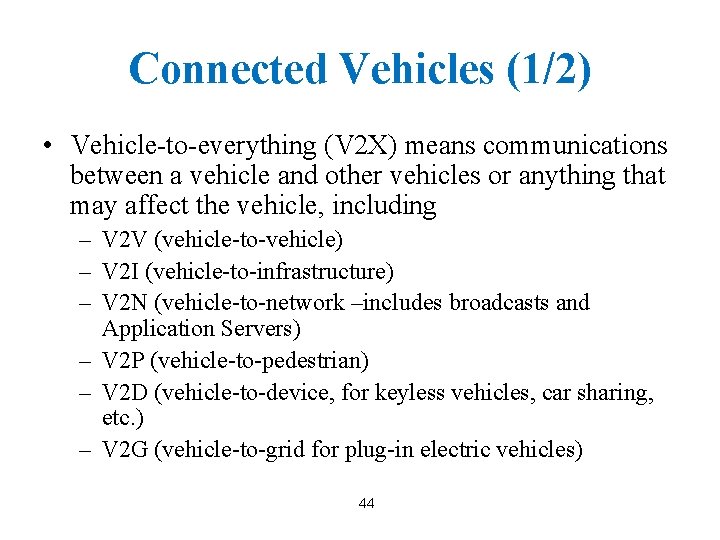
Connected Vehicles (1/2) • Vehicle-to-everything (V 2 X) means communications between a vehicle and other vehicles or anything that may affect the vehicle, including – V 2 V (vehicle-to-vehicle) – V 2 I (vehicle-to-infrastructure) – V 2 N (vehicle-to-network –includes broadcasts and Application Servers) – V 2 P (vehicle-to-pedestrian) – V 2 D (vehicle-to-device, for keyless vehicles, car sharing, etc. ) – V 2 G (vehicle-to-grid for plug-in electric vehicles) 44
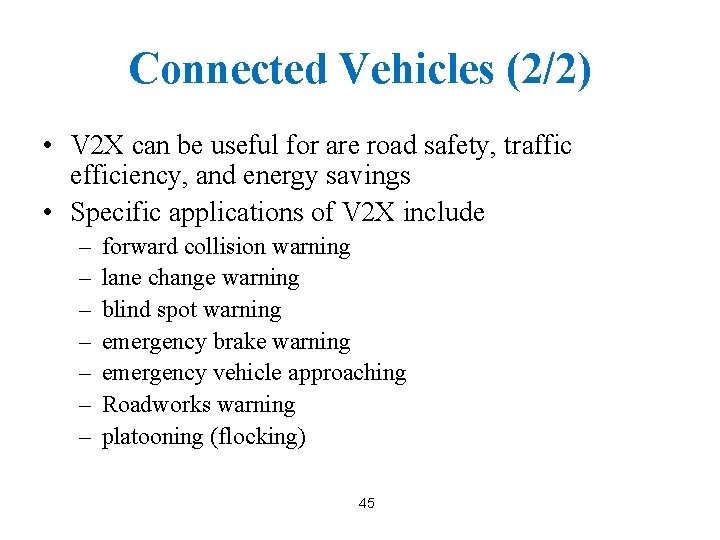
Connected Vehicles (2/2) • V 2 X can be useful for are road safety, traffic efficiency, and energy savings • Specific applications of V 2 X include – – – – forward collision warning lane change warning blind spot warning emergency brake warning emergency vehicle approaching Roadworks warning platooning (flocking) 45
5 G-V 2 X (1/2) • Current V 2 X communication technologies are based on – Wi. Fi (802. 11 p Wireless Access in Vehicular Environments) • • based on Dedicated Short Range Communication supports V 2 V and V 2 I Toyota introduced DSRC in Japan in 2016 and GM/Cadillac introduced DSRC in the US in 2017 – Cellular (C-V 2 X), as defined in R 14 (LTE-V 2 X) and R 15/R 16 (5 G-V 2 X) • supports V 2 V, V 2 I, and V 2 N • V 2 V exploits PC 5 UE-UE interface (instead of Uu) – LTE-V 2 X chipsets available, intersection right-of-way Po. C in 2018 – Ford announced that all their new US cars will have C-V 2 X in 2022 46
5 G-V 2 X (2/2) • Comparative studies show that C-V 2 X transmission – – have better range enabling earlier receipt of messages have better performance at low SNR is more likely to successfully deliver urgent messages will eventually become available on standard smartphones for V 2 P • C-V 2 X transmission results in higher level of accident avoidance and reduction in injury 47
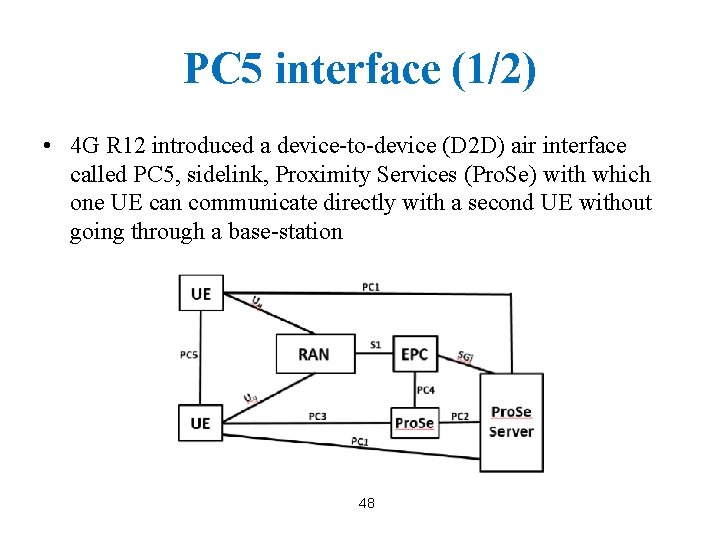
PC 5 interface (1/2) • 4 G R 12 introduced a device-to-device (D 2 D) air interface called PC 5, sidelink, Proximity Services (Pro. Se) with which one UE can communicate directly with a second UE without going through a base-station 48
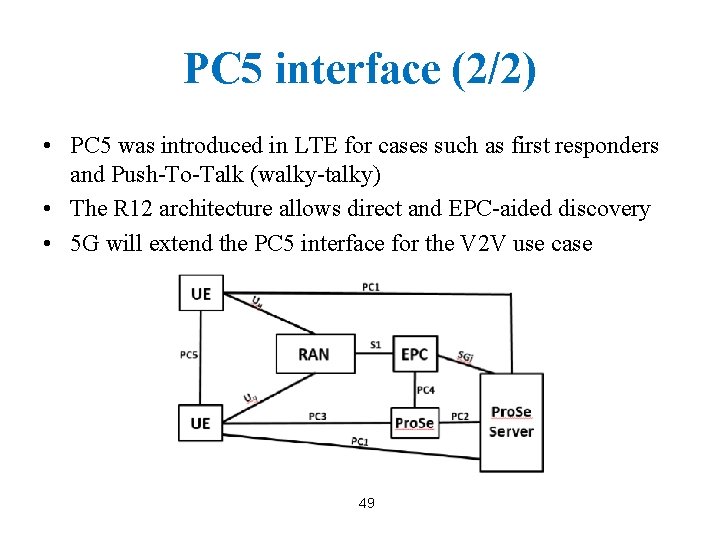
PC 5 interface (2/2) • PC 5 was introduced in LTE for cases such as first responders and Push-To-Talk (walky-talky) • The R 12 architecture allows direct and EPC-aided discovery • 5 G will extend the PC 5 interface for the V 2 V use case 49
e. Health / Telemedicine (1/2) • 5 G will improve/enable new use cases, including – – – – remote monitoring of health or wellness data cloud connected pacemakers tele-pharmacy and smart medication micro-hospitals hospital asset and intervention management remote EKG remote surgery (first performed in Sept 2001 –the Lindbergh Operation) – telenursing and robotics for assisted living – tele-rehabilitation (remote audiology, occupational/physical therapy) 50
e. Health / Telemedicine (2/2) • e. Health / Telemedicine Requirements – very low delay – ultra high reliability – strict security requirements 51
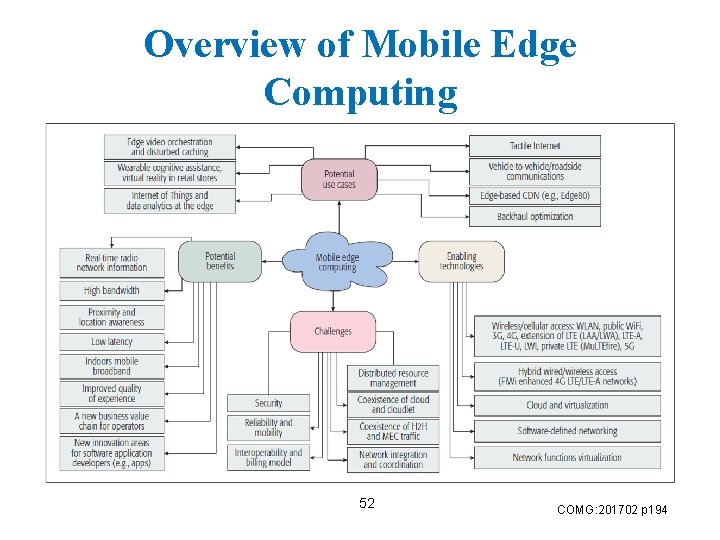
Overview of Mobile Edge Computing 52 COMG: 201702 p 194
Possible Use Cases • Edge computing can resolve several issues in various scenarios – real-time image processing – Gaming – smart grid – smart traffic lights – connected vehicles, – smart building control – smart health environment 53
Real-Time Image Processing • Peter, a foreign visitor in Japan, wants to know the details on the food listed in a hotel menu written in Japanese. Thus, he takes a snapshot of the menu to process it using a character recognition application. The execution of the application is compute-intensive. Therefore, he is unable to run the application on his mobile phone. In this context, he can execute his application on the edge server available inside • the hotel network. He registers with the edge server and migrates the application to the server. The results are then sent back to him upon completion of the task. 54
Gaming • Peter’s son, who is fond of computer games, wants to play a high definition 3 D game from his mobile phone on a train while traveling from Seoul to Pohang-si, South Korea. He finds an available edge server on the train that provides the services to passengers of the train to run their applications. The game engine is migrated to the edge server where the actual business logic of the game will run. The game interface is the only component that runs on the mobile device. The execution of the business logic on the edge server extends the battery life of the mobile device and enables game execution on the resource-constrained mobile device. 55
Smart Grid • Energy load balancing applications running on smart meters and micro grids enable automatic switching to alternative energies, such as wind and solar energy after considering the lowest price, energy demands, and availability. The data generated by grid devices and sensors are processed by the edge collector at the edge network. Edge devices process the • delay-sensitive data in the edge network and send the rest of the data to the cloud server. In a smart grid environment, the lowest tier stores temporary data, whereas the highest tier stores the semi-permanent data. 56
Smart Transportation • Edge computing can also contribute to improving the functionalities and services provided by smart transportation. Smart lights that can serve as edge devices can take sensing information of the flashing lights of an ambulance from a video camera and consequently open lanes for the ambulance. Similarly, smart street lights take information from sensors to detect the presence of bikers and pedestrians and then turn the lights on or off depending on when movement is detected or traffic has passed. 57
Real-Time Big Data Analytics • Big data processing has been a hot research area for computer science researchers. Real-time big data analytics in cloud computing is a challenging process because of the enormous volume of data and large WAN latency. Edge computing furnishes on-demand resources for processing huge amounts of real-time big data. Processing big data in the edge network reduces the traffic in the network and the workload on the cloud server. 58
Real-Time Big Data Analytics • Edge computing can complement the services provided by cloud computing. For instance, in a large-scale environment monitoring system, regional and local data can be collected and mined at edge servers, thereby enabling timely responses in emergency cases. Compute-intensive tasks such as detailed analysis can be performed in the cloud server. Such edge computing-based big data analytics can be useful for the Internet of Things (Io. T) and smart cities where sensor devices continuously generate enormous amounts of data. 59
Case Studies • Case Study I: Joint Resource Allocation and Computing • Case Study II: Proactive vs. Reactive Computing • Case Study III: AR-Enabled Self-Driving Vehicles • Case Study IV: Service-oriented Hybr. Id access Network and Cloud Architectur. E (SHINE) 60
- Slides: 60