
MEBT Absorber Design Status Update Project X Collaboration
MEBT Absorber Design Status Update Project X Collaboration Meeting, 11 -April-2012 Curt Baffes: cbaffes@fnal. gov PX Doc DB ID: Project X-doc-1027 V 2
MEBT Chopper Absorber Design Status Update • Requirements and Challenges • Material Choice and Thermal Analysis • PXIE Absorber Mechanical Packaging Concept • Prototype Plans • Backup Slides • Material Blistering • Preliminary Thermal Analysis • Mechanical Packing Details • Prototype Module Fabrication Processes 04/11/2012 MEBT Absorber Design Status Update 2
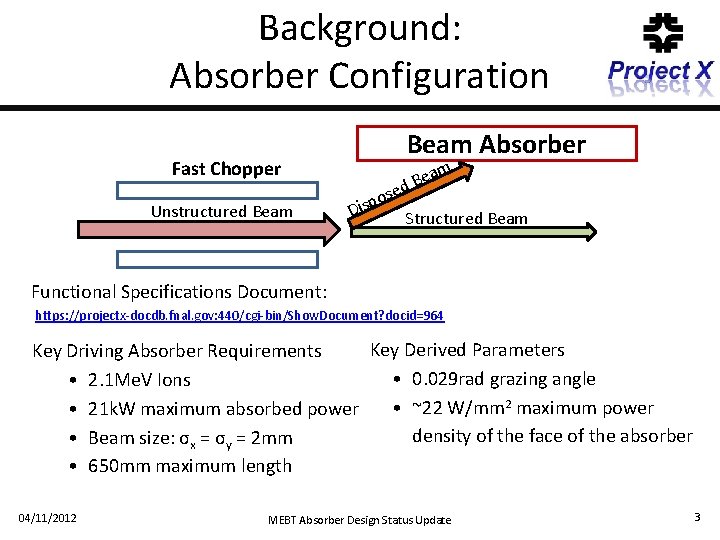
Background: Absorber Configuration Fast Chopper Unstructured Beam Absorber se o p s Di eam B d Structured Beam Functional Specifications Document: https: //projectx-docdb. fnal. gov: 440/cgi-bin/Show. Document? docid=964 Key Derived Parameters Key Driving Absorber Requirements • 0. 029 rad grazing angle • 2. 1 Me. V Ions • ~22 W/mm 2 maximum power • 21 k. W maximum absorbed power density of the face of the absorber • Beam size: σx = σy = 2 mm • 650 mm maximum length 04/11/2012 MEBT Absorber Design Status Update 3
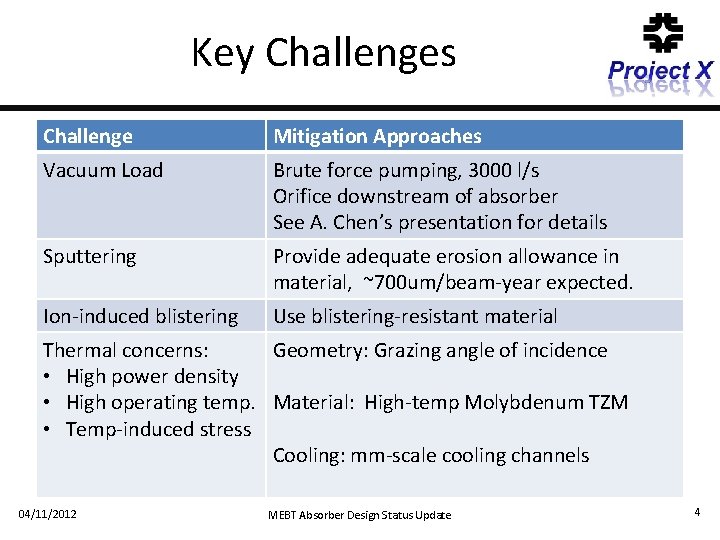
Key Challenges Challenge Mitigation Approaches Vacuum Load Brute force pumping, 3000 l/s Orifice downstream of absorber See A. Chen’s presentation for details Sputtering Provide adequate erosion allowance in material, ~700 um/beam-year expected. Ion-induced blistering Use blistering-resistant material Thermal concerns: Geometry: Grazing angle of incidence • High power density • High operating temp. Material: High-temp Molybdenum TZM • Temp-induced stress Cooling: mm-scale cooling channels 04/11/2012 MEBT Absorber Design Status Update 4
MEBT Chopper Absorber Design Status Update • Requirements and Challenges • Material Choice and Thermal Analysis • PXIE Absorber Mechanical Packaging Concept • Prototype Plans • Backup Slides • Material Blistering • Preliminary Thermal Analysis • Mechanical Packing Details • Prototype Module Fabrication Processes 04/11/2012 MEBT Absorber Design Status Update 5
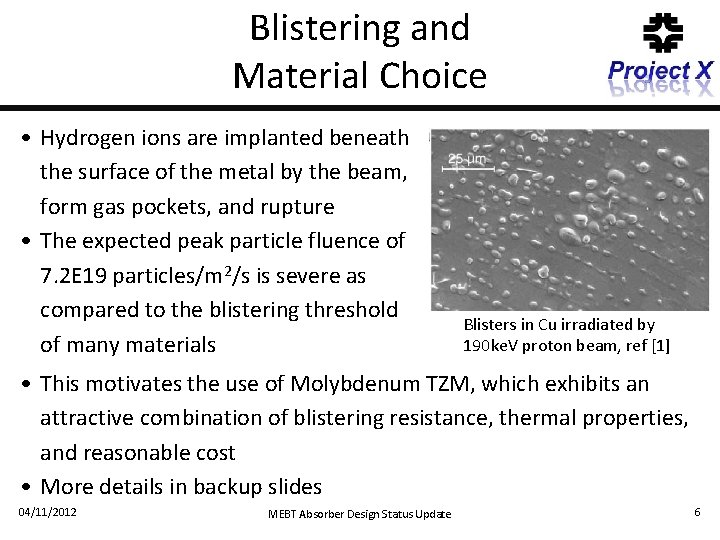
Blistering and Material Choice • Hydrogen ions are implanted beneath the surface of the metal by the beam, form gas pockets, and rupture • The expected peak particle fluence of 7. 2 E 19 particles/m 2/s is severe as compared to the blistering threshold of many materials Blisters in Cu irradiated by 190 ke. V proton beam, ref [1] • This motivates the use of Molybdenum TZM, which exhibits an attractive combination of blistering resistance, thermal properties, and reasonable cost • More details in backup slides 04/11/2012 6/30/2010 MEBT Absorber Design Status Update NML Beam Absorber Analysis 6
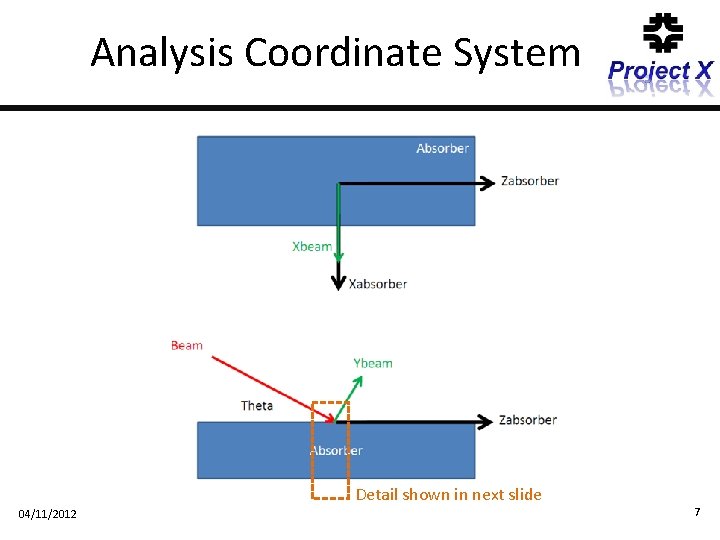
Analysis Coordinate System Detail shown in next slide 04/11/2012 7
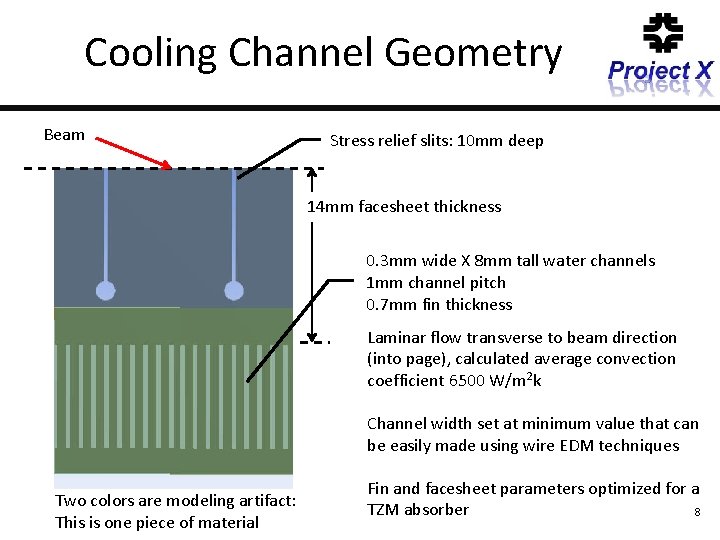
Cooling Channel Geometry Beam Stress relief slits: 10 mm deep 14 mm facesheet thickness 0. 3 mm wide X 8 mm tall water channels 1 mm channel pitch 0. 7 mm fin thickness Laminar flow transverse to beam direction (into page), calculated average convection coefficient 6500 W/m 2 k Channel width set at minimum value that can be easily made using wire EDM techniques Two colors are modeling artifact: This is one piece of material Fin and facesheet parameters optimized for a TZM absorber 8
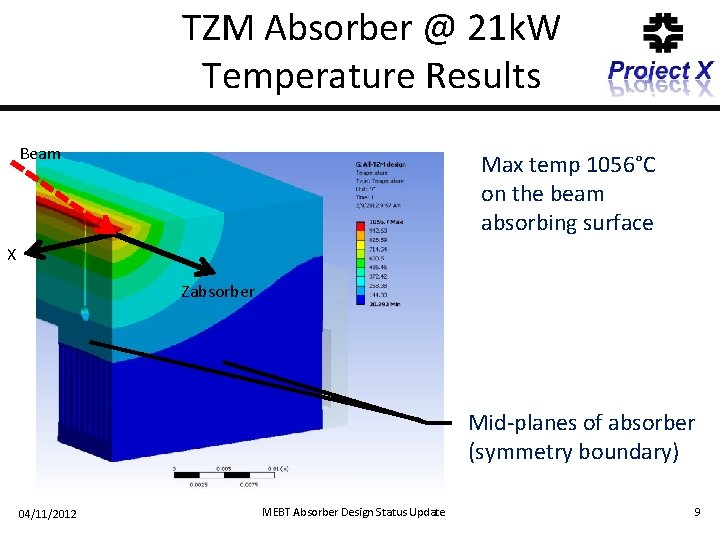
TZM Absorber @ 21 k. W Temperature Results Beam Max temp 1056°C on the beam absorbing surface X Zabsorber Mid-planes of absorber (symmetry boundary) 04/11/2012 MEBT Absorber Design Status Update 9
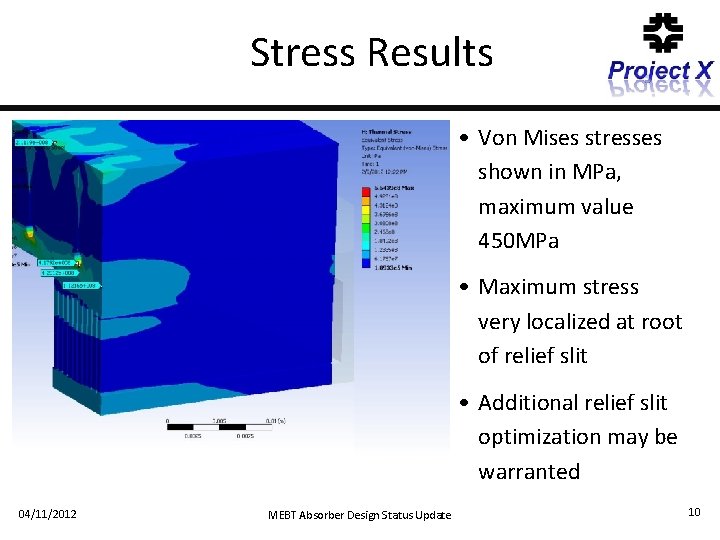
Stress Results • Von Mises stresses shown in MPa, maximum value 450 MPa • Maximum stress very localized at root of relief slit • Additional relief slit optimization may be warranted 04/11/2012 MEBT Absorber Design Status Update 10
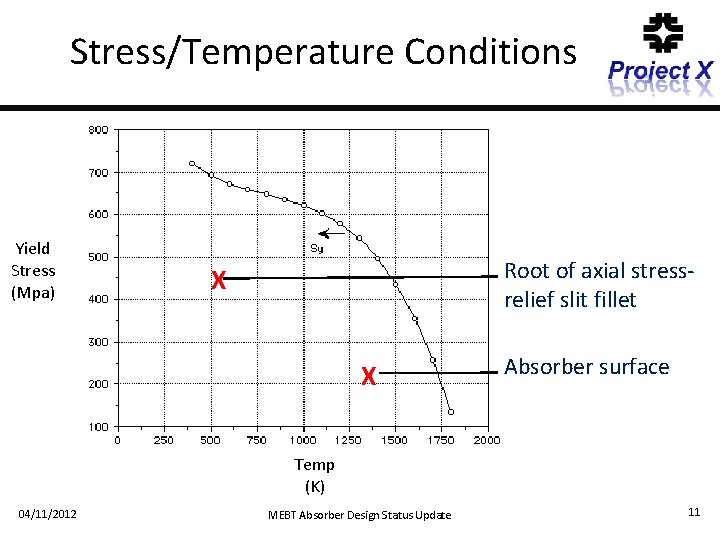
Stress/Temperature Conditions Yield Stress (Mpa) Root of axial stressrelief slit fillet X X Absorber surface Temp (K) 04/11/2012 MEBT Absorber Design Status Update 11
Analysis Conclusions and Next Steps • TZM absorber would operate at high temperatures and appreciable stresses • This preliminary analysis shows that predicted operating conditions are within the capability of the material • Analysis next steps • Analyze specific geometry and beam conditions for planned E-beam test • Correlate analysis and test results 04/11/2012 6/30/2010 MEBT Absorber Design Status Update NML Beam Absorber Analysis 12
MEBT Chopper Absorber Design Status Update • Requirements and Challenges • Material Choice and Thermal Analysis • PXIE Absorber Mechanical Packaging Concept • Prototype Plans • Backup Slides • Material Blistering • Preliminary Thermal Analysis • Mechanical Packing Details • Prototype Module Fabrication Processes 04/11/2012 MEBT Absorber Design Status Update 13
Motivation for a Modular Design • The design we’re moving towards has: • Complex features, with heavy use of EDM • Expensive materials • Some amount of risk associated with the fabrication process • We can minimize this risk by designing a modular absorber • Benefits of a modular absorber: • Lower value-added during machining process • Ability to replace modules rather than absorbers • Planned electron beam testing can be done on a high-fidelity module prototype rather than a sub-scale mockup 04/11/2012 MEBT Absorber Design Status Update 14
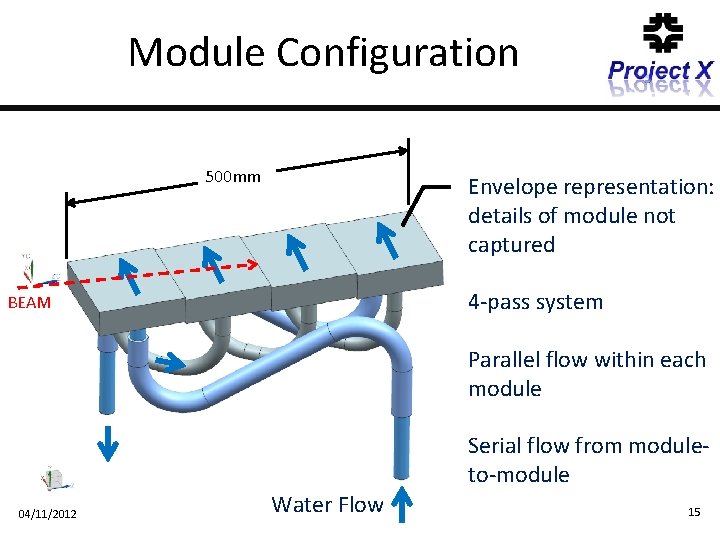
Module Configuration 500 mm Envelope representation: details of module not captured 4 -pass system BEAM Parallel flow within each module Serial flow from moduleto-module 04/11/2012 Water Flow 15
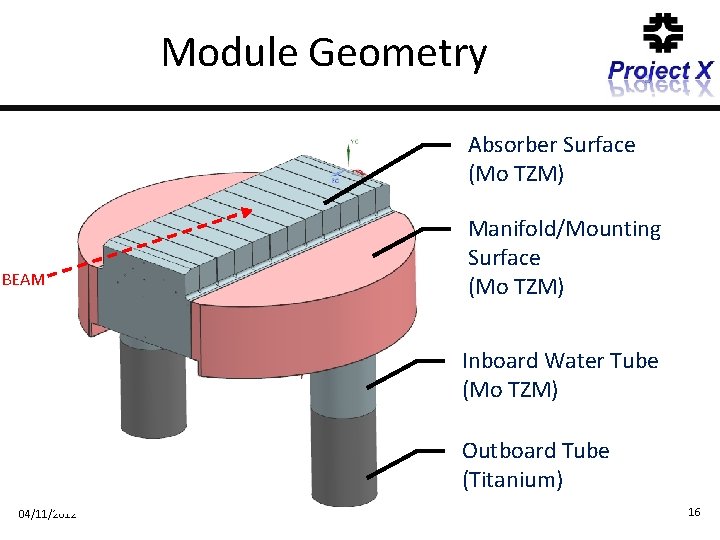
Module Geometry Absorber Surface (Mo TZM) BEAM Manifold/Mounting Surface (Mo TZM) Inboard Water Tube (Mo TZM) Outboard Tube (Titanium) 04/11/2012 16
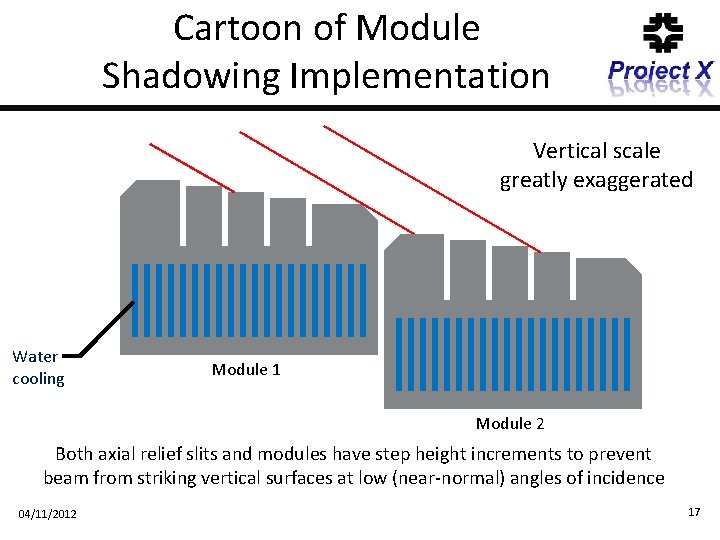
Cartoon of Module Shadowing Implementation Vertical scale greatly exaggerated Water cooling Module 1 Module 2 Both axial relief slits and modules have step height increments to prevent beam from striking vertical surfaces at low (near-normal) angles of incidence 04/11/2012 17
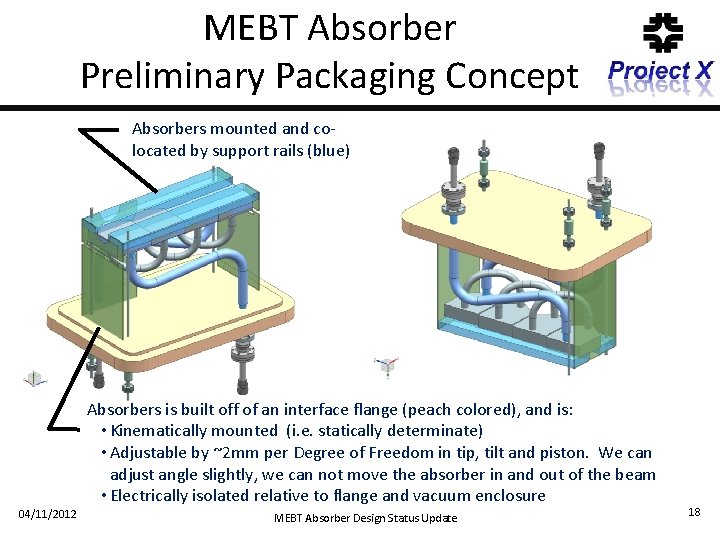
MEBT Absorber Preliminary Packaging Concept Absorbers mounted and colocated by support rails (blue) Absorbers is built off of an interface flange (peach colored), and is: • Kinematically mounted (i. e. statically determinate) • Adjustable by ~2 mm per Degree of Freedom in tip, tilt and piston. We can adjust angle slightly, we can not move the absorber in and out of the beam • Electrically isolated relative to flange and vacuum enclosure 04/11/2012 Packaging MEBT Absorber Design. Concept Status Update 18
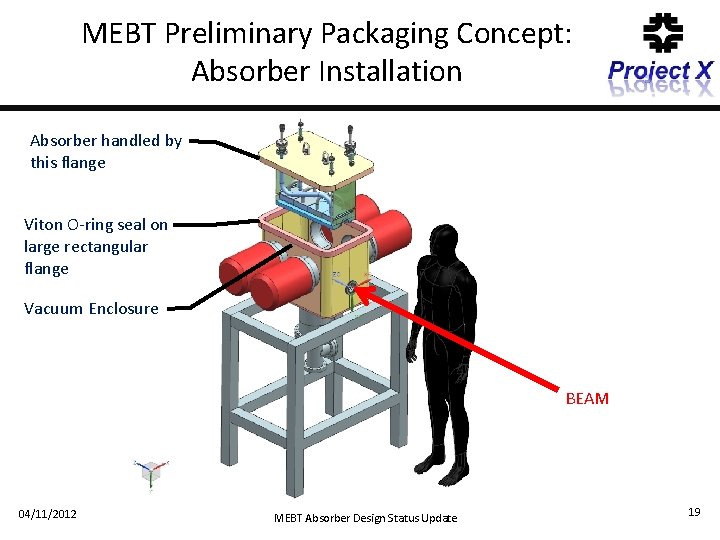
MEBT Preliminary Packaging Concept: Absorber Installation Absorber handled by this flange Viton O-ring seal on large rectangular flange Vacuum Enclosure BEAM 04/11/2012 Packaging MEBT Absorber Design. Concept Status Update 19
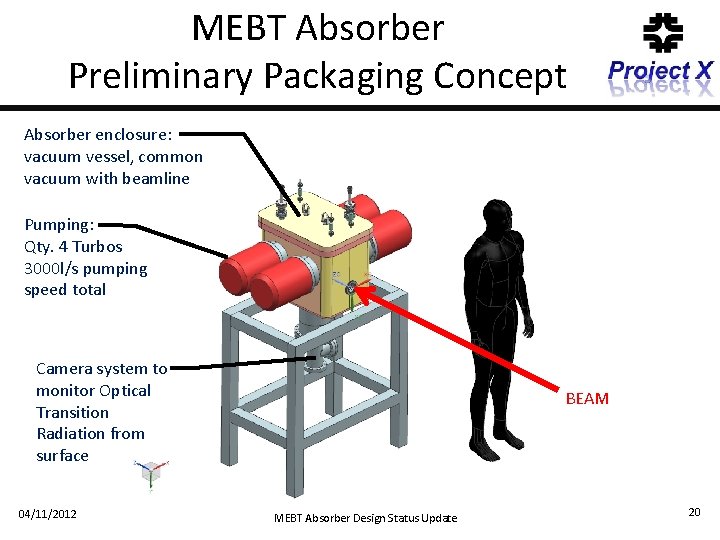
MEBT Absorber Preliminary Packaging Concept Absorber enclosure: vacuum vessel, common vacuum with beamline Pumping: Qty. 4 Turbos 3000 l/s pumping speed total Camera system to monitor Optical Transition Radiation from surface 04/11/2012 BEAM Packaging MEBT Absorber Design. Concept Status Update 20
MEBT Chopper Absorber Design Status Update • Requirements and Challenges • Material Choice and Thermal Analysis • PXIE Absorber Mechanical Packaging Concept • Prototype Plans • Backup Slides • Material Blistering • Preliminary Thermal Analysis • Mechanical Packing Details • Prototype Module Fabrication Processes 04/11/2012 MEBT Absorber Design Status Update 21
Design Risks Key absorber design risks include: • High temperatures in absorber material Addressed • Flow characteristics and heat transfer by prototype • Manufacturing processes testing • Machining of Mo TZM • TZM-to-Ti transitions • Ti-to-stainless transitions • Module-to-module and global alignment stability • Blistering of TZM material in H- Beam 04/11/2012 MEBT Absorber Design Status Update 22
Prototype Approach • Prototype a single absorber module • 116 mm length • Single-pass water cooling • Test in existing E-beam gun • 30 k. V, 0. 17 A, ~5 k. W beam • Gun system is flexible enough to provide a range of beam conditions • Angle of incidence between absorber and beam 120 mrad • 4 X greater (more normal) than PXIE plan • Allows us to replicate peak power deposition within limited length of test module 04/11/2012 MEBT Absorber Design Status Update 23
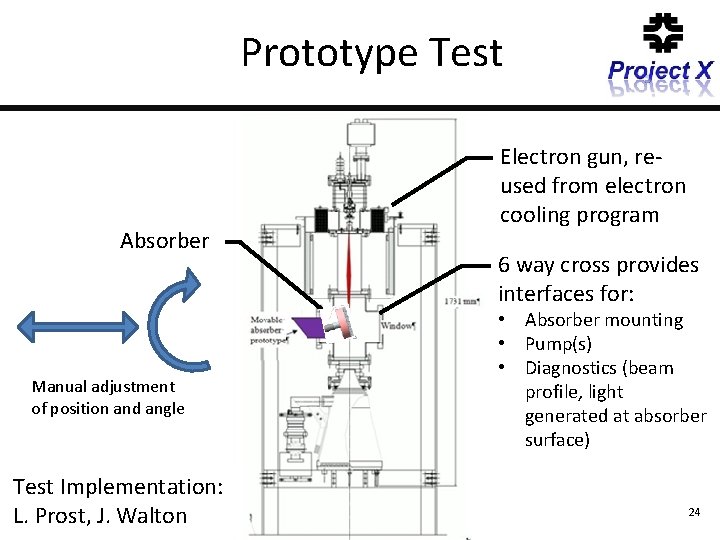
Prototype Test Electron gun, reused from electron cooling program Absorber 6 way cross provides interfaces for: • Absorber mounting • Pump(s) • Diagnostics (beam profile, light generated at absorber surface) Manual adjustment of position and angle Test Implementation: L. 04/11/2012 Prost, J. Walton MEBT Absorber Design Status Update 24
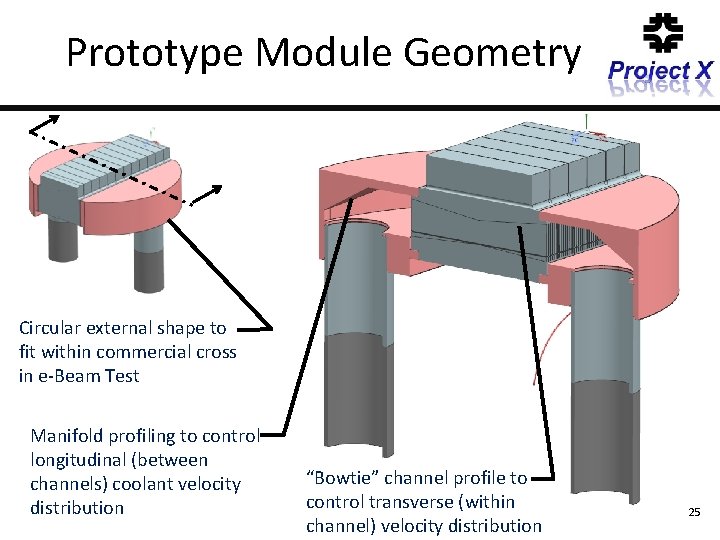
Prototype Module Geometry Circular external shape to fit within commercial cross in e-Beam Test Manifold profiling to control longitudinal (between channels) coolant velocity distribution “Bowtie” channel profile to control transverse (within channel) velocity distribution 25
Prototype Status • Electron test bench being assembled • First cathode emission within the next month • Beam characterization to be done prior to absorber test • Long-lead Molybdenum TZM material on order, expected mid. May • Prototype absorber module design being finalized • In discussions with vendors for machining and manufacturing process development 04/11/2012 MEBT Absorber Design Status Update 26
Summary • A conceptual design exists that responds to the functional requirements • Analysis indicates that a Molybdenum TZM absorber will operate at a high, but survivable stress/temperature condition • Design risks exist, but many of them will be investigated by a planned prototype test in advance of PXIE 04/11/2012 MEBT Absorber Design Status Update 27
MEBT Chopper Absorber Design Status Update • Requirements and Challenges • Material Choice and Thermal Analysis • PXIE Absorber Mechanical Packaging Concept • Prototype Plans • Backup Slides • Material Blistering • Preliminary Thermal Analysis • Mechanical Packing Details • Prototype Module Fabrication Processes 04/11/2012 MEBT Absorber Design Status Update 28
Blistering • In November, we presented thermal analysis for a Copper beam absorber https: //projectx-docdb. fnal. gov: 440/cgi-bin/Show. Document? docid=961 • It was pointed out to us (by V. Dudnikov) that beam-induced blistering could be a concern • We have investigated blistering, and have found that it is likely a show-stopper for a Copper absorber design • This has motivated us to change the proposed absorber material to a Molybdenum alloy (Mo TZM) 04/11/2012 6/30/2010 MEBT Absorber Design Status Update NML Beam Absorber Analysis 29
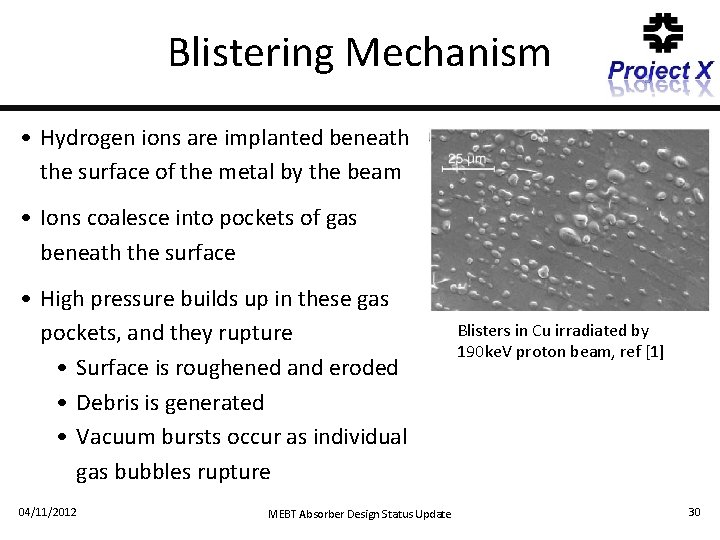
Blistering Mechanism • Hydrogen ions are implanted beneath the surface of the metal by the beam • Ions coalesce into pockets of gas beneath the surface • High pressure builds up in these gas pockets, and they rupture • Surface is roughened and eroded • Debris is generated • Vacuum bursts occur as individual gas bubbles rupture 04/11/2012 6/30/2010 MEBT Absorber Design Status Update NML Beam Absorber Analysis Blisters in Cu irradiated by 190 ke. V proton beam, ref [1] 30
Existing Data • A literature search was done to look for relevant data • A list of the most relevant references may be found here: https: //projectx-docdb. fnal. gov: 440/cgi-bin/Show. Document? docid=989 • Data is most available for beam at normal incidence with E<200 ke. V • Our beam is 2. 1 Me. V incident at a steep angle (~. 029 rad) • Particles will travel of order 20 um along the beam direction, and end up at a depth (from the surface) of ~0. 6 um • “Effective energy” with the same implantation depth at normal incidence is ~100 ke. V • A wide variety of test conditions in the literature makes direct comparisons to existing data challenging 31
Blistering Trends • In general, blistering is more severe when… • Current density is high • Less time for diffusion/desorption to occur • Particle energy is low • Implantation depth is lower, so imposed gas concentration is higher • Blistering effects are well documented in the 1 ke. V-200 ke. V range • Hydrogen solubility and diffusion rates of the target metal are low • Metal temperature is low • diffusion rate of gas increases with temp. • Metal surface is smooth • less free surface area for gas desorption 04/11/2012 6/30/2010 32
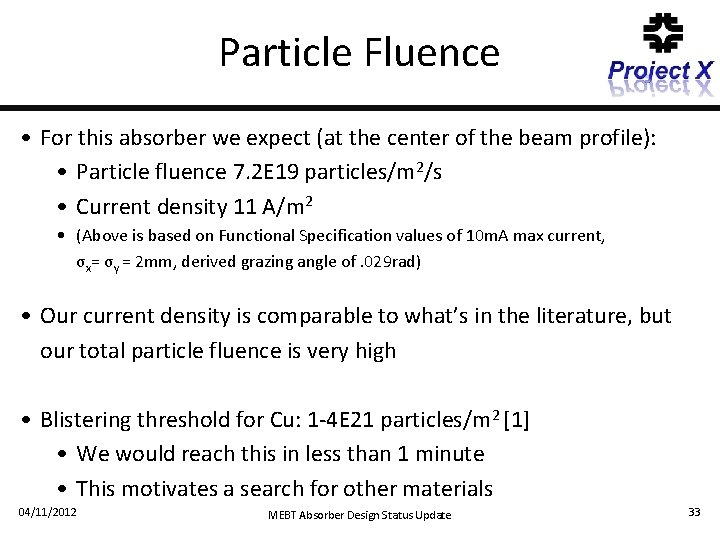
Particle Fluence • For this absorber we expect (at the center of the beam profile): • Particle fluence 7. 2 E 19 particles/m 2/s • Current density 11 A/m 2 • (Above is based on Functional Specification values of 10 m. A max current, σx= σy = 2 mm, derived grazing angle of. 029 rad) • Our current density is comparable to what’s in the literature, but our total particle fluence is very high • Blistering threshold for Cu: 1 -4 E 21 particles/m 2 [1] • We would reach this in less than 1 minute • This motivates a search for other materials 04/11/2012 6/30/2010 MEBT Absorber Design Status Update 33
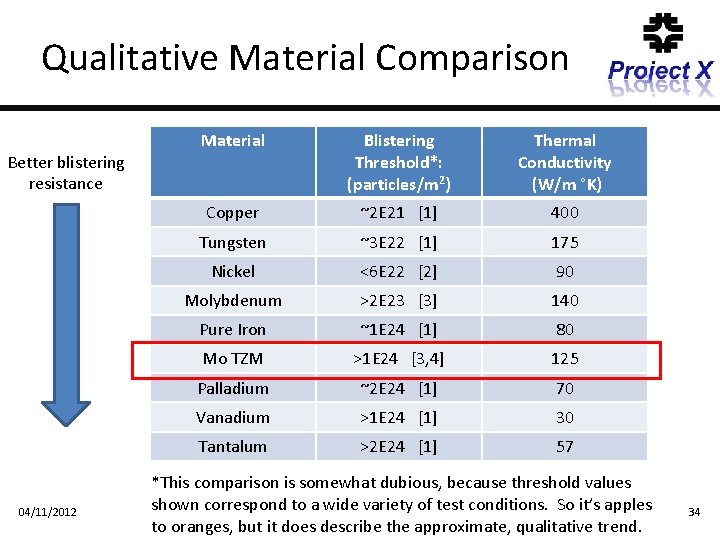
Qualitative Material Comparison Better blistering resistance 04/11/2012 6/30/2010 Material Blistering Threshold*: (particles/m 2) Thermal Conductivity (W/m °K) Copper ~2 E 21 [1] 400 Tungsten ~3 E 22 [1] 175 Nickel <6 E 22 [2] 90 Molybdenum >2 E 23 [3] 140 Pure Iron ~1 E 24 [1] 80 Mo TZM >1 E 24 [3, 4] 125 Palladium ~2 E 24 [1] 70 Vanadium >1 E 24 [1] 30 Tantalum >2 E 24 [1] 57 *This comparison is somewhat dubious, because threshold values shown correspond to a wide variety of test conditions. So it’s apples to oranges, but it does describe the approximate, qualitative trend. 34
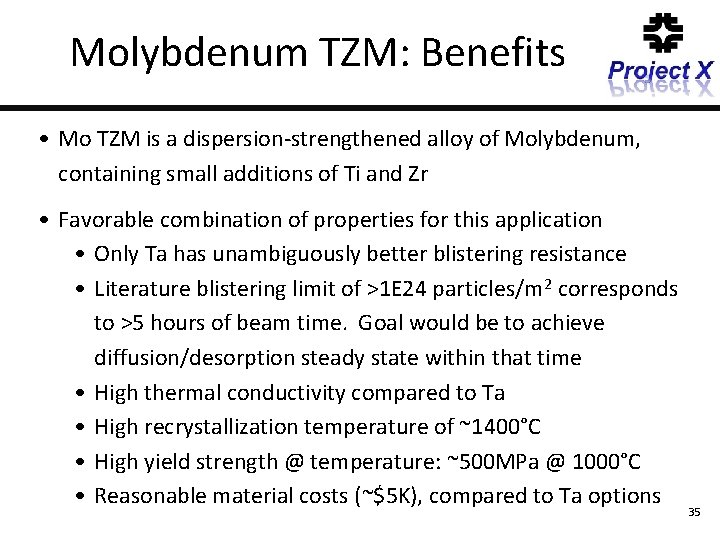
Molybdenum TZM: Benefits • Mo TZM is a dispersion-strengthened alloy of Molybdenum, containing small additions of Ti and Zr • Favorable combination of properties for this application • Only Ta has unambiguously better blistering resistance • Literature blistering limit of >1 E 24 particles/m 2 corresponds to >5 hours of beam time. Goal would be to achieve diffusion/desorption steady state within that time • High thermal conductivity compared to Ta • High recrystallization temperature of ~1400°C • High yield strength @ temperature: ~500 MPa @ 1000°C • Reasonable material costs (~$5 K), compared to Ta options 35
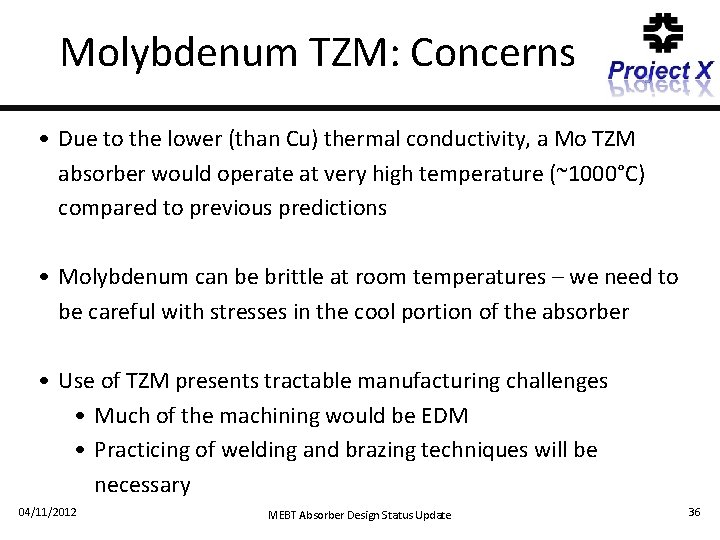
Molybdenum TZM: Concerns • Due to the lower (than Cu) thermal conductivity, a Mo TZM absorber would operate at very high temperature (~1000°C) compared to previous predictions • Molybdenum can be brittle at room temperatures – we need to be careful with stresses in the cool portion of the absorber • Use of TZM presents tractable manufacturing challenges • Much of the machining would be EDM • Practicing of welding and brazing techniques will be necessary 04/11/2012 6/30/2010 MEBT Absorber Design Status Update 36
Molybdenum TZM: Concerns • Two Mo isotopes have a neutron production threshold < 2. 1 Me. V • 97 Mo (pn) 97 Tc, 1. 11 Me. V threshold, 9. 5% abundance • 100 Mo (pn) 100 Tc, 0. 96 Me. V threshold, 9. 6% abundance • See Y. Eidelman report on this topic https: //projectx-docdb. fnal. gov: 440/cgi-bin/Show. Document? docid=986 • A Mo absorber will produce more neutrons than a Cu absorber • In PXIE, neutrons streaming back from the main beam dump will be a bigger issue. As such, we may be able to tolerate some neutron production in the absorber 04/11/2012 6/30/2010 MEBT Absorber Design Status Update 37
![Blistering References [1] V. T. Astrelin et al, “Blistering of the selected materials irradiated](http://slidetodoc.com/presentation_image_h/1377fef0582e811d964473850159f951/image-38.jpg "Blistering References [1] V. T. Astrelin et al, “Blistering of the selected materials irradiated")
Blistering References [1] V. T. Astrelin et al, “Blistering of the selected materials irradiated by intense 200 ke. V proton beam, ” Journal of Nuclear Materials 396 p 43, 2010 [2] M. K. Sinha, S. K. Das, and M. Kaminsky, “Temperature dependence of helium blistering in nickel monocrystals, ” Journal of Applied Physics 49(1) p 170, 1978 [3] S. K. Das, M. Kaminsky, and P. Dusza, “Surface damage of molybdenum and TZM alloy under D+ impact, ” Journal of Vacuum Science and Technology 15(2) p 170, 1978 [4] Y. Nakamura, T. Shibata and M. Tanaka, “Grain ejection from the surface of polycrystalline Molybdenum irradiated by intense H+ and H 2+ ion beams, ” Journal of Nuclear Materials 68 p 253, 1977 04/11/2012 6/30/2010 MEBT Absorber Design Status Update NML Beam Absorber Analysis 38
MEBT Chopper Absorber Design Status Update • Requirements and Challenges • Material Choice and Thermal Analysis • PXIE Absorber Mechanical Packaging Concept • Prototype Plans • Backup Slides • Material Blistering • Preliminary Thermal Analysis • Mechanical Packing Details • Prototype Module Fabrication Processes 04/11/2012 MEBT Absorber Design Status Update 39
Preliminary Thermal Analysis of a Mo TZM Absorber • Though changing material to Mo TZM, we will maintain the same overall absorber configuration presented previously: • Previous work: https: //projectx-docdb. fnal. gov: 440/cgi-bin/Show. Document? docid=961 • Rectangular geometry, grazing angle of incidence, and axial stress relief slits as proposed in the Hassan et al. concept • mm-scale channel water cooling scheme as presented previously • Dimensions of the stress relief slits and cooling channels have been re-optimized for the lower thermal conductivity of the Mo TZM material 04/11/2012 6/30/2010 MEBT Absorber Design Status Update NML Beam Absorber Analysis 40
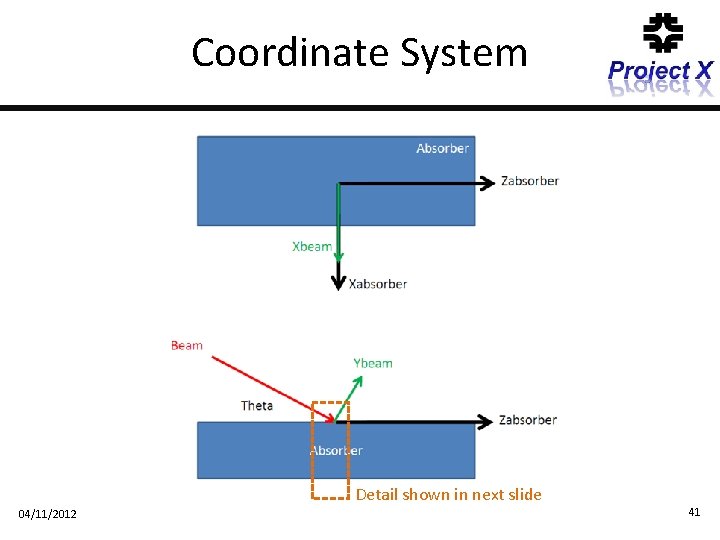
Coordinate System Detail shown in next slide 04/11/2012 41
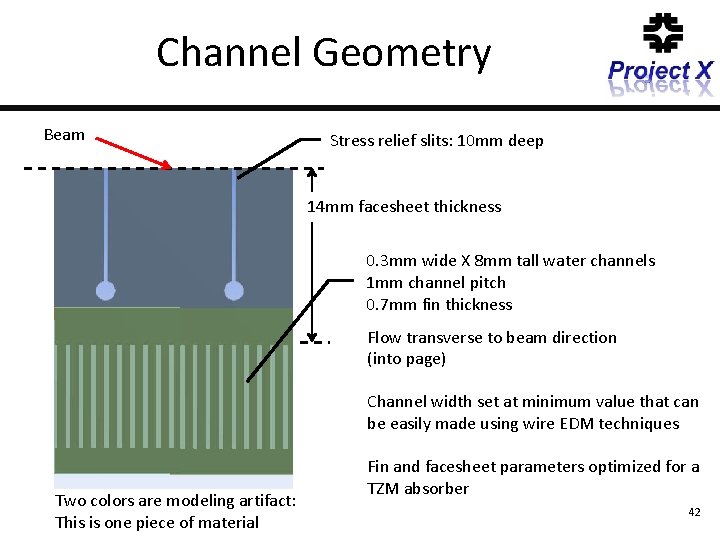
Channel Geometry Beam Stress relief slits: 10 mm deep 14 mm facesheet thickness 0. 3 mm wide X 8 mm tall water channels 1 mm channel pitch 0. 7 mm fin thickness Flow transverse to beam direction (into page) Channel width set at minimum value that can be easily made using wire EDM techniques Two colors are modeling artifact: This is one piece of material Fin and facesheet parameters optimized for a TZM absorber 42
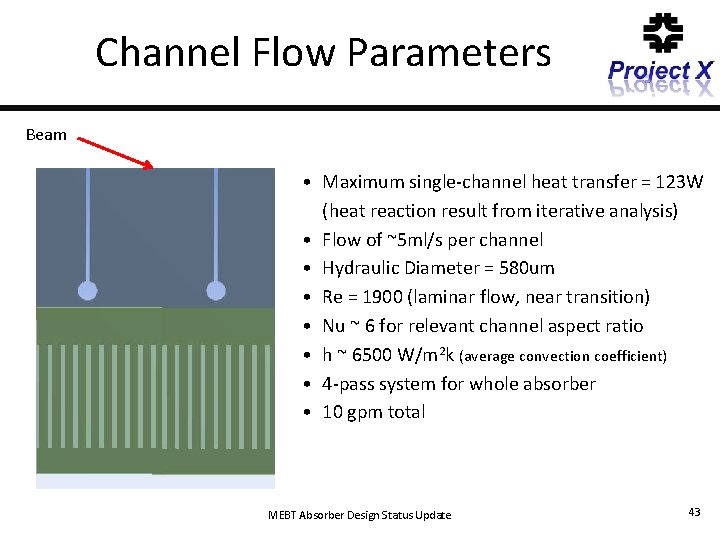
Channel Flow Parameters Beam • Maximum single-channel heat transfer = 123 W (heat reaction result from iterative analysis) • Flow of ~5 ml/s per channel • Hydraulic Diameter = 580 um • Re = 1900 (laminar flow, near transition) • Nu ~ 6 for relevant channel aspect ratio • h ~ 6500 W/m 2 k (average convection coefficient) • 4 -pass system for whole absorber • 10 gpm total MEBT Absorber Design Status Update 43
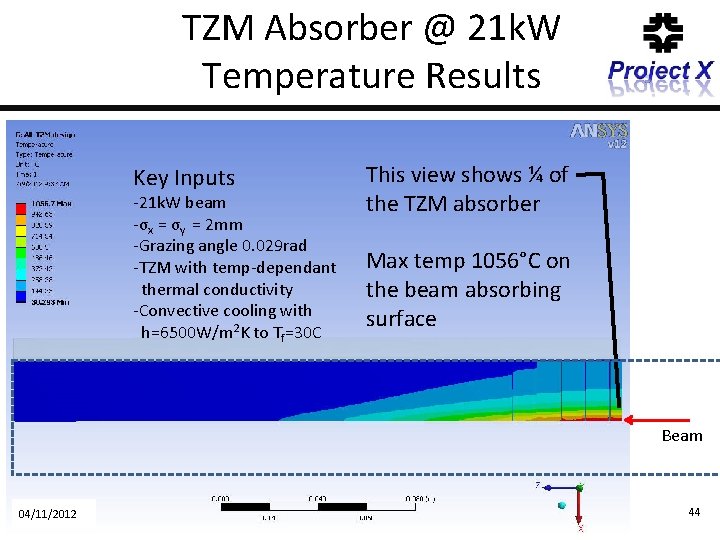
TZM Absorber @ 21 k. W Temperature Results Key Inputs -21 k. W beam -σx = σy = 2 mm -Grazing angle 0. 029 rad -TZM with temp-dependant thermal conductivity -Convective cooling with h=6500 W/m 2 K to Tf=30 C This view shows ¼ of the TZM absorber Max temp 1056°C on the beam absorbing surface Beam 04/11/2012 44
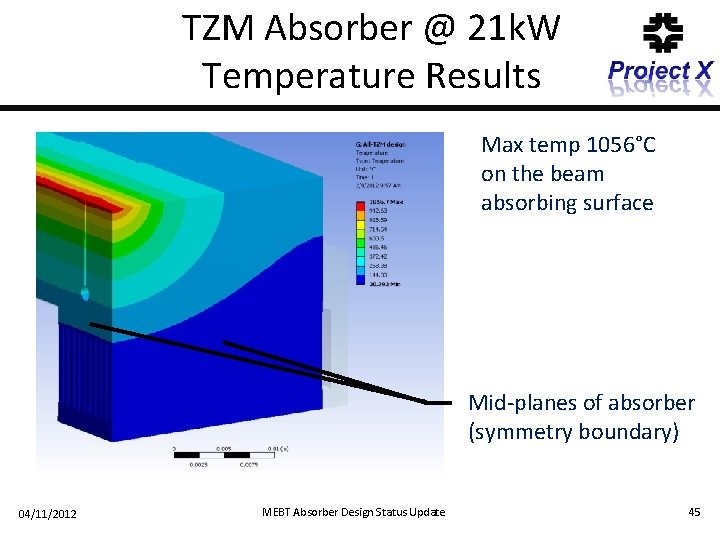
TZM Absorber @ 21 k. W Temperature Results Max temp 1056°C on the beam absorbing surface Mid-planes of absorber (symmetry boundary) 04/11/2012 MEBT Absorber Design Status Update 45
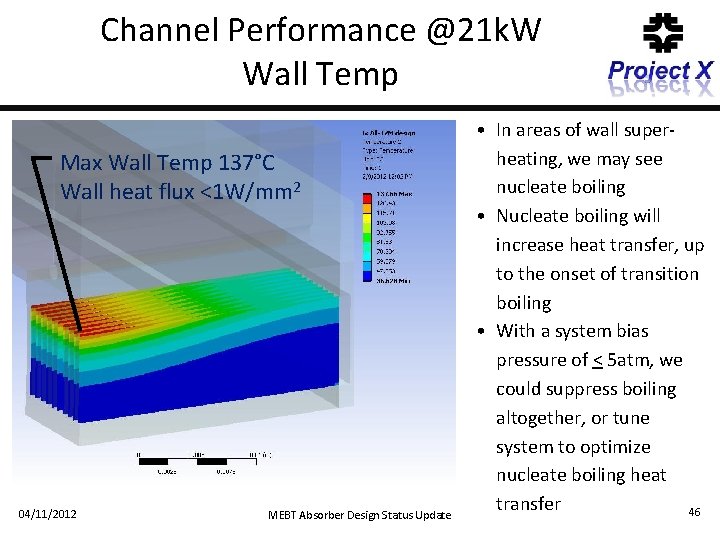
Channel Performance @21 k. W Wall Temp Max Wall Temp 137°C Wall heat flux <1 W/mm 2 04/11/2012 MEBT Absorber Design Status Update • In areas of wall superheating, we may see nucleate boiling • Nucleate boiling will increase heat transfer, up to the onset of transition boiling • With a system bias pressure of < 5 atm, we could suppress boiling altogether, or tune system to optimize nucleate boiling heat transfer 46
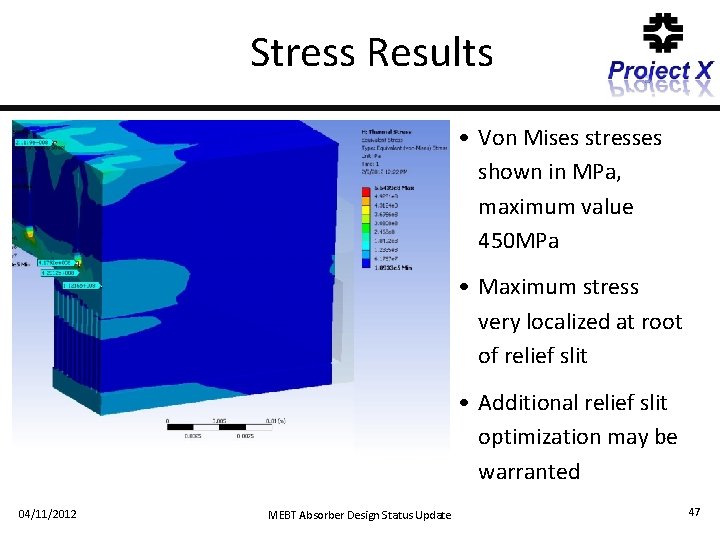
Stress Results • Von Mises stresses shown in MPa, maximum value 450 MPa • Maximum stress very localized at root of relief slit • Additional relief slit optimization may be warranted 04/11/2012 MEBT Absorber Design Status Update 47
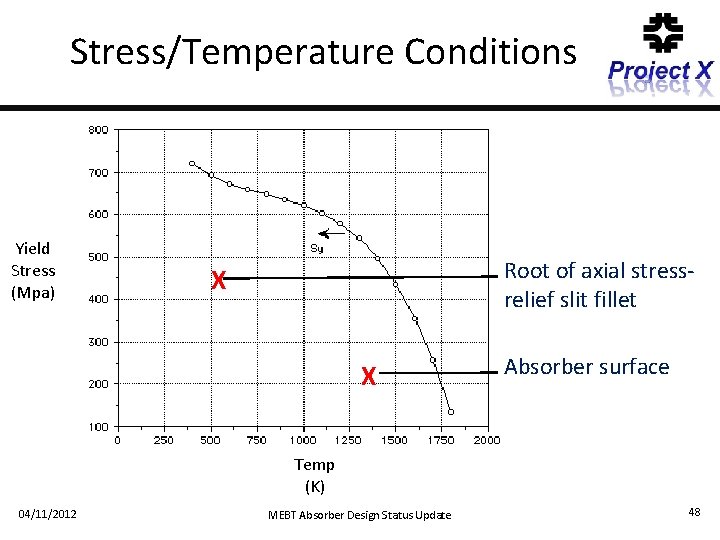
Stress/Temperature Conditions Yield Stress (Mpa) Root of axial stressrelief slit fillet X X Absorber surface Temp (K) 04/11/2012 MEBT Absorber Design Status Update 48
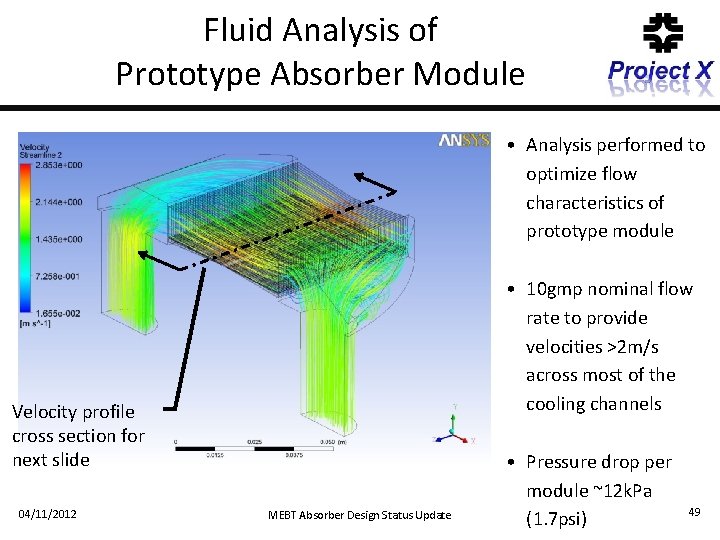
Fluid Analysis of Prototype Absorber Module • Analysis performed to optimize flow characteristics of prototype module • 10 gmp nominal flow rate to provide velocities >2 m/s across most of the cooling channels Velocity profile cross section for next slide 04/11/2012 MEBT Absorber Design Status Update • Pressure drop per module ~12 k. Pa (1. 7 psi) 49
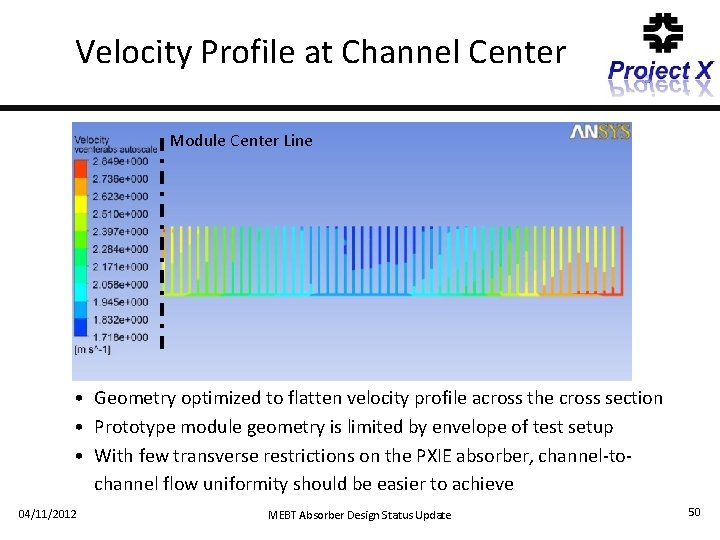
Velocity Profile at Channel Center Module Center Line • Geometry optimized to flatten velocity profile across the cross section • Prototype module geometry is limited by envelope of test setup • With few transverse restrictions on the PXIE absorber, channel-tochannel flow uniformity should be easier to achieve 04/11/2012 MEBT Absorber Design Status Update 50
Analysis Conclusions and Next Steps • TZM absorber would operate at high temperatures and appreciable stresses • This preliminary analysis shows that predicted operating conditions are within the capability of the material • Analysis next steps • Analyze specific beam conditions for planned E-beam test • Correlate analysis and test results 04/11/2012 6/30/2010 MEBT Absorber Design Status Update NML Beam Absorber Analysis 51
MEBT Chopper Absorber Design Status Update • Requirements and Challenges • Material Choice and Thermal Analysis • PXIE Absorber Mechanical Packaging Concept • Prototype Plans • Backup Slides • Material Blistering • Preliminary Thermal Analysis • Mechanical Packing Details • Prototype Module Fabrication Processes 04/11/2012 MEBT Absorber Design Status Update 52
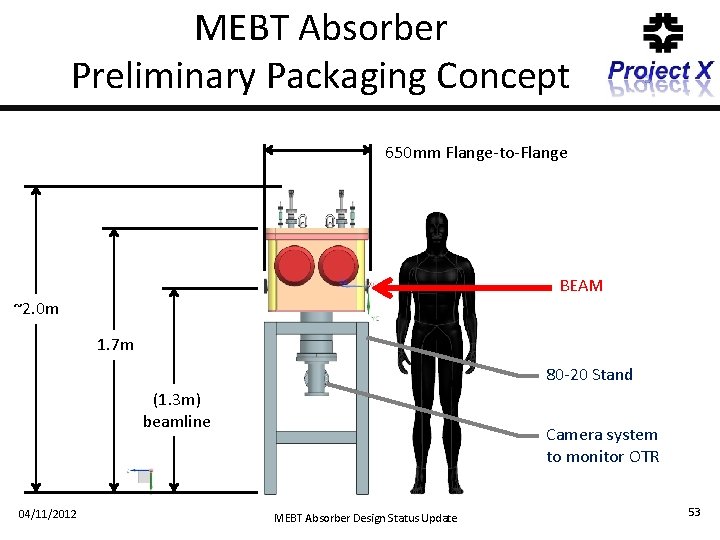
MEBT Absorber Preliminary Packaging Concept 650 mm Flange-to-Flange BEAM ~2. 0 m 1. 7 m 80 -20 Stand (1. 3 m) beamline 04/11/2012 Camera system to monitor OTR Packaging MEBT Absorber Design. Concept Status Update 53
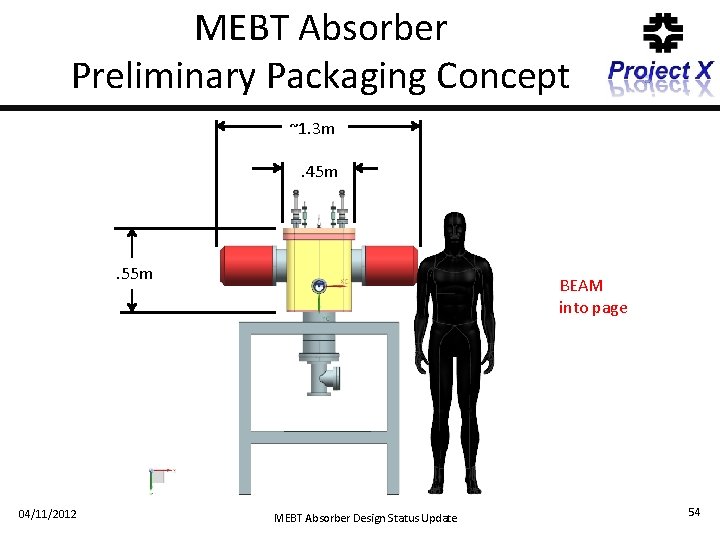
MEBT Absorber Preliminary Packaging Concept ~1. 3 m. 45 m . 55 m 04/11/2012 BEAM into page Packaging MEBT Absorber Design. Concept Status Update 54
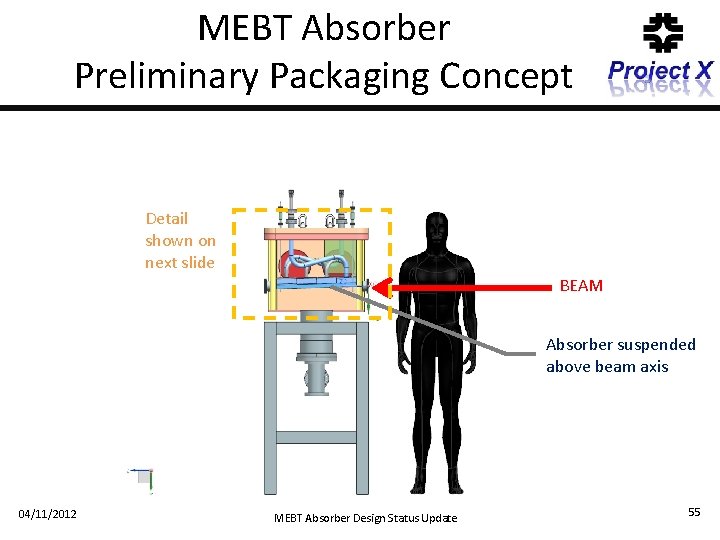
MEBT Absorber Preliminary Packaging Concept Detail shown on next slide BEAM Absorber suspended above beam axis 04/11/2012 Packaging MEBT Absorber Design. Concept Status Update 55
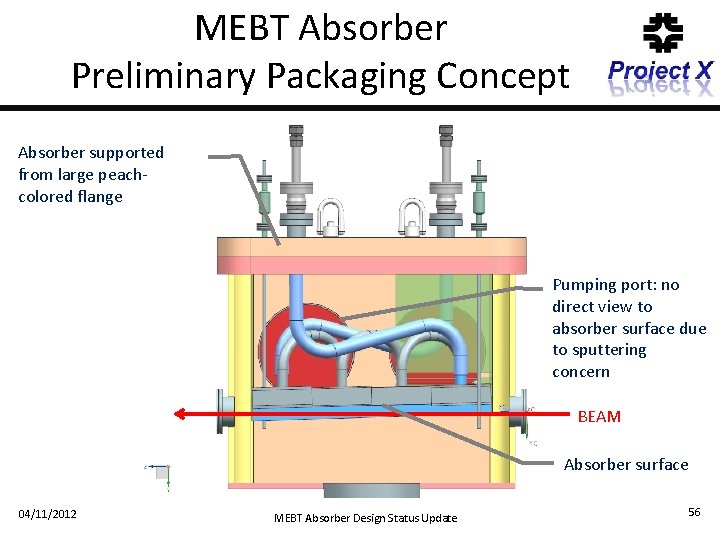
MEBT Absorber Preliminary Packaging Concept Absorber supported from large peachcolored flange Pumping port: no direct view to absorber surface due to sputtering concern BEAM Absorber surface 04/11/2012 Packaging MEBT Absorber Design. Concept Status Update 56
MEBT Chopper Absorber Design Status Update • Requirements and Challenges • Material Choice and Thermal Analysis • PXIE Absorber Mechanical Packaging Concept • Prototype Plans • Backup Slides • Material Blistering • Preliminary Thermal Analysis • Mechanical Packing Details • Prototype Module Fabrication Processes 04/11/2012 MEBT Absorber Design Status Update 57
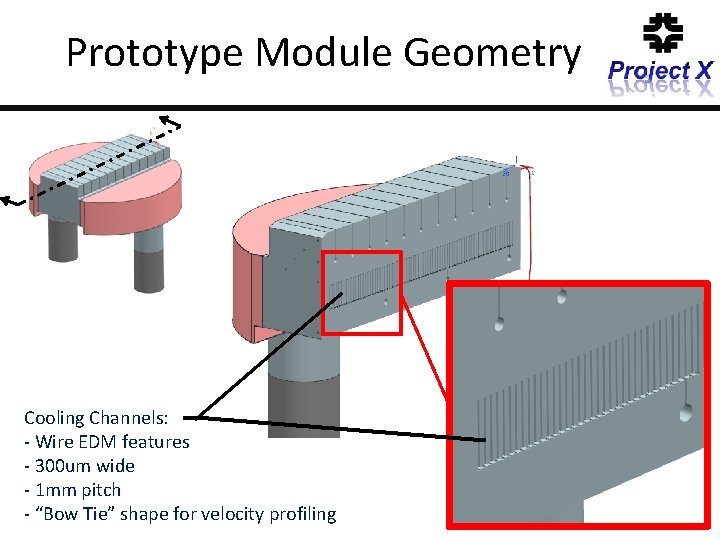
Prototype Module Geometry Cooling Channels: - Wire EDM features - 300 um wide - 1 mm pitch - “Bow Tie” shape for velocity profiling 58
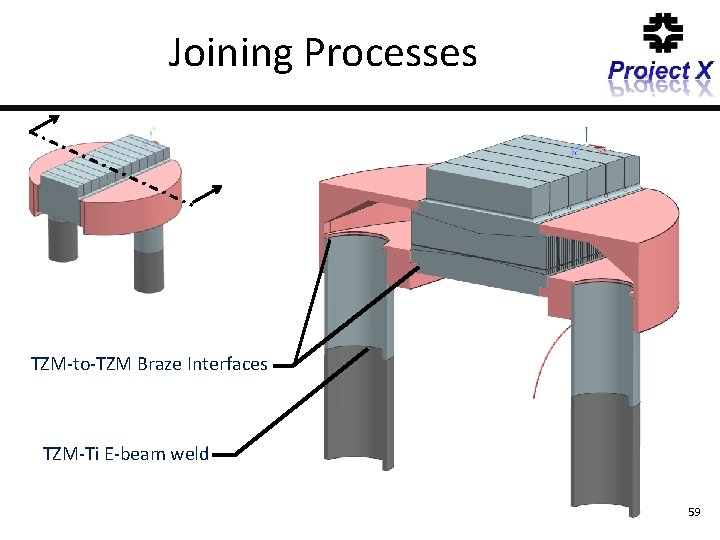
Joining Processes TZM-to-TZM Braze Interfaces TZM-Ti E-beam weld 59
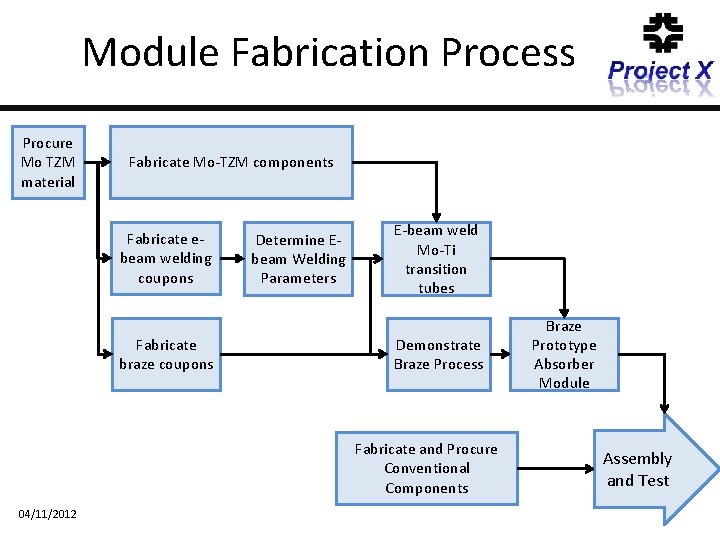
Module Fabrication Process Procure Mo TZM material Fabricate Mo-TZM components Fabricate ebeam welding coupons Fabricate braze coupons Determine Ebeam Welding Parameters E-beam weld Mo-Ti transition tubes Demonstrate Braze Process Fabricate and Procure Conventional Components 04/11/2012 Braze Prototype Absorber Module Assembly and Test
- Slides: 60