
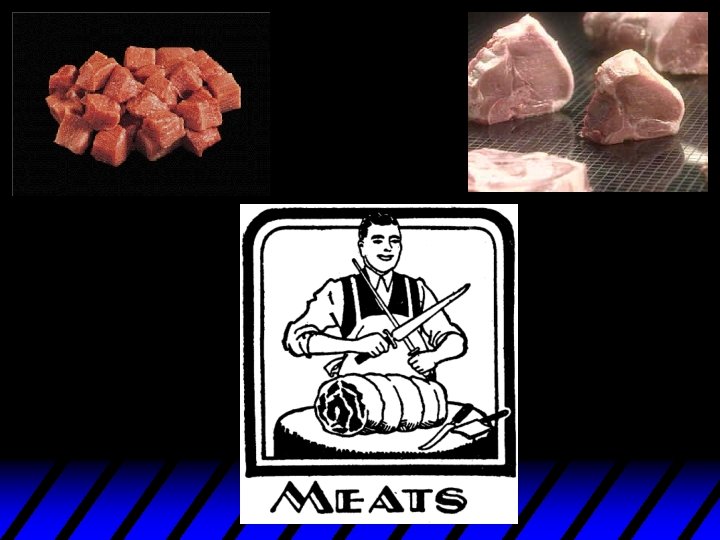
Meats u Usually the most expensive of all


- Slides: 48
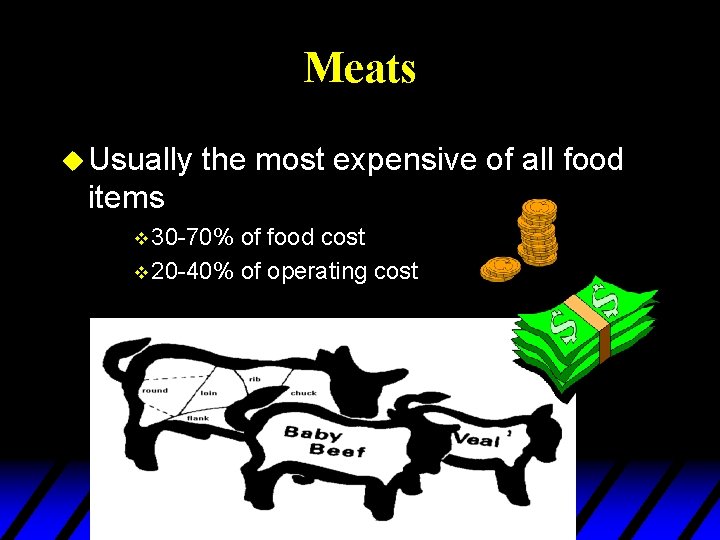
Meats u Usually the most expensive of all food items v 30 -70% of food cost v 20 -40% of operating cost
u Make-up: – 75% water, 20% protein, 5% fat – Shrinkage and deterioration v Humidity v Temperature
Animal Fat u 5% of animal tissue u 30% of carcass? u Bred and raised leaner u Some fat is desirable. . .
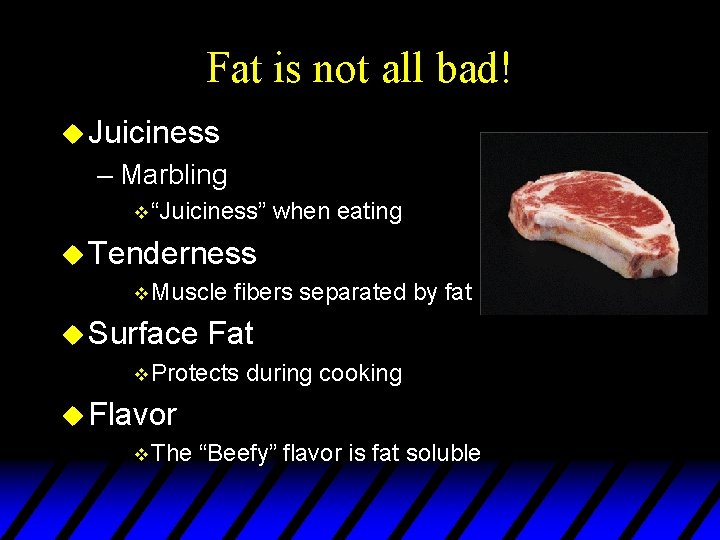
Fat is not all bad! u Juiciness – Marbling v “Juiciness” when eating u Tenderness v Muscle fibers separated by fat u Surface Fat v Protects during cooking u Flavor v The “Beefy” flavor is fat soluble
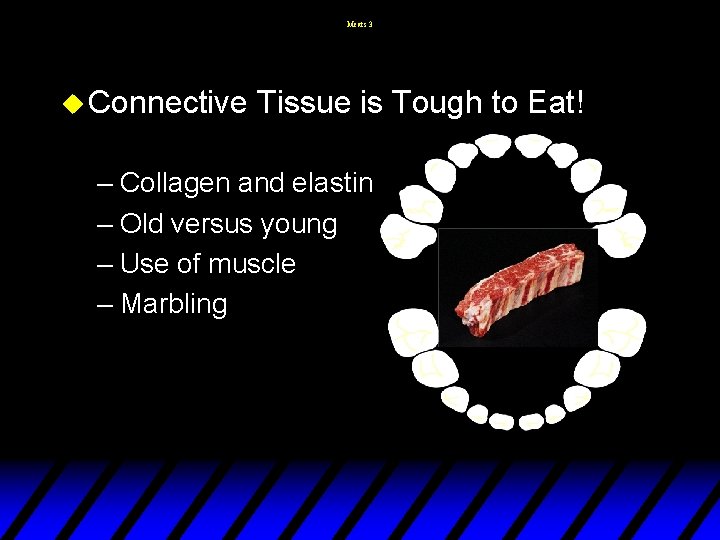
Meats 3 u Connective Tissue is Tough to Eat! – Collagen and elastin – Old versus young – Use of muscle – Marbling
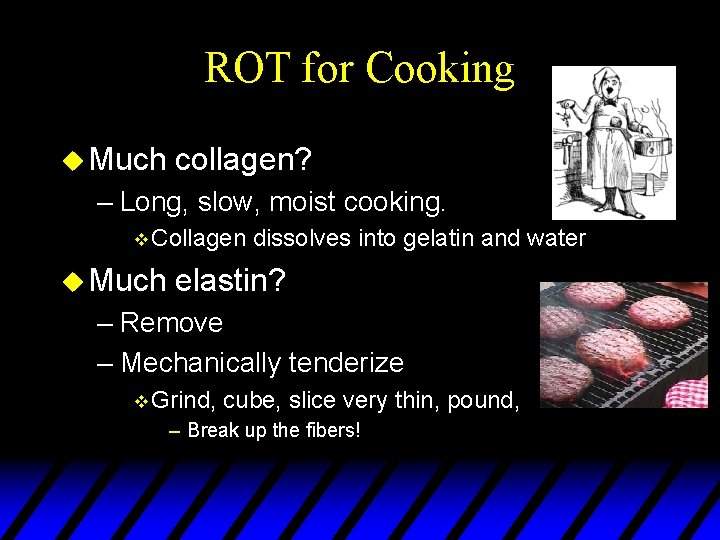
ROT for Cooking u Much collagen? – Long, slow, moist cooking. v Collagen u Much dissolves into gelatin and water elastin? – Remove – Mechanically tenderize v Grind, cube, slice very thin, pound, – Break up the fibers!
Meats: Inspections and Grading u Authorized by Agricultural Marketing Act u The Wholesome Meat Act – All meat must be inspected – Grading is voluntary v Quality v Yield
The Seal of Approval? u The Circular Inspection Stamp – Wholesome and Fit for Human Consumption u The Shield shaped Grading stamp – A Quality Designation v Clearly specified
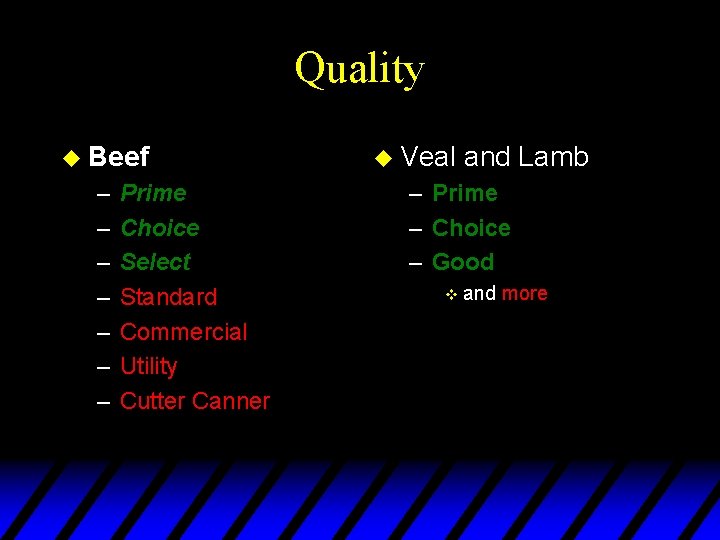
Quality u Beef – – – – Prime Choice Select Standard Commercial Utility Cutter Canner u Veal and Lamb – Prime – Choice – Good v and more
Quality u Proprietary Quality Grade? – Caveat Emptor! v Know your supplier – You can none-the-less specify USDA grade
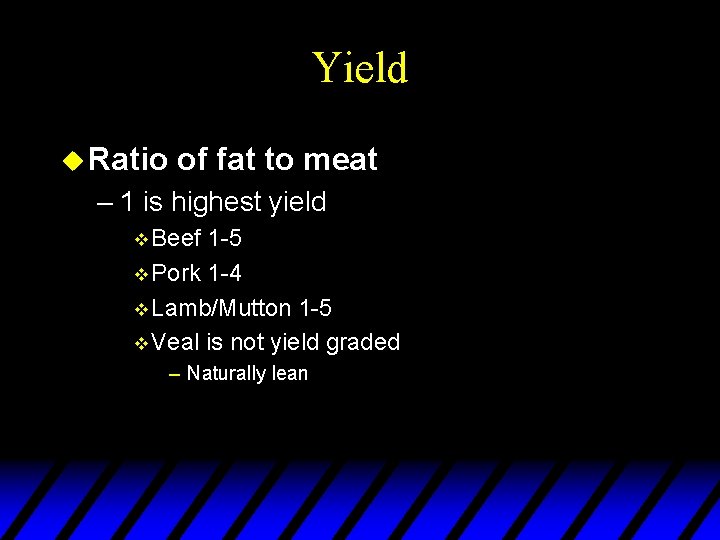
Yield u Ratio of fat to meat – 1 is highest yield v Beef 1 -5 v Pork 1 -4 v Lamb/Mutton 1 -5 v Veal is not yield graded – Naturally lean
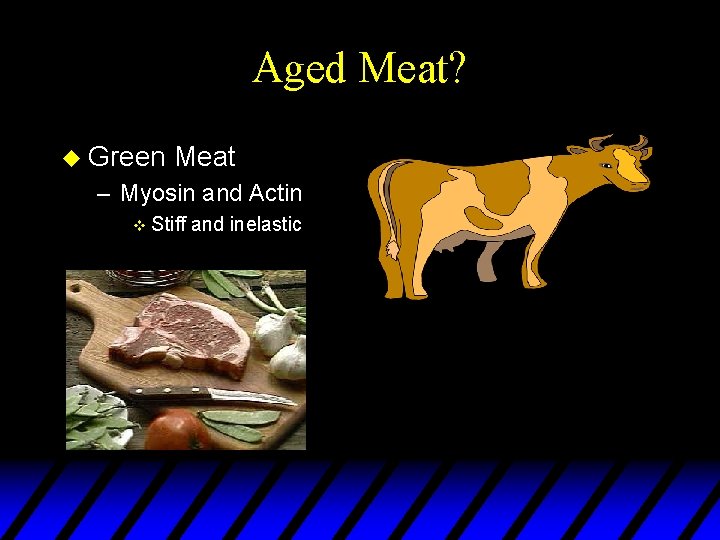
Aged Meat? u Green Meat – Myosin and Actin v Stiff and inelastic
Aged Meat? u Tenderize: – – – Natural High temperature Enzymatic Vacuum aging Electrical stimulation u Tenderize: – Dry aging v May lose up to 20% of moisture content – Wet aging v Less initial moisture loss – Greater cooking loss
Aged Meat u Slightly u If changed flavor profile meat smells (or tastes) spoiled, it probably is
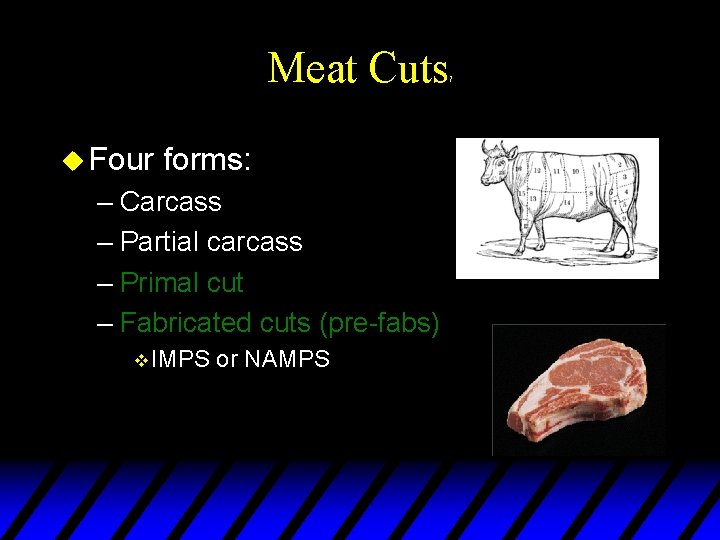
Meat Cuts u Four forms: – Carcass – Partial carcass – Primal cut – Fabricated cuts (pre-fabs) v IMPS or NAMPS 7
Bone Structure u Important to know: – Help identify a cut of meat – Help minimize loss when de-boning – Help you avoid messy carving/carving loss
Know the carcasses
Cooking Meats u Low temp if possible u ID-the connective tissue/cut – ROT for cooking methods: v Moist heat – Larger or tougher cuts v Dry heat – Smaller or tender cuts 8
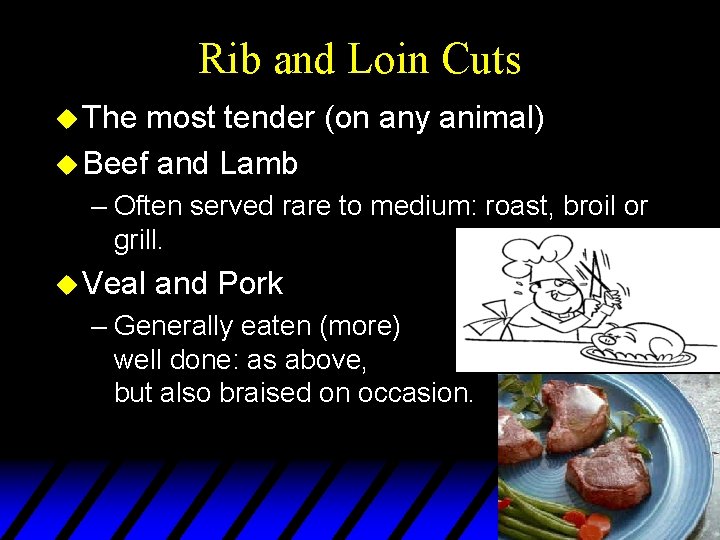
Rib and Loin Cuts u The most tender (on any animal) u Beef and Lamb – Often served rare to medium: roast, broil or grill. u Veal and Pork – Generally eaten (more) well done: as above, but also braised on occasion.
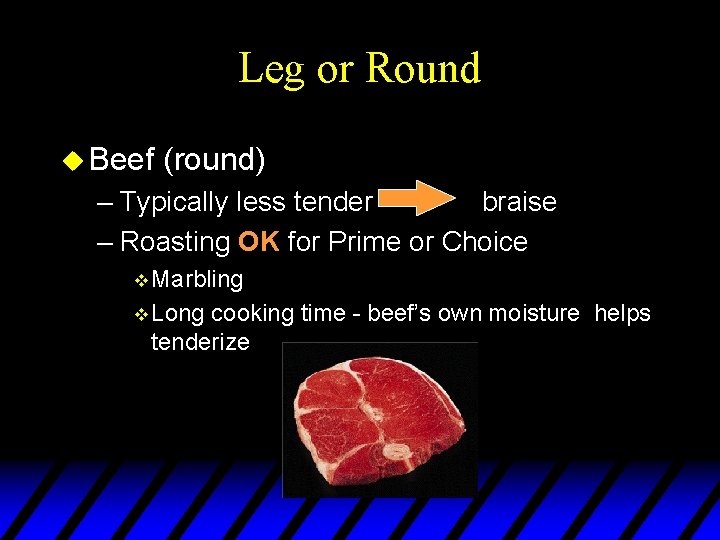
Leg or Round u Beef (round) – Typically less tender braise – Roasting OK for Prime or Choice v Marbling v Long cooking time - beef’s own moisture helps tenderize
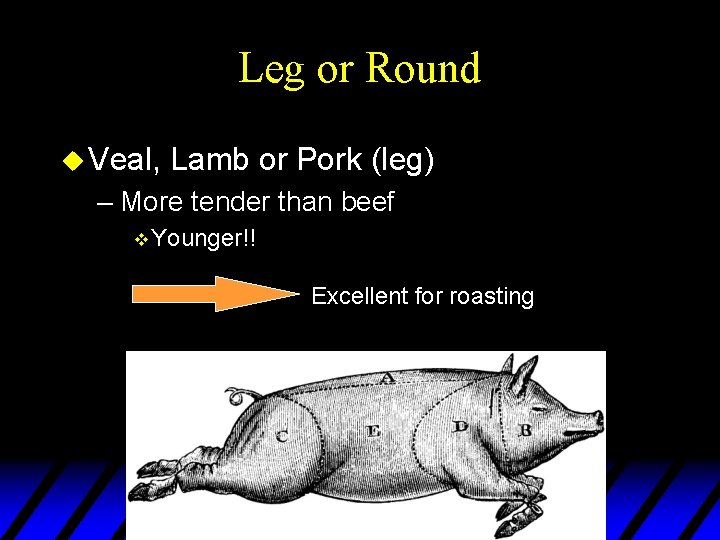
Leg or Round u Veal, Lamb or Pork (leg) – More tender than beef v Younger!! Excellent for roasting
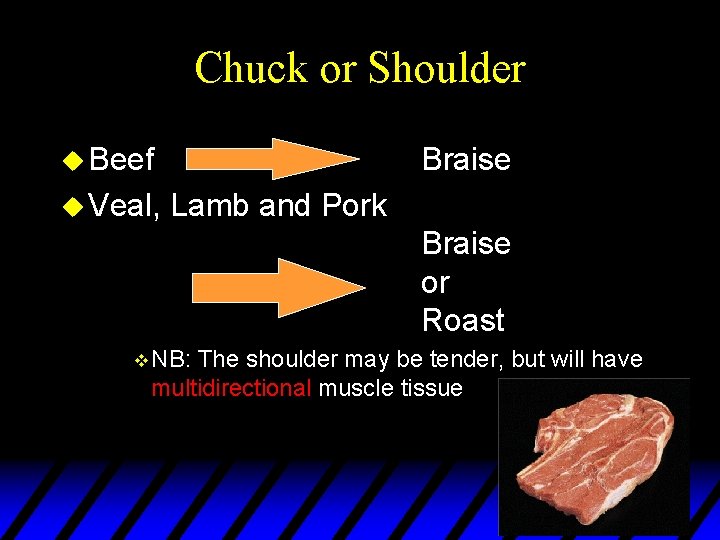
Chuck or Shoulder u Beef u Veal, Braise Lamb and Pork Braise or Roast v NB: The shoulder may be tender, but will have multidirectional muscle tissue
Shanks, Breasts, Briskets and Flank u Usually not tender even on young animals – Shanks are high in collagen: excellent for braising – Beef flank, if carefully cut across the grain, can be broiled: London Broil
u Mechanically tenderized meats, such as cubed or ground, can be cooked by dry or moist heat u Searing and blanching? . . . does not seal in the juices !
Do not cook meats when frozen u Does not retain or increase moisture – Same or slightly increased (delayed) u Complicates the cooking process – Timing – Surface dry and done - center frozen u Waste of energy and time
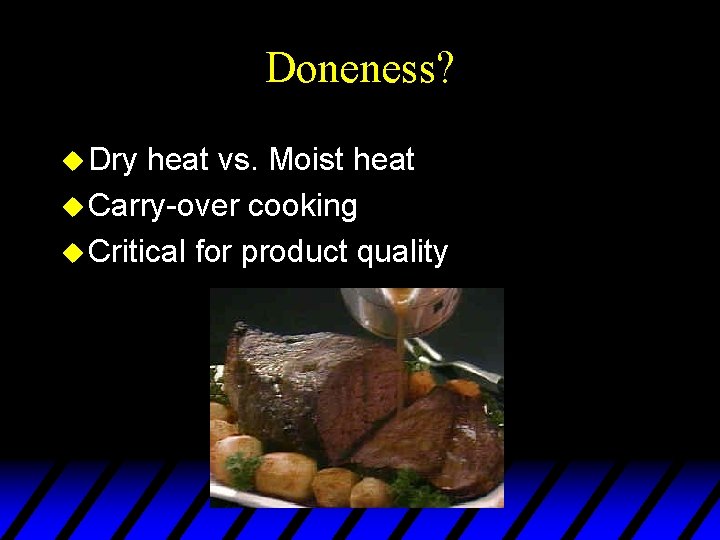
Doneness? u Dry heat vs. Moist heat u Carry-over cooking u Critical for product quality
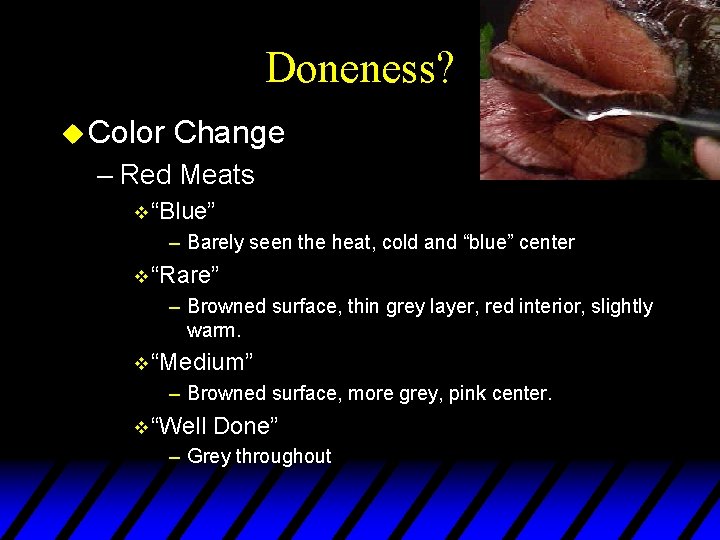
Doneness? u Color Change – Red Meats v “Blue” – Barely seen the heat, cold and “blue” center v “Rare” – Browned surface, thin grey layer, red interior, slightly warm. v “Medium” – Browned surface, more grey, pink center. v “Well Done” – Grey throughout
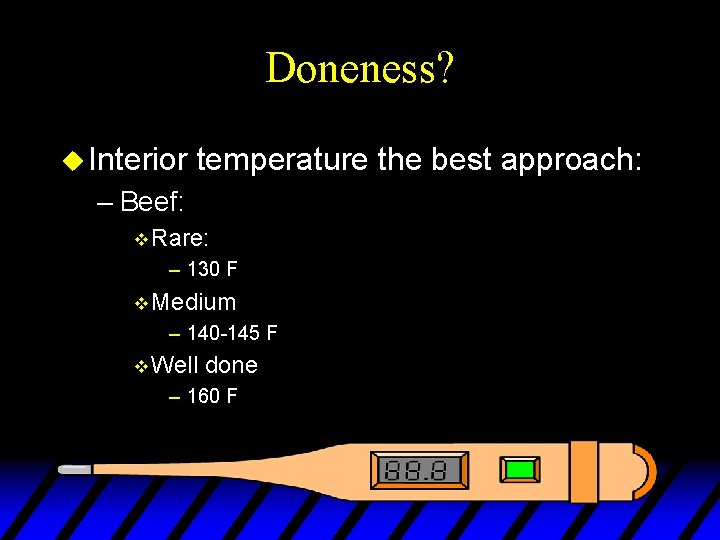
Doneness? u Interior temperature the best approach: – Beef: v Rare: – 130 F v Medium – 140 -145 F v Well done – 160 F
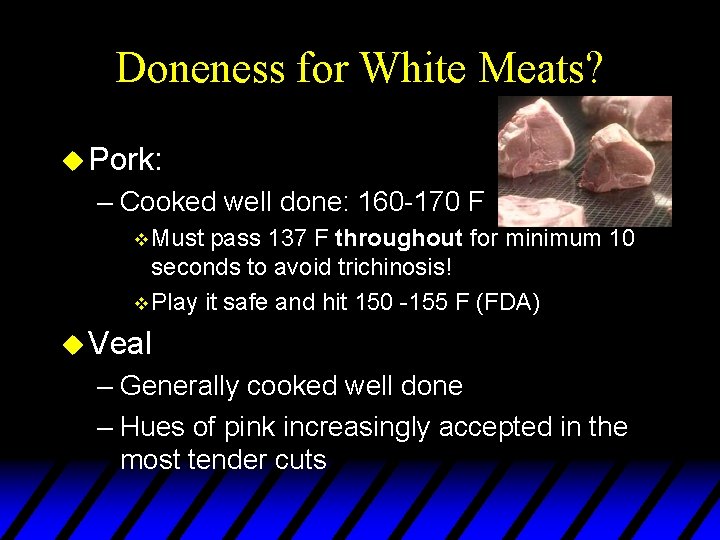
Doneness for White Meats? u Pork: – Cooked well done: 160 -170 F v Must pass 137 F throughout for minimum 10 seconds to avoid trichinosis! v Play it safe and hit 150 -155 F (FDA) u Veal – Generally cooked well done – Hues of pink increasingly accepted in the most tender cuts
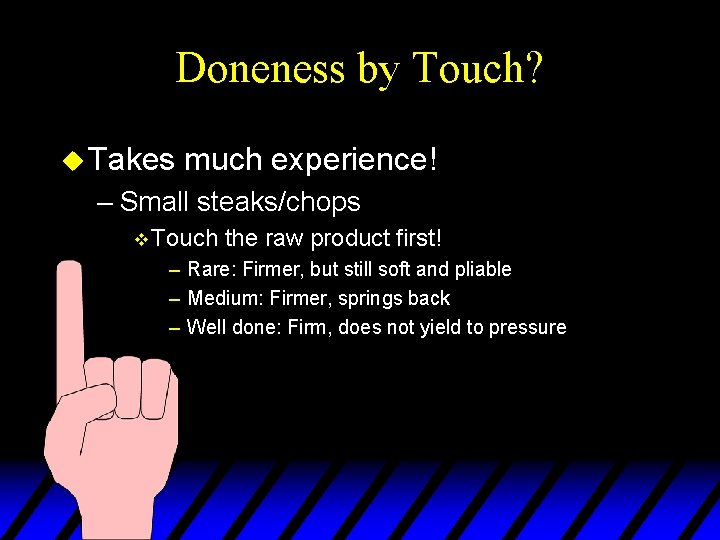
Doneness by Touch? u Takes much experience! – Small steaks/chops v Touch the raw product first! – Rare: Firmer, but still soft and pliable – Medium: Firmer, springs back – Well done: Firm, does not yield to pressure
Dry Heat Meat Cookery u Seasoning – If you season just prior to roasting v Only fractions of an inch will be seasoned v Browning will be retarded – 3 choices: v Season several hours/days in advance v Season after roasting v Do not season, but have a well seasoned sauce
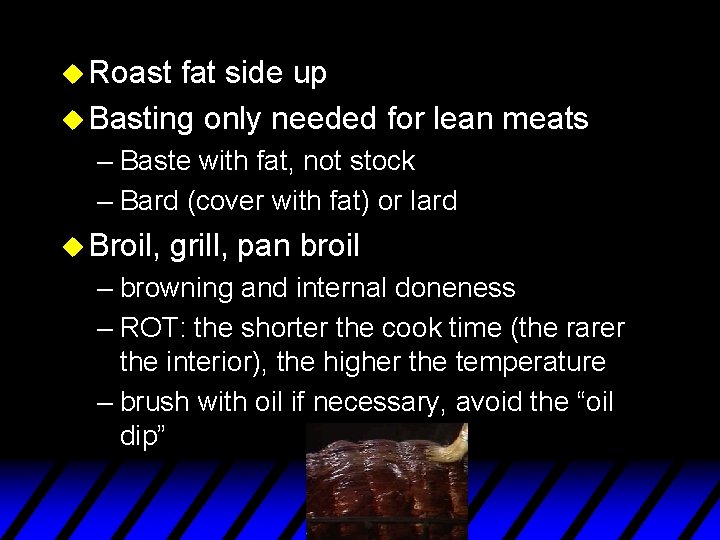
u Roast fat side up u Basting only needed for lean meats – Baste with fat, not stock – Bard (cover with fat) or lard u Broil, grill, pan broil – browning and internal doneness – ROT: the shorter the cook time (the rarer the interior), the higher the temperature – brush with oil if necessary, avoid the “oil dip”
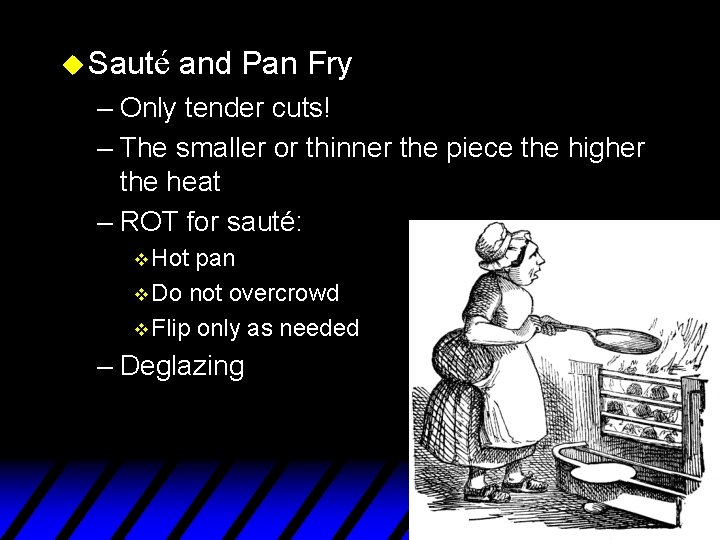
u Sauté and Pan Fry – Only tender cuts! – The smaller or thinner the piece the higher the heat – ROT for sauté: v Hot pan v Do not overcrowd v Flip only as needed – Deglazing
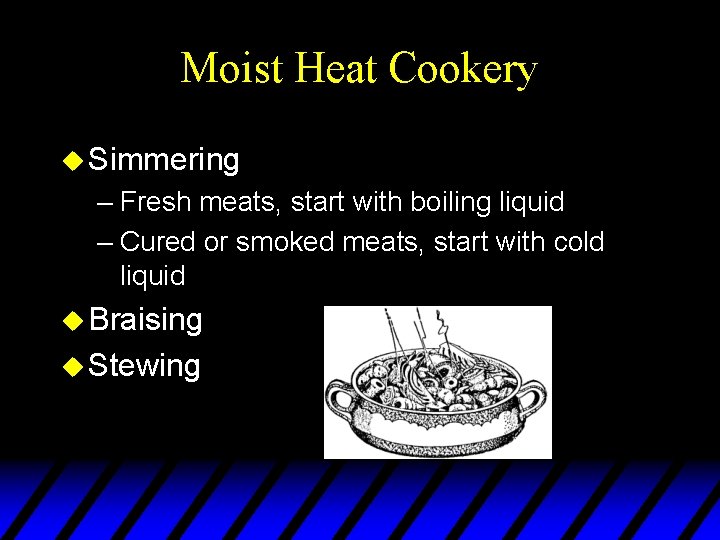
Moist Heat Cookery u Simmering – Fresh meats, start with boiling liquid – Cured or smoked meats, start with cold liquid u Braising u Stewing
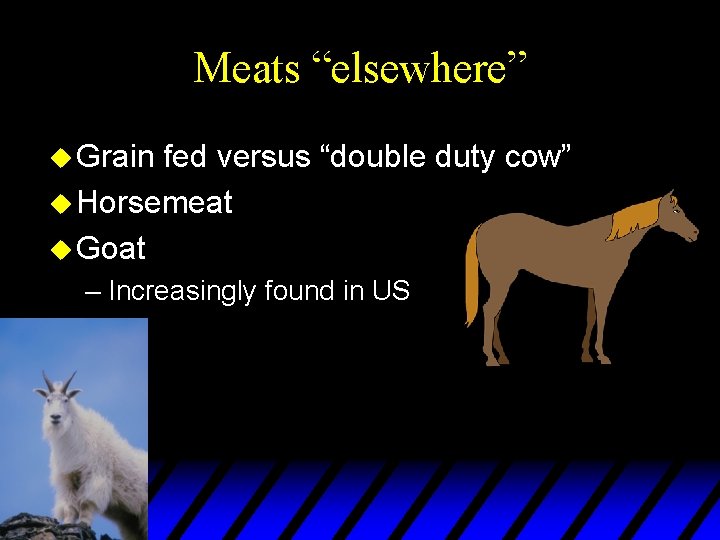
Meats “elsewhere” u Grain fed versus “double duty cow” u Horsemeat u Goat – Increasingly found in US
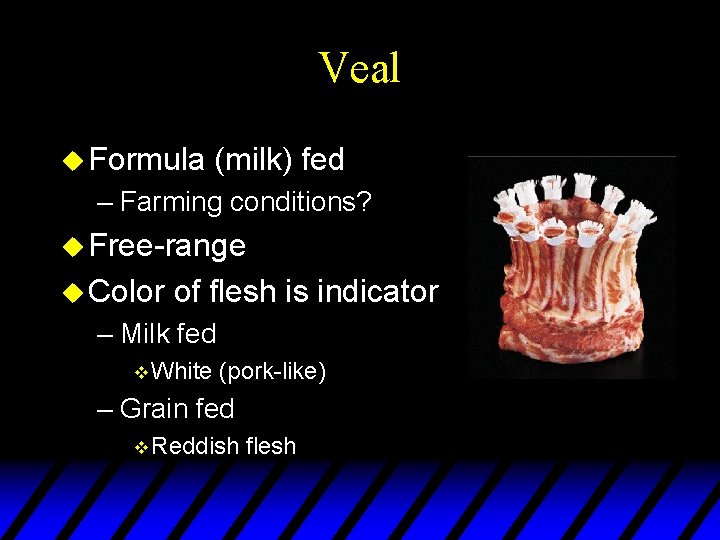
Veal u Formula (milk) fed – Farming conditions? u Free-range u Color of flesh is indicator – Milk fed v White (pork-like) – Grain fed v Reddish flesh
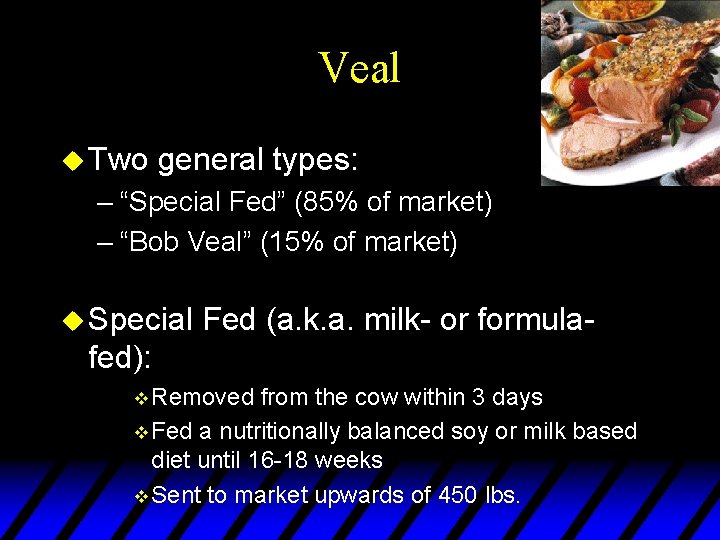
Veal u Two general types: – “Special Fed” (85% of market) – “Bob Veal” (15% of market) u Special Fed (a. k. a. milk- or formula- fed): v Removed from the cow within 3 days v Fed a nutritionally balanced soy or milk based diet until 16 -18 weeks v Sent to market upwards of 450 lbs.
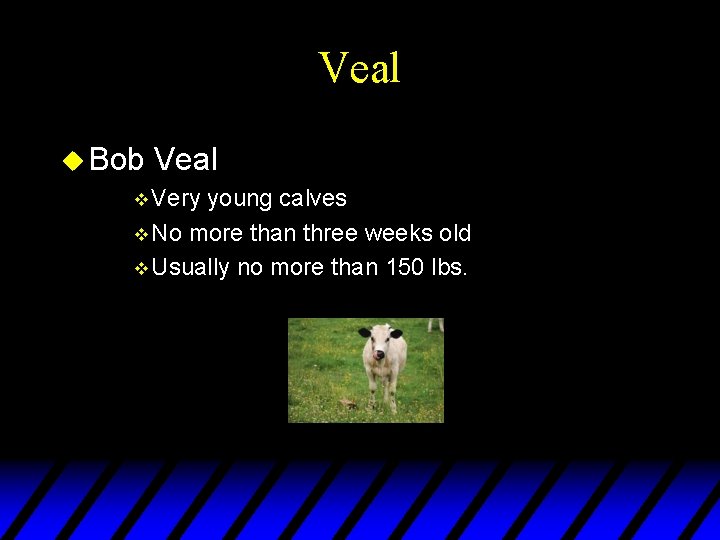
Veal u Bob Veal v Very young calves v No more than three weeks old v Usually no more than 150 lbs.
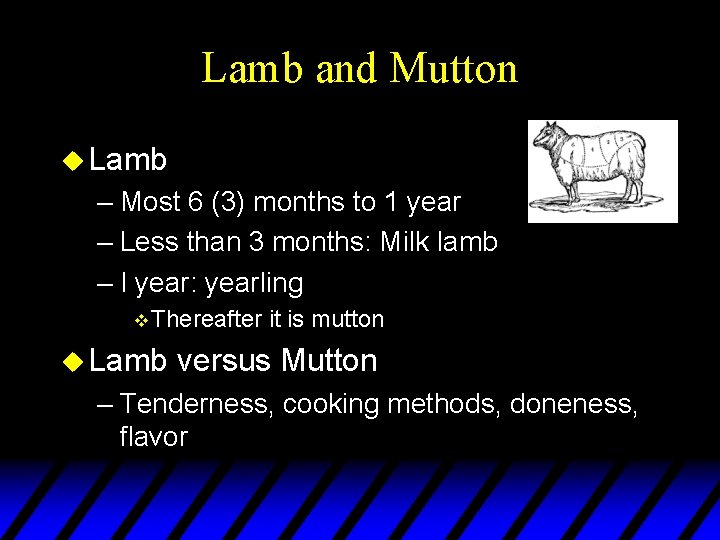
Lamb and Mutton u Lamb – Most 6 (3) months to 1 year – Less than 3 months: Milk lamb – I year: yearling v Thereafter u Lamb it is mutton versus Mutton – Tenderness, cooking methods, doneness, flavor
Variety meats (offal) u Two categories – Glandular meats v Liver, kidney, sweetbread, brains – Muscle meats v Heart, tongue, oxtails, and tripe
Glandular u Liver – Easy to prepare v Remove outer skin and tough membranes v Cut on the bias v Cook carefully and to order – Slightly pink or it will be dry – Calf liver the most tender and prized – Beef also OK – Pork mostly used in pate and sausage
Glandular u Kidneys – Lamb and Veal best v Dry heat – Beef OK v Moist heat – May need blanching or milk marinades – Split in half – Remove any white fatty tissue and veins
Glandular u Sweetbreads v (Thymus glands of young cattle) – Soak – Blanch and refresh in ice water – Remove membrane – Press? – Braise or Sauté
Glandular u Brains – Low priority in the US – Delicacy elsewhere v “Mad Cow Disease”. .
Muscular u Heart (Veal or Beef) – Tough v Casseroles u Beef and forcemeat preparations (veal) Tongue – Fresh, cured or smoked v Braised: Entrée or as “deli meat” u Oxtail – Very high gelatin and good flavor v Excellent for soups and stews v Cut between joints
Receiving and Storing Meats u Fresh – Check upon arrival – If not vacuum packed do not wrap tightly v Molds and “off” flavors may develop – Store at 32 -36 F – Separate by type v Fresh below cooked – Unless you have proper facilities, use quickly (2 -4 days)
Receiving and Storing Meats u Frozen – Check upon arrival: Receive frozen! – Store at 0 F or colder v Lean meats max 6 months v Fattier meats (pork) max 4 months – Never refreeze