
Meat Preservation Prof Dr Fahim Shaltout Professor of

- Slides: 53
Meat Preservation Prof. Dr. Fahim Shaltout Professor of Meat Hygiene Faculty of Veterinary Medicine Benha University fahimshaltout@hotmail. com
Chemical Changes in food during Preservation The primary purpose of food preservation is to prevent food spoilage.
The primary cause of food spoilage is the action of microorganisms; bacteria, moulds, or yeasts aided by enzymes.
Under unfavorable conditions the microorganisms die or fail to develop As physical means Chemical means Combination of physical and chemical means
The principle of all food preserving methods is the creation of conditions unfavorable to the growth or survival of spoilage microorganisms by for example extreme heat or cold, removal of water and some times oxygen , excess of saltiness or increased acidity.
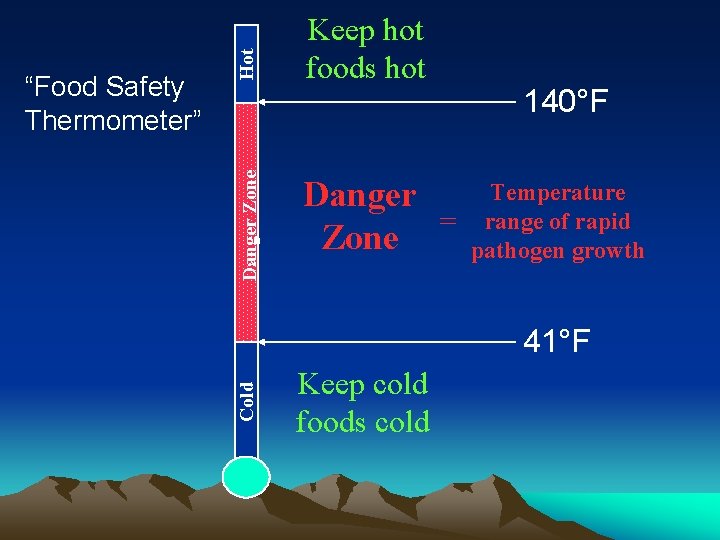
Hot Danger Zone Danger = Zone 140°F Temperature range of rapid pathogen growth 41°F Cold “Food Safety Thermometer” Keep hot foods hot Keep cold foods cold
Methods of preservation drying, curing, cold, heat, chemicals and irradiation
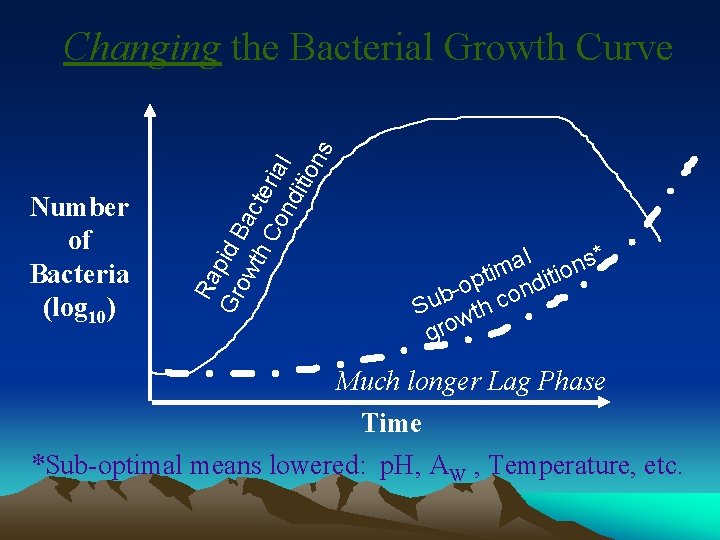
Number of Bacteria (log 10) Ra Gr pid B ow th acte Co ria nd l itio ns Changing the Bacterial Growth Curve * l s a n im itio t p d o n b o Su wth c gro Much longer Lag Phase Time *Sub-optimal means lowered: p. H, AW , Temperature, etc.
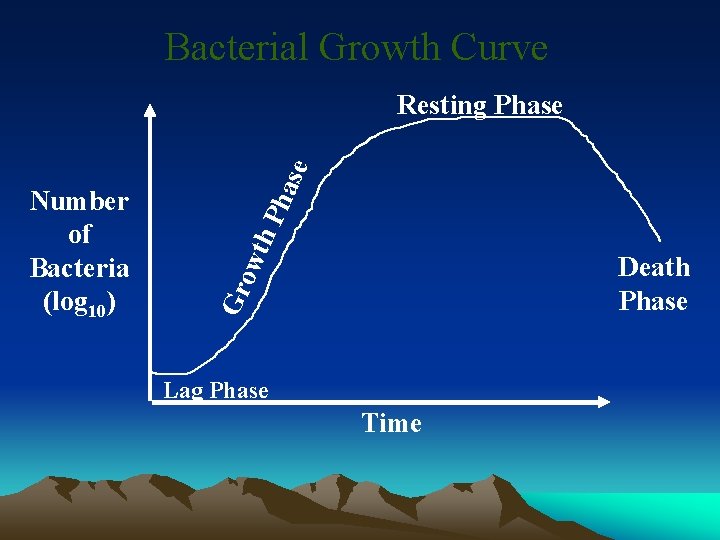
Bacterial Growth Curve th P ow Death Phase Gr Number of Bacteria (log 10) has e Resting Phase Lag Phase Time
Drying (Dehydration ) The meat should be cut into strips for easily removal of water. Dried meat contains 10 % water. Inactivation of bacteria till reach 12 % water in the product.
Drying methods 1 -Sun drying: 2 - Mechanical dryers 3 - Sublimation (Freeze drying ) 4 - Smoking then drying 5 - Cure drying 6 - Electronic drying
Affections 1 -Mould growth : R. H. of air over 75 % 2 -Hardening of surface 3 - Public health dangers : a- Salmonella b- contamination due to handling , preparation and storage
Refrigeration or Cold Storage 1 -Natural type : put in or on ice 2 - Mechanical type : by using ammonia , Freon , or methyl chloride
Chilled meat At 0 to -1 C Chilling methods 1 -Traditional 2 - Quick chilling 3 -Ultra – rapid chilling
Changes in chilled meat or affections 1 -Conditioning , ripening or maturation 2 -Shrinkage 3 -Soiling 4 - Absorption of foreign odor 5 - Sweating 6 - Loss of bloom 7 -Chemical changes 8 -Spoilage a-Mould formation b-bacterial decomposition
Effect of CO 2 in less than 20 % to prevent formation of metamyoglobin
Effect of exposure to air Myohemoglobin may be converted to Metahaemoglobin ( brown color ) due to exposure to air
Frozen meat Freezing rate 1 -Slow Feezing -15 to -29 C 36 -72 hours ice crystals 12 mm x 3 mm 2 - Rapid freezing -18 to - 40 C 30 minutes ultra microscopic ice crystals 0. 001 – 0. 002 mm
Freezing methods 1 -Still air freezing 2 -Blast freezing 3 -Direct immersion freezing 4 -Cryogenic freezing 5 -Plate freezing
1 -Still air freezing At -10 to -30 C Placing packaged or loose foods in suitable freezing rooms till freezing
2 -Blast freezing As still air but using a compressor Push cold air to pass over, under and through the food Air temperature -10 to -40 C Air velocity 15 m /s
3 -Direct immersion freezing Direct immersion of food in a liquid refrigerant as Nacl , glycerol , and sugar solutions Liquids must be: Safe , non toxic , cheap , with low viscosity , good heat conductors
4 -Cryogenic freezing The best method of quick freezing use condensed gases such as liquid nitrogen ( -195 C) or liquid nitric oxide ( - 79 C) and Freon ( - 30 C) Advantage : 1 - non toxic 2 -minimize oxidative changes 3 -less dehydration 4 -less drip
5 -Plate freezing By indirect contact with refrigerants food is placed on cold plates or walls. Food may be packed in a can
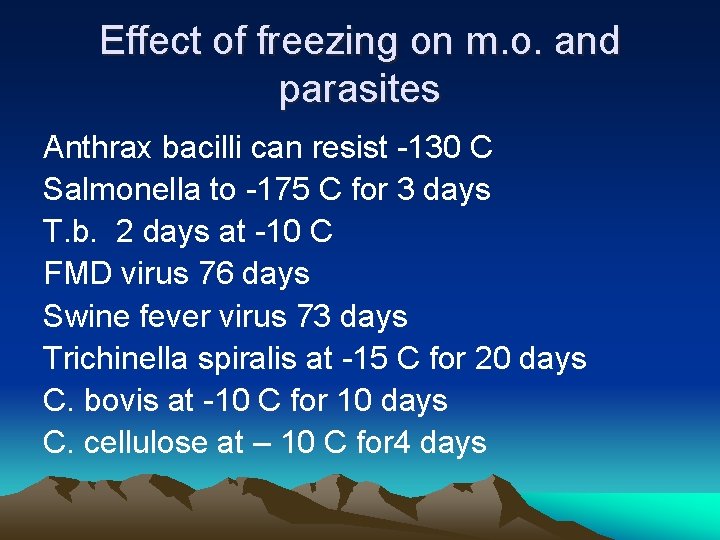
Effect of freezing on m. o. and parasites Anthrax bacilli can resist -130 C Salmonella to -175 C for 3 days T. b. 2 days at -10 C FMD virus 76 days Swine fever virus 73 days Trichinella spiralis at -15 C for 20 days C. bovis at -10 C for 10 days C. cellulose at – 10 C for 4 days
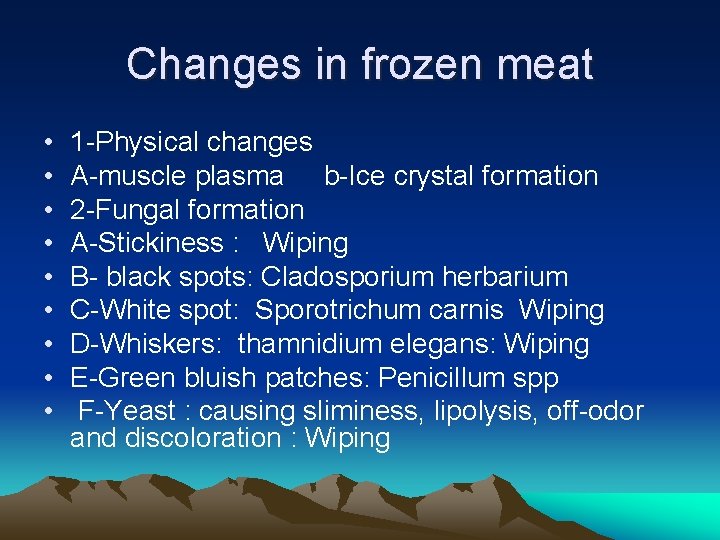
Changes in frozen meat • • • 1 -Physical changes A-muscle plasma b-Ice crystal formation 2 -Fungal formation A-Stickiness : Wiping B- black spots: Cladosporium herbarium C-White spot: Sporotrichum carnis Wiping D-Whiskers: thamnidium elegans: Wiping E-Green bluish patches: Penicillum spp F-Yeast : causing sliminess, lipolysis, off-odor and discoloration : Wiping
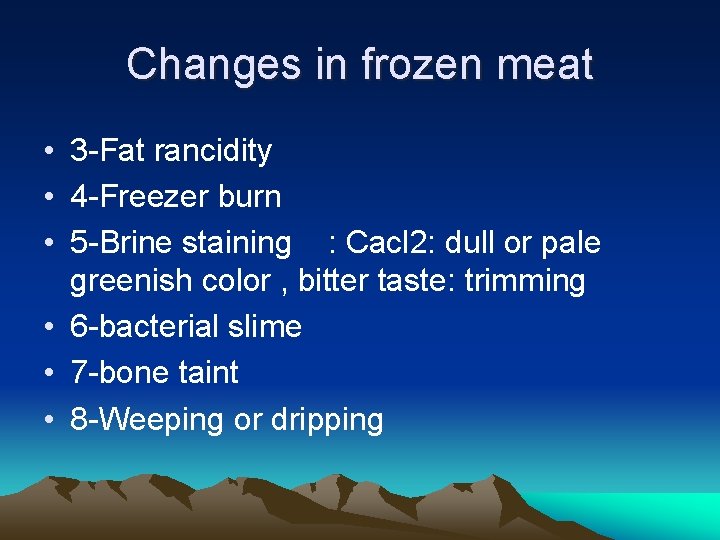
Changes in frozen meat • 3 -Fat rancidity • 4 -Freezer burn • 5 -Brine staining : Cacl 2: dull or pale greenish color , bitter taste: trimming • 6 -bacterial slime • 7 -bone taint • 8 -Weeping or dripping
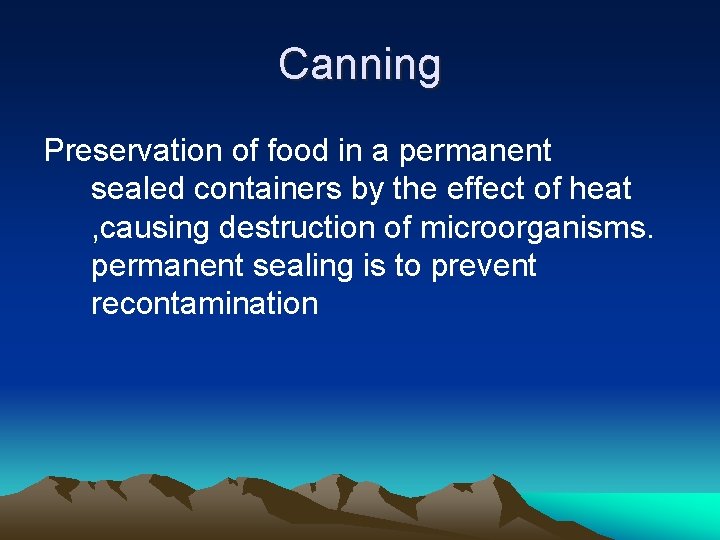
Canning Preservation of food in a permanent sealed containers by the effect of heat , causing destruction of microorganisms. permanent sealing is to prevent recontamination
Types of containers • • • 1 -Metal High conductivity of heat Opaque, to avoid bad effect of light Can not be easily broken 2 -Glass
Canned food divided into • 1 -Acid food p. H below 4. 5 as fruits and some vegetables. • 2 -Low acid food p. H above 4. 5 as corned beef or corned pork or sheep, sea food.
Canning operation • • • 1 -Preparation and blanching of the food 2 -Filling of the can 3 -Exhosting 4 -Processing 5 -Cooling
Spoilage of canned food • • • A- According to the cause 1 -Microbial 2 -Chemical 3 -Physical 4 -Rust or damage
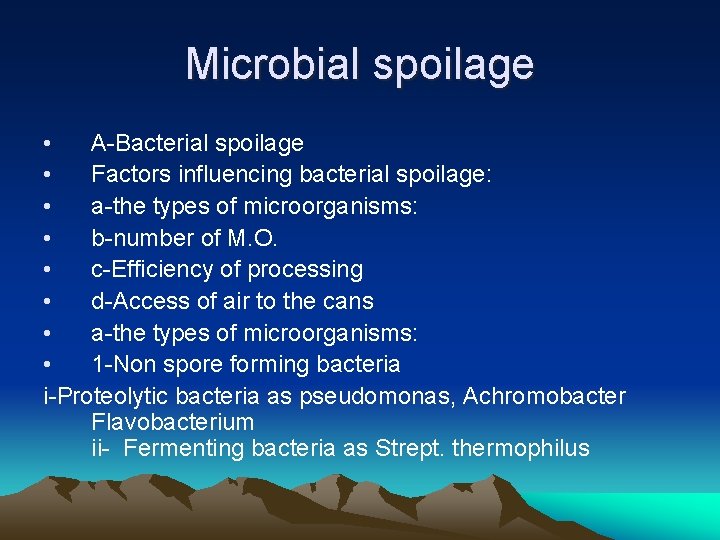
Microbial spoilage • A-Bacterial spoilage • Factors influencing bacterial spoilage: • a-the types of microorganisms: • b-number of M. O. • c-Efficiency of processing • d-Access of air to the cans • a-the types of microorganisms: • 1 -Non spore forming bacteria i-Proteolytic bacteria as pseudomonas, Achromobacter Flavobacterium ii- Fermenting bacteria as Strept. thermophilus
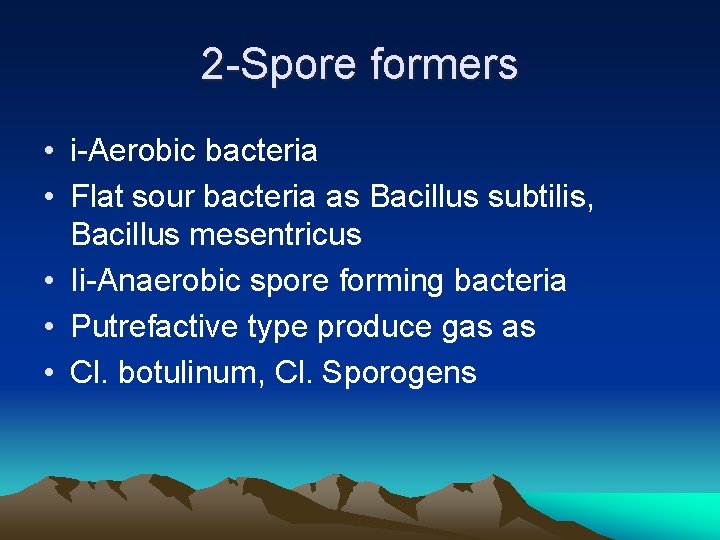
2 -Spore formers • i-Aerobic bacteria • Flat sour bacteria as Bacillus subtilis, Bacillus mesentricus • Ii-Anaerobic spore forming bacteria • Putrefactive type produce gas as • Cl. botulinum, Cl. Sporogens
B- Mould Spoilage
2 -Chemical Spoilage • • A- Hydrogen swells B-Sulphiding 3 -physical Spoilage 4 -Rust & damage
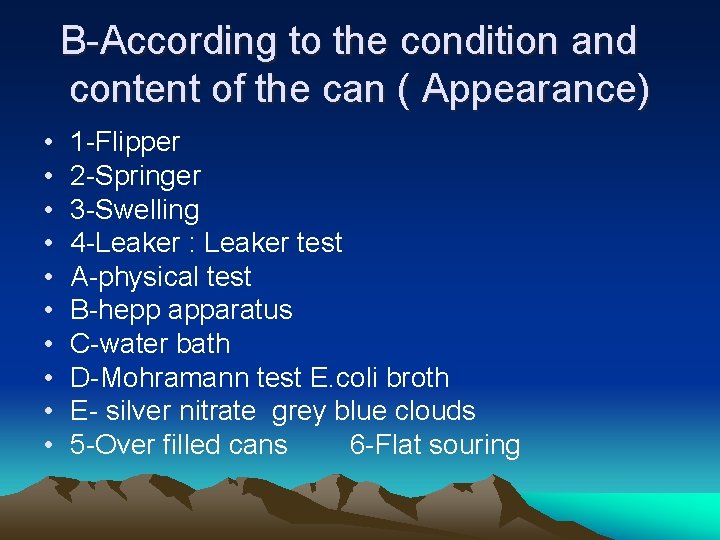
B-According to the condition and content of the can ( Appearance) • • • 1 -Flipper 2 -Springer 3 -Swelling 4 -Leaker : Leaker test A-physical test B-hepp apparatus C-water bath D-Mohramann test E. coli broth E- silver nitrate grey blue clouds 5 -Over filled cans 6 -Flat souring
Electromagnetic radiation • • 1 - Ionizing radiation (short wave radiation ) (Cold sterilization ) (X ray & Gamma rays) II-Non- ionizing radiation (Long wave radiation ) (Heat sterilization ) as Radio wave , Infra red & UV rays
Preservation by Ionizing radiation • Used for sterilization of canned , and refrigerated food even in combination with antibiotics • Side effect: • Change in colour, flavor , odour and texture of the treated food. these reduced by irradiation at temperature below 20 C
Preservation by non- ionizing radiation • Used to control surface spoilage of sausage, and meat kept at warm temperature or to sterilize air in cold stores • Advantage of radiation: • 1 -Extend the shelf life of food. • 2 -Minimize high cost of refrigeration and canning • 3 -used in defrosting frozen food and blanching of vegetables
Disadvantage • 1 -Induced radio activity. • 2 - Carcinogenic production.
Chemical means of preservation • A- By antibiotics: • 1 -Taken as a part of normal feeding in small doses for long period. • 2 -in food in large doses for short period. • 3 -injection of antibiotic into living animal shortly before slaughtering. • 4 -injection into quarter by artery pump • 5 -applying either to surface or within the finished product. • 6 -aid in other processing of food treatment as canning, heat treatment or smoking.
B- By other chemicals • • • To mask putrefaction Takes place by addition of 1 - 2% sulfur dioxide 2 - Borax dust 3 -Burning sulfur and salt petre
Smoking • • • Purpose of smoking 1 -creation of new product 2 - As a method of preservation 3 - colour development 4 - Flavor development 5 - Antioxidant
Kind of smoking • 1 - Hot smoking at 35 -60 C for 24 -36 hours • 2 -Cold smoking at 22 C for 24 hours
Smoke mixture • Phenol , cresol , formaldehyde , acetaldehyde, acids as propionic , lactic butyric, alcohols as methanol
The preservative action • 1 - Bactericidal • 2 - Surface dehydration • 3 - formation of crusts on surface by protein coagulation resist bacterial invasion • 4 - help in production of desirable flavor • 5 - help in production of desirable colour
Preservation by salting and pickling • Salting use of dry salt • Pickling use of salt solution
The value of curing agents • A- common salt: sodium chloride • 1 - cause plasmolysis sharp cytoplasmic destruction Gram negative plasmolysis easily Gram positive very resistence 2 - dehydration of food 3 -ionized producing cl ions harmful to bacteria 4 - reduce solubility of oxygen 5 -interfere with action of proteolytic enzymes
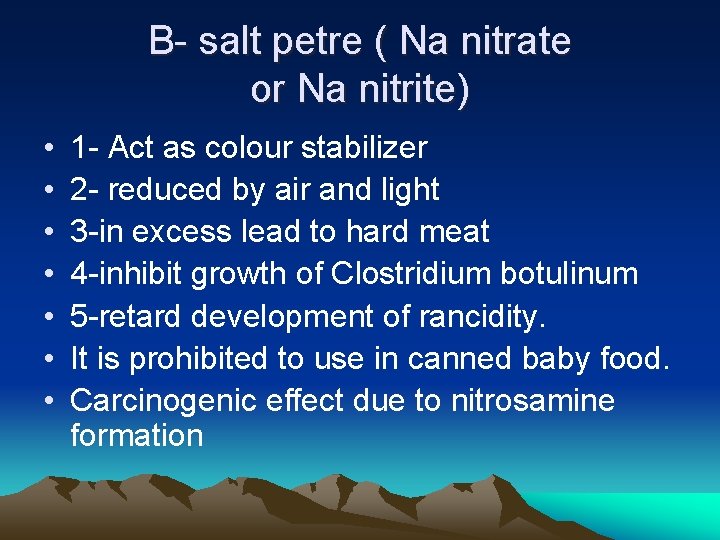
B- salt petre ( Na nitrate or Na nitrite) • • 1 - Act as colour stabilizer 2 - reduced by air and light 3 -in excess lead to hard meat 4 -inhibit growth of Clostridium botulinum 5 -retard development of rancidity. It is prohibited to use in canned baby food. Carcinogenic effect due to nitrosamine formation
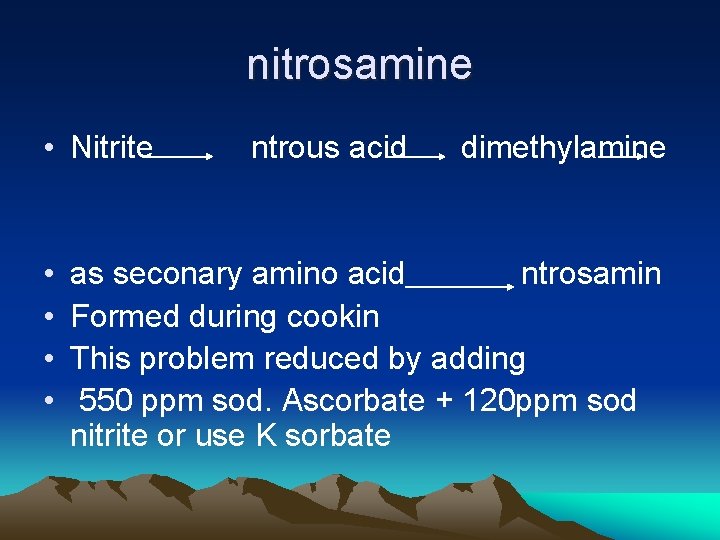
nitrosamine • Nitrite • • ntrous acid dimethylamine as seconary amino acid ntrosamin Formed during cookin This problem reduced by adding 550 ppm sod. Ascorbate + 120 ppm sod nitrite or use K sorbate
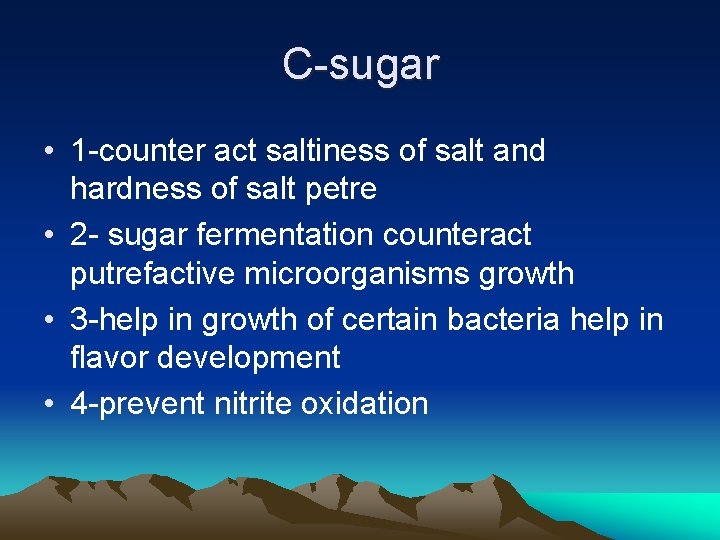
C-sugar • 1 -counter act saltiness of salt and hardness of salt petre • 2 - sugar fermentation counteract putrefactive microorganisms growth • 3 -help in growth of certain bacteria help in flavor development • 4 -prevent nitrite oxidation
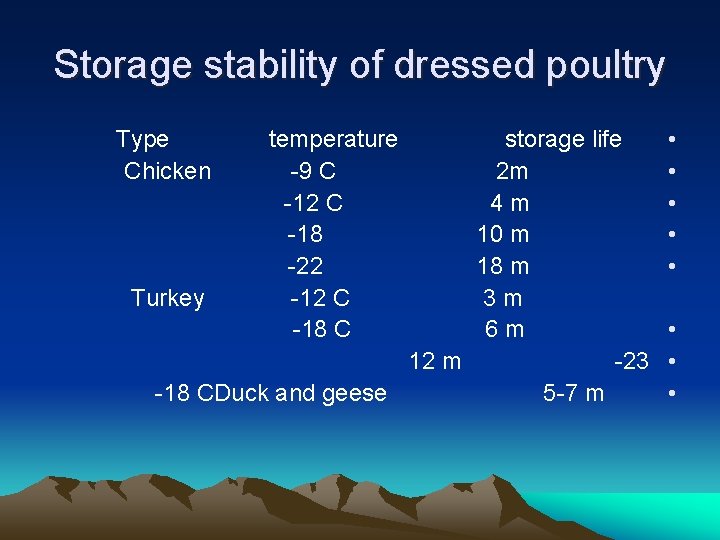
Storage stability of dressed poultry Type Chicken temperature -9 C -12 C -18 -22 -12 C -18 C storage life 2 m 4 m 10 m 18 m Turkey 3 m 6 m 12 m -23 -18 CDuck and geese 5 -7 m • •