
Measuring what matters coproduction of a PROM for

- Slides: 15
Measuring what matters: co-production of a PROM for mental health services Lesley Herbert Consumer Advisor Christie Garner Project Support Officer
Context “Improve contracting of mental health services through development of quality and outcome measures to support new contract currency, as part of preparations for MH payment system” ‘Payment by activity’ to ‘payment by results’ DH guidance sets out expectations to develop/identify quality and outcome measures to be used alongside care clusters and understand their inter-relationship SHFT and commissioners continue to work closely together on this priority area to ensure that future contracting on this new basis is robust, and to explore how the rich data provided through the process can inform service design The PROM and PREM 2014 – 2015 CQUIN aims to further implement and embed the use of Patient reported outcome measures as a way of evaluating service effectiveness. It acknowledges the developmental nature of the programme. (MH PROM and PREM CQUIN 2014 – 2015)
Co-production “Co-production…. goes well beyond the idea of ‘citizen engagement’ or ‘service user involvement’ to foster the principle of equal partnership. It offers to transform the dynamic between the public and public service workers, putting an end to ‘them’ and ‘us’. Instead, people pool different types of knowledge and skills, based on lived experience and professional learning. ” One of the defining features of co-production is that it, “involves a redefinition of what constitutes an ‘outcome’ in public services, focusing on those things that are important to people who use services (often less tangible issues like relationships and quality of life)” Needham, C (2009) SCIE Research briefing 31: Co-production: an emerging evidence base for adult social care transformation Boyle & Harris (2009) THE CHALLENGE OF CO-PRODUCTION: How equal partnerships between professionals and the public are crucial to improving public services The Recovery College…
Measuring what matters Recovery in the context of mental health Key themes from the literature Desire to understand how far we are supporting individuals in their personal recovery Consideration of recommended/validated tools Recovery College development ‘Growing our own’ PROM…
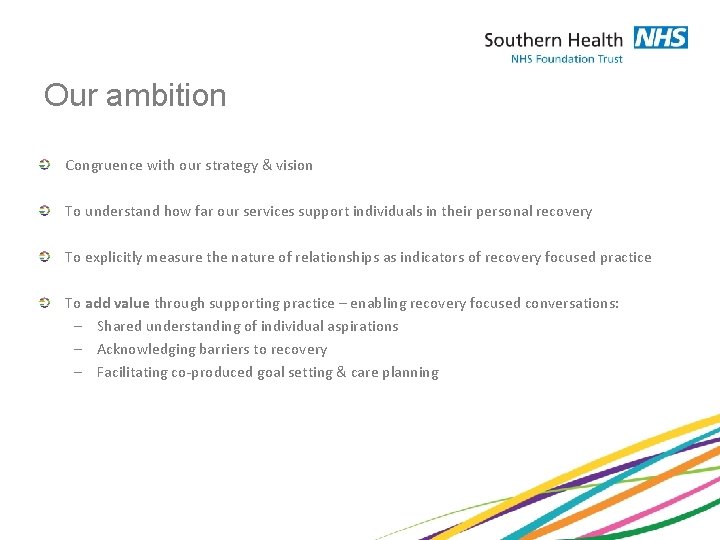
Our ambition Congruence with our strategy & vision To understand how far our services support individuals in their personal recovery To explicitly measure the nature of relationships as indicators of recovery focused practice To add value through supporting practice – enabling recovery focused conversations: – Shared understanding of individual aspirations – Acknowledging barriers to recovery – Facilitating co-produced goal setting & care planning
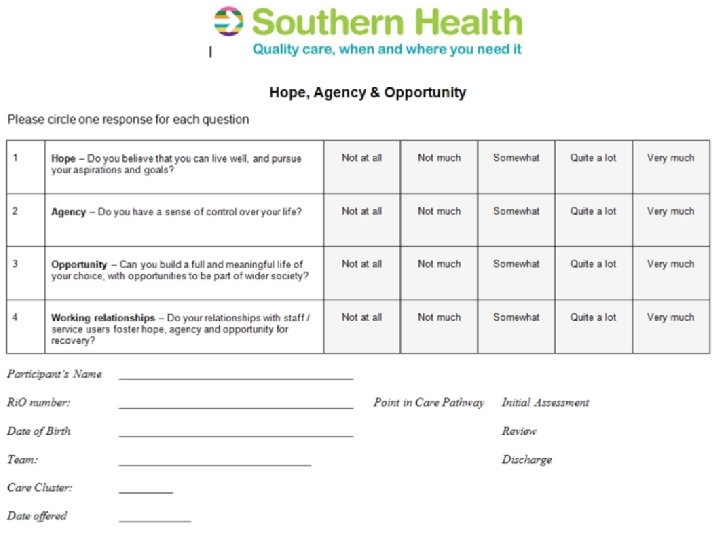
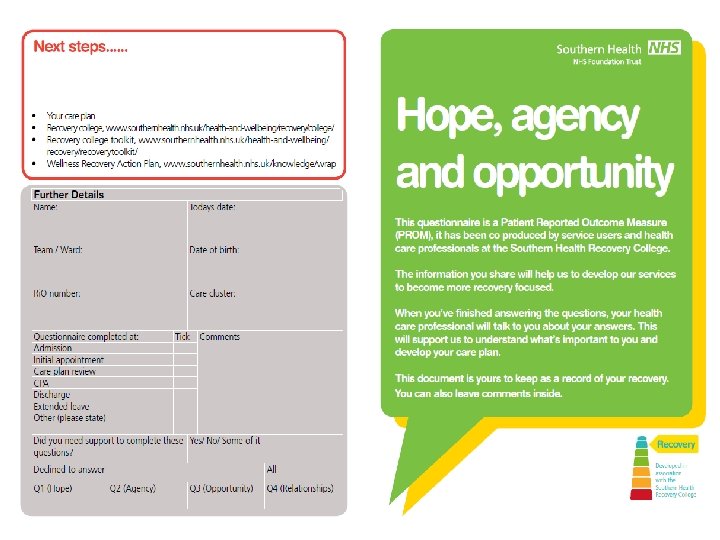
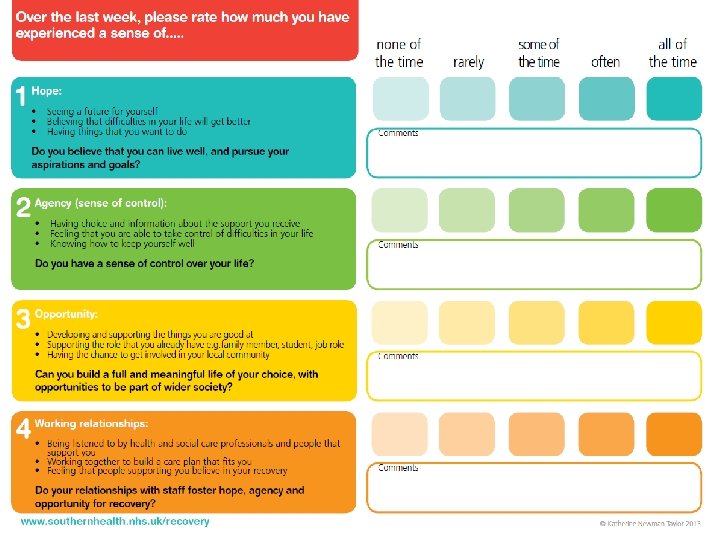
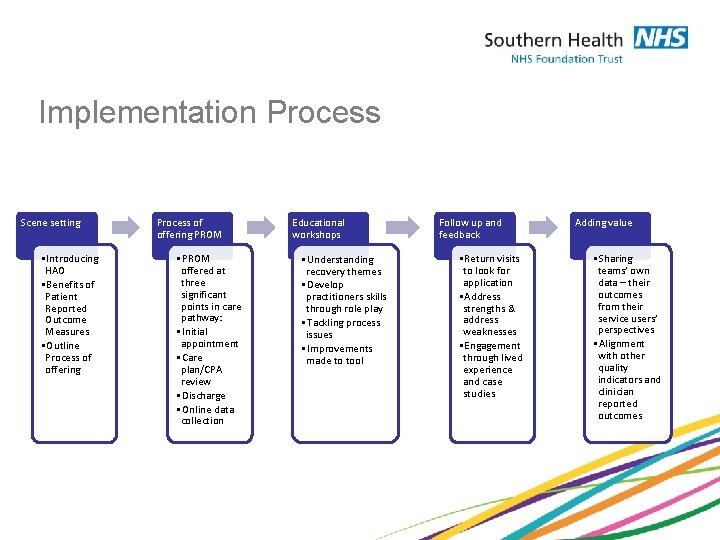
Implementation Process Scene setting • Introducing HAO • Benefits of Patient Reported Outcome Measures • Outline Process of offering PROM • PROM offered at three significant points in care pathway: • Initial appointment • Care plan/CPA review • Discharge • Online data collection Educational workshops • Understanding recovery themes • Develop practitioners skills through role play • Tackling process issues • Improvements made to tool Follow up and feedback • Return visits to look for application • Address strengths & address weaknesses • Engagement through lived experience and case studies Adding value • Sharing teams’ own data – their outcomes from their service users’ perspectives • Alignment with other quality indicators and clinician reported outcomes
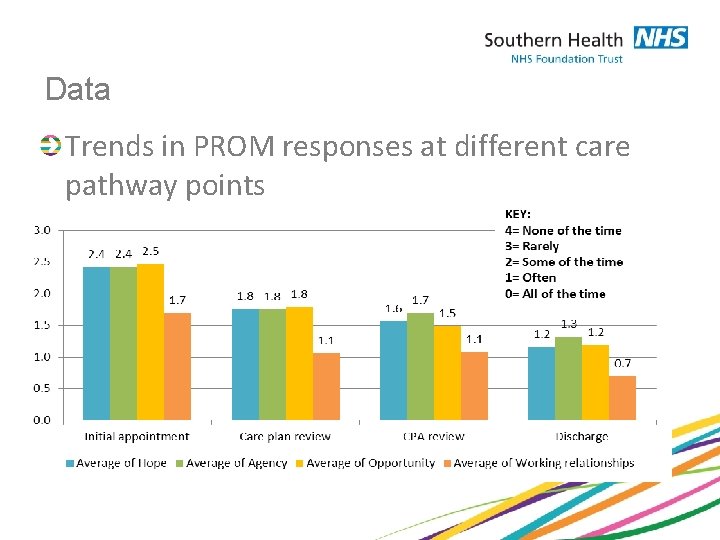
Data Trends in PROM responses at different care pathway points
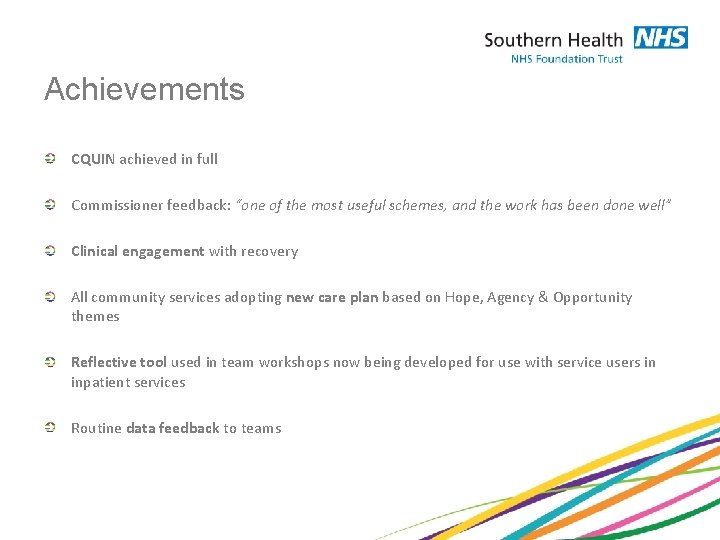
Achievements CQUIN achieved in full Commissioner feedback: “one of the most useful schemes, and the work has been done well” Clinical engagement with recovery All community services adopting new care plan based on Hope, Agency & Opportunity themes Reflective tool used in team workshops now being developed for use with service users in inpatient services Routine data feedback to teams
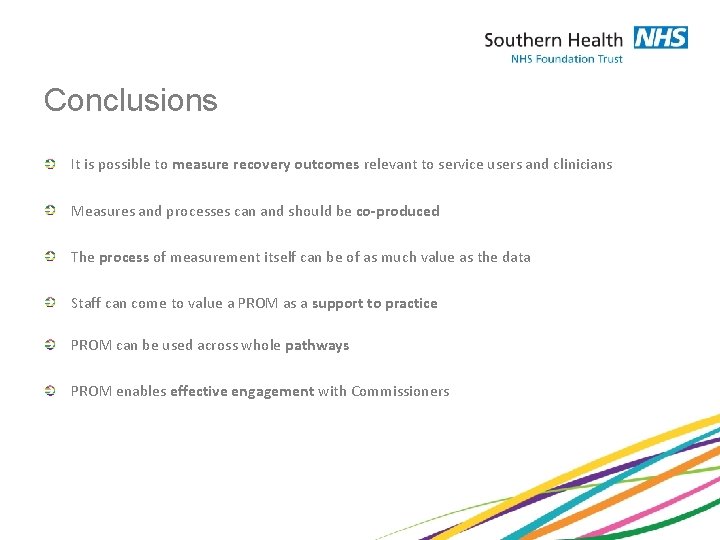
Conclusions It is possible to measure recovery outcomes relevant to service users and clinicians Measures and processes can and should be co-produced The process of measurement itself can be of as much value as the data Staff can come to value a PROM as a support to practice PROM can be used across whole pathways PROM enables effective engagement with Commissioners
Next Steps Improving evidence of individual outcomes Ongoing development & support for implementation Sharing learning between teams Integrating care plans into electronic systems Triangulation and maximising benefits of all data – PROM, PREM & CROM Complete validation of tool
Any questions?
With thanks to. . Dr Katherine Newman Taylor Dr Liz Vernon-Wilson Mrs Chris Woodfine Consultant Clinical Psychologist Clinical Outcomes Researcher Service Improvement Project Manager lesley. herbert@southernhealth. nhs. uk christie. garner@southernhealth. nhs. uk