
Measuring Uptake Coefficients for Polycyclic Aromatic Hydrocarbons onto
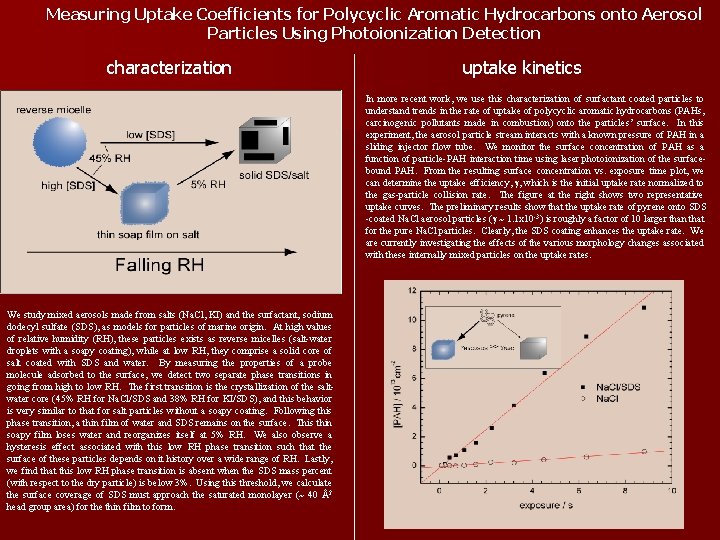
Measuring Uptake Coefficients for Polycyclic Aromatic Hydrocarbons onto Aerosol Particles Using Photoionization Detection characterization uptake kinetics In more recent work, we use this characterization of surfactant coated particles to understand trends in the rate of uptake of polycyclic aromatic hydrocarbons (PAHs, carcinogenic pollutants made in combustion) onto the particles’ surface. In this experiment, the aerosol particle stream interacts with a known pressure of PAH in a sliding injector flow tube. We monitor the surface concentration of PAH as a function of particle-PAH interaction time using laser photoionization of the surfacebound PAH. From the resulting surface concentration vs. exposure time plot, we can determine the uptake efficiency, g, which is the initial uptake rate normalized to the gas-particle collision rate. The figure at the right shows two representative uptake curves. The preliminary results show that the uptake rate of pyrene onto SDS -coated Na. Cl aerosol particles (g ~ 1. 1 x 10 -3) is roughly a factor of 10 larger than that for the pure Na. Cl particles. Clearly, the SDS coating enhances the uptake rate. We are currently investigating the effects of the various morphology changes associated with these internally mixed particles on the uptake rates. We study mixed aerosols made from salts (Na. Cl, KI) and the surfactant, sodium dodecyl sulfate (SDS), as models for particles of marine origin. At high values of relative humidity (RH), these particles exists as reverse micelles (salt-water droplets with a soapy coating), while at low RH, they comprise a solid core of salt coated with SDS and water. By measuring the properties of a probe molecule adsorbed to the surface, we detect two separate phase transitions in going from high to low RH. The first transition is the crystallization of the saltwater core (45% RH for Na. Cl/SDS and 38% RH for KI/SDS), and this behavior is very similar to that for salt particles without a soapy coating. Following this phase transition, a thin film of water and SDS remains on the surface. This thin soapy film loses water and reorganizes itself at 5% RH. We also observe a hysteresis effect associated with this low RH phase transition such that the surface of these particles depends on it history over a wide range of RH. Lastly, we find that this low RH phase transition is absent when the SDS mass percent (with respect to the dry particle) is below 3%. Using this threshold, we calculate the surface coverage of SDS must approach the saturated monolayer (~ 40 Å2 head group area) for the thin film to form.
- Slides: 1