
MEASURING THE VALUE OF INTANGIBLES to discover the
MEASURING THE VALUE OF INTANGIBLES to discover the roots of company’s future success Geneva, July 11, 2006
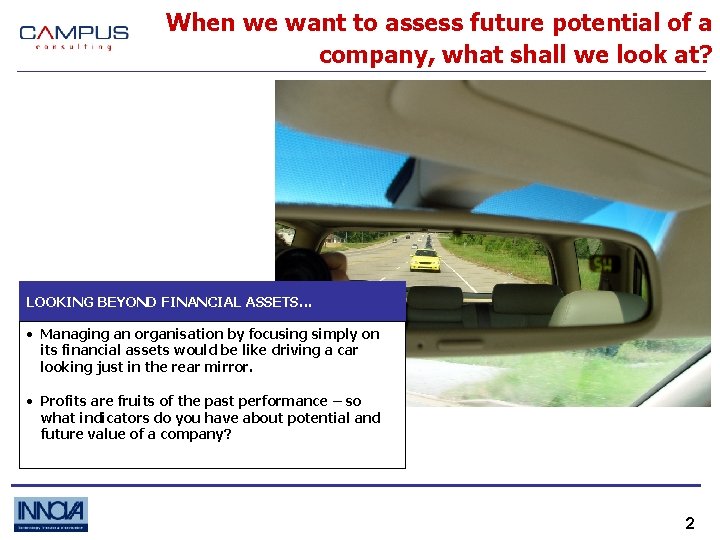
When we want to assess future potential of a company, what shall we look at? LOOKING BEYOND FINANCIAL ASSETS. . . • Managing an organisation by focusing simply on its financial assets would be like driving a car looking just in the rear mirror. • Profits are fruits of the past performance – so what indicators do you have about potential and future value of a company? 2
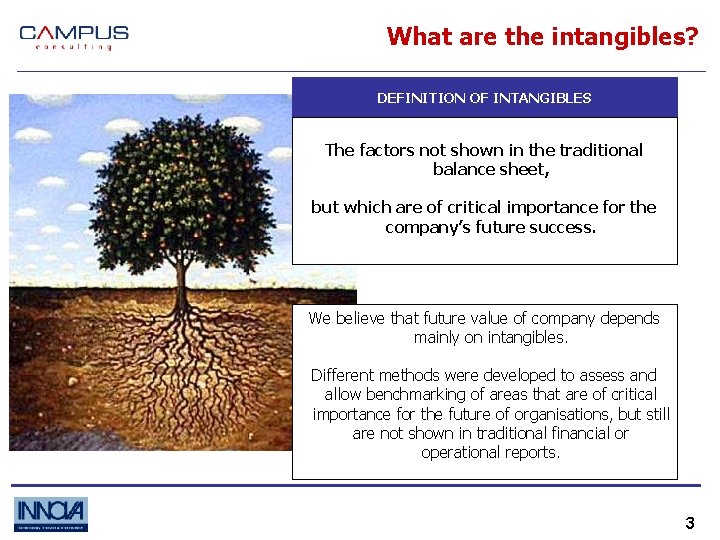
What are the intangibles? DEFINITION OF INTANGIBLES The factors not shown in the traditional balance sheet, but which are of critical importance for the company’s future success. We believe that future value of company depends mainly on intangibles. Different methods were developed to assess and allow benchmarking of areas that are of critical importance for the future of organisations, but still are not shown in traditional financial or operational reports. 3
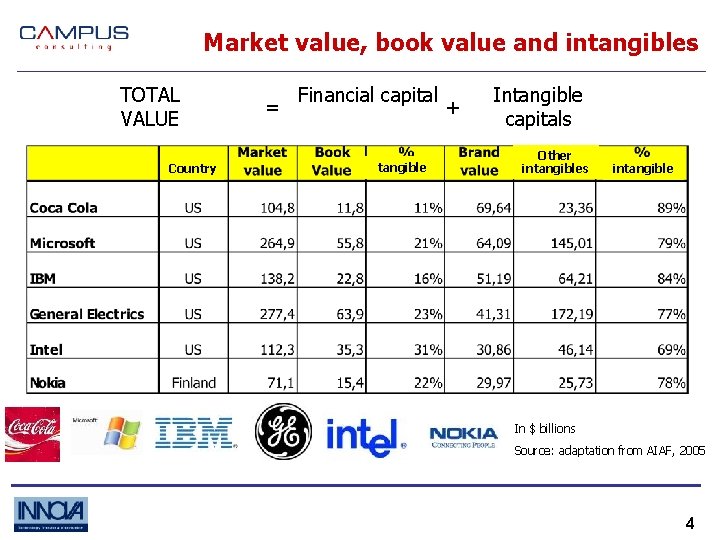
Market value, book value and intangibles TOTAL VALUE Country = Financial capital tangible + Intangible capitals Other intangibles intangible In $ billions Source: adaptation from AIAF, 2005 4
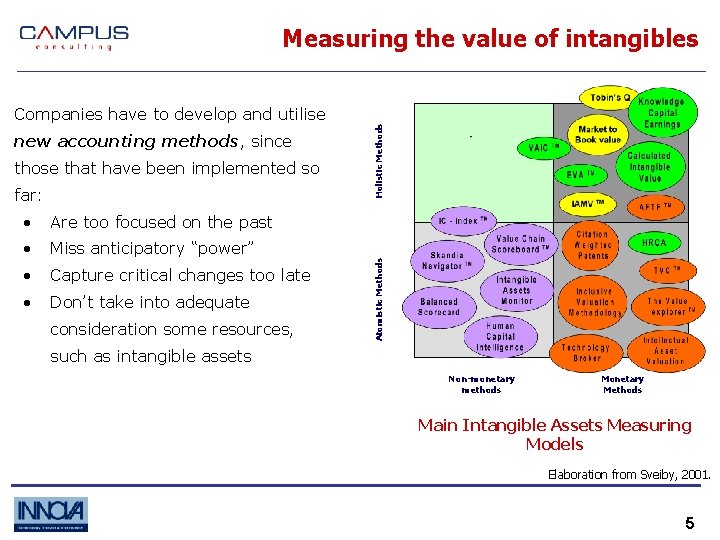
new accounting methods, since those that have been implemented so far: Are too focused on the past Miss anticipatory “power” Capture critical changes too late • Don’t take into adequate consideration some resources, Atomistic Methods Companies have to develop and utilise Holistic Methods Measuring the value of intangibles such as intangible assets Non-monetary methods Monetary Methods Main Intangible Assets Measuring Models Elaboration from Sveiby, 2001. 5
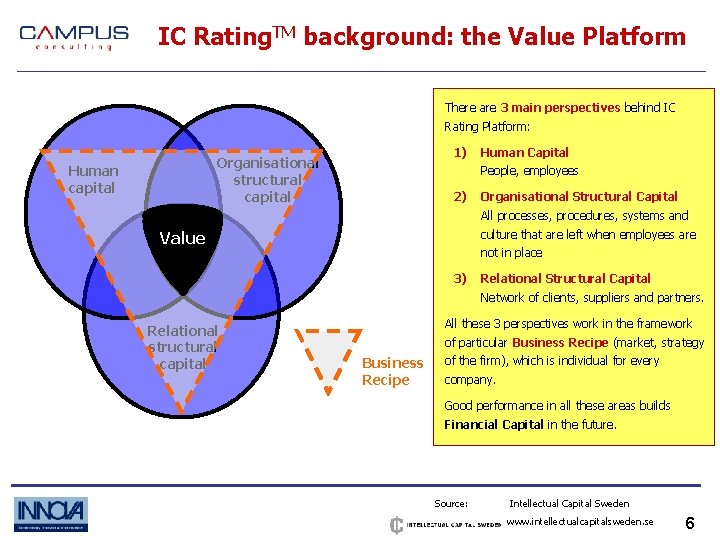
IC Rating. TM background: the Value Platform There are 3 main perspectives behind IC Rating Platform: 1) Organisational structural capital Human Capital People, employees 2) Organisational Structural Capital All processes, procedures, systems and culture that are left when employees are Value not in place 3) Relational Structural Capital Network of clients, suppliers and partners. Relational structural capital All these 3 perspectives work in the framework of particular Business Recipe (market, strategy Business Recipe of the firm), which is individual for every company. Good performance in all these areas builds Financial Capital in the future. Source: Intellectual Capital Sweden www. intellectualcapitalsweden. se 6
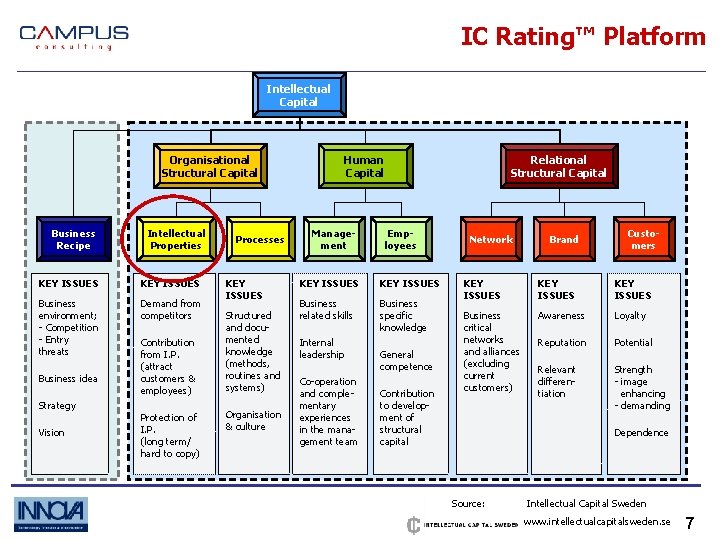
IC Rating™ Platform Intellectual Capital Organisational Structural Capital Business Recipe Intellectual Properties KEY ISSUES Business environment; - Competition - Entry threats Demand from competitors Business idea Strategy Vision Contribution from I. P. (attract customers & employees) Protection of I. P. (long term/ hard to copy) Processes KEY ISSUES Structured and documented knowledge (methods, routines and systems) Organisation & culture Human Capital Management Relational Structural Capital Employees KEY ISSUES Business related skills Business specific knowledge Internal leadership Co-operation and complementary experiences in the management team General competence Contribution to development of structural capital Network Brand Customers KEY ISSUES Business critical networks and alliances (excluding current customers) Awareness Loyalty Reputation Potential Relevant differentiation Strength - image enhancing - demanding Dependence Source: Intellectual Capital Sweden www. intellectualcapitalsweden. se 7
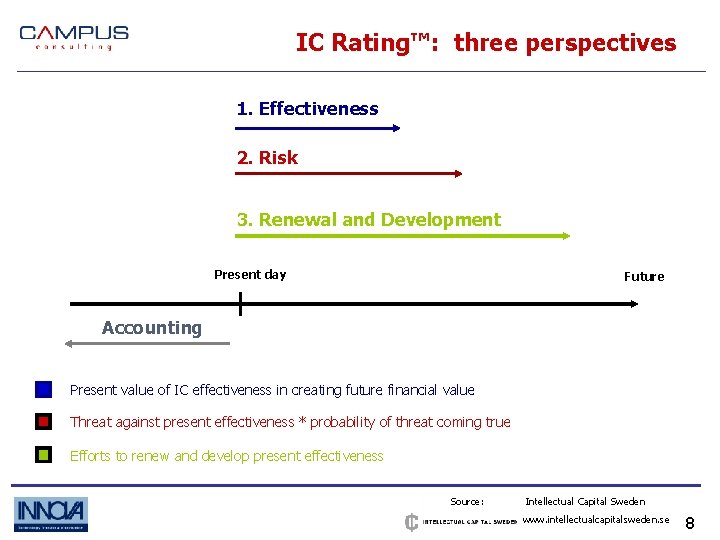
IC Rating™: three perspectives 1. Effectiveness 2. Risk 3. Renewal and Development Present day Future Accounting Present value of IC effectiveness in creating future financial value Threat against present effectiveness * probability of threat coming true Efforts to renew and develop present effectiveness Source: Intellectual Capital Sweden www. intellectualcapitalsweden. se 8
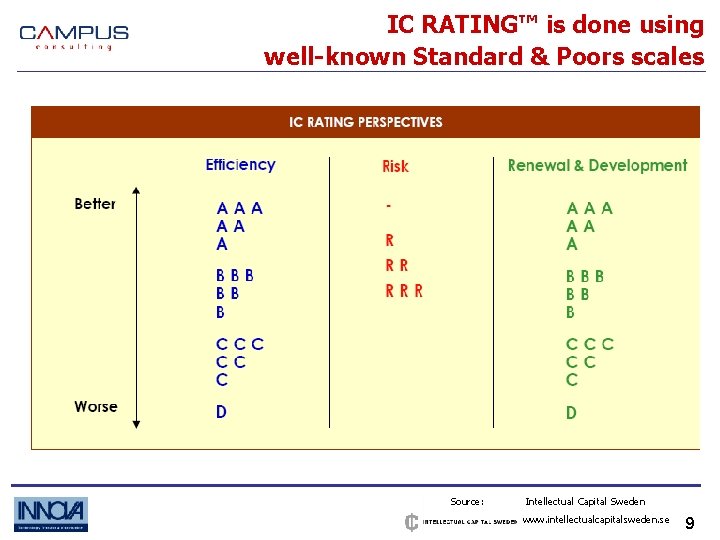
IC RATING™ is done using well-known Standard & Poors scales Source: Intellectual Capital Sweden www. intellectualcapitalsweden. se 9
IC RATING™ is mainly based on interviews with people PROCEDURE: • Rating is primarily based on interviews with carefully select 35 -50 respondents who knows most about this company, of which ü 2/3 is external (customers, lobby organizations, competitors, suppliers, partners, etc. ) ü 1/3 is internal (employees), • rating of intellectual capital is weight average of answers for more than 150 questions that are strictly connected to business performance of the company, • rating usually takes 4 -6 weeks. Source: Intellectual Capital Sweden www. intellectualcapitalsweden. se 10
IC RATING™ and IP assessment • 17 questions out of about 150 are focused on IP evaluation • Examples of key issues to be pointed out during the evaluation process: ü Market awareness about company's IP ü IP influence on company’s brand ü Company's IP “replaceability” ü Time period during which the IP has value ü IP contribution to rise barriers to entry ü Etc. Source: Intellectual Capital Sweden www. intellectualcapitalsweden. se 11
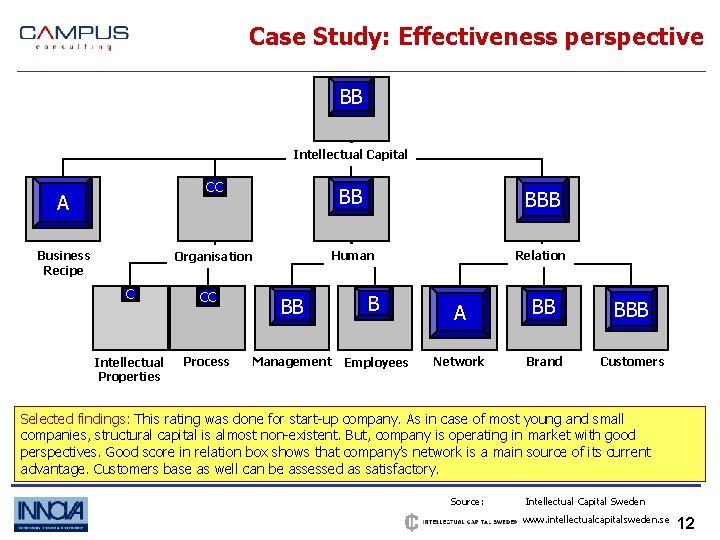
Case Study: Effectiveness perspective BB Intellectual Capital A Business Recipe CC BB BBB Organisation Human Relation C CC BB B Intellectual Properties Process Management Employees A Network BB Brand Customers Selected findings: This rating was done for start-up company. As in case of most young and small companies, structural capital is almost non-existent. But, company is operating in market with good perspectives. Good score in relation box shows that company’s network is a main source of its current advantage. Customers base as well can be assessed as satisfactory. Source: Intellectual Capital Sweden www. intellectualcapitalsweden. se 12
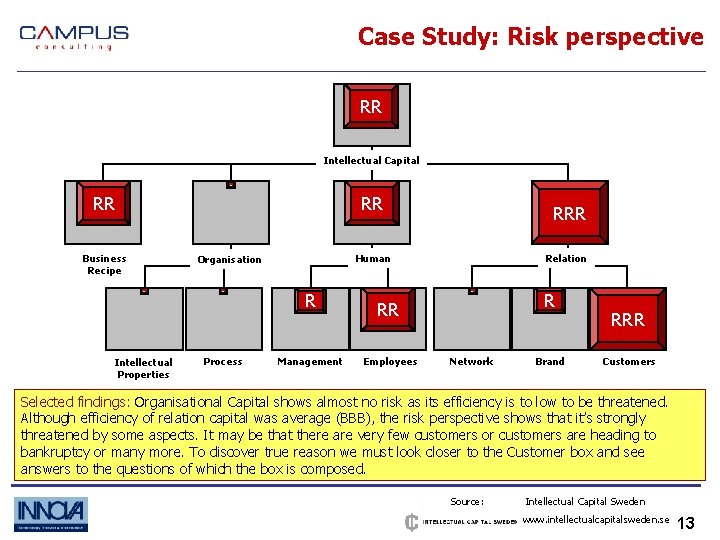
Case Study: Risk perspective RR Intellectual Capital - RR RR Business Recipe Human Organisation - Intellectual Properties - Process RRR R Management Relation - RR Employees Network R Brand RRR Customers Selected findings: Organisational Capital shows almost no risk as its efficiency is to low to be threatened. Although efficiency of relation capital was average (BBB), the risk perspective shows that it’s strongly threatened by some aspects. It may be that there are very few customers or customers are heading to bankruptcy or many more. To discover true reason we must look closer to the Customer box and see answers to the questions of which the box is composed. Source: Intellectual Capital Sweden www. intellectualcapitalsweden. se 13
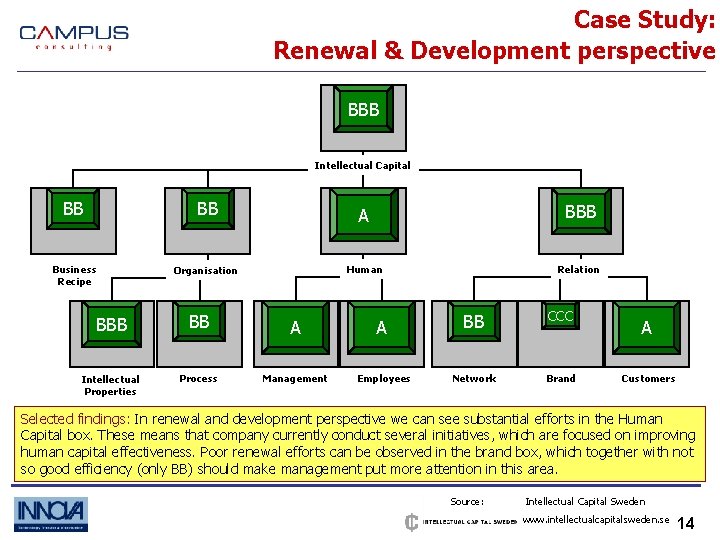
Case Study: Renewal & Development perspective BBB Intellectual Capital BB BB Business Recipe Organisation BBB BB Intellectual Properties Process A Management A BBB Human Relation A Employees BB CCC Network Brand A Customers Selected findings: In renewal and development perspective we can see substantial efforts in the Human Capital box. These means that company currently conduct several initiatives, which are focused on improving human capital effectiveness. Poor renewal efforts can be observed in the brand box, which together with not so good efficiency (only BB) should make management put more attention in this area. Source: Intellectual Capital Sweden www. intellectualcapitalsweden. se 14
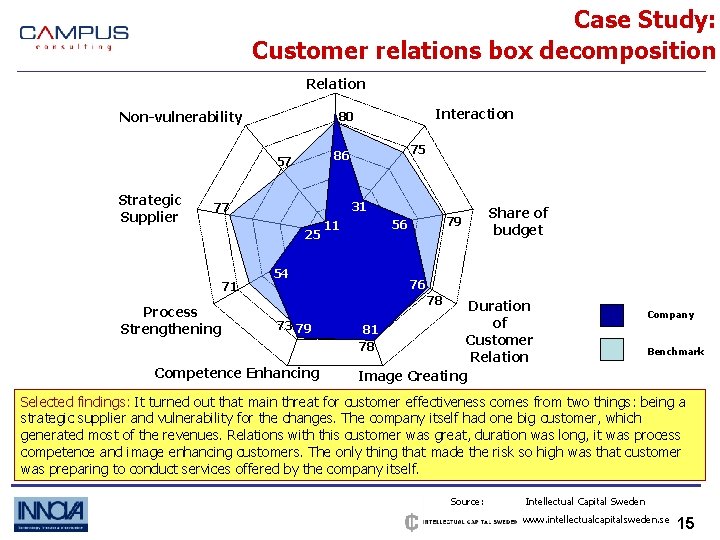
Case Study: Customer relations box decomposition Relation Non-vulnerability 31 77 25 71 Process Strengthening 75 86 57 Strategic Supplier Interaction 80 54 11 79 56 Share of budget 76 78 73 79 Competence Enhancing Duration of 81 Customer 78 Relation Image Creating Company Benchmark Selected findings: It turned out that main threat for customer effectiveness comes from two things: being a strategic supplier and vulnerability for the changes. The company itself had one big customer, which generated most of the revenues. Relations with this customer was great, duration was long, it was process competence and image enhancing customers. The only thing that made the risk so high was that customer was preparing to conduct services offered by the company itself. Source: Intellectual Capital Sweden www. intellectualcapitalsweden. se 15
IC RATING™ - A Comprehensive View RR BB + BB BBB CC R RR BB BBB R - RR A R Processer för Affärsmiljöns tillväxt intern administration på 5 års sikt IR: s förmåga att göra Processer för 94 oss oberoende av Affärsmiljöns lönsamhet kundhantering Vår position i affärsmiljön 80 prissättning 77 på 5 årskonkurrenternas sikt 59 55 59 IR: s varaktighet 55 37 79 Vår lönsamhet med utgångspunkt i vårt affärsrecept 50 74 32 36 Affärsmiljöns IR: s förmåga att skapa 100 konkurrenssituation inträdesbarriärer Vår tillväxt med utgångspunkt Potentiella hot mot i vårt affärsrecept affärsmiljön • 49 67 48 Processer produktion 45 77 77 86 R RR RR 77 BBB BB BBB Ledningens fokus 85 Kundhantering 84 75 59 59 Effektivitet 79 58 61 55 Processer för 80 distribution Affärsegenskaper och logistik Processer för utveckling av medarbetarna Processer försäljning RR Sakkunskaper 72 35 B RR Processer innovation Intern atmosfär 75 51 70 86 BB 62 51 76 61 77 B B • 22 47 67 Ledningens samspel 84 Kundbaspotential Internt ledarskap. Tydlighet i ledarskapet B Nätverk försäljning Nätverk för personal Kompetensutvecklande 92 och kompetens kunder 80 82 Leverantörs- och 71 65 86 Imagekunder 63 86 75 65 distributionsnätverk Sårbarhet mot 81 kundavhopp 82 CCC BB + Kundlojalitet 69 85 55 94 Kännedom 67 76 85 Anseende Relevant differentiering • Source: Intellectual Capital Sweden www. intellectualcapitalsweden. se 16
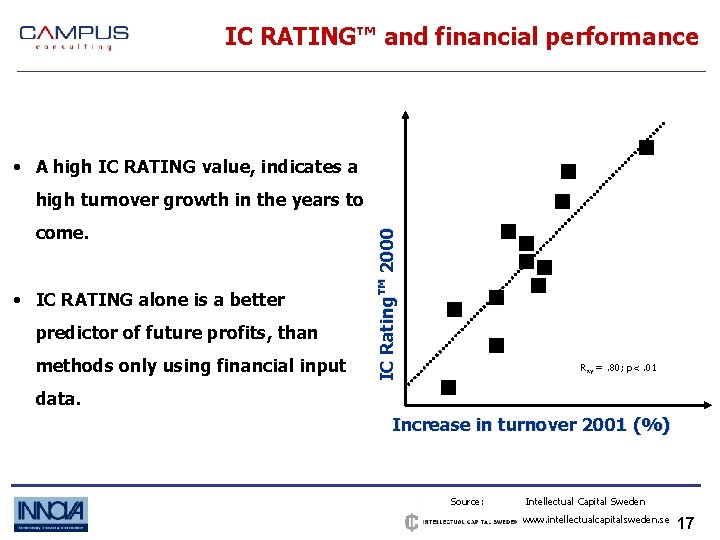
IC RATING™ and financial performance • A high IC RATING value, indicates a come. • IC RATING alone is a better predictor of future profits, than methods only using financial input IC Rating™ 2000 high turnover growth in the years to Rxy =. 80; p<. 01 data. Increase in turnover 2001 (%) Source: Intellectual Capital Sweden www. intellectualcapitalsweden. se 17
Beyond IC RATING™: IP “monetization” and brand equity • Monetary evaluation of some IP forms (e. g. : brands) can complement methods like IC RATING that basically provide qualitative findings and point out improvement areas • There are many methods to evaluate the brand equity: • ü Based on cost criteria, oriented to the past and to the resources spent on the brand ü Based on the “benefits flows”: the value of the brand is determined by the cash flows that it generates ü Based on market indicators and, therefore, on ex post performances The monetary assessment of the brand allows the company to have immediate benefits, e. g. : ü Further financing from investors trough specific financial tools (e. g. : salelease back) ü A better rating according to Basel II criteria 18
Thanks Mauro De Bona Campus - Innova Group +39 320 6130308 mauro. debona@campusconsulting. it skype: maurodebona 19
- Slides: 19