
Measuring the value of cultural tourism What economic
- Slides: 22
Measuring the value of cultural tourism: What economic impact studies can tell you, and what they leave out. Tourism Talk 1 February 2017 Port Elizabeth Professor Jen Snowball Chief Research Strategist, South African Cultural Observatory
What Are Economic Impact Studies?
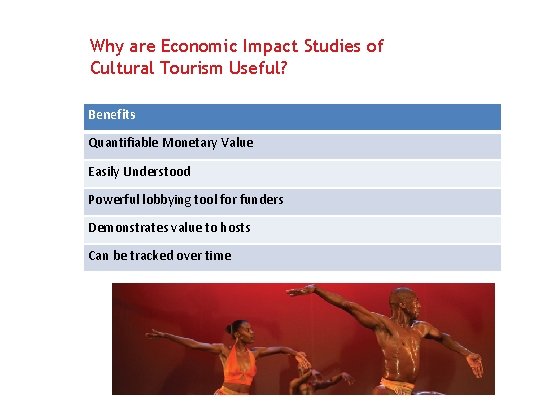
Why are Economic Impact Studies of Cultural Tourism Useful? Benefits Quantifiable Monetary Value Easily Understood Powerful lobbying tool for funders Demonstrates value to hosts Can be tracked over time
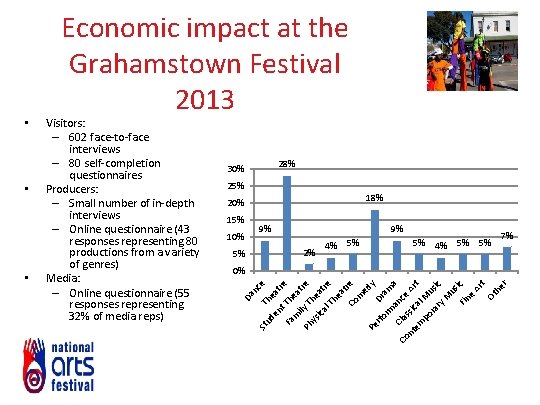
25% 18% 20% 15% 9% 10% 9% 2% 5% 4% 5% 5% 7% 0% nc e T ud he en at r t Fa Th e ea m t i Ph ly T re ys he ica at l T re he at Co re m ed Pe y rfo Dr rm am a a Co Clas nce A s nt em ical rt po Mu ra ry sic M us Fin ic e Ar t Ot he r • 28% 30% St • Visitors: – 602 face-to-face interviews – 80 self-completion questionnaires Producers: – Small number of in-depth interviews – Online questionnaire (43 responses representing 80 productions from a variety of genres) Media: – Online questionnaire (55 responses representing 32% of media reps) Da • Economic impact at the Grahamstown Festival 2013
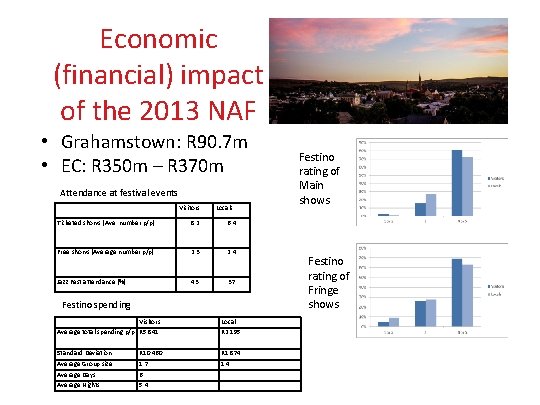
Economic (financial) impact of the 2013 NAF • Grahamstown: R 90. 7 m • EC: R 350 m – R 370 m Attendance at festival events Visitors Locals 6. 4 Ticketed shows (Ave. number p/p) 8. 2 Free shows (Average number p/p) 2. 3 2. 4 Jazz Fest attendance (%) 43 37 Festino spending Visitors Local Average total spending p/p R 5 841 R 2 195 Standard Deviation R 10 460 R 1 874 Average Group size 1. 7 1. 4 Average Days 6 Average Nights 5. 4 Festino rating of Main shows Festino rating of Fringe shows
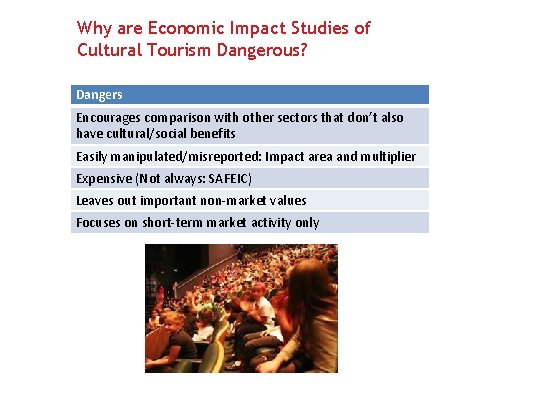
Why are Economic Impact Studies of Cultural Tourism Dangerous? Dangers Encourages comparison with other sectors that don’t also have cultural/social benefits Easily manipulated/misreported: Impact area and multiplier Expensive (Not always: SAFEIC) Leaves out important non-market values Focuses on short-term market activity only
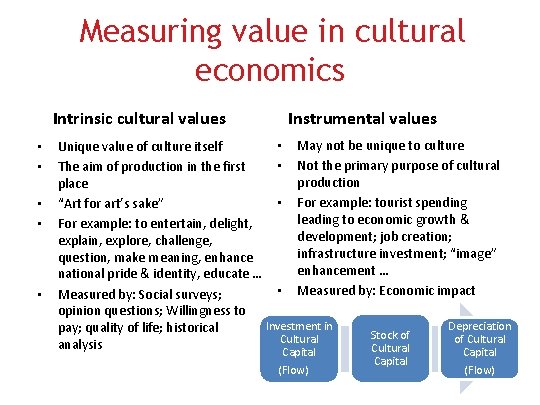
Measuring value in cultural economics Intrinsic cultural values • • • Instrumental values • May not be unique to culture Unique value of culture itself • Not the primary purpose of cultural The aim of production in the first production place • For example: tourist spending “Art for art’s sake” leading to economic growth & For example: to entertain, delight, development; job creation; explain, explore, challenge, infrastructure investment; “image” question, make meaning, enhancement … national pride & identity, educate … • Measured by: Economic impact Measured by: Social surveys; opinion questions; Willingness to Investment in Depreciation pay; quality of life; historical Stock of Cultural analysis Cultural Capital (Flow)
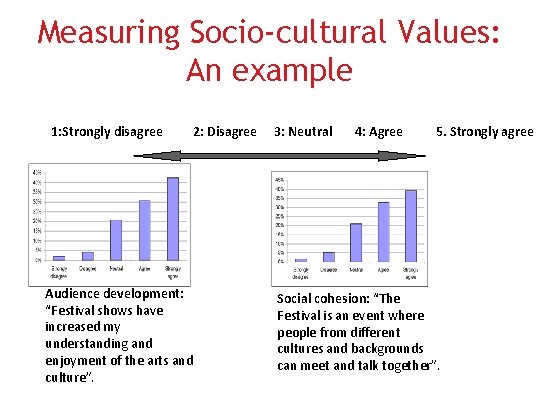
Measuring Socio-cultural Values: An example 1: Strongly disagree 2: Disagree Audience development: “Festival shows have increased my understanding and enjoyment of the arts and culture”. 3: Neutral 4: Agree 5. Strongly agree Social cohesion: “The Festival is an event where people from different cultures and backgrounds can meet and talk together”.
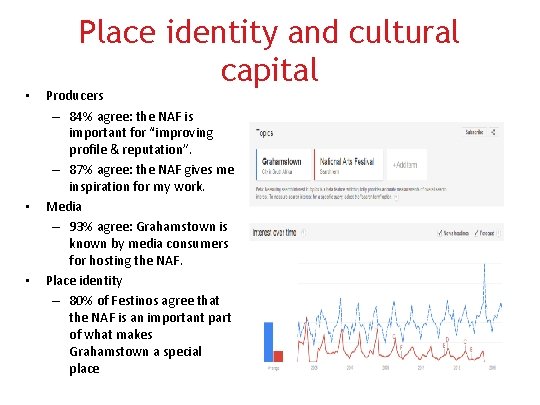
• • • Place identity and cultural capital Producers – 84% agree: the NAF is important for “improving profile & reputation”. – 87% agree: the NAF gives me inspiration for my work. Media – 93% agree: Grahamstown is known by media consumers for hosting the NAF. Place identity – 80% of Festinos agree that the NAF is an important part of what makes Grahamstown a special place
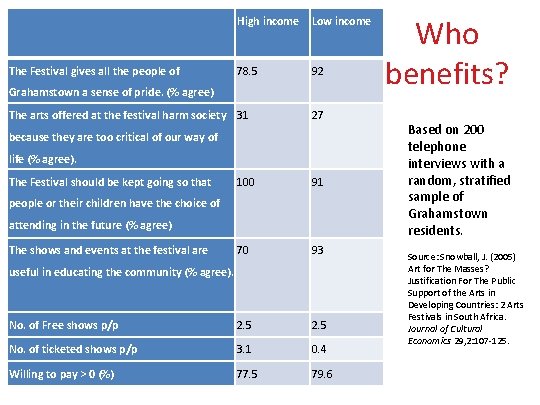
High income Low income The Festival gives all the people of 78. 5 92 Grahamstown a sense of pride. (% agree) The arts offered at the festival harm society 31 27 because they are too critical of our way of life (% agree). The Festival should be kept going so that 100 91 70 93 No. of Free shows p/p 2. 5 No. of ticketed shows p/p 3. 1 0. 4 Willing to pay > 0 (%) 77. 5 79. 6 people or their children have the choice of attending in the future (% agree) The shows and events at the festival are useful in educating the community (% agree). Who benefits? Based on 200 telephone interviews with a random, stratified sample of Grahamstown residents. Source: Snowball, J. (2005) Art for The Masses? Justification For The Public Support of the Arts in Developing Countries: 2 Arts Festivals in South Africa. Journal of Cultural Economics 29, 2: 107 -125.
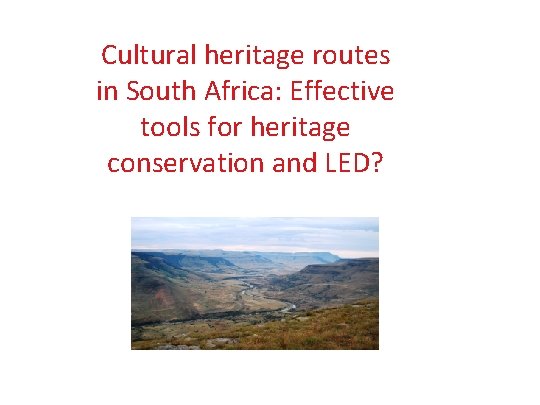
Cultural heritage routes in South Africa: Effective tools for heritage conservation and LED?
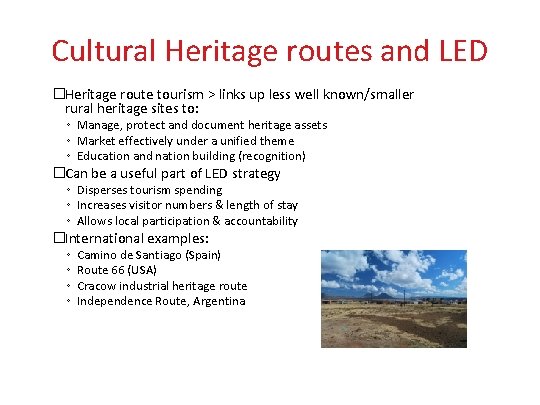
Cultural Heritage routes and LED �Heritage route tourism > links up less well known/smaller rural heritage sites to: ◦ Manage, protect and document heritage assets ◦ Market effectively under a unified theme ◦ Education and nation building (recognition) �Can be a useful part of LED strategy ◦ Disperses tourism spending ◦ Increases visitor numbers & length of stay ◦ Allows local participation & accountability �International examples: ◦ ◦ Camino de Santiago (Spain) Route 66 (USA) Cracow industrial heritage route Independence Route, Argentina
Potential dangers �Tourism routes often not financially successful in the short run ◦ Pro-growth versus pro-poor ◦ Too much focus on supply side ◦ Lack of management capacity & experience in small centres �Idea that heritage conservation can be selffinancing can lead to: ◦ Designation of too many sites ◦ Lack of sustainability & loss of heritage assets
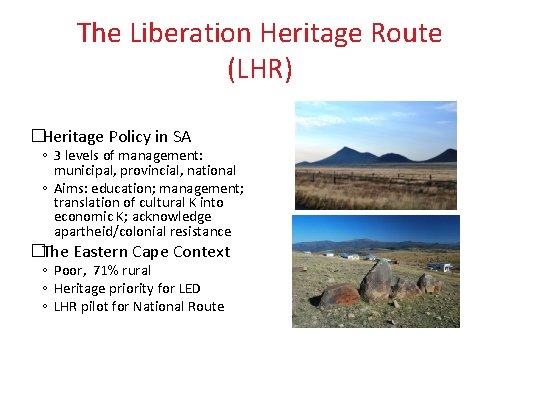
The Liberation Heritage Route (LHR) �Heritage Policy in SA ◦ 3 levels of management: municipal, provincial, national ◦ Aims: education; management; translation of cultural K into economic K; acknowledge apartheid/colonial resistance �The Eastern Cape Context ◦ Poor, 71% rural ◦ Heritage priority for LED ◦ LHR pilot for National Route
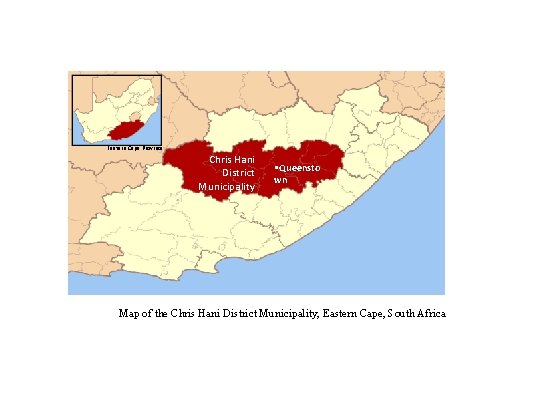
Eastern Cape Province Chris Hani District Municipality • Queensto wn Map of the Chris Hani District Municipality, Eastern Cape, South Africa
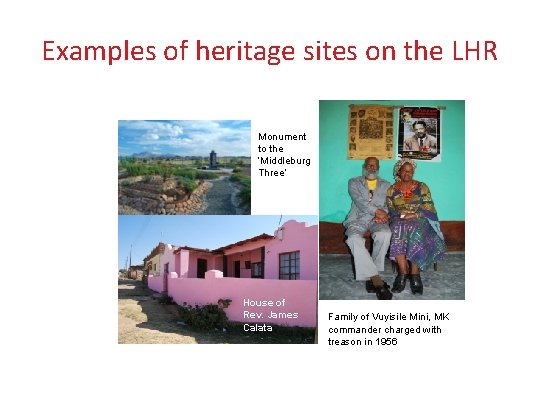
Examples of heritage sites on the LHR Monument to the ‘Middleburg Three’ House of Rev. James Calata Family of Vuyisile Mini, MK commander charged with treason in 1956
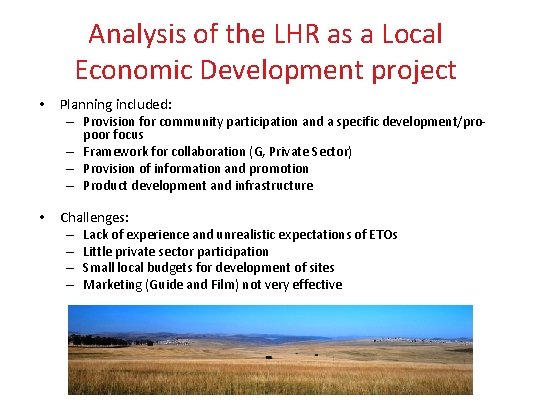
Analysis of the LHR as a Local Economic Development project • Planning included: – Provision for community participation and a specific development/propoor focus – Framework for collaboration (G, Private Sector) – Provision of information and promotion – Product development and infrastructure • Challenges: – – Lack of experience and unrealistic expectations of ETOs Little private sector participation Small local budgets for development of sites Marketing (Guide and Film) not very effective
Way forward? • Potential for win-win – A – INTRINSIC value: conserve & manage heritage assets; educ. ; pride & dignity (non-market cultural K) – B - INSTRUMENTAL value/Economic impact: LED through job creation, economic growth, development (financial/market value) • Danger: A depends on B, which may not happen in the SR, so A will also be lost. The LHR was not developed “in response to market research according to the requirements of prospective clients…it was conceptualised as a monument to SA’s freedom struggle. The LHR as a preserver of cultural heritage & outstanding value for humanity should be prioritised and safeguarded, whether it brings the expected economic benefits or not” (Bialostocka 2014: 104).
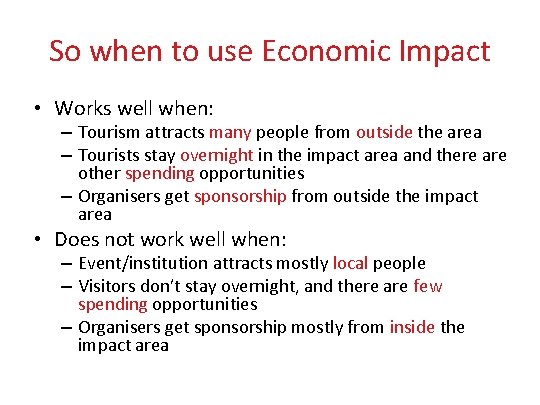
So when to use Economic Impact • Works well when: – Tourism attracts many people from outside the area – Tourists stay overnight in the impact area and there are other spending opportunities – Organisers get sponsorship from outside the impact area • Does not work well when: – Event/institution attracts mostly local people – Visitors don’t stay overnight, and there are few spending opportunities – Organisers get sponsorship mostly from inside the impact area
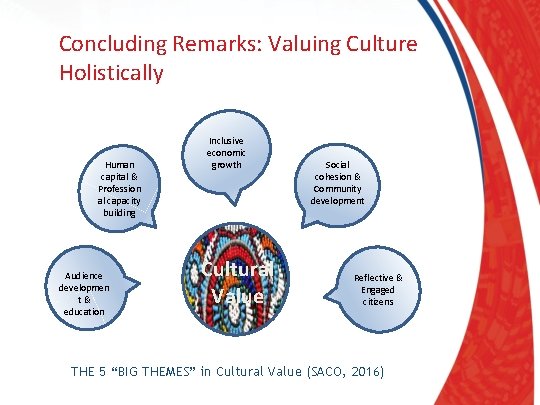
Concluding Remarks: Valuing Culture Holistically Human capital & Profession al capacity building Audience developmen t& education Inclusive economic growth Cultural Value Social cohesion & Community development Reflective & Engaged citizens THE 5 “BIG THEMES” in Cultural Value (SACO, 2016)