
Measuring the stability of typological parameters Dik Bakker
Measuring the stability of typological parameters Dik Bakker Amsterdam Typological Stability
Typology TYPOLOGY Typological Stability 2
Typology TYPOLOGY Linguistic Variables Typological Stability 3
Typology TYPOLOGY Linguistic Variables Constituent order: SOV, SVO, VSO, … Typological Stability 4

Typology TYPOLOGY Linguistic Variables Constituent order: Adposition type: SOV, SVO, VSO, … Prep, Post, None Typological Stability 5

Typology TYPOLOGY Linguistic Variables Constituent order: Adposition type: Morphological type: SOV, SVO, VSO, … Prep, Post, None Isol, Aggl, Fuse, Polisynt Typological Stability 6
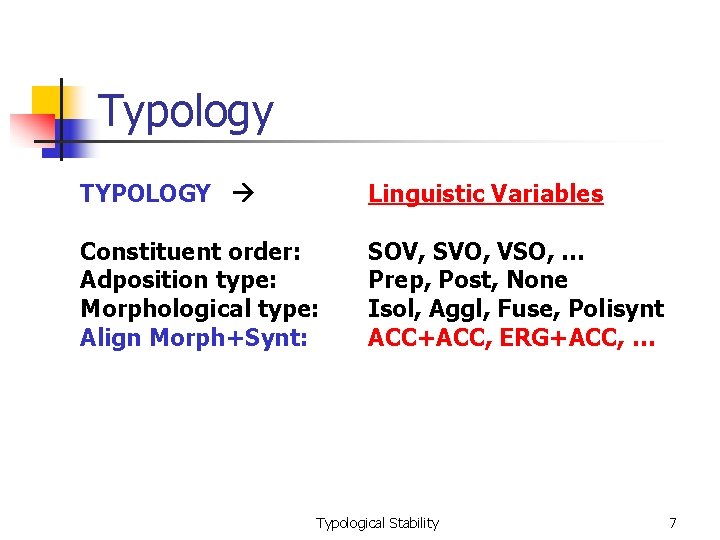
Typology TYPOLOGY Linguistic Variables Constituent order: Adposition type: Morphological type: Align Morph+Synt: SOV, SVO, VSO, … Prep, Post, None Isol, Aggl, Fuse, Polisynt ACC+ACC, ERG+ACC, … Typological Stability 7
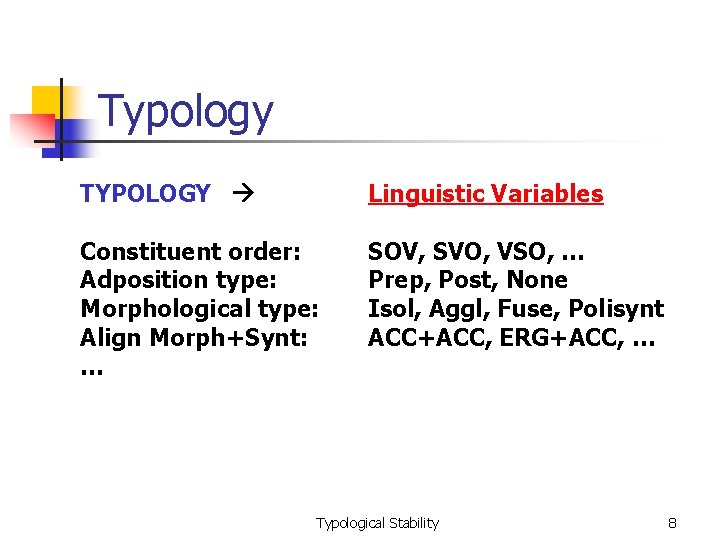
Typology TYPOLOGY Linguistic Variables Constituent order: Adposition type: Morphological type: Align Morph+Synt: … SOV, SVO, VSO, … Prep, Post, None Isol, Aggl, Fuse, Polisynt ACC+ACC, ERG+ACC, … Typological Stability 8
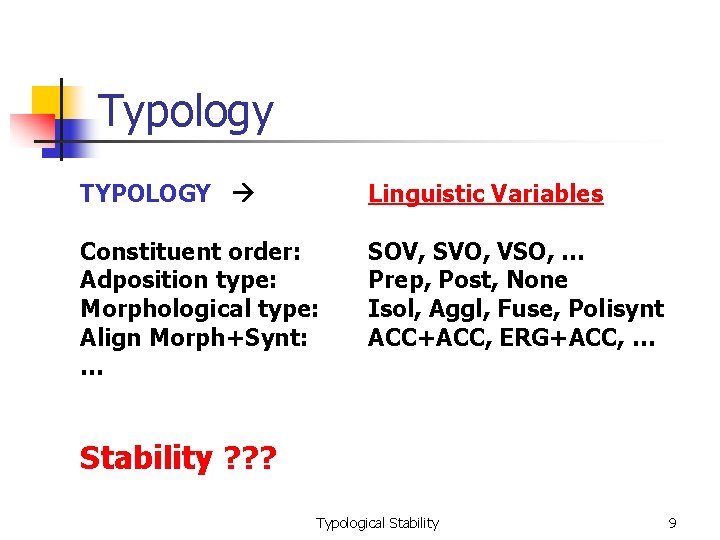
Typology TYPOLOGY Linguistic Variables Constituent order: Adposition type: Morphological type: Align Morph+Synt: … SOV, SVO, VSO, … Prep, Post, None Isol, Aggl, Fuse, Polisynt ACC+ACC, ERG+ACC, … Stability ? ? ? Typological Stability 9
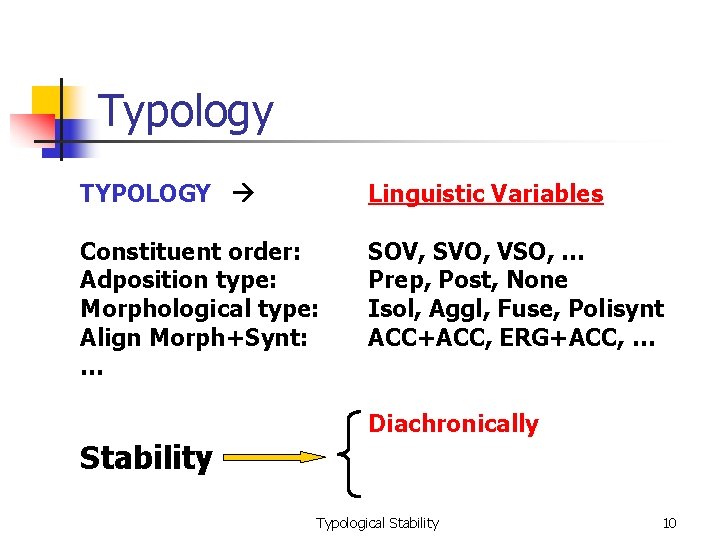
Typology TYPOLOGY Linguistic Variables Constituent order: Adposition type: Morphological type: Align Morph+Synt: … SOV, SVO, VSO, … Prep, Post, None Isol, Aggl, Fuse, Polisynt ACC+ACC, ERG+ACC, … Stability Diachronically Typological Stability 10
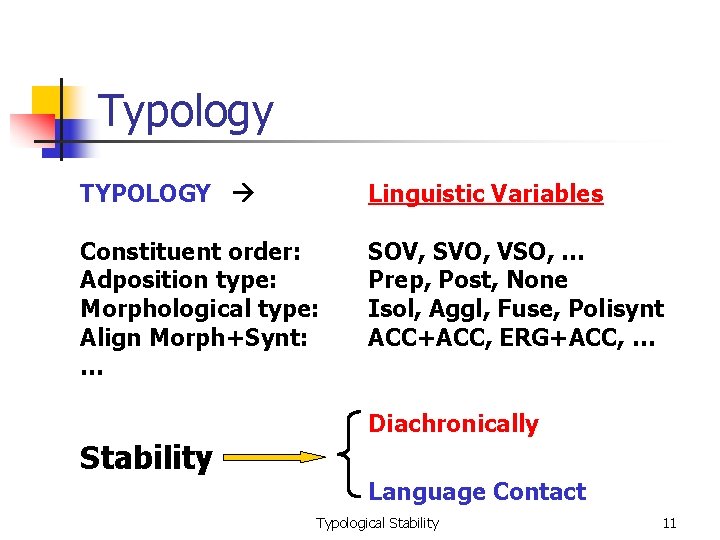
Typology TYPOLOGY Linguistic Variables Constituent order: Adposition type: Morphological type: Align Morph+Synt: … SOV, SVO, VSO, … Prep, Post, None Isol, Aggl, Fuse, Polisynt ACC+ACC, ERG+ACC, … Stability Diachronically Language Contact Typological Stability 11
Overview Typological Stability 12
Overview 1. Measuring Stability: the data Typological Stability 13
Overview 1. Measuring Stability: the data 2. Measuring Stability: method 1 Typological Stability 14
Overview 1. Measuring Stability: the data 2. Measuring Stability: method 1 3. Measuring Stability: method 2 Typological Stability 15
Overview 1. Measuring Stability: the data 2. Measuring Stability: method 1 3. Measuring Stability: method 2 4. Comparing 1 & 2 Typological Stability 16
Overview 1. Measuring Stability: the data 2. Measuring Stability: method 1 3. Measuring Stability: method 2 4. Comparing 1 & 2 5. Some of the problems Typological Stability 17
Data Typological Stability 18
Data IDEALLY Historical linguistics: Typological Stability 19
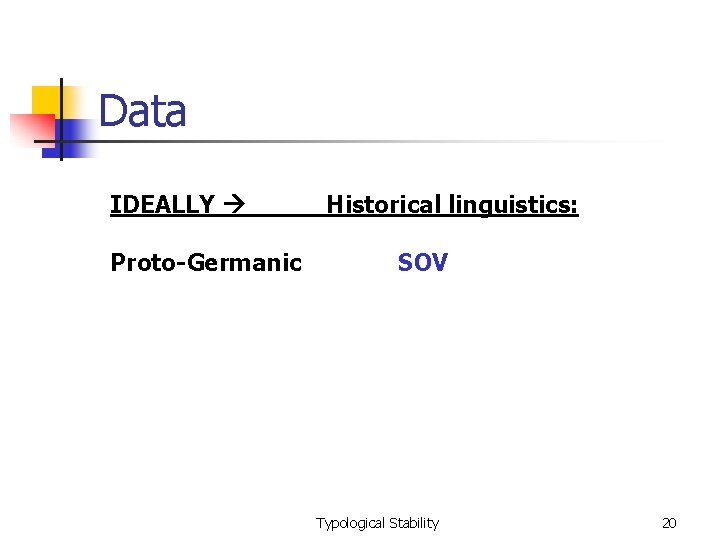
Data IDEALLY Proto-Germanic Historical linguistics: SOV Typological Stability 20
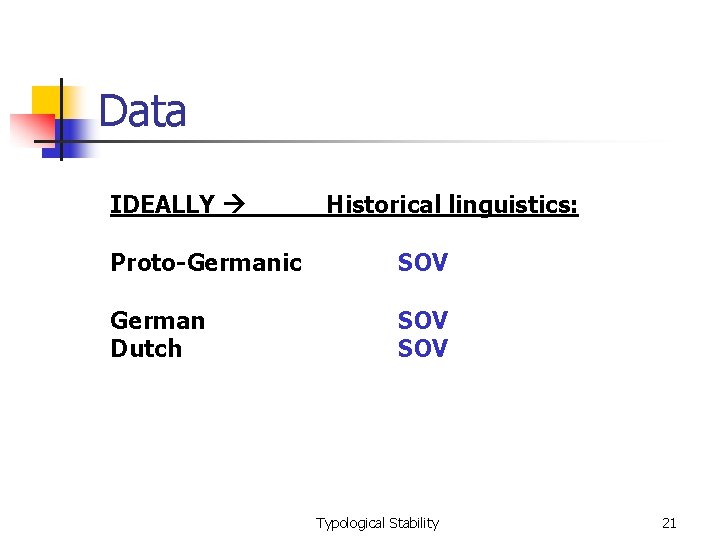
Data IDEALLY Historical linguistics: Proto-Germanic SOV German Dutch SOV Typological Stability 21
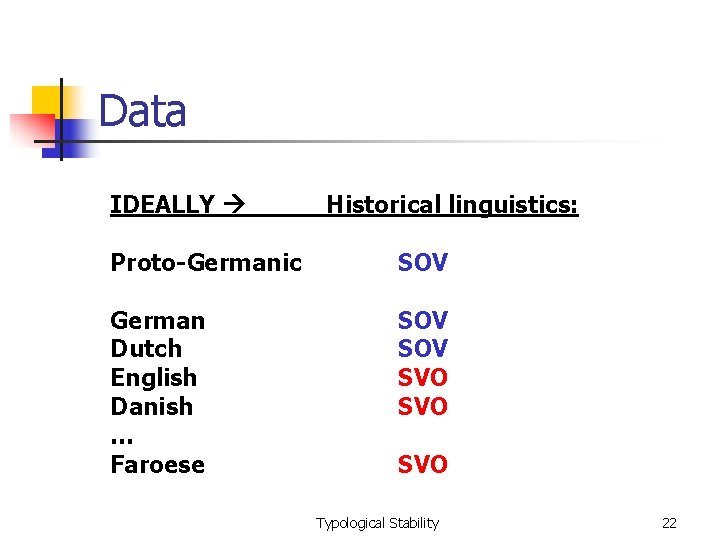
Data IDEALLY Historical linguistics: Proto-Germanic SOV German Dutch English Danish … Faroese SOV SVO SVO Typological Stability 22
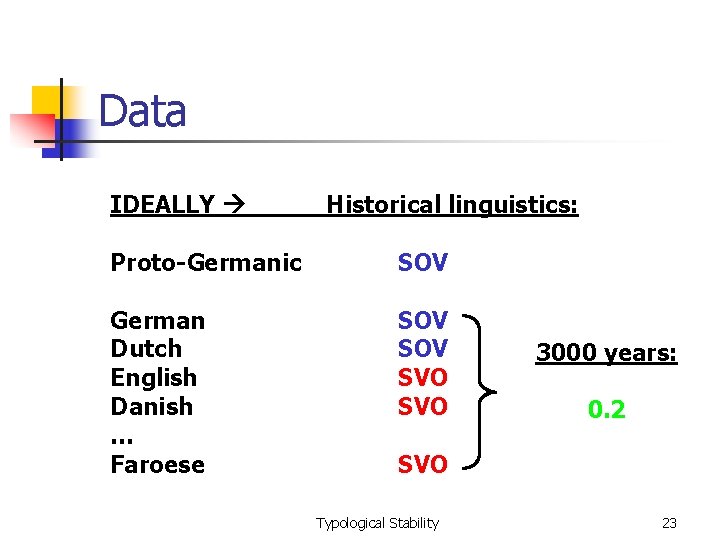
Data IDEALLY Historical linguistics: Proto-Germanic SOV German Dutch English Danish … Faroese SOV SVO 3000 years: 0. 2 SVO Typological Stability 23
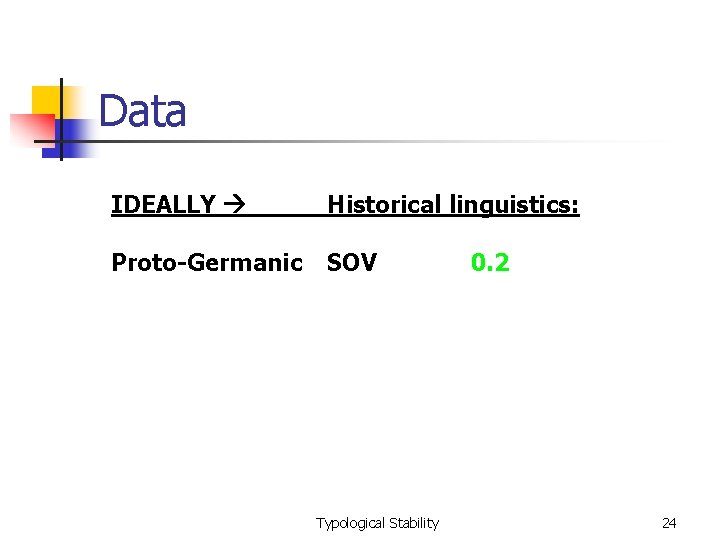
Data IDEALLY Historical linguistics: Proto-Germanic SOV Typological Stability 0. 2 24
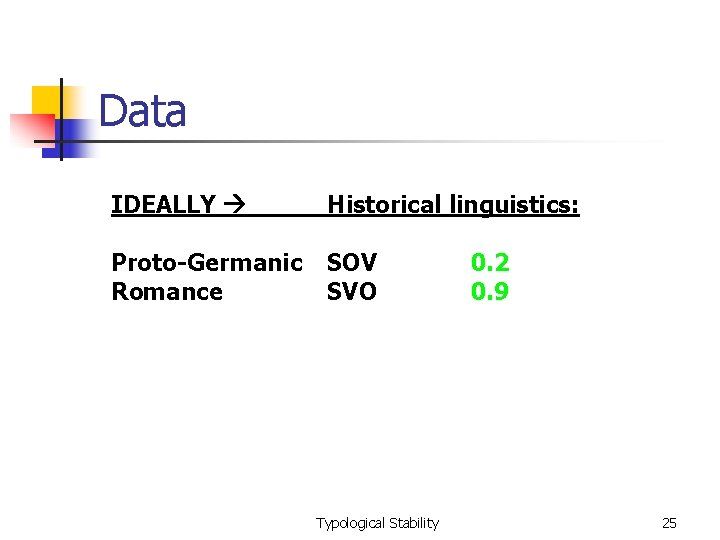
Data IDEALLY Historical linguistics: Proto-Germanic Romance SOV SVO Typological Stability 0. 2 0. 9 25
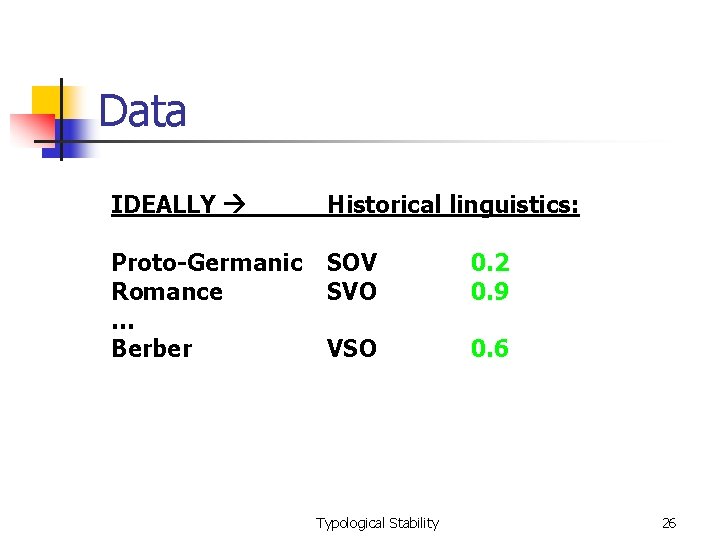
Data IDEALLY Historical linguistics: Proto-Germanic Romance … Berber SOV SVO 0. 2 0. 9 VSO 0. 6 Typological Stability 26
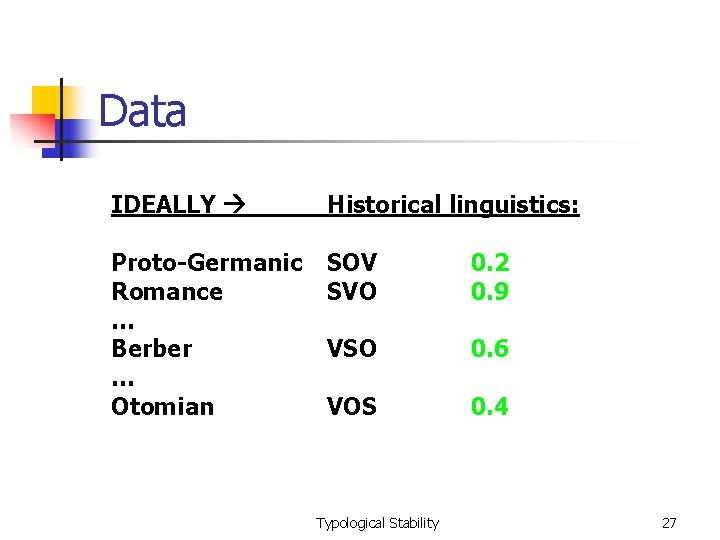
Data IDEALLY Historical linguistics: Proto-Germanic Romance … Berber … Otomian SOV SVO 0. 2 0. 9 VSO 0. 6 VOS 0. 4 Typological Stability 27
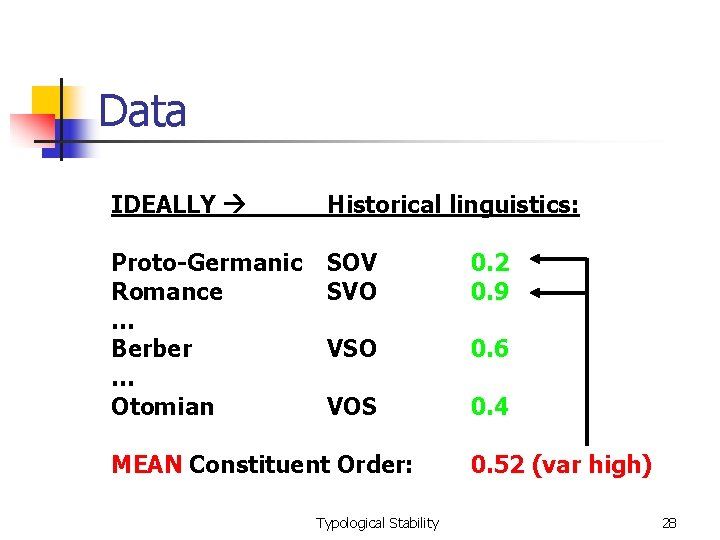
Data IDEALLY Historical linguistics: Proto-Germanic Romance … Berber … Otomian SOV SVO 0. 2 0. 9 VSO 0. 6 VOS 0. 4 MEAN Constituent Order: Typological Stability 0. 52 (var high) 28
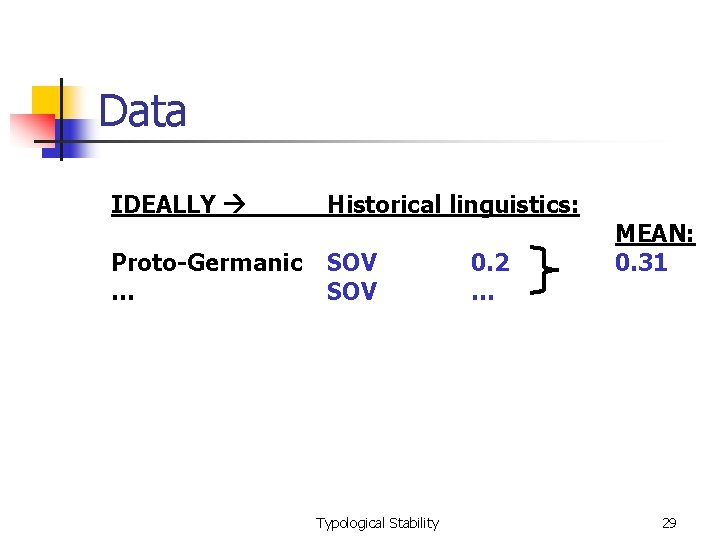
Data IDEALLY Proto-Germanic … Historical linguistics: SOV Typological Stability 0. 2 … MEAN: 0. 31 29
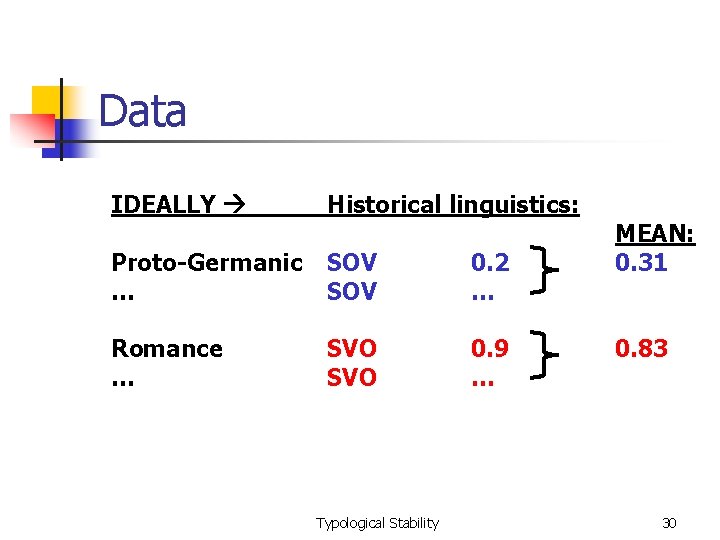
Data IDEALLY Historical linguistics: Proto-Germanic … SOV 0. 2 … Romance … SVO 0. 9 … Typological Stability MEAN: 0. 31 0. 83 30
Data Historical Data ? Typological Stability 31
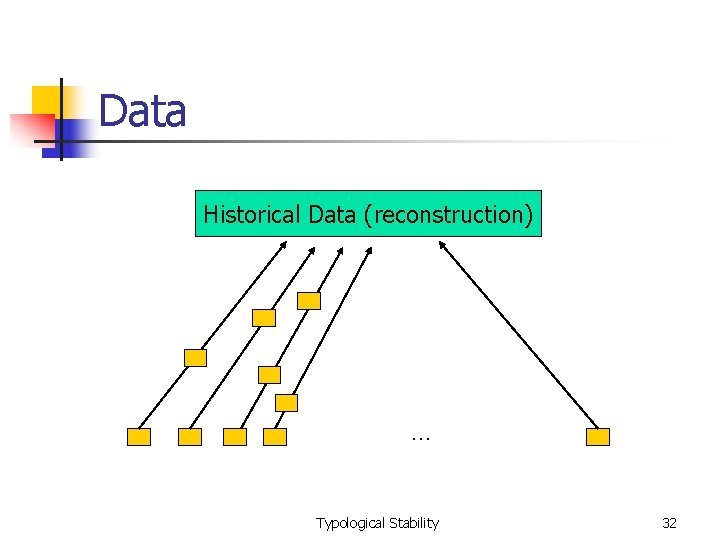
Data Historical Data (reconstruction) … Typological Stability 32
Data Method: hypothetical reconstruction on the basis of a large typological database Typological Stability 33
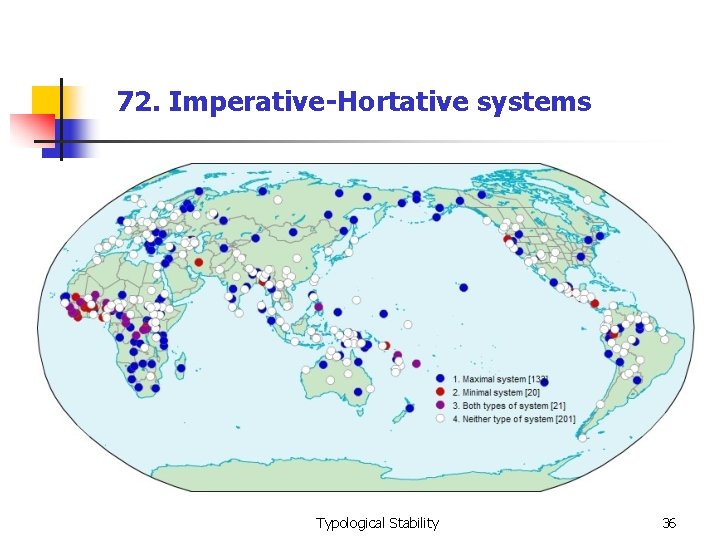
Data: WALS World Atlas of Language Structures Haspelmath, Martin, Matthew S. Dryer, David Gil & Bernard Comrie (eds) (2005) Oxford: Oxford University Press. Typological Stability 34
Data: WALS World Atlas of Language Structures Variables: 139 (Phon; Morph; Synt; Lex; etc) Typological Stability 35
72. Imperative-Hortative systems Typological Stability 36
Data: WALS – database: Variables: 139 (Phon; Morph; Synt; Lex; etc) Typological Stability 37
Data: WALS – database: Variables: 139 (Phon; Morph; Synt; Lex; etc) Authors: Bickel Comrie Corbet Dryer Haspelmath Nichols Siewierska … Typological Stability 38
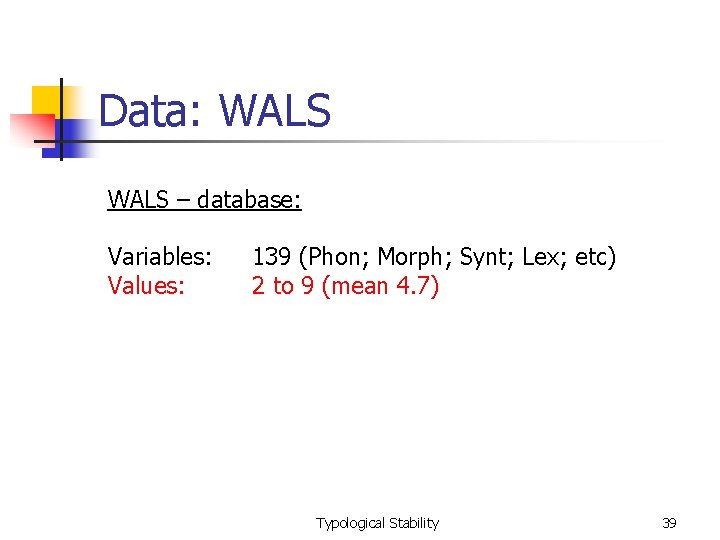
Data: WALS – database: Variables: Values: 139 (Phon; Morph; Synt; Lex; etc) 2 to 9 (mean 4. 7) Typological Stability 39
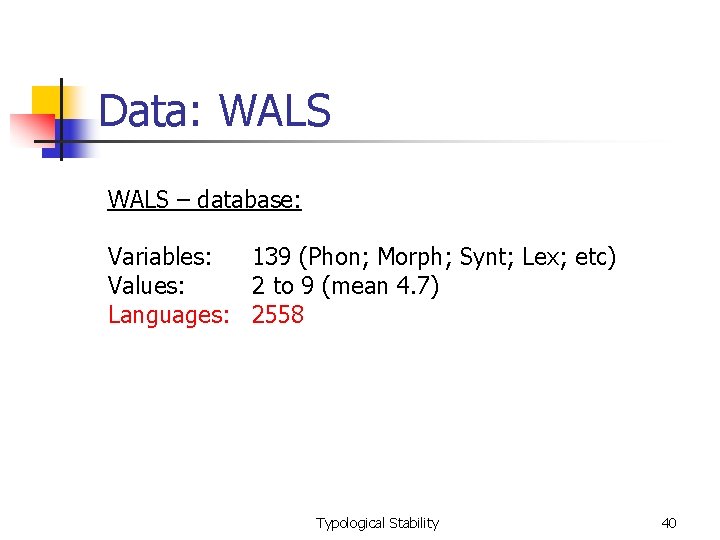
Data: WALS – database: Variables: 139 (Phon; Morph; Synt; Lex; etc) Values: 2 to 9 (mean 4. 7) Languages: 2558 Typological Stability 40
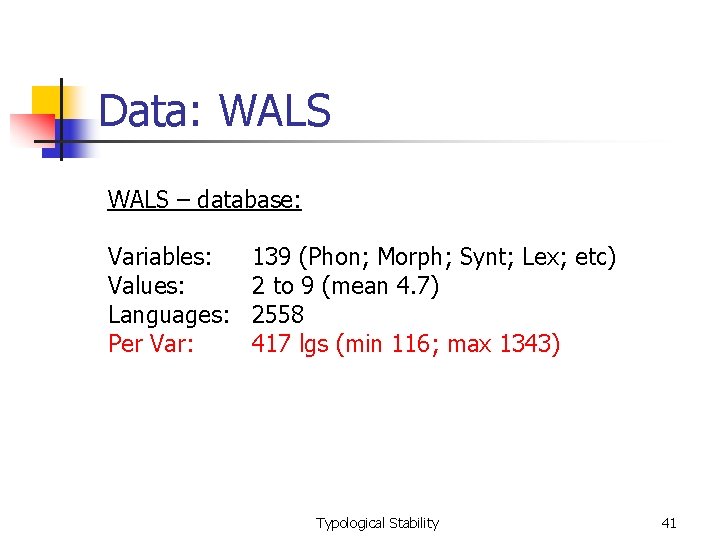
Data: WALS – database: Variables: Values: Languages: Per Var: 139 (Phon; Morph; Synt; Lex; etc) 2 to 9 (mean 4. 7) 2558 417 lgs (min 116; max 1343) Typological Stability 41
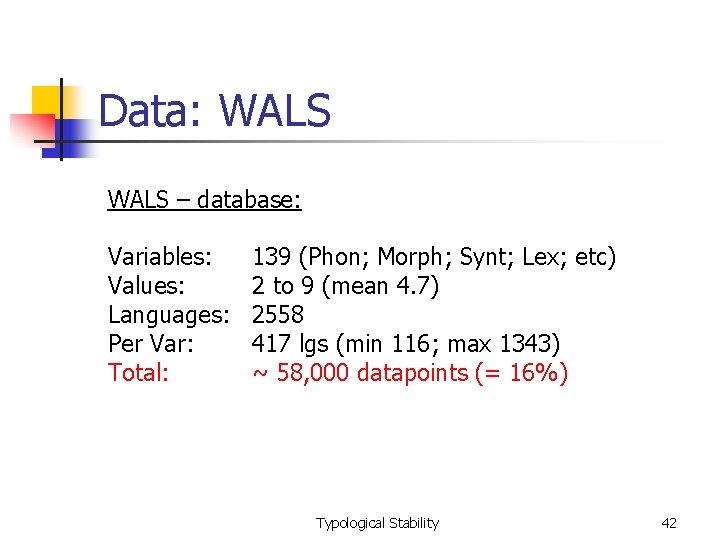
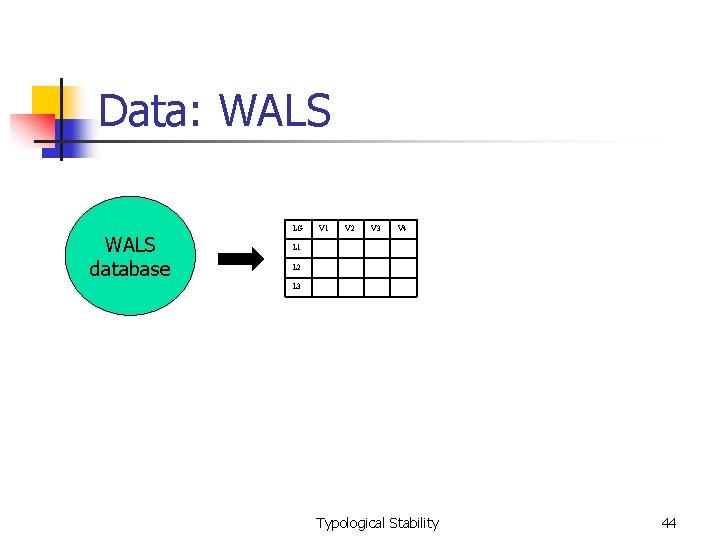
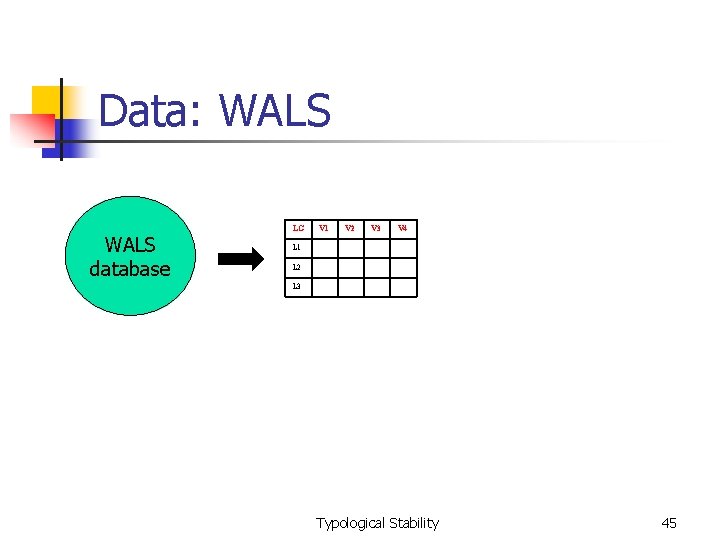
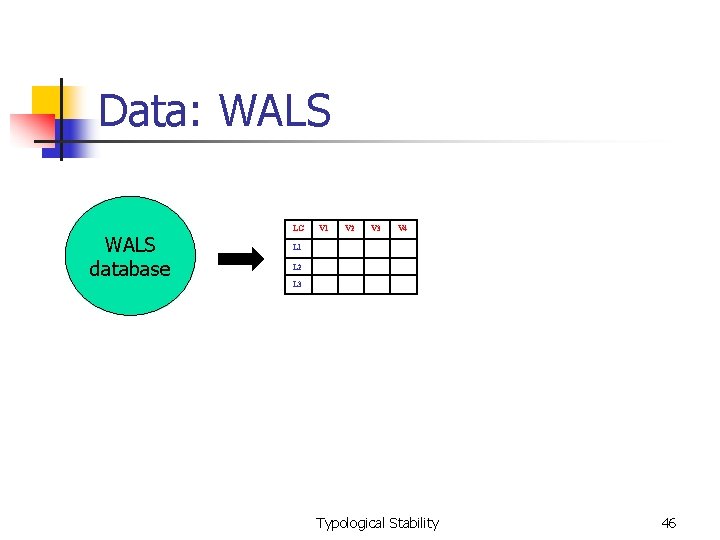
Data: WALS – database: Variables: Values: Languages: Per Var: Total: 139 (Phon; Morph; Synt; Lex; etc) 2 to 9 (mean 4. 7) 2558 417 lgs (min 116; max 1343) ~ 58, 000 datapoints (= 16%) Typological Stability 42
Data: WALS database Typological Stability 43
Data: WALS database LG V 1 V 2 V 3 V 4 L 1 L 2 L 3 Typological Stability 44
Data: WALS database LG V 1 V 2 V 3 V 4 L 1 L 2 L 3 Typological Stability 45
Data: WALS database LG V 1 V 2 V 3 V 4 L 1 L 2 L 3 Typological Stability 46
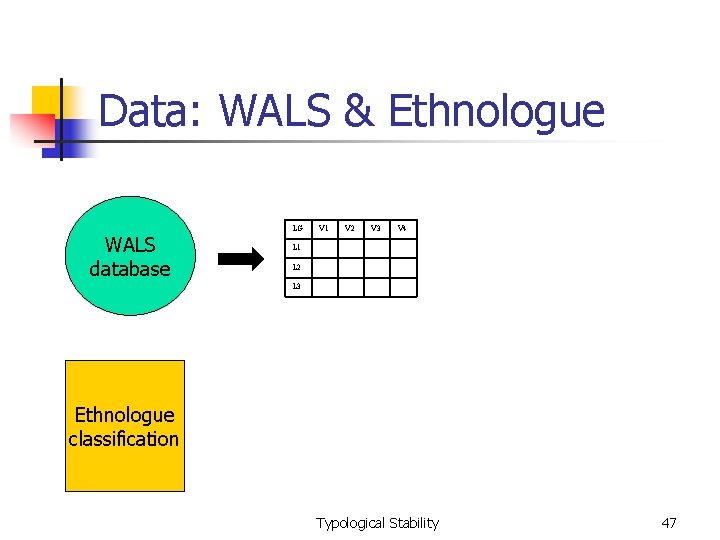
Data: WALS & Ethnologue WALS database LG V 1 V 2 V 3 V 4 L 1 L 2 L 3 Ethnologue classification Typological Stability 47
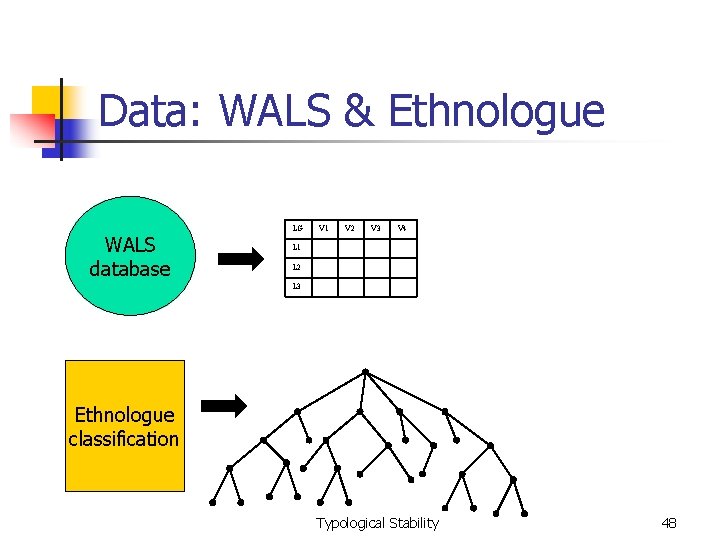
Data: WALS & Ethnologue WALS database LG V 1 V 2 V 3 V 4 L 1 L 2 L 3 Ethnologue classification Typological Stability 48
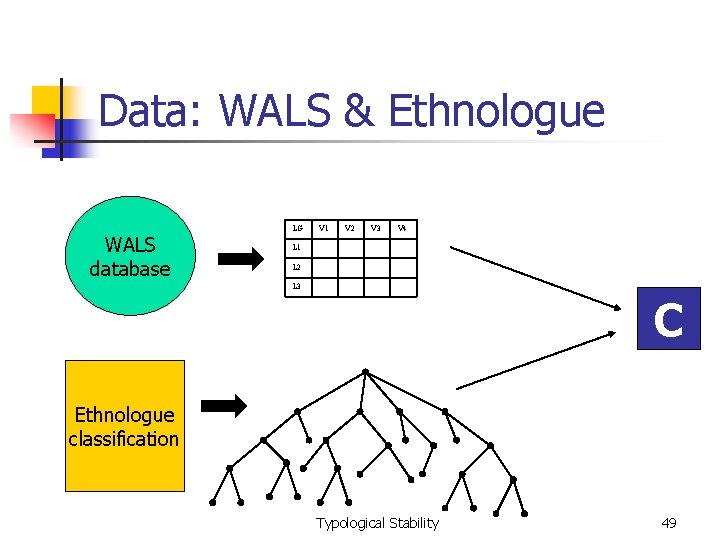
Data: WALS & Ethnologue WALS database LG V 1 V 2 V 3 V 4 L 1 L 2 L 3 C Ethnologue classification Typological Stability 49
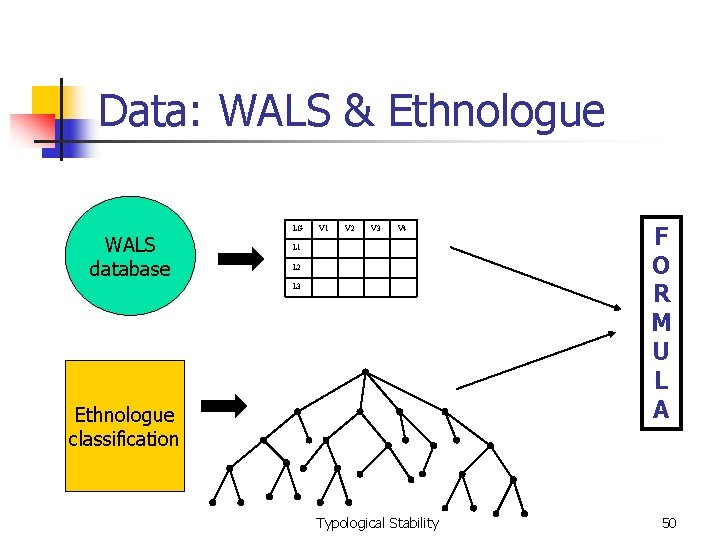
Data: WALS & Ethnologue WALS database LG V 1 V 2 V 3 V 4 L 1 L 2 L 3 Ethnologue classification Typological Stability F O R M U L A 50
Stability #1 Typological Stability 51
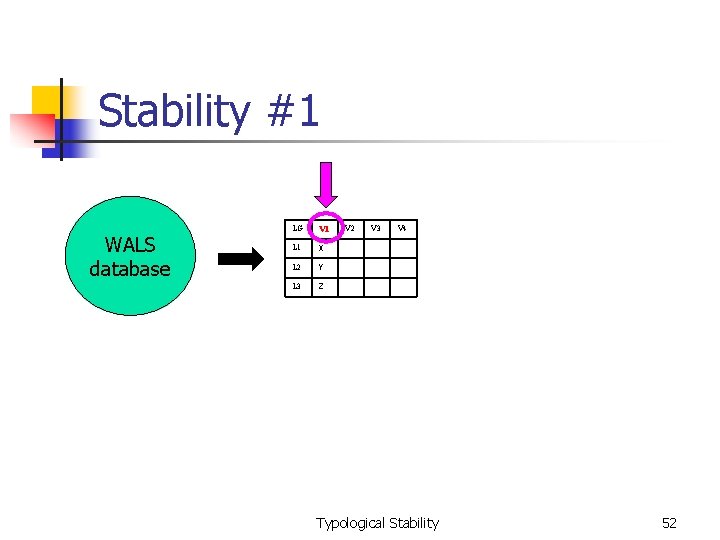
Stability #1 WALS database LG V 1 L 1 X L 2 Y L 3 Z V 2 V 3 V 4 Typological Stability 52
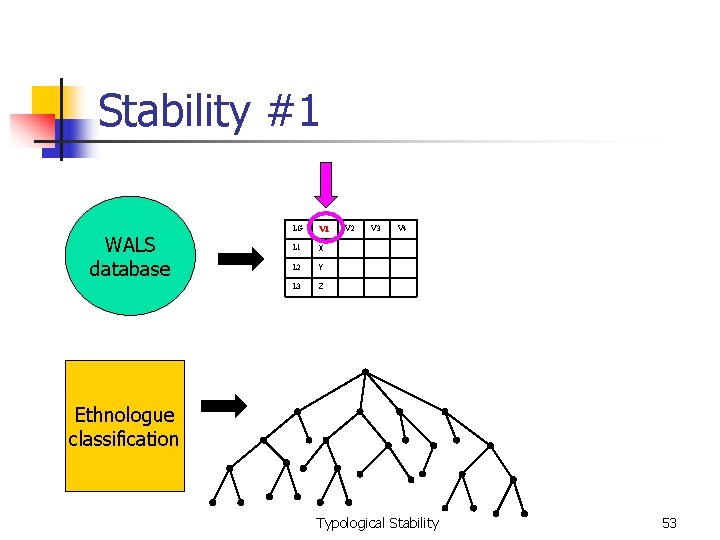
Stability #1 WALS database LG V 1 L 1 X L 2 Y L 3 Z V 2 V 3 V 4 Ethnologue classification Typological Stability 53
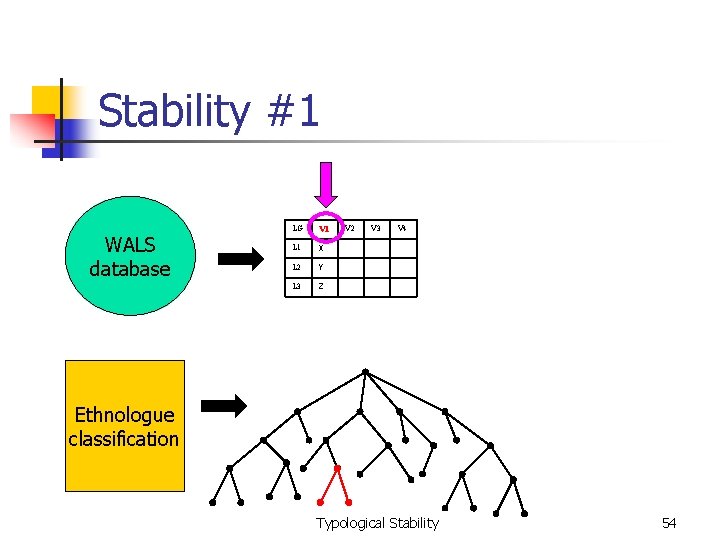
Stability #1 WALS database LG V 1 L 1 X L 2 Y L 3 Z V 2 V 3 V 4 Ethnologue classification Typological Stability 54
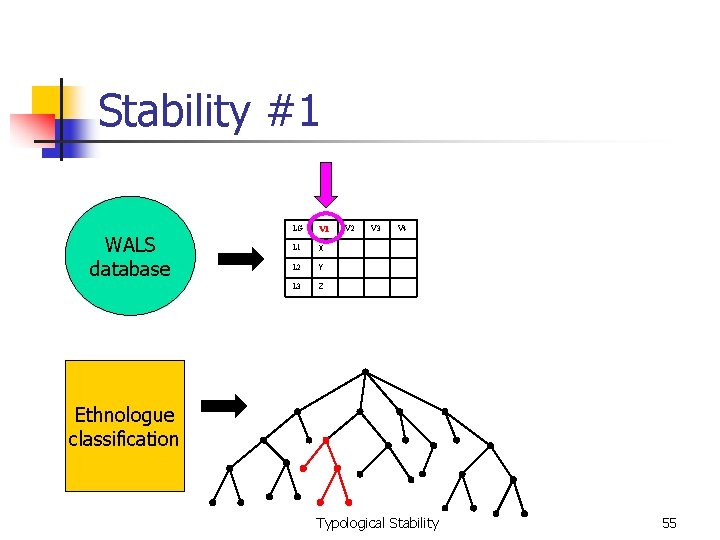
Stability #1 WALS database LG V 1 L 1 X L 2 Y L 3 Z V 2 V 3 V 4 Ethnologue classification Typological Stability 55
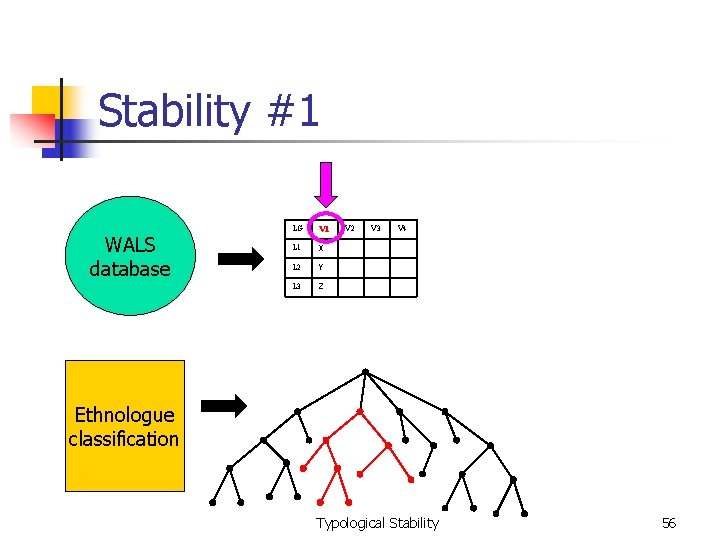
Stability #1 WALS database LG V 1 L 1 X L 2 Y L 3 Z V 2 V 3 V 4 Ethnologue classification Typological Stability 56
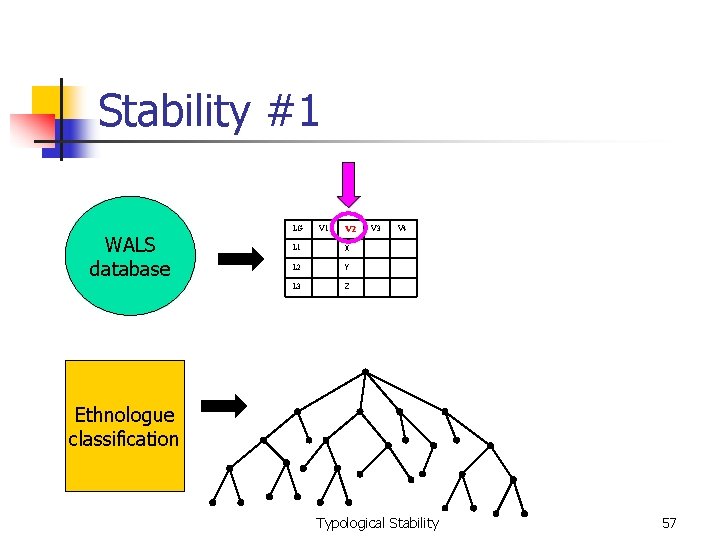
Stability #1 WALS database LG V 1 V 2 L 1 X L 2 Y L 3 Z V 3 V 4 Ethnologue classification Typological Stability 57
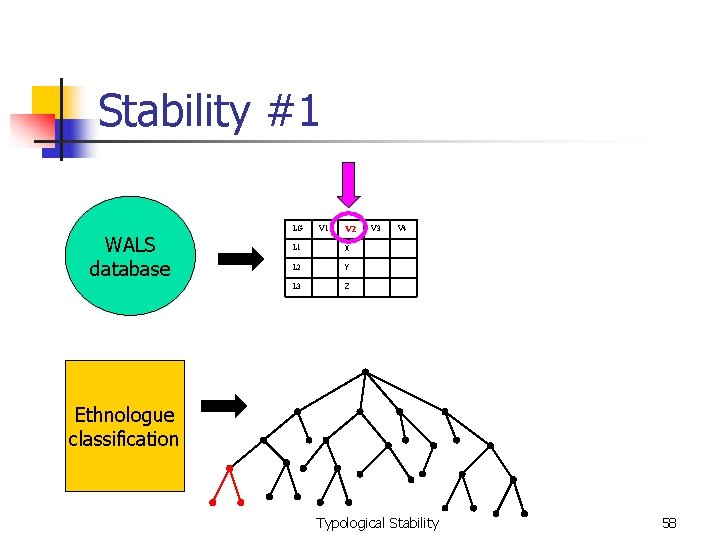
Stability #1 WALS database LG V 1 V 2 L 1 X L 2 Y L 3 Z V 3 V 4 Ethnologue classification Typological Stability 58
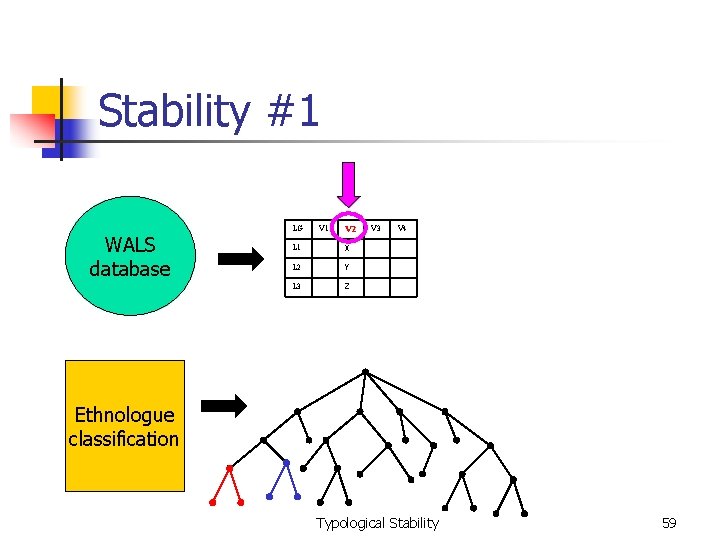
Stability #1 WALS database LG V 1 V 2 L 1 X L 2 Y L 3 Z V 3 V 4 Ethnologue classification Typological Stability 59
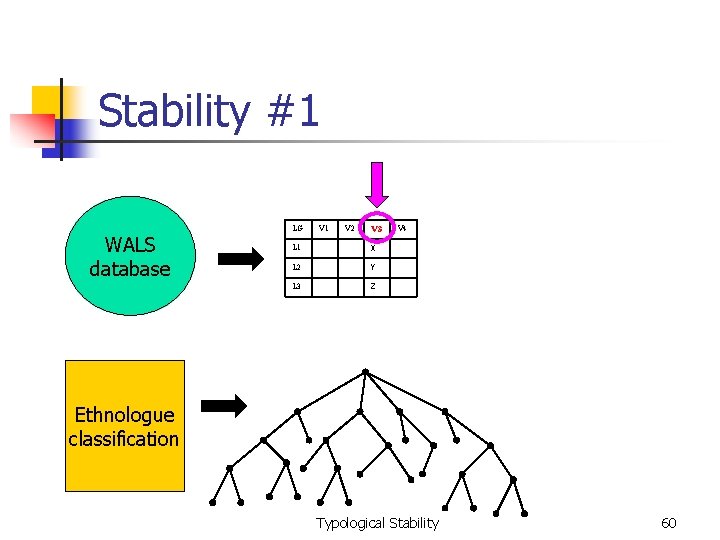
Stability #1 WALS database LG V 1 V 2 V 3 L 1 X L 2 Y L 3 Z V 4 Ethnologue classification Typological Stability 60
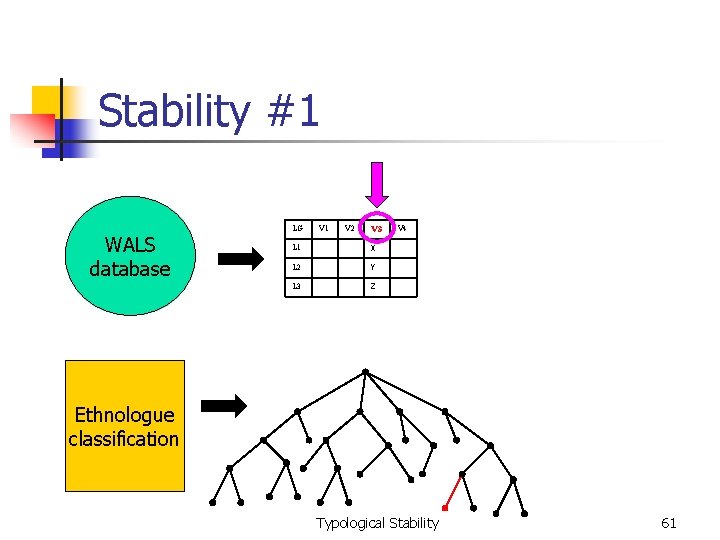
Stability #1 WALS database LG V 1 V 2 V 3 L 1 X L 2 Y L 3 Z V 4 Ethnologue classification Typological Stability 61
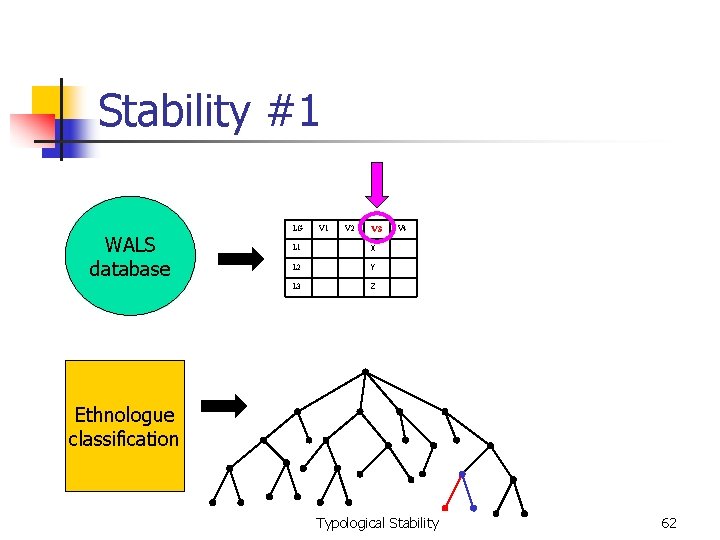
Stability #1 WALS database LG V 1 V 2 V 3 L 1 X L 2 Y L 3 Z V 4 Ethnologue classification Typological Stability 62
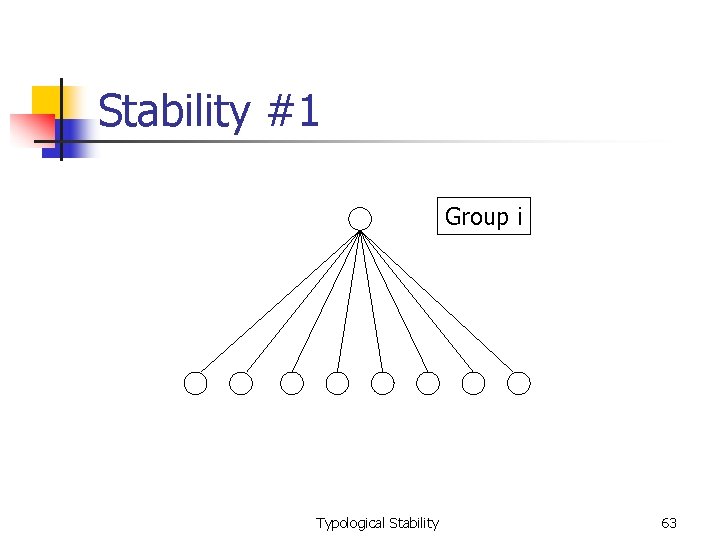
Stability #1 Group i Typological Stability 63
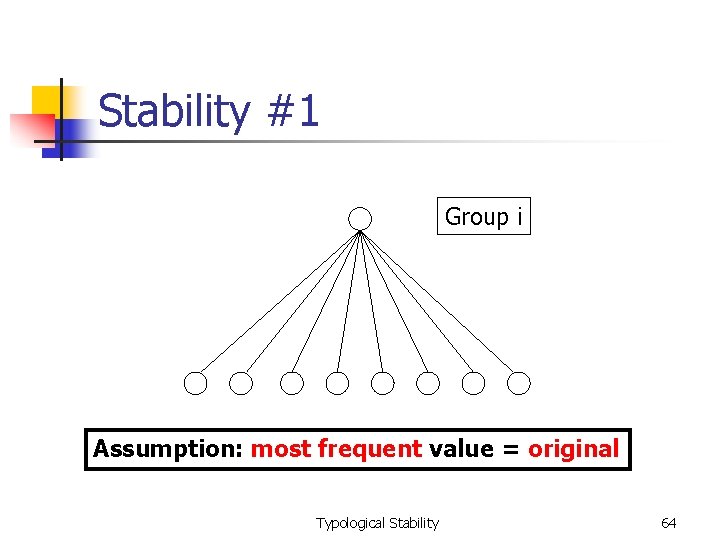
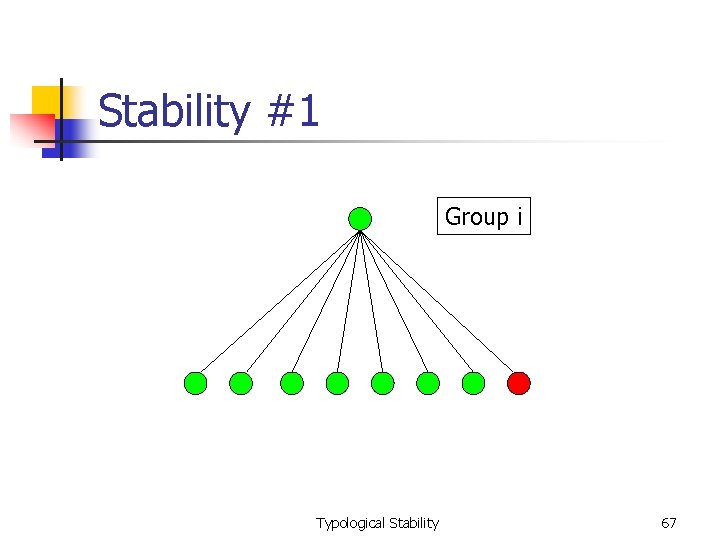
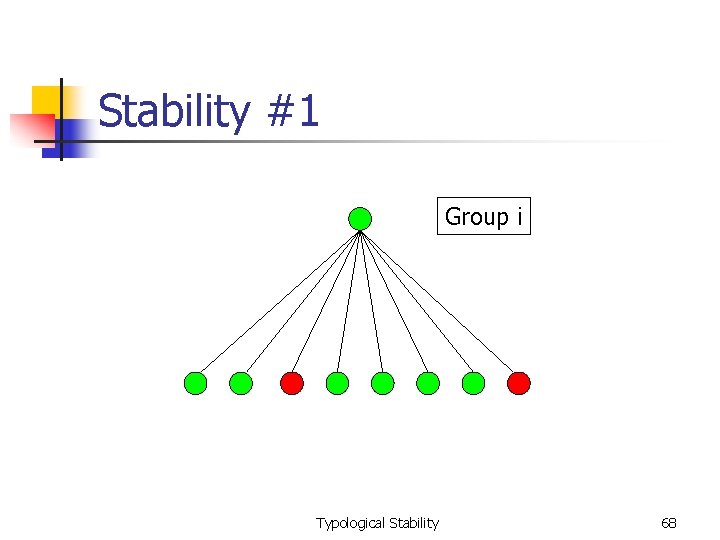
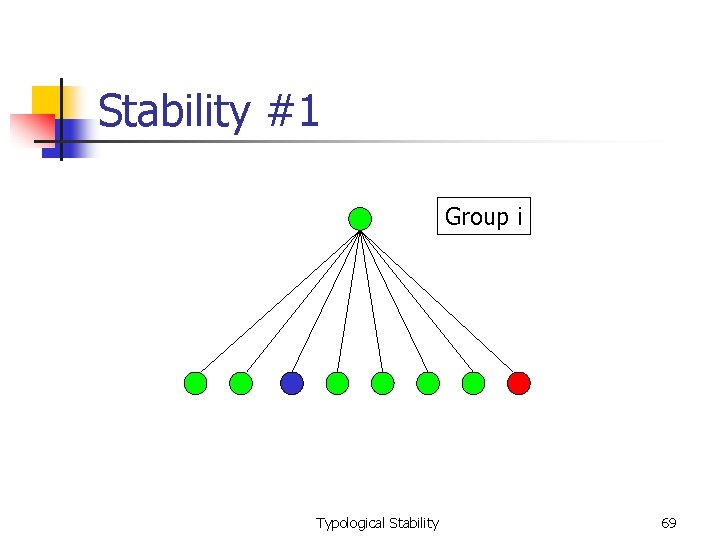
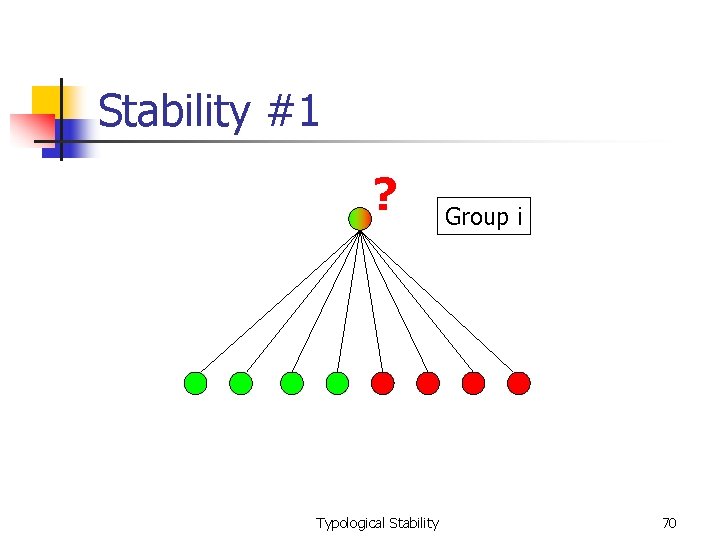
Stability #1 Group i Assumption: most frequent value = original Typological Stability 64
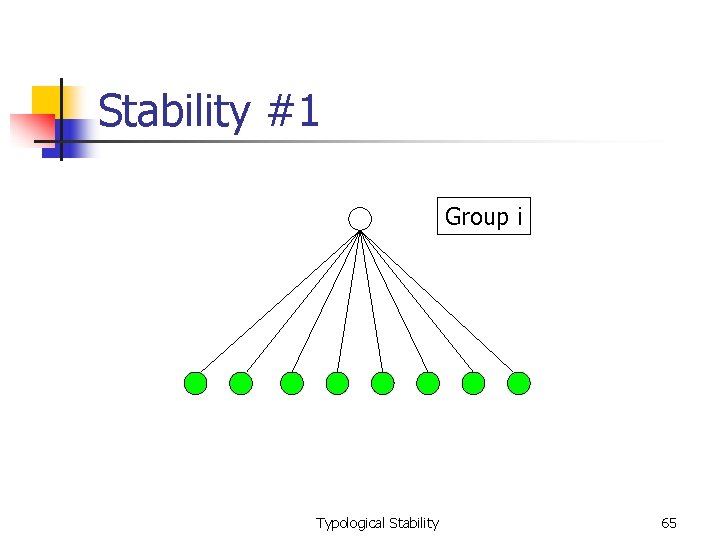
Stability #1 Group i Typological Stability 65
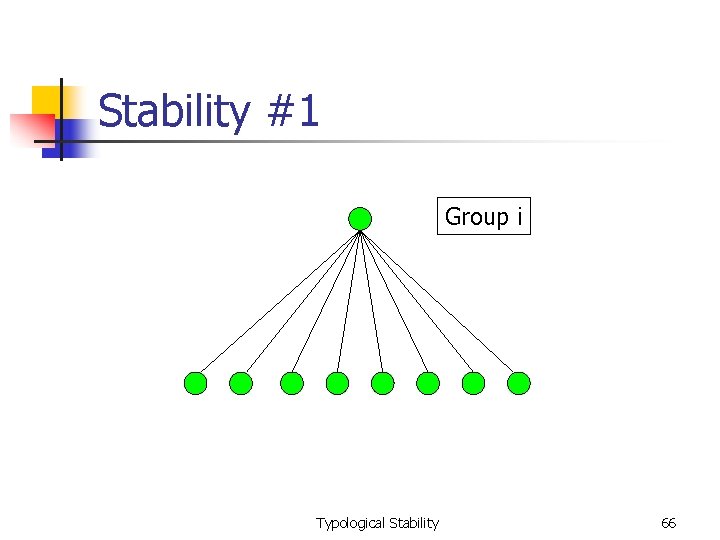
Stability #1 Group i Typological Stability 66
Stability #1 Group i Typological Stability 67
Stability #1 Group i Typological Stability 68
Stability #1 Group i Typological Stability 69
Stability #1 ? Typological Stability Group i 70
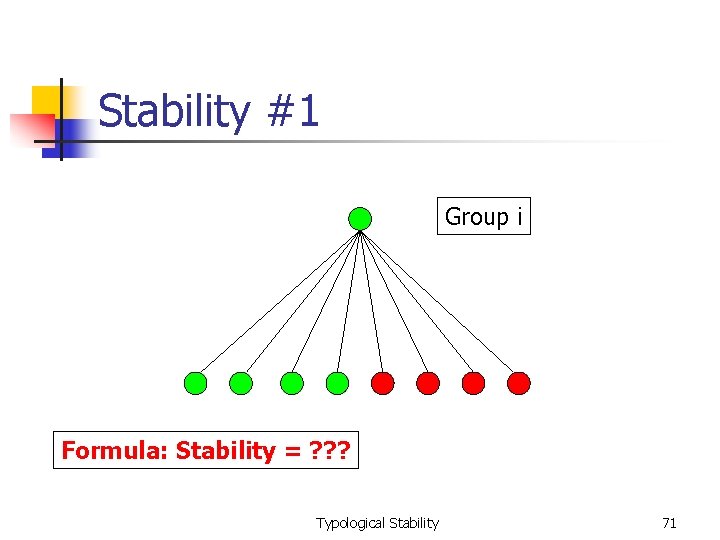
Stability #1 Group i Formula: Stability = ? ? ? Typological Stability 71
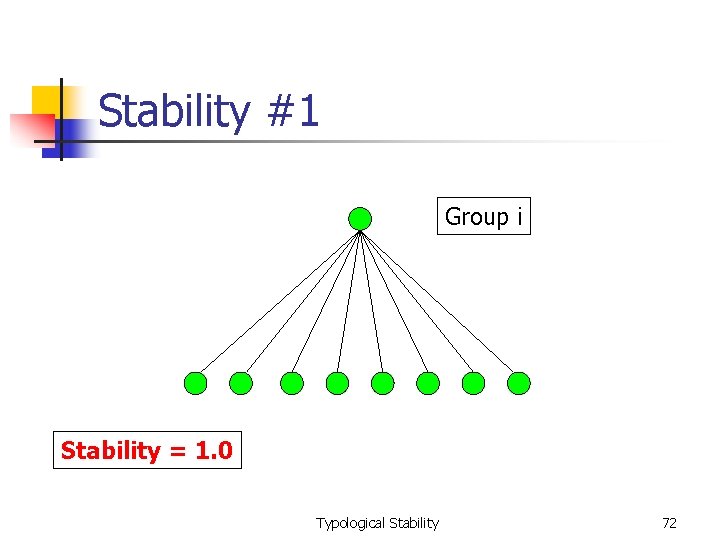
Stability #1 Group i Stability = 1. 0 Typological Stability 72
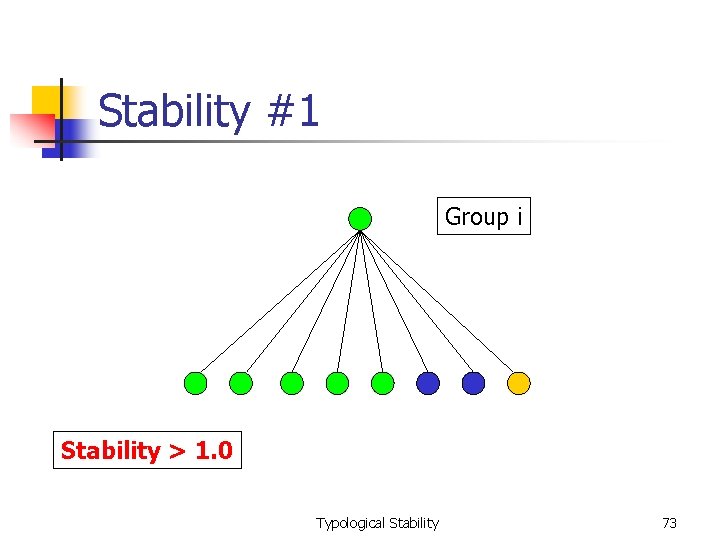
Stability #1 Group i Stability > 1. 0 Typological Stability 73
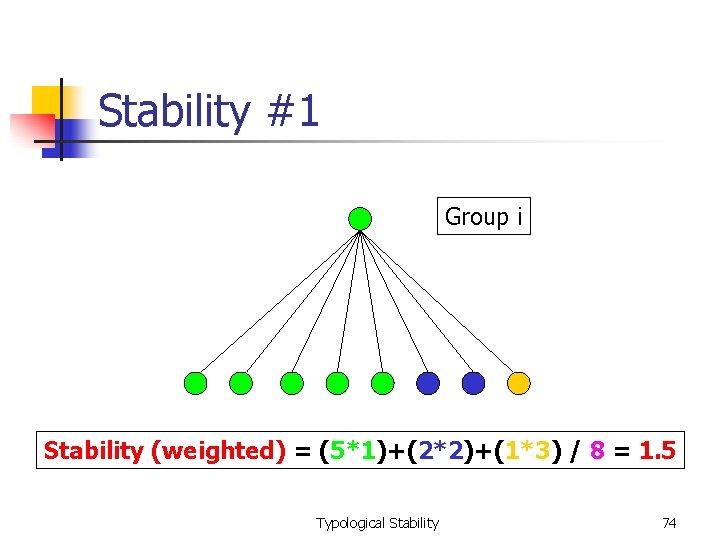
Stability #1 Group i Stability (weighted) = (5*1)+(2*2)+(1*3) / 8 = 1. 5 Typological Stability 74
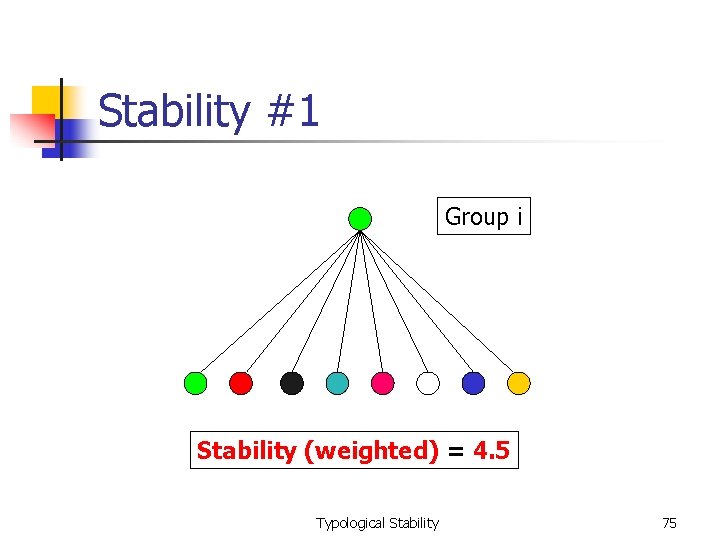
Stability #1 Group i Stability (weighted) = 4. 5 Typological Stability 75
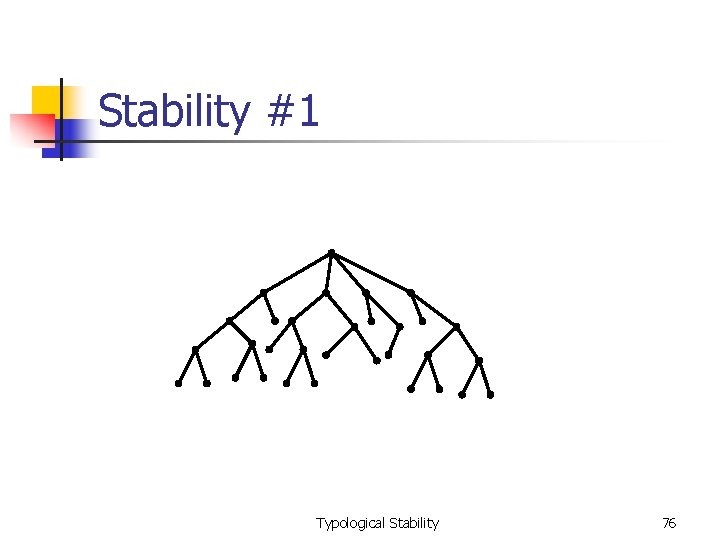
Stability #1 Typological Stability 76
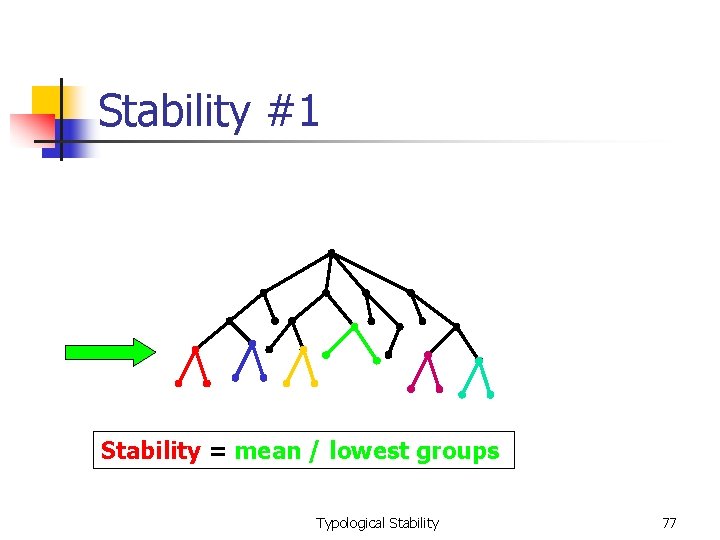
Stability #1 Stability = mean / lowest groups Typological Stability 77
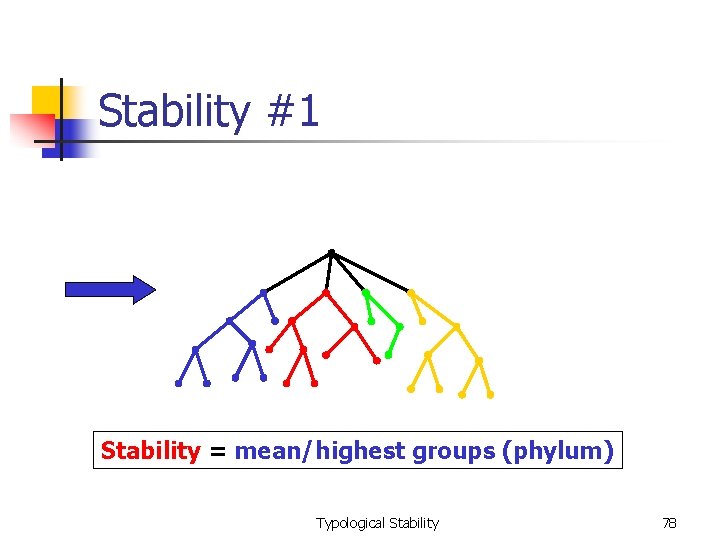
Stability #1 Stability = mean/highest groups (phylum) Typological Stability 78
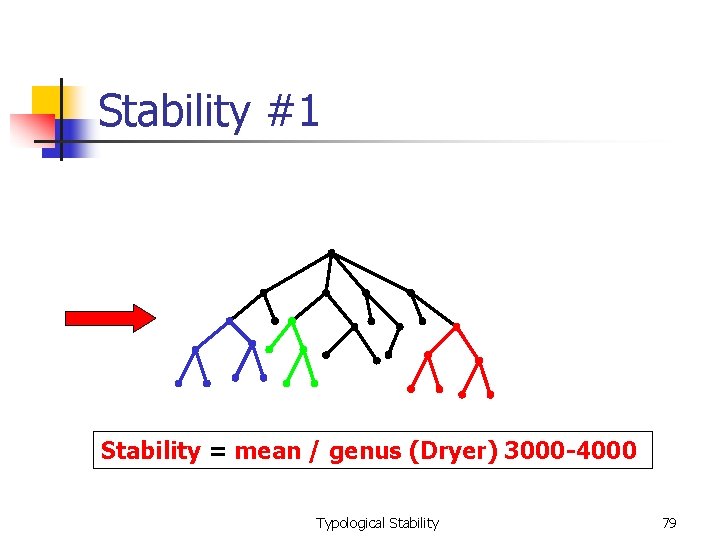
Stability #1 Stability = mean / genus (Dryer) 3000 -4000 Typological Stability 79
Stability #1 Typological Stability 80
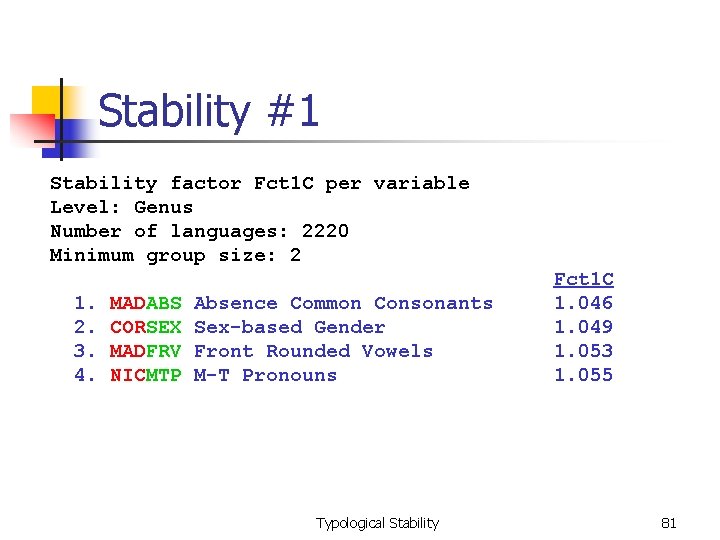
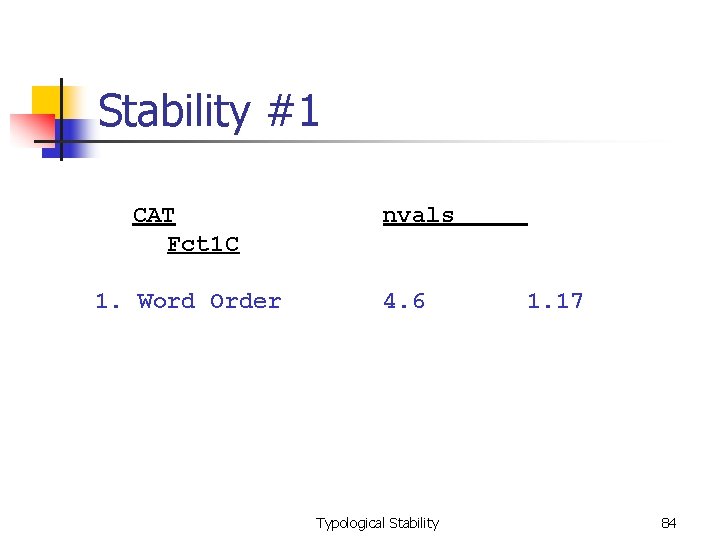
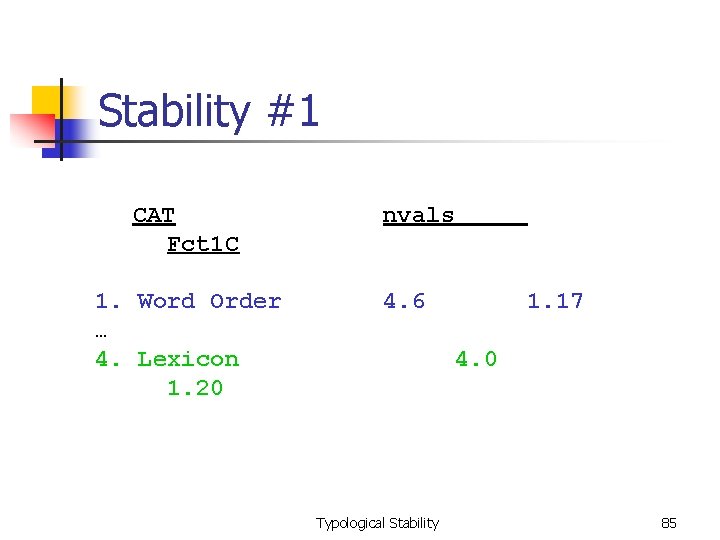
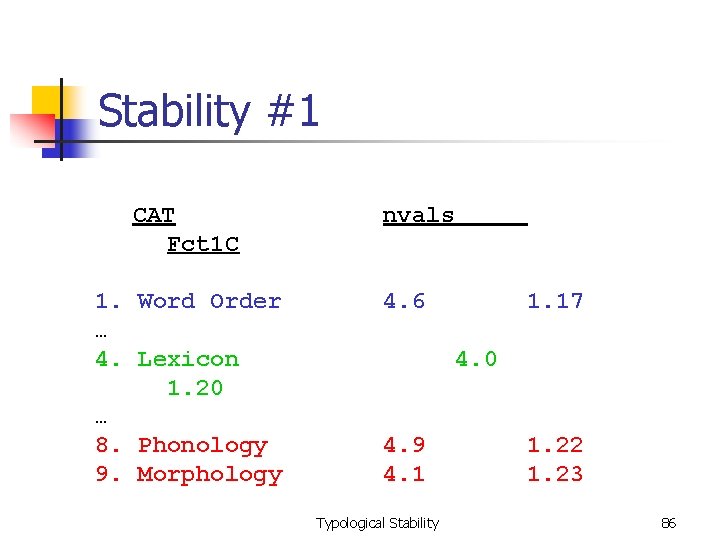
Stability #1 Stability factor Fct 1 C per variable Level: Genus Number of languages: 2220 Minimum group size: 2 1. 2. 3. 4. MADABS CORSEX MADFRV NICMTP Absence Common Consonants Sex-based Gender Front Rounded Vowels M-T Pronouns Typological Stability Fct 1 C 1. 046 1. 049 1. 053 1. 055 81
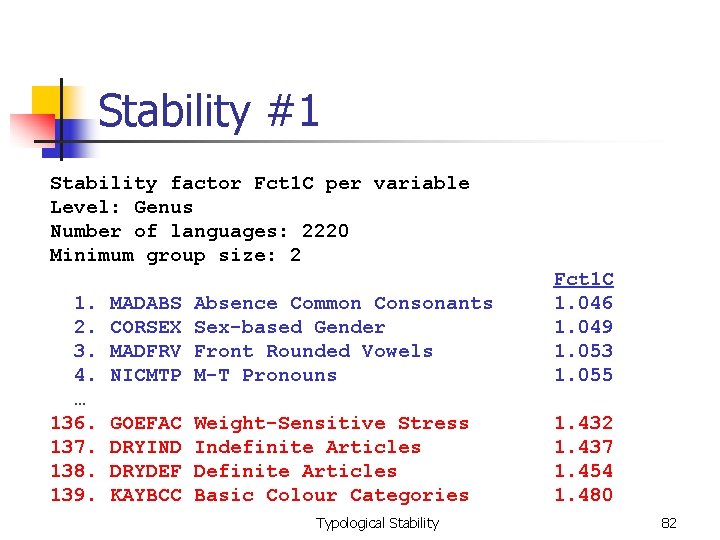
Stability #1 Stability factor Fct 1 C per variable Level: Genus Number of languages: 2220 Minimum group size: 2 1. 2. 3. 4. … 136. 137. 138. 139. MADABS CORSEX MADFRV NICMTP Absence Common Consonants Sex-based Gender Front Rounded Vowels M-T Pronouns Fct 1 C 1. 046 1. 049 1. 053 1. 055 GOEFAC DRYIND DRYDEF KAYBCC Weight-Sensitive Stress Indefinite Articles Definite Articles Basic Colour Categories 1. 432 1. 437 1. 454 1. 480 Typological Stability 82
Stability #1 CAT Fct 1 C nvals Typological Stability 83
Stability #1 CAT Fct 1 C 1. Word Order nvals 4. 6 Typological Stability 1. 17 84
Stability #1 CAT Fct 1 C 1. Word Order … 4. Lexicon 1. 20 nvals 4. 6 1. 17 4. 0 Typological Stability 85
Stability #1 CAT Fct 1 C 1. Word Order … 4. Lexicon 1. 20 … 8. Phonology 9. Morphology nvals 4. 6 1. 17 4. 0 4. 9 4. 1 Typological Stability 1. 22 1. 23 86
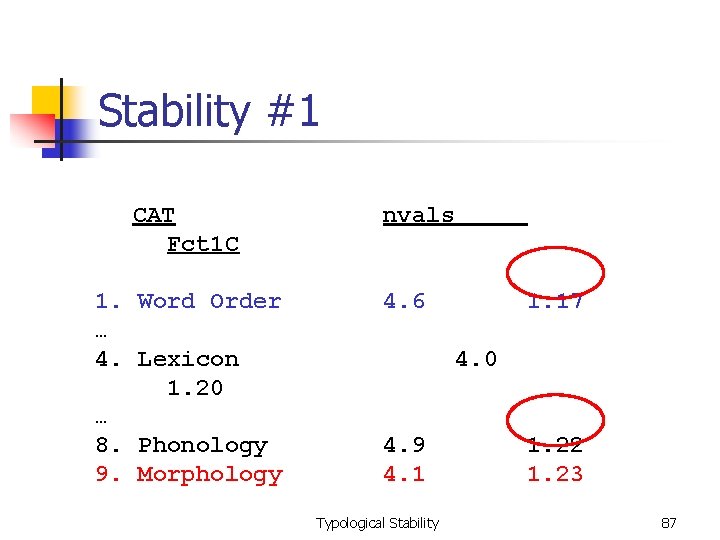
Stability #1 CAT Fct 1 C 1. Word Order … 4. Lexicon 1. 20 … 8. Phonology 9. Morphology nvals 4. 6 1. 17 4. 0 4. 9 4. 1 Typological Stability 1. 22 1. 23 87
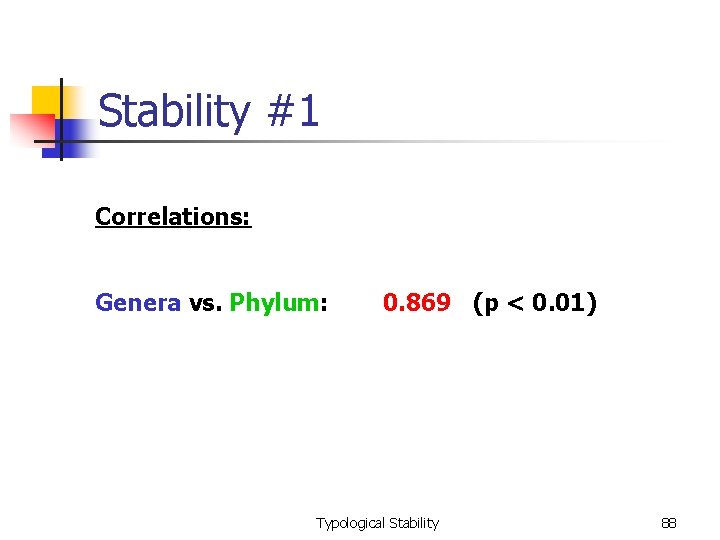
Stability #1 Correlations: Genera vs. Phylum: 0. 869 (p < 0. 01) Typological Stability 88
Stability #2 Typological Stability 89
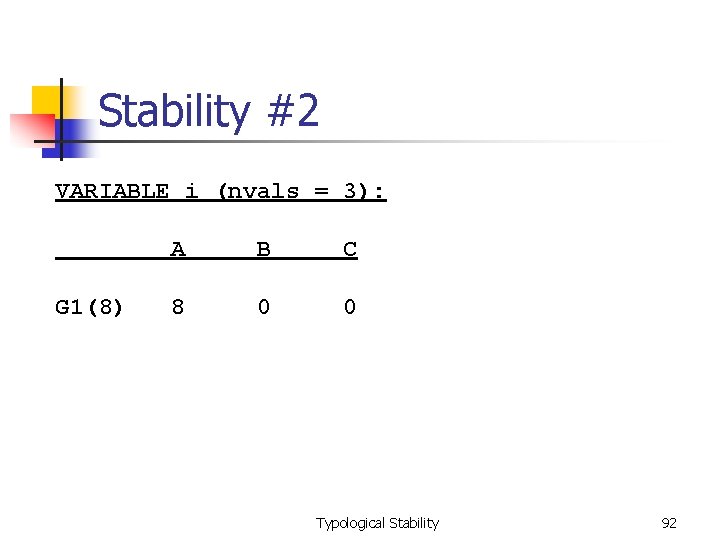
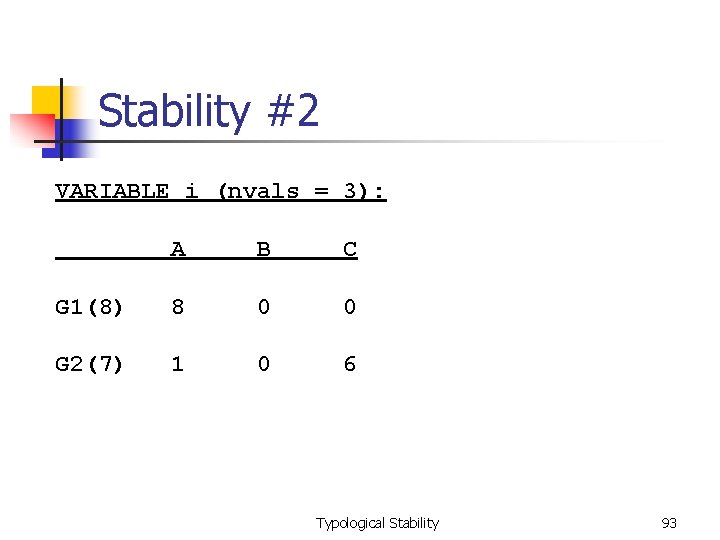
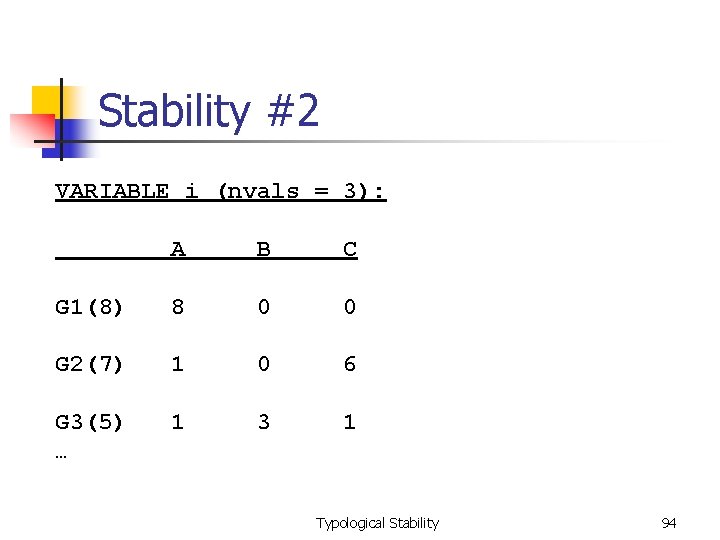
Stability #2 VARIABLE i (nvals = 3): Typological Stability 90
Stability #2 VARIABLE i (nvals = 3): A B C Typological Stability 91
Stability #2 VARIABLE i (nvals = 3): G 1(8) A B C 8 0 0 Typological Stability 92
Stability #2 VARIABLE i (nvals = 3): A B C G 1(8) 8 0 0 G 2(7) 1 0 6 Typological Stability 93
Stability #2 VARIABLE i (nvals = 3): A B C G 1(8) 8 0 0 G 2(7) 1 0 6 G 3(5) … 1 3 1 Typological Stability 94
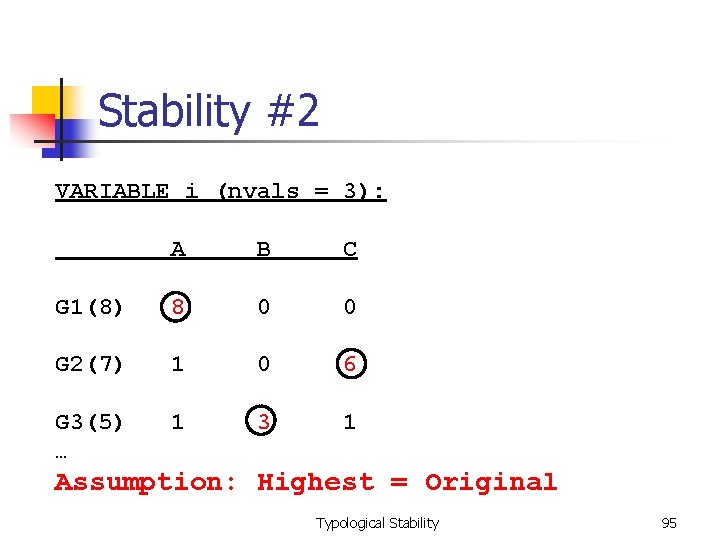
Stability #2 VARIABLE i (nvals = 3): A B C G 1(8) 8 0 0 G 2(7) 1 0 6 G 3(5) … 1 3 1 Assumption: Highest = Original Typological Stability 95
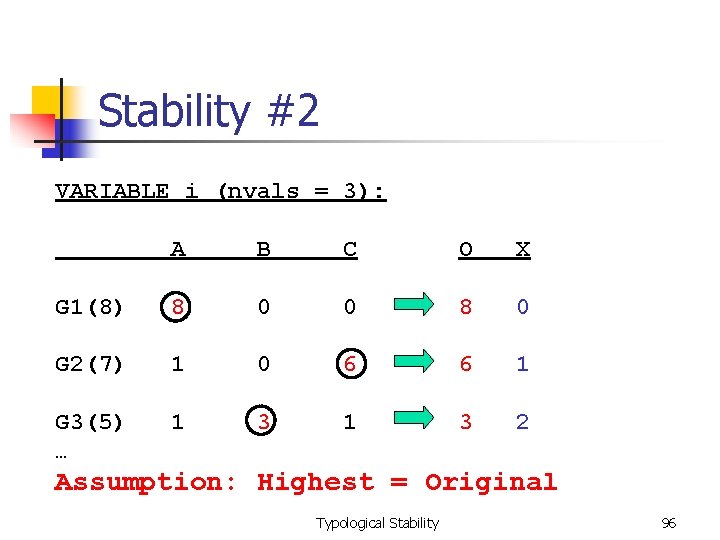
Stability #2 VARIABLE i (nvals = 3): A B C O X G 1(8) 8 0 0 8 0 G 2(7) 1 0 6 6 1 G 3(5) … 1 3 2 Assumption: Highest = Original Typological Stability 96
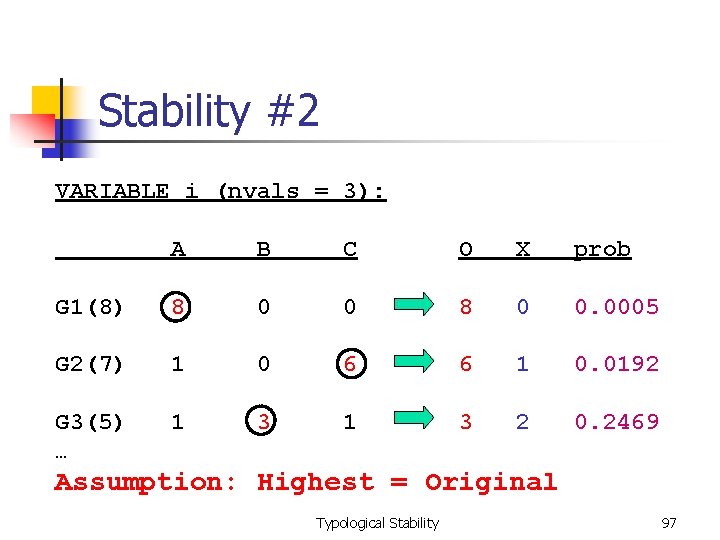
Stability #2 VARIABLE i (nvals = 3): A B C O X prob G 1(8) 8 0 0. 0005 G 2(7) 1 0 6 6 1 0. 0192 G 3(5) … 1 3 2 0. 2469 Assumption: Highest = Original Typological Stability 97
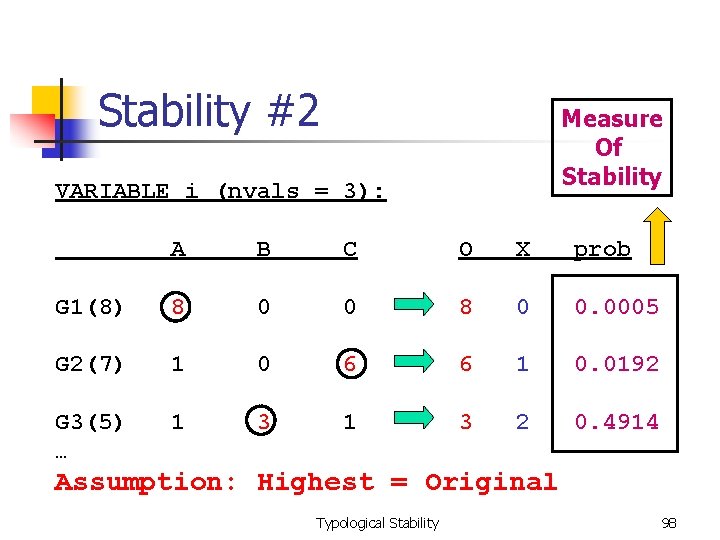
Stability #2 Measure Of Stability VARIABLE i (nvals = 3): A B C O X prob G 1(8) 8 0 0. 0005 G 2(7) 1 0 6 6 1 0. 0192 G 3(5) … 1 3 2 0. 4914 Assumption: Highest = Original Typological Stability 98
Stability #2 Stability factor Fct 2 B per variable Level: Genus Number of languages: 2220 Minimum group size: 2 Typological Stability 99
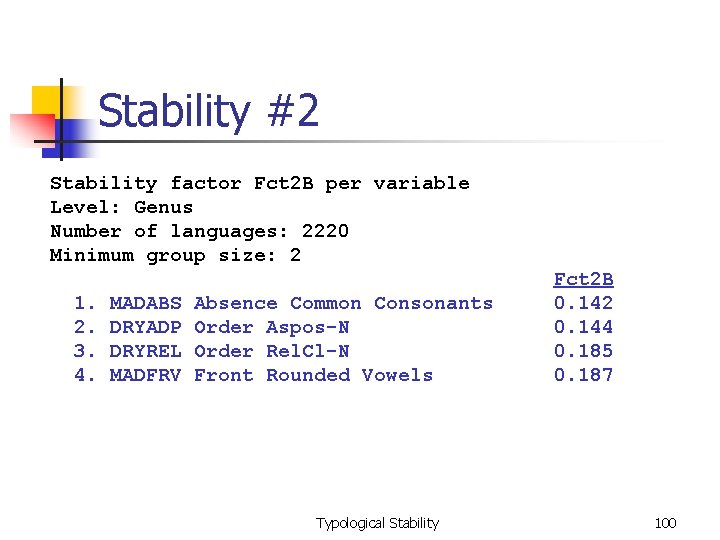
Stability #2 Stability factor Fct 2 B per variable Level: Genus Number of languages: 2220 Minimum group size: 2 1. 2. 3. 4. MADABS DRYADP DRYREL MADFRV Absence Common Consonants Order Aspos-N Order Rel. Cl-N Front Rounded Vowels Typological Stability Fct 2 B 0. 142 0. 144 0. 185 0. 187 100
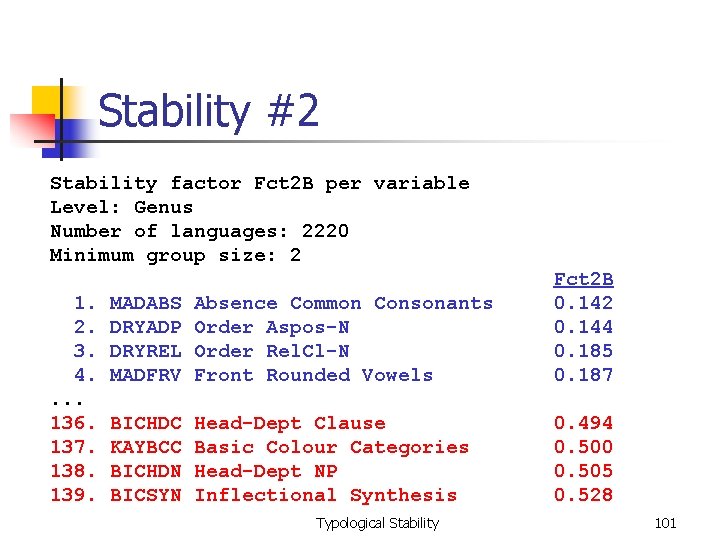
Stability #2 Stability factor Fct 2 B per variable Level: Genus Number of languages: 2220 Minimum group size: 2 1. 2. 3. 4. . 136. 137. 138. 139. MADABS DRYADP DRYREL MADFRV Absence Common Consonants Order Aspos-N Order Rel. Cl-N Front Rounded Vowels Fct 2 B 0. 142 0. 144 0. 185 0. 187 BICHDC KAYBCC BICHDN BICSYN Head-Dept Clause Basic Colour Categories Head-Dept NP Inflectional Synthesis 0. 494 0. 500 0. 505 0. 528 Typological Stability 101
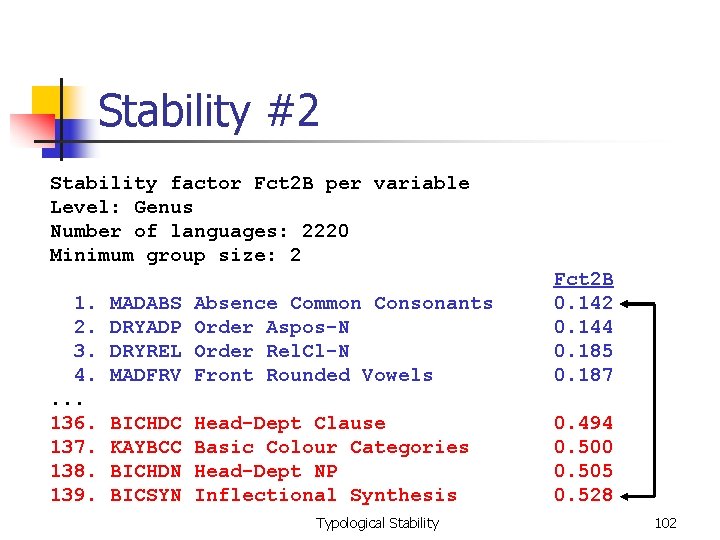
Stability #2 Stability factor Fct 2 B per variable Level: Genus Number of languages: 2220 Minimum group size: 2 1. 2. 3. 4. . 136. 137. 138. 139. MADABS DRYADP DRYREL MADFRV Absence Common Consonants Order Aspos-N Order Rel. Cl-N Front Rounded Vowels Fct 2 B 0. 142 0. 144 0. 185 0. 187 BICHDC KAYBCC BICHDN BICSYN Head-Dept Clause Basic Colour Categories Head-Dept NP Inflectional Synthesis 0. 494 0. 500 0. 505 0. 528 Typological Stability 102
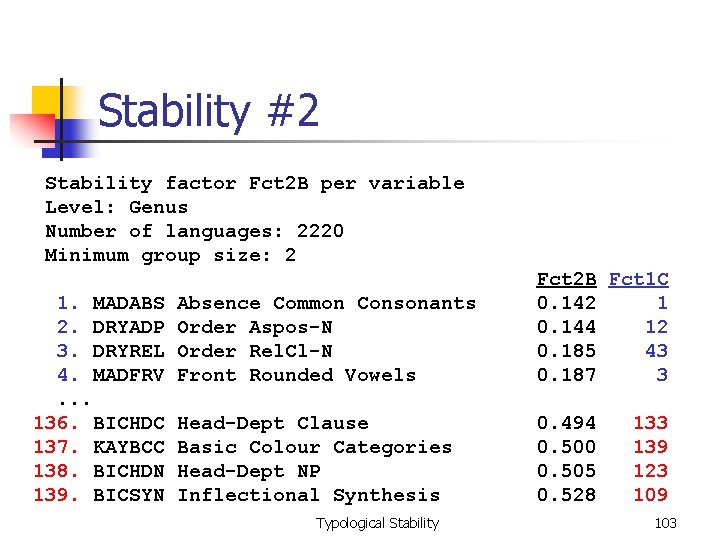
Stability #2 Stability factor Fct 2 B per variable Level: Genus Number of languages: 2220 Minimum group size: 2 1. MADABS 2. DRYADP 3. DRYREL 4. MADFRV. . . 136. BICHDC 137. KAYBCC 138. BICHDN 139. BICSYN Absence Common Consonants Order Aspos-N Order Rel. Cl-N Front Rounded Vowels Fct 2 B Fct 1 C 0. 142 1 0. 144 12 0. 185 43 0. 187 3 Head-Dept Clause Basic Colour Categories Head-Dept NP Inflectional Synthesis 0. 494 0. 500 0. 505 0. 528 Typological Stability 133 139 123 109 103
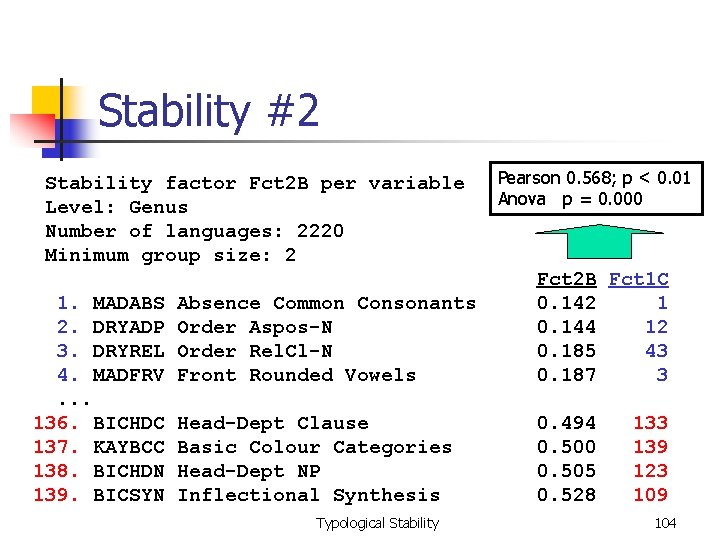
Stability #2 Stability factor Fct 2 B per variable Level: Genus Number of languages: 2220 Minimum group size: 2 1. MADABS 2. DRYADP 3. DRYREL 4. MADFRV. . . 136. BICHDC 137. KAYBCC 138. BICHDN 139. BICSYN Pearson 0. 568; p < 0. 01 Anova p = 0. 000 Absence Common Consonants Order Aspos-N Order Rel. Cl-N Front Rounded Vowels Fct 2 B Fct 1 C 0. 142 1 0. 144 12 0. 185 43 0. 187 3 Head-Dept Clause Basic Colour Categories Head-Dept NP Inflectional Synthesis 0. 494 0. 500 0. 505 0. 528 Typological Stability 133 139 123 109 104
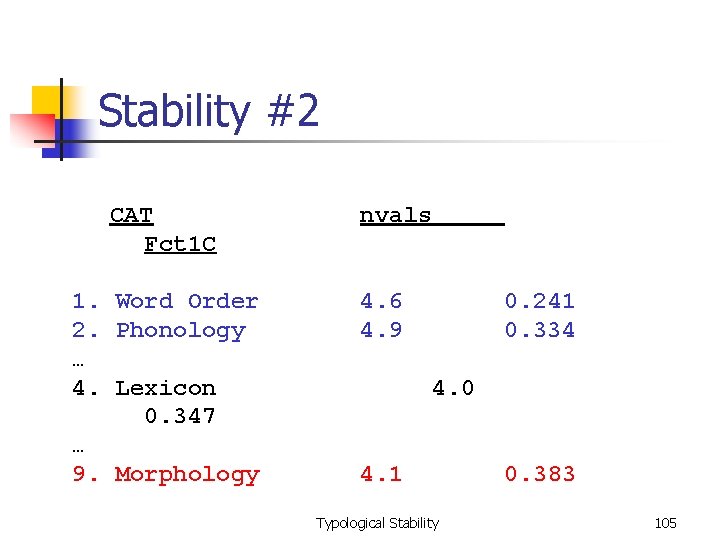
Stability #2 CAT Fct 1 C 1. Word Order 2. Phonology … 4. Lexicon 0. 347 … 9. Morphology nvals 4. 6 4. 9 0. 241 0. 334 4. 0 4. 1 Typological Stability 0. 383 105
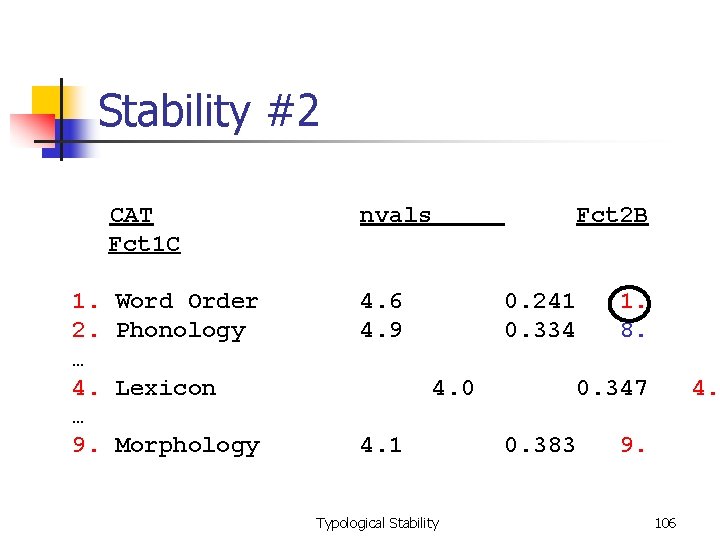
Stability #2 CAT Fct 1 C 1. 2. … 4. … 9. Word Order Phonology nvals 4. 6 4. 9 Lexicon Morphology Fct 2 B 0. 241 0. 334 4. 0 4. 1 Typological Stability 1. 8. 0. 347 0. 383 4. 9. 106
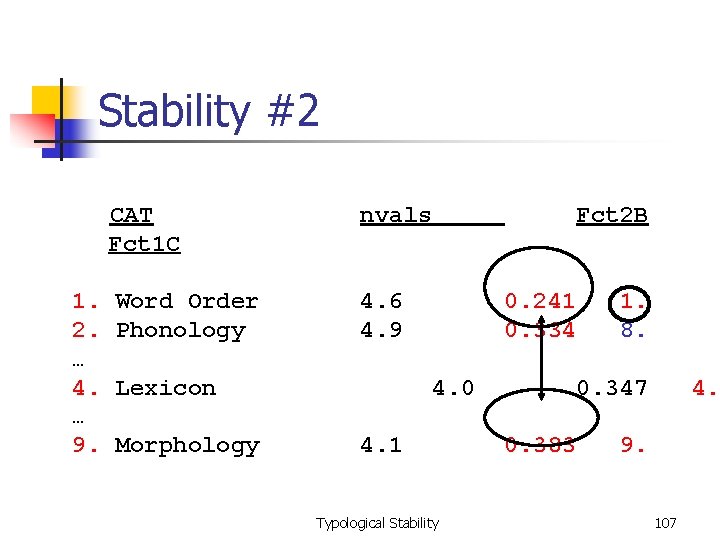
Stability #2 CAT Fct 1 C 1. 2. … 4. … 9. Word Order Phonology nvals 4. 6 4. 9 Lexicon Morphology Fct 2 B 0. 241 0. 334 4. 0 4. 1 Typological Stability 1. 8. 0. 347 0. 383 4. 9. 107
Problems Typological Stability 108
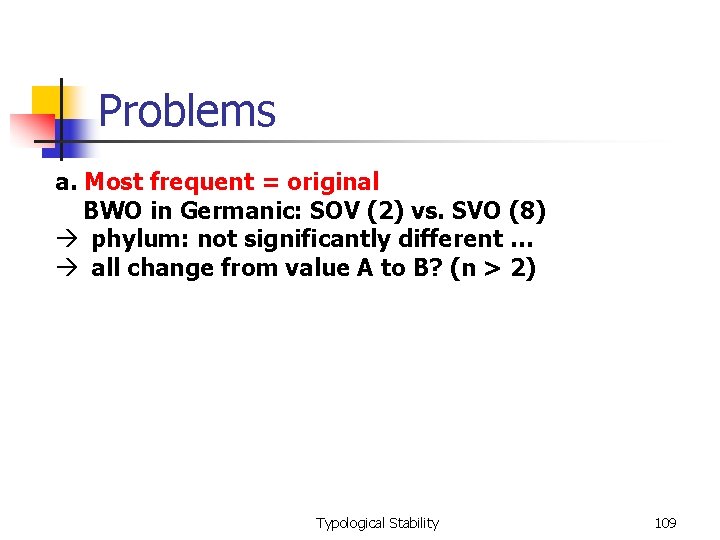
Problems a. Most frequent = original BWO in Germanic: SOV (2) vs. SVO (8) à phylum: not significantly different … à all change from value A to B? (n > 2) Typological Stability 109
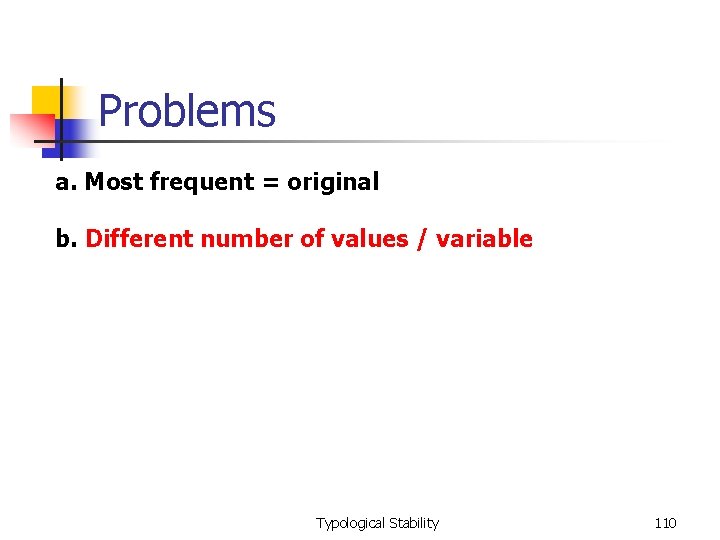
Problems a. Most frequent = original b. Different number of values / variable Typological Stability 110
Problems a. Most frequent = original b. Different number of values / variable c. Different distributions values / transitions blocked Typological Stability 111
Problems a. Most frequent = original b. Different number of values / variable c. Different distributions values / transitions blocked d. Different group size (1(!) - 90) Typological Stability 112
Problems a. Most frequent = original b. Different number of values / variable c. Different distributions values / transitions blocked d. Different group size (1(!) - 90) e. Different distribution of variables (WALS = empty) Typological Stability 113
Problems a. Most frequent = original b. Different number of values / variable c. Different distributions values / transitions blocked d. Different group size (1(!) - 90) e. Different distribution of variables (WALS = empty) f. Right statistics/measurements: - distributions <> normal - combinatorial explosion groups > 12 lgs Typological Stability 114
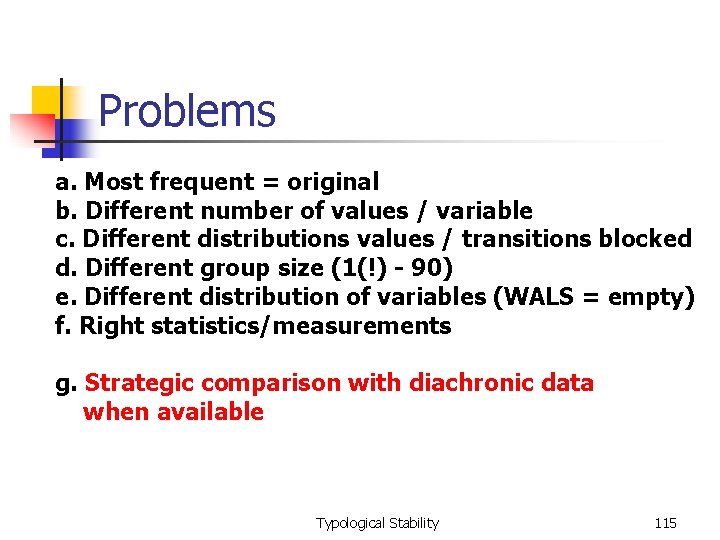
Problems a. Most frequent = original b. Different number of values / variable c. Different distributions values / transitions blocked d. Different group size (1(!) - 90) e. Different distribution of variables (WALS = empty) f. Right statistics/measurements g. Strategic comparison with diachronic data when available Typological Stability 115
Solution The Real Thing Is The Best Typological Stability 116
? Typological Stability 117
- Slides: 117