
Measuring the PNC Spin Rotation of Polarized Neutrons

- Slides: 28
Measuring the PNC Spin. Rotation of Polarized Neutrons Traversing Liquid Helium C. Bass, D. Luo, H. Nann, M. Sarsour, W. Snow Indiana University P. Huffman NIST C. Gould, D. Haase, D. Markoff North Carolina State University E. Adelberger, B. Heckel, H. Swanson University of Washington
Seminar Overview • Weak NN-Interaction and the Meson. Exchange Model • Spin-Rotation Observable • Experimental Apparatus • Project Status
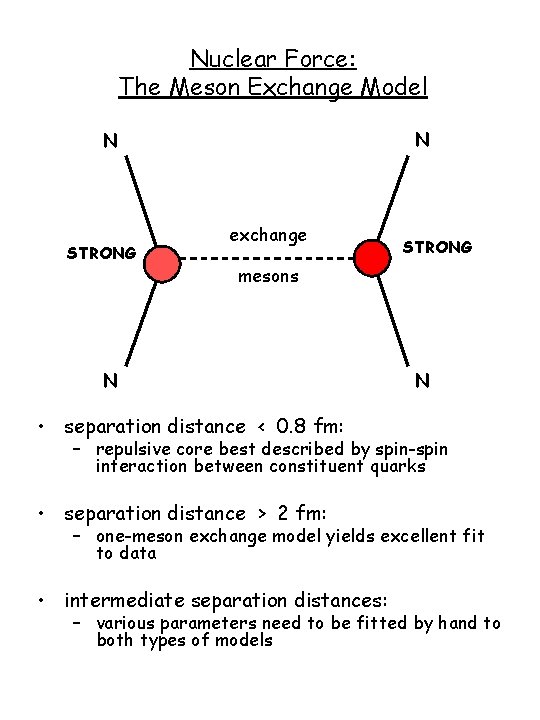
Nuclear Force: The Meson Exchange Model N N STRONG exchange STRONG mesons N N • separation distance < 0. 8 fm: – repulsive core best described by spin-spin interaction between constituent quarks • separation distance > 2 fm: – one-meson exchange model yields excellent fit to data • intermediate separation distances: – various parameters need to be fitted by hand to both types of models
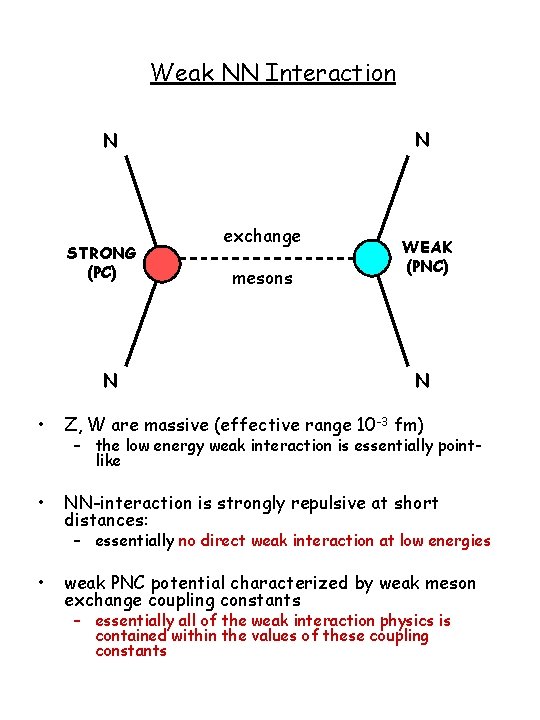
Weak NN Interaction N N STRONG (PC) N exchange mesons WEAK (PNC) N • Z, W are massive (effective range 10 -3 fm) • NN-interaction is strongly repulsive at short distances: – the low energy weak interaction is essentially pointlike – essentially no direct weak interaction at low energies • weak PNC potential characterized by weak meson exchange coupling constants – essentially all of the weak interaction physics is contained within the values of these coupling constants
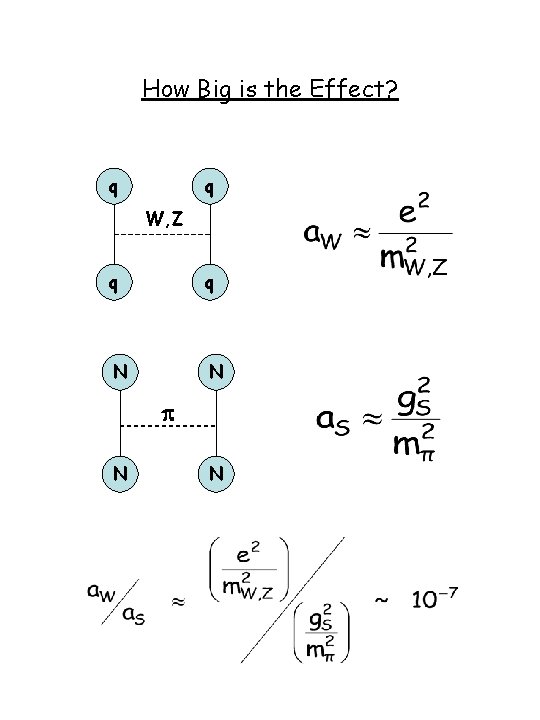
How Big is the Effect? q q W, Z q q N N p N N
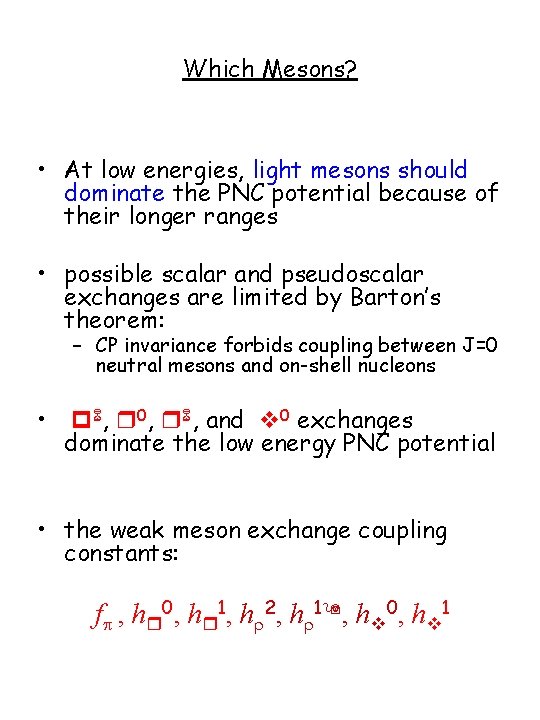
Which Mesons? • At low energies, light mesons should dominate the PNC potential because of their longer ranges • possible scalar and pseudoscalar exchanges are limited by Barton’s theorem: – CP invariance forbids coupling between J=0 neutral mesons and on-shell nucleons • p 6, r 0, r 6, and v 0 exchanges dominate the low energy PNC potential • the weak meson exchange coupling constants: fp , hr 0, hr 1, hr 2, hr 19, hv 0, hv 1
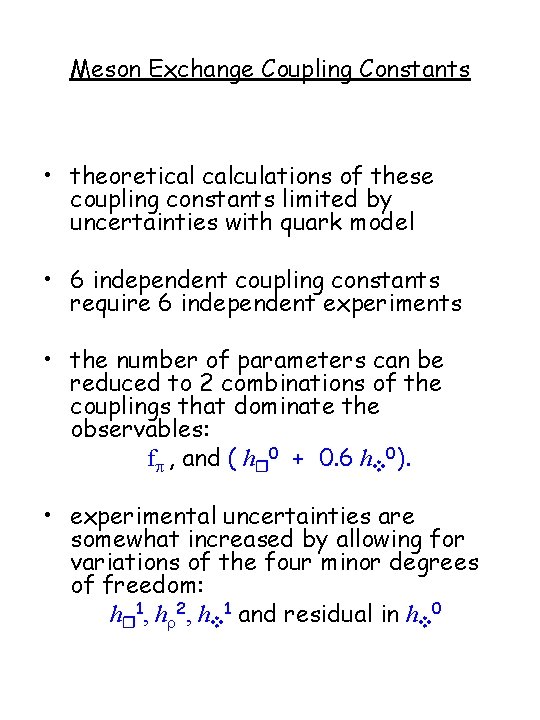
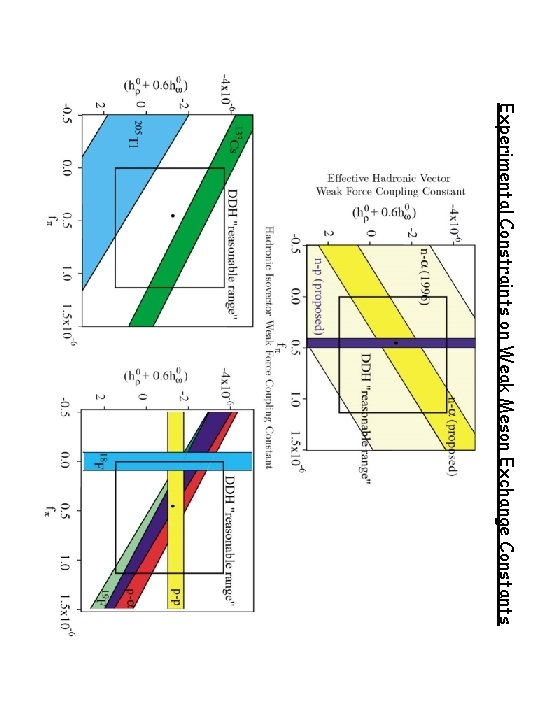
Meson Exchange Coupling Constants • theoretical calculations of these coupling constants limited by uncertainties with quark model • 6 independent coupling constants require 6 independent experiments • the number of parameters can be reduced to 2 combinations of the couplings that dominate the observables: fp , and ( hr 0 + 0. 6 hv 0). • experimental uncertainties are somewhat increased by allowing for variations of the four minor degrees of freedom: hr 1, hr 2, hv 1 and residual in hv 0
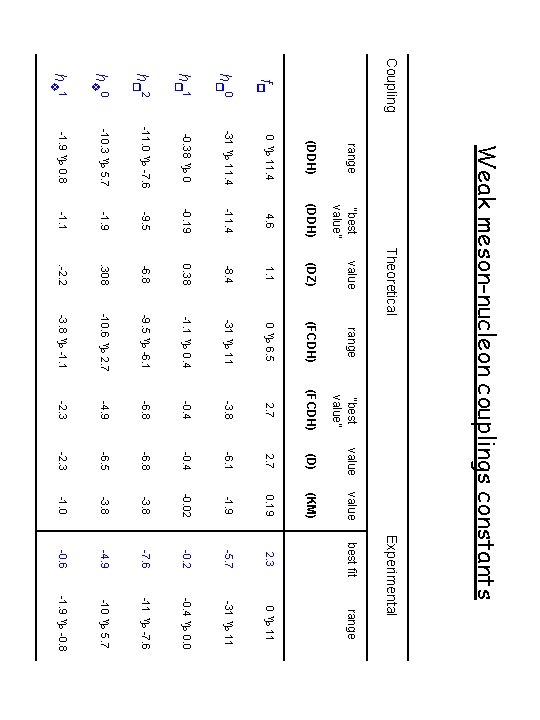
Weak meson-nucleon couplings constants hr 1 hr 0 fp -11. 0 g -7. 6 -0. 38 g 0 -31 g 11. 4 0 g 11. 4 (DDH) range -1. 9 -9. 5 -0. 19 -11. 4 4. 6 (DDH) “best value” . -2. 2 . 308 -6. 8 0. 38 -8. 4 1. 1 (DZ) value -3. 8 g -1. 1 -10. 6 g 2. 7 -9. 5 g -6. 1 -1. 1 g 0. 4 -31 g 11 0 g 6. 5 (FCDH) range -2. 3 -4. 9 -6. 8 -0. 4 -3. 8 2. 7 (FCDH) “best value” -2. 3 -6. 5 -6. 8 -0. 4 -6. 1 2. 7 (D) value -1. 0 -3. 8 -0. 02 -1. 9 0. 19 (KM) value -0. 6 -4. 9 -7. 6 -0. 2 -5. 7 2. 3 best fit -1. 9 g -0. 8 -10 g 5. 7 -11 g -7. 6 -0. 4 g 0. 0 -31 g 11 0 g 11 range Experimental hr 2 -10. 3 g 5. 7 -1. 1 Theoretical hv 0 -1. 9 g 0. 8 Coupling hv 1
Experimental Constraints on Weak Meson Exchange Constants
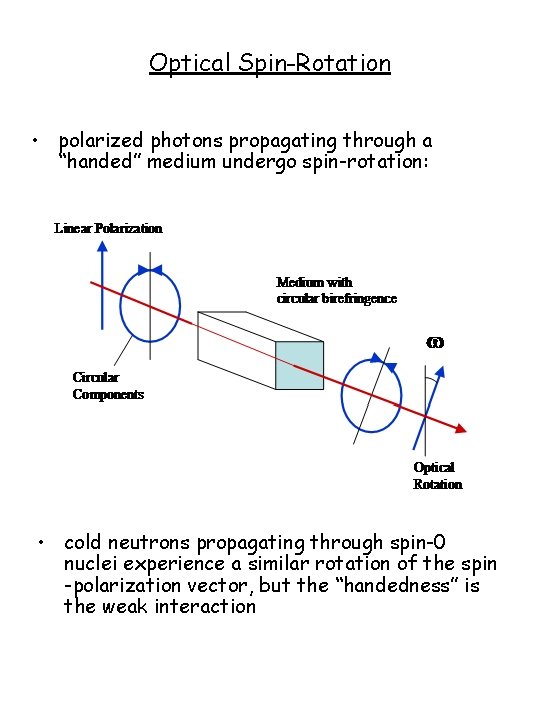
Optical Spin-Rotation • polarized photons propagating through a “handed” medium undergo spin-rotation: • cold neutrons propagating through spin-0 nuclei experience a similar rotation of the spin -polarization vector, but the “handedness” is the weak interaction
Neutron Optics
Neutrons Traveling Through Helium
Spin Rotation Observable
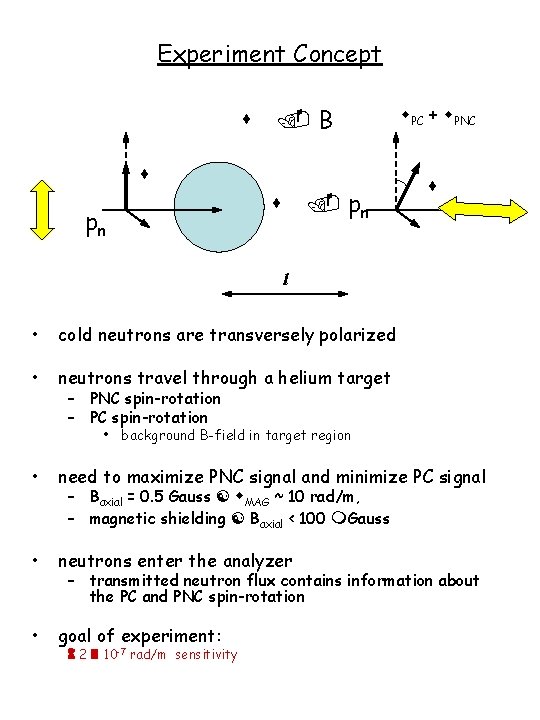
Experiment Concept s . B s pn s w. PC + w. PNC s l • cold neutrons are transversely polarized • neutrons travel through a helium target – PNC spin-rotation – PC spin-rotation • background B-field in target region • need to maximize PNC signal and minimize PC signal • neutrons enter the analyzer • goal of experiment: – Baxial = 0. 5 Gauss [ w. MAG ~ 10 rad/m, – magnetic shielding [ Baxial < 100 m. Gauss – transmitted neutron flux contains information about the PC and PNC spin-rotation 6 2 3 10 -7 rad/m sensitivity
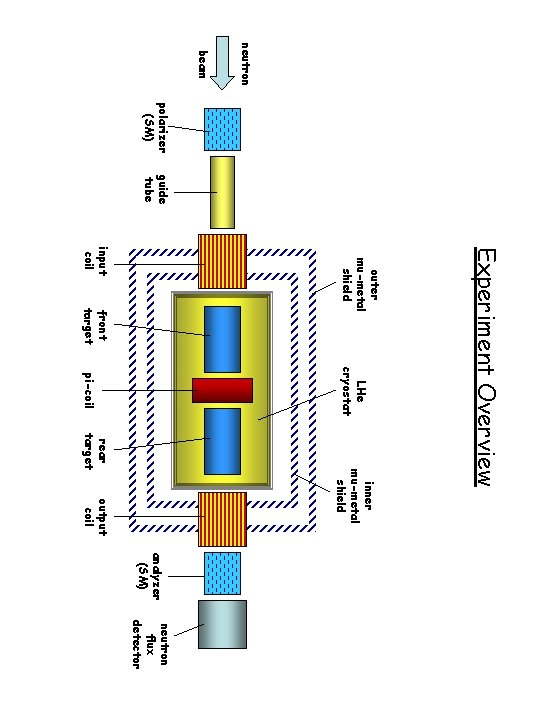
neutron beam polarizer (SM) guide tube pi-coil LHe cryostat rear target output coil inner mu-metal shield Experiment Overview front target outer mu-metal shield input coil analyzer (SM) neutron flux detector
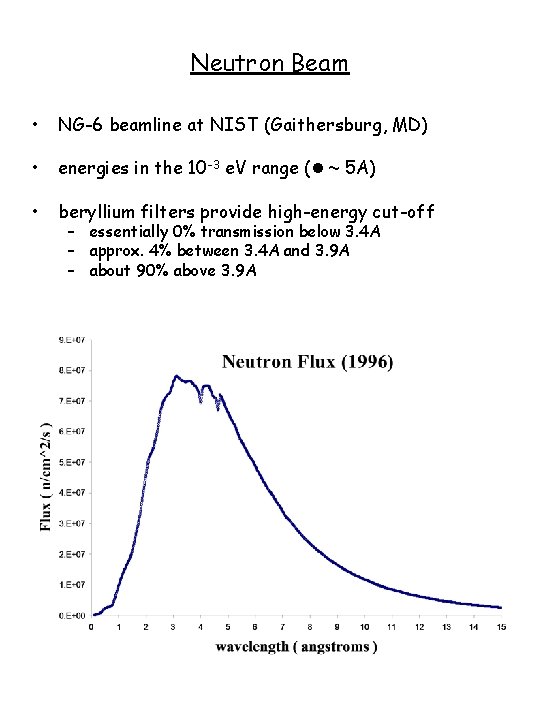
Neutron Beam • NG-6 beamline at NIST (Gaithersburg, MD) • energies in the 10 -3 e. V range (l ~ 5 A) • beryllium filters provide high-energy cut-off – essentially 0% transmission below 3. 4 A – approx. 4% between 3. 4 A and 3. 9 A – about 90% above 3. 9 A
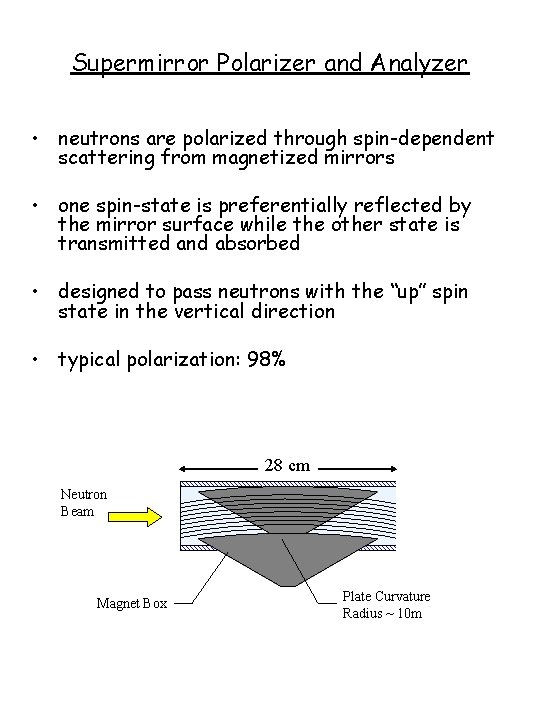
Supermirror Polarizer and Analyzer • neutrons are polarized through spin-dependent scattering from magnetized mirrors • one spin-state is preferentially reflected by the mirror surface while the other state is transmitted and absorbed • designed to pass neutrons with the “up” spin state in the vertical direction • typical polarization: 98% 28 cm Neutron Beam Magnet Box Plate Curvature Radius ~ 10 m
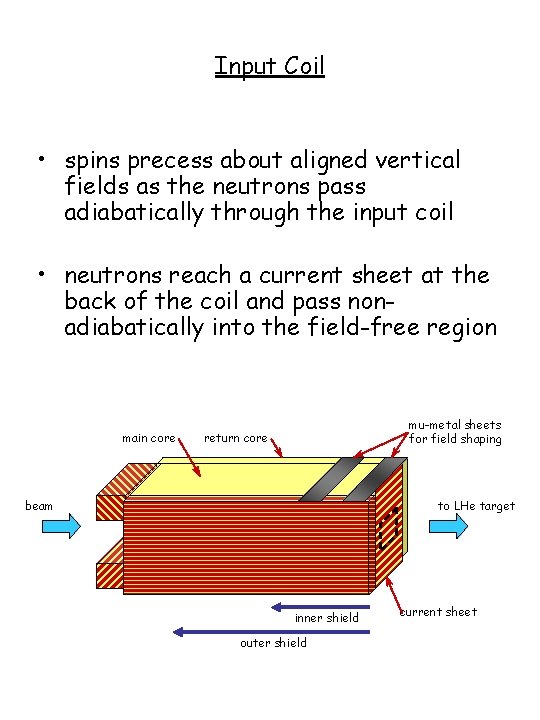
Input Coil • spins precess about aligned vertical fields as the neutrons pass adiabatically through the input coil • neutrons reach a current sheet at the back of the coil and pass nonadiabatically into the field-free region main core mu-metal sheets for field shaping return core beam to LHe target inner shield outer shield current sheet
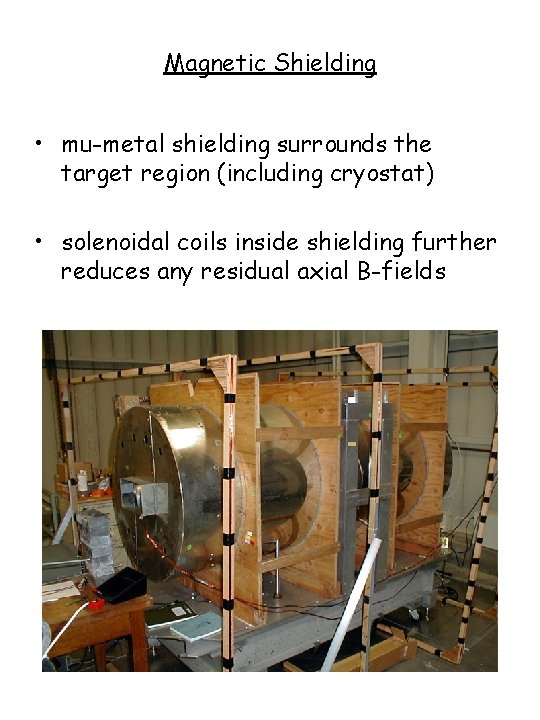
Magnetic Shielding • mu-metal shielding surrounds the target region (including cryostat) • solenoidal coils inside shielding further reduces any residual axial B-fields
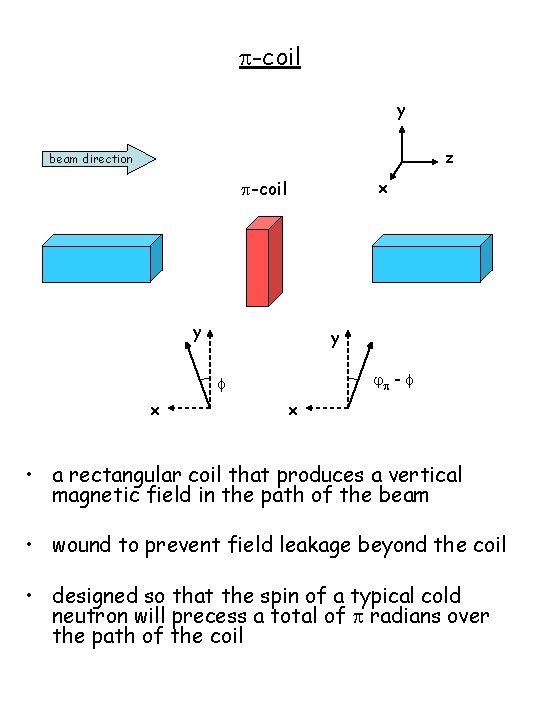
p-coil y z beam direction x p-coil y y jp - f f x x • a rectangular coil that produces a vertical magnetic field in the path of the beam • wound to prevent field leakage beyond the coil • designed so that the spin of a typical cold neutron will precess a total of p radians over the path of the coil
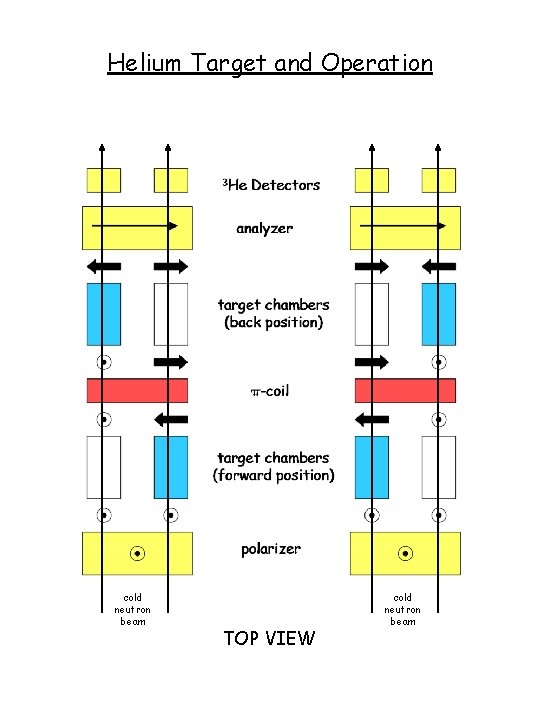
Helium Target and Operation cold neutron beam TOP VIEW cold neutron beam
Output Coil • neutron spins pass non-adiabatically through front of output coil • transverse component of spin adiabatically rotated into a horizontal B-field (y-axis) • the orientation of this (y-axis) B-field is flipped at a rate of ~ 1 Hz • spins then adiabatically rotated into the vertical (x-axis) direction of the analyzer • neutrons spins are now either parallel or antiparallel to the analyzer (depending on the target state and the orientation of the y-axis B -field)
3 He Neutron Detector • neutrons detected through the following reaction: n 1 3 He g 3 H 1 1 H • charged reaction-products ionize the gas mixture • high voltage and grounded charge-collecting plates produce a current proportional to the neutron flux
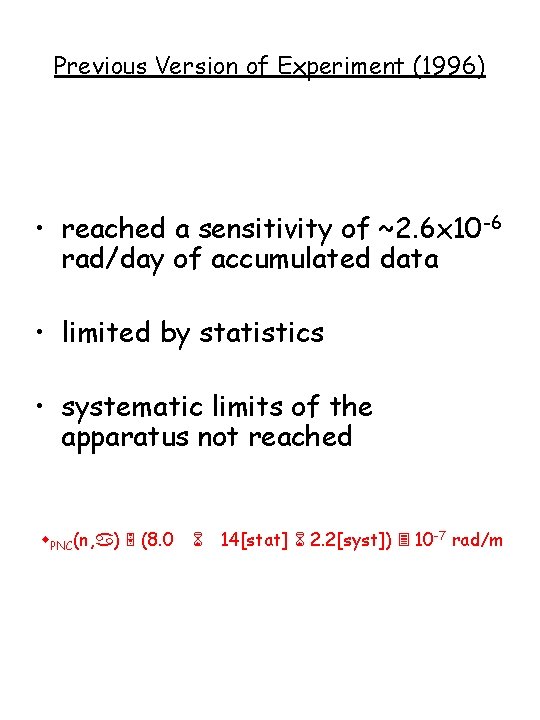
Previous Version of Experiment (1996) • reached a sensitivity of ~2. 6 x 10 -6 rad/day of accumulated data • limited by statistics • systematic limits of the apparatus not reached w. PNC(n, a) 5 (8. 0 6 14[stat] 6 2. 2[syst]) 3 10 -7 rad/m
Redesign of Experiment • increase available statistics by improving reliability and decreasing downtime • increase the detected beam flux (NIST reactor upgrade: factor ~1. 5) • use of superfluid helium • additional layer of mu-metal shielding • want a factor of x 10 higher sensitivity in order to obtain a non-zero / null result: ~ 0. 6310 -6 rad / day of accumulated data estimate ~30 days of data for desired sensitivity
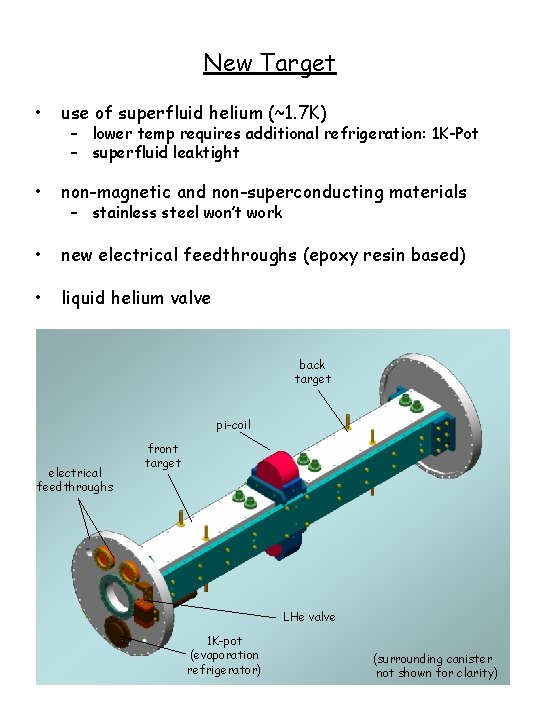
New Target • use of superfluid helium (~1. 7 K) • non-magnetic and non-superconducting materials • new electrical feedthroughs (epoxy resin based) • liquid helium valve – lower temp requires additional refrigeration: 1 K-Pot – superfluid leaktight – stainless steel won’t work back target pi-coil electrical feedthroughs front target LHe valve 1 K-pot (evaporation refrigerator) (surrounding canister not shown for clarity)
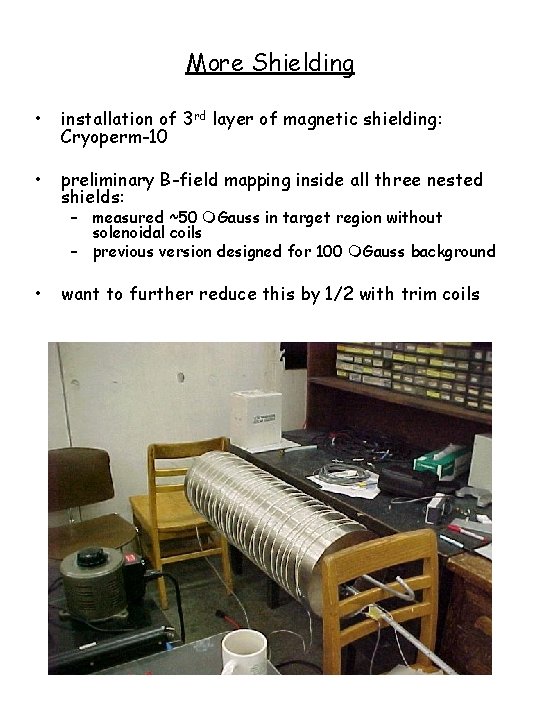
More Shielding • installation of 3 rd layer of magnetic shielding: Cryoperm-10 • preliminary B-field mapping inside all three nested shields: – measured ~50 m. Gauss in target region without solenoidal coils – previous version designed for 100 m. Gauss background • want to further reduce this by 1/2 with trim coils
Current Status • field mapping of in/output coils and magnetic shielding • analysis of systematic effects • computer simulations • new target ready for machining • machining of target components • run at NIST in fall 2003