
Measuring the Physical Properties of Matter Mass vs

- Slides: 12
Measuring the Physical Properties of Matter:
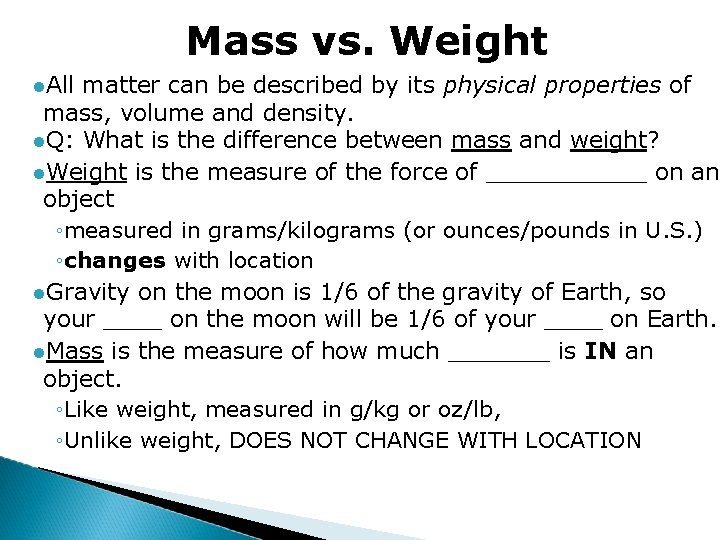
Mass vs. Weight ●All matter can be described by its physical properties of mass, volume and density. ●Q: What is the difference between mass and weight? ●Weight is the measure of the force of ______ on an object ◦measured in grams/kilograms (or ounces/pounds in U. S. ) ◦changes with location ●Gravity on the moon is 1/6 of the gravity of Earth, so your ____ on the moon will be 1/6 of your ____ on Earth. ●Mass is the measure of how much _______ is IN an object. ◦Like weight, measured in g/kg or oz/lb, ◦Unlike weight, DOES NOT CHANGE WITH LOCATION
Quick Review Put the following steps of engineering a new watch in order: ● Five digital watches are tested to determine which prototype uses up the least battery charge ● The final watch prototype is evaluated and redesigned to make it even more efficient in its battery use ● Different ideas for designing a smaller and more powerful watch battery are brainstormed ● Five different prototypes that fit the specifications and constraints are produced ● A group of engineers is presented with the challenge to produce a new watch with a smaller and longer lasting battery
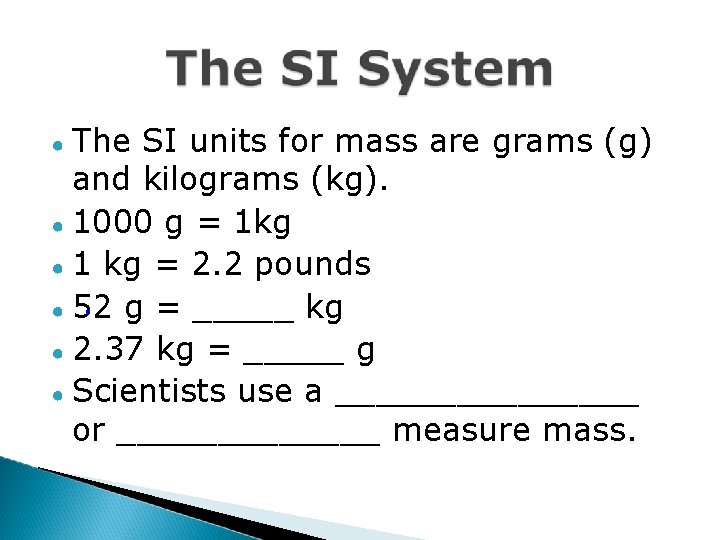
The SI units for mass are grams (g) and kilograms (kg). ● 1000 g = 1 kg ● 1 kg = 2. 2 pounds ● 52 g = _____ kg ● 2. 37 kg = _____ g ● Scientists use a ________ or _______ measure mass. ●
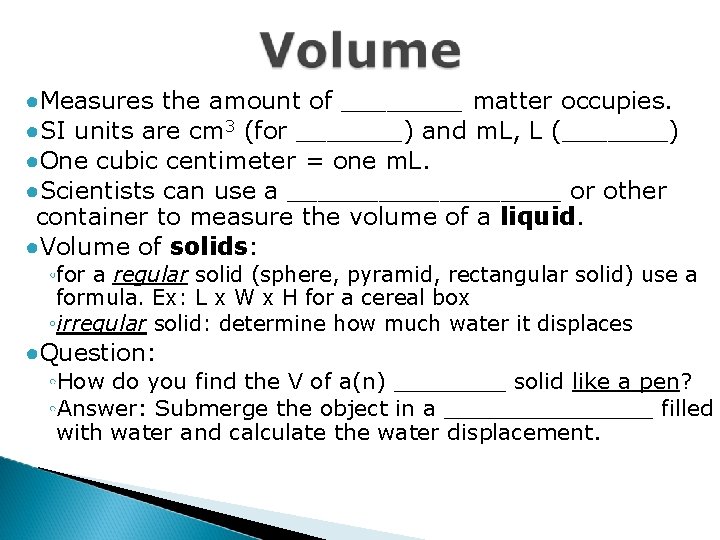
●Measures the amount of ____ matter occupies. ●SI units are cm 3 (for _______) and m. L, L (_______) ●One cubic centimeter = one m. L. ●Scientists can use a _________ or other container to measure the volume of a liquid. ●Volume of solids: ◦for a regular solid (sphere, pyramid, rectangular solid) use a formula. Ex: L x W x H for a cereal box ◦irregular solid: determine how much water it displaces ●Question: ◦How do you find the V of a(n) ____ solid like a pen? ◦Answer: Submerge the object in a ________ filled with water and calculate the water displacement.
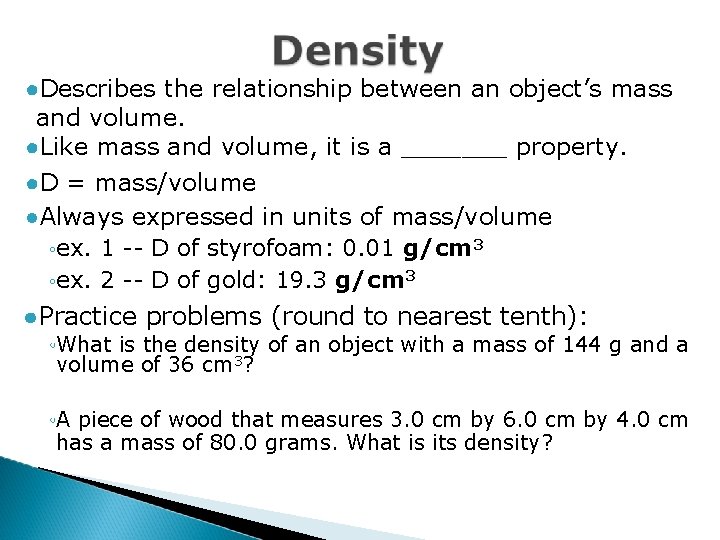
●Describes the relationship between an object’s mass and volume. ●Like mass and volume, it is a _______ property. ●D = mass/volume ●Always expressed in units of mass/volume ◦ex. 1 -- D of styrofoam: 0. 01 g/cm 3 ◦ex. 2 -- D of gold: 19. 3 g/cm 3 ●Practice problems (round to nearest tenth): ◦What is the density of an object with a mass of 144 g and a volume of 36 cm 3? ◦A piece of wood that measures 3. 0 cm by 6. 0 cm by 4. 0 cm has a mass of 80. 0 grams. What is its density?
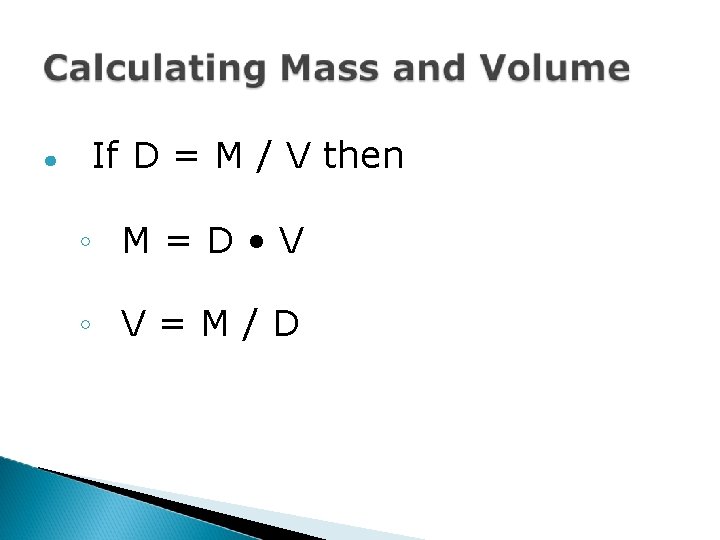
● If D = M / V then ◦ M=D • V ◦ V=M/D
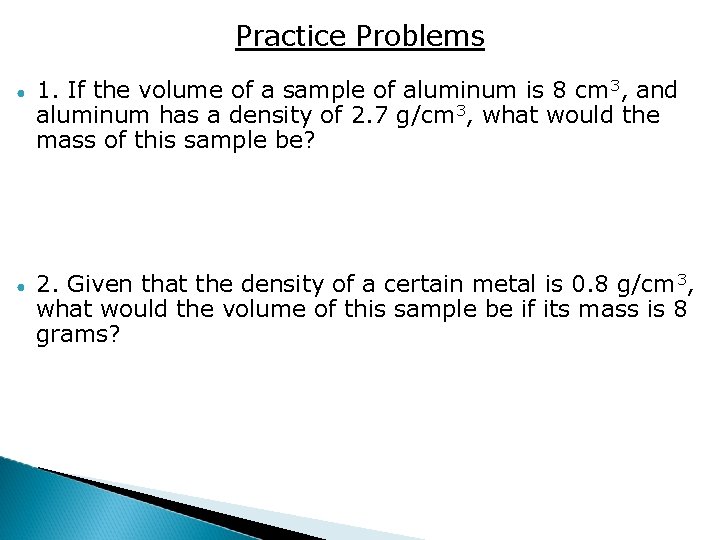
Practice Problems ● ● 1. If the volume of a sample of aluminum is 8 cm 3, and aluminum has a density of 2. 7 g/cm 3, what would the mass of this sample be? 2. Given that the density of a certain metal is 0. 8 g/cm 3, what would the volume of this sample be if its mass is 8 grams?
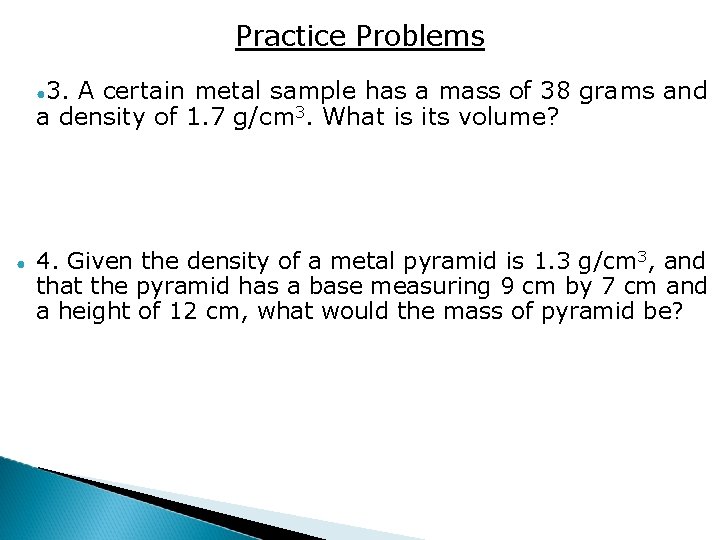
Practice Problems ● 3. A certain metal sample has a mass of 38 grams and a density of 1. 7 g/cm 3. What is its volume? ● 4. Given the density of a metal pyramid is 1. 3 g/cm 3, and that the pyramid has a base measuring 9 cm by 7 cm and a height of 12 cm, what would the mass of pyramid be?
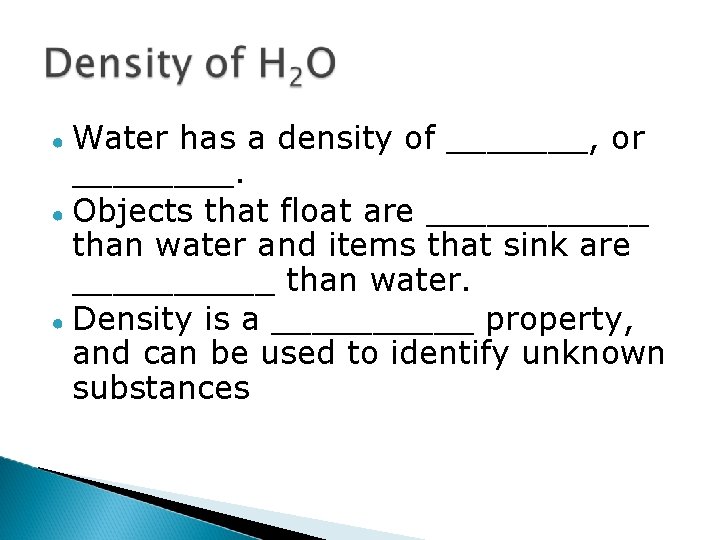
Water has a density of _______, or ____. ● Objects that float are ______ than water and items that sink are _____ than water. ● Density is a _____ property, and can be used to identify unknown substances ●
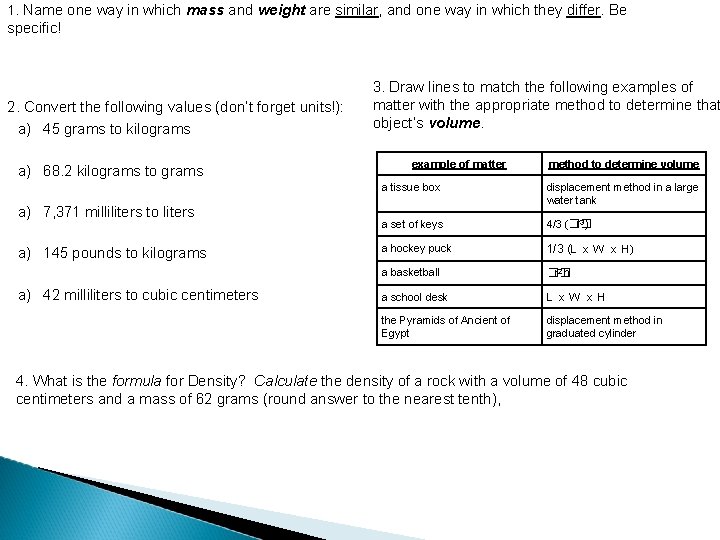
1. Name one way in which mass and weight are similar, and one way in which they differ. Be specific! 2. Convert the following values (don’t forget units!): a) 45 grams to kilograms a) 68. 2 kilograms to grams a) 7, 371 milliliters to liters a) 145 pounds to kilograms a) 42 milliliters to cubic centimeters 3. Draw lines to match the following examples of matter with the appropriate method to determine that object’s volume. example of matter method to determine volume a tissue box displacement method in a large water tank a set of keys 4/3 (�� r 3) a hockey puck 1/3 (L x W x H) a basketball �� r 2 h a school desk L x W x H the Pyramids of Ancient of Egypt displacement method in graduated cylinder 4. What is the formula for Density? Calculate the density of a rock with a volume of 48 cubic centimeters and a mass of 62 grams (round answer to the nearest tenth),
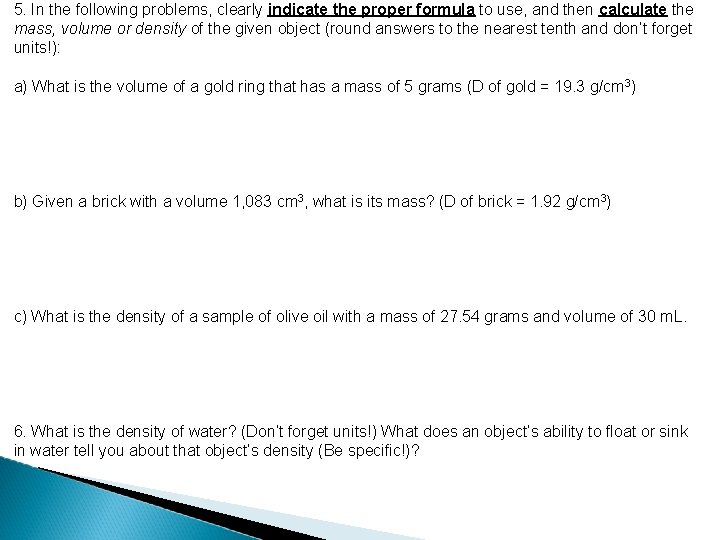
5. In the following problems, clearly indicate the proper formula to use, and then calculate the mass, volume or density of the given object (round answers to the nearest tenth and don’t forget units!): a) What is the volume of a gold ring that has a mass of 5 grams (D of gold = 19. 3 g/cm 3) b) Given a brick with a volume 1, 083 cm 3, what is its mass? (D of brick = 1. 92 g/cm 3) c) What is the density of a sample of olive oil with a mass of 27. 54 grams and volume of 30 m. L. 6. What is the density of water? (Don’t forget units!) What does an object’s ability to float or sink in water tell you about that object’s density (Be specific!)?