
Measuring the Multiple Dimensions of Poverty a way

- Slides: 35
Measuring the Multiple Dimensions of Poverty: a way forward The Way Forward in Poverty Measurement Seminar Geneva, 2 -4 December 2013
OPHI – MPI Team OPHI Research Team: Sabina Alkire (Director), James Foster (Research Fellow), John Hammock (Co-Founder and Research Associate), José Manuel Roche (coordination MPI 2011), Adriana Conconi (coordination MPI 2013), Maria Emma Santos (coordination MPI 2010), Suman Seth, Paola Ballon, Gaston Yalonetzky, Diego Zavaleta, Mauricio Apablaza Data analysts and MPI calculation 2013: Akmal Abdurazakov, Cecilia Calderon, Iván Gonzalez De Alba, Usha Kanagaratnam, Gisela Robles Aguilar, Juan Pablo Ocampo Sheen, Christian Oldiges and Ana Vaz. Special contributions: Heidi Fletcher (preparation of the maps), Esther Kwan and Garima Sahai (research assistance and preparation of graphs), Christian Oldiges (research assistance for regional decomposition and standard error), John Hammock (new Ground Reality Check field material), Yadira Diaz (helping in map preparation). Communication Team: Paddy Coulter (Director of Communications), Emmy Feena (Research Communications Officer), Heidi Fletcher (Web Manager), Moizza B Sarwar (Research Communications Assistant), Cameron Thibos (Design Assistant), Joanne Tomkinson. Administrative Support: Laura O'Mahony (Project Coordinator) OPHI prepare the MPI for publication in the UNDP Human Development Report and we are grateful to our colleagues in HDRO for their support.
Outline • Motivations to consider a multidimensional approach for measuring poverty • The Alkire Foster (AF) methodology Ø Global Multidimensional Poverty Index (MPI) • Properties of the AF method Ø Illustrations • MPI 2015+ and the post-2015 development agenda
Why Multidimensional Poverty Measures?
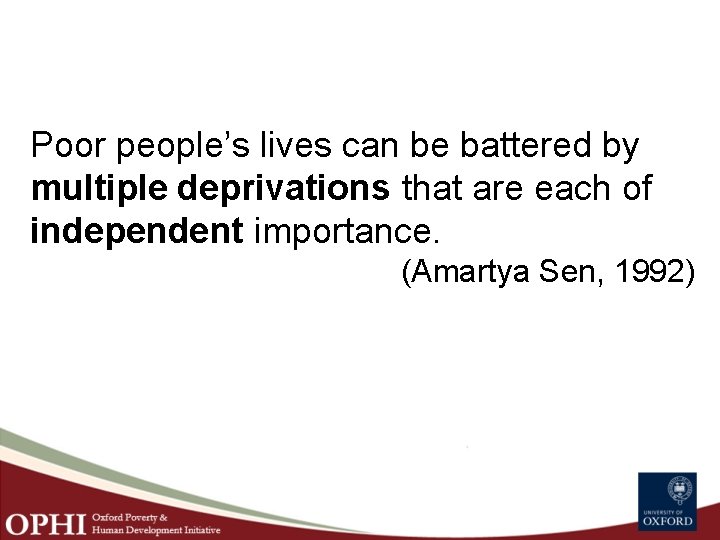
Poor people’s lives can be battered by multiple deprivations that are each of independent importance. (Amartya Sen, 1992)
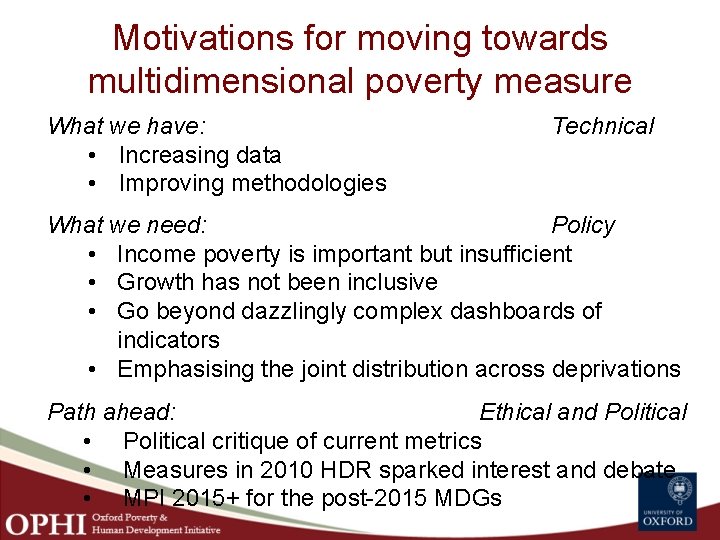
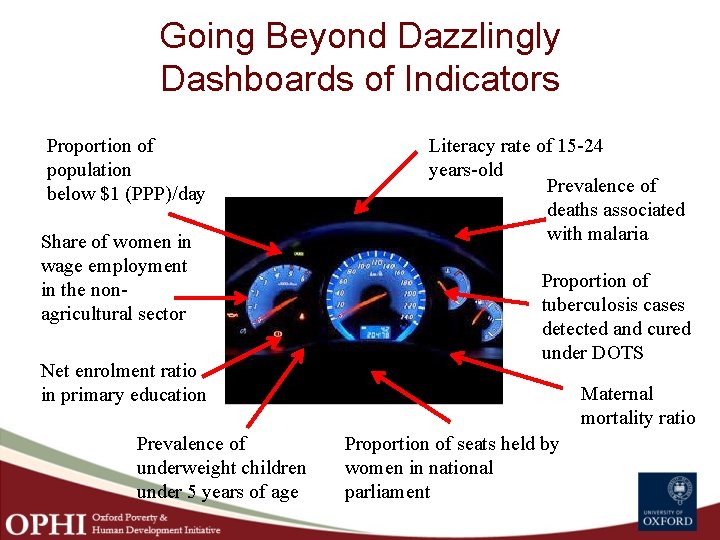
Motivations for moving towards multidimensional poverty measure What we have: • Increasing data • Improving methodologies Technical What we need: Policy • Income poverty is important but insufficient • Growth has not been inclusive • Go beyond dazzlingly complex dashboards of indicators • Emphasising the joint distribution across deprivations Path ahead: Ethical and Political • Political critique of current metrics • Measures in 2010 HDR sparked interest and debate • MPI 2015+ for the post-2015 MDGs
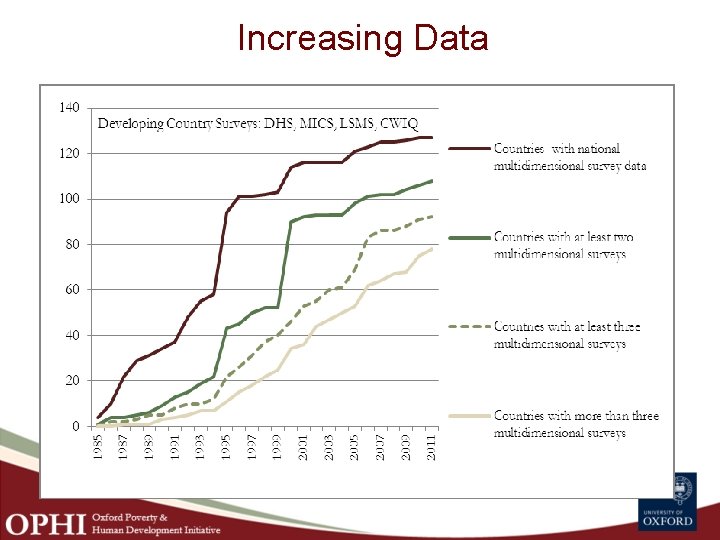
Increasing Data
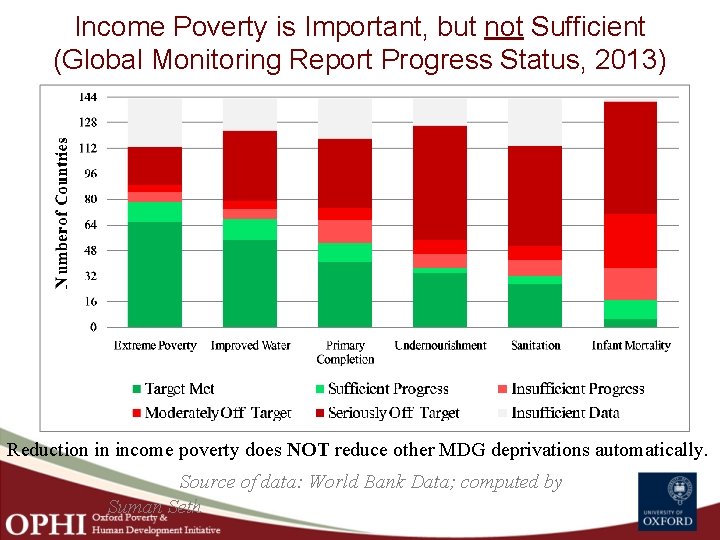
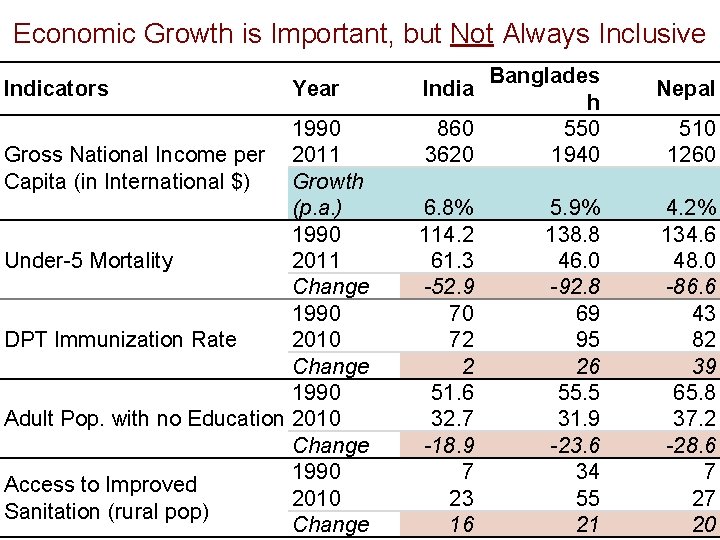
Income Poverty is Important, but not Sufficient (Global Monitoring Report Progress Status, 2013) Reduction in income poverty does NOT reduce other MDG deprivations automatically. Source of data: World Bank Data; computed by Suman Seth
Economic Growth is Important, but Not Always Inclusive Indicators Year 1990 Gross National Income per 2011 Growth Capita (in International $) (p. a. ) 1990 2011 Under-5 Mortality Change 1990 DPT Immunization Rate 2010 Change 1990 Adult Pop. with no Education 2010 Change 1990 Access to Improved 2010 Sanitation (rural pop) Change Banglades India h 860 550 3620 1940 6. 8% 114. 2 61. 3 -52. 9 70 72 2 51. 6 32. 7 -18. 9 7 23 16 5. 9% 138. 8 46. 0 -92. 8 69 95 26 55. 5 31. 9 -23. 6 34 55 21 Nepal 510 1260 4. 2% 134. 6 48. 0 -86. 6 43 82 39 65. 8 37. 2 -28. 6 7 27 20
Going Beyond Dazzlingly Dashboards of Indicators Proportion of population below $1 (PPP)/day Share of women in wage employment in the nonagricultural sector Net enrolment ratio in primary education Prevalence of underweight children under 5 years of age Literacy rate of 15 -24 years-old Prevalence of deaths associated with malaria Proportion of tuberculosis cases detected and cured under DOTS Maternal mortality ratio Proportion of seats held by women in national parliament
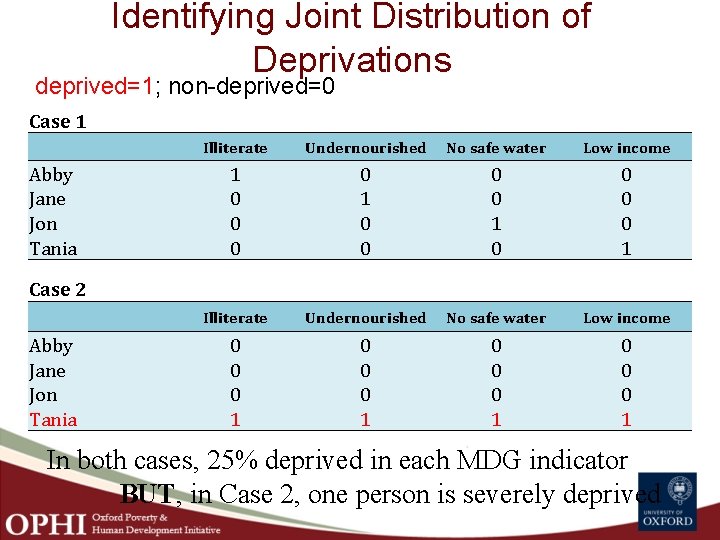
Identifying Joint Distribution of Deprivations deprived=1; non-deprived=0 Case 1 Abby Jane Jon Tania Illiterate Undernourished No safe water Low income 1 0 0 0 0 1 Illiterate Undernourished No safe water Low income 0 0 0 1 Case 2 Abby Jane Jon Tania In both cases, 25% deprived in each MDG indicator BUT, in Case 2, one person is severely deprived
Political recognition • “MDGs did not focus enough on reaching the very poorest” - High-Level Panel on the Post-2015 Development Agenda (2013) Ø Should be able to distinguish poorest from the less poor • “Acceleration in one goal often speeds up progress in others; to meet MDGs strategically we need to see them together” - What Will It Take to Achieve the Millennium Development Goals? (2010) Ø Emphasis on joint distribution and synergies • “While assessing quality-of-life requires a plurality of indicators, there are strong demands to develop a single summary measure” - Stiglitz Sen Fitoussi Commission Report (2009)
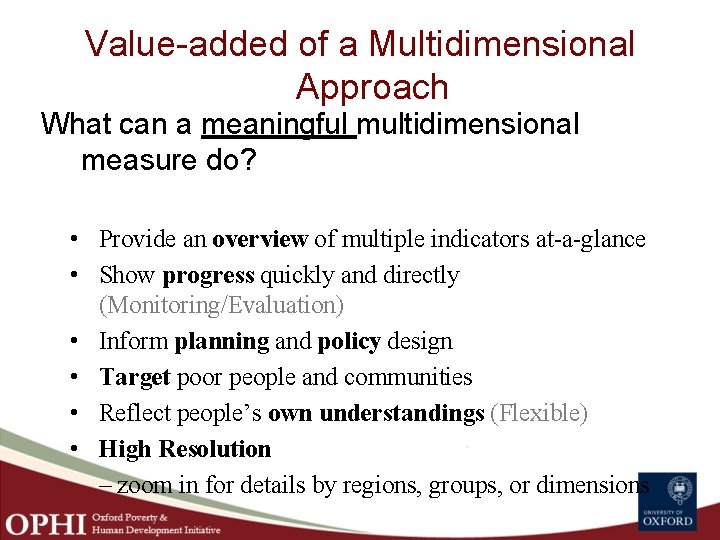
Value-added of a Multidimensional Approach What can a meaningful multidimensional measure do? • Provide an overview of multiple indicators at-a-glance • Show progress quickly and directly (Monitoring/Evaluation) • Inform planning and policy design • Target poor people and communities • Reflect people’s own understandings (Flexible) • High Resolution – zoom in for details by regions, groups, or dimensions
The Global Multidimensional Poverty Index (MPI) - applying Alkire Foster (AF) method
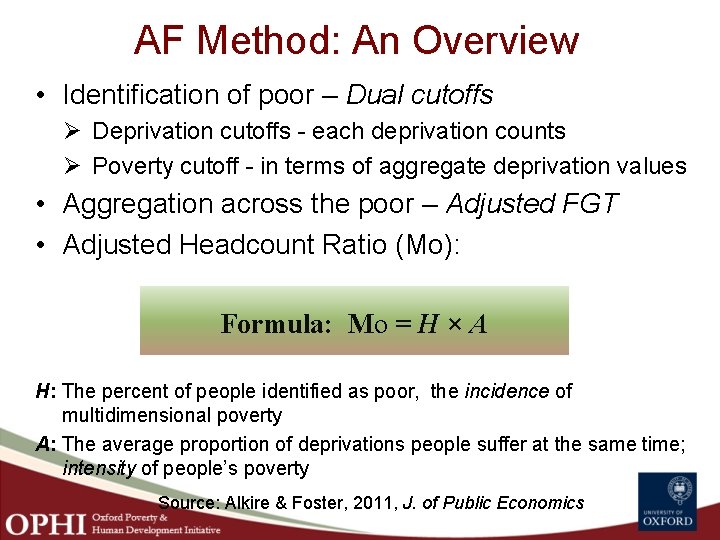
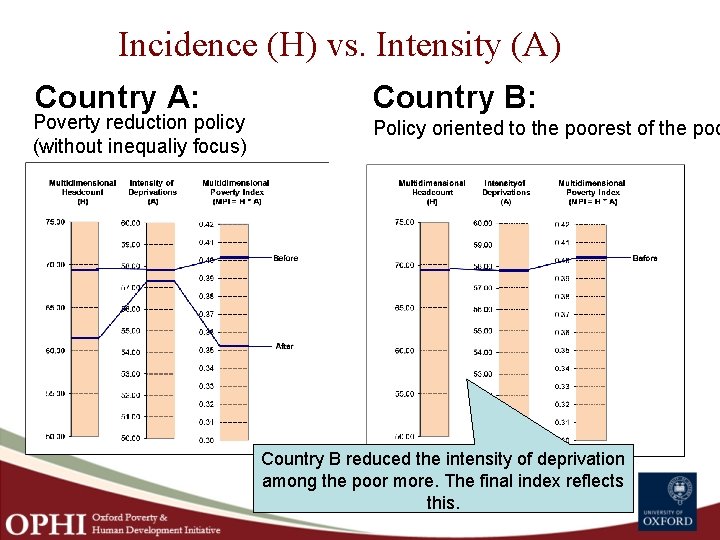
AF Method: An Overview • Identification of poor – Dual cutoffs Ø Deprivation cutoffs - each deprivation counts Ø Poverty cutoff - in terms of aggregate deprivation values • Aggregation across the poor – Adjusted FGT • Adjusted Headcount Ratio (Mο): Formula: Mο = H × A H: The percent of people identified as poor, the incidence of multidimensional poverty A: The average proportion of deprivations people suffer at the same time; intensity of people’s poverty Source: Alkire & Foster, 2011, J. of Public Economics
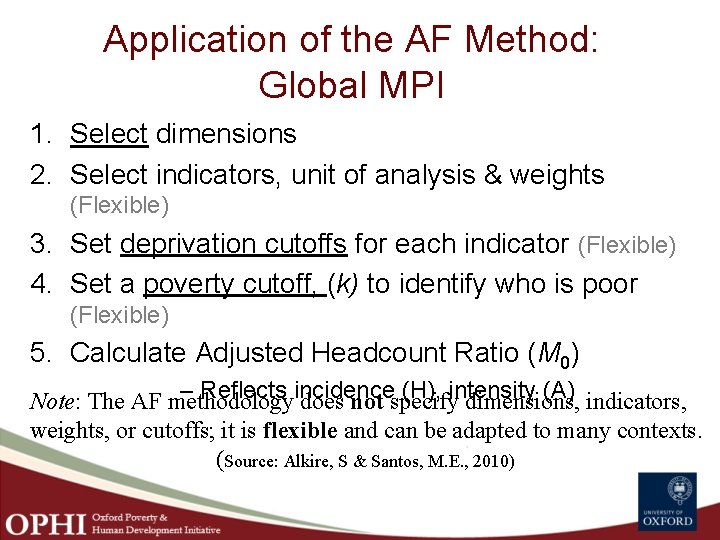
Application of the AF Method: Global MPI 1. Select dimensions 2. Select indicators, unit of analysis & weights (Flexible) 3. Set deprivation cutoffs for each indicator (Flexible) 4. Set a poverty cutoff, (k) to identify who is poor (Flexible) 5. Calculate Adjusted Headcount Ratio (M 0) – Reflects incidence (H), intensity (A) Note: The AF methodology does not specify dimensions, indicators, weights, or cutoffs; it is flexible and can be adapted to many contexts. (Source: Alkire, S & Santos, M. E. , 2010)
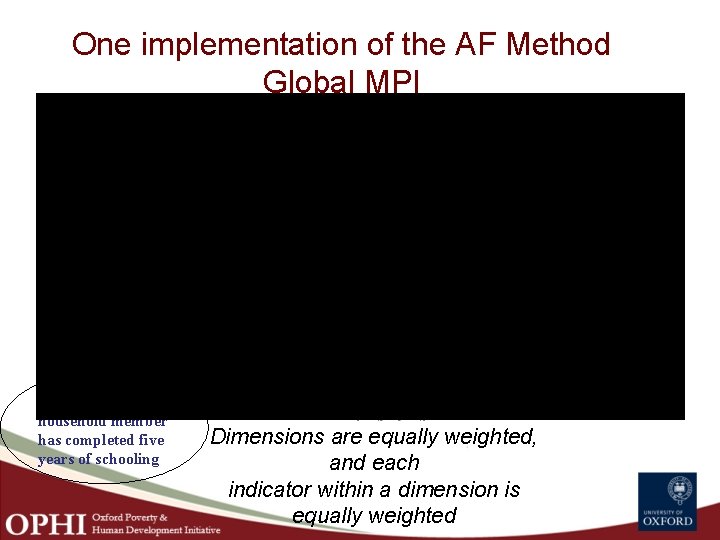
One implementation of the AF Method Global MPI Deprived if no household member has completed five years of schooling Dimensions are equally weighted, and each indicator within a dimension is equally weighted
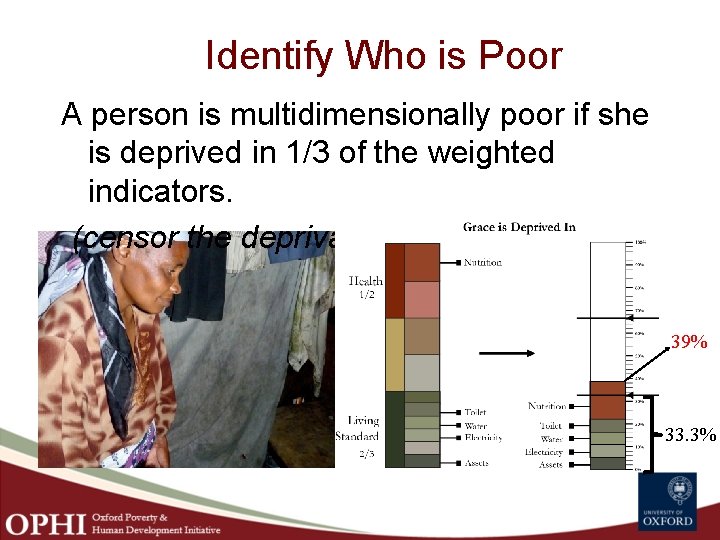
Identify Who is Poor A person is multidimensionally poor if she is deprived in 1/3 of the weighted indicators. (censor the deprivations of the non-poor) 39% 33. 3%
Properties of the AF method -An illustration using findings from MPI 2013
Properties of AF method: an overview • Can be broken down into incidence (H) and the intensity (A) • Is decomposable across population subgroups – Overall poverty is population-share weighted average of subgroup poverty • Overall poverty can be broken down by dimensions & indicators to understand their contribution 20
Incidence (H) vs. Intensity (A) Country A: Poverty reduction policy (without inequaliy focus) Country B: Policy oriented to the poorest of the poo Country B reduced the intensity of deprivation Source: Roche (2013) among the poor more. The final index reflects this.
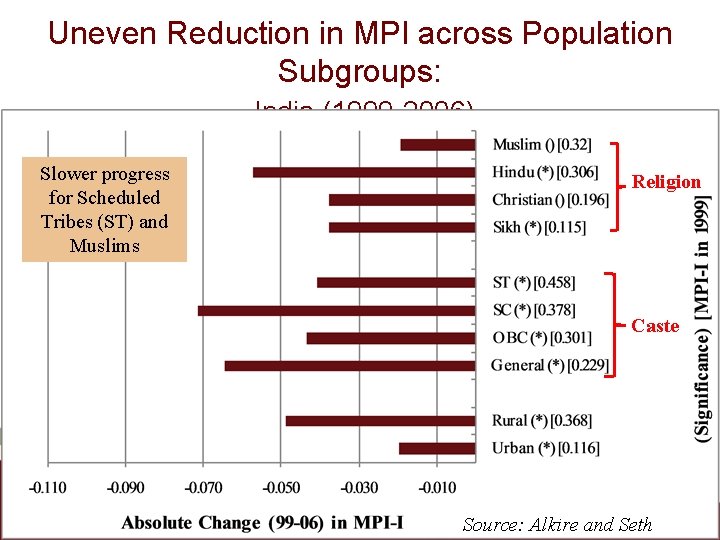
Uneven Reduction in MPI across Population Subgroups: India (1999 -2006) Slower progress for Scheduled Tribes (ST) and Muslims Religion Caste 22 Source: Alkire and Seth
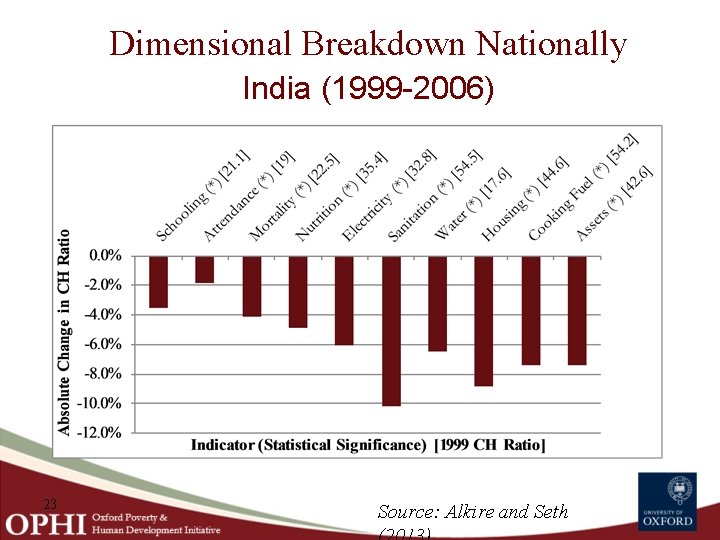
Dimensional Breakdown Nationally India (1999 -2006) 23 Source: Alkire and Seth
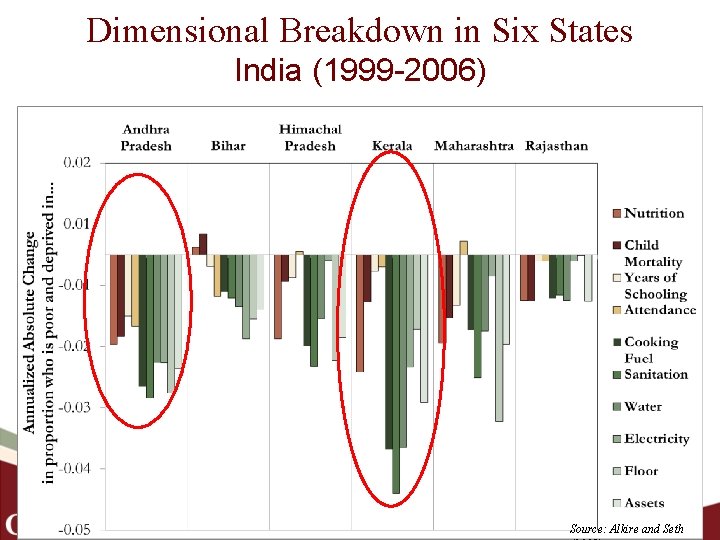
Dimensional Breakdown in Six States India (1999 -2006) 24 Source: Alkire and Seth
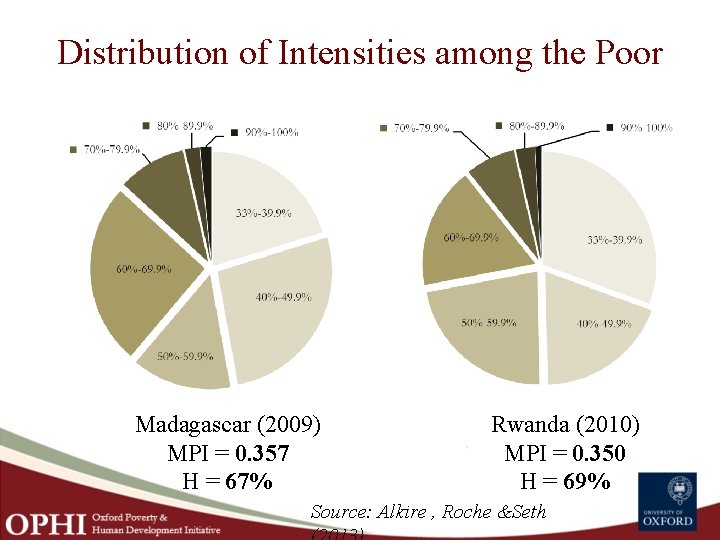
Distribution of Intensities among the Poor Madagascar (2009) MPI = 0. 357 H = 67% Rwanda (2010) MPI = 0. 350 H = 69% Source: Alkire , Roche &Seth
The Global MPI 2015+ In the Post 2015 MDG Development Agenda
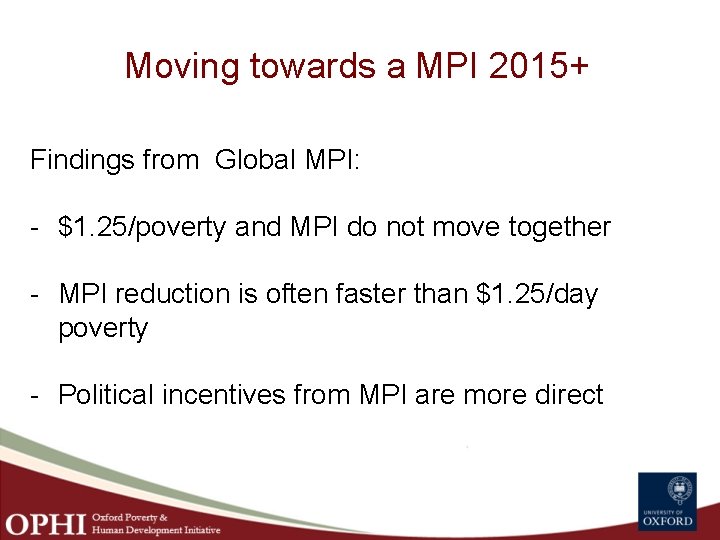
Moving towards a MPI 2015+ Findings from Global MPI: - $1. 25/poverty and MPI do not move together - MPI reduction is often faster than $1. 25/day poverty - Political incentives from MPI are more direct
Height of the bar: MPI Headcount Ratio Height at ‘ • ’ : $1. 25 -a-day Headcount Ratio Source: Alkire , Roche &Seth (2013)
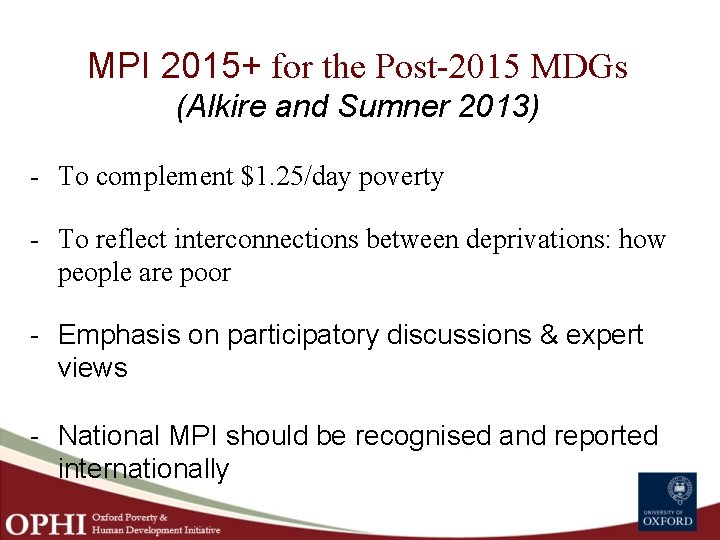
MPI 2015+ for the Post-2015 MDGs (Alkire and Sumner 2013) - To complement $1. 25/day poverty - To reflect interconnections between deprivations: how people are poor - Emphasis on participatory discussions & expert views - National MPI should be recognised and reported internationally
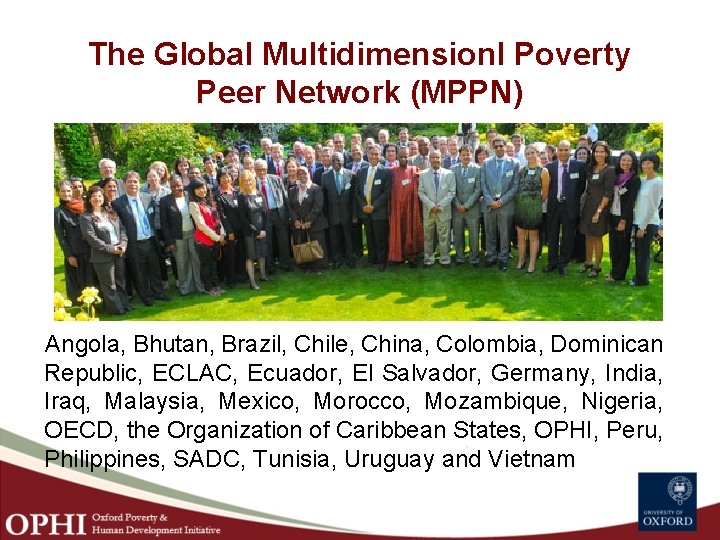
The Global Multidimensionl Poverty Peer Network (MPPN) Angola, Bhutan, Brazil, Chile, China, Colombia, Dominican Republic, ECLAC, Ecuador, El Salvador, Germany, India, Iraq, Malaysia, Mexico, Morocco, Mozambique, Nigeria, OECD, the Organization of Caribbean States, OPHI, Peru, Philippines, SADC, Tunisia, Uruguay and Vietnam
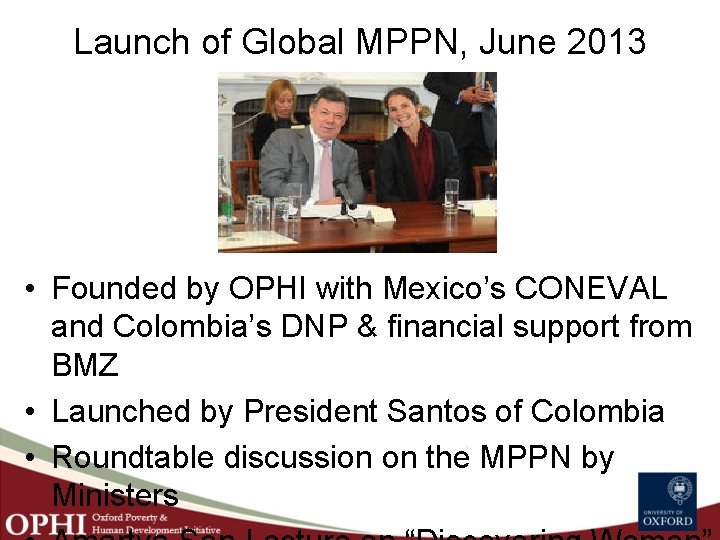
Launch of Global MPPN, June 2013 • Founded by OPHI with Mexico’s CONEVAL and Colombia’s DNP & financial support from BMZ • Launched by President Santos of Colombia • Roundtable discussion on the MPPN by Ministers
The MPPN Moving Forward • Expansion of Multidimensional Poverty Index ü Official national poverty measures ü Subnational Pilots (China, Brazil) • An Effective and Informed Voice in the Post 2015 Discussions ü Colombia, Mexico, Germany, OPHI and the MPPN host a side event at the UN General Assembly 2013 • The Promotion of Joint Research and
• Emphasizes on joint distribution of deprivations Summary • Decompositions by subpopulation - policy relevance • Flexible and can be adapted to national contexts • MPI 2015+: comparable across countries • National MPI and Global MPI 2015+ can be reported like national income poverty and $1. 25/day
References: Alkire, S. and Santos, M. E. 2010. Acute multidimensional poverty: a new index for developing countries. OPHI Working Paper 38, Oxford Poverty and Human Development Initiative, University of Oxford. Alkire, S. and Foster, J. E. 2011. Counting and multidimensional poverty measurement. Journal of Public Economics, 95 (7 -8): 476 -487. Alkire, S. and Sumner, A. 2013. Multidimensional Poverty and the Post-2015 MDGs. OPHI Briefing Note. http: //www. ophi. org. uk/wp-content/uploads/MPI-post-2015 -MDGs-FINAL. pdf? cda 6 c 1 Alkire, S. and Seth, S. 2013. “Multidimensional Poverty Reduction in India 1999 and 2006: Slowest Progress for the Poorest Groups”, Research Brief, Oxford Poverty & Human Development Initiative, Oxford University. http: //www. ophi. org. uk/wp-content/uploads/Multidimensional-Poverty-Reduction-in-India-199920061. pdf? 3 f 40 f 1 Alkire, S. and Roche, J. M. 2013. ‘Multidimensional Poverty Index 2013’, Research Brief, Oxford Poverty & Human Development Initiative, Oxford University. http: //www. ophi. org. uk/wp-content/uploads/Multidimensional-Poverty-Index-2013 -Alkire-Roche-and. Seth. pdf Drèze J and Sen, A. K. 2011. “Putting Growth In Its Place”, Outlookindia. com Magazine, November 2011, accessed at www. outlookindia. com/article. aspx? 278843 on January 11, 2013. Weblinks: High-Level Panel on the Post-2015 Development Agenda (2013) http: //www. post 2015 hlp. org/the-report/ Stiglitz Sen Fitoussi Commission Report (2009) http: //stiglitz-sen-fitoussi. fr/documents/rapport_anglais. pdf What Will It Take to Achieve the Millennium Development Goals? (2010) http: //www. undp. org/content/undp/en/home/librarypage/mdg/international-assessment---english-fullversion. html
Thank You More information: The Global MPI is published annually in the Human Development Report of UNDP Working Papers and resources available on www. ophi. org. uk