
Measuring the Earthquake Magnitude Intensity Magnitude Measures the
- Slides: 6
Measuring the Earthquake: Magnitude Intensity
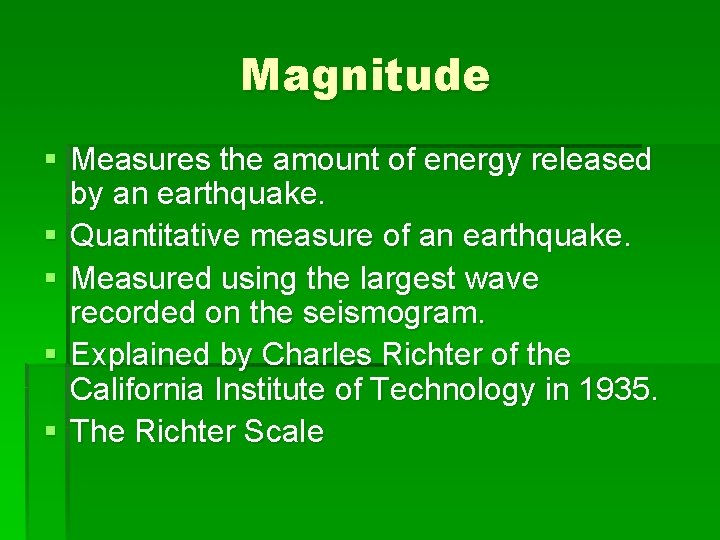
Magnitude § Measures the amount of energy released by an earthquake. § Quantitative measure of an earthquake. § Measured using the largest wave recorded on the seismogram. § Explained by Charles Richter of the California Institute of Technology in 1935. § The Richter Scale
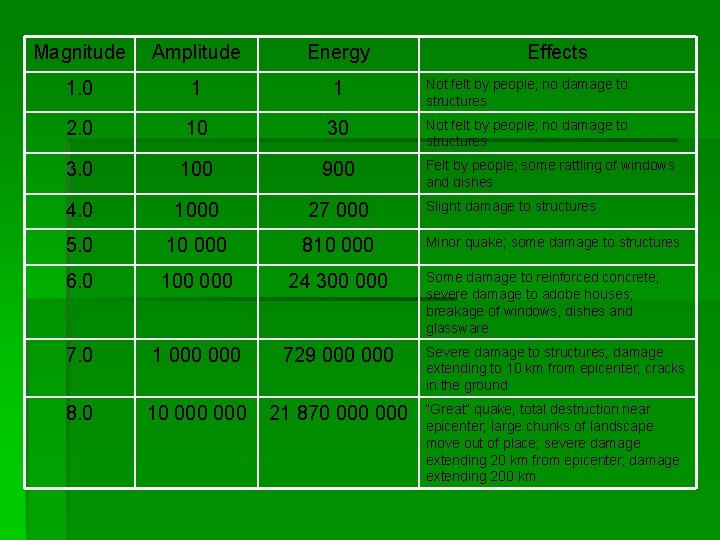
Magnitude Amplitude Energy Effects 1. 0 1 1 Not felt by people; no damage to structures 2. 0 10 30 Not felt by people; no damage to structures 3. 0 100 900 4. 0 1000 27 000 5. 0 10 000 810 000 6. 0 100 000 24 300 000 7. 0 1 000 729 000 Severe damage to structures; damage extending to 10 km from epicenter; cracks in the ground 8. 0 10 000 21 870 000 “Great” quake; total destruction near epicenter; large chunks of landscape move out of place; severe damage extending 20 km from epicenter; damage extending 200 km Felt by people; some rattling of windows and dishes Slight damage to structures Minor quake; some damage to structures Some damage to reinforced concrete; severe damage to adobe houses; breakage of windows, dishes and glassware
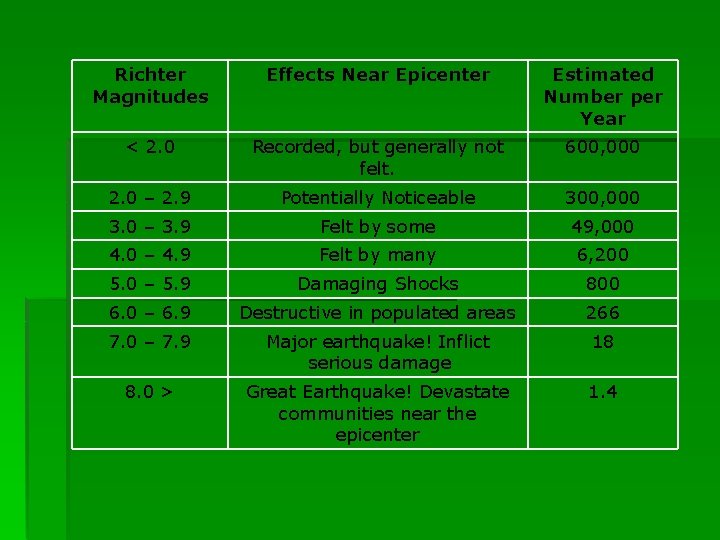
Richter Magnitudes Effects Near Epicenter Estimated Number per Year < 2. 0 Recorded, but generally not felt. 600, 000 2. 0 – 2. 9 Potentially Noticeable 300, 000 3. 0 – 3. 9 Felt by some 49, 000 4. 0 – 4. 9 Felt by many 6, 200 5. 0 – 5. 9 Damaging Shocks 800 6. 0 – 6. 9 Destructive in populated areas 266 7. 0 – 7. 9 Major earthquake! Inflict serious damage 18 8. 0 > Great Earthquake! Devastate communities near the epicenter 1. 4
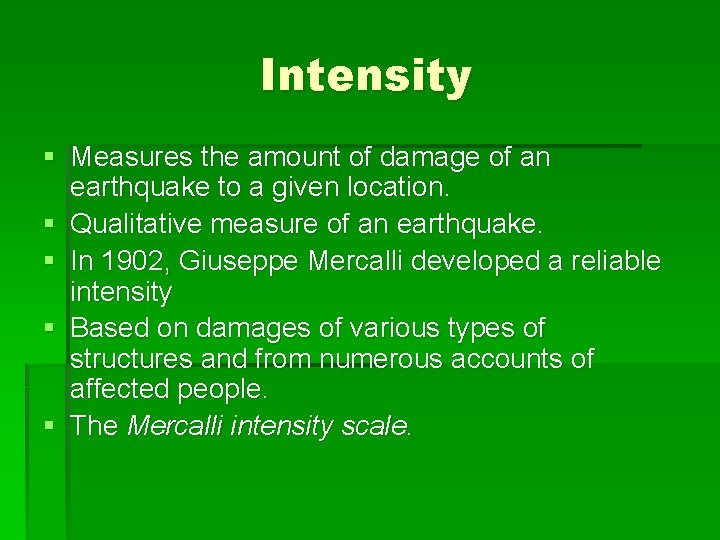
Intensity § Measures the amount of damage of an earthquake to a given location. § Qualitative measure of an earthquake. § In 1902, Giuseppe Mercalli developed a reliable intensity § Based on damages of various types of structures and from numerous accounts of affected people. § The Mercalli intensity scale.
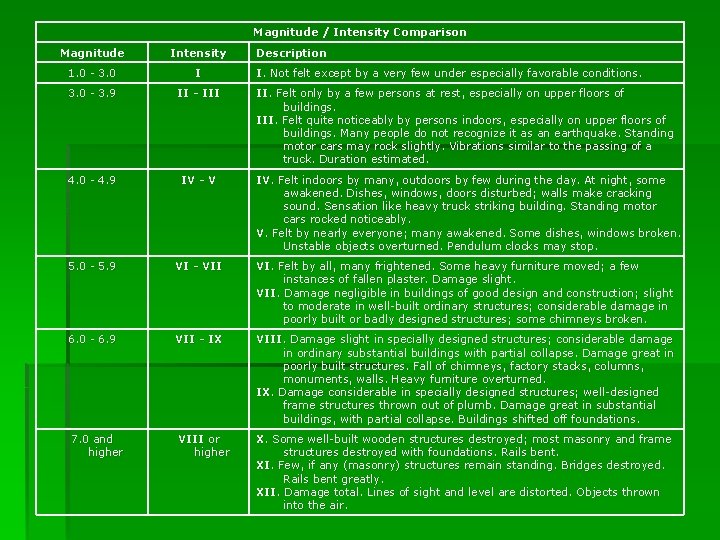
Magnitude / Intensity Comparison Magnitude Intensity Description 1. 0 - 3. 0 I 3. 0 - 3. 9 II - III 4. 0 - 4. 9 IV - V 5. 0 - 5. 9 VI - VII VI. Felt by all, many frightened. Some heavy furniture moved; a few instances of fallen plaster. Damage slight. VII. Damage negligible in buildings of good design and construction; slight to moderate in well-built ordinary structures; considerable damage in poorly built or badly designed structures; some chimneys broken. 6. 0 - 6. 9 VII - IX VIII. Damage slight in specially designed structures; considerable damage in ordinary substantial buildings with partial collapse. Damage great in poorly built structures. Fall of chimneys, factory stacks, columns, monuments, walls. Heavy furniture overturned. IX. Damage considerable in specially designed structures; well-designed frame structures thrown out of plumb. Damage great in substantial buildings, with partial collapse. Buildings shifted off foundations. 7. 0 and higher VIII or higher X. Some well-built wooden structures destroyed; most masonry and frame structures destroyed with foundations. Rails bent. XI. Few, if any (masonry) structures remain standing. Bridges destroyed. Rails bent greatly. XII Damage total. Lines of sight and level are distorted. Objects thrown into the air. I. Not felt except by a very few under especially favorable conditions. II. Felt only by a few persons at rest, especially on upper floors of buildings. III. . Felt quite noticeably by persons indoors, especially on upper floors of III buildings. Many people do not recognize it as an earthquake. Standing motor cars may rock slightly. Vibrations similar to the passing of a truck. Duration estimated. IV. Felt indoors by many, outdoors by few during the day. At night, some awakened. Dishes, windows, doors disturbed; walls make cracking sound. Sensation like heavy truck striking building. Standing motor cars rocked noticeably. V. Felt by nearly everyone; many awakened. Some dishes, windows broken. Unstable objects overturned. Pendulum clocks may stop.