
Measuring socioeconomic background and its influence on school
Measuring socio-economic background and its influence on school education outcomes John Ainley South Australian Institute for Education Research Spring Seminar Series Quality and equity in education: Can we have both?
Outline • Introduction • What is meant by “socioeconomic status” and related concepts? • Students • Schools • How is socioeconomic status measured? • Students • Schools • How are the measures applied? • What are the implications for “quality and equality?

Introduction • Enduring interest • socioeconomic status of parents and • educational outcomes of children • Range of special initiatives / funding • National – Disadvantaged schools program, National equity program for schools • State programs – Priority action schools program / Priority schools funding program • Other countries – Title 1 of Elementary and Secondary Education Act (USA) – Education action zones (UK) – Dutch Educational Opportunity Program

Introduction (2) • Represents a status attainment model rather than a social class model • Extensively researched • Focus of meta-analytic reviews • White (1980), Sirin (2005) • New perspectives from international studies • Countries differ in the relationship between SES and outcomes • Differences relate to policies and cultural traditions

Terminology Level Student School Terms Comment Socioeconomic status Defined in terms of parental occupation, education, wealth Social/socioeconomic disadvantage (or advantage) Also includes other factors such as Indigenous status, language background etc. Socioeconomic context Social-demographic composition or Community social educational advantage Either • aggregated student characteristics, or • community characteristics

Definitions: Socioeconomic Status • Attained “status that depicts overall social standing” (Graetz, 1995) • Determined by individual achievements: • Employment or occupational status • Educational attainment • Income and wealth (Graetz, 1995, p 50). • Components sometimes used separately and sometimes as a combined index • Socioeconomic status of children is taken as that of their parents
Concept of Social Advantage / Disadvantage • In addition to socioeconomic status includes other attributes • • • Indigenous status Language background Ethnicity Geographic location Residential mobility • Various combinations used
Concept of Social / Socioeconomic Context • Refers to the aggregate composition of: – The school population – The community / area from which the school population is drawn • Aggregate compositional influences may be greater than the combination of individual influences • Usually based on the broad notion of advantage / disadvantage
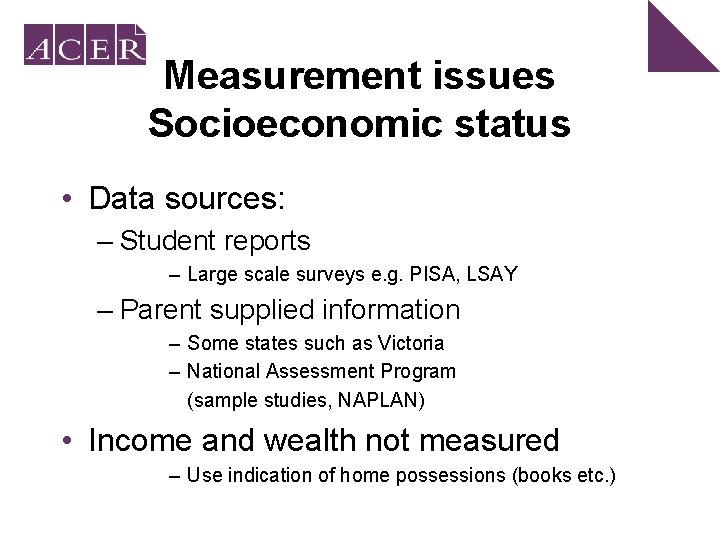
Measurement issues Socioeconomic status • Data sources: – Student reports – Large scale surveys e. g. PISA, LSAY – Parent supplied information – Some states such as Victoria – National Assessment Program (sample studies, NAPLAN) • Income and wealth not measured – Use indication of home possessions (books etc. )
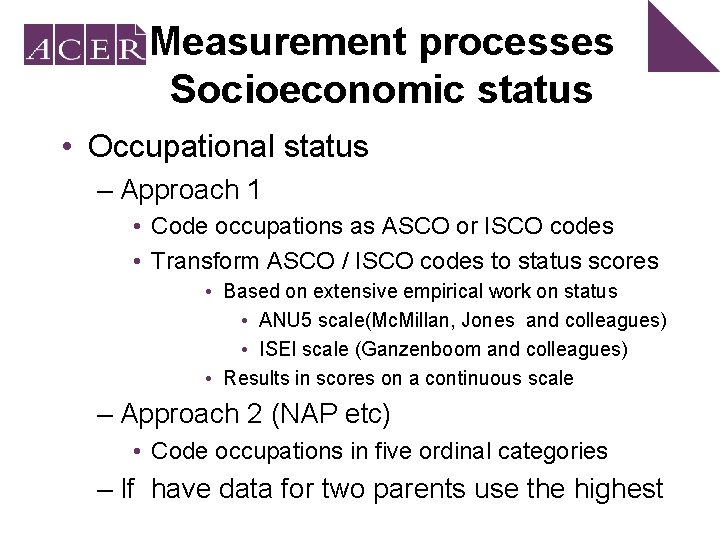
Measurement processes Socioeconomic status • Occupational status – Approach 1 • Code occupations as ASCO or ISCO codes • Transform ASCO / ISCO codes to status scores • Based on extensive empirical work on status • ANU 5 scale(Mc. Millan, Jones and colleagues) • ISEI scale (Ganzenboom and colleagues) • Results in scores on a continuous scale – Approach 2 (NAP etc) • Code occupations in five ordinal categories – If have data for two parents use the highest
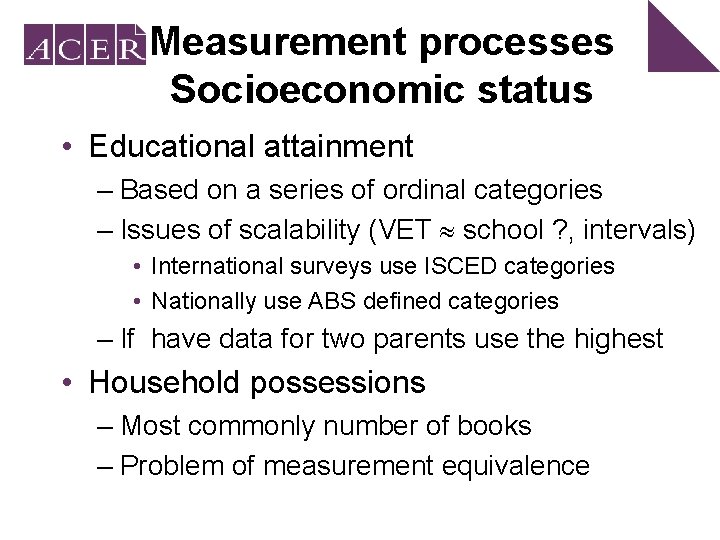
Measurement processes Socioeconomic status • Educational attainment – Based on a series of ordinal categories – Issues of scalability (VET school ? , intervals) • International surveys use ISCED categories • Nationally use ABS defined categories – If have data for two parents use the highest • Household possessions – Most commonly number of books – Problem of measurement equivalence
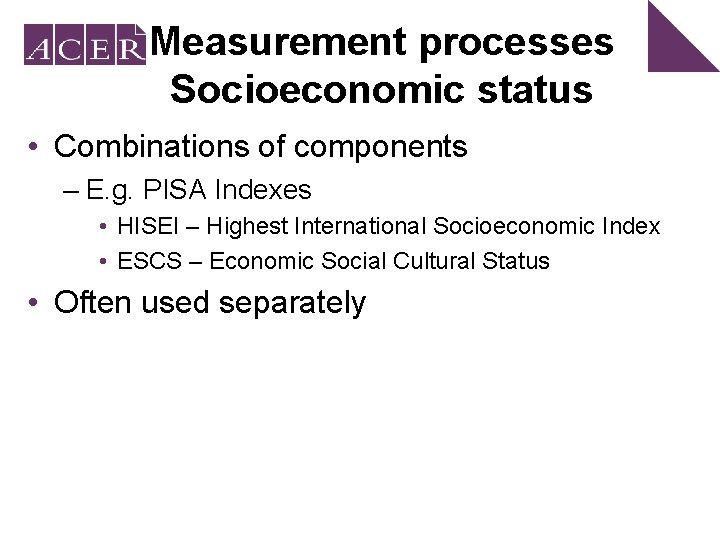
Measurement processes Socioeconomic status • Combinations of components – E. g. PISA Indexes • HISEI – Highest International Socioeconomic Index • ESCS – Economic Social Cultural Status • Often used separately

Measurement processes School socioeconomic context • Approach 1 Aggregate individual scores (e. g. SFO) – Various occupational categories and their weightings are used in the calculation of SFO as a weighted mean. • Approach 2 Use census data • • Code each students home address to a CCD Assign scores for the CCD to each student Combine selected measures to form an index Index is the average of scores
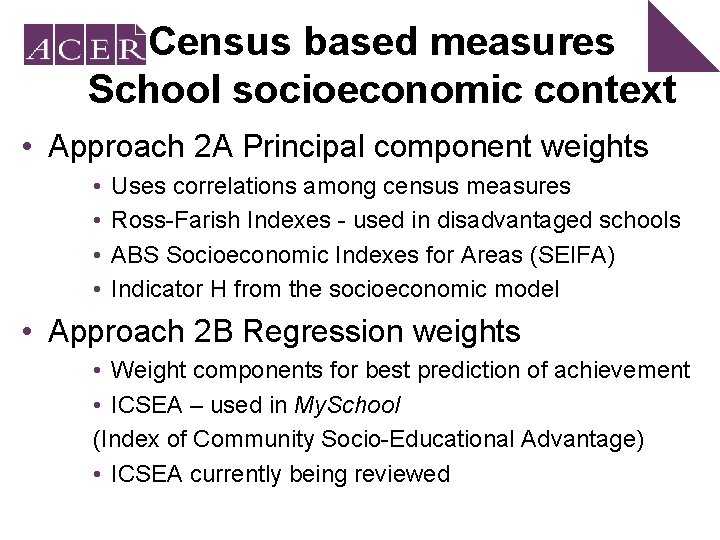
Census based measures School socioeconomic context • Approach 2 A Principal component weights • • Uses correlations among census measures Ross-Farish Indexes - used in disadvantaged schools ABS Socioeconomic Indexes for Areas (SEIFA) Indicator H from the socioeconomic model • Approach 2 B Regression weights • Weight components for best prediction of achievement • ICSEA – used in My. School (Index of Community Socio-Educational Advantage) • ICSEA currently being reviewed
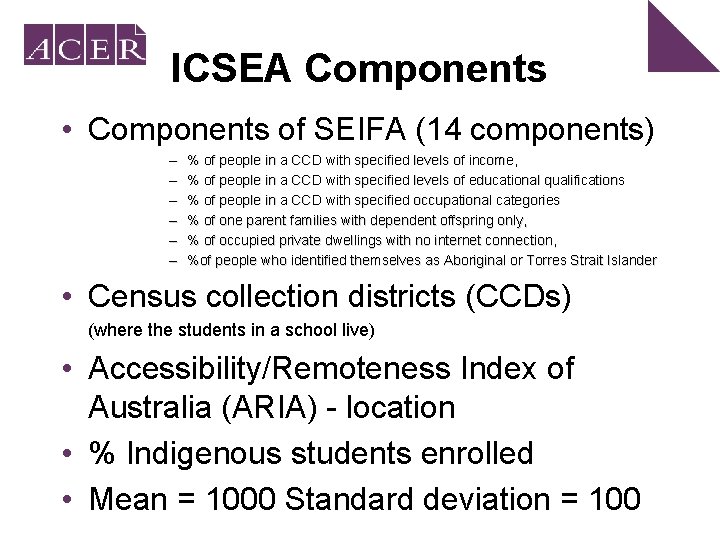
ICSEA Components • Components of SEIFA (14 components) – – – % of people in a CCD with specified levels of income, % of people in a CCD with specified levels of educational qualifications % of people in a CCD with specified occupational categories % of one parent families with dependent offspring only, % of occupied private dwellings with no internet connection, %of people who identified themselves as Aboriginal or Torres Strait Islander • Census collection districts (CCDs) (where the students in a school live) • Accessibility/Remoteness Index of Australia (ARIA) - location • % Indigenous students enrolled • Mean = 1000 Standard deviation = 100
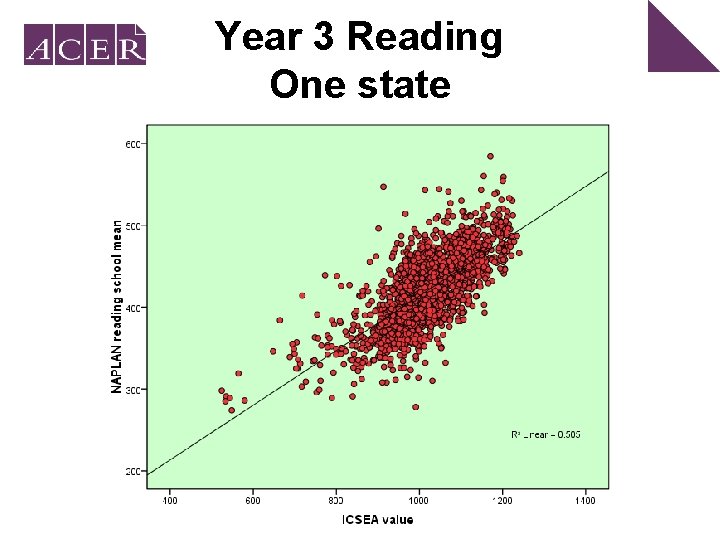
Year 3 Reading One state
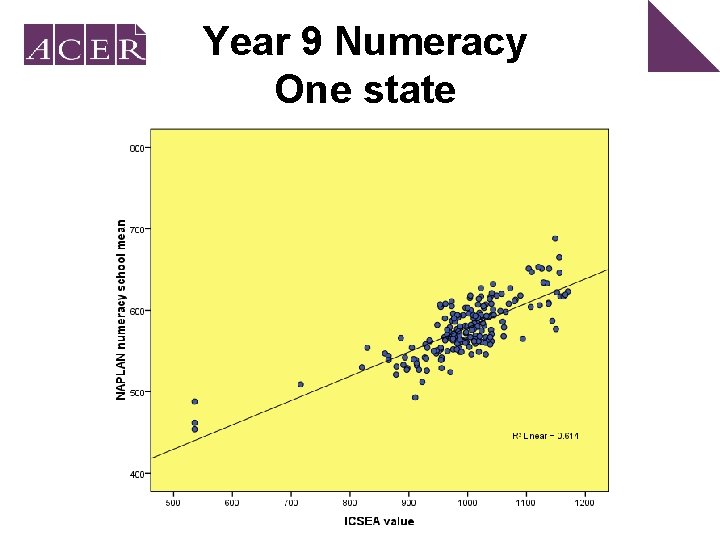
Year 9 Numeracy One state
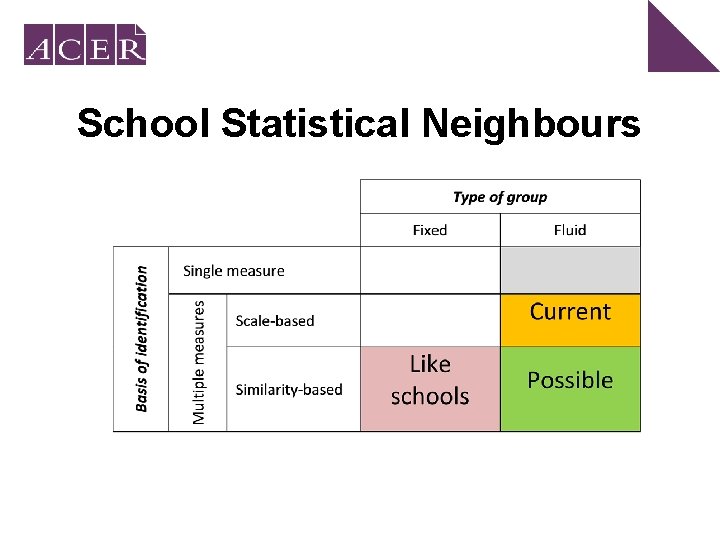
School Statistical Neighbours
School Statistical Neighbours • Scale-based approach • Based on similar ICSEA scores • Closest scores above and below • Can be made of different mix of components • Alternative would be a cluster approach • Multidimensional approach • Define characteristics of interest • Look at schools that are similar in combination of characteristics
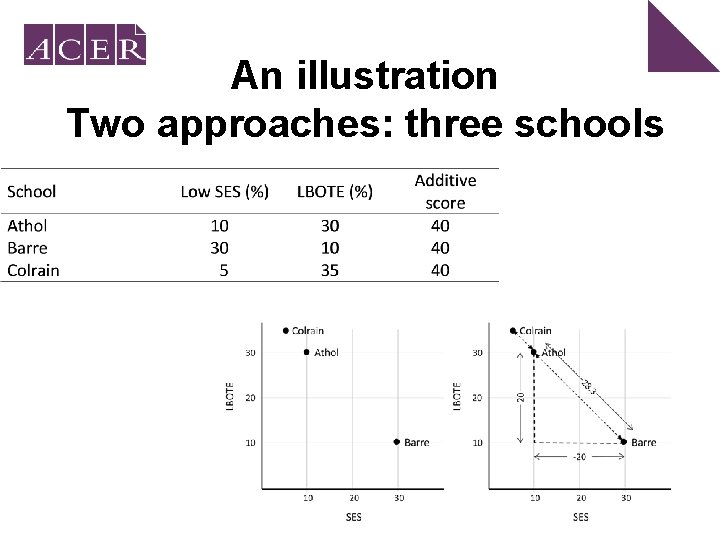
An illustration Two approaches: three schools
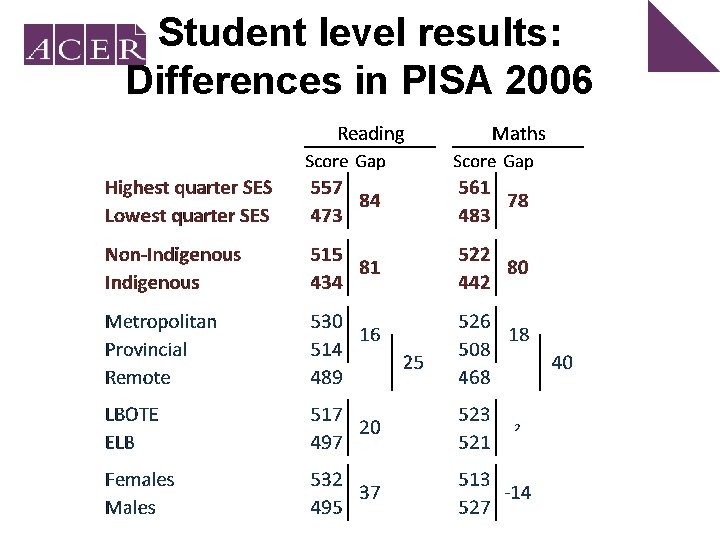
Student level results: Differences in PISA 2006
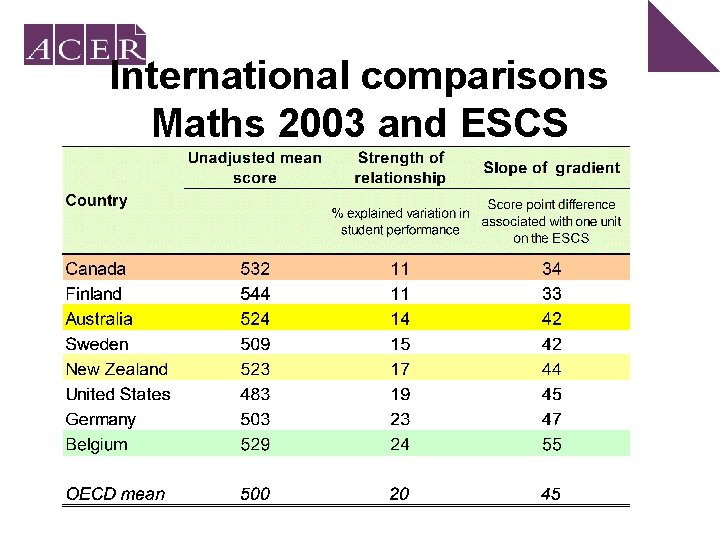
International comparisons Maths 2003 and ESCS
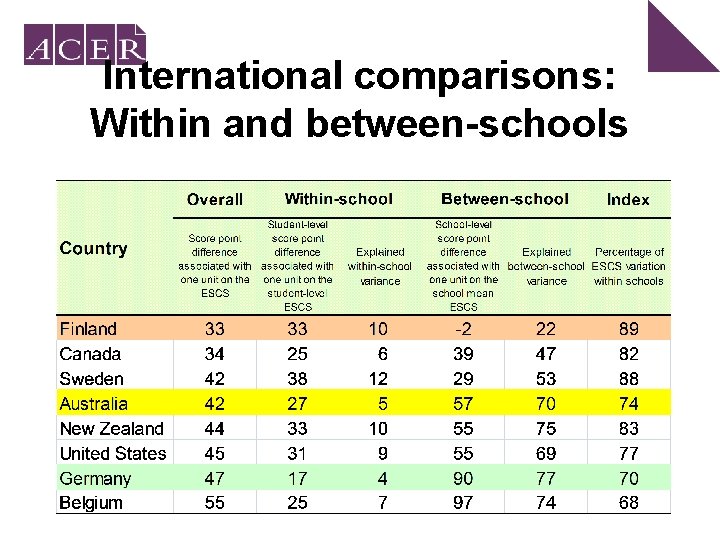
International comparisons: Within and between-schools
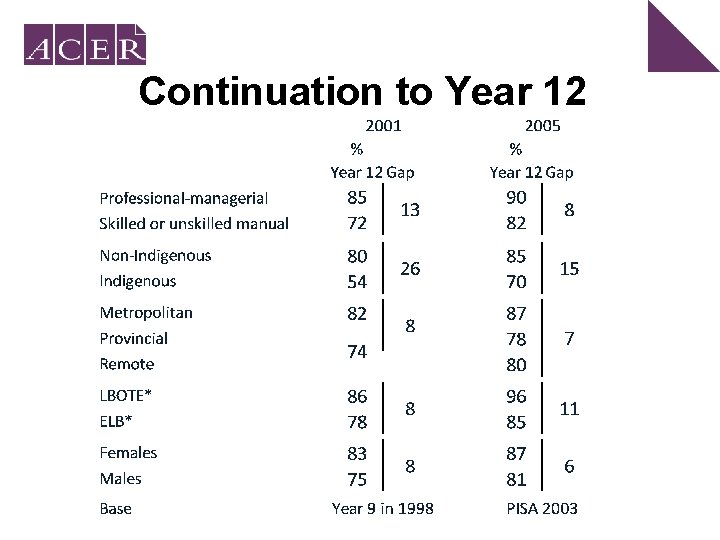
Continuation to Year 12
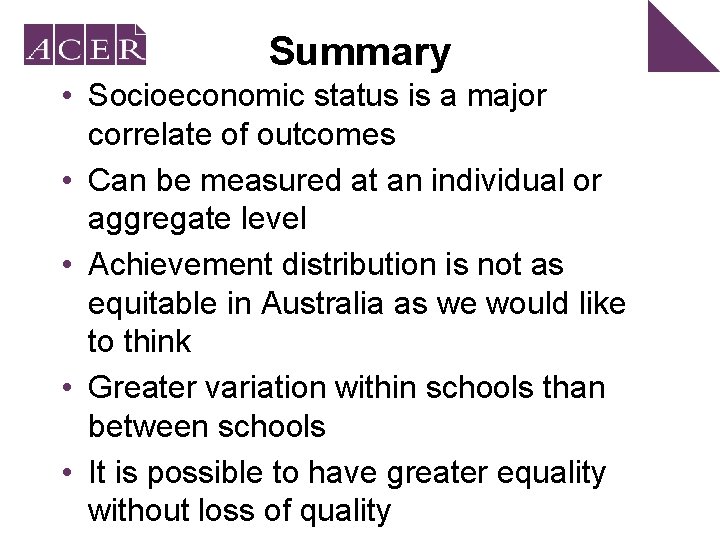
Summary • Socioeconomic status is a major correlate of outcomes • Can be measured at an individual or aggregate level • Achievement distribution is not as equitable in Australia as we would like to think • Greater variation within schools than between schools • It is possible to have greater equality without loss of quality
Thank you Comments Discussion Questions
- Slides: 26