
Measuring Program Quality for TAVR The TVT Registry


- Slides: 13
Measuring Program Quality for TAVR The TVT Registry Approach David J. Cohen, M. D. , M. Sc. Professor of Medicine University of Missouri-Kansas City CRT 2020 - 8 mins
A funny thing happened on the way to CRT… Best Laid Plans
TAVR Quality • Key goal of CMS– particularly with low-risk approval and recent relaxation of programmatic requirements • Monitor whether sites are achieving the expected benefits of TAVR (↑ survival, ↑ QOL), especially for Medicare beneficiaries TVT strategic objective • Develop a reliable and valid metric that discriminates sitelevel performance and can be used to support “star ratings” of quality for public reporting (similar to STS)
Currently Available TAVR Models
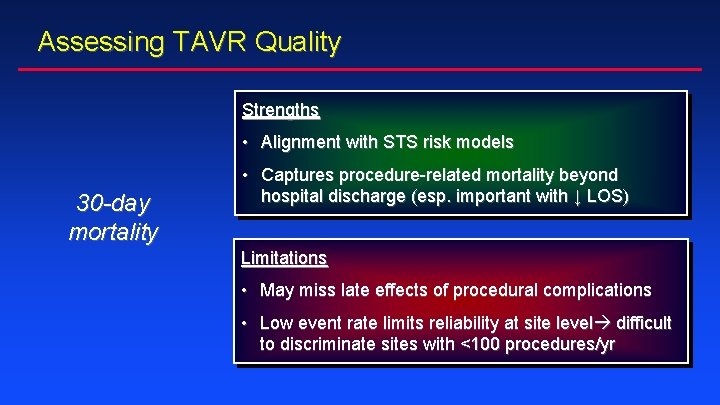
Assessing TAVR Quality Strengths • Alignment with STS risk models 30 -day mortality • Captures procedure-related mortality beyond hospital discharge (esp. important with ↓ LOS) Limitations • May miss late effects of procedural complications • Low event rate limits reliability at site level difficult to discriminate sites with <100 procedures/yr
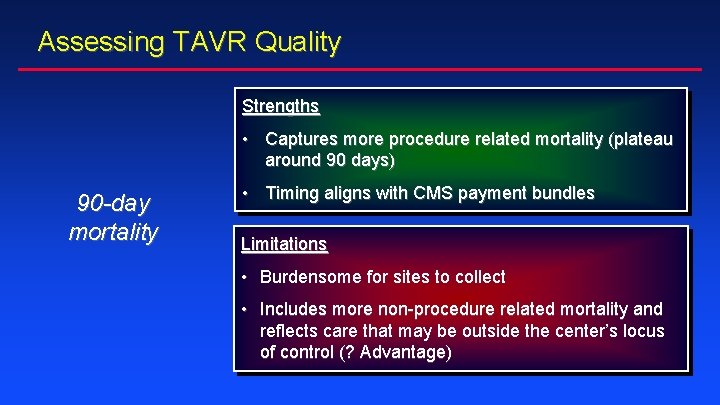
Assessing TAVR Quality Strengths • Captures more procedure related mortality (plateau around 90 days) 90 -day mortality • Timing aligns with CMS payment bundles Limitations • Burdensome for sites to collect • Includes more non-procedure related mortality and reflects care that may be outside the center’s locus of control (? Advantage)
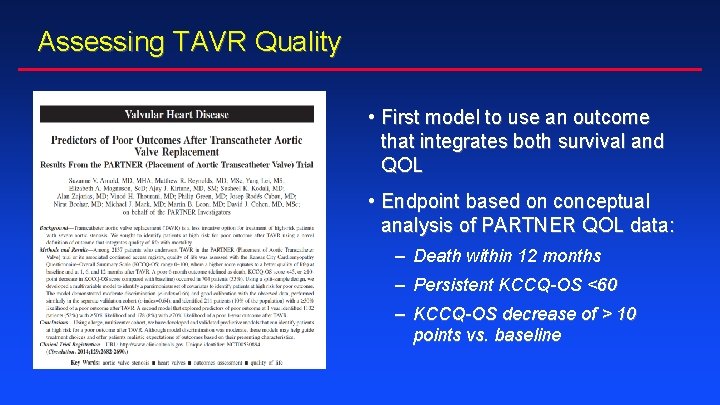
Assessing TAVR Quality • First model to use an outcome that integrates both survival and QOL “Alive and Well” at 1 -Year • Endpoint based on conceptual analysis of PARTNER QOL data: – Death within 12 months – Persistent KCCQ-OS <60 – KCCQ-OS decrease of > 10 points vs. baseline
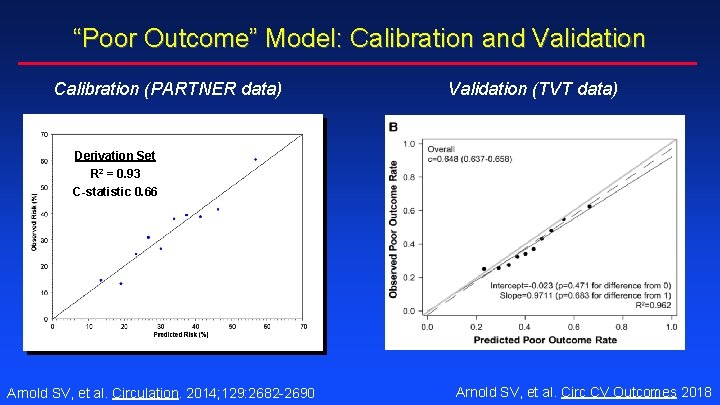
“Poor Outcome” Model: Calibration and Validation Calibration (PARTNER data) Validation (TVT data) Derivation Set R 2 = 0. 93 C-statistic 0. 66 Arnold SV, et al. Circulation. 2014; 129: 2682 -2690 Arnold SV, et al. Circ CV Outcomes 2018
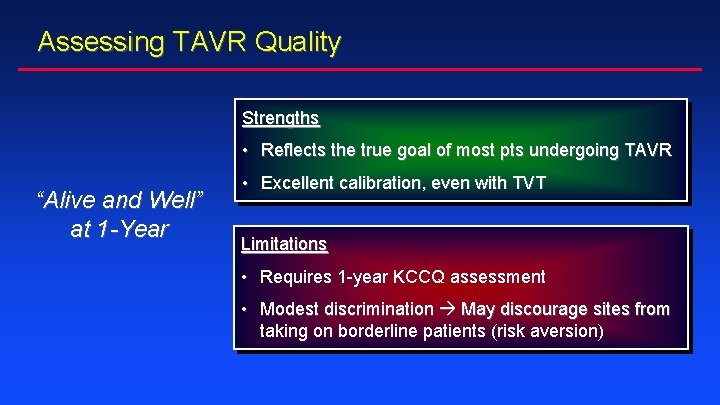
Assessing TAVR Quality Strengths • Reflects the true goal of most pts undergoing TAVR “Alive and Well” at 1 -Year • Excellent calibration, even with TVT Limitations • Requires 1 -year KCCQ assessment • Modest discrimination May discourage sites from taking on borderline patients (risk aversion)
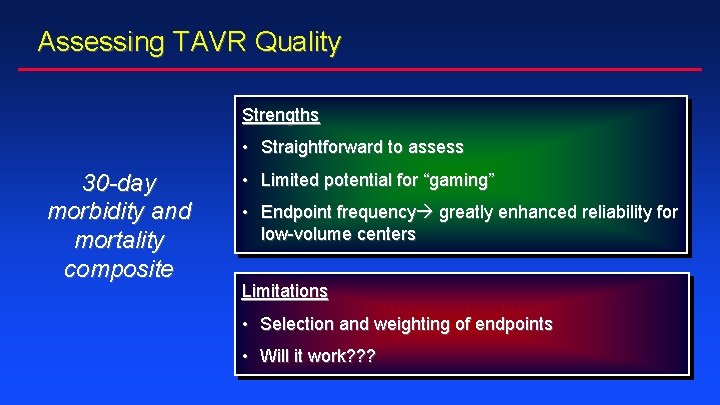
Assessing TAVR Quality Strengths • Straightforward to assess 30 -day morbidity and mortality composite • Limited potential for “gaming” • Endpoint frequency greatly enhanced reliability for low-volume centers Limitations • Selection and weighting of endpoints • Will it work? ? ?
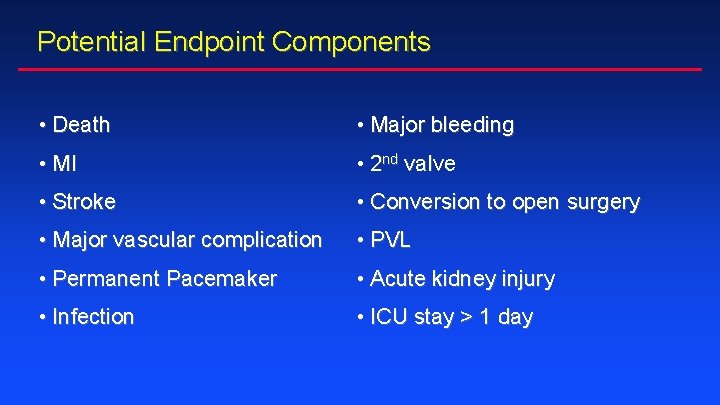
Potential Endpoint Components • Death • Major bleeding • MI • 2 nd valve • Stroke • Conversion to open surgery • Major vascular complication • PVL • Permanent Pacemaker • Acute kidney injury • Infection • ICU stay > 1 day
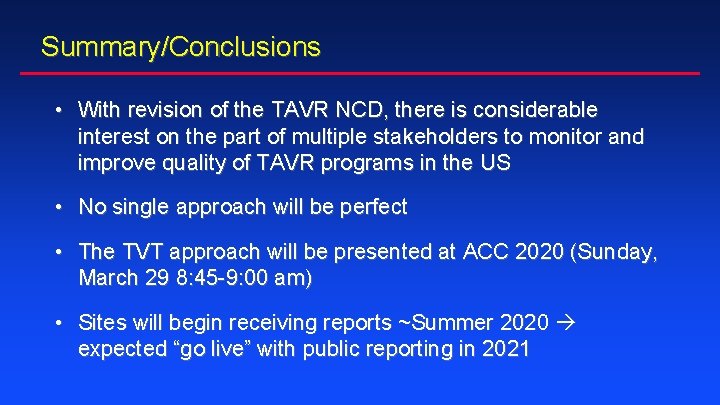
Summary/Conclusions • With revision of the TAVR NCD, there is considerable interest on the part of multiple stakeholders to monitor and improve quality of TAVR programs in the US • No single approach will be perfect • The TVT approach will be presented at ACC 2020 (Sunday, March 29 8: 45 -9: 00 am) • Sites will begin receiving reports ~Summer 2020 expected “go live” with public reporting in 2021