
Measuring Physical Activity What we need to know



- Slides: 20
Measuring Physical Activity
What we need to know… • Methods of measuring physical activity • Subjective measures • Objective measures
Why Measure Physical Activity? • Document the frequency and distribution of physical activity in defined population groups. • Monitor the achievement of physical activity guidelines and population trends • Study the relationship between physical activity and health conditions e. g. cardiovascular disease, diabetes etc • Determine the amount of physical activity required to influence specific health issues • Identify the biological, psychological and environmental factors that influence physical activity • Evaluate intervention programs
Subjective Measures • These measures rely on the person recalling the activity which they perform. • Recall instruments require the subjects to remember which physical activity they engaged in over a period of time e. g. day, week, month
Self Report Measures • Most common measure of physical activity • Self administered recalls • Diaries-excellent tool if participants follow instructions correctly • Questionnaires
Advantages Can be administered quickly and easily for large groups Cost-effective for large scale studies Usually low participant burden Easy to complete Can provide detailed information i. e. how the subject was feeling, location, other participants.
Disadvantages • Not suitable for children under 10 and older adults due to cognitive limitations to recall • Reliability and subjects may over or under record their data to make them look like they are doing more or less of what the self-report is asking.
Objective Measures • Assessment using either direct observation or a device such as a pedometer, heart rate monitor etc. • Removes the disadvantages of subjective measures
Direct Observation • Watching peoples behaviours within specific settings, whilst recordings specific activities or intensity etc • Provides detailed, accurate information about several dimensions of physical activity • Time sampling technique involves documenting data for a set period of time e. g. 2 min followed by a 30 sec break • Most commonly used to assess children
Advantages • Can capture excellent quantitative and qualitative information • Allows for specific physical activity to be observed • Allows for the collection of contextual information (environmental situation) • Software programs are now available to simplify data collection • Useful in a variety of community and school based settings
Disadvantages • • Difficult to use with large populations Time consuming and labour intensive Presence of observer may bias behaviour Training is required for the observer
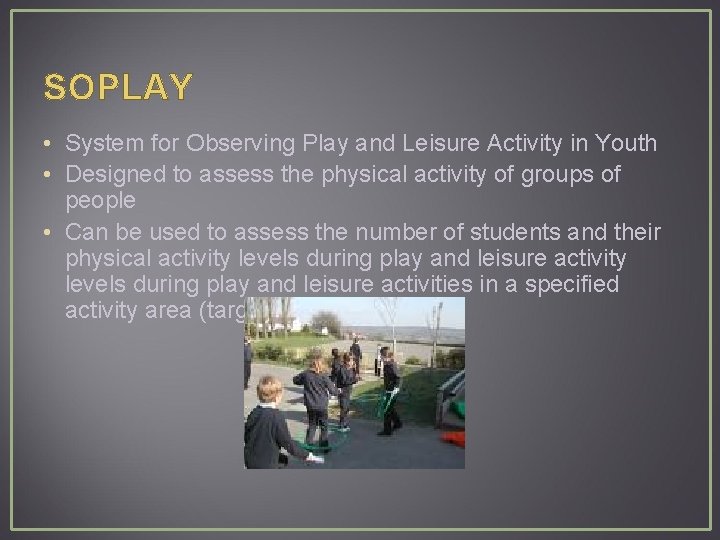
SOPLAY • System for Observing Play and Leisure Activity in Youth • Designed to assess the physical activity of groups of people • Can be used to assess the number of students and their physical activity levels during play and leisure activities in a specified activity area (target area)
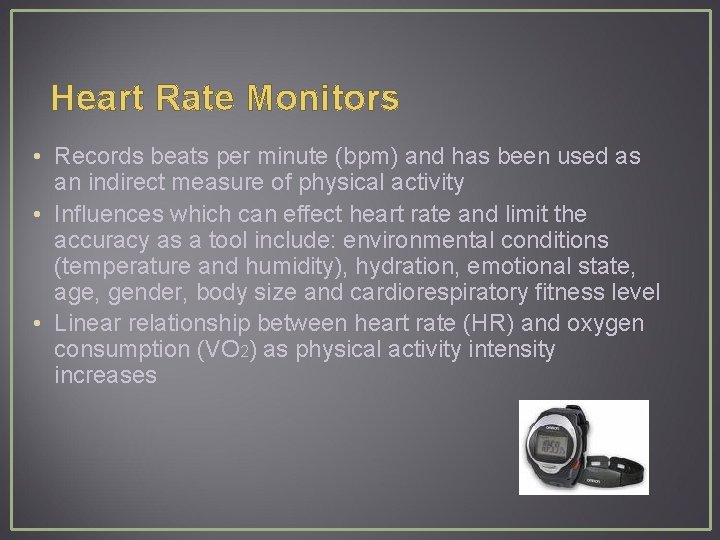
Heart Rate Monitors • Records beats per minute (bpm) and has been used as an indirect measure of physical activity • Influences which can effect heart rate and limit the accuracy as a tool include: environmental conditions (temperature and humidity), hydration, emotional state, age, gender, body size and cardiorespiratory fitness level • Linear relationship between heart rate (HR) and oxygen consumption (VO 2) as physical activity intensity increases
Advantages • Valid in laboratory and field based settings • Provides a good description of several dimensions of physical activity among adults • Quick and easy data collection
Disadvantages • Expensive for use with large numbers of participants • Some discomfort with wearing heart rate monitors for extended periods • Useful only for aerobic activities • Influenced by other factors e. g. stress, and fitness levels • Changes in heart rate lag behind changes in physical activity, which can underestimate children’s physical activity and mask the sporadic nature of their movements
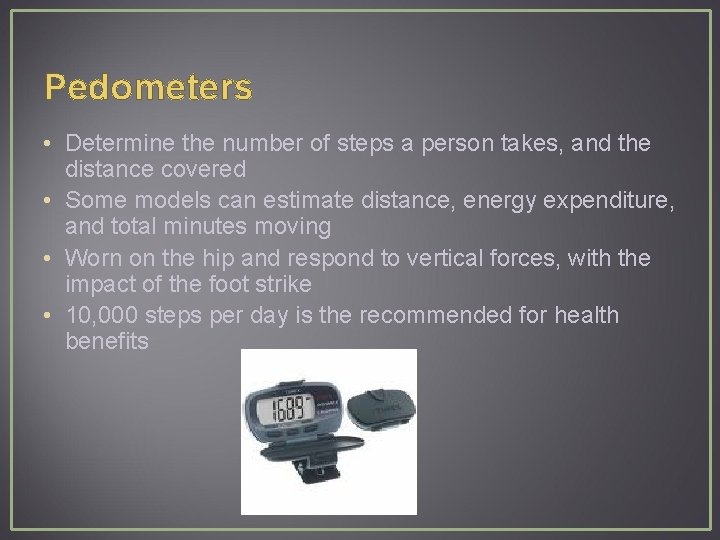
Pedometers • Determine the number of steps a person takes, and the distance covered • Some models can estimate distance, energy expenditure, and total minutes moving • Worn on the hip and respond to vertical forces, with the impact of the foot strike • 10, 000 steps per day is the recommended for health benefits
Advantages • • Inexpensive Small and lightweight Easy to use with large groups Useful in detecting change in daily average steps taken between pre and post tests, or to identify changes in rank among groups • Objective measurement of the most common physical activity behaviour (walking) • Appropriate for use in a range of settings (school, work and community) • Provide immediate feedback and have the potential to promote behaviour change
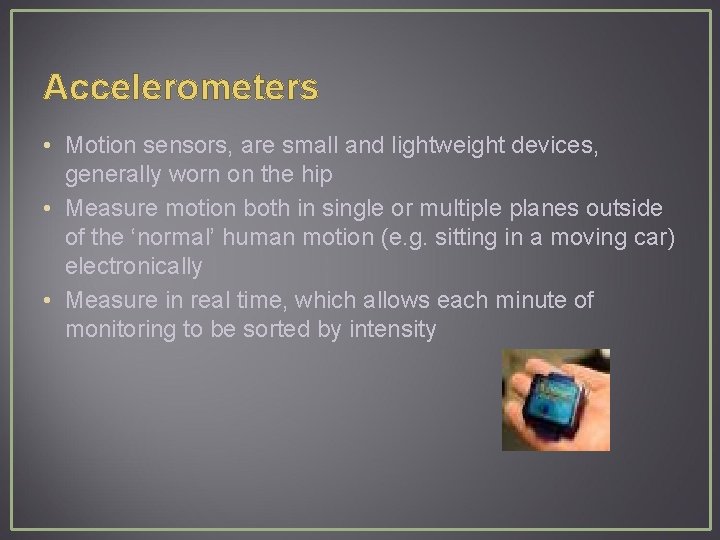
Accelerometers • Motion sensors, are small and lightweight devices, generally worn on the hip • Measure motion both in single or multiple planes outside of the ‘normal’ human motion (e. g. sitting in a moving car) electronically • Measure in real time, which allows each minute of monitoring to be sorted by intensity
Advantages • • Small, lightweight and non invasive Objective measure of body movement (acceleration) Good alternative to self reporting activity by children Can be used in laboratory or field settings Assesses intensity, frequency and duration Records in real time Can store date for several weeks
Disadvantages • Expensive for large groups • Cannot be worn during aquatic based activities • Underestimates movement during bike riding, rollerblading, or activities which are predominately upper body