
Measuring Phase Difference ECE 2100 Dr Len Trombetta

Measuring Phase Difference ECE 2100 Dr. Len Trombetta 1
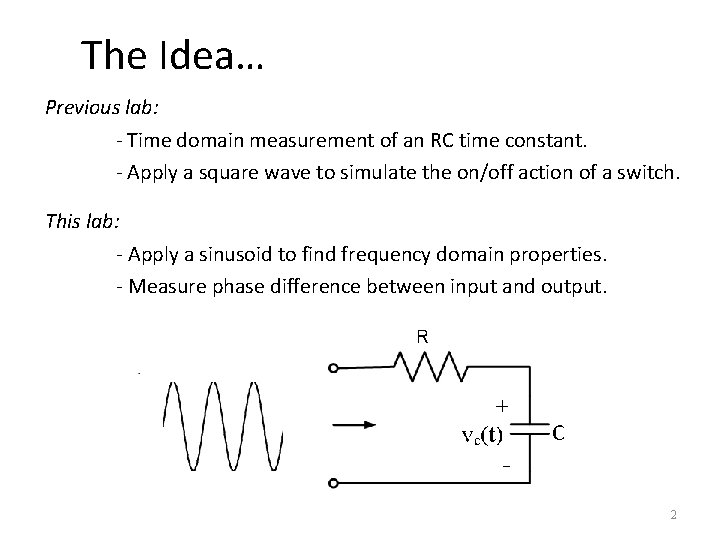
The Idea… Previous lab: - Time domain measurement of an RC time constant. - Apply a square wave to simulate the on/off action of a switch. This lab: - Apply a sinusoid to find frequency domain properties. - Measure phase difference between input and output. 2
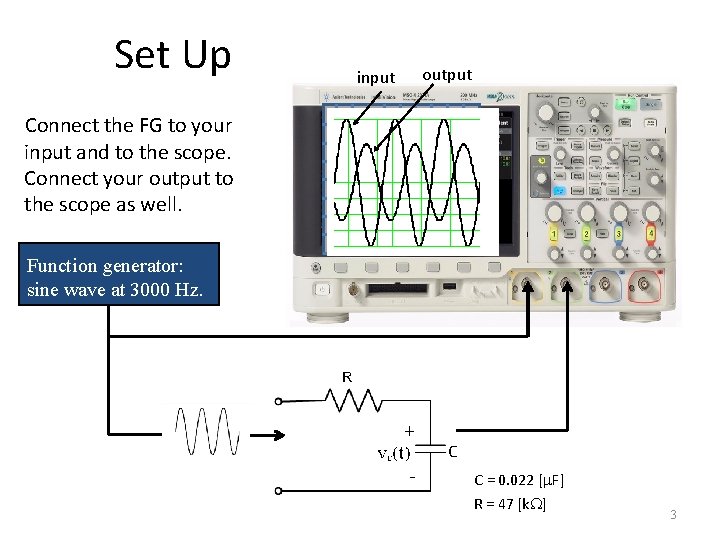
Set Up input output Connect the FG to your input and to the scope. Connect your output to the scope as well. Function generator: sine wave at 3000 Hz. C = 0. 022 [m. F] R = 47 [k. W] 3

Frequency Analysis + Vin - + Vout - What happens to the output at very high and very low frequencies? Is there a phase change? Observe this on the scope. 4

Phase Difference We cannot measure the absolute phase of either waveform we can only measure the phase difference. 5
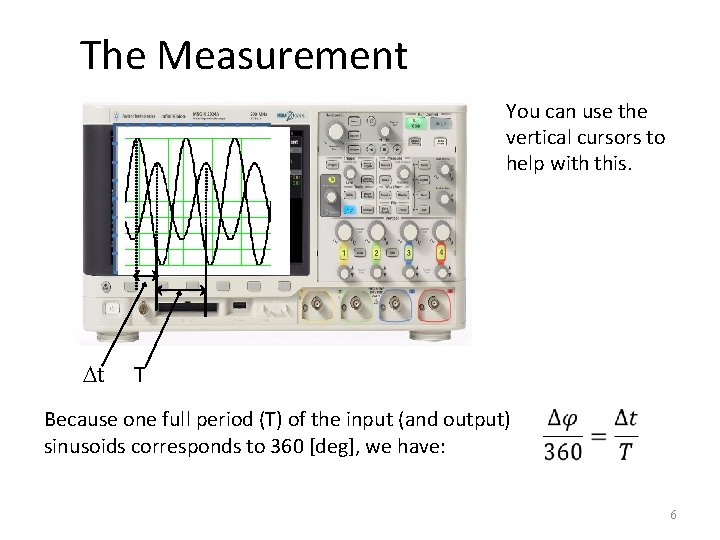
The Measurement You can use the vertical cursors to help with this. Dt T Because one full period (T) of the input (and output) sinusoids corresponds to 360 [deg], we have: 6
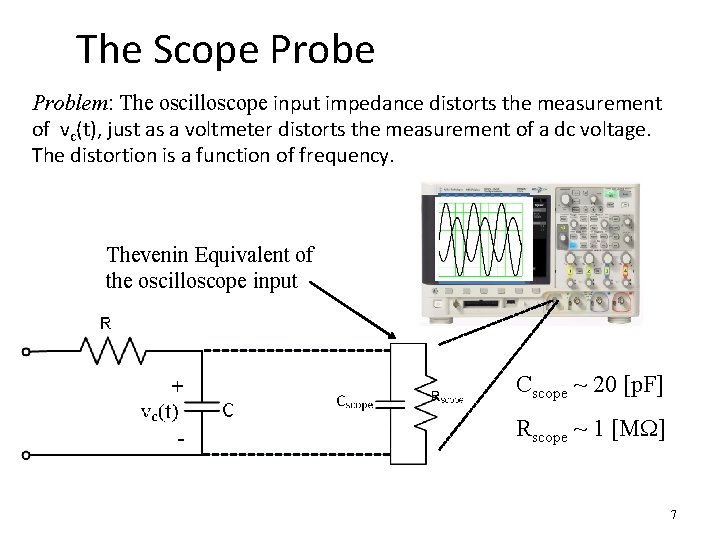
The Scope Problem: The oscilloscope input impedance distorts the measurement of vc(t), just as a voltmeter distorts the measurement of a dc voltage. The distortion is a function of frequency. Thevenin Equivalent of the oscilloscope input Cscope ~ 20 [p. F] Rscope ~ 1 [MW] 7
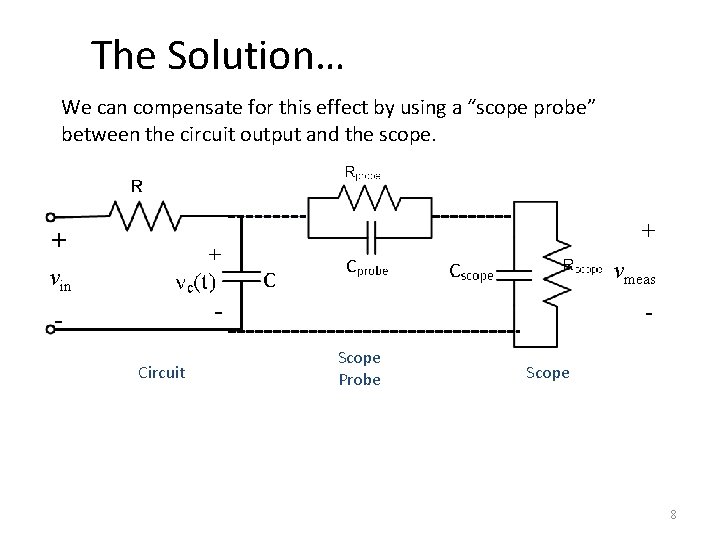
The Solution… We can compensate for this effect by using a “scope probe” between the circuit output and the scope. + + vin vmeas - Circuit Scope Probe Scope 8
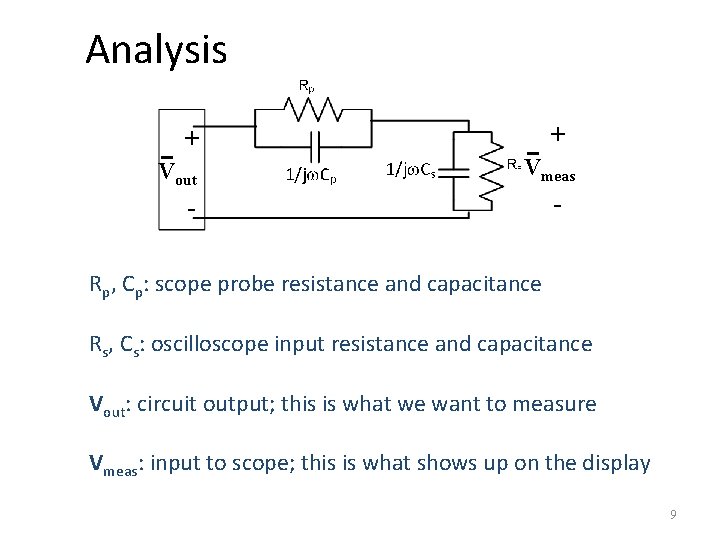
Analysis + + Vout - Vmeas - Rp, Cp: scope probe resistance and capacitance Rs, Cs: oscilloscope input resistance and capacitance Vout: circuit output; this is what we want to measure Vmeas: input to scope; this is what shows up on the display 9
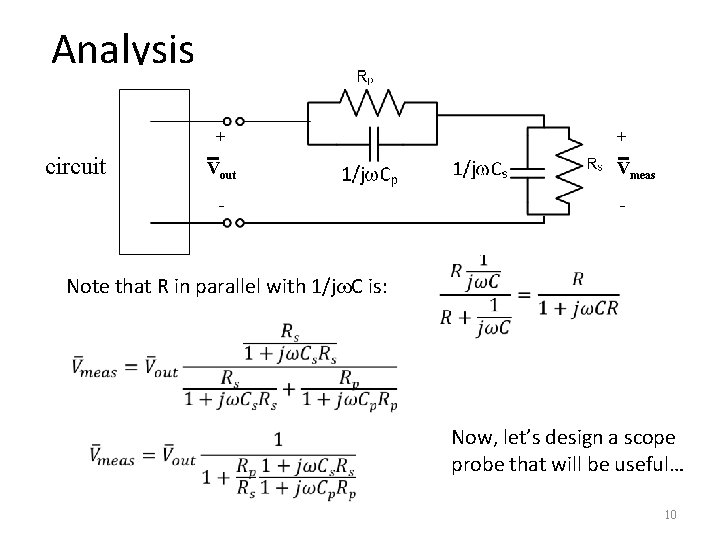
Analysis + circuit Vout - + Vmeas - Note that R in parallel with 1/jw. C is: Now, let’s design a scope probe that will be useful… 10
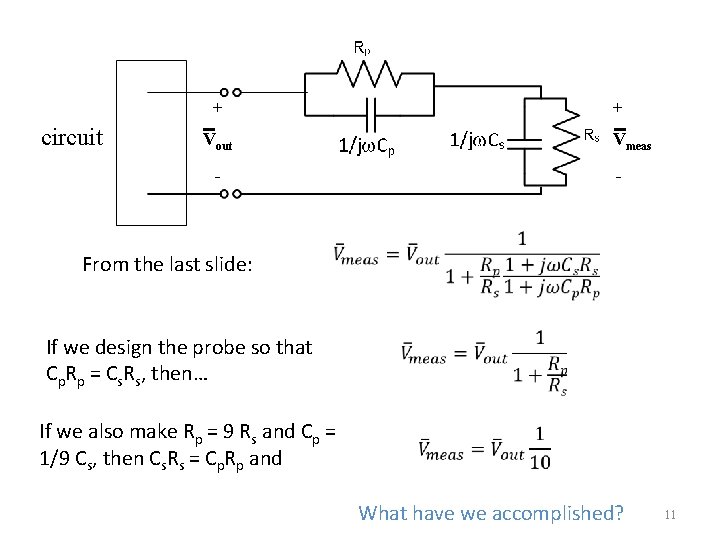
+ circuit Vout - + Vmeas - From the last slide: If we design the probe so that Cp. Rp = Cs. Rs, then… If we also make Rp = 9 Rs and Cp = 1/9 Cs, then Cs. Rs = Cp. Rp and What have we accomplished? 11
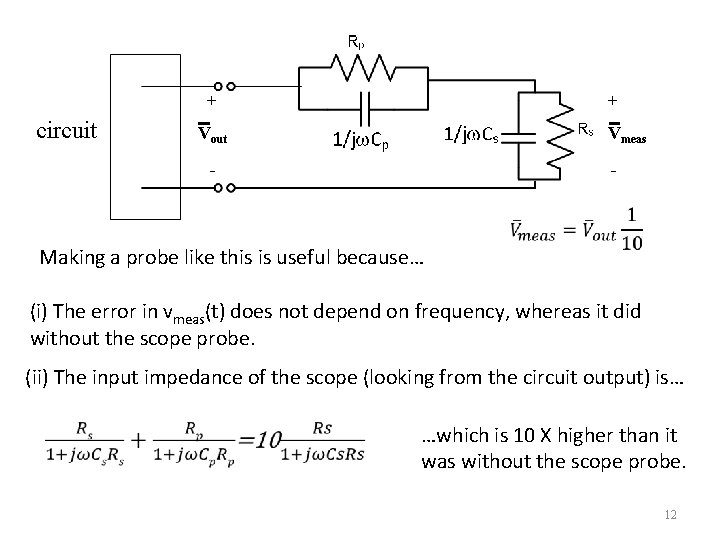
+ circuit + Vout Vmeas - - Making a probe like this is useful because… (i) The error in vmeas(t) does not depend on frequency, whereas it did without the scope probe. (ii) The input impedance of the scope (looking from the circuit output) is… …which is 10 X higher than it was without the scope probe. 12
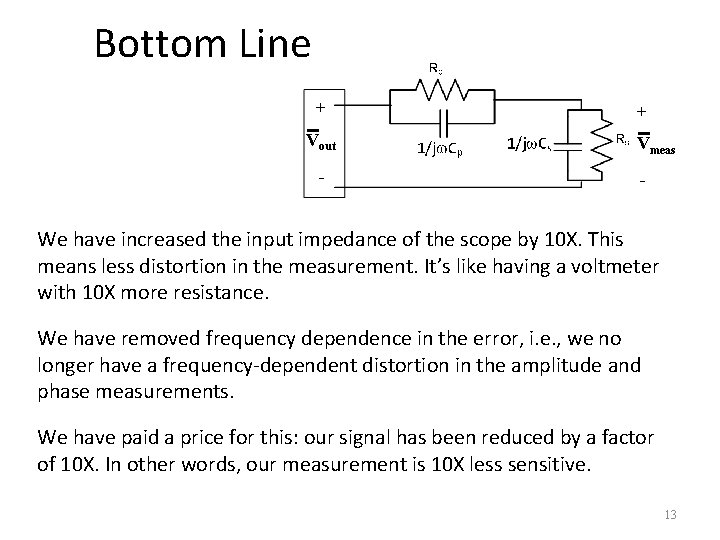
Bottom Line + Vout - + Vmeas - We have increased the input impedance of the scope by 10 X. This means less distortion in the measurement. It’s like having a voltmeter with 10 X more resistance. We have removed frequency dependence in the error, i. e. , we no longer have a frequency-dependent distortion in the amplitude and phase measurements. We have paid a price for this: our signal has been reduced by a factor of 10 X. In other words, our measurement is 10 X less sensitive. 13
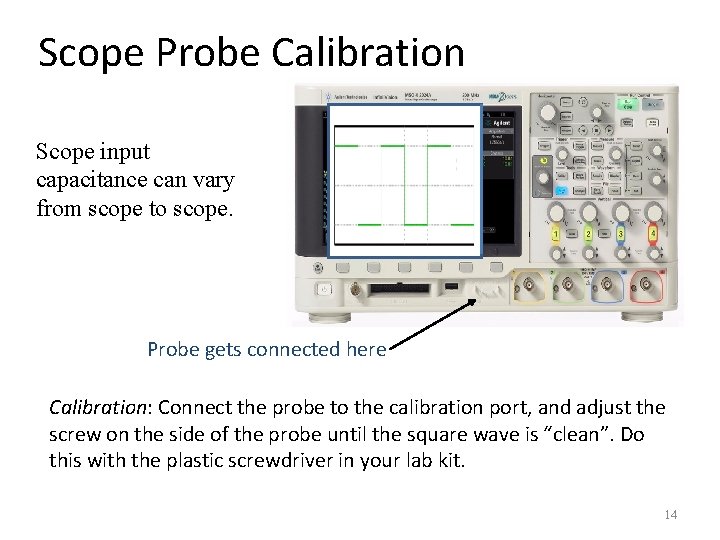
Scope Probe Calibration Scope input capacitance can vary from scope to scope. Probe gets connected here Calibration: Connect the probe to the calibration port, and adjust the screw on the side of the probe until the square wave is “clean”. Do this with the plastic screwdriver in your lab kit. 14
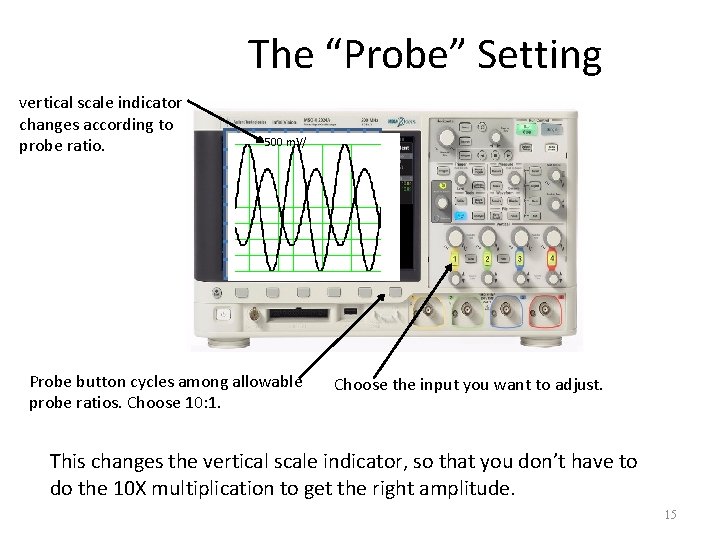
The “Probe” Setting vertical scale indicator changes according to probe ratio. 500 m. V/ Probe button cycles among allowable probe ratios. Choose 10: 1. Choose the input you want to adjust. This changes the vertical scale indicator, so that you don’t have to do the 10 X multiplication to get the right amplitude. 15
Summary If the scope probe is properly adjusted, it compensates for the input impedance of the oscilloscope. It removes the frequency dependence in the measurement error, and reduces the error by increasing the input impedance of the scope by 10 X. But it also reduces the sensitivity of the measurement by 10 X. Usually, this is a good tradeoff. 16
- Slides: 16