
Measuring Performance in A Knowledge Economy Linking Subjective
Measuring Performance in A Knowledge Economy: Linking Subjective and Objective Measurement into a Vector-Based Approach for Performance Measurement Juergen H. Daum, Chief Solution Architect, SAP AG, Walldorf, Germany Peter Bretscher, Ing. Büro für Wirtschaftsentwicklung, Eggersriet, Switzerland Presentation prepared for the PMA Conference 2004 (“The 4 th International Conference on Theory and Practice in Performance Measurement and Management”) , 28 -30 July 2004 in Edinburgh, UK
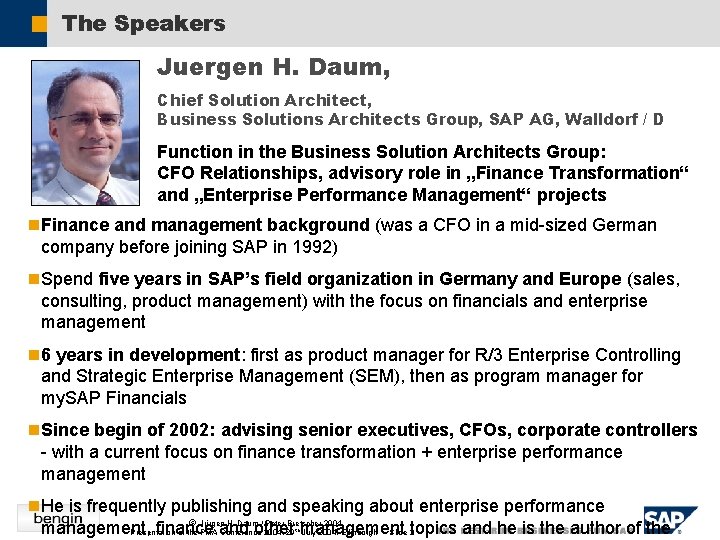
The Speakers Juergen H. Daum, Chief Solution Architect, Business Solutions Architects Group, SAP AG, Walldorf / D Function in the Business Solution Architects Group: CFO Relationships, advisory role in „Finance Transformation“ and „Enterprise Performance Management“ projects n Finance and management background (was a CFO in a mid-sized German company before joining SAP in 1992) n Spend five years in SAP’s field organization in Germany and Europe (sales, consulting, product management) with the focus on financials and enterprise management n 6 years in development: first as product manager for R/3 Enterprise Controlling and Strategic Enterprise Management (SEM), then as program manager for my. SAP Financials n Since begin of 2002: advising senior executives, CFOs, corporate controllers - with a current focus on finance transformation + enterprise performance management n He is frequently publishing and speaking about enterprise performance ã Jürgen H. Daum / Peter Bretscher 2004, management, finance other Presentation at the PMA and Conference 2004, 29 management July 2004, Edinburgh - Slide 2 topics and he is the author of the th
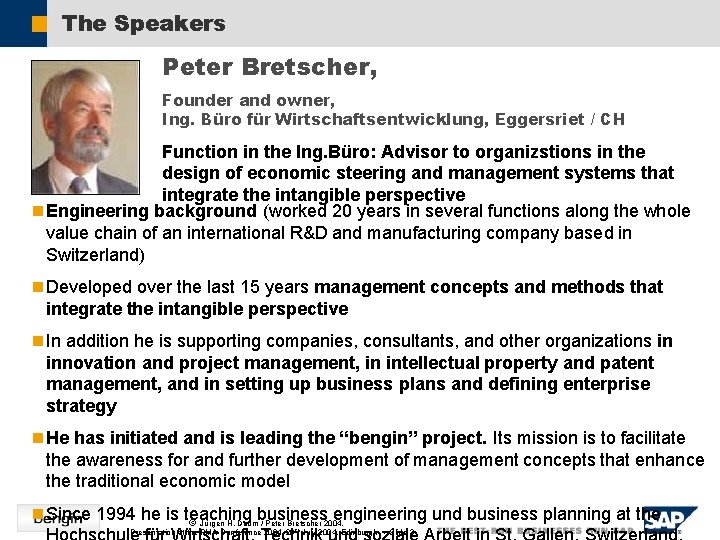
The Speakers Peter Bretscher, Founder and owner, Ing. Büro für Wirtschaftsentwicklung, Eggersriet / CH Function in the Ing. Büro: Advisor to organizstions in the design of economic steering and management systems that integrate the intangible perspective n Engineering background (worked 20 years in several functions along the whole value chain of an international R&D and manufacturing company based in Switzerland) n Developed over the last 15 years management concepts and methods that integrate the intangible perspective n In addition he is supporting companies, consultants, and other organizations in innovation and project management, in intellectual property and patent management, and in setting up business plans and defining enterprise strategy n He has initiated and is leading the “bengin” project. Its mission is to facilitate the awareness for and further development of management concepts that enhance the traditional economic model n Since 1994 he is teaching business engineering und business planning at the ã Jürgen H. Daum / Peter Bretscher 2004, Presentation at the PMA Conference 2004, 29 th July 2004, Edinburgh - Slide 3
Agenda ¢ Implications of the knowledge economy for performance measurement and management: subjective measurement - why and how? n The concept of Vector-Based Performance Measurement & Visualisation n Practical application cases of the concept n Conclusion & outlook ã Jürgen H. Daum / Peter Bretscher 2004, Presentation at the PMA Conference 2004, 29 th July 2004, Edinburgh - Slide 4
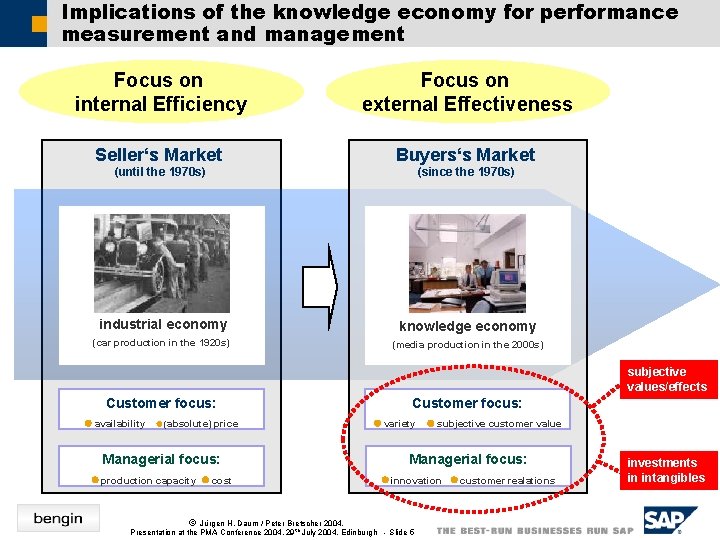
Implications of the knowledge economy for performance measurement and management Focus on internal Efficiency Focus on external Effectiveness Seller‘s Market Buyers‘s Market (until the 1970 s) (since the 1970 s) industrial economy knowledge economy (car production in the 1920 s) (media production in the 2000 s) subjective values/effects Customer focus: availability (absolute) price Customer focus: variety subjective customer value Managerial focus: production capacity cost innovation customer realations ã Jürgen H. Daum / Peter Bretscher 2004, Presentation at the PMA Conference 2004, 29 th July 2004, Edinburgh - Slide 5 investments in intangibles
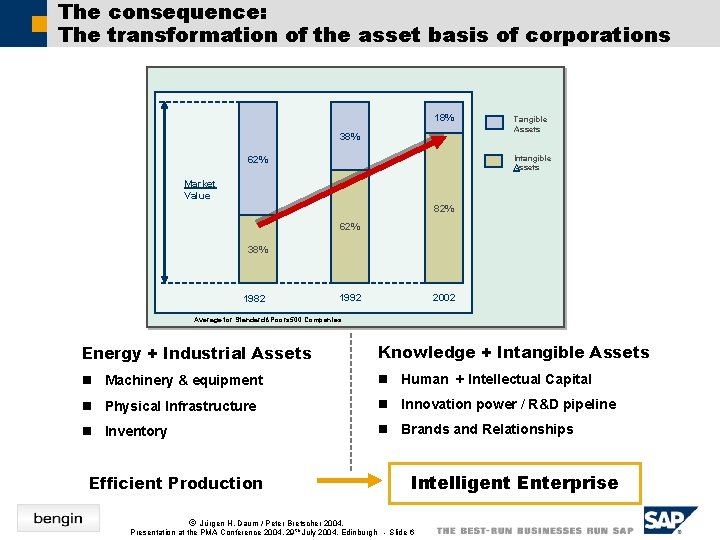
The consequence: The transformation of the asset basis of corporations 18% 38% 62% Tangible Assets Intangible Assets Market Value 82% 62% 38% 1982 2002 1992 Average for Standard&Poors 500 Companies Energy + Industrial Assets Knowledge + Intangible Assets n Machinery & equipment n Human + Intellectual Capital n Physical Infrastructure n Innovation power / R&D pipeline n Inventory n Brands and Relationships Efficient Production Intelligent Enterprise ã Jürgen H. Daum / Peter Bretscher 2004, Presentation at the PMA Conference 2004, 29 th July 2004, Edinburgh - Slide 6
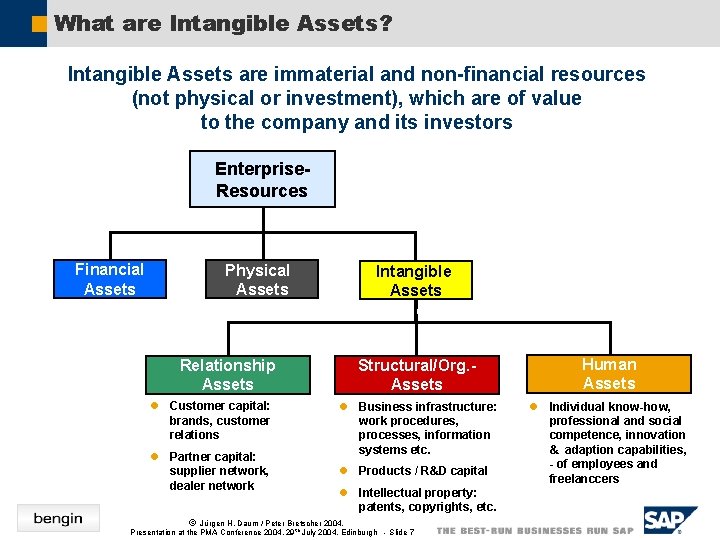
What are Intangible Assets? Intangible Assets are immaterial and non-financial resources (not physical or investment), which are of value to the company and its investors Enterprise. Resources Financial Assets Physical Assets Relationship Assets l Customer capital: brands, customer relations l Partner capital: supplier network, dealer network Intangible Assets Structural/Org. Assets Human Assets l Business infrastructure: work procedures, processes, information systems etc. l Individual know-how, professional and social competence, innovation & adaption capabilities, - of employees and freelanccers l Products / R&D capital l Intellectual property: patents, copyrights, etc. ã Jürgen H. Daum / Peter Bretscher 2004, Presentation at the PMA Conference 2004, 29 th July 2004, Edinburgh - Slide 7
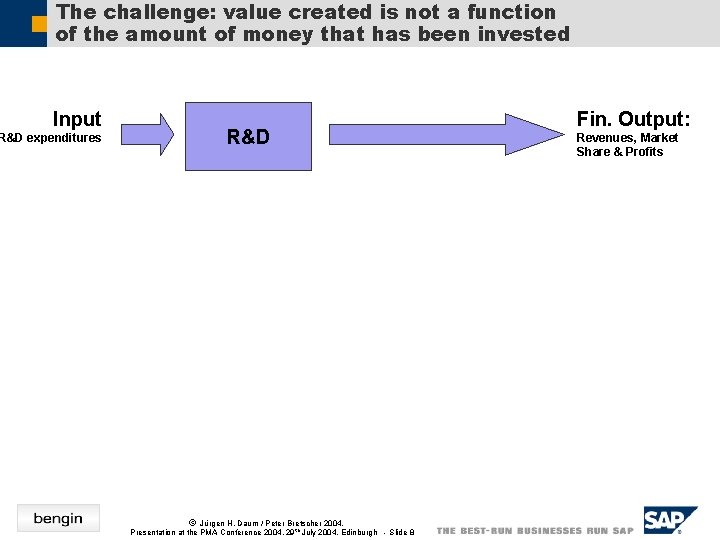
The challenge: value created is not a function of the amount of money that has been invested Input R&D expenditures R&D ã Jürgen H. Daum / Peter Bretscher 2004, Presentation at the PMA Conference 2004, 29 th July 2004, Edinburgh - Slide 8 Fin. Output: Revenues, Market Share & Profits
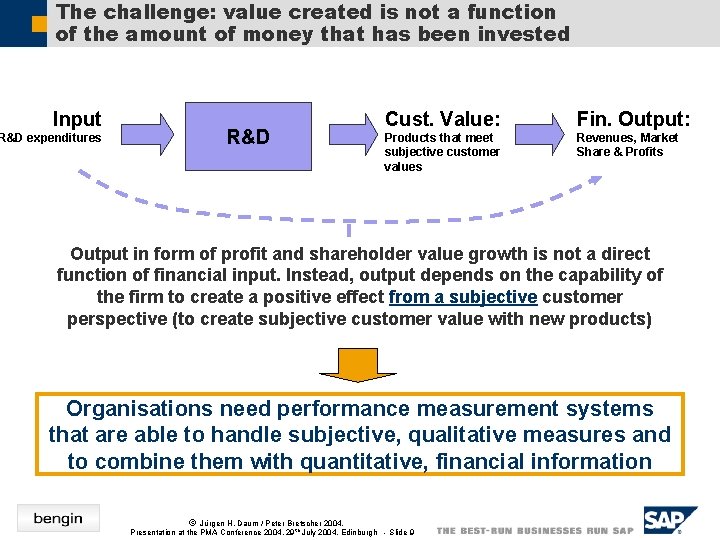
The challenge: value created is not a function of the amount of money that has been invested Input R&D expenditures R&D Cust. Value: Fin. Output: Products that meet subjective customer values Revenues, Market Share & Profits Output in form of profit and shareholder value growth is not a direct function of financial input. Instead, output depends on the capability of the firm to create a positive effect from a subjective customer perspective (to create subjective customer value with new products) Organisations need performance measurement systems that are able to handle subjective, qualitative measures and to combine them with quantitative, financial information ã Jürgen H. Daum / Peter Bretscher 2004, Presentation at the PMA Conference 2004, 29 th July 2004, Edinburgh - Slide 9
“Measurement” of subjective values – sounds unusual? ã Jürgen H. Daum / Peter Bretscher 2004, Presentation at the PMA Conference 2004, 29 th July 2004, Edinburgh - Slide 10
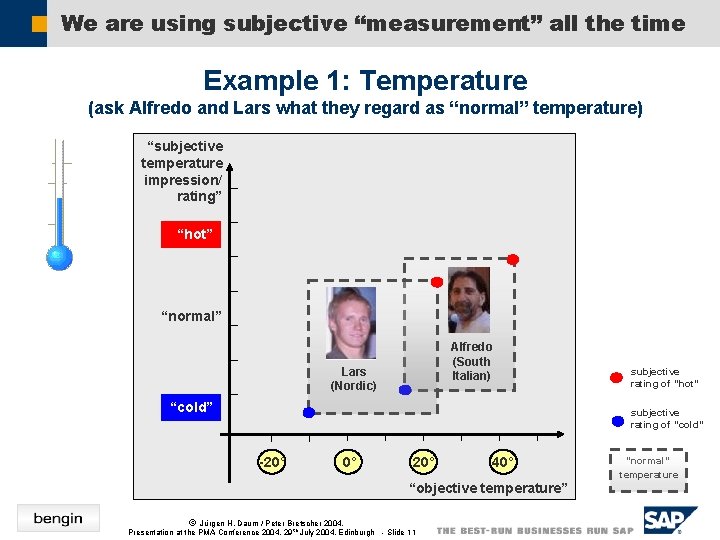
We are using subjective “measurement” all the time Example 1: Temperature (ask Alfredo and Lars what they regard as “normal” temperature) “subjective temperature impression/ rating” “hot” “normal” Alfredo (South Italian) Lars (Nordic) “cold” subjective rating of “hot” subjective rating of “cold” -20° 0° 20° 40° “objective temperature” ã Jürgen H. Daum / Peter Bretscher 2004, Presentation at the PMA Conference 2004, 29 th July 2004, Edinburgh - Slide 11 “normal” temperature
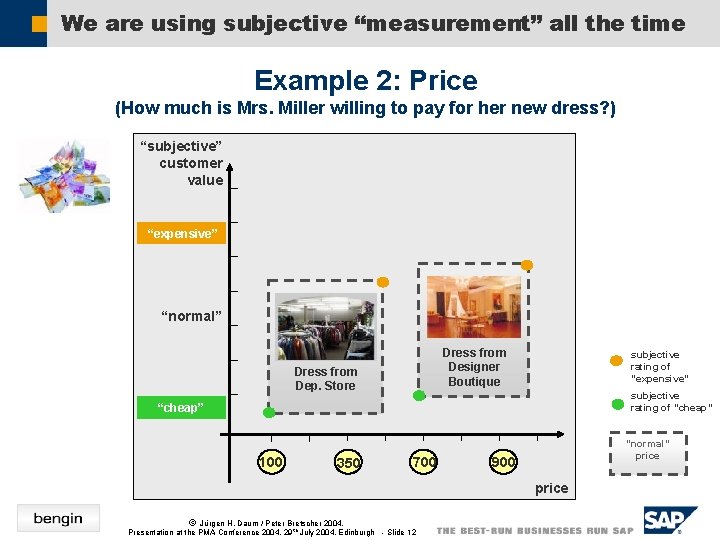
We are using subjective “measurement” all the time Example 2: Price (How much is Mrs. Miller willing to pay for her new dress? ) “subjective” customer value “expensive” “normal” Dress from Designer Boutique Dress from Dep. Store subjective rating of “expensive” subjective rating of “cheap” 100 350 700 “normal” price 900 price ã Jürgen H. Daum / Peter Bretscher 2004, Presentation at the PMA Conference 2004, 29 th July 2004, Edinburgh - Slide 12
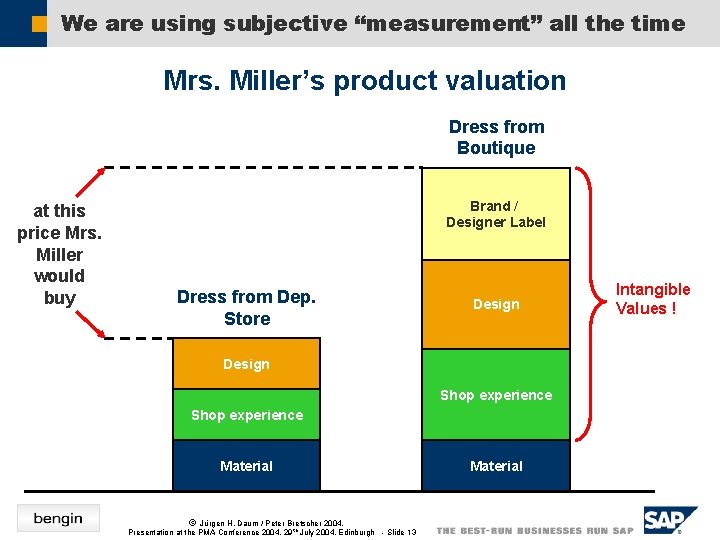
We are using subjective “measurement” all the time Mrs. Miller’s product valuation Dress from Boutique at this price Mrs. Miller would buy Brand / Designer Label Dress from Dep. Store Design Shop experience Material ã Jürgen H. Daum / Peter Bretscher 2004, Presentation at the PMA Conference 2004, 29 th July 2004, Edinburgh - Slide 13 Material Intangible Values !
“Measurement” of subjective values – sounds unusual? n Every customer is placing a (intangible) value on products or services according to subjective qualitative criteria. n Organizations that provide services or products to customer have to consider this subjective, qualitative (intangible) dimension in managerial decision making throughout the entire value chain. n Otherwise they would not be able to use their full potential to create value (for customers, shareholders and other stakeholders) Organisations need performance measurement systems that value subjective, qualitative value through relative ratings and that combine them with quantitative, financial information ã Jürgen H. Daum / Peter Bretscher 2004, Presentation at the PMA Conference 2004, 29 th July 2004, Edinburgh - Slide 14
“Measurement” of subjective values – sounds unusual? Consider the Credit Rating Services of S&P: An example for of a qualitative measurement system is the rating of a company’s credit worthiness by Standard & Poor's (S&P) with ratings ranging from “AAA” to “D”. While S&P has probably internal rules and standard procedures governing how they rate a company, the rating results are nevertheless “subjective”: they are based on a S&P's -specific valuation/measurement system and on personal qualitative expert-judgments by the analysts in charge. Because no objective measurement scale for the credit worthiness of a company exists (at least not yet), the S&P rating cannot be compared directly with the ranking of e. g. another rating agency or with the rating of a company's housebank. Nevertheless, the S&P rating is widely accepted and provides useful information about a company for capital market participants or suppliers. Measurement of subjective values: based e. g. on expert rating or by using relative measure scales (such as a 1 -5 point system) ã Jürgen H. Daum / Peter Bretscher 2004, Presentation at the PMA Conference 2004, 29 th July 2004, Edinburgh - Slide 15
Agenda ¢ Implications of the knowledge economy for performance measurement and management: subjective measurement - why and how? n The concept of Vector-Based Performance Measurement & Visualisation n Practical application cases of the concept n Conclusion & outlook ã Jürgen H. Daum / Peter Bretscher 2004, Presentation at the PMA Conference 2004, 29 th July 2004, Edinburgh - Slide 16
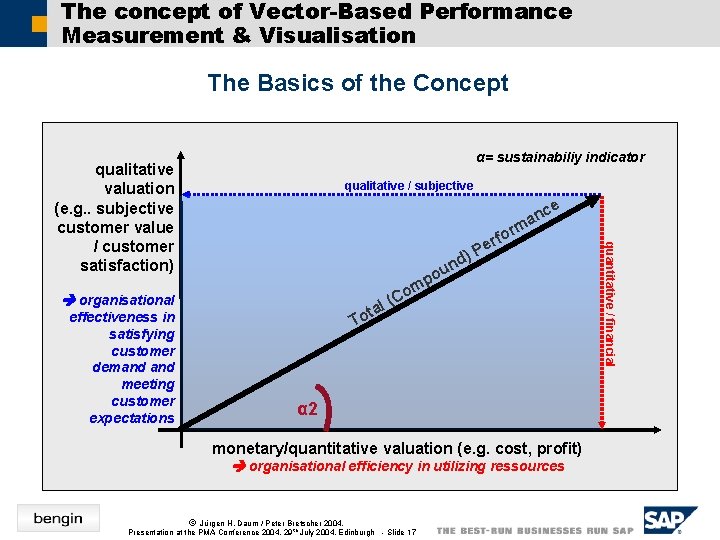
The concept of Vector-Based Performance Measurement & Visualisation The Basics of the Concept α= sustainabiliy indicator qualitative valuation (e. g. . subjective customer value / customer satisfaction) qualitative / subjective ce ta To α 2 monetary/quantitative valuation (e. g. cost, profit) organisational efficiency in utilizing ressources ã Jürgen H. Daum / Peter Bretscher 2004, Presentation at the PMA Conference 2004, 29 th July 2004, Edinburgh - Slide 17 quantitative / financial p om C ( l organisational effectiveness in satisfying customer demand meeting customer expectations r rfo e P d) n ou n ma
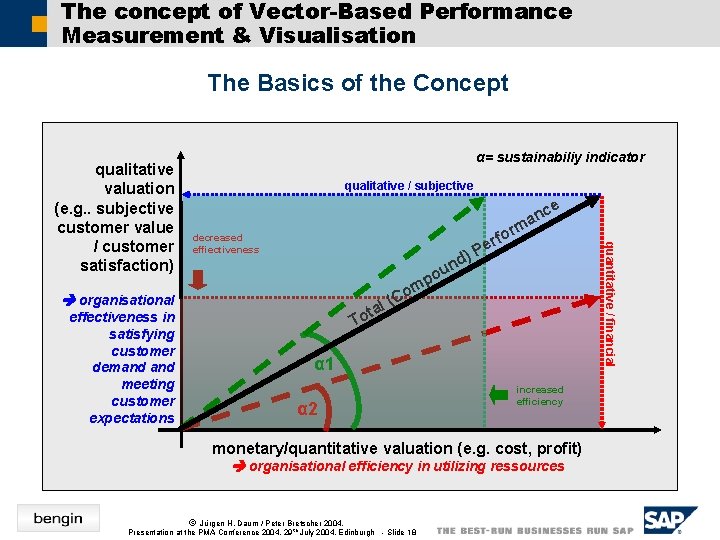
The concept of Vector-Based Performance Measurement & Visualisation The Basics of the Concept α= sustainabiliy indicator qualitative / subjective ce p om C ( l organisational effectiveness in satisfying customer demand meeting customer expectations r rfo e P d) n ou decreased effiectiveness n ma quantitative / financial qualitative valuation (e. g. . subjective customer value / customer satisfaction) ta To α 1 α 2 increased efficiency monetary/quantitative valuation (e. g. cost, profit) organisational efficiency in utilizing ressources ã Jürgen H. Daum / Peter Bretscher 2004, Presentation at the PMA Conference 2004, 29 th July 2004, Edinburgh - Slide 18
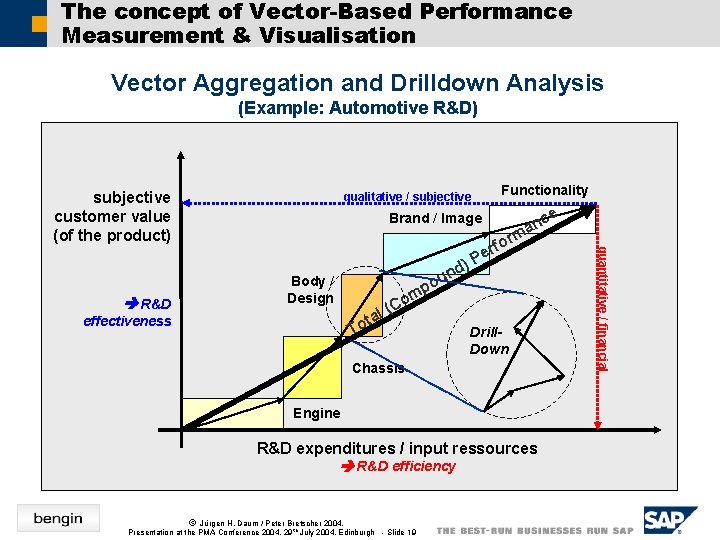
The concept of Vector-Based Performance Measurement & Visualisation Vector Aggregation and Drilldown Analysis (Example: Automotive R&D) subjective customer value (of the product) ce Brand / Image n ma or Body / Design d) n u rf e P o l ota effectiveness mp o C ( T Drill. Down Chassis Engine R&D expenditures / input ressources R&D efficiency ã Jürgen H. Daum / Peter Bretscher 2004, Presentation at the PMA Conference 2004, 29 th July 2004, Edinburgh - Slide 19 quantitative / financial R&D Functionality qualitative / subjective
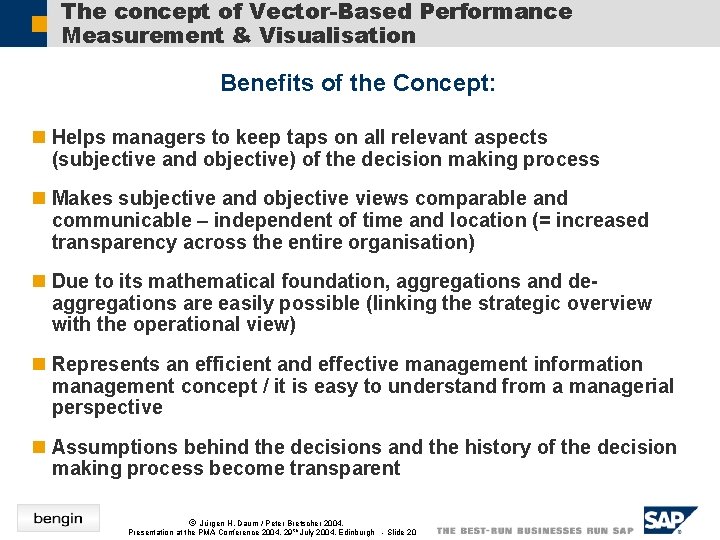
The concept of Vector-Based Performance Measurement & Visualisation Benefits of the Concept: n Helps managers to keep taps on all relevant aspects (subjective and objective) of the decision making process n Makes subjective and objective views comparable and communicable – independent of time and location (= increased transparency across the entire organisation) n Due to its mathematical foundation, aggregations and deaggregations are easily possible (linking the strategic overview with the operational view) n Represents an efficient and effective management information management concept / it is easy to understand from a managerial perspective n Assumptions behind the decisions and the history of the decision making process become transparent ã Jürgen H. Daum / Peter Bretscher 2004, Presentation at the PMA Conference 2004, 29 th July 2004, Edinburgh - Slide 20
Agenda ¢ Implications of the knowledge economy for performance measurement and management: subjective measurement - why and how? n The concept of Vector-Based Performance Measurement & Visualisation n Practical application cases of the concept n Conclusion & outlook ã Jürgen H. Daum / Peter Bretscher 2004, Presentation at the PMA Conference 2004, 29 th July 2004, Edinburgh - Slide 21
Application at Public Service Organisations ã Jürgen H. Daum / Peter Bretscher 2004, Presentation at the PMA Conference 2004, 29 th July 2004, Edinburgh - Slide 22
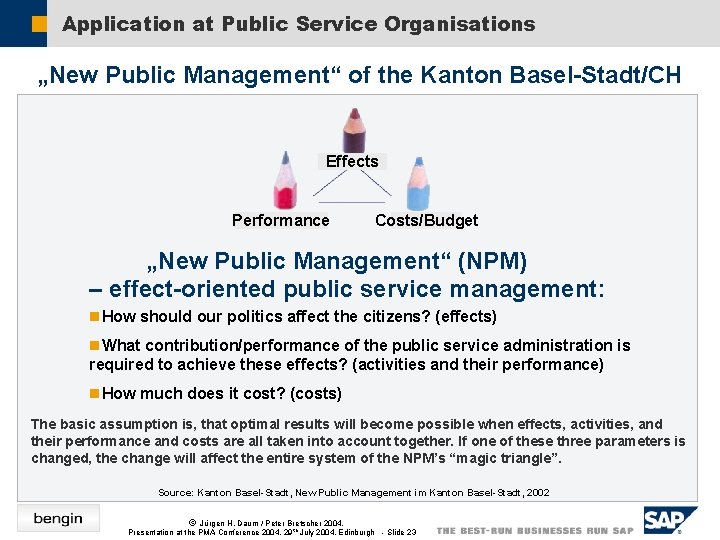
Application at Public Service Organisations „New Public Management“ of the Kanton Basel-Stadt/CH Effects Performance Costs/Budget „New Public Management“ (NPM) – effect-oriented public service management: n. How should our politics affect the citizens? (effects) n. What contribution/performance of the public service administration is required to achieve these effects? (activities and their performance) n. How much does it cost? (costs) The basic assumption is, that optimal results will become possible when effects, activities, and their performance and costs are all taken into account together. If one of these three parameters is changed, the change will affect the entire system of the NPM’s “magic triangle”. Source: Kanton Basel-Stadt, New Public Management im Kanton Basel-Stadt, 2002 ã Jürgen H. Daum / Peter Bretscher 2004, Presentation at the PMA Conference 2004, 29 th July 2004, Edinburgh - Slide 23
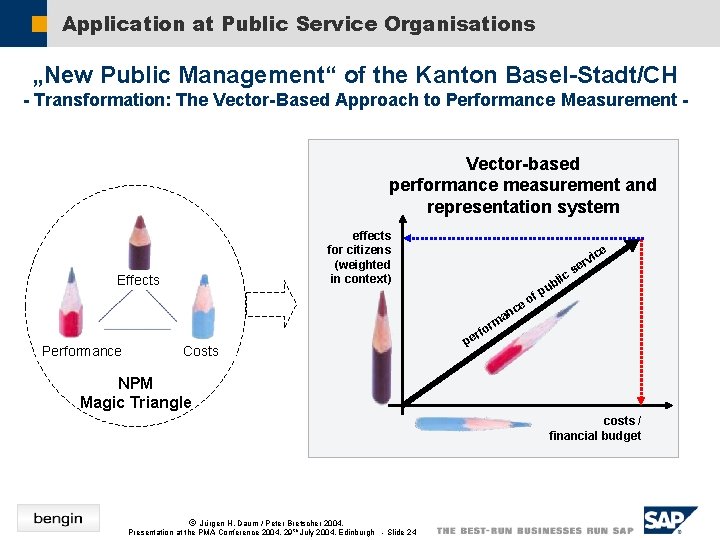
Application at Public Service Organisations „New Public Management“ of the Kanton Basel-Stadt/CH - Transformation: The Vector-Based Approach to Performance Measurement Vector-based performance measurement and representation system effects for citizens (weighted in context) Effects e a rm nc f eo li ub vic er cs p rfo Performance Costs pe NPM Magic Triangle costs / financial budget ã Jürgen H. Daum / Peter Bretscher 2004, Presentation at the PMA Conference 2004, 29 th July 2004, Edinburgh - Slide 24
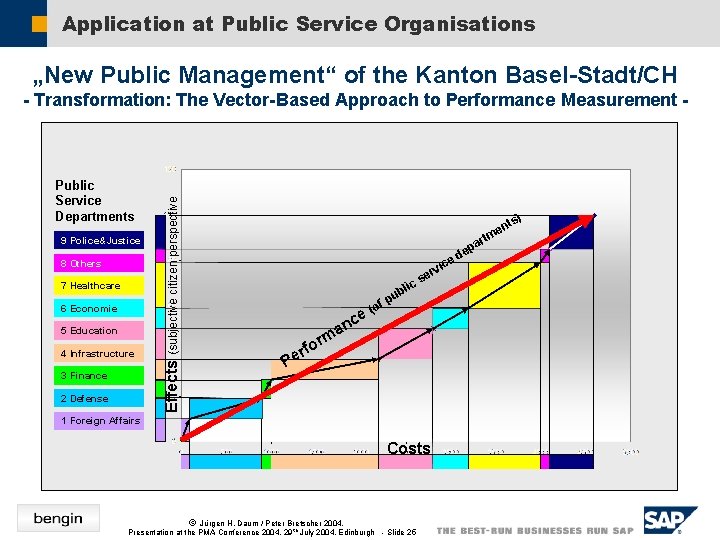
Application at Public Service Organisations „New Public Management“ of the Kanton Basel-Stadt/CH Public Service Departments 9 Police&Justice 8 Others 7 Healthcare 6 Economie 5 Education 4 Infrastructure 3 Finance 2 Defense Effects (subjective citizen perspective - Transformation: The Vector-Based Approach to Performance Measurement - ts) t n me e vic c an m for r e ce li ub p (of r se P 1 Foreign Affairs Costs ã Jürgen H. Daum / Peter Bretscher 2004, Presentation at the PMA Conference 2004, 29 th July 2004, Edinburgh - Slide 25 r pa de
Application at Public Service Organisations Benefits for a Kantonalverwaltung in applying the Concept Vector-Based Performance Measurement & Visualisation: n Public service managers do not need to wade through 300 -page budget documents (that is for instance the actual number of pages for the Kanton Basel-Stadt budget, including product and product group effect objectives and performance targets: 140 product groups, 1000 measures, 140 budgets). A few graphs/charts are enough to get an overview and to link strategy with operational management. n The focus is set in the first place on value and performance (effects for citizens and performance of the public service) and then on financial budgets (on how to get and spend funds). This is alignsing the whole organization with the intended effect of its activities for society and is enabling management to make better trade-off decisions between tight budgets (efficient use of resources) and benefits (effects) from a citizen perspective. n Budget adjustments (e. g. reduction by 10%) are now based on citizens valuations and not just on internal budget/departmental policies ã Jürgen H. Daum / Peter Bretscher 2004, Presentation at the PMA Conference 2004, 29 th July 2004, Edinburgh - Slide 26

Application at Car Manufacturers (OEMs) ã Jürgen H. Daum / Peter Bretscher 2004, Presentation at the PMA Conference 2004, 29 th July 2004, Edinburgh - Slide 27
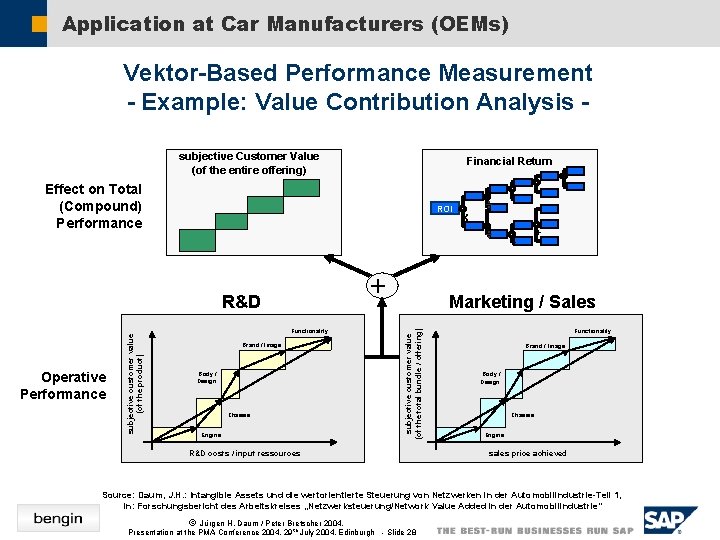
Application at Car Manufacturers (OEMs) Vektor-Based Performance Measurement - Example: Value Contribution Analysis subjective Customer Value (of the entire offering) Financial Return Effect on Total (Compound) Performance ROI + Functionality Brand / Image Body / Design Chassis Engine - + + Marketing / Sales subjective customer value (of the total bundle / offering) subjective customer value (of the product) ÷ ÷ R&D Operative Performance x - - R&D costs / input ressources Functionality Brand / Image Body / Design Chassis Engine sales price achieved Source: Daum, J. H. : Intangible Assets und die wertorientierte Steuerung von Netzwerken in der Automobilindustrie-Teil 1, in: Forschungsbericht des Arbeitskreises „Netzwerksteuerung/Network Value Added in der Automobilindustrie“ ã Jürgen H. Daum / Peter Bretscher 2004, Presentation at the PMA Conference 2004, 29 th July 2004, Edinburgh - Slide 28
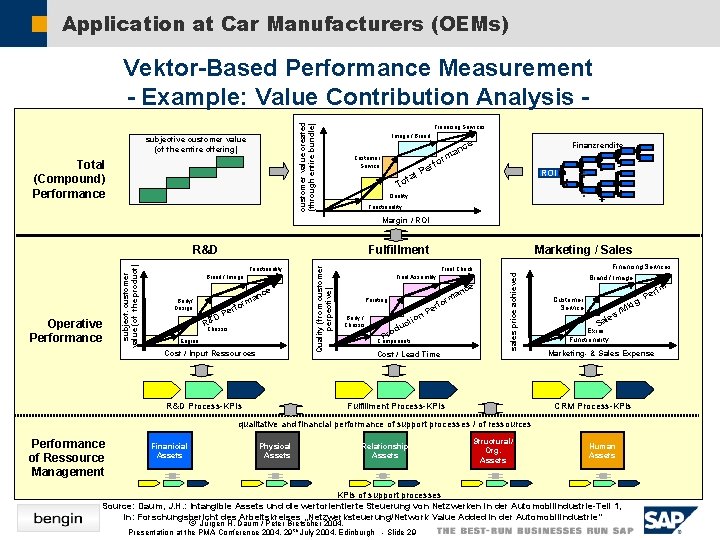
Application at Car Manufacturers (OEMs) customer value created (through entire bundle) Vektor-Based Performance Measurement - Example: Value Contribution Analysis subjective customer value (of the entire offering) Total (Compound) Performance Financing Services Image / Brand Customer Service ce Finanzrendite an orm erf P tal ROI To Quality Functionality x ÷ - - - ÷ + + Margin / ROI Fulfillment Body/ Design rf Pe ce an orm &D RChassis Engine Cost / Input Ressources R&D Process-KPIs Marketing / Sales Financing Services Final Check Final Assembly e nc ma r rfo Painting Body / Chassis tio uc rod e n. P P Components Cost / Lead Time sales price achieved Functionality Brand / Image Quality (from customer perpective) Operative Performance subject. customer value (of the product) R&D Fulfillment Process-KPIs Brand / Image . Customer Service tg Mk s/ le Sa Exras Functionality Marketing- & Sales Expense CRM Process-KPIs qualitative and financial performance of support processes / of ressources Performance of Ressource Management Finanicial Assets Physical Assets Relationship Assets Structural/ Org. Assets Human Assets KPIs of support processes Source: Daum, J. H. : Intangible Assets und die wertorientierte Steuerung von Netzwerken in der Automobilindustrie-Teil 1, in: Forschungsbericht des Arbeitskreises „Netzwerksteuerung/Network Value Added in der Automobilindustrie“ ã Jürgen H. Daum / Peter Bretscher 2004, Presentation at the PMA Conference 2004, 29 th July 2004, Edinburgh - Slide 29 m. rf Pe
Application at Software Companies ã Jürgen H. Daum / Peter Bretscher 2004, Presentation at the PMA Conference 2004, 29 th July 2004, Edinburgh - Slide 30
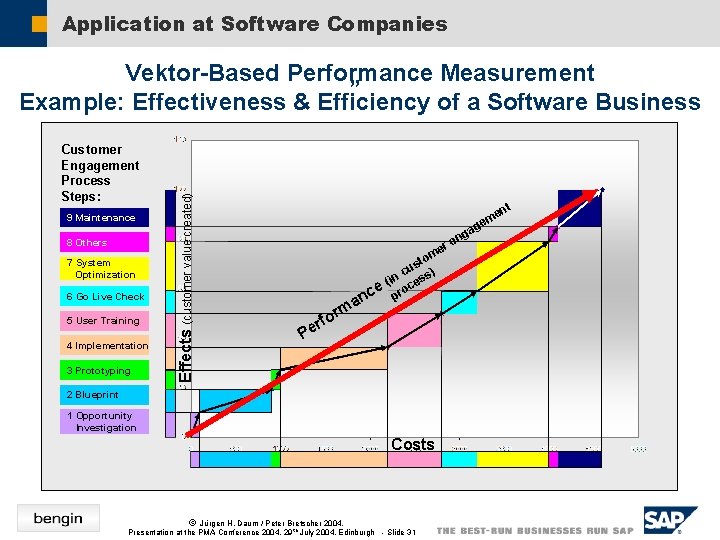
Application at Software Companies Customer Engagement Process Steps: 9 Maintenance 8 Others 7 System Optimization 6 Go Live Check 5 User Training 4 Implementation 3 Prototyping Effects (customer value created) Vektor-Based Performance Measurement „ Example: Effectiveness & Efficiency of a Software Business e em an m for r e ce me o t s cu s) n s i ( ce o pr P 2 Blueprint 1 Opportunity Investigation Costs ã Jürgen H. Daum / Peter Bretscher 2004, Presentation at the PMA Conference 2004, 29 th July 2004, Edinburgh - Slide 31 r g ga n e nt
Application in Enterprise Valuation ã Jürgen H. Daum / Peter Bretscher 2004, Presentation at the PMA Conference 2004, 29 th July 2004, Edinburgh - Slide 32
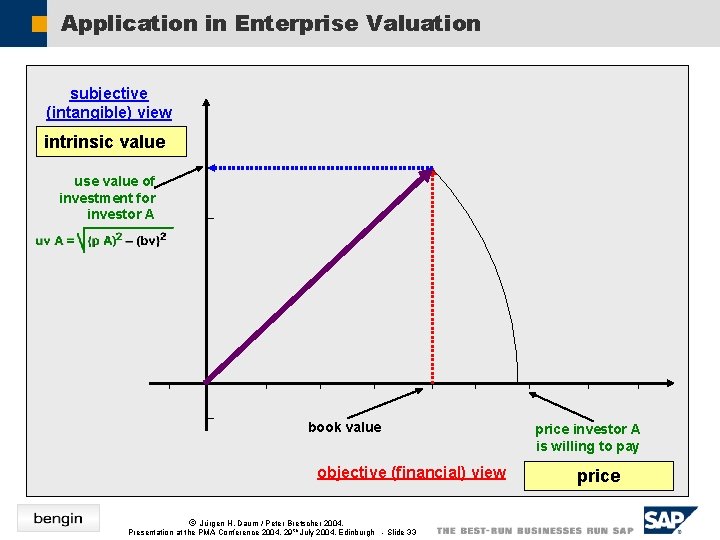
Application in Enterprise Valuation subjective (intangible) view intrinsic value use value of investment for investor A book value objective (financial) view ã Jürgen H. Daum / Peter Bretscher 2004, Presentation at the PMA Conference 2004, 29 th July 2004, Edinburgh - Slide 33 price investor A is willing to pay price
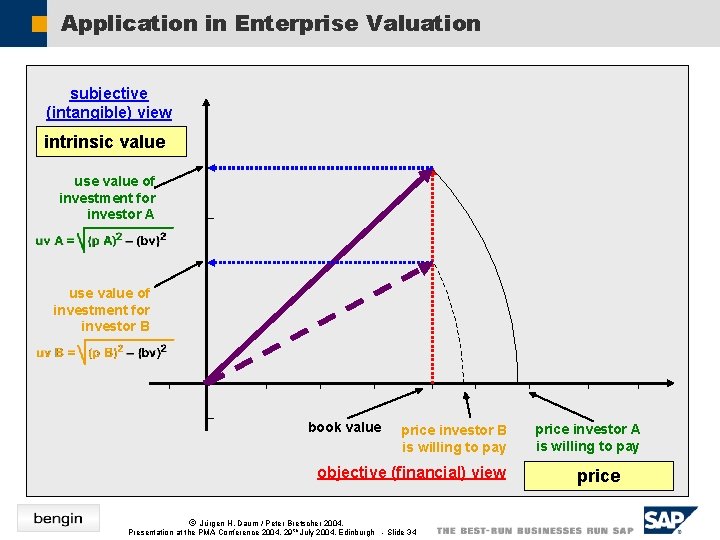
Application in Enterprise Valuation subjective (intangible) view intrinsic value use value of investment for investor A use value of investment for investor B book value price investor B is willing to pay objective (financial) view ã Jürgen H. Daum / Peter Bretscher 2004, Presentation at the PMA Conference 2004, 29 th July 2004, Edinburgh - Slide 34 price investor A is willing to pay price
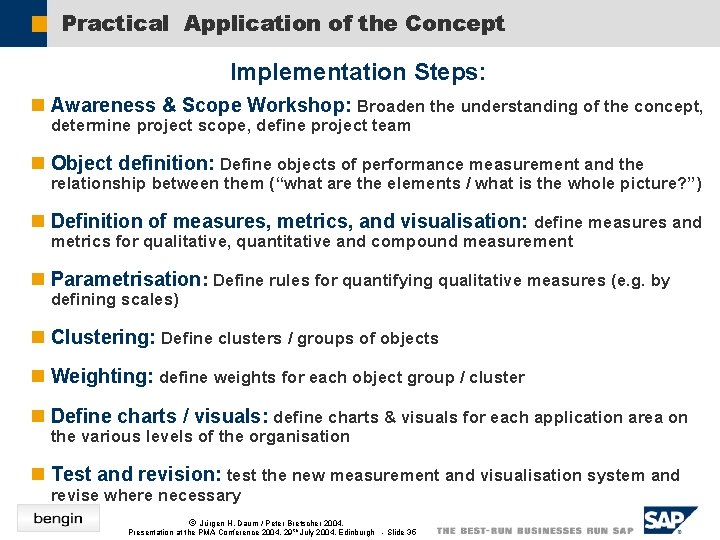
Practical Application of the Concept Implementation Steps: n Awareness & Scope Workshop: Broaden the understanding of the concept, determine project scope, define project team n Object definition: Define objects of performance measurement and the relationship between them (“what are the elements / what is the whole picture? ”) n Definition of measures, metrics, and visualisation: define measures and metrics for qualitative, quantitative and compound measurement n Parametrisation: Define rules for quantifying qualitative measures (e. g. by defining scales) n Clustering: Define clusters / groups of objects n Weighting: define weights for each object group / cluster n Define charts / visuals: define charts & visuals for each application area on the various levels of the organisation n Test and revision: test the new measurement and visualisation system and revise where necessary ã Jürgen H. Daum / Peter Bretscher 2004, Presentation at the PMA Conference 2004, 29 th July 2004, Edinburgh - Slide 35
Agenda ¢ Implications of the knowledge economy for performance measurement and management: subjective measurement - why and how? n The concept of Vector-Based Performance Measurement & Visualisation n Practical application cases of the concept n Conclusion & outlook ã Jürgen H. Daum / Peter Bretscher 2004, Presentation at the PMA Conference 2004, 29 th July 2004, Edinburgh - Slide 36
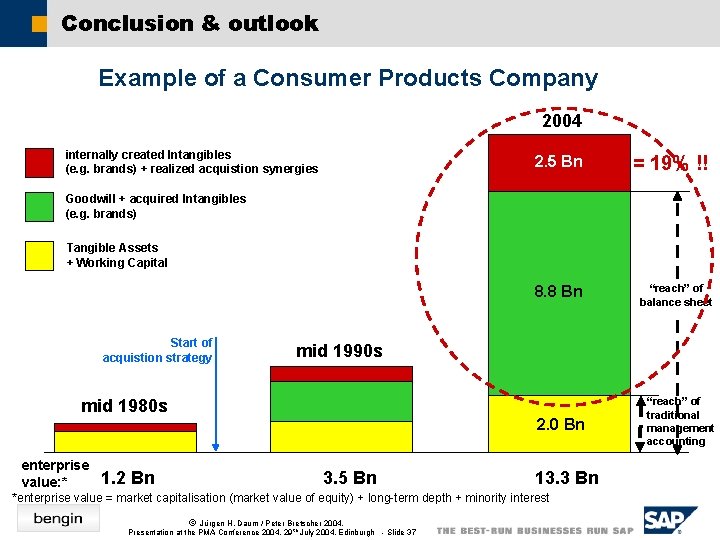
Conclusion & outlook Example of a Consumer Products Company 2004 internally created Intangibles (e. g. brands) + realized acquistion synergies 2. 5 Bn = 19% !! Goodwill + acquired Intangibles (e. g. brands) Tangible Assets + Working Capital Start of acquistion strategy 1. 2 Bn “reach” of balance sheet 2. 0 Bn “reach” of traditional management accounting mid 1990 s mid 1980 s enterprise value: * 8. 8 Bn 3. 5 Bn 13. 3 Bn *enterprise value = market capitalisation (market value of equity) + long-term depth + minority interest ã Jürgen H. Daum / Peter Bretscher 2004, Presentation at the PMA Conference 2004, 29 th July 2004, Edinburgh - Slide 37
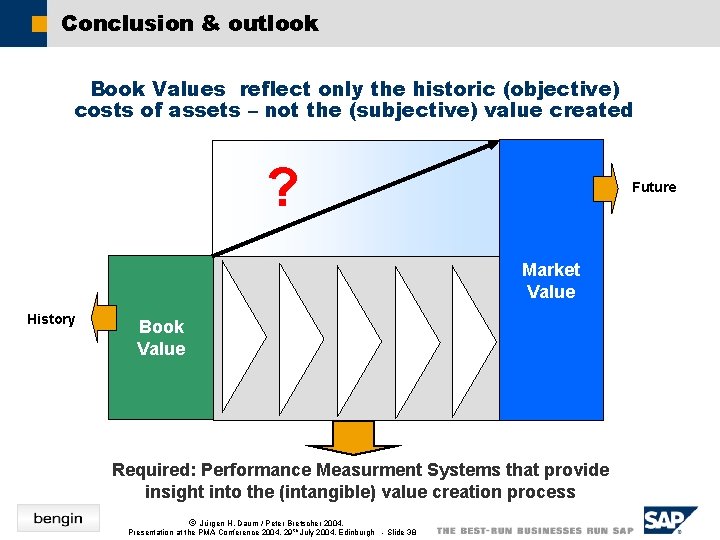
Conclusion & outlook Book Values reflect only the historic (objective) costs of assets – not the (subjective) value created ? Future Market Value History Book Value Required: Performance Measurment Systems that provide insight into the (intangible) value creation process ã Jürgen H. Daum / Peter Bretscher 2004, Presentation at the PMA Conference 2004, 29 th July 2004, Edinburgh - Slide 38
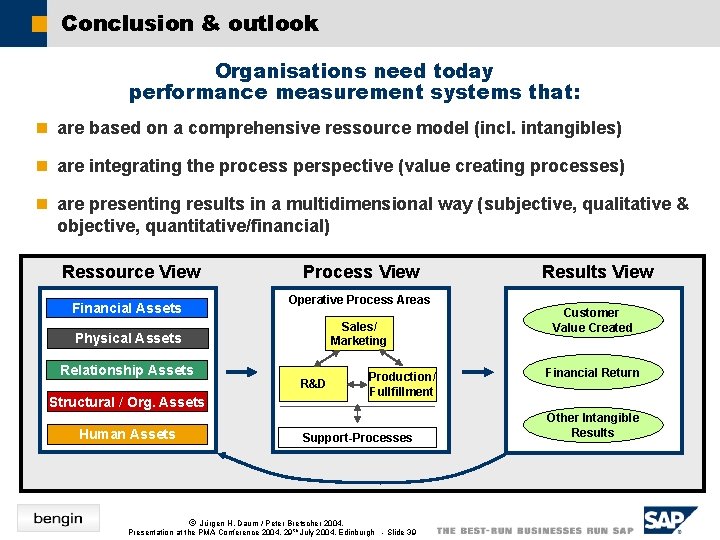
Conclusion & outlook Organisations need today performance measurement systems that: n are based on a comprehensive ressource model (incl. intangibles) n are integrating the process perspective (value creating processes) n are presenting results in a multidimensional way (subjective, qualitative & objective, quantitative/financial) Ressource View Financial Assets Process View Operative Process Areas Sales/ Marketing Physical Assets Relationship Assets Structural / Org. Assets Human Assets R&D Production/ Fullfillment Support-Processes ã Jürgen H. Daum / Peter Bretscher 2004, Presentation at the PMA Conference 2004, 29 th July 2004, Edinburgh - Slide 39 Results View Customer Value Created Financial Return Other Intangible Results
Conclusion & outlook n Organisation will need and use in the future instruments that can handle intangible, qualitative, subjective values in a similar way that financial accounting and financial statements can handle today’s financial information. n The concept of Vector-Based Performance Measurement & Visualisation brings an unprecedented degree of rigor and discipline into the rating, measurement and handling of qualitative performance measurement in organisation. n The Concept of Vector-Based Performance Measurement is providing the tools to measure performance of every aspect of the Value Chain of a modern organisation (Ressource, Process and Results) by taking in each area subjective, qualitative and objective, quantitative/financial information into account. n This is important because intangible, qualitative assets can only create value when they are combined to the physical, tangible, and financial world of our economies. ã Jürgen H. Daum / Peter Bretscher 2004, Presentation at the PMA Conference 2004, 29 th July 2004, Edinburgh - Slide 40

Thank You! Juergen H. Daum Chief Solutions Architect Business Solutions Architect Group, SAP AG E-Mail: juergen. daum@sap. com Personal Website: http: //www. juergendaum. com ã Jürgen H. Daum / Peter Bretscher 2004, Presentation at the PMA Conference 2004, 29 th July 2004, Edinburgh - Slide 41
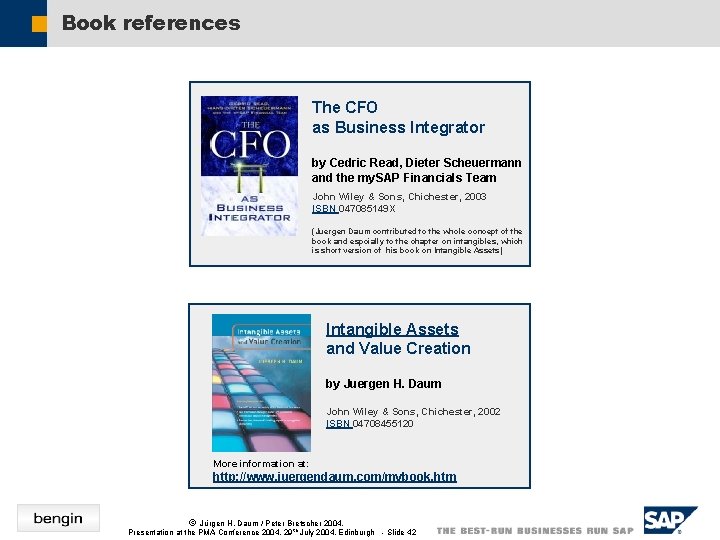
Book references The CFO as Business Integrator by Cedric Read, Dieter Scheuermann and the my. SAP Financials Team John Wiley & Sons, Chichester, 2003 ISBN 047085149 X (Juergen Daum contributed to the whole concept of the book and espcially to the chapter on intangibles, which is short version of his book on Intangible Assets) Intangible Assets and Value Creation by Juergen H. Daum John Wiley & Sons, Chichester, 2002 ISBN 04708455120 More information at: http: //www. juergendaum. com/mybook. htm ã Jürgen H. Daum / Peter Bretscher 2004, Presentation at the PMA Conference 2004, 29 th July 2004, Edinburgh - Slide 42
- Slides: 42