
Measuring Metal Release Rate from an Arsenopyrite Sample


- Slides: 33
Measuring Metal Release Rate from an Arsenopyrite Sample Chemistry of Metal Sulfide Minerals
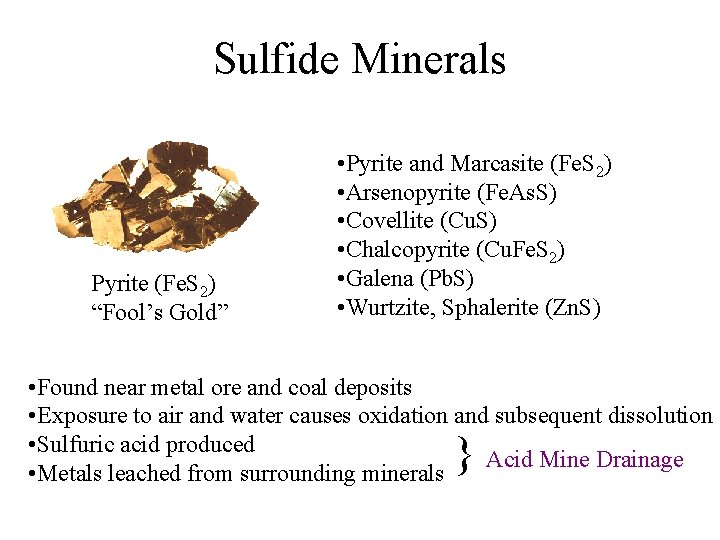
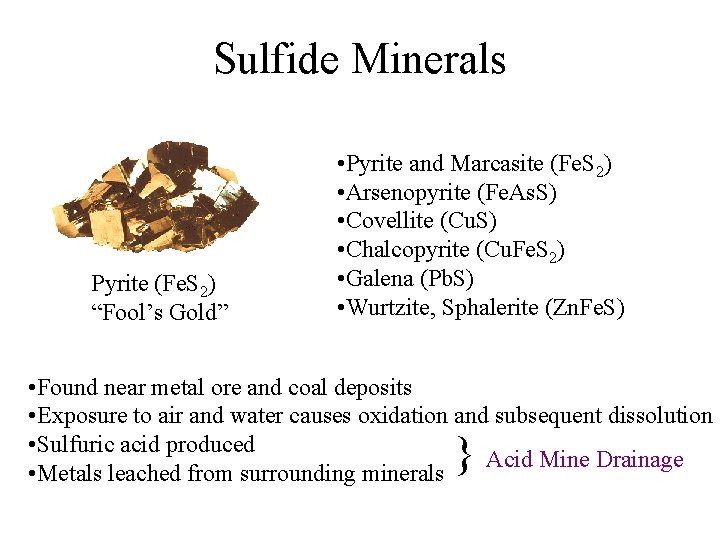
Sulfide Minerals Pyrite (Fe. S 2) “Fool’s Gold” • Pyrite and Marcasite (Fe. S 2) • Arsenopyrite (Fe. As. S) • Covellite (Cu. S) • Chalcopyrite (Cu. Fe. S 2) • Galena (Pb. S) • Wurtzite, Sphalerite (Zn. S) • Found near metal ore and coal deposits • Exposure to air and water causes oxidation and subsequent dissolution • Sulfuric acid produced Acid Mine Drainage • Metals leached from surrounding minerals }
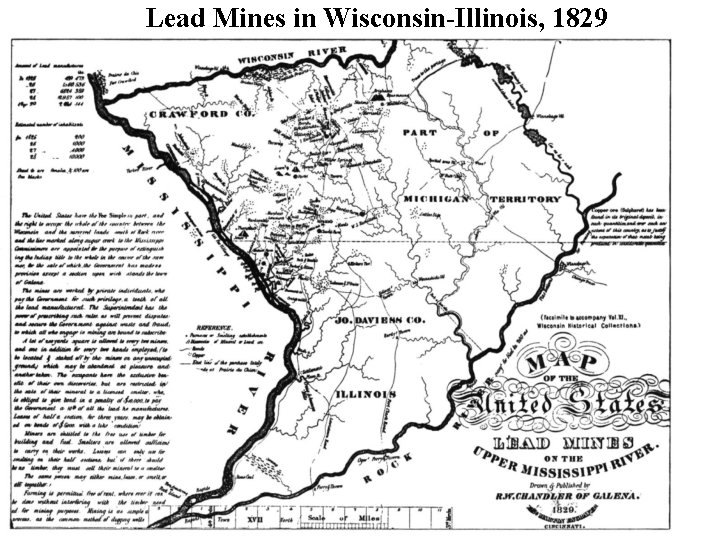
Lead Mines in Wisconsin-Illinois, 1829
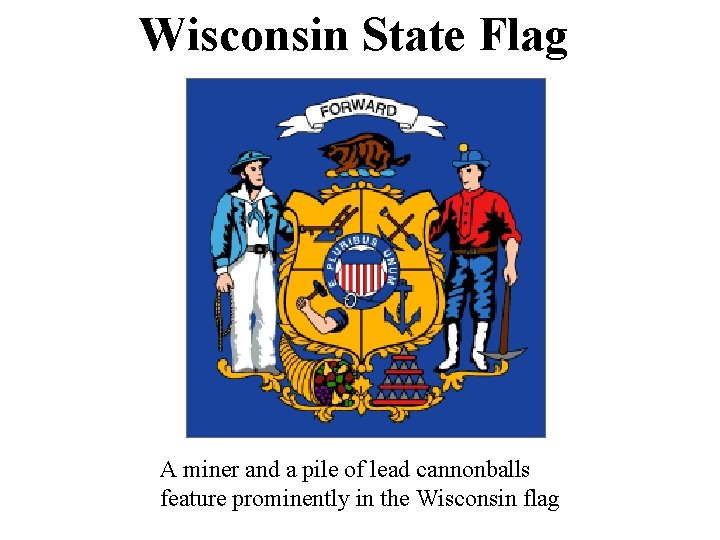
Wisconsin State Flag A miner and a pile of lead cannonballs feature prominently in the Wisconsin flag
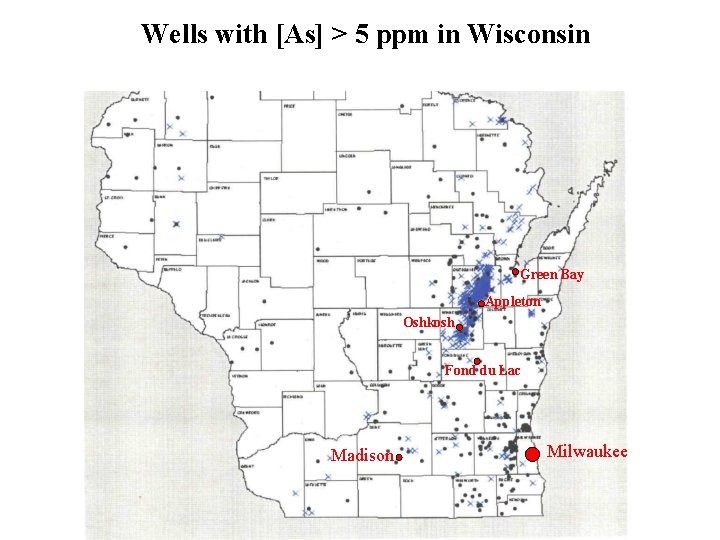
Wells with [As] > 5 ppm in Wisconsin Green Bay Appleton Oshkosh Fond du Lac Madison Milwaukee
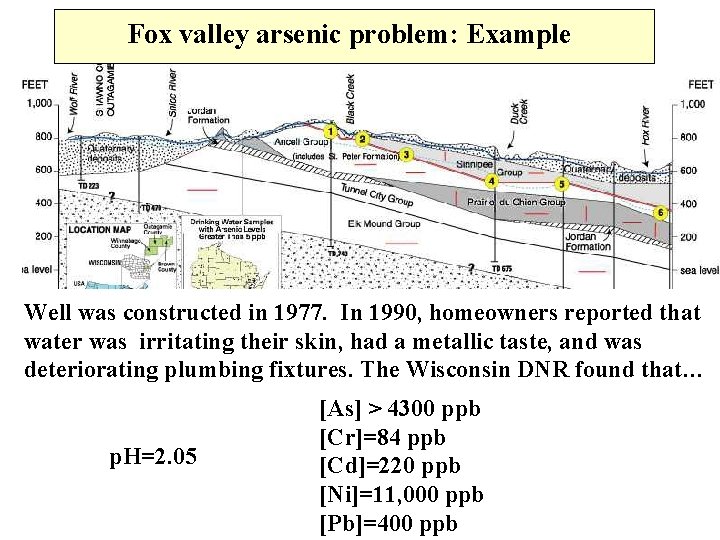
Fox valley arsenic problem: Example Well was constructed in 1977. In 1990, homeowners reported that water was irritating their skin, had a metallic taste, and was deteriorating plumbing fixtures. The Wisconsin DNR found that… p. H=2. 05 [As] > 4300 ppb [Cr]=84 ppb [Cd]=220 ppb [Ni]=11, 000 ppb [Pb]=400 ppb
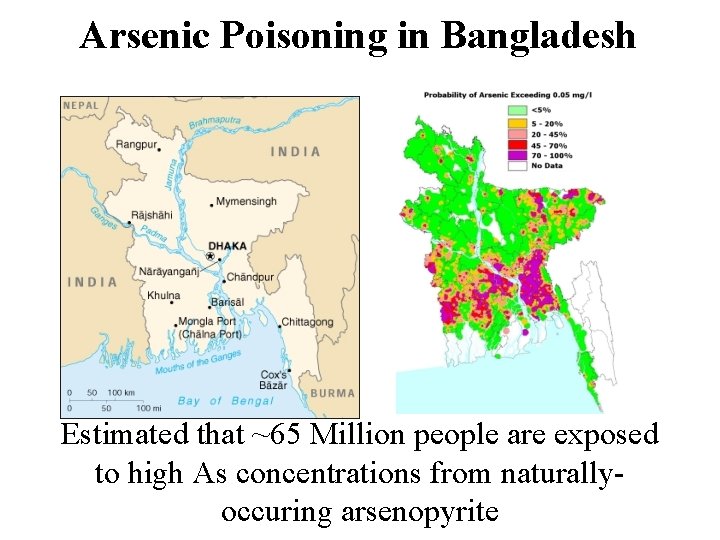
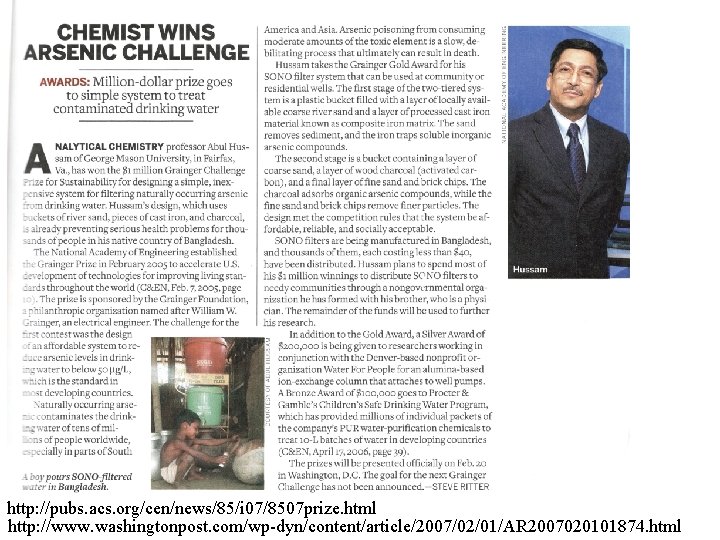
Arsenic Poisoning in Bangladesh Estimated that ~65 Million people are exposed to high As concentrations from naturallyoccuring arsenopyrite
Arsenic Poisoning in Bangladesh
http: //pubs. acs. org/cen/news/85/i 07/8507 prize. html http: //www. washingtonpost. com/wp-dyn/content/article/2007/02/01/AR 2007020101874. html
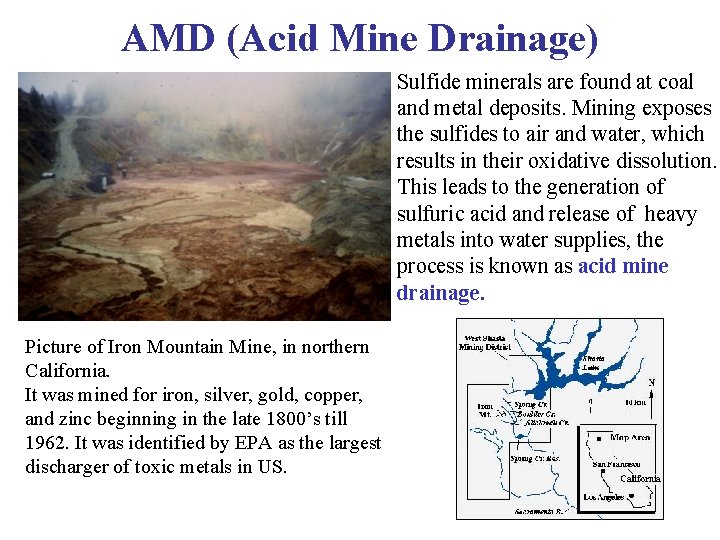
AMD (Acid Mine Drainage) Sulfide minerals are found at coal and metal deposits. Mining exposes the sulfides to air and water, which results in their oxidative dissolution. This leads to the generation of sulfuric acid and release of heavy metals into water supplies, the process is known as acid mine drainage. Picture of Iron Mountain Mine, in northern California. It was mined for iron, silver, gold, copper, and zinc beginning in the late 1800’s till 1962. It was identified by EPA as the largest discharger of toxic metals in US.
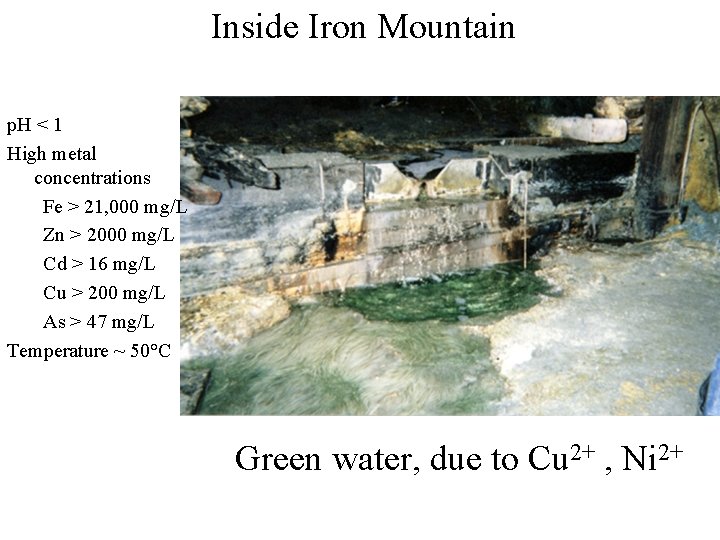
Inside Iron Mountain p. H < 1 High metal concentrations Fe > 21, 000 mg/L Zn > 2000 mg/L Cd > 16 mg/L Cu > 200 mg/L As > 47 mg/L Temperature ~ 50°C Green water, due to Cu 2+ , Ni 2+
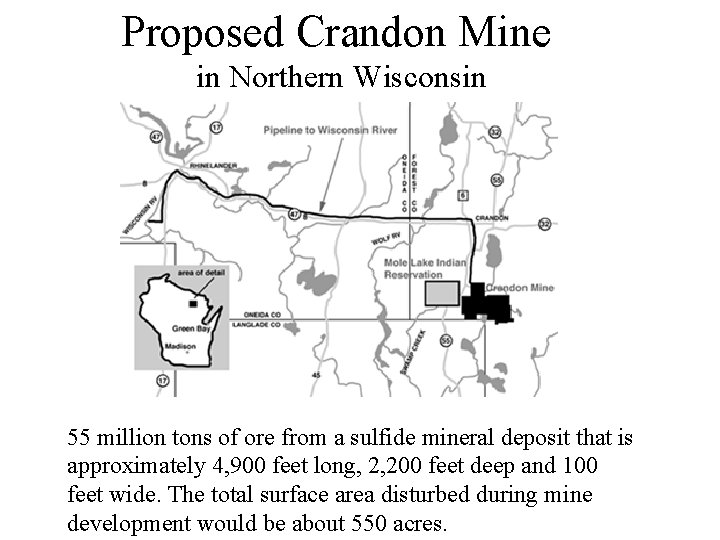
Proposed Crandon Mine in Northern Wisconsin 55 million tons of ore from a sulfide mineral deposit that is approximately 4, 900 feet long, 2, 200 feet deep and 100 feet wide. The total surface area disturbed during mine development would be about 550 acres.
Sulfide Minerals Pyrite (Fe. S 2) “Fool’s Gold” • Pyrite and Marcasite (Fe. S 2) • Arsenopyrite (Fe. As. S) • Covellite (Cu. S) • Chalcopyrite (Cu. Fe. S 2) • Galena (Pb. S) • Wurtzite, Sphalerite (Zn. Fe. S) • Found near metal ore and coal deposits • Exposure to air and water causes oxidation and subsequent dissolution • Sulfuric acid produced Acid Mine Drainage • Metals leached from surrounding minerals }
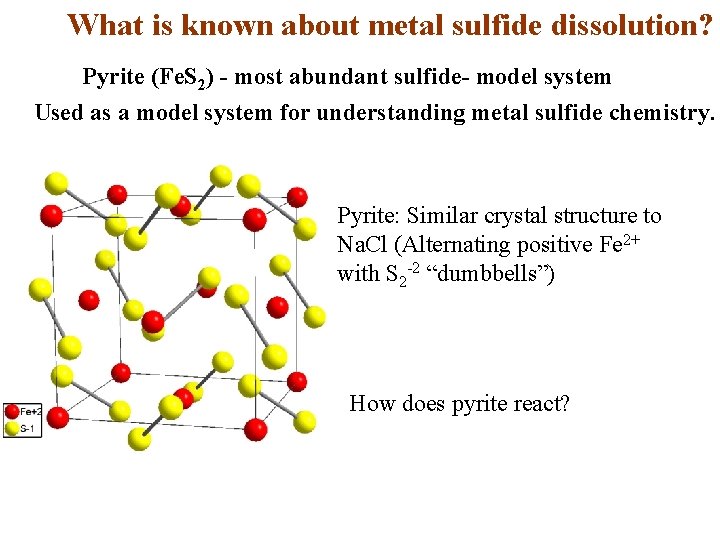
What is known about metal sulfide dissolution? Pyrite (Fe. S 2) - most abundant sulfide- model system Used as a model system for understanding metal sulfide chemistry. Pyrite: Similar crystal structure to Na. Cl (Alternating positive Fe 2+ with S 2 -2 “dumbbells”) How does pyrite react?
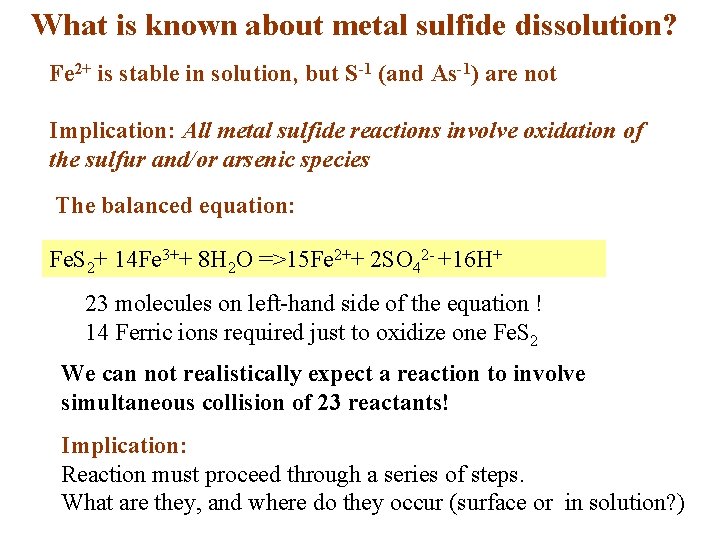
What is known about metal sulfide dissolution? Fe 2+ is stable in solution, but S-1 (and As-1) are not Implication: All metal sulfide reactions involve oxidation of the sulfur and/or arsenic species The balanced equation: Fe. S 2+ 14 Fe 3++ 8 H 2 O =>15 Fe 2++ 2 SO 42 - +16 H+ 23 molecules on left-hand side of the equation ! 14 Ferric ions required just to oxidize one Fe. S 2 We can not realistically expect a reaction to involve simultaneous collision of 23 reactants! Implication: Reaction must proceed through a series of steps. What are they, and where do they occur (surface or in solution? )
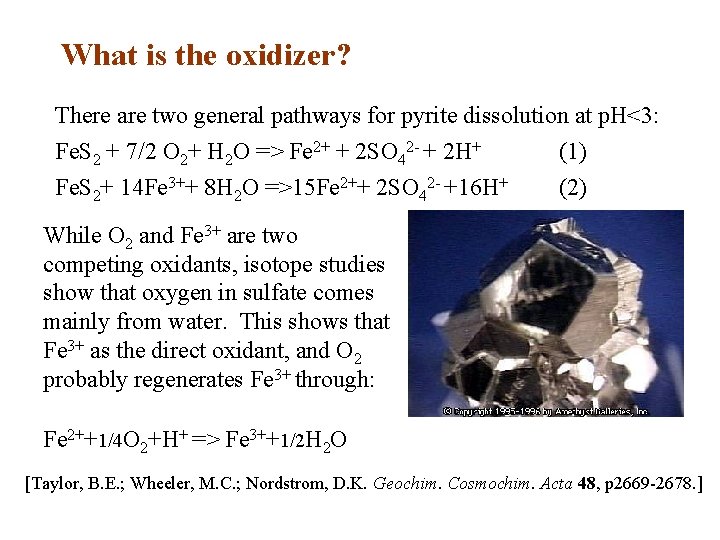
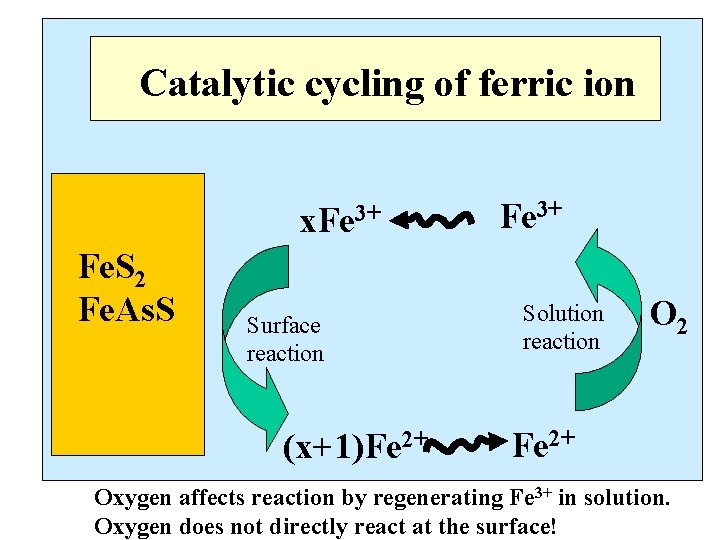
What is the oxidizer? There are two general pathways for pyrite dissolution at p. H<3: Fe. S 2 + 7/2 O 2+ H 2 O => Fe 2+ + 2 SO 42 - + 2 H+ Fe. S 2+ 14 Fe 3++ 8 H 2 O =>15 Fe 2++ 2 SO 42 - +16 H+ (1) (2) While O 2 and Fe 3+ are two competing oxidants, isotope studies show that oxygen in sulfate comes mainly from water. This shows that Fe 3+ as the direct oxidant, and O 2 probably regenerates Fe 3+ through: Fe 2++1/4 O 2+H+ => Fe 3++1/2 H 2 O [Taylor, B. E. ; Wheeler, M. C. ; Nordstrom, D. K. Geochim. Cosmochim. Acta 48, p 2669 -2678. ]
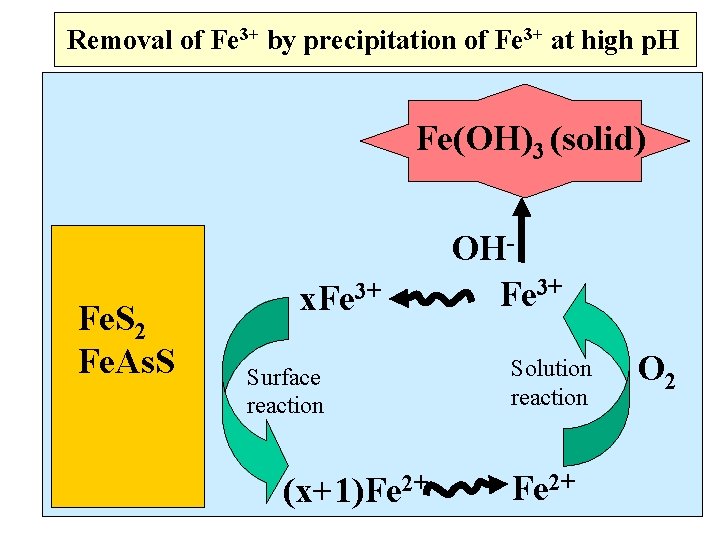
Catalytic cycling of ferric ion Fe. S 22 Fe. As. S 3+ x. Fe 3+ Surface reaction 2+ y. Fe (x+1)Fe 2+ Fe 3+ O 2 Solution reaction O 2 Fe 2+ Oxygen affects reaction by regenerating Fe 3+ in solution. Oxygen does not directly react at the surface!
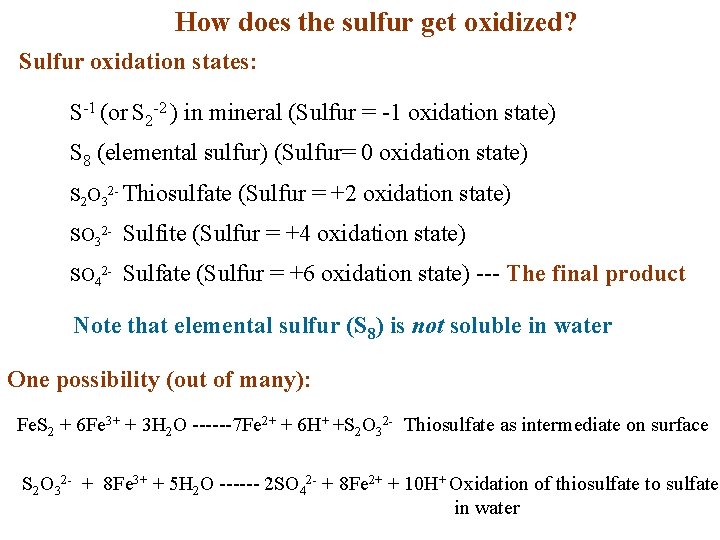
How does the sulfur get oxidized? Sulfur oxidation states: S-1 (or S 2 -2 ) in mineral (Sulfur = -1 oxidation state) S 8 (elemental sulfur) (Sulfur= 0 oxidation state) S 2 O 32 - Thiosulfate (Sulfur = +2 oxidation state) SO 32 - Sulfite (Sulfur = +4 oxidation state) SO 42 - Sulfate (Sulfur = +6 oxidation state) --- The final product Note that elemental sulfur (S 8) is not soluble in water One possibility (out of many): Fe. S 2 + 6 Fe 3+ + 3 H 2 O ------7 Fe 2+ + 6 H+ +S 2 O 32 - Thiosulfate as intermediate on surface S 2 O 32 - + 8 Fe 3+ + 5 H 2 O ------ 2 SO 42 - + 8 Fe 2+ + 10 H+ Oxidation of thiosulfate to sulfate in water
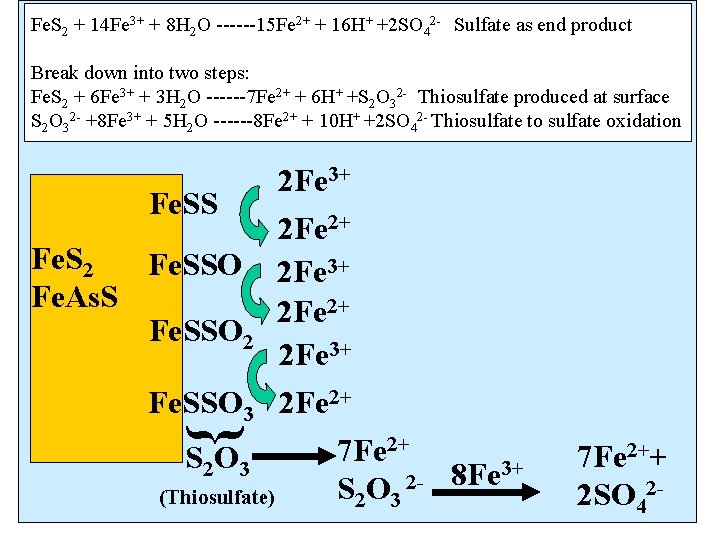
Fe. S 2 + 14 Fe 3+ + 8 H 2 O ------15 Fe 2+ + 16 H+ +2 SO 42 - Sulfate as end product Break down into two steps: Fe. S 2 + 6 Fe 3+ + 3 H 2 O ------7 Fe 2+ + 6 H+ +S 2 O 32 - Thiosulfate produced at surface S 2 O 32 - +8 Fe 3+ + 5 H 2 O ------8 Fe 2+ + 10 H+ +2 SO 42 - Thiosulfate to sulfate oxidation } 2 Fe 3+ Fe. SS 2 Fe 2+ Fe. S 2 Fe. SSO 2 Fe 3+ Fe. As. S 2 Fe 2+ Fe. SSO 2 2 Fe 3+ Fe. SSO 3 2 Fe 2+ 2+ 7 Fe S 2 O 3 3+ 8 Fe S 2 O 3 2(Thiosulfate) 7 Fe 2++ 2 SO 42 -
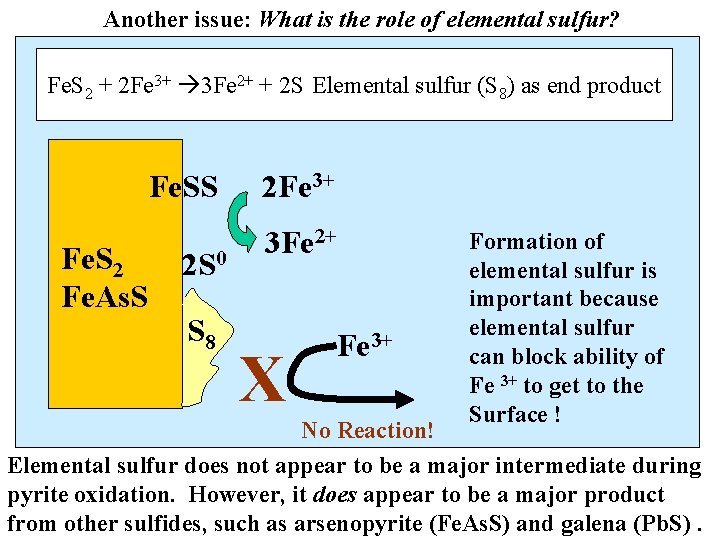
Another issue: What is the role of elemental sulfur? Fe. S 2 + 2 Fe 3+ 3 Fe 2+ + 2 S Elemental sulfur (S 8) as end product Fe. SS Fe. S 2 Fe. As. S 2 S 0 S 8 2 Fe 3+ 3 Fe 2+ X Fe 3+ Formation of elemental sulfur is important because elemental sulfur can block ability of Fe 3+ to get to the Surface ! No Reaction! Elemental sulfur does not appear to be a major intermediate during pyrite oxidation. However, it does appear to be a major product from other sulfides, such as arsenopyrite (Fe. As. S) and galena (Pb. S).
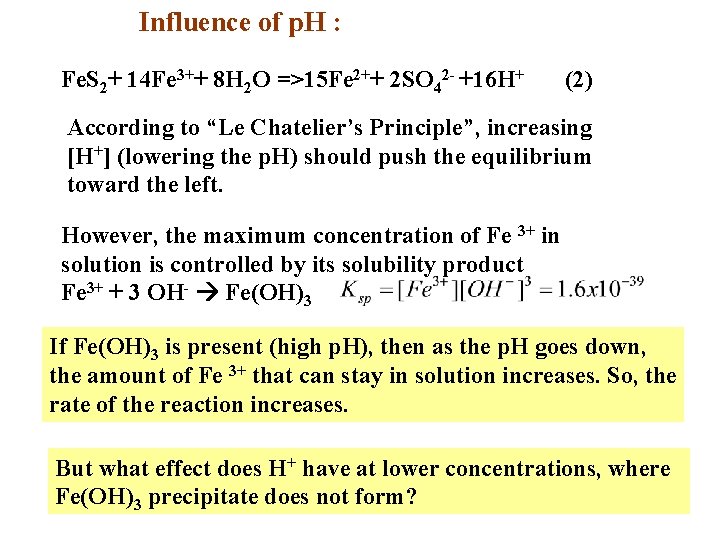
Influence of p. H : Fe. S 2+ 14 Fe 3++ 8 H 2 O =>15 Fe 2++ 2 SO 42 - +16 H+ (2) According to “Le Chatelier’s Principle”, increasing [H+] (lowering the p. H) should push the equilibrium toward the left. However, the maximum concentration of Fe 3+ in solution is controlled by its solubility product Fe 3+ + 3 OH- Fe(OH)3 If Fe(OH)3 is present (high p. H), then as the p. H goes down, the amount of Fe 3+ that can stay in solution increases. So, the rate of the reaction increases. But what effect does H+ have at lower concentrations, where Fe(OH)3 precipitate does not form?
Removal of Fe 3+ by precipitation of Fe 3+ at high p. H Fe(OH)3 (solid) Fe. S 22 Fe. As. S 3+ x. Fe 3+ Surface reaction 2+ 2+ y. Fe (x+1)Fe OHFe 3+ O 2 Solution reaction Fe 2+ O 2
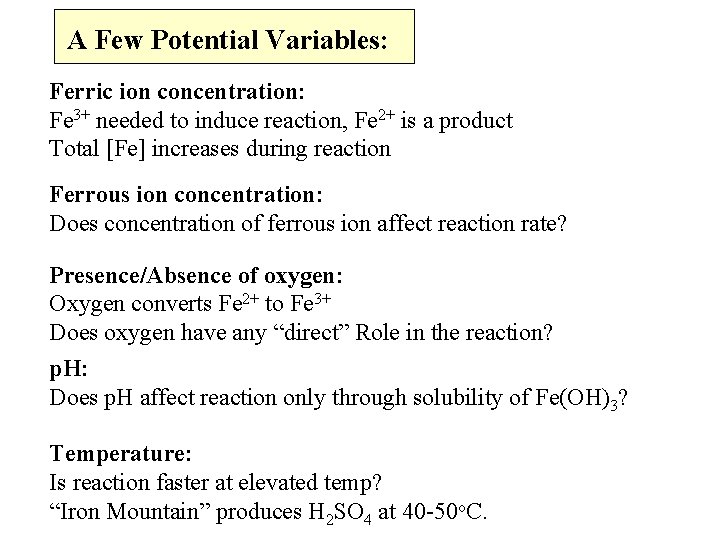
A Few Potential Variables: Ferric ion concentration: Fe 3+ needed to induce reaction, Fe 2+ is a product Total [Fe] increases during reaction Ferrous ion concentration: Does concentration of ferrous ion affect reaction rate? Presence/Absence of oxygen: Oxygen converts Fe 2+ to Fe 3+ Does oxygen have any “direct” Role in the reaction? p. H: Does p. H affect reaction only through solubility of Fe(OH)3? Temperature: Is reaction faster at elevated temp? “Iron Mountain” produces H 2 SO 4 at 40 -50 o. C.
Goals of the Design Project Are for you to: 1. Learn quantitative analysis in the context of a real-life environmental problem. 2. Learn how to apply the scientific method as you develop hypotheses, design your experiments, and develop your own interpretation. 3. Understand some of the complexities and uncertainties associated with scientific measurements, especially when working with complex systems and the natural environment. 4. Learn how to communicate your scientific results, orally and in writing.
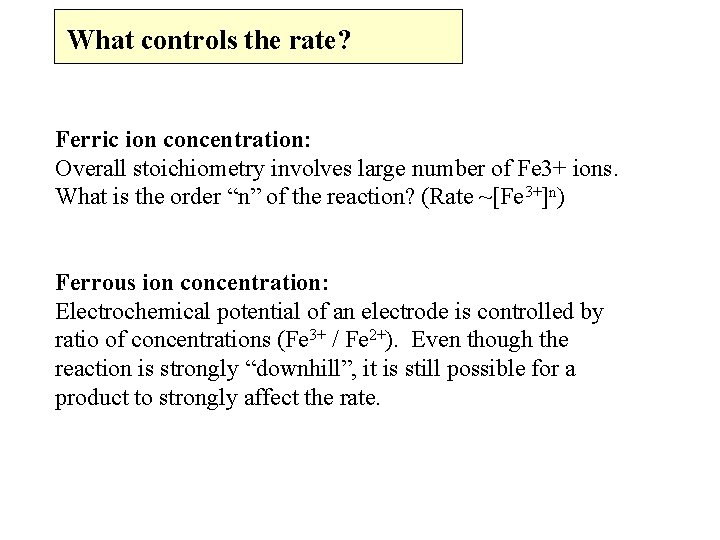
What controls the rate? Ferric ion concentration: Overall stoichiometry involves large number of Fe 3+ ions. What is the order “n” of the reaction? (Rate ~[Fe 3+]n) Ferrous ion concentration: Electrochemical potential of an electrode is controlled by ratio of concentrations (Fe 3+ / Fe 2+). Even though the reaction is strongly “downhill”, it is still possible for a product to strongly affect the rate.
What controls the rate? Presence/Absence of oxygen: Oxygen converts Fe 2+ to Fe 3+ Does oxygen have any “direct” Role in the reaction? p. H: Does p. H affect reaction only through solubility of Fe(OH)3, Le Chatelier’s principle says that since H+ is a product, lowering the p. H should shift the equilibrium toward the reactants. However, the system is far from equilibrium… Temperature: Is reaction faster at elevated temp? “Iron Mountain” produces H 2 SO 4 at 40 -50 o. C.
How can you learn about the mechanism of a reaction? 1) Measure the rate of reaction ! Determine how the rate of reaction depends on certain key variables such as [H+], [Fe 3+ ], Presence/absence of oxygen, etc. Kinetic measurements typically give good information about the slowest step(s) in a chemical reaction. Those are usually the steps that of the most interest.
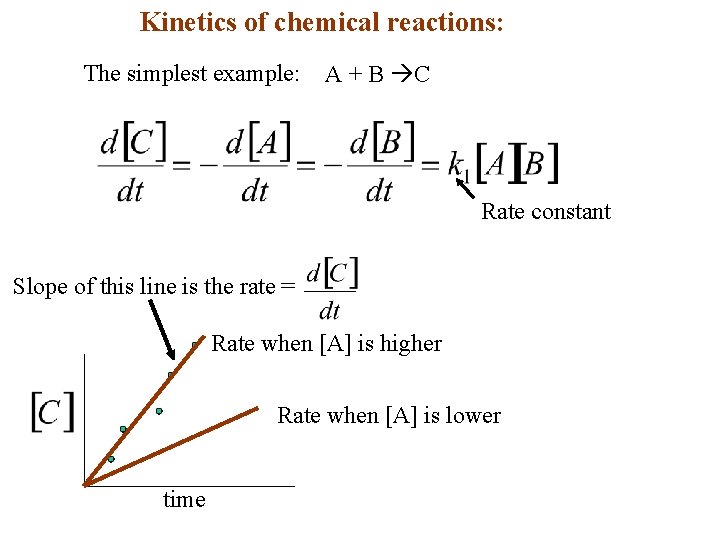
Kinetics of chemical reactions: The simplest example: A + B C Rate constant Slope of this line is the rate = Rate when [A] is higher Rate when [A] is lower time
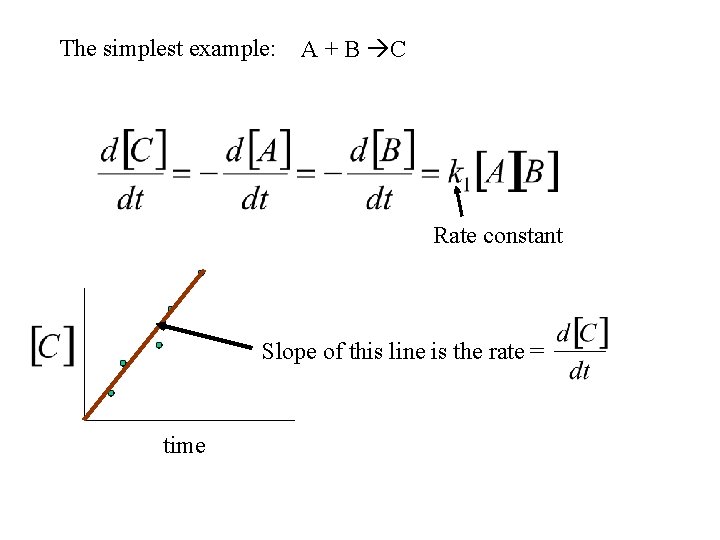
The simplest example: A + B C Rate constant Slope of this line is the rate = time
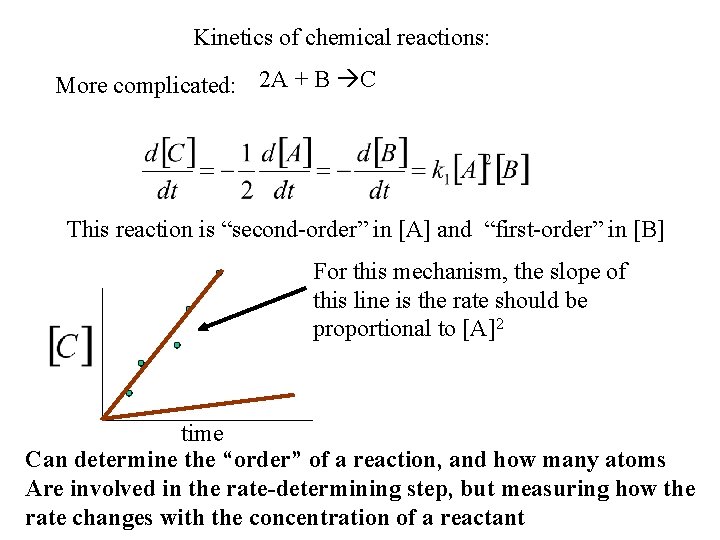
Kinetics of chemical reactions: More complicated: 2 A + B C This reaction is “second-order” in [A] and “first-order” in [B] For this mechanism, the slope of this line is the rate should be proportional to [A]2 time Can determine the “order” of a reaction, and how many atoms Are involved in the rate-determining step, but measuring how the rate changes with the concentration of a reactant
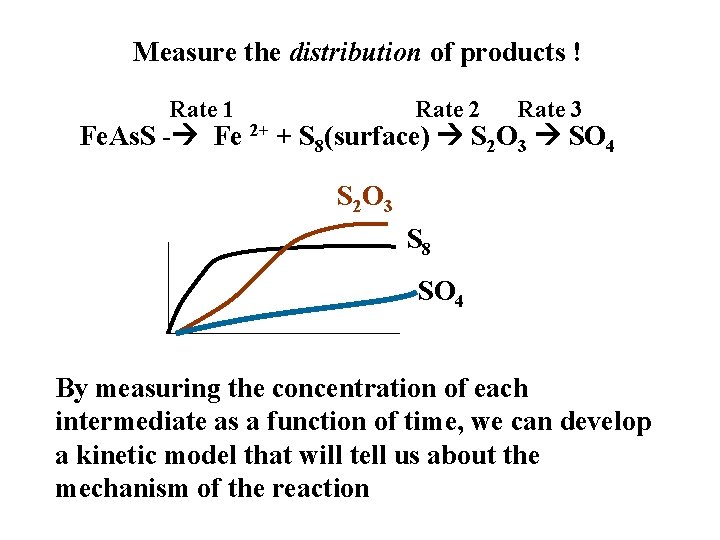
Measure the distribution of products ! Rate 1 Rate 2 Rate 3 Fe. As. S - Fe 2+ + S 8(surface) S 2 O 3 SO 4 S 2 O 3 S 8 SO 4 By measuring the concentration of each intermediate as a function of time, we can develop a kinetic model that will tell us about the mechanism of the reaction
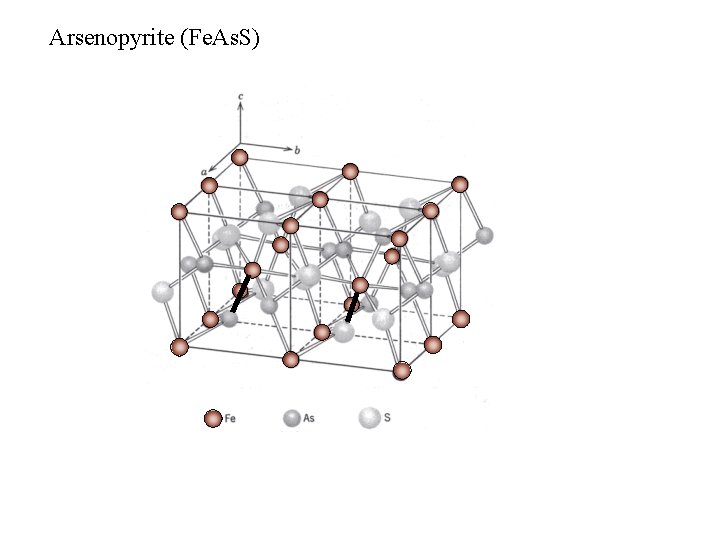
Arsenopyrite (Fe. As. S)