
Measuring low concentrations of naturally occurring uranium by
Measuring low concentrations of naturally occurring uranium by analysing the 351. 9 ke. V gamma ray peak of 214 Pb. Jacques Bezuidenhout Stellenbosch University South Africa
Naturally Occurring Radioactive Nuclides - Earth’s sciences - Exploration - Environmental monitoring - Classification of soil and rocks - Fossil areas - Mining areas
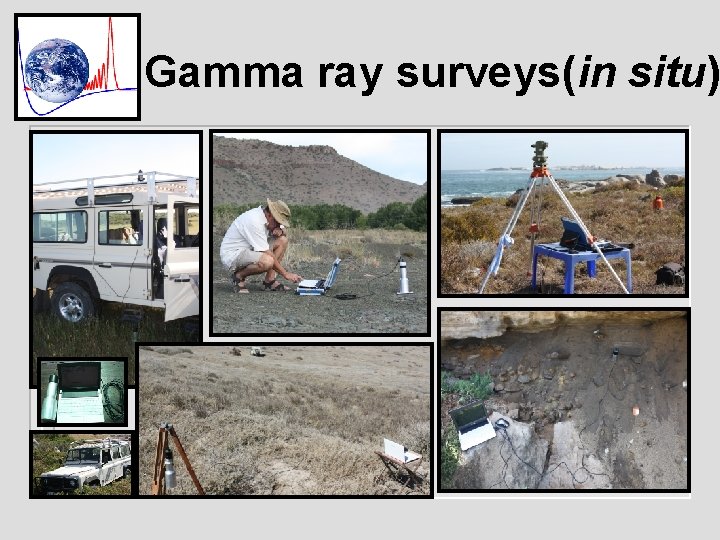
Gamma ray surveys(in situ)

Primordial nuclides Uranium (238 U), Thorium (232 Th) and Potassium (40 K)
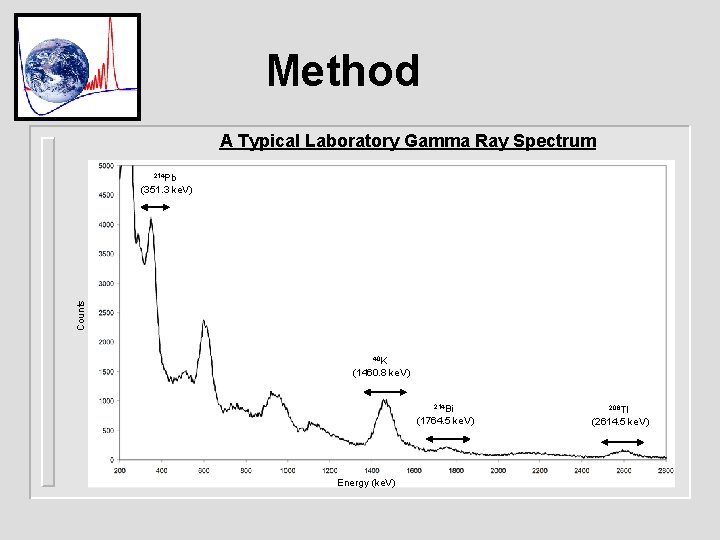
Method A Typical Laboratory Gamma Ray Spectrum 214 Pb Counts (351. 3 ke. V) 40 K (1460. 8 ke. V) 214 Bi (1764. 5 ke. V) Energy (ke. V) 208 Tl (2614. 5 ke. V)
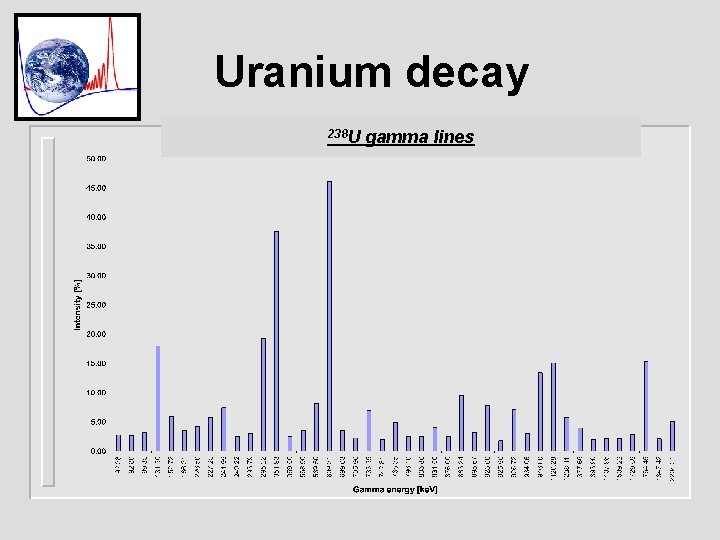
Uranium decay 238 U gamma lines
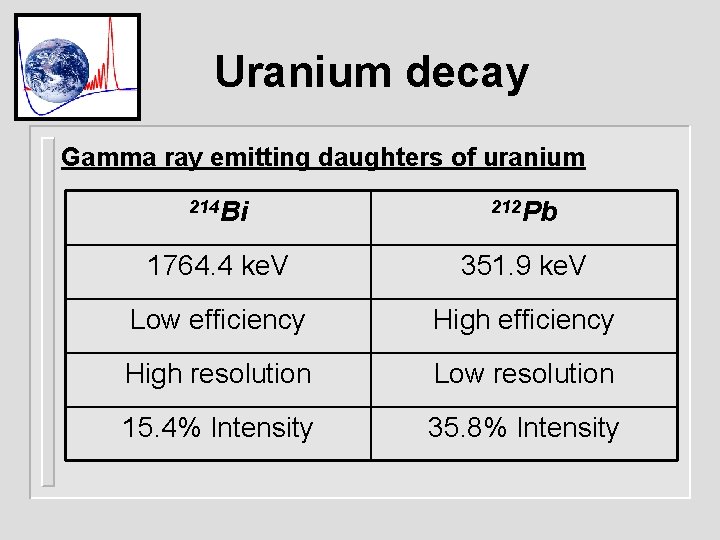
Uranium decay Gamma ray emitting daughters of uranium 214 Bi 212 Pb 1764. 4 ke. V 351. 9 ke. V Low efficiency High resolution Low resolution 15. 4% Intensity 35. 8% Intensity
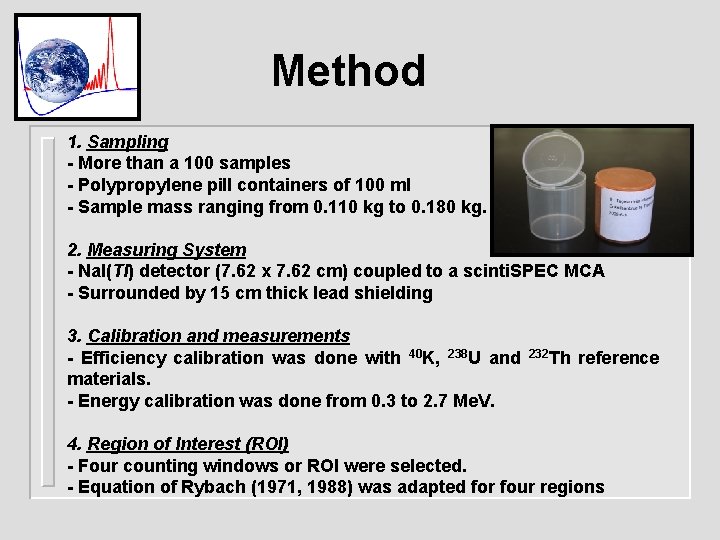
Method 1. Sampling - More than a 100 samples - Polypropylene pill containers of 100 ml - Sample mass ranging from 0. 110 kg to 0. 180 kg. 2. Measuring System - Na. I(Tl) detector (7. 62 x 7. 62 cm) coupled to a scinti. SPEC MCA - Surrounded by 15 cm thick lead shielding 3. Calibration and measurements - Efficiency calibration was done with 40 K, 238 U and materials. - Energy calibration was done from 0. 3 to 2. 7 Me. V. 232 Th reference 4. Region of Interest (ROI) - Four counting windows or ROI were selected. - Equation of Rybach (1971, 1988) was adapted for four regions
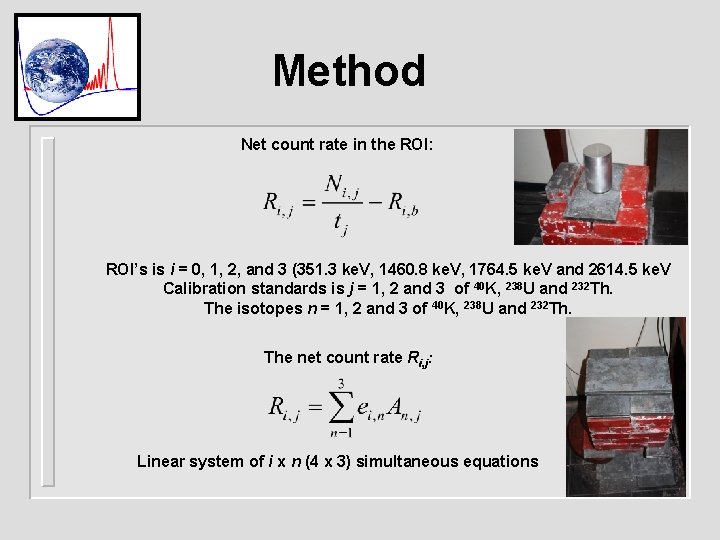
Method Net count rate in the ROI: ROI’s is i = 0, 1, 2, and 3 (351. 3 ke. V, 1460. 8 ke. V, 1764. 5 ke. V and 2614. 5 ke. V Calibration standards is j = 1, 2 and 3 of 40 K, 238 U and 232 Th. The isotopes n = 1, 2 and 3 of 40 K, 238 U and 232 Th. The net count rate Ri, j: Linear system of i x n (4 x 3) simultaneous equations
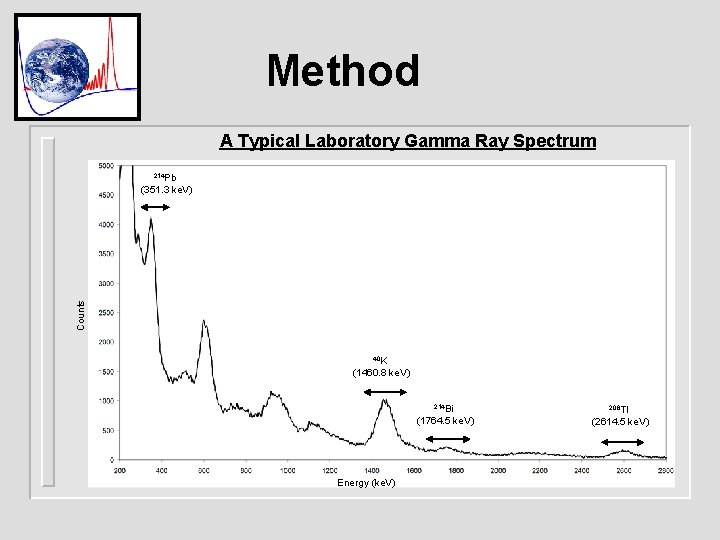
Method A Typical Laboratory Gamma Ray Spectrum 214 Pb Counts (351. 3 ke. V) 40 K (1460. 8 ke. V) 214 Bi (1764. 5 ke. V) Energy (ke. V) 208 Tl (2614. 5 ke. V)
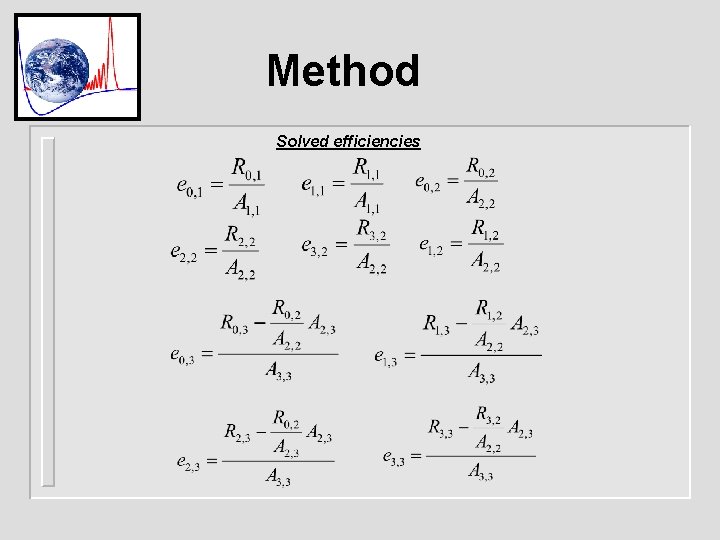
Method Solved efficiencies
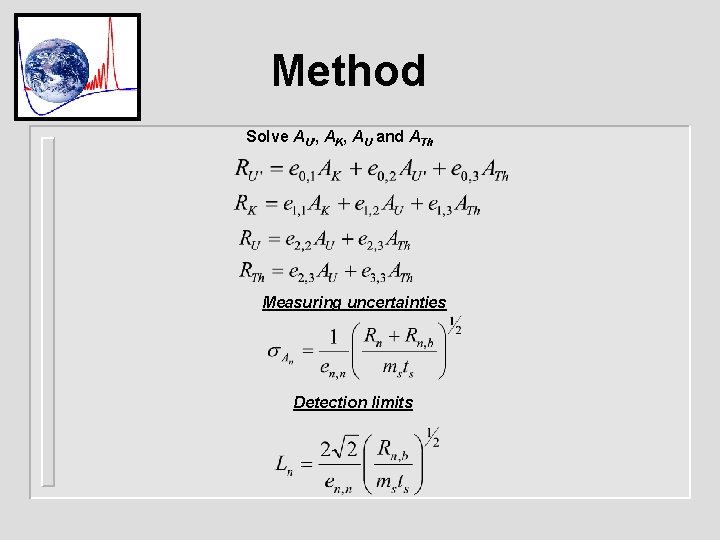
Method Solve AU’, AK, AU and ATh Measuring uncertainties Detection limits
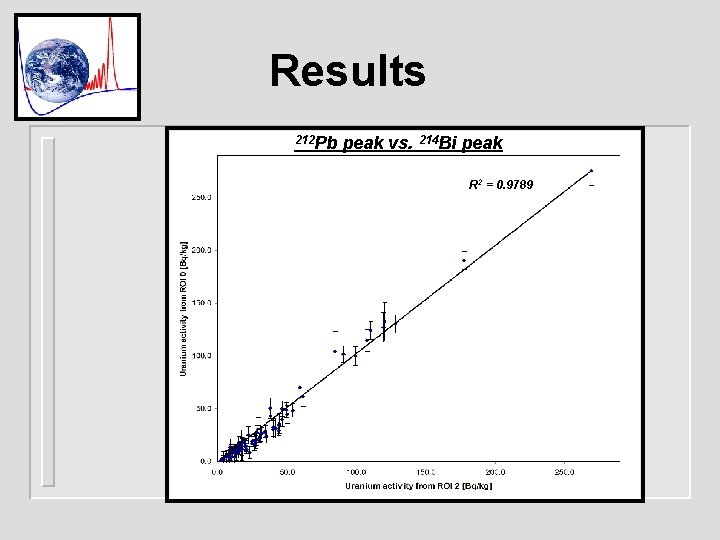
Results 212 Pb peak vs. 214 Bi peak R 2 = 0. 9789
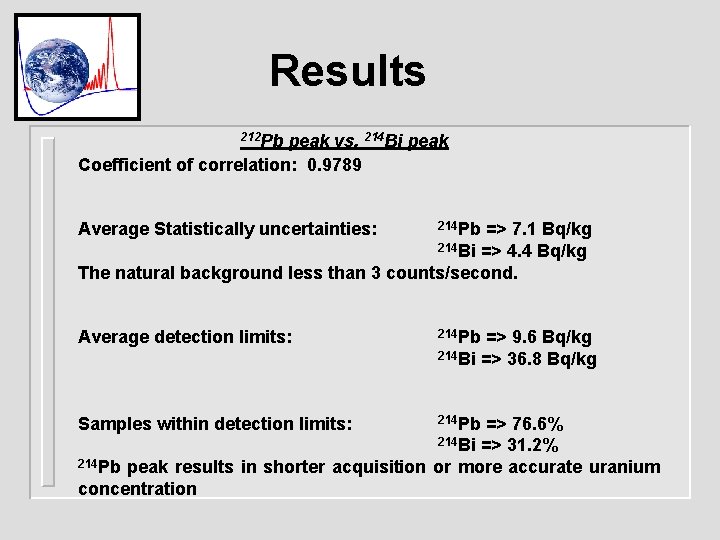
Results 212 Pb peak vs. 214 Bi peak Coefficient of correlation: 0. 9789 Average Statistically uncertainties: 214 Pb => 7. 1 Bq/kg 214 Bi => 4. 4 Bq/kg The natural background less than 3 counts/second. Average detection limits: 214 Pb Samples within detection limits: 214 Pb => 9. 6 Bq/kg 214 Bi => 36. 8 Bq/kg => 76. 6% 214 Bi => 31. 2% 214 Pb peak results in shorter acquisition or more accurate uranium concentration
Future - In Situ measurements - Fossil areas - 234 Pa measurements - 232 Th measurements

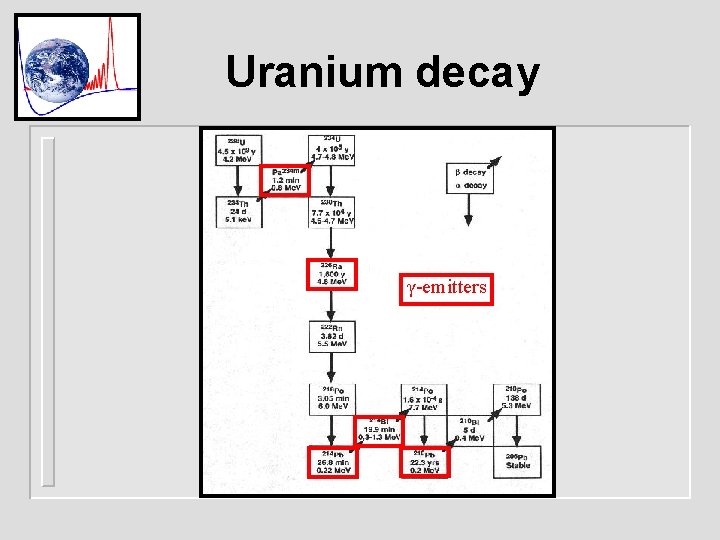
Uranium decay γ-emitters
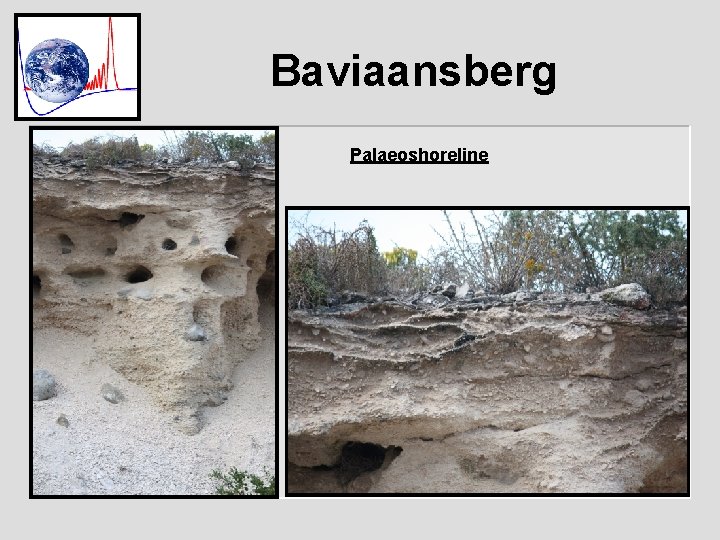
Baviaansberg Palaeoshoreline
- Slides: 18