
Measuring livability at the neighborhood scale development of

Measuring livability at the neighborhood scale – development of indicators and methods for the comparison between neighborhoods and best practice within the chosen city Hsiao-Hui Chen and Udo Dietrich REAP Research Group, Hafen. City University Hamburg, Germany hsiao-hui. chen@hcuhamburg. de, udo. dietrich@hcu-hamburg. de
Targets § Create an assessment tool of the livability § By comparing different neighborhoods § By comparing neighborhoods with the city-specific best practice Download full paper at www. cesb. cz/19/8888 1283
Challenges § 1. Different units § the indicators use different units minutes, meters, percentages, or ratios) § 2. Inconsistent ranges of the indicator value § The distance between the ideal values and the calculated value entails different information and meaning. § For example, the indicator values may range from 0% to 100%, from 0 to an open end, from 1 to 6, etc. § 3. Inconsistent directions of comparison § 4. Non city-specific § Cities are not always comparable and, when a city is considered to be livable, the ideal value should be city-specific in order to make the comparison between values suitable for the context. Download full paper at www. cesb. cz/19/8888 1283
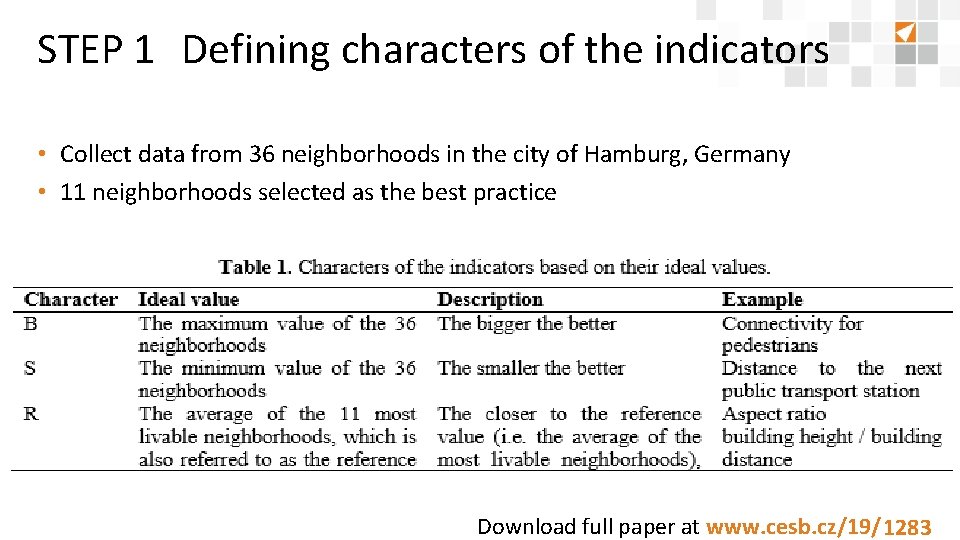
STEP 1 Defining characters of the indicators • Collect data from 36 neighborhoods in the city of Hamburg, Germany • 11 neighborhoods selected as the best practice Download full paper at www. cesb. cz/19/8888 1283
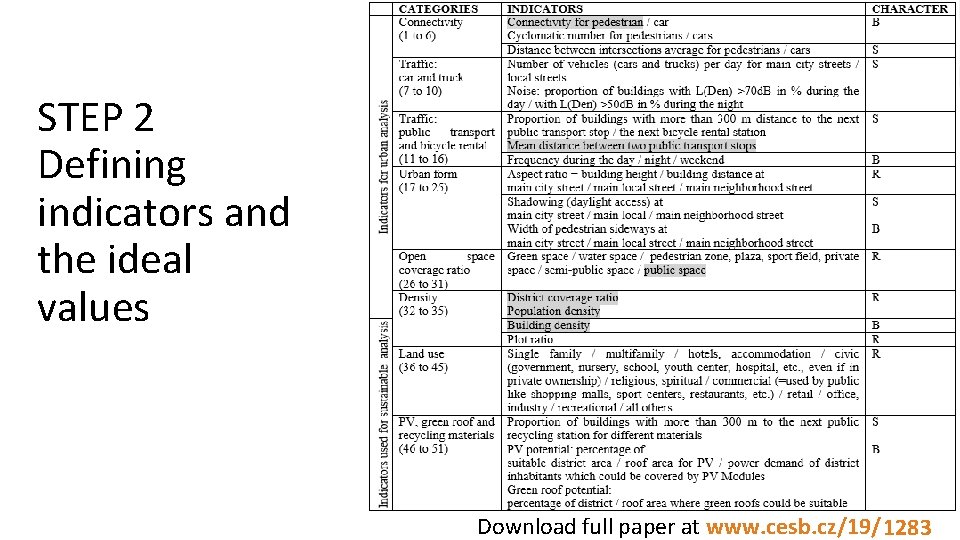
STEP 2 Defining indicators and the ideal values Download full paper at www. cesb. cz/19/8888 1283
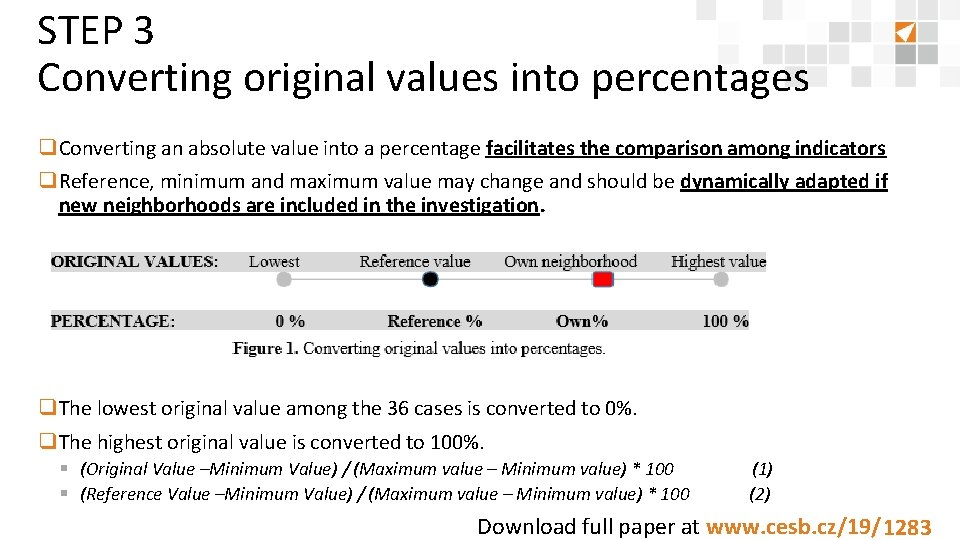
STEP 3 Converting original values into percentages q Converting an absolute value into a percentage facilitates the comparison among indicators q Reference, minimum and maximum value may change and should be dynamically adapted if new neighborhoods are included in the investigation. q The lowest original value among the 36 cases is converted to 0%. q The highest original value is converted to 100%. § (Original Value –Minimum Value) / (Maximum value – Minimum value) * 100 § (Reference Value –Minimum Value) / (Maximum value – Minimum value) * 100 (1) (2) Download full paper at www. cesb. cz/19/8888 1283
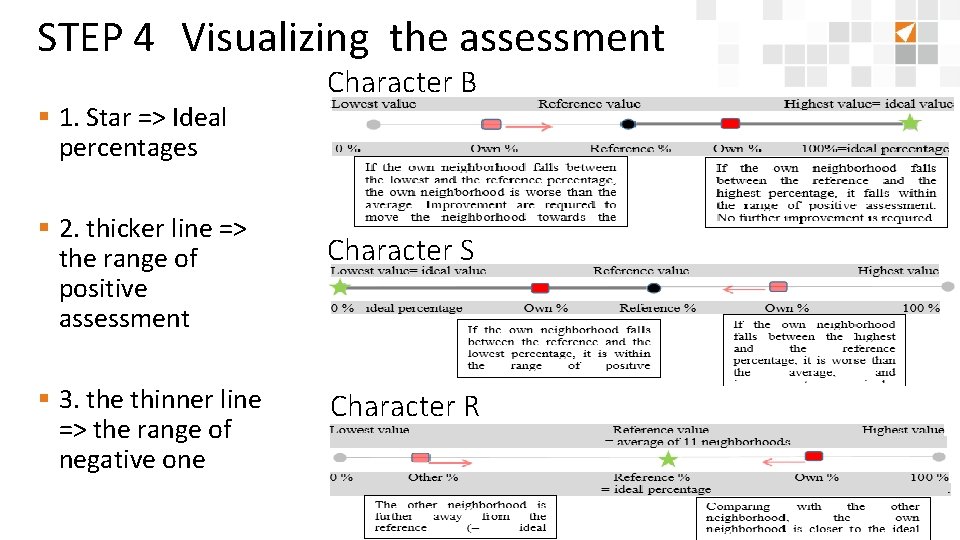
STEP 4 Visualizing the assessment § 1. Star => Ideal percentages § 2. thicker line => the range of positive assessment § 3. the thinner line => the range of negative one Character B Character S Character R Download full paper at www. cesb. cz/19/8888 1283
STEP 5 Standard deviation and decisive indicators for the most livable neighborhoods § Among all indicators, 6 decisive ones were defined § 1) For each indicator, calculate the average and standard deviation of the 11 livable neighborhoods § 2) For each indicator, divide the standard deviation by the average and express in percentage. § Standard deviation range = (Standard deviation / Average) * 100 (3) § 3) Criteria for the decisive indicators: If the result from formula 3 is smaller than 50%, the indicator is considered to be decisive. Download full paper at www. cesb. cz/19/8888 1283

Visualizing results § comparing different neighborhoods § comparing neighborhoods with the cityspecific best practice Download full paper at www. cesb. cz/19/8888 1283

Thank you for your attention! Hsiao-Hui Chen hsiao-hui. chen@hcuhamburg. de Scan QR or download full paper at www. cesb. cz/19/ 1283
- Slides: 10