
Measuring intervention effects in children with ASD The
- Slides: 1
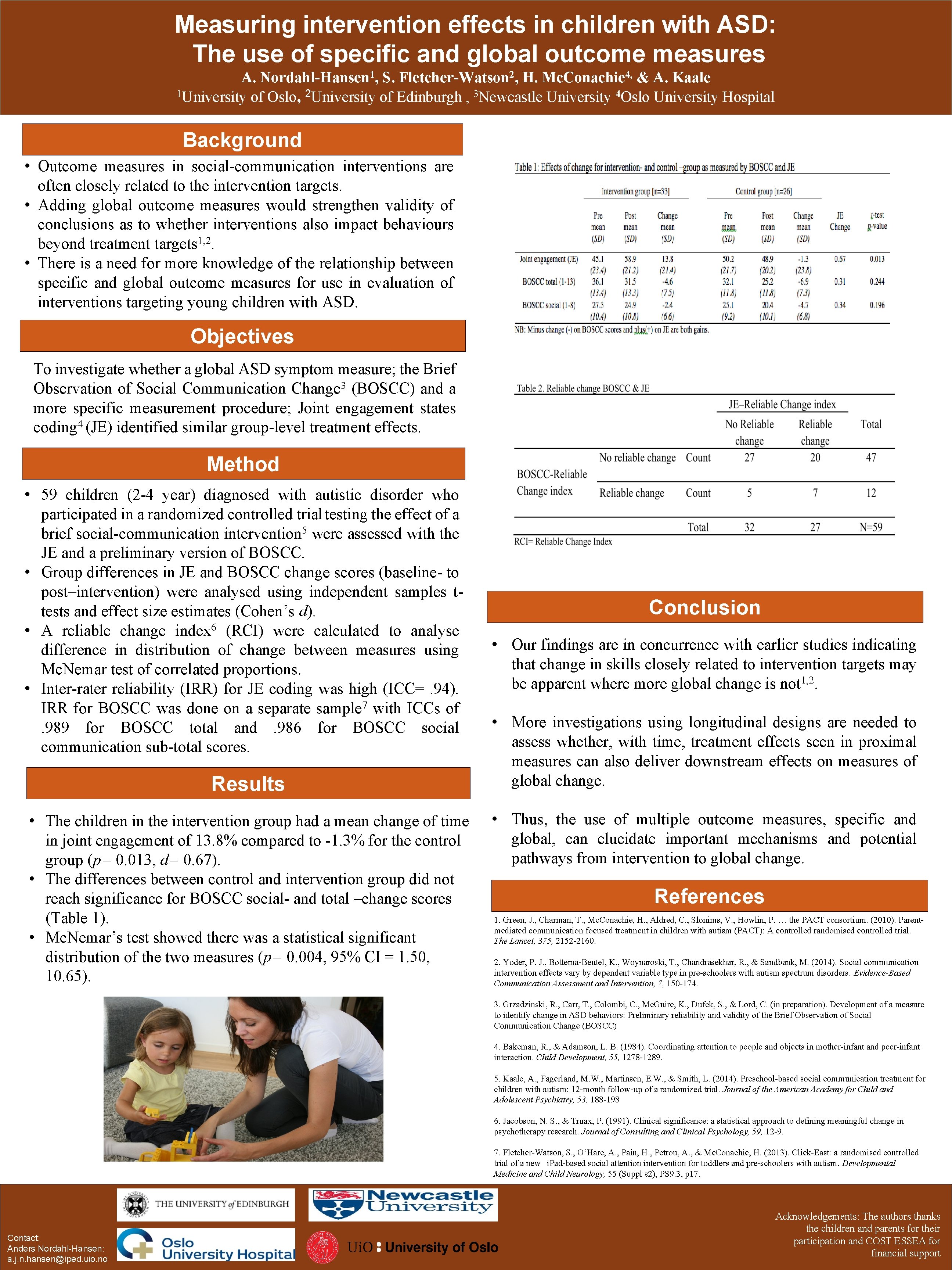
Measuring intervention effects in children with ASD: The use of specific and global outcome measures 1 Nordahl-Hansen , 2 Fletcher-Watson , 4, Mc. Conachie A. S. H. & A. Kaale 1 University of Oslo, 2 University of Edinburgh , 3 Newcastle University 4 Oslo University Hospital Background • Outcome measures in social-communication interventions are often closely related to the intervention targets. • Adding global outcome measures would strengthen validity of conclusions as to whether interventions also impact behaviours beyond treatment targets 1, 2. • There is a need for more knowledge of the relationship between specific and global outcome measures for use in evaluation of interventions targeting young children with ASD. Objectives To investigate whether a global ASD symptom measure; the Brief Observation of Social Communication Change 3 (BOSCC) and a more specific measurement procedure; Joint engagement states 4 coding (JE) identified similar group-level treatment effects. Method • 59 children (2 -4 year) diagnosed with autistic disorder who participated in a randomized controlled trial testing the effect of a brief social-communication intervention 5 were assessed with the JE and a preliminary version of BOSCC. • Group differences in JE and BOSCC change scores (baseline- to post–intervention) were analysed using independent samples ttests and effect size estimates (Cohen’s d). • A reliable change index 6 (RCI) were calculated to analyse difference in distribution of change between measures using Mc. Nemar test of correlated proportions. • Inter-rater reliability (IRR) for JE coding was high (ICC=. 94). 7 IRR for BOSCC was done on a separate sample with ICCs of. 989 for BOSCC total and. 986 for BOSCC social communication sub-total scores. Results • The children in the intervention group had a mean change of time in joint engagement of 13. 8% compared to -1. 3% for the control group (p= 0. 013, d= 0. 67). • The differences between control and intervention group did not reach significance for BOSCC social- and total –change scores (Table 1). • Mc. Nemar’s test showed there was a statistical significant distribution of the two measures (p= 0. 004, 95% CI = 1. 50, 10. 65). Conclusion • Our findings are in concurrence with earlier studies indicating that change in skills closely related to intervention targets may be apparent where more global change is not 1, 2. • More investigations using longitudinal designs are needed to assess whether, with time, treatment effects seen in proximal measures can also deliver downstream effects on measures of global change. • Thus, the use of multiple outcome measures, specific and global, can elucidate important mechanisms and potential pathways from intervention to global change. References 1. Green, J. , Charman, T. , Mc. Conachie, H. , Aldred, C. , Slonims, V. , Howlin, P. … the PACT consortium. (2010). Parentmediated communication focused treatment in children with autism (PACT): A controlled randomised controlled trial. The Lancet, 375, 2152 -2160. 2. Yoder, P. J. , Bottema-Beutel, K. , Woynaroski, T. , Chandrasekhar, R. , & Sandbank, M. (2014). Social communication intervention effects vary by dependent variable type in pre-schoolers with autism spectrum disorders. Evidence-Based Communication Assessment and Intervention, 7, 150 -174. 3. Grzadzinski, R. , Carr, T. , Colombi, C. , Mc. Guire, K. , Dufek, S. , & Lord, C. (in preparation). Development of a measure to identify change in ASD behaviors: Preliminary reliability and validity of the Brief Observation of Social Communication Change (BOSCC) 4. Bakeman, R. , & Adamson, L. B. (1984). Coordinating attention to people and objects in mother-infant and peer-infant interaction. Child Development, 55, 1278 -1289. 5. Kaale, A. , Fagerland, M. W. , Martinsen, E. W. , & Smith, L. (2014). Preschool-based social communication treatment for children with autism: 12 -month follow-up of a randomized trial. Journal of the American Academy for Child and Adolescent Psychiatry, 53, 188 -198 6. Jacobson, N. S. , & Truax, P. (1991). Clinical significance: a statistical approach to defining meaningful change in psychotherapy research. Journal of Consulting and Clinical Psychology, 59, 12 -9. 7. Fletcher-Watson, S. , O’Hare, A. , Pain, H. , Petrou, A. , & Mc. Conachie, H. (2013). Click-East: a randomised controlled trial of a new i. Pad-based social attention intervention for toddlers and pre-schoolers with autism. Developmental Medicine and Child Neurology, 55 (Suppl s 2), PS 9. 3, p 17. . Contact: Anders Nordahl-Hansen: a. j. n. hansen@iped. uio. no Acknowledgements: The authors thanks the children and parents for their participation and COST ESSEA for financial support