
Measuring Interpupillary distance IPD for distance near What

- Slides: 20
Measuring Inter-pupillary distance (IPD) for distance & near.
What is IPD(Inter pupillary distance) Ø It is the distance from the center of one pupil to the center of the other pupil. Ø It is measured in millimeters. Why to measure IPD Failure to accurately determine the interpupillary distance results in a misplacement of the optical center of the lenses. Prismatic Effect Inward /Outward Visual Discomfort/Asthenopia Impaired Binocular Vision
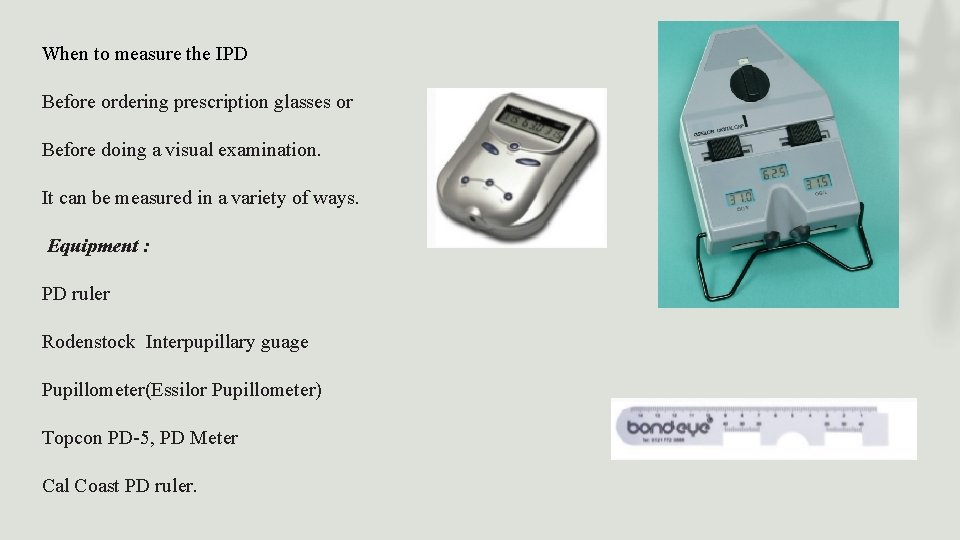
When to measure the IPD Before ordering prescription glasses or Before doing a visual examination. It can be measured in a variety of ways. Equipment : PD ruler Rodenstock Interpupillary guage Pupillometer(Essilor Pupillometer) Topcon PD-5, PD Meter Cal Coast PD ruler.
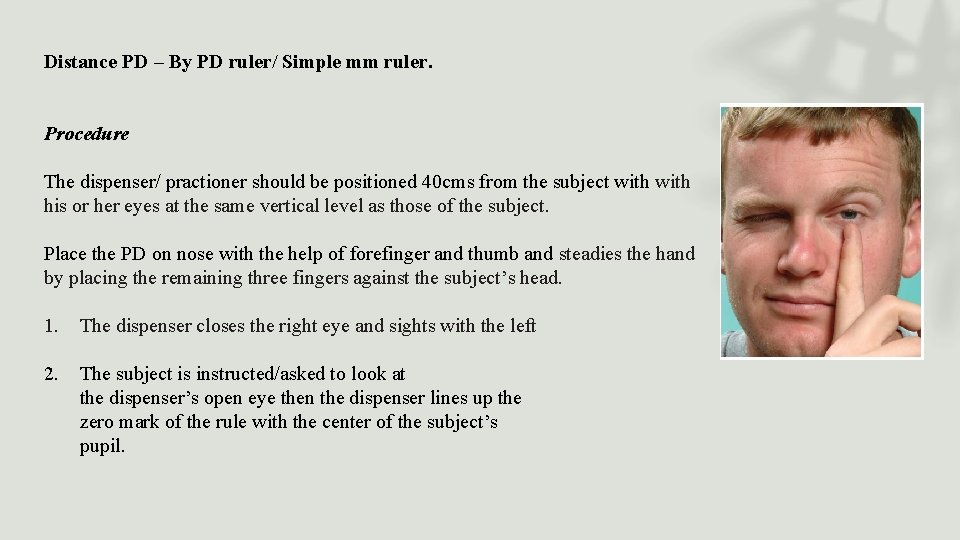
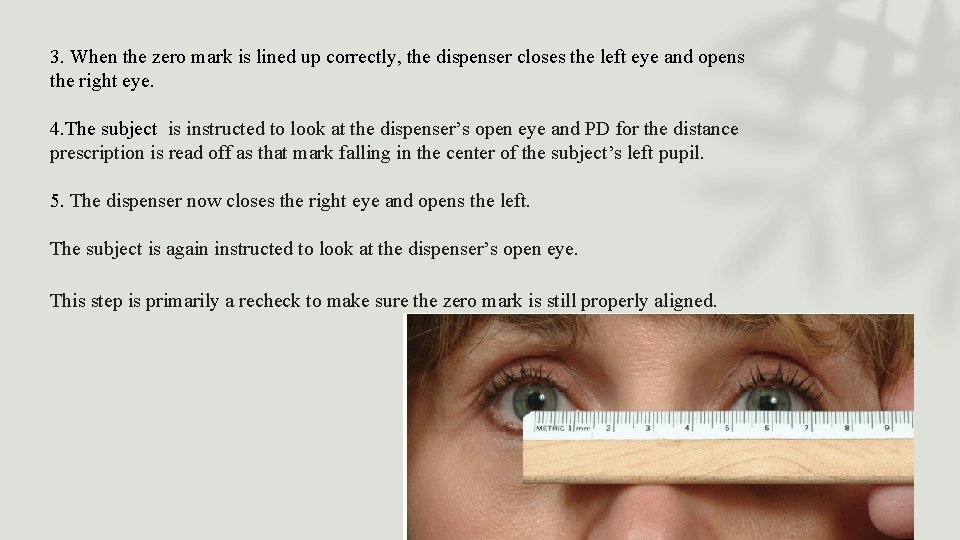
Distance PD – By PD ruler/ Simple mm ruler. Procedure The dispenser/ practioner should be positioned 40 cms from the subject with his or her eyes at the same vertical level as those of the subject. Place the PD on nose with the help of forefinger and thumb and steadies the hand by placing the remaining three fingers against the subject’s head. 1. The dispenser closes the right eye and sights with the left 2. The subject is instructed/asked to look at the dispenser’s open eye then the dispenser lines up the zero mark of the rule with the center of the subject’s pupil.
3. When the zero mark is lined up correctly, the dispenser closes the left eye and opens the right eye. 4. The subject is instructed to look at the dispenser’s open eye and PD for the distance prescription is read off as that mark falling in the center of the subject’s left pupil. 5. The dispenser now closes the right eye and opens the left. The subject is again instructed to look at the dispenser’s open eye. This step is primarily a recheck to make sure the zero mark is still properly aligned.
To Summarize Steps in Measuring the Binocular Distance PD 1. Dispenser positions at 40 cm (16 in). 2. Dispenser closes right eye, subject fixates on dispenser’s left eye. 3. Dispenser lines up zero point on subject’s right eye at the pupil center, left pupillary border, or left limbus. 4. Dispenser closes left eye, opens right eye; subject fixates right eye. 5. Dispenser reads off scale directly in line with left pupil center, left pupillary border, or left limbus. 6. Dispenser closes right eye, opens left; subject fixates left eye. 7. Dispenser checks to make sure zero point is still correct.
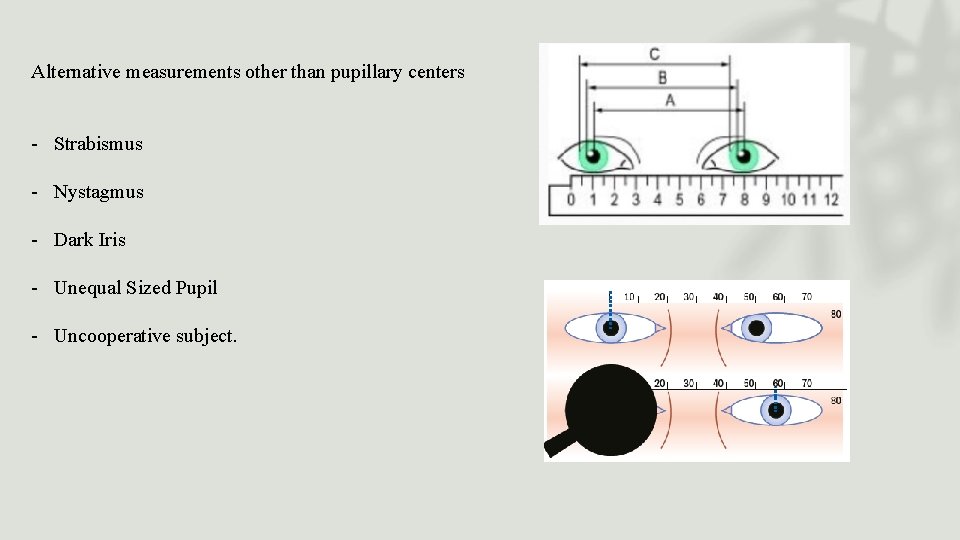
Alternative measurements other than pupillary centers - Strabismus - Nystagmus - Dark Iris - Unequal Sized Pupil - Uncooperative subject.
Common Difficulties and Their Solutions Problem Solution Subject Is Strabismic. Occlude the fellow eye Subject Is an Uncooperative Child Canthus to Canthus Measurement Dispenser Cannot Close One Eye. Occlude the with free hand Dispenser Visually Impaired in One Eye Use good eye /use alternative method which requires only one eye.
Common Causes of Errors 1. There will be an error in measurement if the measurer’s PD differs significantly from the subject’s because the lines of sight are not parallel. 2. Just as error will be increased when the measurer’s PD is significantly different from the subject’s, the parallactic error will also be increased even more if the dispenser is too close to the subject. Too close is closer than the normal 40 cm (16 inch) distance. 3. A significant error will be induced if the subject is strabismic (one eye turns in or out) or if the subject does not fixate binocularly during the PD measurement. 4. An error can result if the subject’s head moves. 5. An error can result if the person measuring moves his or head. 6. An error will result if the person measuring does not close or occlude one eye at a time to ensure sighting from directly in front of the subject’s eye under observation. 7. The subject may not look directly at the measurer’s pupil during the test, as he or she should, which will result in an error.
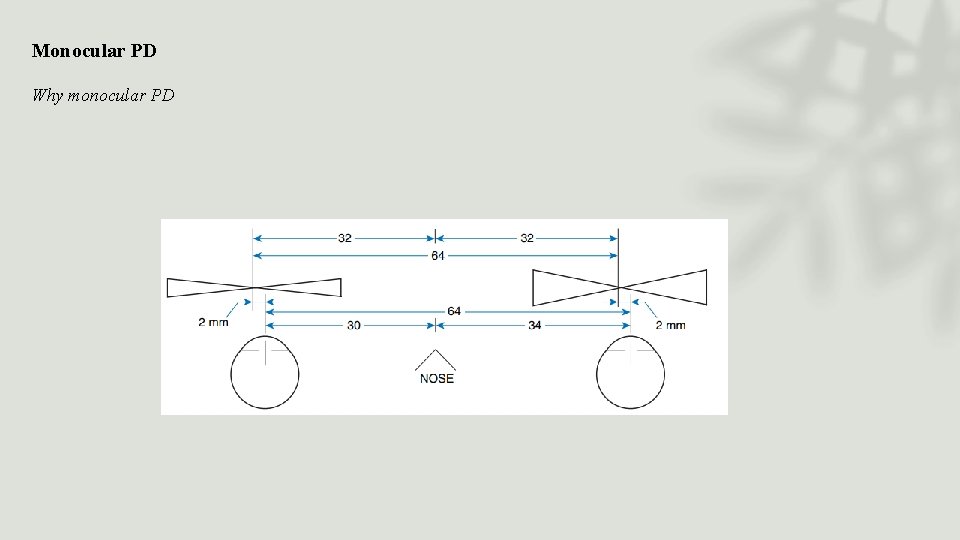
Monocular PD Why monocular PD
Procedure for Measuring Monocular PDs Using a Ruler The monocular PD is best taken using a pupillometer. When a pupillometer is not available, monocular PDs are taken by measuring from the center of the nose to the center of the pupils. Steps : 1. Measure the binocular PD as described earlier in the slides. Use the center of the pupil as the reference point. 2. Before moving the ruler, note the scale reading on the ruler at the center of the nose. This is the right monocular PD. 3. Subtract this reading from the binocular reading to obtain the left monocular PD.
Procedure for Measuring Monocular PDs Using the Frame 1. The selected frame is adjusted in exactly the same manner as it will be when worn. 2. Dispenser positions at 40 cm from the wearer and at the same level. Note : If the sample frame does not have glazed lenses, clear tape may be placed over the lens opening of the empty frame. 3. Dispenser opens left eye, closes right eye, and instructs wearer to look at dispenser’s open (left) eye. 4. Dispenser marks location of wearer’s right pupil center on glazed lens. 5. Dispenser opens right eye, closes left eye, and instructs wearer to look at dispenser’s open (right) eye. 6. Dispenser marks location of wearer’s left pupil center on glazed lens. 7. Dispenser rechecks the locations of the marked crosses by repeating steps 3 and 5 and notes the positions of the marked crosses. 8. If one or both crosses are wrong, the frames are removed and the cross(es) erased using a damp cloth. 9. When crosses are accurate, monocular PDs are measured from frame center to cross center.
PD Measuring Instruments Ideal Features: It should reduce/avoid the parallox error caused by measurement by PD ruler It should solves the problems caused when the person doing the measuring is monocular or is amblyopic in one eye. A well-designed PD measuring instrument should rest against the bridge of the subject’s nose exactly as a frame would. This most accurately approximates the way the glasses will position themselves.
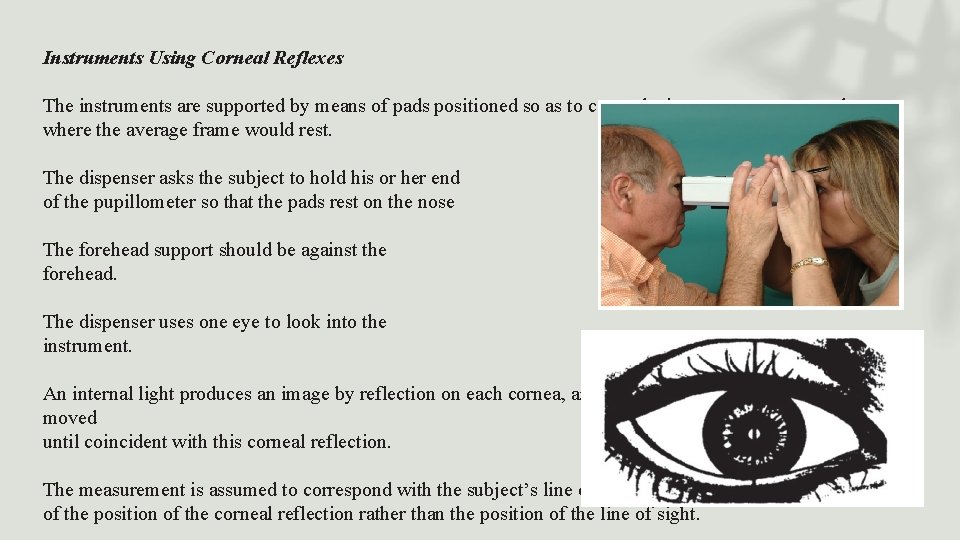
Instruments Using Corneal Reflexes The instruments are supported by means of pads positioned so as to cause the instrument to rest on the nose where the average frame would rest. The dispenser asks the subject to hold his or her end of the pupillometer so that the pads rest on the nose The forehead support should be against the forehead. The dispenser uses one eye to look into the instrument. An internal light produces an image by reflection on each cornea, and the hairline within the device is moved until coincident with this corneal reflection. The measurement is assumed to correspond with the subject’s line of sight, but is an objective measurement of the position of the corneal reflection rather than the position of the line of sight.
Photographic Instruments for Measuring PD The reflection of the pen light on the cornea is used as the reference point instead of the geometric center of the pupil. There are instruments available for taking a wearer’s interpupillary distance that make use of a photograph of the wearer’s eyes with the frame in place. The frames are adjusted as they are to be worn. The wearer fixates a light in the instrument, and the photo is taken. PD and segment height measurements are determined using the picture.
Corneal Reflections to Measure the PD without a Pupillometer It is possible to use corneal reflections to measure interpupillary distance with even a PD ruler, or by using the frame with glazed lenses. Procedure : The dispenser should be positioned at the near working distance. The dispenser holds a pen light directly below his or her eye and shines it into the eye of the subject. The subject looks either at the pen light or the dispenser’s eye. The reflection of the pen light on the cornea is used as the reference point instead of the geometric center of the pupil.
NEAR PD Why near PD The near PD is required for single vision reading glasses or for multifocals. In single vision reading glasses, the lenses are set so that their optical centers will be in the lines of sight of the eyes when the eyes are converged for reading. In multifocals the distance portion is ground to correspond to the distance PD, while the bifocal or trifocal portion is decentered inward to be properly situated for near vision. The near PD can be either measured or calculated.
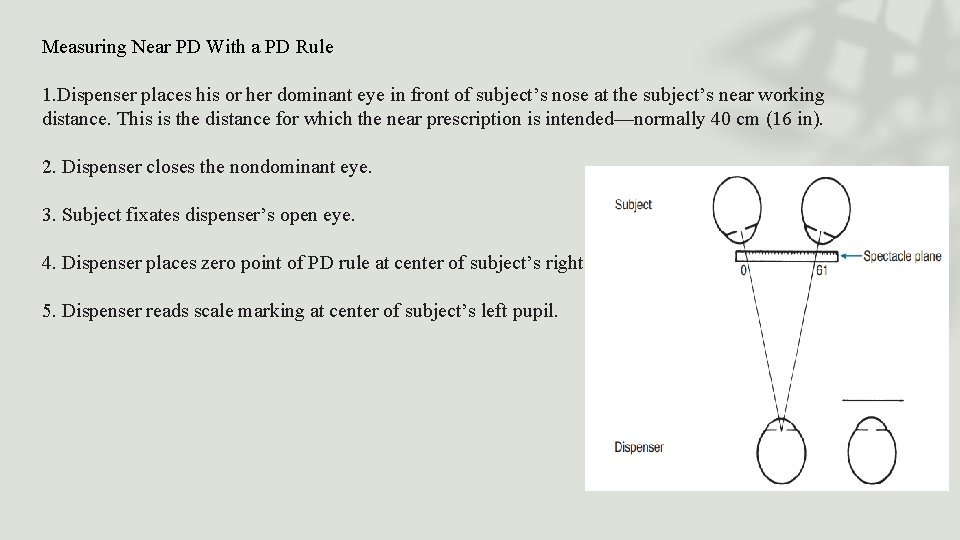
Measuring Near PD With a PD Rule 1. Dispenser places his or her dominant eye in front of subject’s nose at the subject’s near working distance. This is the distance for which the near prescription is intended—normally 40 cm (16 in). 2. Dispenser closes the nondominant eye. 3. Subject fixates dispenser’s open eye. 4. Dispenser places zero point of PD rule at center of subject’s right pupil. 5. Dispenser reads scale marking at center of subject’s left pupil.
Taking Near PD Using a Pupillometer Usually a PD measuring instrument will allow both distance and near PD to be measured. This is done through the use of a movable internal lens that changes the image distance and convergence for the subject. The near readings are carried out in the same manner as the distance readings.
Thank You. . .