
Measuring Intelligence Packet Intelligence Intro What is intelligence
![[Packet] Intelligence Intro What is intelligence? Free write for 5 minutes giving definitions, examples,](https://slidetodoc.com/presentation_image_h2/9d96efa91488e74b199cea52c4e39e0f/image-2.jpg "[Packet] Intelligence Intro What is intelligence? Free write for 5 minutes giving definitions, examples,")
![[Packet] Reflections on Success Fact: Intelligence tests were designed to measure potential for success](https://slidetodoc.com/presentation_image_h2/9d96efa91488e74b199cea52c4e39e0f/image-7.jpg "[Packet] Reflections on Success Fact: Intelligence tests were designed to measure potential for success")
![[Packet] Cornell Notes on IQ Cornell Notes: How has our society traditionally measured intelligence](https://slidetodoc.com/presentation_image_h2/9d96efa91488e74b199cea52c4e39e0f/image-10.jpg "[Packet] Cornell Notes on IQ Cornell Notes: How has our society traditionally measured intelligence")
![[Packet] Aptitude Pedigree Chart (1) Start a pedigree chart. Make a box for you,](https://slidetodoc.com/presentation_image_h2/9d96efa91488e74b199cea52c4e39e0f/image-27.jpg "[Packet] Aptitude Pedigree Chart (1) Start a pedigree chart. Make a box for you,")
![[Packet] Origin of Intelligence Nature vs Nurture: Which is more intelligent? Phase 1: Make](https://slidetodoc.com/presentation_image_h2/9d96efa91488e74b199cea52c4e39e0f/image-28.jpg "[Packet] Origin of Intelligence Nature vs Nurture: Which is more intelligent? Phase 1: Make")
![[Packet] Intro to Three Major Theorists Examine Fig. 9. 18 on pg. 367. According](https://slidetodoc.com/presentation_image_h2/9d96efa91488e74b199cea52c4e39e0f/image-39.jpg "[Packet] Intro to Three Major Theorists Examine Fig. 9. 18 on pg. 367. According")
![[Packet] Evaluate Which theory of intelligence should we teach to children in the United](https://slidetodoc.com/presentation_image_h2/9d96efa91488e74b199cea52c4e39e0f/image-48.jpg "[Packet] Evaluate Which theory of intelligence should we teach to children in the United")
![[Packet] Student Choice Activities (pick one) 1. (Spiral) Personal Application Activity: Read “Understanding Creativity”](https://slidetodoc.com/presentation_image_h2/9d96efa91488e74b199cea52c4e39e0f/image-52.jpg "[Packet] Student Choice Activities (pick one) 1. (Spiral) Personal Application Activity: Read “Understanding Creativity”")
- Slides: 52
Measuring Intelligence
[Packet] Intelligence Intro What is intelligence? Free write for 5 minutes giving definitions, examples, and thoughts on this topic. Skip few lines, and make this title in your spiral: Vignette Responses Read the following three vignettes and respond to the question at the bottom of each.
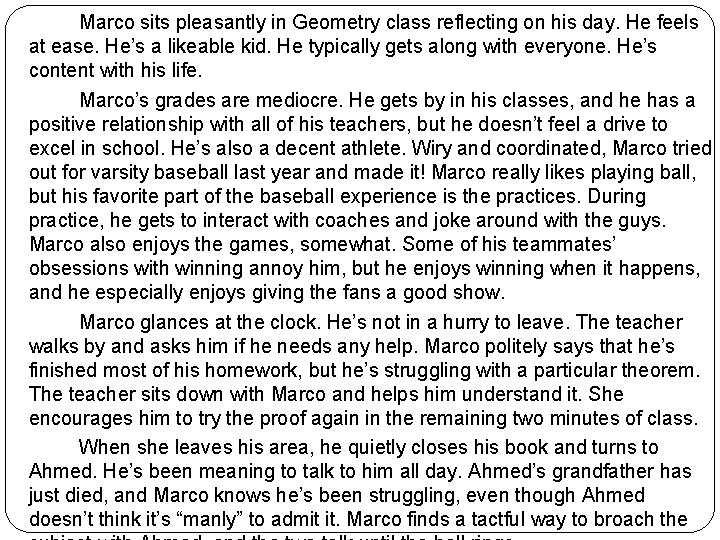
Marco sits pleasantly in Geometry class reflecting on his day. He feels at ease. He’s a likeable kid. He typically gets along with everyone. He’s content with his life. Marco’s grades are mediocre. He gets by in his classes, and he has a positive relationship with all of his teachers, but he doesn’t feel a drive to excel in school. He’s also a decent athlete. Wiry and coordinated, Marco tried out for varsity baseball last year and made it! Marco really likes playing ball, but his favorite part of the baseball experience is the practices. During practice, he gets to interact with coaches and joke around with the guys. Marco also enjoys the games, somewhat. Some of his teammates’ obsessions with winning annoy him, but he enjoys winning when it happens, and he especially enjoys giving the fans a good show. Marco glances at the clock. He’s not in a hurry to leave. The teacher walks by and asks him if he needs any help. Marco politely says that he’s finished most of his homework, but he’s struggling with a particular theorem. The teacher sits down with Marco and helps him understand it. She encourages him to try the proof again in the remaining two minutes of class. When she leaves his area, he quietly closes his book and turns to Ahmed. He’s been meaning to talk to him all day. Ahmed’s grandfather has just died, and Marco knows he’s been struggling, even though Ahmed doesn’t think it’s “manly” to admit it. Marco finds a tactful way to broach the
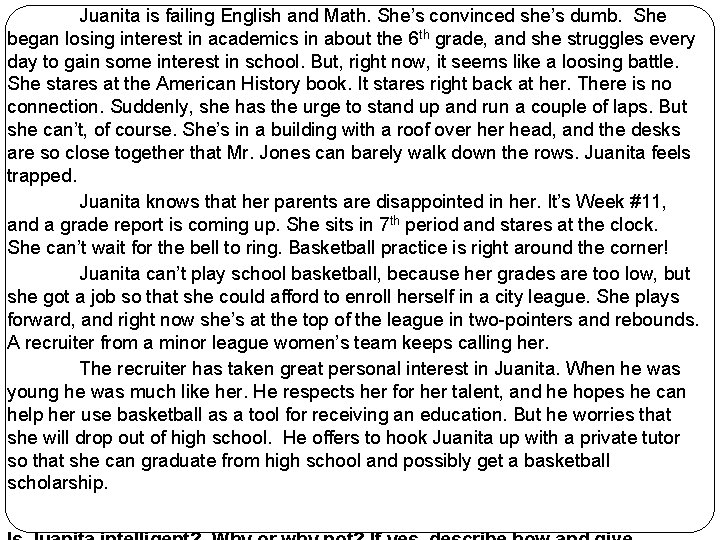
Juanita is failing English and Math. She’s convinced she’s dumb. She began losing interest in academics in about the 6 th grade, and she struggles every day to gain some interest in school. But, right now, it seems like a loosing battle. She stares at the American History book. It stares right back at her. There is no connection. Suddenly, she has the urge to stand up and run a couple of laps. But she can’t, of course. She’s in a building with a roof over head, and the desks are so close together that Mr. Jones can barely walk down the rows. Juanita feels trapped. Juanita knows that her parents are disappointed in her. It’s Week #11, and a grade report is coming up. She sits in 7 th period and stares at the clock. She can’t wait for the bell to ring. Basketball practice is right around the corner! Juanita can’t play school basketball, because her grades are too low, but she got a job so that she could afford to enroll herself in a city league. She plays forward, and right now she’s at the top of the league in two-pointers and rebounds. A recruiter from a minor league women’s team keeps calling her. The recruiter has taken great personal interest in Juanita. When he was young he was much like her. He respects her for her talent, and he hopes he can help her use basketball as a tool for receiving an education. But he worries that she will drop out of high school. He offers to hook Juanita up with a private tutor so that she can graduate from high school and possibly get a basketball scholarship.
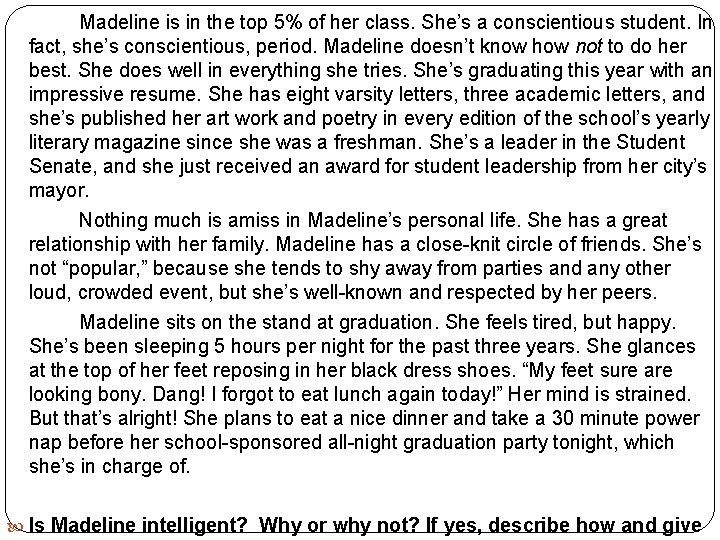
Madeline is in the top 5% of her class. She’s a conscientious student. In fact, she’s conscientious, period. Madeline doesn’t know how not to do her best. She does well in everything she tries. She’s graduating this year with an impressive resume. She has eight varsity letters, three academic letters, and she’s published her art work and poetry in every edition of the school’s yearly literary magazine since she was a freshman. She’s a leader in the Student Senate, and she just received an award for student leadership from her city’s mayor. Nothing much is amiss in Madeline’s personal life. She has a great relationship with her family. Madeline has a close-knit circle of friends. She’s not “popular, ” because she tends to shy away from parties and any other loud, crowded event, but she’s well-known and respected by her peers. Madeline sits on the stand at graduation. She feels tired, but happy. She’s been sleeping 5 hours per night for the past three years. She glances at the top of her feet reposing in her black dress shoes. “My feet sure are looking bony. Dang! I forgot to eat lunch again today!” Her mind is strained. But that’s alright! She plans to eat a nice dinner and take a 30 minute power nap before her school-sponsored all-night graduation party tonight, which she’s in charge of. Is Madeline intelligent? Why or why not? If yes, describe how and give
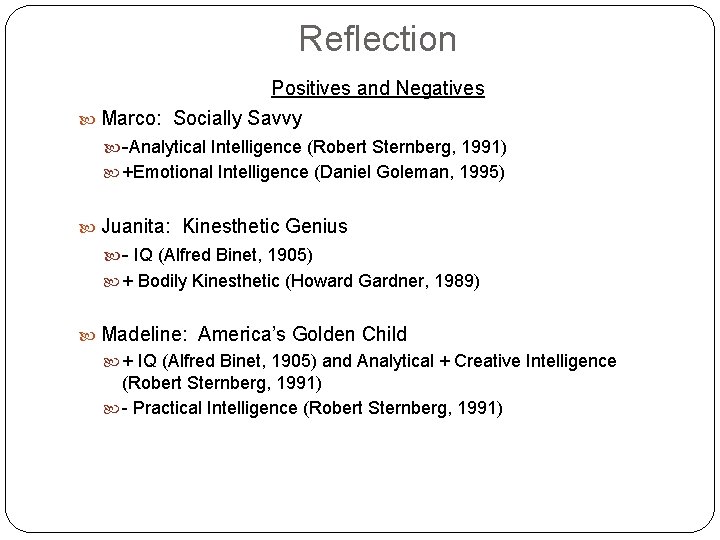
Reflection Positives and Negatives Marco: Socially Savvy -Analytical Intelligence (Robert Sternberg, 1991) +Emotional Intelligence (Daniel Goleman, 1995) Juanita: Kinesthetic Genius - IQ (Alfred Binet, 1905) + Bodily Kinesthetic (Howard Gardner, 1989) Madeline: America’s Golden Child + IQ (Alfred Binet, 1905) and Analytical + Creative Intelligence (Robert Sternberg, 1991) - Practical Intelligence (Robert Sternberg, 1991)
[Packet] Reflections on Success Fact: Intelligence tests were designed to measure potential for success in life. Question: What is success in life? How do you define and measure it? • Money? • Comfort? • Routine? • Education? • Relationships? • Communication? • Balanced Life? • Achievement of goals? • Impressiveness? • Social Status? • Independence? • Recreation? • Creativity? • Stability? • Predictability? • Logical decision making? • Integrity? • Good works? • Protecting the vulnerable? • Community involvement? • Making a difference? • Being involved in a cause? • Self-reported happiness?
Success Survey (same assignment as “Reflections on Success”) �Definitions of Success � 1. �Elaboration � 2. � 3. � 4. � 5. Instructions: Survey five people on the paragraph they just wrote. Break their responses into the two columns shown above. 2 minutes person
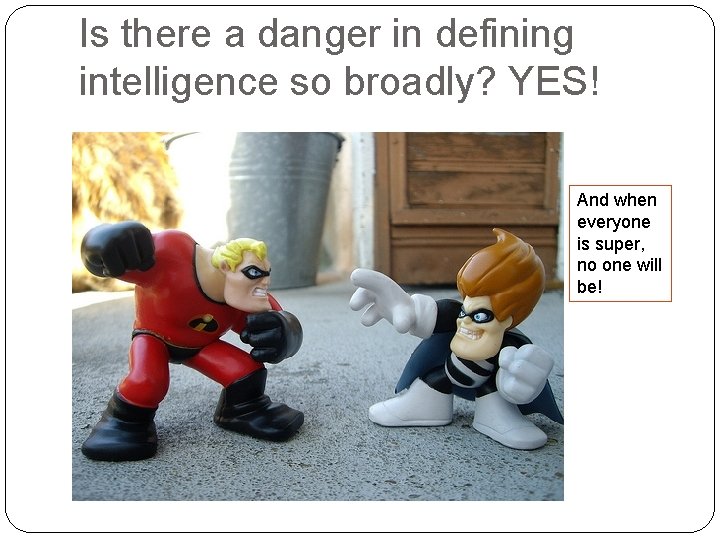
Is there a danger in defining intelligence so broadly? YES! And when everyone is super, no one will be!
[Packet] Cornell Notes on IQ Cornell Notes: How has our society traditionally measured intelligence and success? (start pg. 342) Key Points Mental Ability Tests vs Personality Scales Standardization Reliability Validity Galton’s hereditary genius IQ (Binet, Turman, etc. ) Weshler’s WAIS The Normal Curve Mental Retardation or “Intellectual Disability” Giftedness Summary: Notes
Principle Types of Psychological Tests Psychological tests are standardized measures of behavior. Mental ability tests Intelligence – general Aptitude – specific Personality “scales” Not called “tests” because there are no right/wrong answers. Measure motives, interests, values, and attitudes
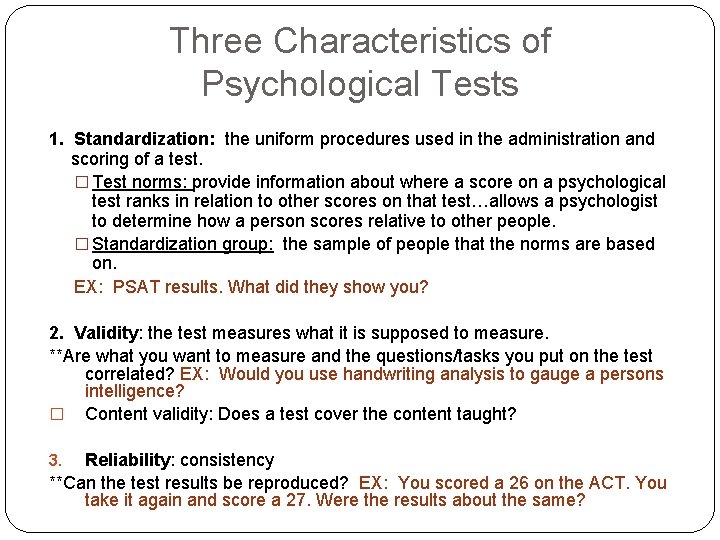
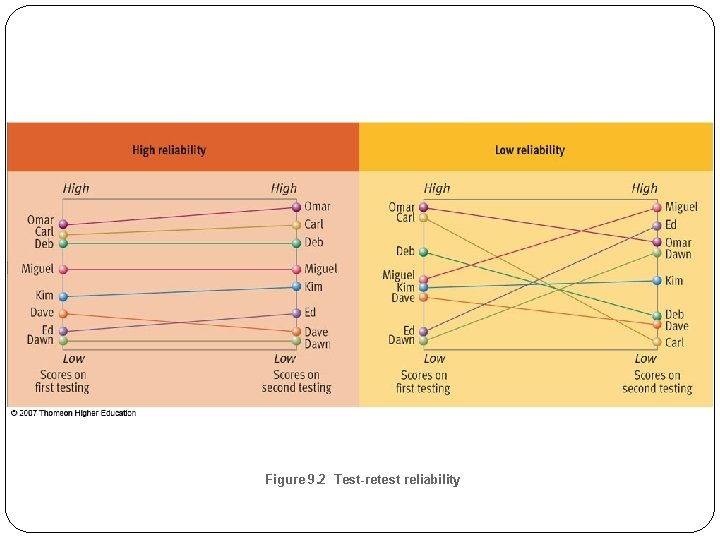
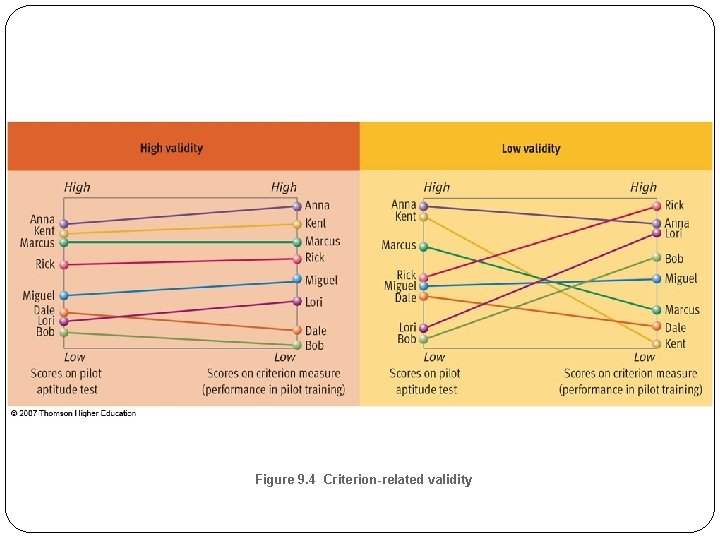
Three Characteristics of Psychological Tests 1. Standardization: the uniform procedures used in the administration and scoring of a test. � Test norms: provide information about where a score on a psychological test ranks in relation to other scores on that test…allows a psychologist to determine how a person scores relative to other people. � Standardization group: the sample of people that the norms are based on. EX: PSAT results. What did they show you? 2. Validity: the test measures what it is supposed to measure. **Are what you want to measure and the questions/tasks you put on the test correlated? EX: Would you use handwriting analysis to gauge a persons intelligence? � Content validity: Does a test cover the content taught? Reliability: consistency **Can the test results be reproduced? EX: You scored a 26 on the ACT. You take it again and score a 27. Were the results about the same? 3.
Figure 9. 2 Test-retest reliability
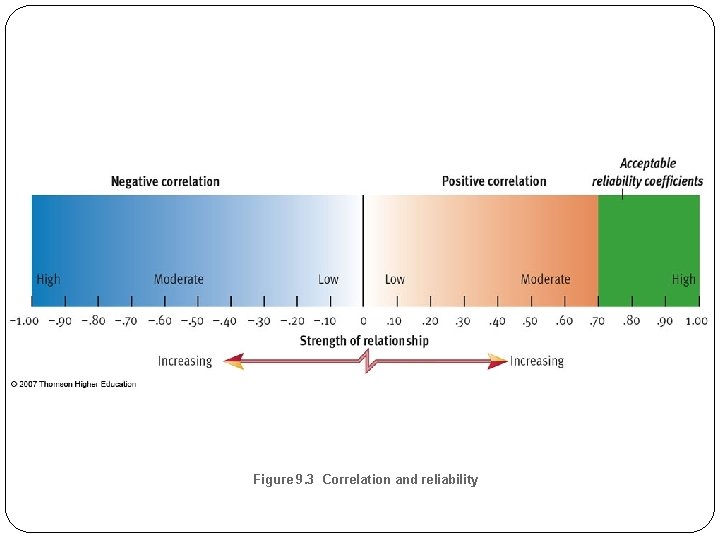
Figure 9. 3 Correlation and reliability
Figure 9. 4 Criterion-related validity
The Evolution of Intelligence Testing • Sir Francis Galton (1869) – Hereditary Genius: proposed that success runs in families because intelligence is inherited • Alfred Binet and Theodore Simon (1905) – Binet-Simon Intelligence Scale: designed to single out youngsters in need of special training – Mental age: EX. a 4 year-old child with a mental age of 6 performed like the average 6 year-old on the test.
The Evolution of Intelligence Testing Lewis Terman (1916) Stanford-Binet Intelligence Scale Intelligence Quotient (IQ) = MA/CA x 100 – divides a child’s mental (MA) age by chronological age (CA) and multiplying by 100…this made it possible to compare children of different ages. David Wechsler (1955) Wechsler Adult Intelligence Scale – Also versions for preschool and elementary school kids – give more emphasis to nonverbal reasoning, yielding a verbal IQ, a performance IQ, and a full-scale IQ. Subscores for verbal comprehension, perceptual organization, working memory, and processing speed – devised a new scoring system based on the normal distribution…the deviation IQ. This scoring system is outlined on the next slide.
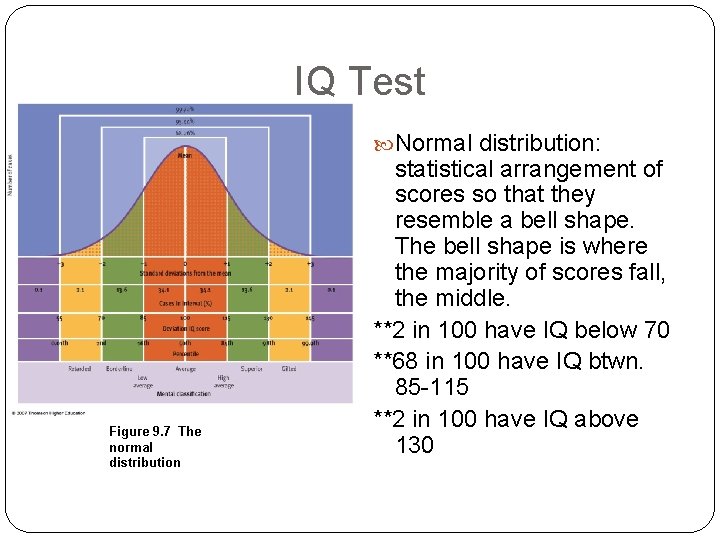
IQ Test Normal distribution: Figure 9. 7 The normal distribution statistical arrangement of scores so that they resemble a bell shape. The bell shape is where the majority of scores fall, the middle. **2 in 100 have IQ below 70 **68 in 100 have IQ btwn. 85 -115 **2 in 100 have IQ above 130
Reliability and Validity of IQ tests Exceptionally reliable – correlations into the . 90 s Qualified validity – valid indicators of academic/verbal intelligence, not intelligence in a truly general sense Correlations: . 40 s–. 50 s with school success . 60 s–. 80 s with number of years in school Predictive of occupational attainment, debate about predictiveness of performance
Mental Retardation or “Intellectual Disability” in IQ scores Mental retardation or “intellectual disability” is a substantial limitation on functioning that is characterized by significantly sub average intellectual functioning, along with related limitation in two of eleven areas, including communication, self-care, home living, social skills, academic skills, leisure, and safety (APA, 2000)
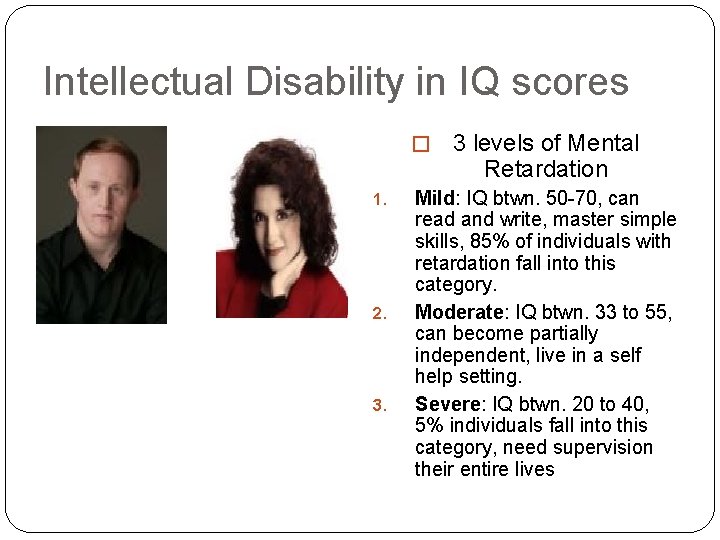
Intellectual Disability in IQ scores � 1. 2. 3 levels of Mental Retardation Mild: IQ btwn. 50 -70, can read and write, master simple skills, 85% of individuals with retardation fall into this category. Moderate: IQ btwn. 33 to 55, can become partially independent, live in a self help setting. Severe: IQ btwn. 20 to 40, 5% individuals fall into this category, need supervision their entire lives
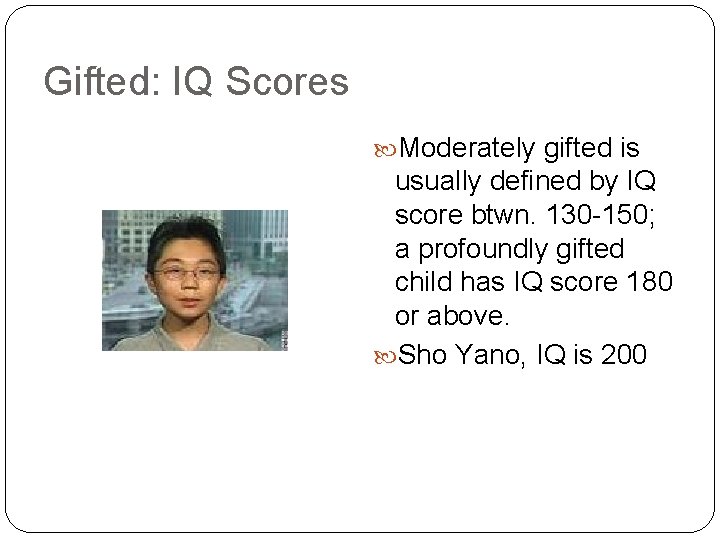
Gifted: IQ Scores Moderately gifted is usually defined by IQ score btwn. 130 -150; a profoundly gifted child has IQ score 180 or above. Sho Yano, IQ is 200
Gifted: IQ Scores How do gifted children turn out? (Terman & Oden, 1959) 1500 gifted children were tracked over 65 years. 30% never finished college 2% flunked out of college 9% had emotional issues 7% committed suicide **Brain areas responsible for higher cognitive reasoning develop differently in highly intelligent children. (Shaw, 2006)
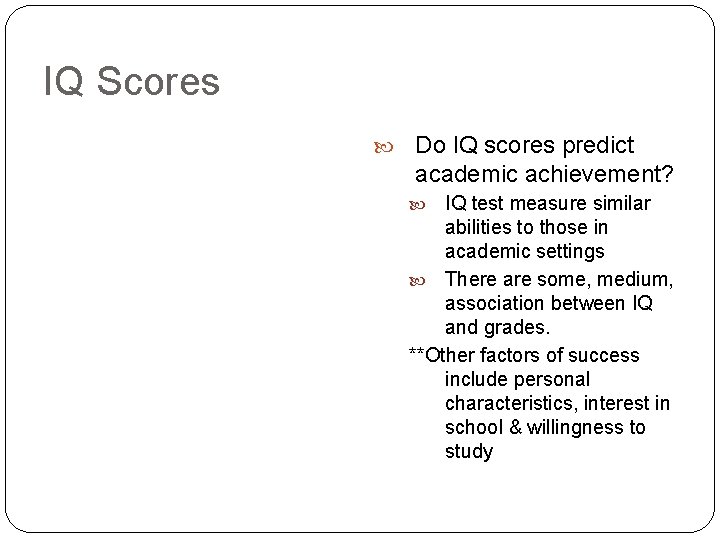
IQ Scores Do IQ scores predict academic achievement? IQ test measure similar abilities to those in academic settings There are some, medium, association between IQ and grades. **Other factors of success include personal characteristics, interest in school & willingness to study
IQ Scores Do IQ scores predict job performance? Not accurate at predicting specific job performance, but does have a moderate correlation
Nature vs Nurture: Intelligence Which is more intelligent? Closely examine the chart on pg. 358 and the on pg. 359. Do they support NATURE or NURTURE? Why? Be ready with a verbal answer.
[Packet] Aptitude Pedigree Chart (1) Start a pedigree chart. Make a box for you, and list your three greatest aptitudes, or abilities. Choose from this list (see pg. 370): Visual-spatial reasoning, logical/mathematical, musical, bodily/kinesthetic, linguistic, interpersonal, intrapersonal, naturalistic (2) Add people from three generations in your family to your chart or, if you’re adopted, three generations of a family you know. (3) List three aptitudes for each person from the list. (4) Reflection: Make a chart with Inherited and Learned columns. Describe a minimum of three Me trends you for each Bro see Sis column. Dad Mom Aunt Uncle (5) Paragraph: Are your family’s aptitudes mostly inherited or. Uncle For Example. . . Gma cousin mostly learned? How do you. Gpa know? Explain. Gpa
[Packet] Origin of Intelligence Nature vs Nurture: Which is more intelligent? Phase 1: Make a T-chart that covers a whole page. Phase 2: -Nature Group: Read through pgs. 357 -359 and/or use your phones to find other current, relevant information. List 3 -5 bits of evidence for the hereditary influence on intelligence. -Nurture Group: Read through pgs. 359 -360 and/or use your phones to find other current, relevant information. List 3 -5 bits of evidence for the environmental influence on intelligence. Phase 3: Form groups of 2 -3 with classmates accessible from your seat. Each group will receive a few sticky notes. Collaborate and decide which are
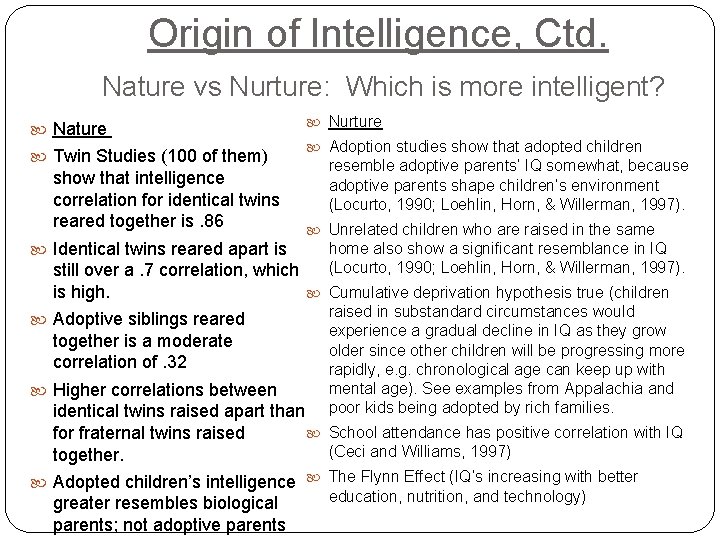
Origin of Intelligence, Ctd. Nature vs Nurture: Which is more intelligent? Nature Twin Studies (100 of them) show that intelligence correlation for identical twins reared together is. 86 Identical twins reared apart is still over a. 7 correlation, which is high. Adoptive siblings reared together is a moderate correlation of. 32 Higher correlations between Nurture Adoption studies show that adopted children resemble adoptive parents’ IQ somewhat, because adoptive parents shape children’s environment (Locurto, 1990; Loehlin, Horn, & Willerman, 1997). Unrelated children who are raised in the same home also show a significant resemblance in IQ (Locurto, 1990; Loehlin, Horn, & Willerman, 1997). Cumulative deprivation hypothesis true (children raised in substandard circumstances would experience a gradual decline in IQ as they grow older since other children will be progressing more rapidly, e. g. chronological age can keep up with mental age). See examples from Appalachia and poor kids being adopted by rich families. identical twins raised apart than School attendance has positive correlation with IQ for fraternal twins raised (Ceci and Williams, 1997) together. Adopted children’s intelligence The Flynn Effect (IQ’s increasing with better education, nutrition, and technology) greater resembles biological parents; not adoptive parents
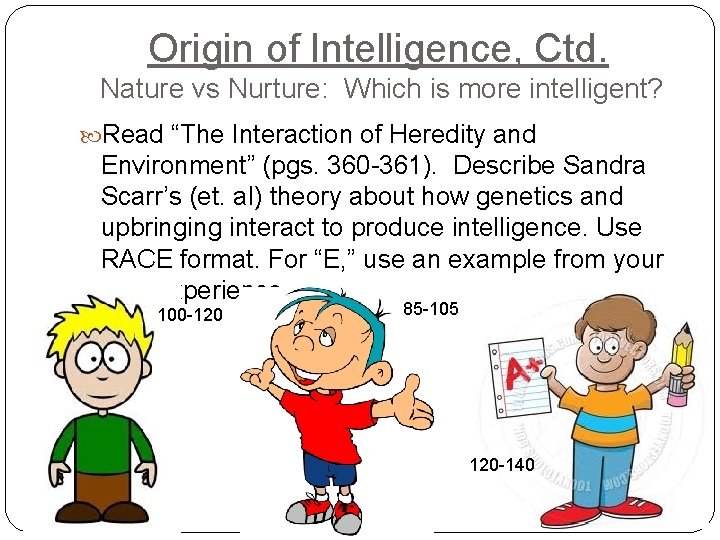
Origin of Intelligence, Ctd. Nature vs Nurture: Which is more intelligent? Read “The Interaction of Heredity and Environment” (pgs. 360 -361). Describe Sandra Scarr’s (et. al) theory about how genetics and upbringing interact to produce intelligence. Use RACE format. For “E, ” use an example from your own experience. 100 -120 85 -105 120 -140
Human Diversity and IQ Scores A Socially-Charged Dimension of the Nature vs Nurture Debate
Fact or Fiction? Instructions: Answer this question verbally. Off hand, would you say the following statement is true or false? Explain why to a close neighbor. In your explanation, you can use statistical evidence (if you happen to know any) or personal experience. There seems to be a correlation between (1) race and intelligence and (2) culture and intelligence.
(Spiral) Apple Slice Experiment Make a Venn Diagram. You will highlight five differences and three similarities. Procedure: Come get an apple slice FROM THE TABLE for a group of 2. One person will pick up a #1 bag and the other will pick up a #2 bag. Together, verbally describe everything you can about your apple slices to your group. On your Venn Diagram, come up with 5 differences between samples 1 and 2 and at least 3 similarities. In your spiral, answer this question: Do you think these differences are due to nurture or nature? Why? Do you think these similarities are due to nurture or nature? Why?
Apple Slice Experiment, Ctd. “Although the full range of IQ scores is seen in all ethnic groups, the average IQ for many of the larger minority groups in the United States (such as African Americans, Native Americans, and Hispanics) is somewhat lower than the average for whites. The disparity ranges from 3 to 15 points” (Textbook, pgs. 361 -362). How would you explain this quote in connection with the apple slice experiment?
Apple Slice Experiment, Ctd. Read “Cultural Differences in IQ Scores” (pgs. 361 -364). Pinpoint at least 5 hypothesis that explain why IQ scores among different races and cultures may be different. Luke, I am your father!
Elaborate Guide Heritability: A heritability estimate (ex. 0. 8 correlation between IQ and DNA) applies only to the specific group on which the estimate is based. Studies dominated by white subjects, so no validity in applying the estimate to other cultural groups. Group averages correlating IQ and heredity aren’t necessarily due entirely to heredity, because group environments are different (EX. Corn EX. Bananas). Race=group. Racial environments are different from each other, so what’s to say that IQ differences aren’t due to nurture? Socioeconomic Minorities have depressed IQ scores b/c children grow up in “deprived” environments that create a disadvantage- in school and in IQ. In general, white people and minorities grow up in very different circumstances. Minority groups have a history of “economic discrimination” Lower-class children likely to come from larger families=disadvantage in parental assistance. Poorer role models and language poverty. Poorer exposure to books. Less pressure to work hard on intellectual pursuits. Poorer schools. Malnutrition. Stereotype vulnerability: Minorities have the added pressure that, if they fail, others will attribute that failure to their race or sex. This undermines emotional investment in the IQ task.
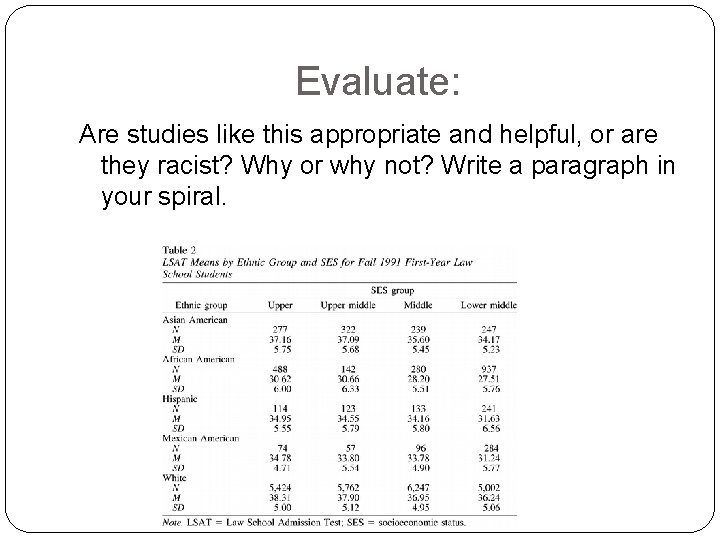
Evaluate: Are studies like this appropriate and helpful, or are they racist? Why or why not? Write a paragraph in your spiral.
Testing and Culture Answer this question: When you get hurt, will you be taken to the hospital in (a) an ambulance, (b) an airplane, (c) a snowmobile How would a kid from rural Alaska answer this question? Why? How would a kid who grew up in the mountains surrounded by ski resorts answer this question? Reflection: What is cultural bias in testing? Has it had a significant impact in our data on IQ and ethnicity? (read pgs. 365 -366)
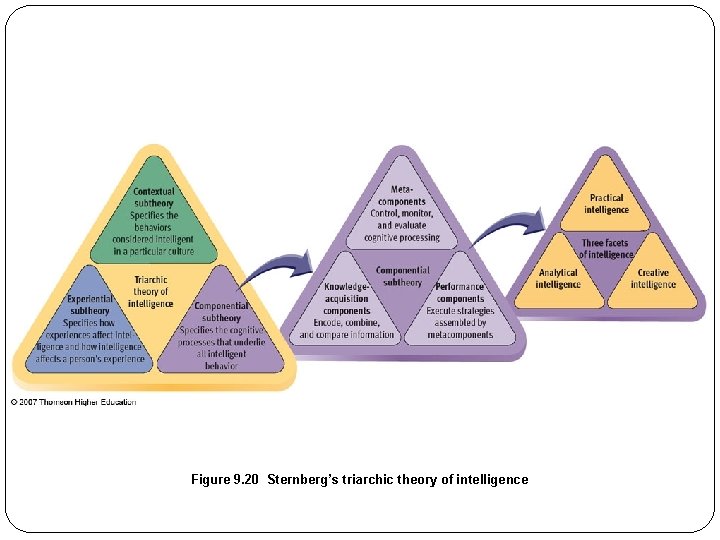
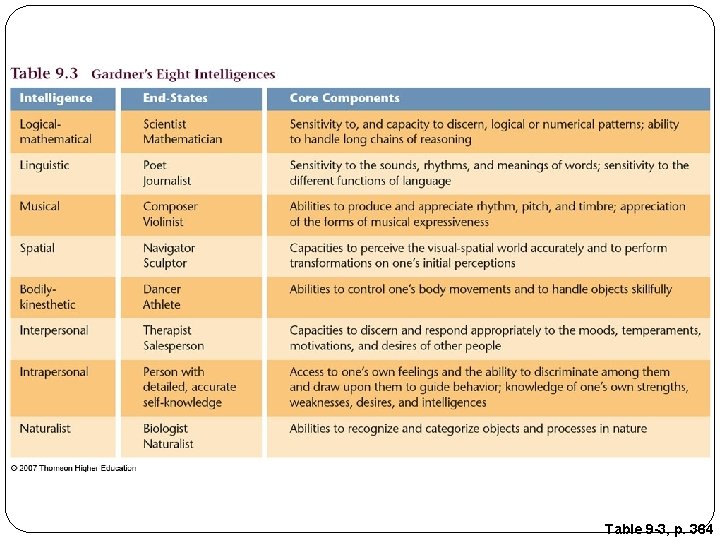
[Packet] Intro to Three Major Theorists Examine Fig. 9. 18 on pg. 367. According to this visual and its caption, how does Spearman define intelligence? Examine Fig. 9. 22 on pg. 369. According to this visual and its caption, how does Sternberg define intelligence? Examine Table 9. 3 on pg. 370. According to this visual and its caption, how does Gardner define intelligence? Read the first two paragraphs of “Increasing Emphasis on Special Abilities” on pg. 366. What can you add to your description of Spearman’s Fig. 9. 18? Read “Investigating Cognitive Processes in Intelligent Behavior” on pgs. 369 -370. What can you add to your description of Sternberg’s Fig. 9. 22? Read “Expanding the Concept of Intelligence” on pgs. 370371. What can you add to your description of Gardner’s Table 9. 3?
Re-cap Following are six summary slides about our three major theorists and their theories. Add anything to your notes from these slides that help you understand the main points of each theory. By the end of this exercise, you should be able to summarize three theories.
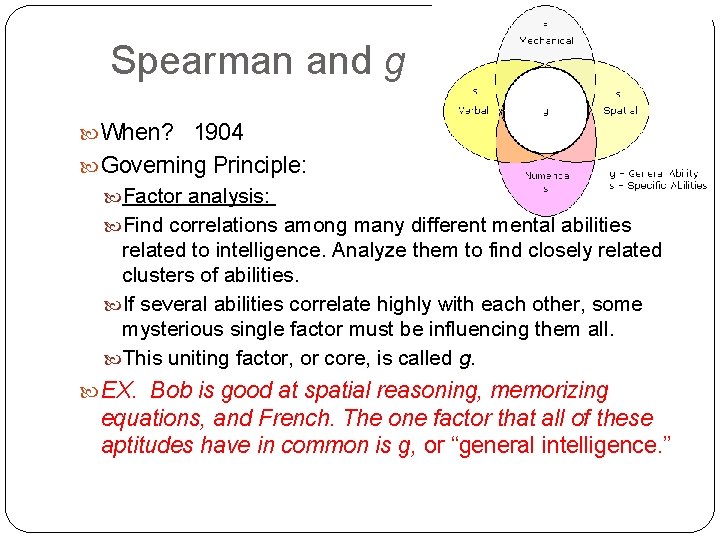
Spearman and g When? 1904 Governing Principle: Factor analysis: Find correlations among many different mental abilities related to intelligence. Analyze them to find closely related clusters of abilities. If several abilities correlate highly with each other, some mysterious single factor must be influencing them all. This uniting factor, or core, is called g. EX. Bob is good at spatial reasoning, memorizing equations, and French. The one factor that all of these aptitudes have in common is g, or “general intelligence. ”
Illustration of g See graphic on pg. 367
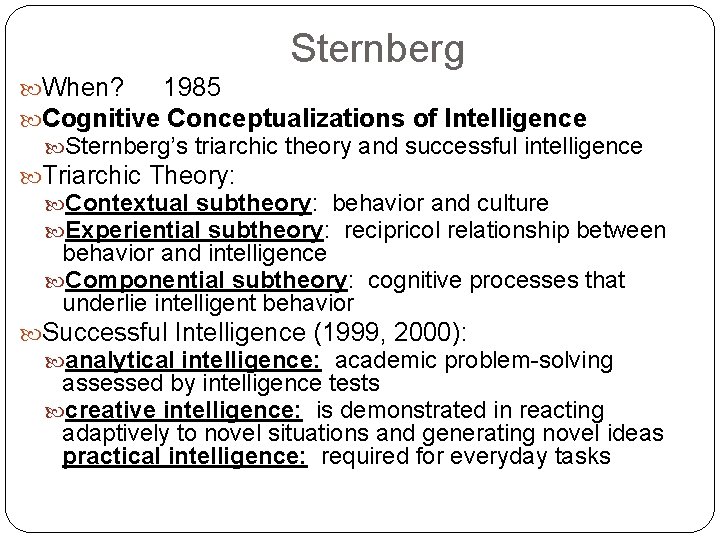
Sternberg When? 1985 Cognitive Conceptualizations of Intelligence Sternberg’s triarchic theory and successful intelligence Triarchic Theory: Contextual subtheory: behavior and culture Experiential subtheory: recipricol relationship between behavior and intelligence Componential subtheory: cognitive processes that underlie intelligent behavior Successful Intelligence (1999, 2000): analytical intelligence: academic problem-solving assessed by intelligence tests creative intelligence: is demonstrated in reacting adaptively to novel situations and generating novel ideas practical intelligence: required for everyday tasks
Figure 9. 20 Sternberg’s triarchic theory of intelligence
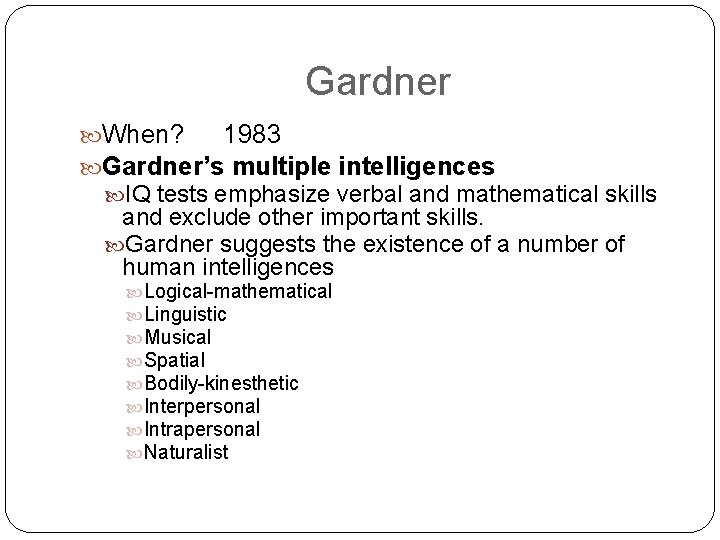
Gardner When? 1983 Gardner’s multiple intelligences IQ tests emphasize verbal and mathematical skills and exclude other important skills. Gardner suggests the existence of a number of human intelligences Logical-mathematical Linguistic Musical Spatial Bodily-kinesthetic Interpersonal Intrapersonal Naturalist
Table 9 -3, p. 364
Summarize Take a card. Blue=Spearman Yellow=Sternberg Red=Gardner. Join with two people who have the other two colors on their cards. Summarize your assigned theory and give them an example.
[Packet] Evaluate Which theory of intelligence should we teach to children in the United States? Why? Write a paragraph stating your opinion. Following is a list of theories of intelligence we’ve discussed: IQ Spearman’s g Sternberg’s triarchic theory Gardner’s theory of multiple intelligences
Intelligences Poster: Review the chart on pg. 369 -370. Choose a form of intelligence that interests you. On you poster, write the title of the intelligence you chose. Describe it in your own words. Next, make a list of five activities/jobs in which someone with this form of intelligence might excel. Finally, design a three-question intelligence test that would measure this form of intelligence. It can be a question with a written answer or some other task. Illustrate your poster if you have time.
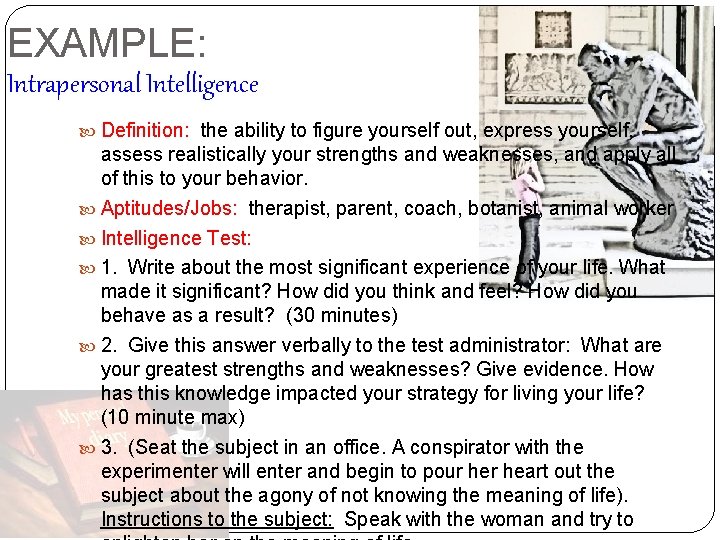
EXAMPLE: Intrapersonal Intelligence Definition: the ability to figure yourself out, express yourself, assess realistically your strengths and weaknesses, and apply all of this to your behavior. Aptitudes/Jobs: therapist, parent, coach, botanist, animal worker Intelligence Test: 1. Write about the most significant experience of your life. What made it significant? How did you think and feel? How did you behave as a result? (30 minutes) 2. Give this answer verbally to the test administrator: What are your greatest strengths and weaknesses? Give evidence. How has this knowledge impacted your strategy for living your life? (10 minute max) 3. (Seat the subject in an office. A conspirator with the experimenter will enter and begin to pour heart out the subject about the agony of not knowing the meaning of life). Instructions to the subject: Speak with the woman and try to
C. 9 Test Focuses Intelligence Testing: standardization, validity, reliability IQ: history, equation, heritability (especially Scarr’s theory), ethnic studies, socioeconomic studies, cultural bias Spearman and g Sternberg’s triangles Gardner’s multiple intelligences- What kinds are there and how are they defined? Vocabulary
[Packet] Student Choice Activities (pick one) 1. (Spiral) Personal Application Activity: Read “Understanding Creativity” on pgs. 373 -375. Then write mini-paragraphs on each of the following questions. (1) According to the subsection, “The Nature of Creativity, ” are you a creative person? Why or why not? (2) Do you think creativity can be measured? Why or why not? (3) Do you agree or disagree with what the author writes in the subsection, “Measuring Creativity”? (4) Do the “correlates” discussed in the subsection, “Correlates of Creativity” surprise you? Why or why not? 2. (Spiral) Critical Thinking Activity: Read “The Intelligence Debate” on pgs. 376 -377. Then write mini-paragraphs on each of the following questions. (1) When have you observed the appeal to ignorance or reification in an argument? (2) When have you used it in an argument/discussion? (3) How can you avoid falling prey to