
Measuring Human Energy Intake Adam Hoover Electrical Computer
- Slides: 38
Measuring Human Energy Intake Adam Hoover Electrical & Computer Engineering Department
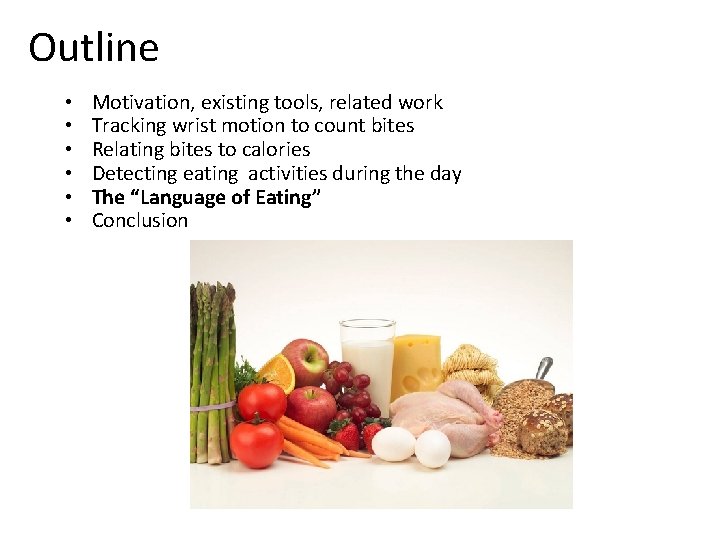
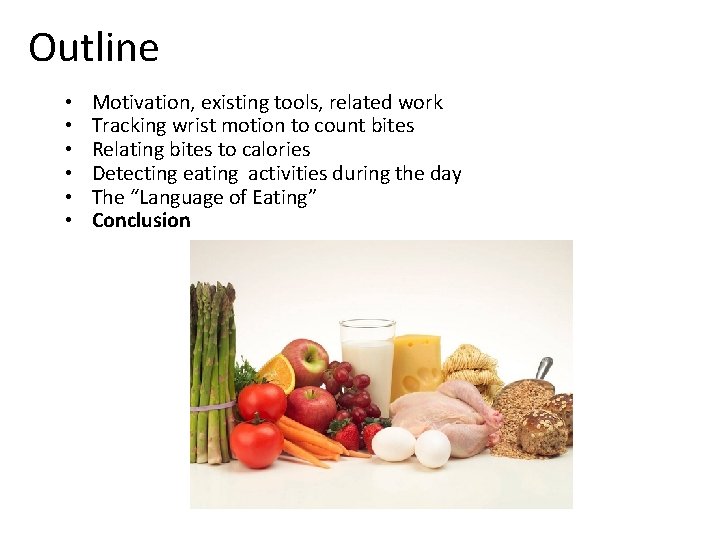
Outline • • • Motivation, existing tools, related work Tracking wrist motion to count bites Relating bites to calories Detecting eating activities during the day The “Language of Eating” Conclusion
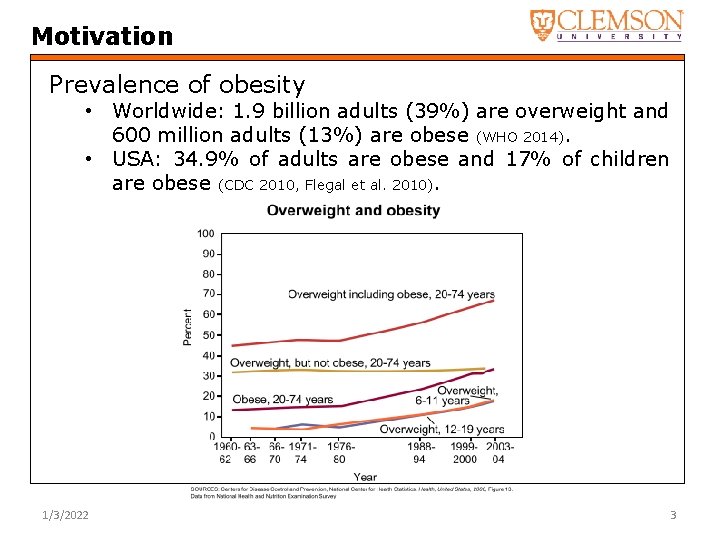
Motivation Prevalence of obesity • Worldwide: 1. 9 billion adults (39%) are overweight and 600 million adults (13%) are obese (WHO 2014). • USA: 34. 9% of adults are obese and 17% of children are obese (CDC 2010, Flegal et al. 2010). 1/3/2022 3
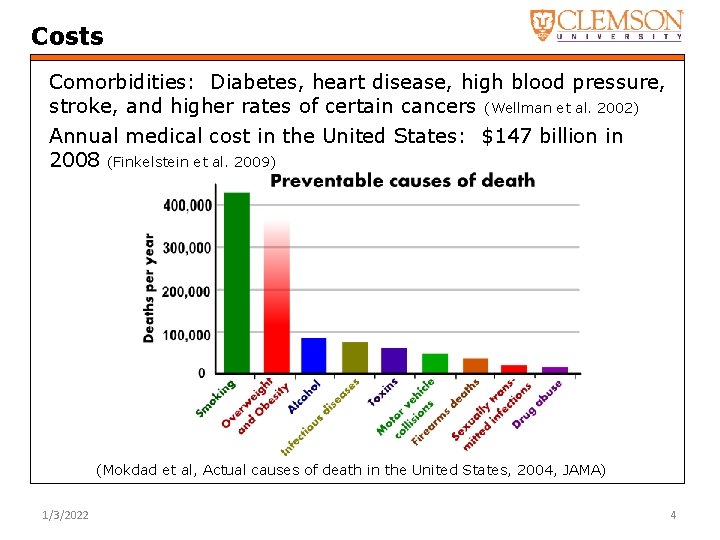
Costs Comorbidities: Diabetes, heart disease, high blood pressure, stroke, and higher rates of certain cancers (Wellman et al. 2002) Annual medical cost in the United States: $147 billion in 2008 (Finkelstein et al. 2009) (Mokdad et al, Actual causes of death in the United States, 2004, JAMA) 1/3/2022 4
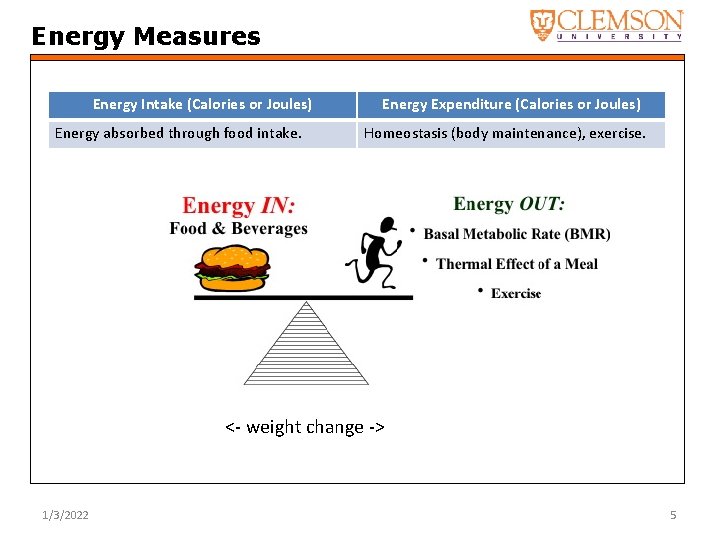
Energy Measures Energy Intake (Calories or Joules) Energy absorbed through food intake. Energy Expenditure (Calories or Joules) Homeostasis (body maintenance), exercise. <- weight change -> 1/3/2022 5
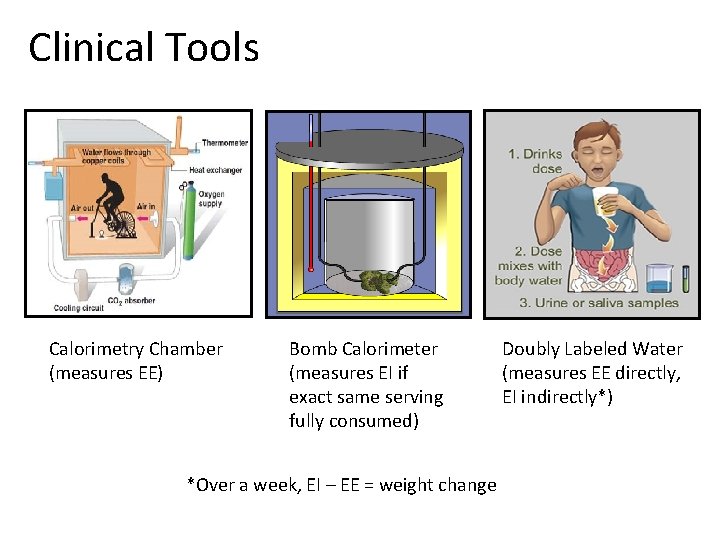
Clinical Tools Calorimetry Chamber (measures EE) Bomb Calorimeter (measures EI if exact same serving fully consumed) *Over a week, EI – EE = weight change Doubly Labeled Water (measures EE directly, EI indirectly*)
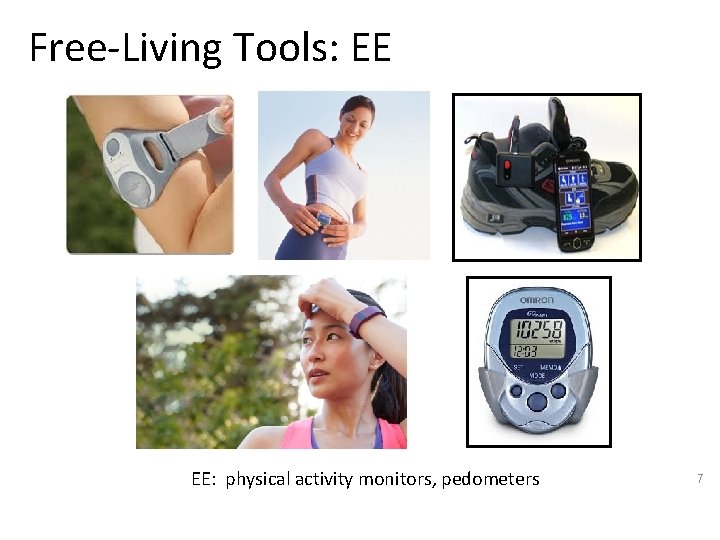
Free-Living Tools: EE EE: physical activity monitors, pedometers 7
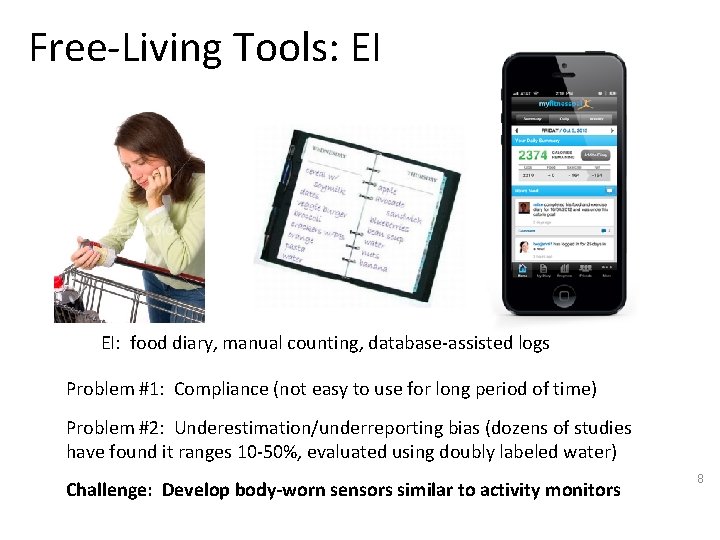
Free-Living Tools: EI EI: food diary, manual counting, database-assisted logs Problem #1: Compliance (not easy to use for long period of time) Problem #2: Underestimation/underreporting bias (dozens of studies have found it ranges 10 -50%, evaluated using doubly labeled water) Challenge: Develop body-worn sensors similar to activity monitors 8
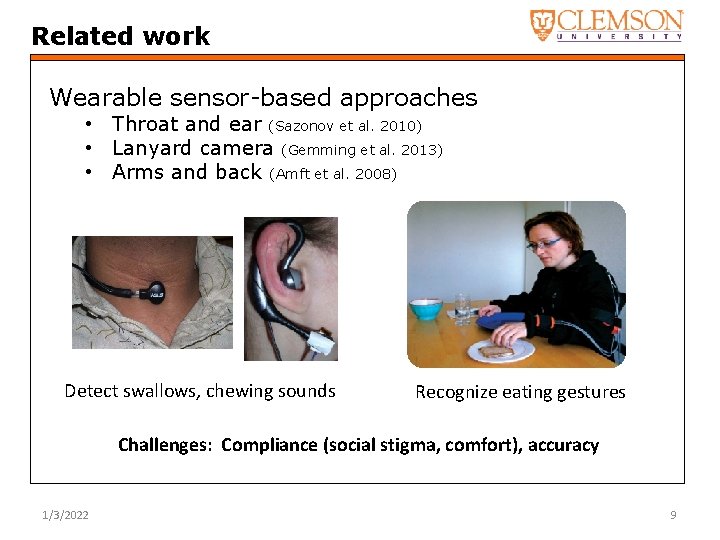
Related work Wearable sensor-based approaches • Throat and ear (Sazonov et al. 2010) • Lanyard camera (Gemming et al. 2013) • Arms and back (Amft et al. 2008) Detect swallows, chewing sounds Recognize eating gestures Challenges: Compliance (social stigma, comfort), accuracy 1/3/2022 9
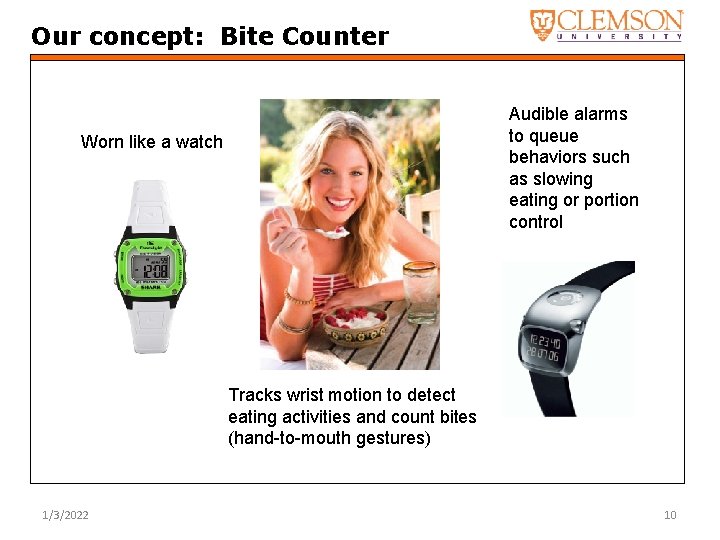
Our concept: Bite Counter Audible alarms to queue behaviors such as slowing eating or portion control Worn like a watch Tracks wrist motion to detect eating activities and count bites (hand-to-mouth gestures) 1/3/2022 10
Outline • • • Motivation, existing tools, related work Tracking wrist motion to count bites Relating bites to calories Detecting eating activities during the day The “Language of Eating” Conclusion
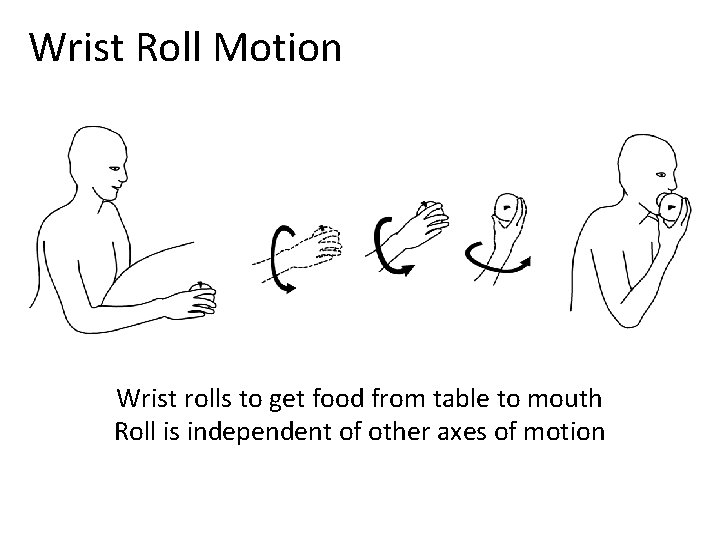
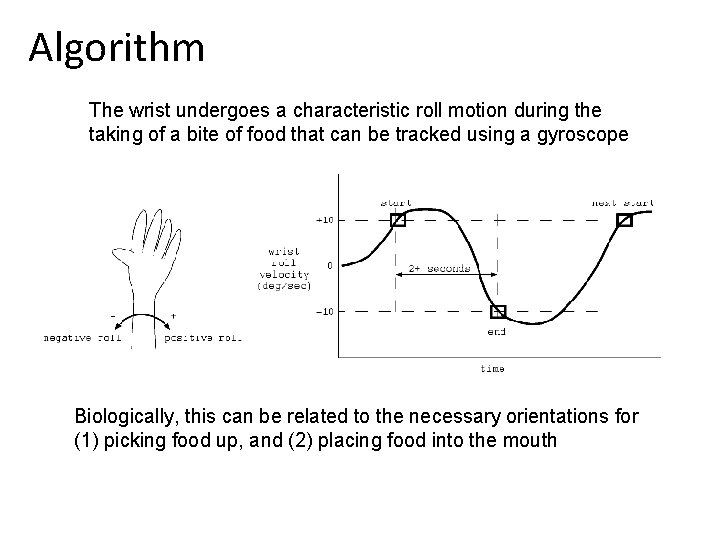
Wrist Roll Motion Wrist rolls to get food from table to mouth Roll is independent of other axes of motion
Algorithm The wrist undergoes a characteristic roll motion during the taking of a bite of food that can be tracked using a gyroscope Biologically, this can be related to the necessary orientations for (1) picking food up, and (2) placing food into the mouth
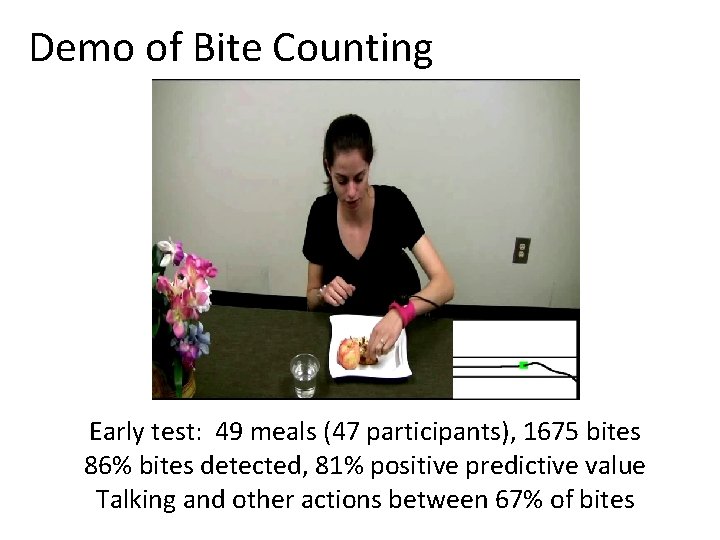
Demo of Bite Counting Early test: 49 meals (47 participants), 1675 bites 86% bites detected, 81% positive predictive value Talking and other actions between 67% of bites
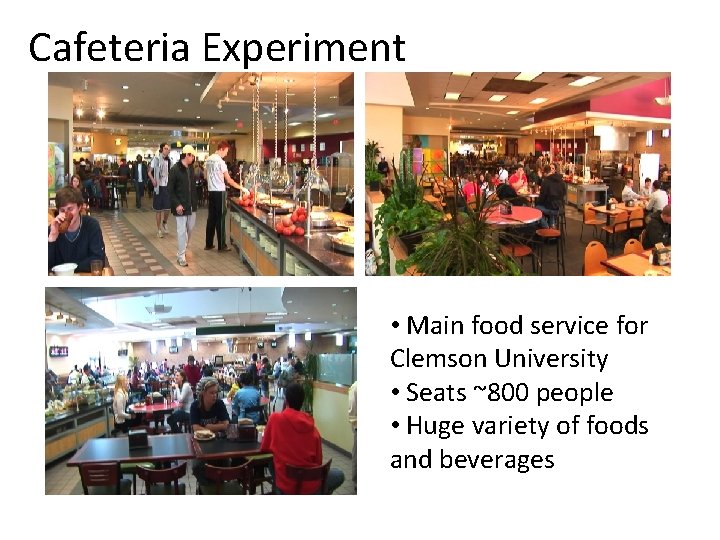
Cafeteria Experiment • Main food service for Clemson University • Seats ~800 people • Huge variety of foods and beverages
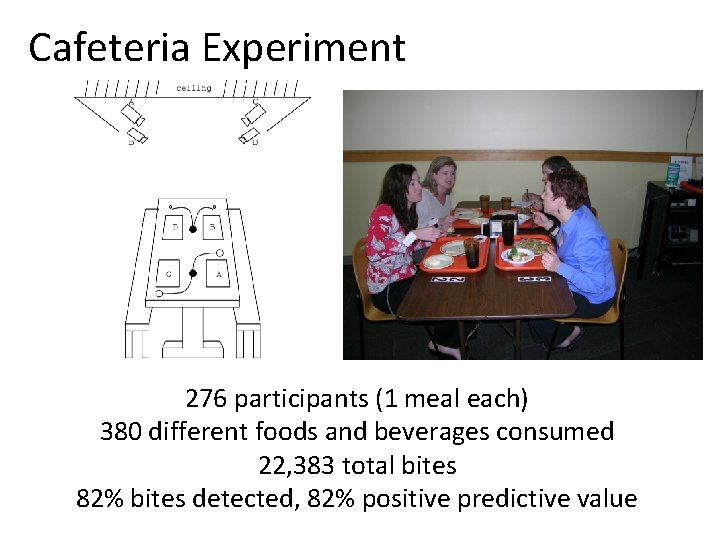
Cafeteria Experiment 276 participants (1 meal each) 380 different foods and beverages consumed 22, 383 total bites 82% bites detected, 82% positive predictive value
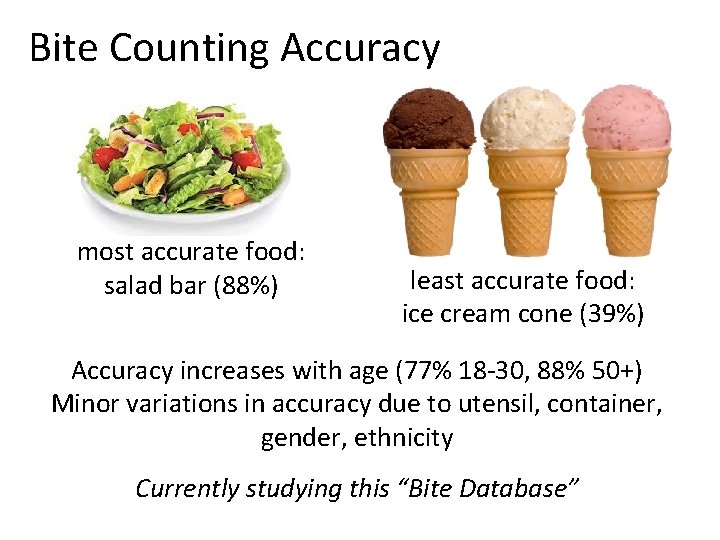
Bite Counting Accuracy most accurate food: salad bar (88%) least accurate food: ice cream cone (39%) Accuracy increases with age (77% 18 -30, 88% 50+) Minor variations in accuracy due to utensil, container, gender, ethnicity Currently studying this “Bite Database”
Outline • • • Motivation, existing tools, related work Tracking wrist motion to count bites Relating bites to calories Detecting eating activities during the day The “Language of Eating” Conclusion
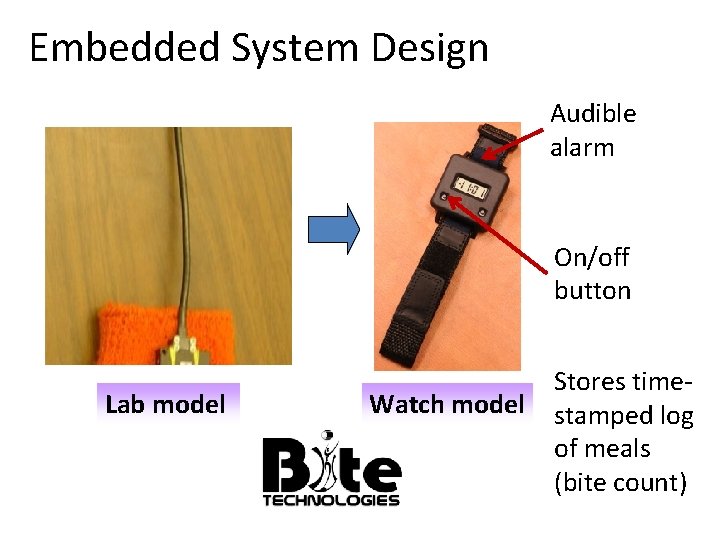
Embedded System Design Audible alarm On/off button Lab model Watch model Stores timestamped log of meals (bite count)
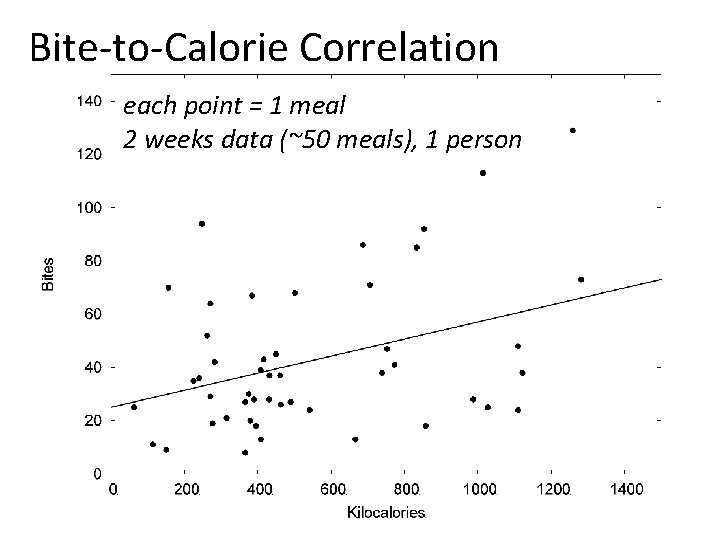
Bite-to-Calorie Correlation each point = 1 meal 2 weeks data (~50 meals), 1 person
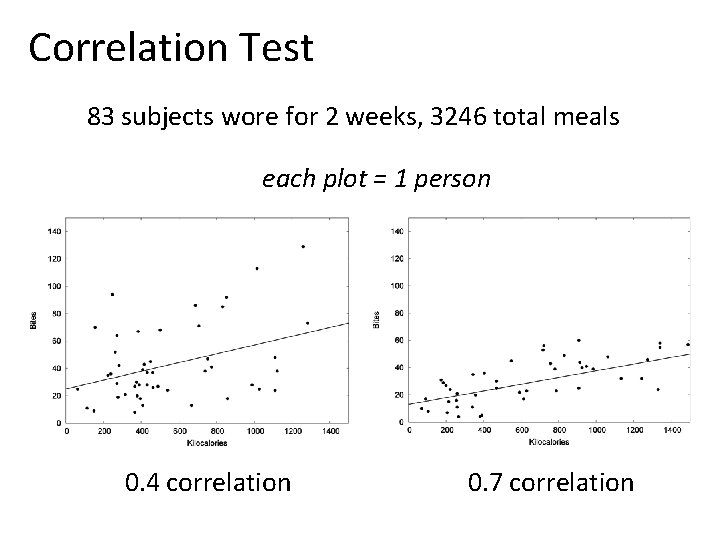
Correlation Test 83 subjects wore for 2 weeks, 3246 total meals each plot = 1 person 0. 4 correlation 0. 7 correlation
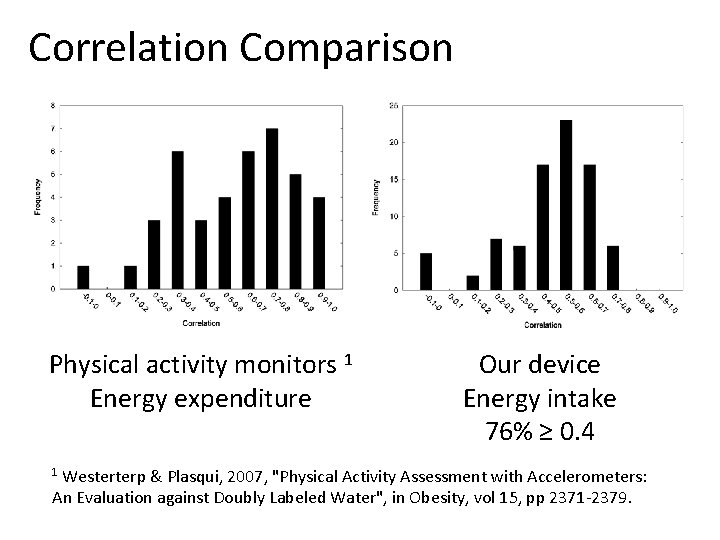
Correlation Comparison Physical activity monitors 1 Energy expenditure Our device Energy intake 76% ≥ 0. 4 Westerterp & Plasqui, 2007, "Physical Activity Assessment with Accelerometers: An Evaluation against Doubly Labeled Water", in Obesity, vol 15, pp 2371 -2379. 1
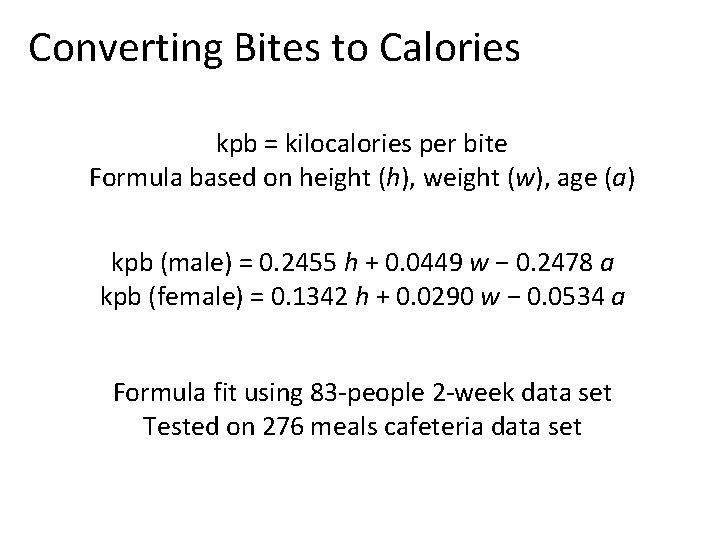
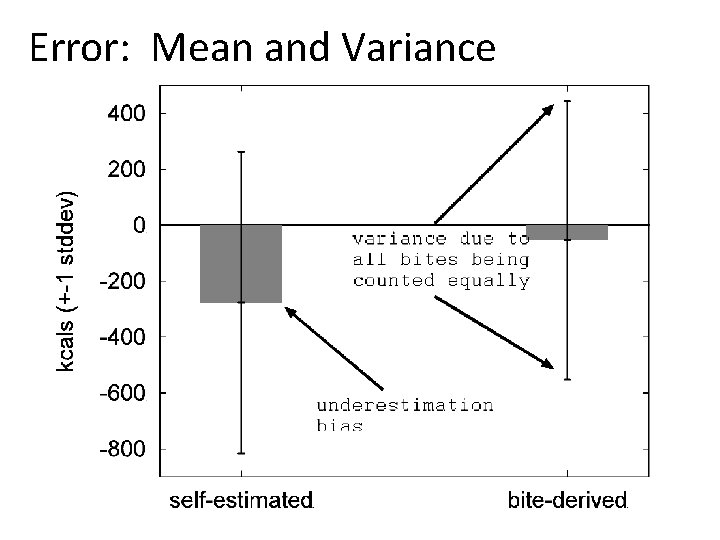
Converting Bites to Calories kpb = kilocalories per bite Formula based on height (h), weight (w), age (a) kpb (male) = 0. 2455 h + 0. 0449 w − 0. 2478 a kpb (female) = 0. 1342 h + 0. 0290 w − 0. 0534 a Formula fit using 83 -people 2 -week data set Tested on 276 meals cafeteria data set
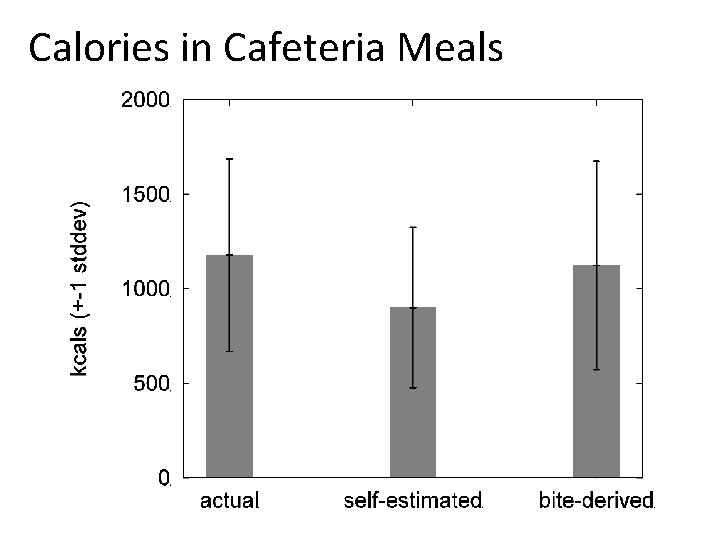
Calories in Cafeteria Meals
Error: Mean and Variance
Outline • • • Motivation, existing tools, related work Tracking wrist motion to count bites Relating bites to calories Detecting eating activities during the day The “Language of Eating” Conclusion
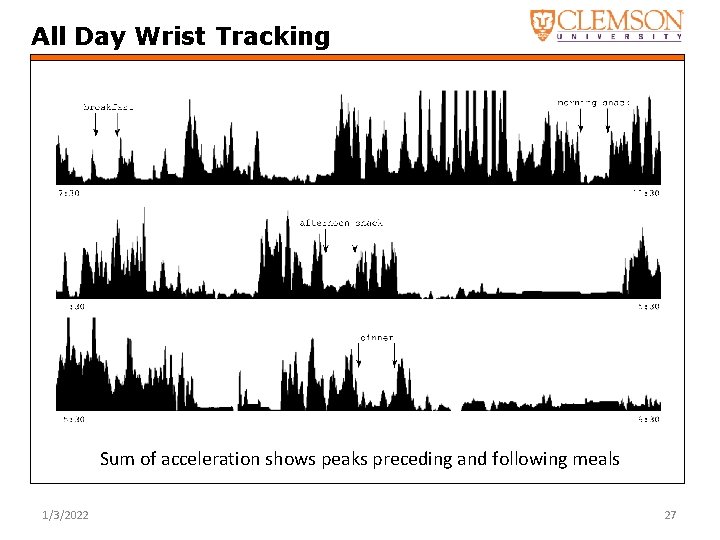
All Day Wrist Tracking Sum of acceleration shows peaks preceding and following meals 1/3/2022 27
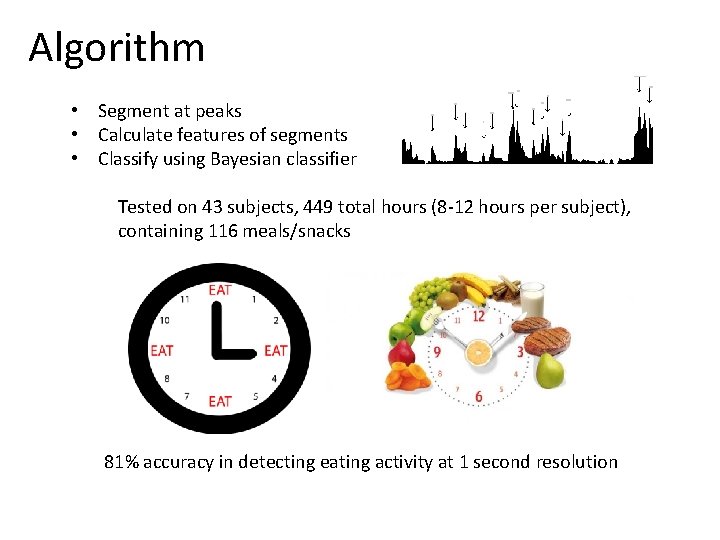
Algorithm • Segment at peaks • Calculate features of segments • Classify using Bayesian classifier Tested on 43 subjects, 449 total hours (8 -12 hours per subject), containing 116 meals/snacks 81% accuracy in detecting eating activity at 1 second resolution
Outline • • • Motivation, existing tools, related work Tracking wrist motion to count bites Relating bites to calories Detecting eating activities during the day The “Language of Eating” Conclusion
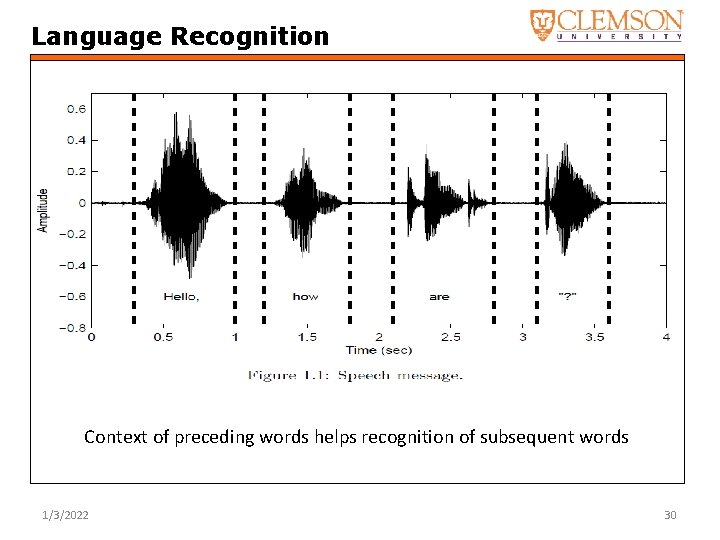
Language Recognition Context of preceding words helps recognition of subsequent words 1/3/2022 30
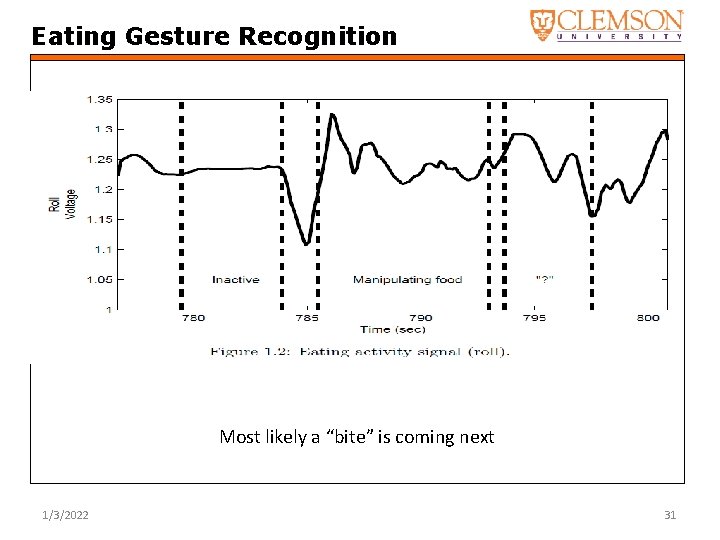
Eating Gesture Recognition Most likely a “bite” is coming next 1/3/2022 31
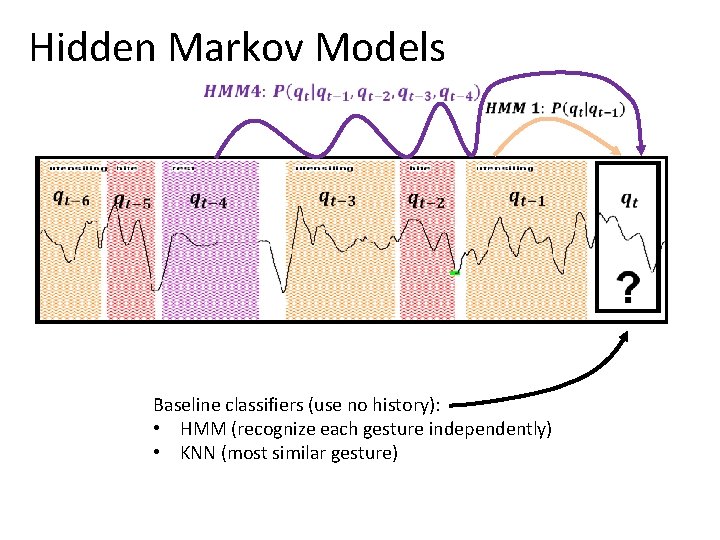
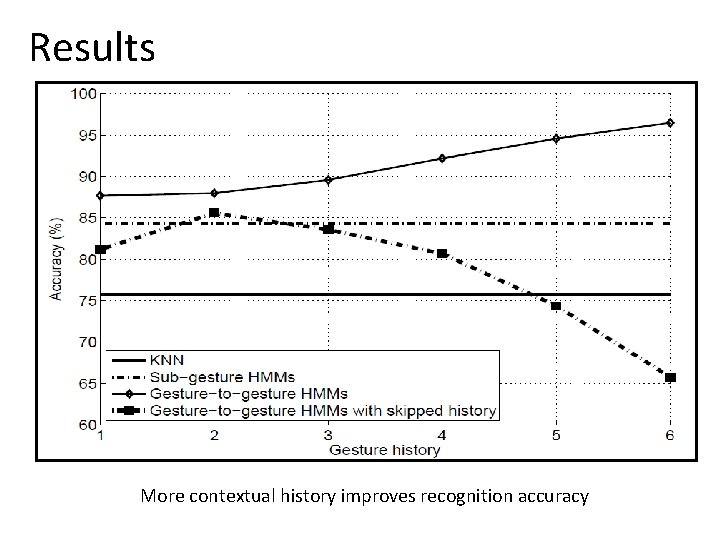
Hidden Markov Models Baseline classifiers (use no history): • HMM (recognize each gesture independently) • KNN (most similar gesture)
Results More contextual history improves recognition accuracy
Outline • • • Motivation, existing tools, related work Tracking wrist motion to count bites Relating bites to calories Detecting eating activities during the day The “Language of Eating” Conclusion
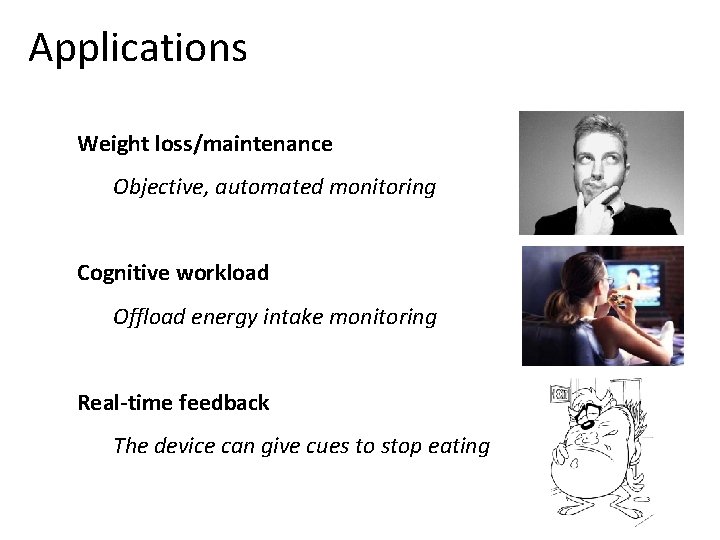
Applications Weight loss/maintenance Objective, automated monitoring Cognitive workload Offload energy intake monitoring Real-time feedback The device can give cues to stop eating
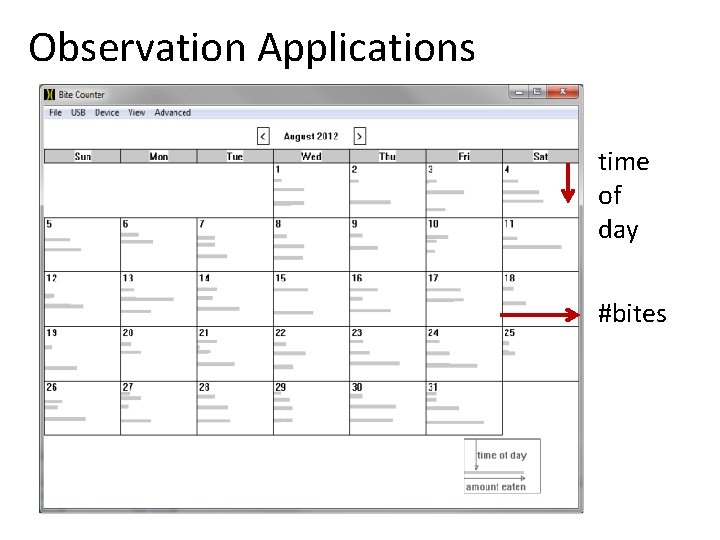
Observation Applications time of day #bites
Acknowledgments Collaborators • • Adam Hoover, Electrical & Computer Engineering Department, Clemson University Eric Muth, Psychology Department, Clemson University Students: Yujie Dong, Jenna Scisco, Raul Ramos-Garcia, James Salley, Mike Wilson, Surya Sharma, Ziqing Huang, Soheila Eskandari, Yiru Shen, Phil Jasper, Amelia Kinsella, Jose Reyes, Meredith Drennan, Xueting Yu, Michael Wooten, Megan Becvarik, Ryan Mattfeld Pat O’Neil, Weight Management Center, Medical University of South Carolina Kevin Hall, Laboratory Biological Modeling, NIH Kathleen Melanson, Slowing Eating, University of Rhode Island Brie Turner-Mc. Grievy, University of South Carolina Corby Martin, Pennington Biomedical Research Center, LSU Funding • • • NIH NIDDK STTR 1 R 41 DK 091141 -01 A 1, 2 R 42 DK 091141 -02 NIH NHLBI R 01 HL 118181 -01 A 1 NIH NCI R 21 CA 187929 -01 A 1 South Carolina Launch South Carolina Clinical and Translational Institute 1/3/2022 37
Questions? For more info: www. ces. clemson. edu/~ahoover