
Measuring Friction between two surfaces Free Body Diagram
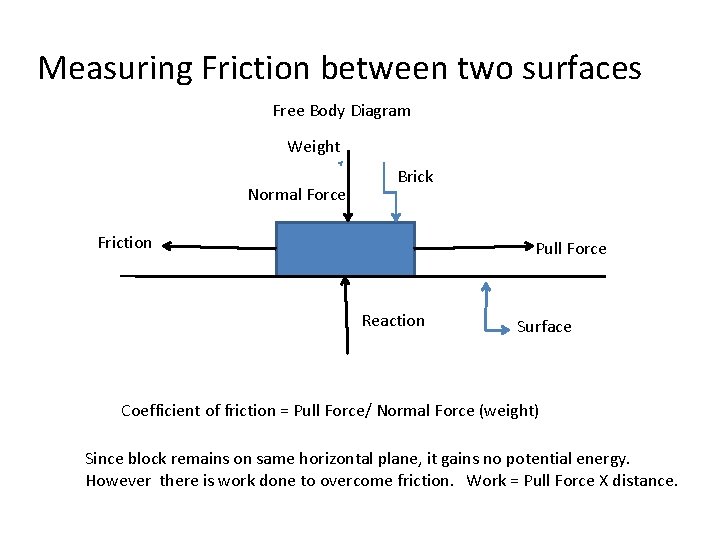
Measuring Friction between two surfaces Free Body Diagram Weight Normal Force Brick Friction Pull Force Reaction Surface Coefficient of friction = Pull Force/ Normal Force (weight) Since block remains on same horizontal plane, it gains no potential energy. However there is work done to overcome friction. Work = Pull Force X distance.
Measuring Friction between two surfaces Weight = 20 newtons = normal force Pull force for smooth board = 5 newtons Coefficient of friction = u = 5/20 = 0. 25 AMA = 20/5 = 4 IMA = 1 Work in = pull force / distance moved Work out = weight X height moved = 0 Efficiency = work out/work in = 0 Efficiency = is meaningless because we did not lift the weight
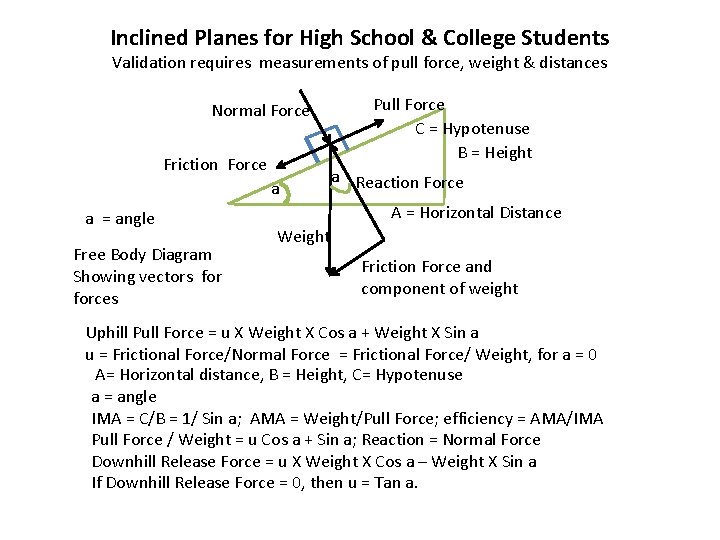
Inclined Planes for High School & College Students Validation requires measurements of pull force, weight & distances Normal Force Friction Force a a = angle Free Body Diagram Showing vectors forces Pull Force C = Hypotenuse B = Height a Reaction Force A = Horizontal Distance Weight Friction Force and component of weight Uphill Pull Force = u X Weight X Cos a + Weight X Sin a u = Frictional Force/Normal Force = Frictional Force/ Weight, for a = 0 A= Horizontal distance, B = Height, C= Hypotenuse a = angle IMA = C/B = 1/ Sin a; AMA = Weight/Pull Force; efficiency = AMA/IMA Pull Force / Weight = u Cos a + Sin a; Reaction = Normal Force Downhill Release Force = u X Weight X Cos a – Weight X Sin a If Downhill Release Force = 0, then u = Tan a.
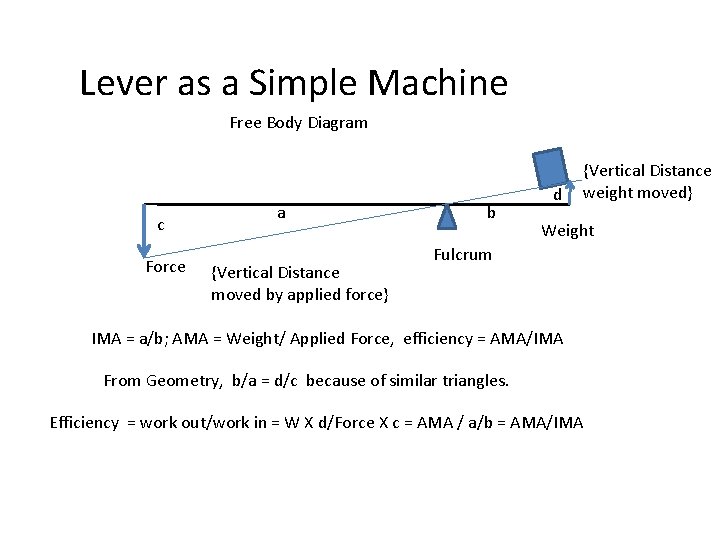
Lever as a Simple Machine Free Body Diagram c Force a {Vertical Distance moved by applied force} b d {Vertical Distance weight moved} Weight Fulcrum IMA = a/b; AMA = Weight/ Applied Force, efficiency = AMA/IMA From Geometry, b/a = d/c because of similar triangles. Efficiency = work out/work in = W X d/Force X c = AMA / a/b = AMA/IMA
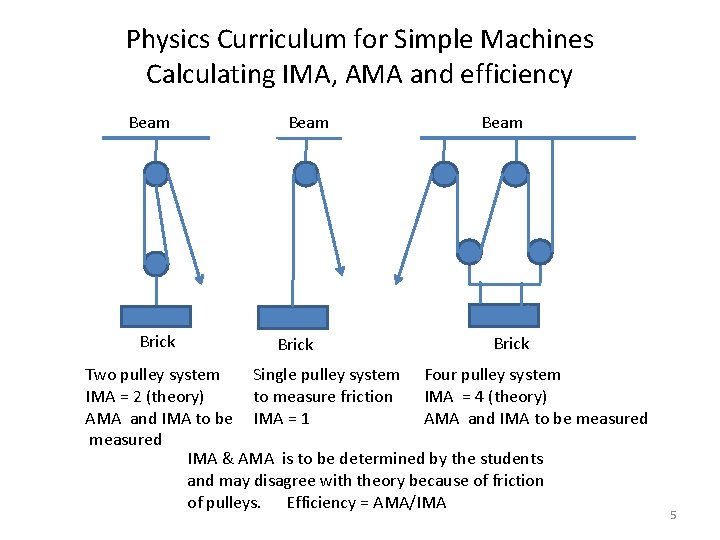
Physics Curriculum for Simple Machines Calculating IMA, AMA and efficiency Beam Brick Two pulley system Single pulley system Four pulley system IMA = 2 (theory) to measure friction IMA = 4 (theory) AMA and IMA to be IMA = 1 AMA and IMA to be measured IMA & AMA is to be determined by the students and may disagree with theory because of friction of pulleys. Efficiency = AMA/IMA 5
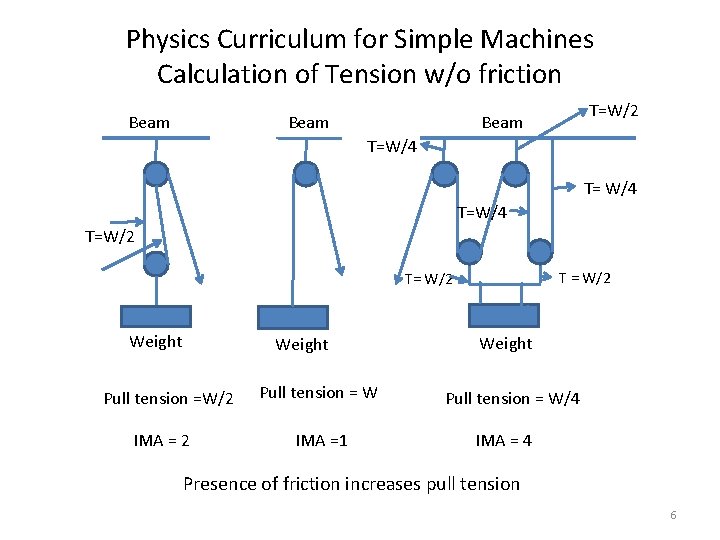
Physics Curriculum for Simple Machines Calculation of Tension w/o friction Beam T=W/2 Beam T=W/4 T=W/2 T = W/2 T= W/2 Weight Pull tension =W/2 IMA = 2 Pull tension = W IMA =1 Weight Pull tension = W/4 IMA = 4 Presence of friction increases pull tension 6
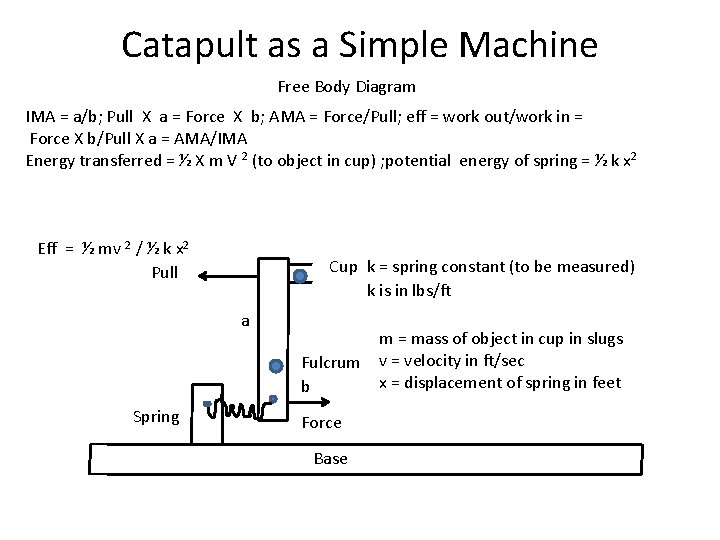
Catapult as a Simple Machine Free Body Diagram IMA = a/b; Pull X a = Force X b; AMA = Force/Pull; eff = work out/work in = Force X b/Pull X a = AMA/IMA Energy transferred = ½ X m V 2 (to object in cup) ; potential energy of spring = ½ k x 2 Eff = ½ mv 2 / ½ k x 2 Pull Cup k = spring constant (to be measured) k is in lbs/ft a Fulcrum b Spring Force Base m = mass of object in cup in slugs v = velocity in ft/sec x = displacement of spring in feet
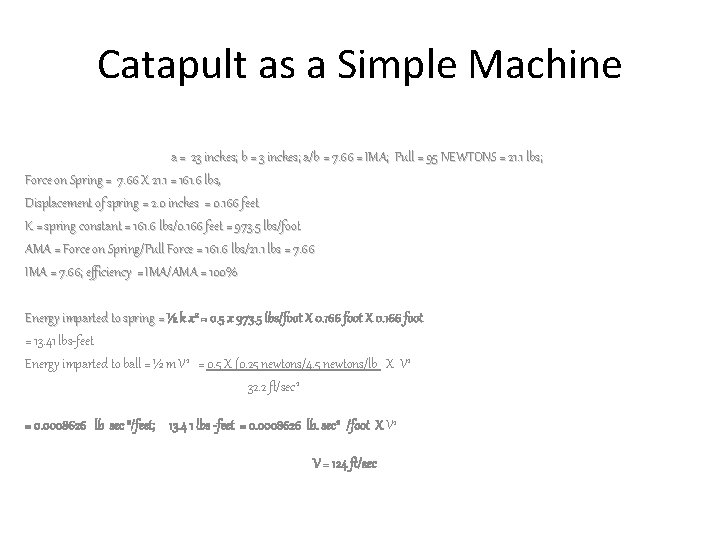
Catapult as a Simple Machine a = 23 inches; b = 3 inches; a/b = 7. 66 = IMA; Pull = 95 NEWTONS = 21. 1 lbs; Force on Spring = 7. 66 X 21. 1 = 161. 6 lbs, Displacement of spring = 2. 0 inches = 0. 166 feet K = spring constant = 161. 6 lbs/0. 166 feet = 973. 5 lbs/foot AMA = Force on Spring/Pull Force = 161. 6 lbs/21. 1 lbs = 7. 66 IMA = 7. 66; efficiency = IMA/AMA = 100% Energy imparted to spring = ½ k x 2 = 0. 5 x 973. 5 lbs/foot X 0. 166 foot = 13. 41 lbs-feet Energy imparted to ball = ½ m V 2 = 0. 5 X (0. 25 newtons/4. 5 newtons/lb X V 2 32. 2 ft/sec 2 = 0. 0008626 lb sec 2/feet; 13. 4 1 lbs -feet = 0. 0008626 lb. sec 2 /foot X V 2 V = 124 ft/sec
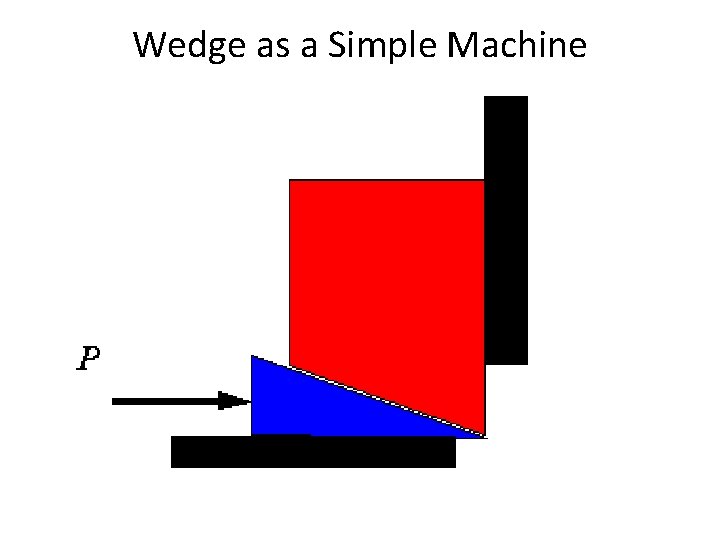
Wedge as a Simple Machine
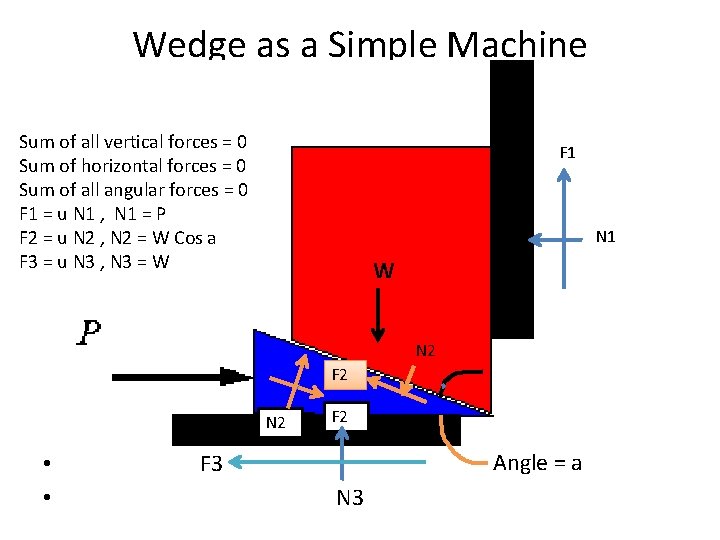
Wedge as a Simple Machine Sum of all vertical forces = 0 Sum of horizontal forces = 0 Sum of all angular forces = 0 F 1 = u N 1 , N 1 = P F 2 = u N 2 , N 2 = W Cos a F 3 = u N 3 , N 3 = W F 1 N 1 W N 2 F 2 N 2 • • F 2 Angle = a F 3 N 3
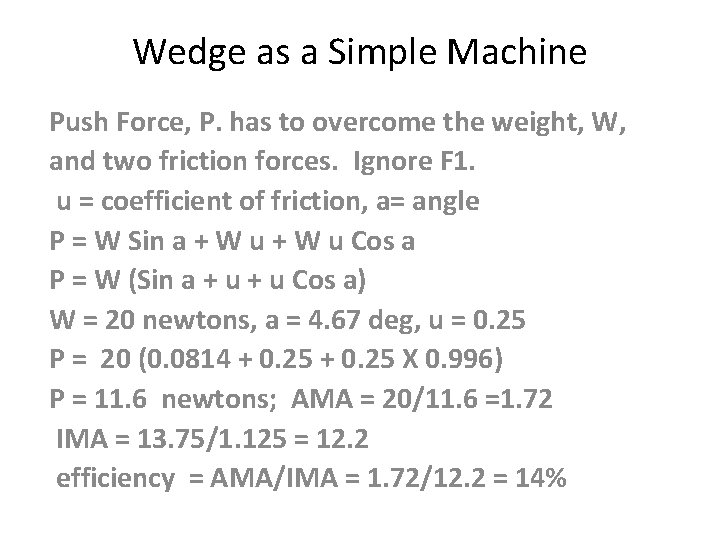
Wedge as a Simple Machine Push Force, P. has to overcome the weight, W, and two friction forces. Ignore F 1. u = coefficient of friction, a= angle P = W Sin a + W u Cos a P = W (Sin a + u Cos a) W = 20 newtons, a = 4. 67 deg, u = 0. 25 P = 20 (0. 0814 + 0. 25 X 0. 996) P = 11. 6 newtons; AMA = 20/11. 6 =1. 72 IMA = 13. 75/1. 125 = 12. 2 efficiency = AMA/IMA = 1. 72/12. 2 = 14%
- Slides: 11